

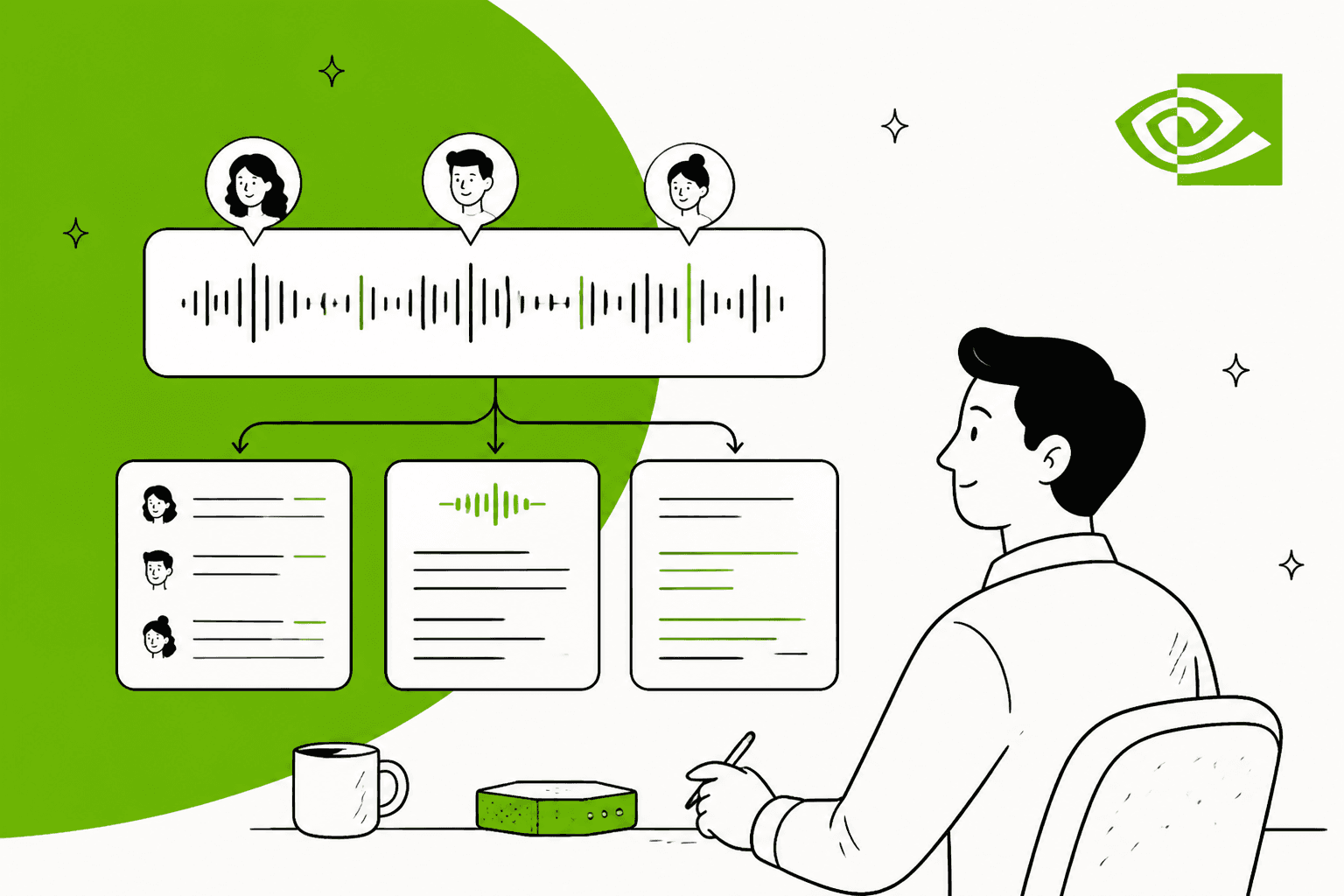
Nemotron 3.5 Transcribe is NVIDIA's free, open-weight speech model, released October 28, 2026, and one checkpoint does four jobs: transcripts in 40 languages, "who said what" labels for up to eight speakers, translation in 31 languages, and answers about the audio. You tell it which job you want with a plain-English prompt.
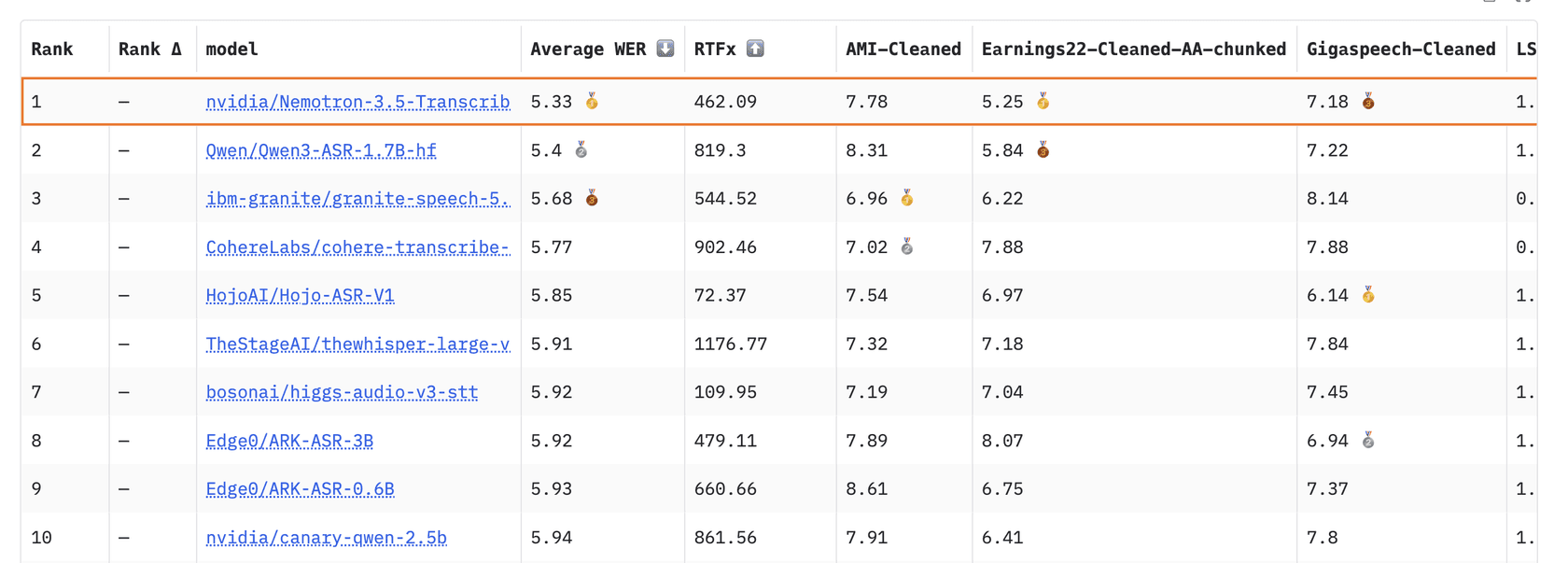
It's accurate for an open model: 2.81% word error rate on Artificial Analysis, second among open models, and first on Hugging Face's open English leaderboard at 5.33%. The catch is size and timing. It needs an 80GB data-center GPU today, and it only works on recordings, not live calls. If you don't want the hardware, DeepInfra hosts it at $0.002 a minute, about half what most transcription APIs charge.
For a support team, a transcript is the first step, not the last. I work on eesel, and the AI helpdesk teammate I help build is what picks up the ticket a call or voicemail turns into and answers it in the customer's language, the way it does for Koffer.ch in German, French, English and Italian.
What is Nemotron 3.5 Transcribe?
Nemotron 3.5 Transcribe is an open-weight speech model from NVIDIA. It takes a recorded file and turns it into text, and after that into whatever kind of text you ask it for. NVIDIA calls it a speech-augmented language model: an audio encoder feeds a language model, so you control the output with instructions instead of settings (model card).
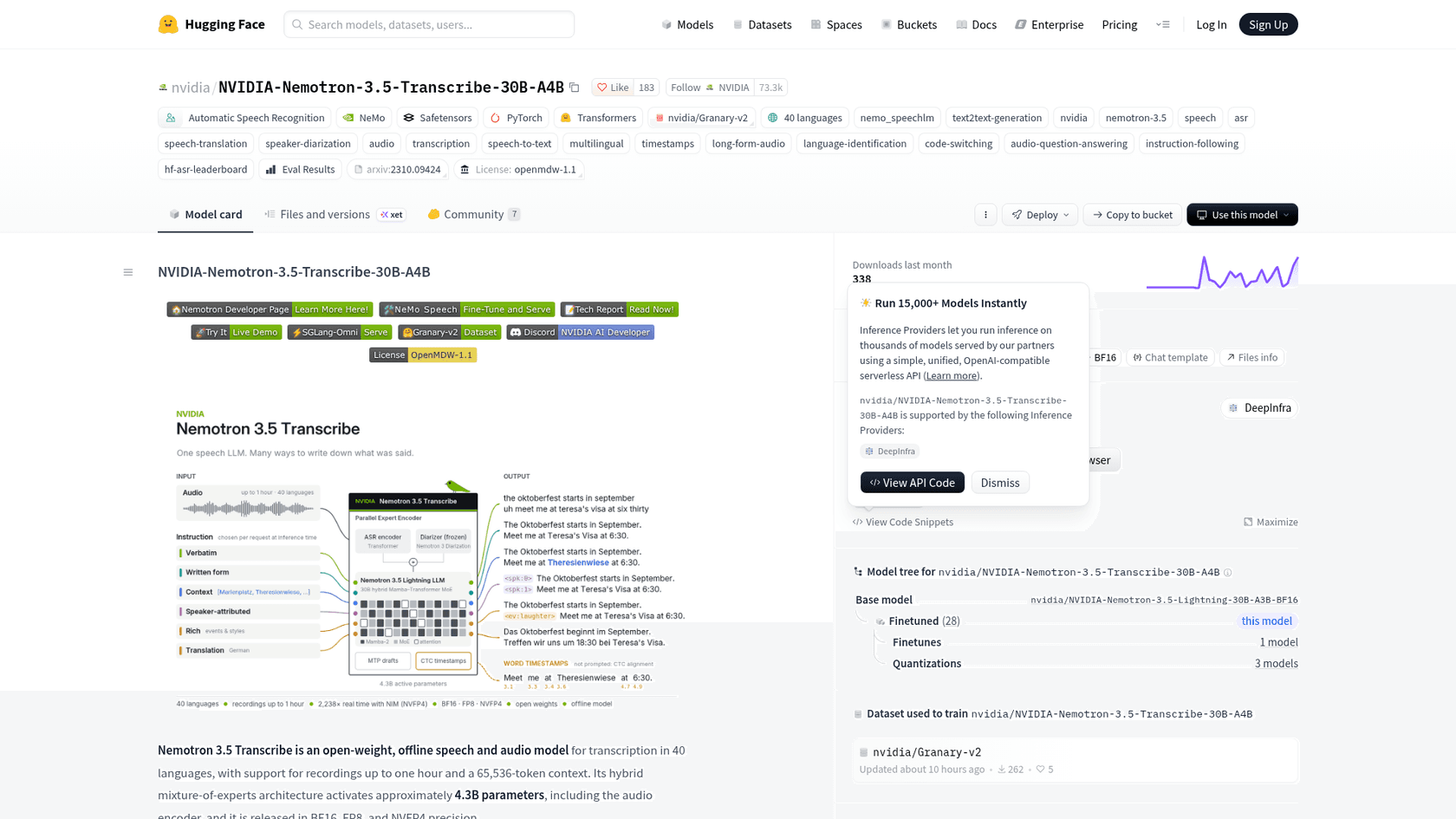
The headline numbers, all from NVIDIA's launch blog and model card:
| Spec | Nemotron 3.5 Transcribe |
|---|---|
| Released | October 28, 2026 |
| Size | 30B-class mixture of experts, about 4B active per token (the card counts 34B total, 4.3B active, with the audio encoder) |
| Transcription | 40 languages |
| Translation | 31 languages, to or from English |
| Speaker labels | 13 languages, up to 8 speakers |
| Longest recording | 1 hour (65,536-token context) |
| Live streaming | No, recorded audio only |
| License | OpenMDW-1.1, commercial use allowed |
| Precisions | BF16 now; FP8 and NVFP4 listed as coming |
The "about 4B active" part is really the reason a model of this size is usable at all. It's a hybrid Mamba-Transformer mixture of experts, built on NVIDIA's Nemotron 3.5 Lightning language model, so only a small slice of the weights does work on each token. It's the same trick behind the rest of the family, like Nemotron 3.5 Super VL.
There is one naming trap I'd flag here. "Nemotron 3.5 ASR" is a different, tiny streaming model, so when you see a price or a speed figure online, check which of the two it's about.
What can you ask it to do?
You can ask it for a verbatim transcript, a cleaned-up one, a speaker-labelled one, a translation or an answer, all from the same file. What changes between them is just one line of prompt. NVIDIA's own examples are as plain as "Transcribe this recording and label each speaker" or "What decisions were made in this meeting?" (launch blog).
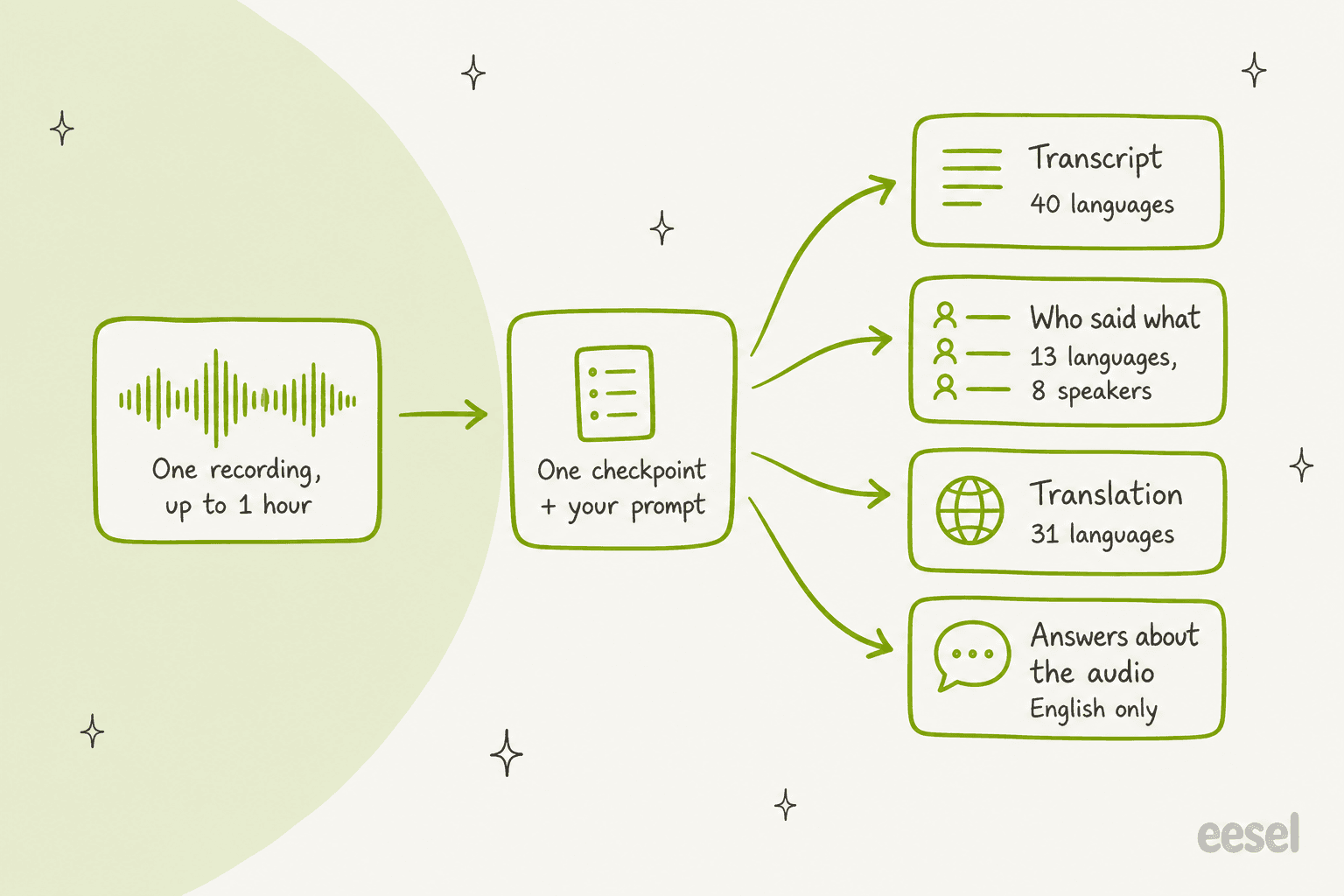
The prompts that matter most for real work, from the model card:
- Verbatim or clean. Keep every "uh" and repeat, or drop them and keep the rest unchanged.
- Context terms. List product names, people or jargon up front. On NVIDIA's contextual earnings-call test, keyword recall went from 58.16% to 96.05% once the terms were supplied.
- Speakers and timestamps. Ask for speaker tags and word timings in one pass, instead of running a separate diarization tool afterwards.
- Exact values. A preset keeps emails, URLs, file paths and order numbers written the way they were said, which is the stuff a support transcript can't get wrong.
- PII tagging. The model was trained to mark or redact personal details, useful if you redact support transcripts before anyone reads them.
The card even names "support recordings" as a fit for the context-terms prompt and lists customer service as an application field. So call centers are pretty clearly on NVIDIA's mind with this one.
How good is it, really?
On the public tests it's the best or second-best open speech model, and a step behind the best closed ones. Below is what the numbers say, and also where they don't agree with each other.
Hugging Face Open ASR leaderboard (English). First among open-weight models at 5.33% average word error rate, just ahead of Qwen3-ASR-1.7B at 5.4% (leaderboard). Word error rate is the share of words a model gets wrong, so lower is better.
Artificial Analysis. 2.81% on its error index, second among open models, a hair behind Voxtral Small at 2.77%, which uses about six times as many active parameters (Artificial Analysis). NVIDIA's own blog calls that a tie for first. Closed models still lead overall: MAI-Transcribe-2 sits at 2.04% and Gemini 3.5 Transcribe at 2.60%. On the voice-agent set, AgentTalk, it scores 1.78%, close to the top of the whole table.
I'd put two asterisks on that number, though. The public DeepInfra endpoint measures 3.4% on the same index, so the 2.81% came from a setup most people can't reach yet. And on earnings calls it scores 5.69%, behind ElevenLabs Scribe v2 at 3.95%.
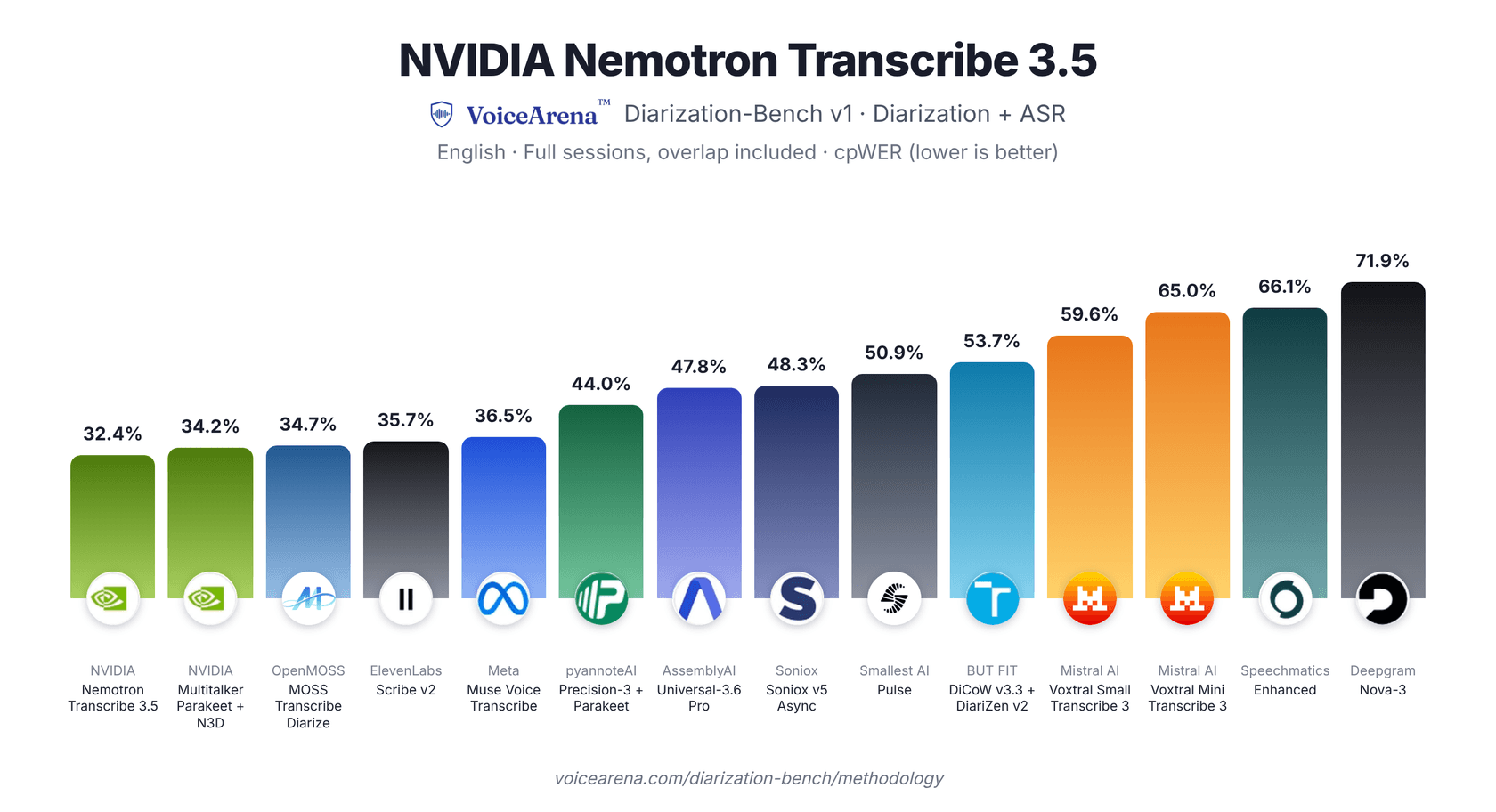
Who said what. This is where it's strongest. On VoiceArena's diarization benchmark, English full sessions with overlapping talk, it came first of 14 systems at 32.4% error after matching speakers, and dropped far fewer words than the rest: 8.32% against a median around 31% (launch blog).
Languages aren't equal. NVIDIA ranks 13 languages as "leading", including English, Spanish, German, French, Hindi and Korean, and 15 more as production-ready. Some lag badly: FLEURS error is 26.93% for Greek and 20.97% for Hebrew, and Norwegian, at 63.76%, has no transcription support at all (model card). So if your customers call in Norwegian, this one isn't for you yet.
What are people saying after day one?
The early reaction is excited about the feature list, but mixed once people actually try it. The r/LocalLLaMA thread passed 193 upvotes within a day, and its top comment set the tone:
"Holy! This might be the holy grail of OS ASR models I have been looking for - something to dethrone venerable Qwen ASR."

The only real test so far, on Hacker News, came from someone running a 4-bit community quant on Japanese audio, which they flagged might not be full accuracy:
"testing it against parakeet right now for ASR, it's slower, heavier, and has a higher error rate. but i'm doing a pass with the embedded translation to see if that's any good, it might be worth it."

Their follow-up on the translation wasn't kinder ("disappointing model"), so treat the benchmark wins as NVIDIA's numbers until independent tests on full-precision weights land. The other thing that keeps coming up is size. As one Reddit commenter put it, "30b for ASR is such a luxury," when NVIDIA's own 0.6B Parakeet runs on almost anything (Reddit).
The use case people seemed to like most is one that support and ops teams know well, which is messy meetings and calls where people talk over each other.
"finally a model that can follow a standup where everyone unmutes at once"
How do you run Nemotron 3.5 Transcribe?
There are three ways in right now. You can try a free demo or call a hosted API, and if you have the hardware, run it on your own GPU.
- Try the demo. NVIDIA's Hugging Face Space takes an upload and a prompt. It's a good way to check your own audio before committing to anything.
- Call a hosted API. DeepInfra lists it at $0.002 per minute with zero data retention. Baseten and Simplismart host it too, but sell GPU time or custom quotes rather than a per-minute price.
- Host it yourself. The model card gives a vLLM 0.32.0 recipe on one H100 80GB, plus Transformers and SGLang-Omni options. The vLLM server speaks the OpenAI chat format, so code written for OpenAI's audio API ports over with small changes.
The card also has a few gotchas that are easy to miss:
- The fast version isn't open yet. NVIDIA's headline of 100 hours of audio in under three minutes uses the unreleased NVFP4 weights and its own optimized server. The open vLLM setup is "expected to be roughly two times slower".
- SGLang-Omni is transcription only. That route skips timestamps, speaker labels and translation, which are half the reason to pick this model.
- Smaller GPUs wait. RTX 5090 support is NVFP4-only and L40S is FP8-only, and neither repo was public on October 29.
- It can loop. NVIDIA ships a cleanup regex for the rare case where output doesn't stop, and warns about hallucinated speech. Spot-check names and speaker changes.
If running open models on your own hardware is new to you, the Hugging Face guide covers the basics of the hub NVIDIA ships through.
How much does it cost?
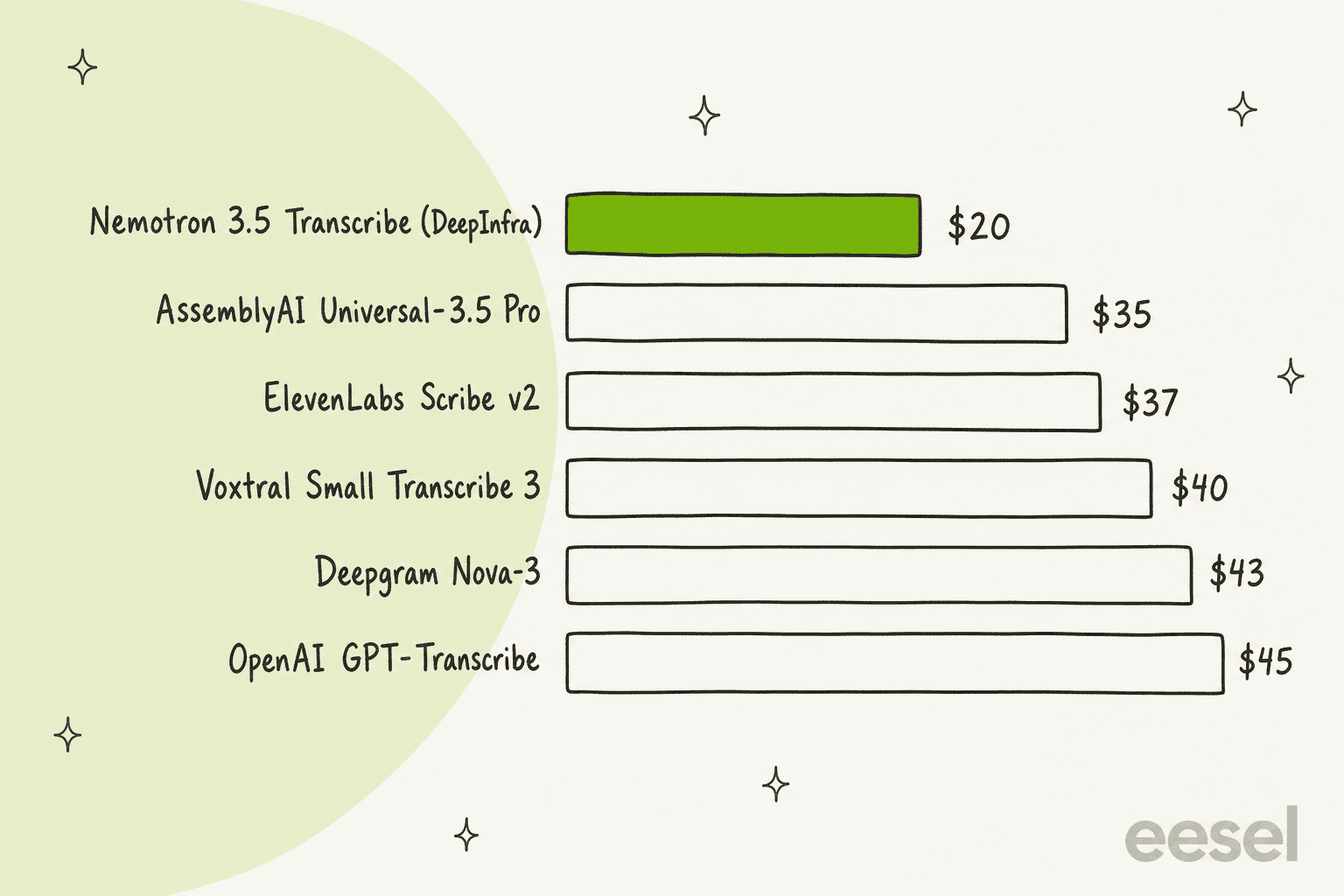
The weights cost nothing, which means the real price is whatever you pay for the GPU or the API. At hosted rates, it came out as the cheapest accurate option I found. Here's 10,000 minutes of recorded calls a month, about 167 hours, priced from each vendor's own page:
| Model | Batch price | 10,000 minutes | Source |
|---|---|---|---|
| Nemotron 3.5 Transcribe (DeepInfra) | $0.002/min | $20 | DeepInfra |
| AssemblyAI Universal-3.5 Pro | $0.21/hr | $35 | AssemblyAI |
| ElevenLabs Scribe v2 | $0.22/hr | about $37 | ElevenLabs |
| Mistral Voxtral Small Transcribe 3 | $0.004/min | $40 | Mistral |
| Deepgram Nova-3, pre-recorded | $0.0043/min | $43 | Deepgram |
| OpenAI GPT-Transcribe | $0.0045/min | $45 | OpenAI |
| Gemini 3.5 Transcribe | about $0.005/min | about $50 |
The gap gets wider once you compare like for like on features. Nemotron includes prompting, context terms and speaker labels in the base call. On AssemblyAI, adding prompting ($0.05/hr) and diarization ($0.02/hr) to Universal-3.5 Pro takes it to $0.28 an hour, more than double Nemotron's $0.12. For a deeper look at the rivals, see the Gemini 3.5 Transcribe and Voxtral 3 breakdowns.
Self-hosting only works out cheaper per hour of audio if the GPU stays busy. Baseten rents an H100 at $0.10833 a minute (Baseten), about $6.50 an hour. NVIDIA measures 260 to 410 times real time on that card for batched English, so one GPU-hour covers 260 to 410 hours of audio. By my maths that's roughly 2 to 3 cents per audio hour, against 12 cents on DeepInfra, but only when you feed it a steady batch. A team with 167 hours a month would pay for a mostly idle GPU, so the API wins until volume gets serious.
Where does it fit for a support team?
It fits anywhere you already have recordings and want text you can search, score or act on. Live conversations are where it doesn't fit.
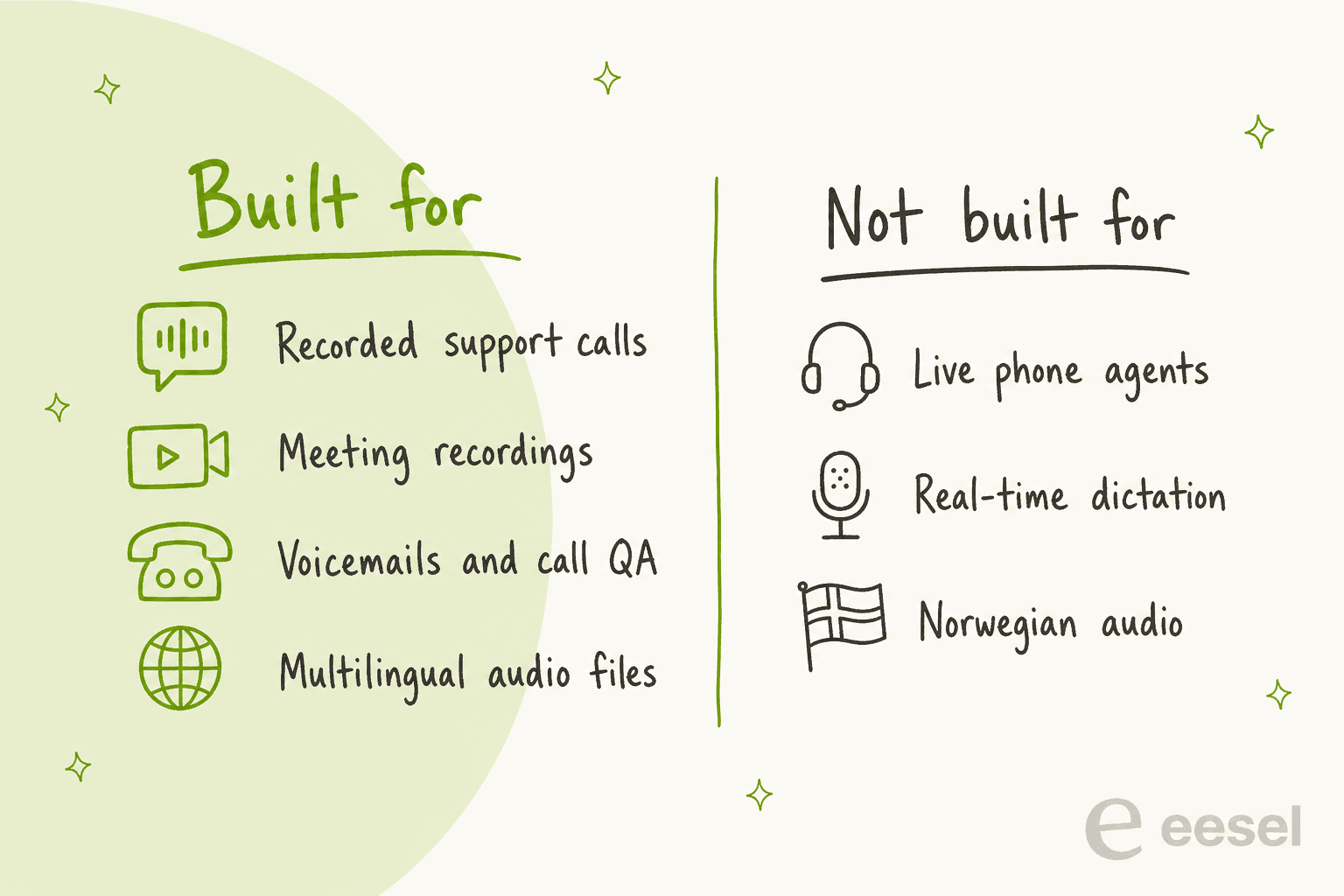
- Call QA. Speaker-labelled transcripts make it easy to score how agents handle calls, which is the dull part of call center quality assurance. Pair it with AI support QA to grade the text.
- Voicemails and callbacks. Transcribe, then let the ticket carry the text, so whoever picks it up doesn't have to listen first.
- Summaries and sentiment. The transcript feeds ticket summarization and sentiment analysis, the same way chat transcripts do.
- Multilingual queues. One model covering 40 languages beats stitching a separate tool per market, which is half the battle in multilingual customer support.
What it won't do is talk to the caller. For that you need a streaming model inside an AI voice agent, or one of the tools in my best AI voice agents list. It also won't decide what to say back. A perfect transcript of a refund request still needs someone, or something, that knows your refund policy.
That second part is where I spend most of my days. In the years eesel has run AI on live support queues, the hard part was never turning words into text. It was answering correctly from a company's own policies, and knowing when to hand off, and it's the reason every rollout gets tested on a team's past tickets before it answers anyone.
Why Nemotron 3.5 Transcribe matters
It matters because it makes "send the audio to someone else's cloud" optional. Until now, the accurate speech models with speaker labels and translation built in were closed APIs, and the open ones were small single-job models you had to chain together. Nemotron 3.5 Transcribe puts all of it in one open checkpoint you can run in your own data center, with a commercial license and NVIDIA's Granary v2 training data (463,062 hours across 48 languages) published alongside it.
The other shift is that adapting it is now cheap. NVIDIA's medical case study fine-tuned it on Indian-accented clinical speech and cut errors from 30.8% out of the box to 11.8%, in about 14 GPU-hours on one GB300 (case study).
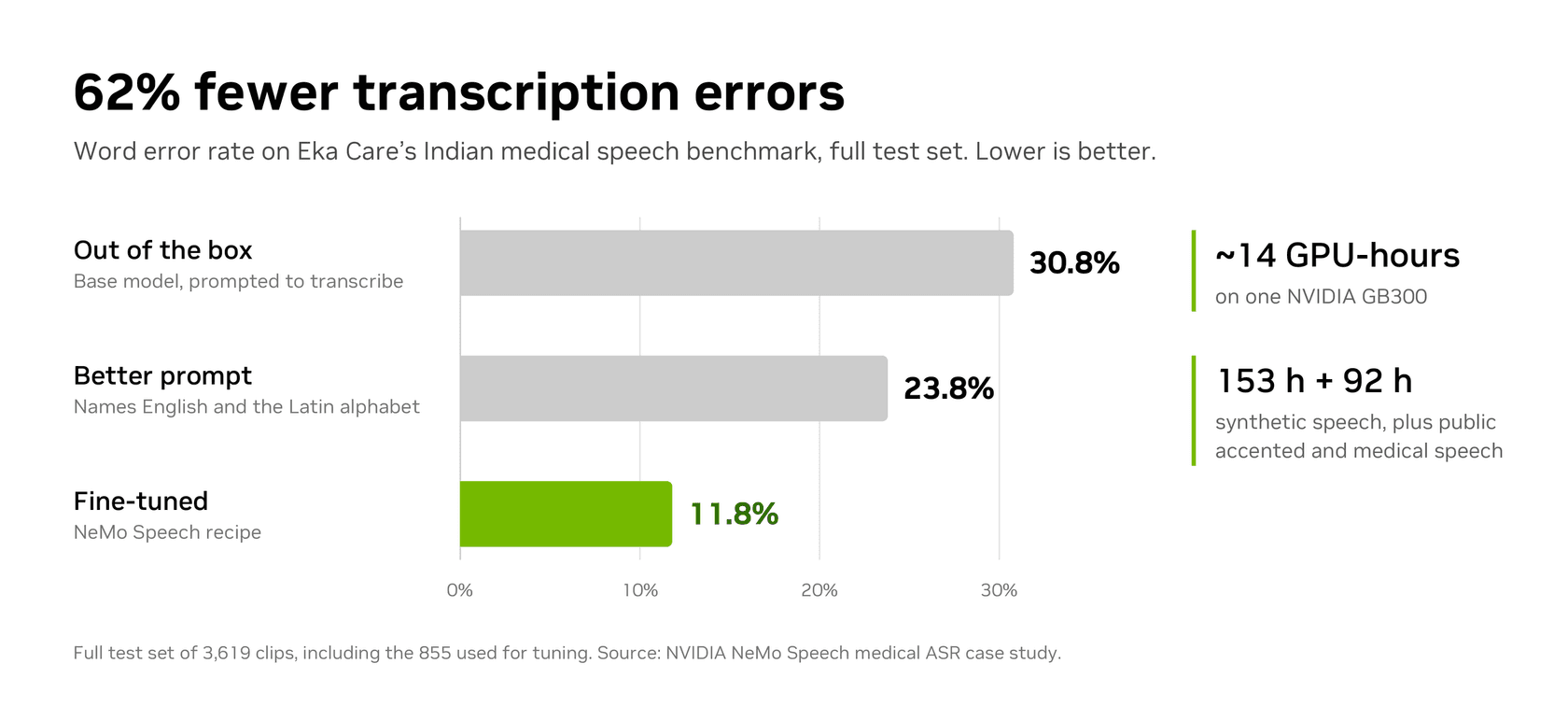
The middle bar is the one to look at. A better prompt alone took it from 30.8% to 23.8% before any training. My take: try the prompt before you try the fine-tune. Telling the model the language and alphabet, plus your product names, costs nothing, and for most support teams it's most of the win.
If you're weighing it against other open models for a wider stack, NVIDIA's open agent safety platform and my open-source AI agents list cover the pieces around it.
Try eesel
Nemotron 3.5 Transcribe is infrastructure: excellent ears, no job description. It turns a call into text. What happens next, reading the ticket, checking the order, answering in the customer's language, escalating the angry one, is a job, and that's what eesel's AI helpdesk teammate does. It joins Zendesk, Freshdesk or Gorgias, learns from your past tickets and help center, and you can test it on hundreds of those tickets before it replies to anyone.
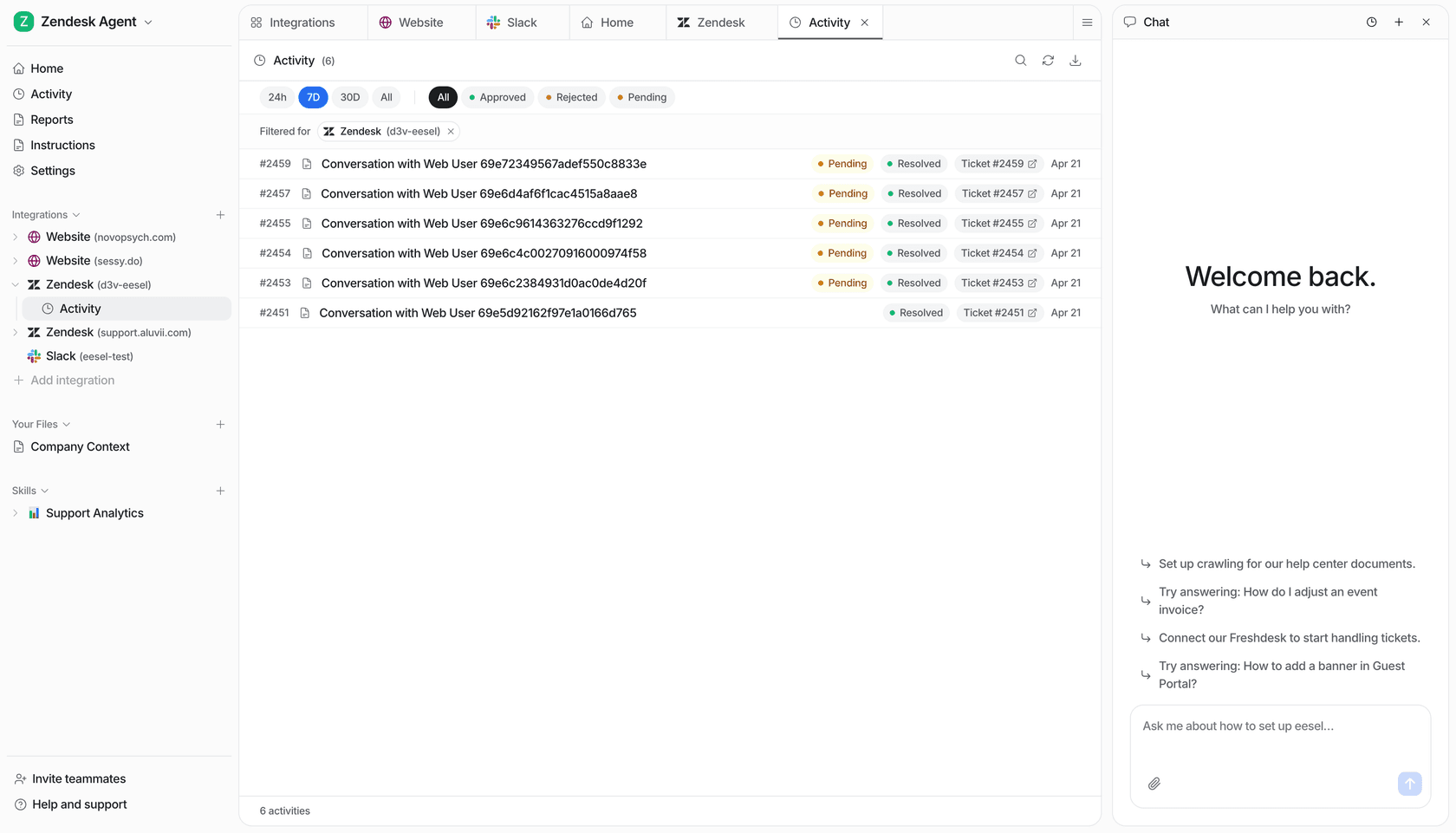
Language is where this pays off the most. At smava, it handled 27,000 Zendesk tickets in a month, tagging each one's language and category and drafting replies in German. At Koffer.ch, it drafts Freshdesk replies in whichever of four languages the customer wrote in, with Swiss spelling in the German.
If you like running models from a terminal, the eesel CLI operates the same teammate: read and edit its instructions, approve actions waiting on a human, and check each run's activity log, with JSON output and dry runs on writes. A coding agent like Claude Code can manage your support teammate next to your transcription pipeline. Try eesel free, or book a demo to see it on your own tickets.