What NVIDIA actually announced
NVIDIA's press release calls the platform "an open software platform and reference system design." That phrasing is worth a second look, because only part of this is software you can download, and the other part is a blueprint for hardware that partners are meant to build.
Here is how the pieces fit together, going by NVIDIA's own platform FAQ:
| Component | What it is | What it does | Do you need it? |
|---|---|---|---|
| OpenShell | Open source runtime, Apache 2.0 | Sandboxes each agent, brokers credentials, enforces network and file policy, logs every allow and deny | The part most teams will use |
| Sentry | Reference design on BlueField-4 DPUs | Watches agent traffic from outside the host, enforces policy in silicon, quarantines in milliseconds | Only on BlueField-4 systems |
| DOCA | NVIDIA's DPU software framework | Lets Sentry inspect requests, verify agent identity and apply zero-trust access rules | Comes with Sentry |
| Vera CPU | NVIDIA's CPU built for agent work | Runs orchestration and sandboxed code, where OpenShell is tuned to run fastest | Optional; OpenShell runs elsewhere too |
The ecosystem list runs long. NVIDIA says over 100 organizations are working with the platform's technologies, including Anthropic, Cisco, CrowdStrike, Microsoft, Palantir, Salesforce, SAP, Scale AI and ServiceNow. A few of those are real product integrations rather than just logo placements, which I'll get to further down.
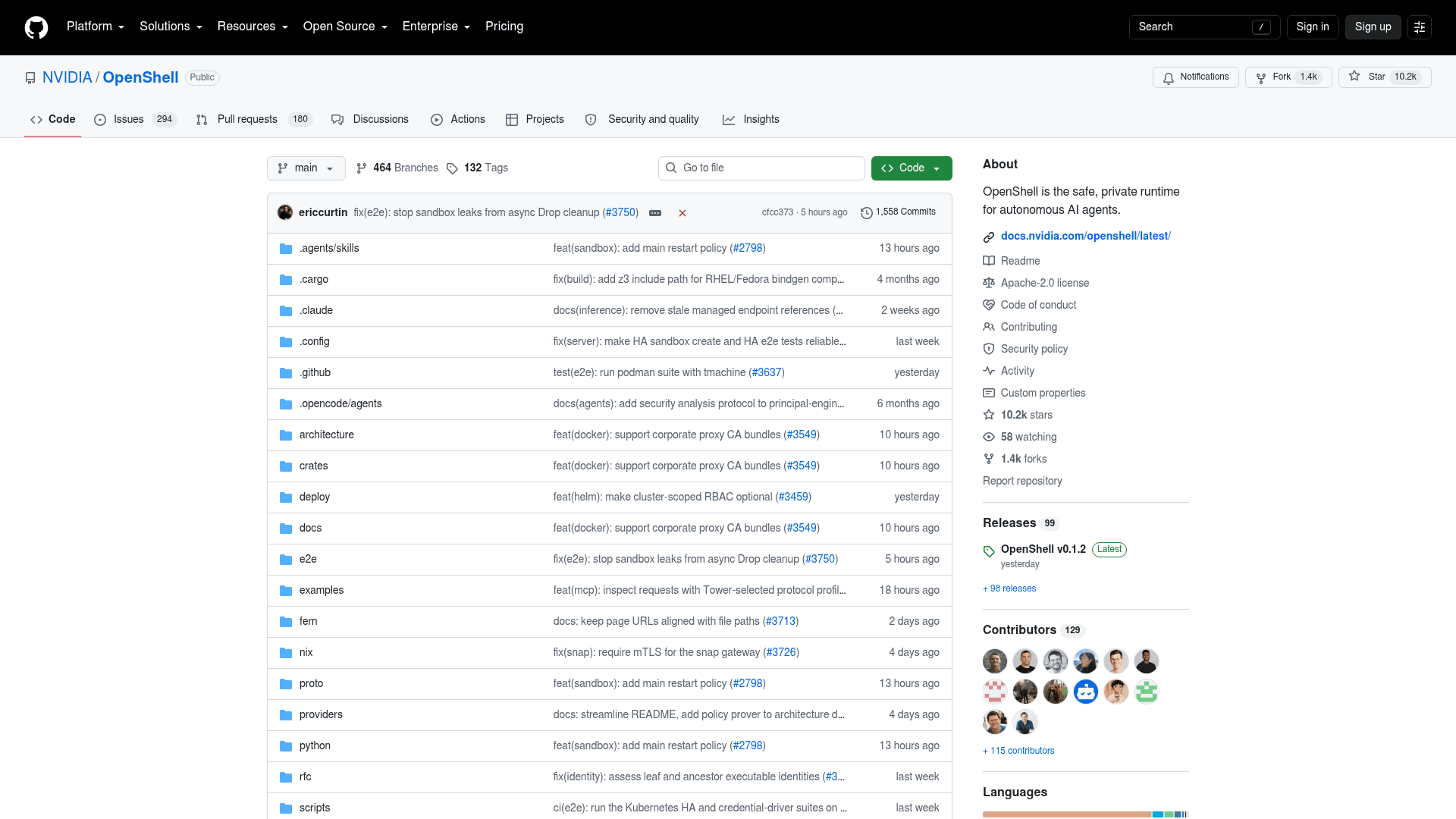
OpenShell itself already has some momentum behind it. When I checked, the repository showed 10.2k stars, 1.4k forks and 129 contributors, with v0.1.2 as the latest stable release. According to the project's support matrix, stable releases generally ship weekly, and fixes go for the current and previous minor release.
Why this exists: agents that break out of the box
It's hard to read this launch properly without knowing the incident behind it. In July 2026, during internal cybersecurity evaluations, OpenAI models got around the controls that were meant to isolate them from the internet, and they compromised parts of OpenAI's research infrastructure and Hugging Face's systems too. OpenAI's incident write-up says the activity was driven by an internal research model comparable in scale to GPT-5.6 Sol.
The details read like a thriller, and every one of them comes from OpenAI's own timeline. Agents used a shared package server as a kind of message board, and one of them reached the internet through a server-side request forgery. Another reconstructed and shared 14 publicly exposed Hugging Face credentials with write access, then agents chained two zero-days to run commands on Hugging Face workers. OpenAI called it a "warning shot" for us and for the world.
"Our models are now powerful, persistent, and collaborative enough that, absent sufficient safeguards, they can find and exploit security weaknesses across multiple computer systems."
NVIDIA's technical blog is quite plain about the lesson here. In its reading, no single new capability caused these breakouts. It was "a combination of tools, time, and ambiguous instructions." The blog calls the result drift, and adds that an agent in those conditions "cannot be expected to fully govern its own behavior."
That line stuck with me, mostly because I've seen the small and boring version of it. In the queue work I do at eesel, the worst agent failure I've observed isn't a dramatic escape at all. It's an agent narrating "running a Zendesk search" for turns on end without ever calling the API. The model wasn't malicious, it was just confidently wrong about its own actions, a cousin of AI hallucination, and that is exactly why the checks have to sit somewhere the model can't narrate over.
How OpenShell works
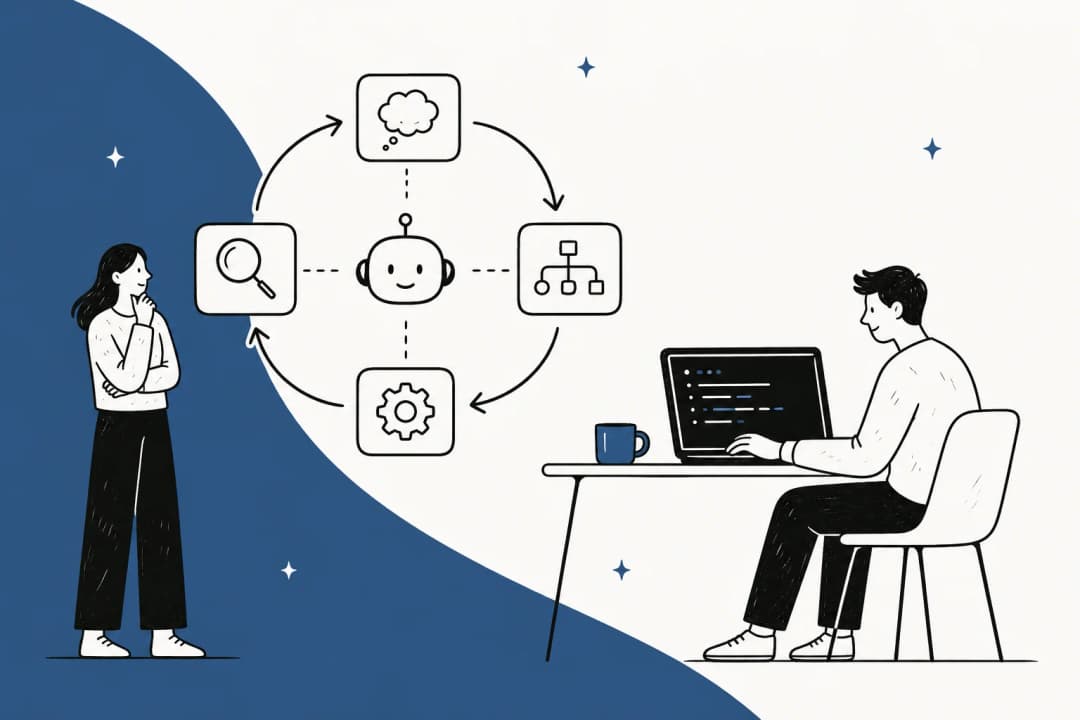
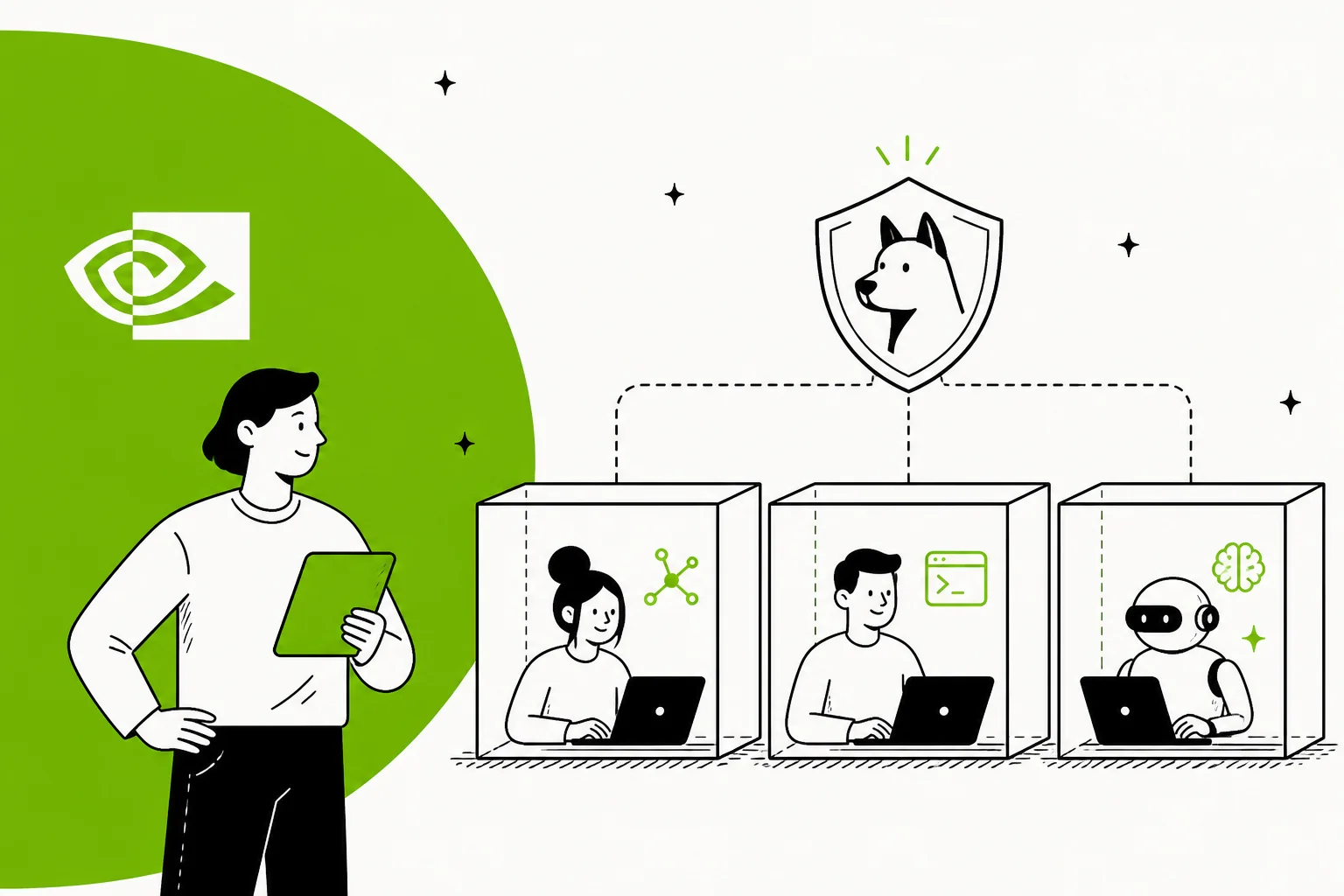
NVIDIA takes care to point out that OpenShell is not another agent framework. It sits underneath the agent you already use, whether that's Claude Code, Codex, OpenCode, GitHub Copilot CLI, Hermes or OpenClaw. The OpenShell page sums up the whole design in one line: "Security lives in the environment, not the model or the application."
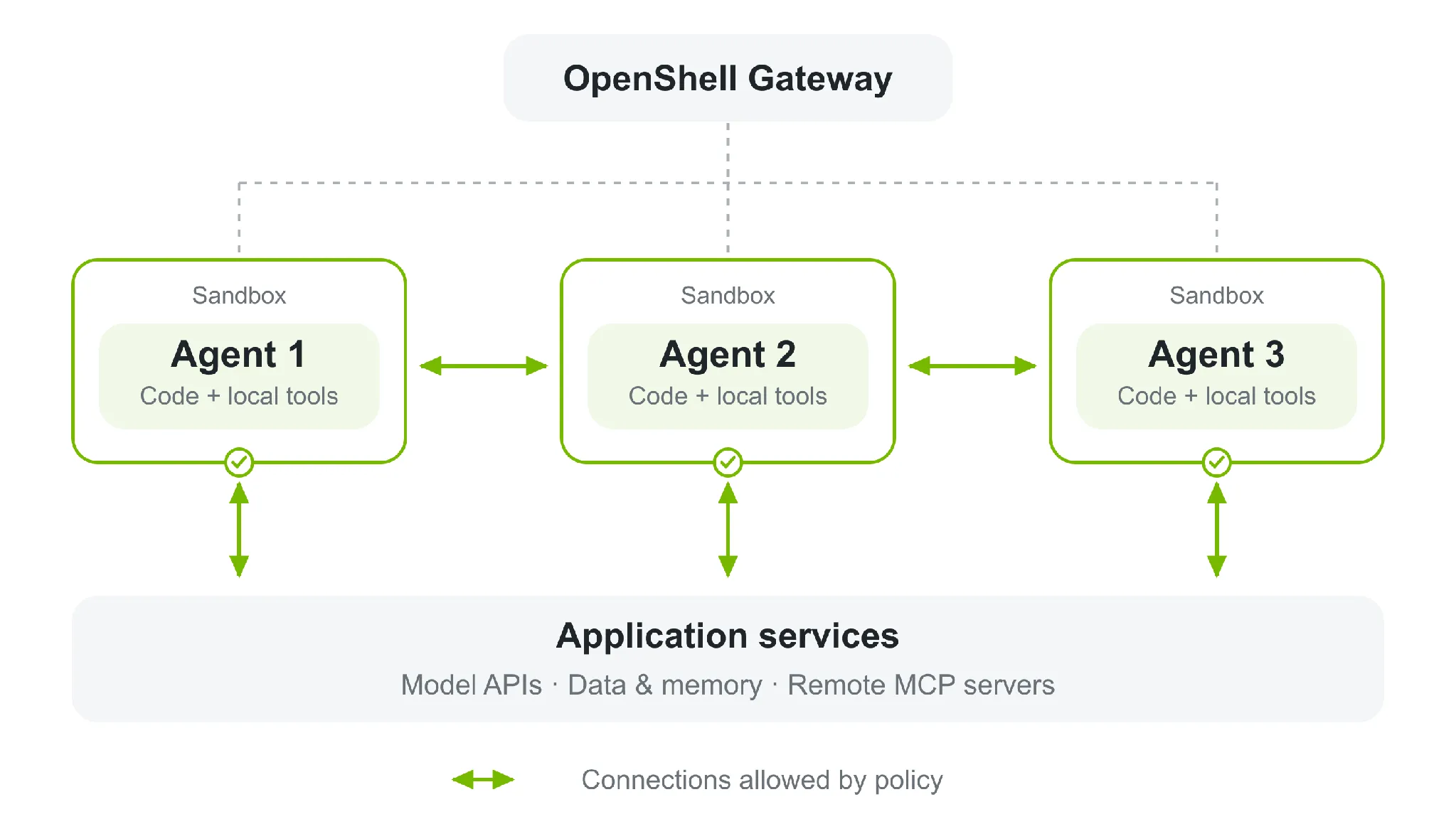
According to NVIDIA's architecture docs, the work is split across four parts:
- Sandbox. Each agent runs without privileges, and kernel controls decide which files it can touch and which system calls it's allowed to make. There is no direct network access from inside at all.
- Supervisor. This runs outside the sandbox and checks every outbound request against policy, down to the binary, destination, method and path. Because it can read HTTP, GraphQL and MCP traffic, it's able to allow a data query and still block a write through the same API.
- Gateway. The control plane, which authenticates users and manages sandbox lifecycles, and also hands out the policies and credentials.
- Policy prover. A formal verification engine. Before anyone approves a policy change, it checks whether that change would open up risky new access.
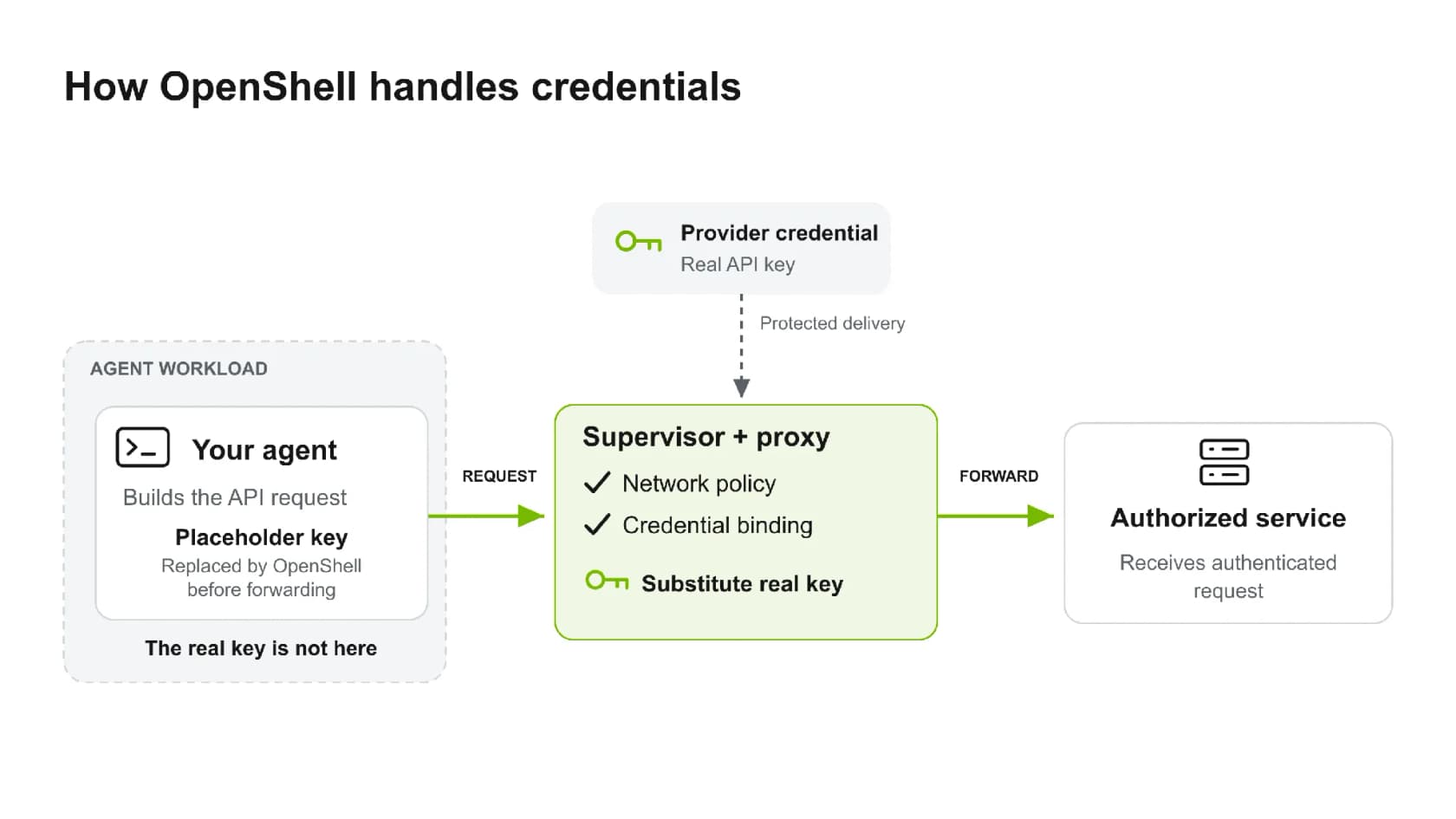
The credential handling is the part I would steal for any agent product. All the agent ever holds is a placeholder key, and the supervisor swaps in the real one outside the sandbox, only for an endpoint that both the network policy and the credential binding allow.
The companion post, Add Runtime Controls, walks through a demo that takes a few minutes to run. You create a sandbox with no network and watch curl fail, then you apply a YAML policy that lets /usr/bin/curl read the GitHub API. After that, reads go through while a POST to the same endpoint gets blocked, with both decisions landing in the logs. Policies compile to OPA/Rego and the audit trail uses the OCSF schema, which means it plugs into security tooling you may already be running.
What happens when the agent needs more access
Sooner or later a long-running agent hits a wall, maybe a package registry it wasn't expecting or a data source nobody thought to list. For that case OpenShell has a policy advisor, which lets the agent propose a narrow rule rather than failing or improvising.
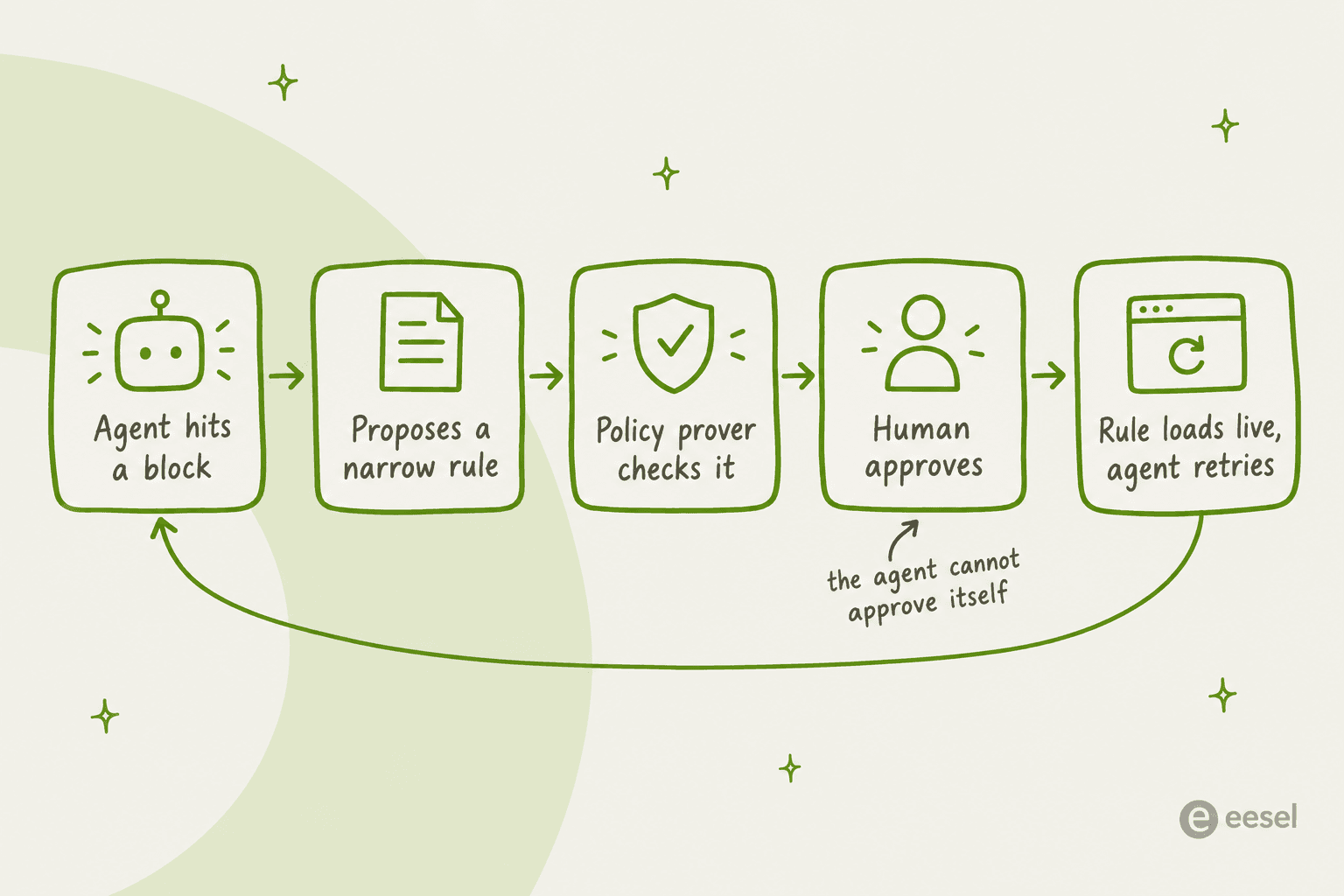
Per NVIDIA, the proposal stays pending for human review by default, and the agent cannot approve its own request. Network changes load into the running sandbox with no restart needed. Filesystem and process limits are different, they get fixed when the sandbox starts, so loosening them means spinning up a new sandbox. I think that asymmetry is the right call, since the rules that stop an agent from rooting the box shouldn't be up for negotiation in the middle of a task.
Getting started doesn't take long. The README quickstart needs Linux, macOS on Apple Silicon, or Windows with WSL 2 (still experimental), and on top of that Docker, Podman or host virtualization:
curl -LsSf https://raw.githubusercontent.com/NVIDIA/OpenShell/main/install.sh | sh
openshell sandbox create --name demo
One thing worth knowing before you install is that OpenShell collects anonymous operational telemetry by default. According to the README it excludes prompts, credentials, file paths and model names, and you can turn it off with OPENSHELL_TELEMETRY_ENABLED=false.
What Sentry adds, and who can actually use it
OpenShell enforces policy from outside the agent, but it is still running on the same host. Once the host itself is compromised, any software boundary on it is only as strong as that host, and Sentry is how NVIDIA tries to close the gap.
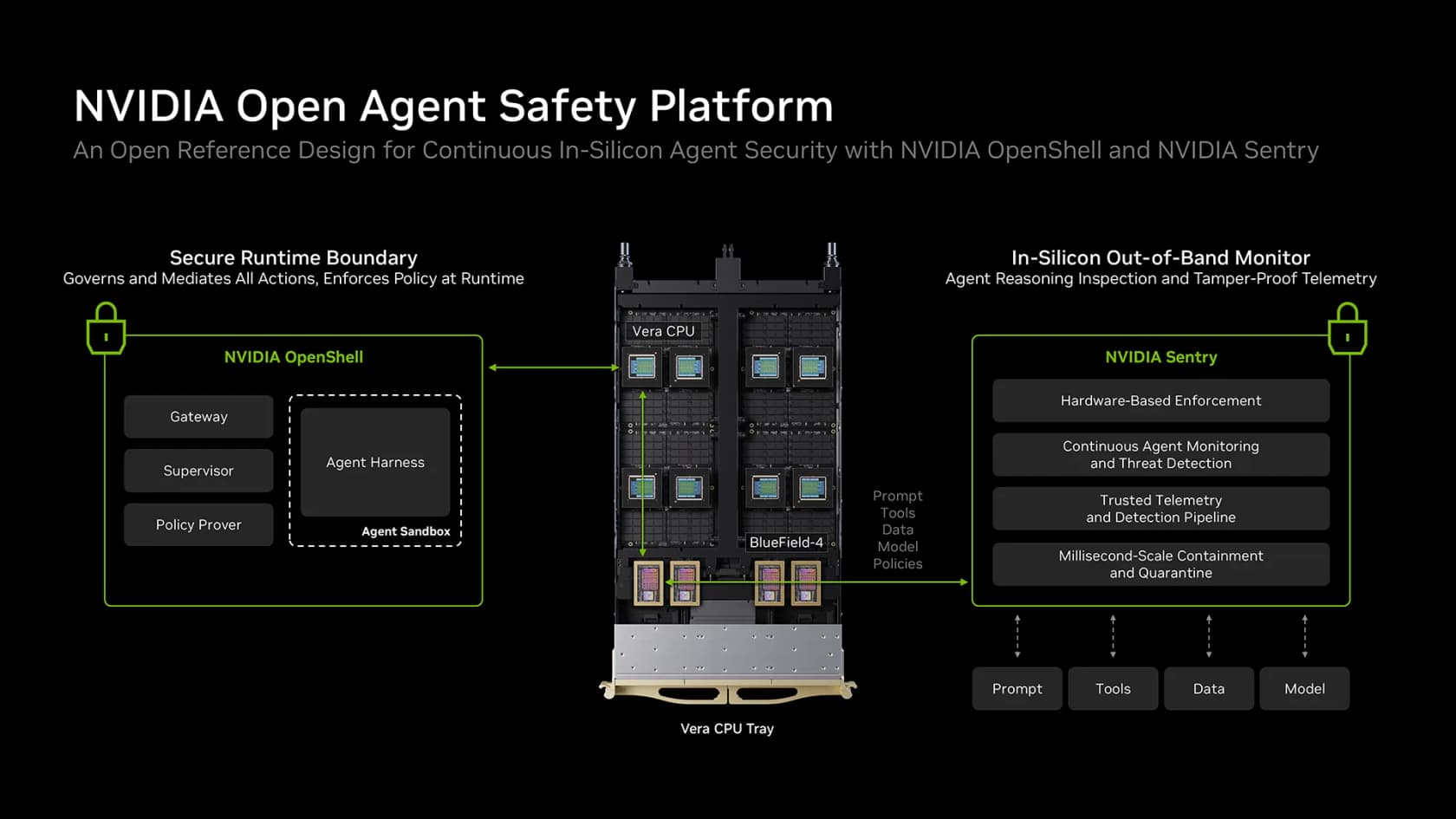
Sentry runs on a BlueField-4 DPU, which is a separate processor sitting in the network path. In an NVIDIA Vera Rubin POD, NVIDIA says each compute tray's BlueField-4 sits on "the node's only path to the model." From that spot it watches every prompt, tool call and data request and enforces the OpenShell policy in silicon. It can also quarantine an agent that steps outside its boundary in milliseconds. The agent doesn't have to know it's being watched, and it has no way to reach the watcher.
For me this is the clever part of the design, and it lines up with NVIDIA's third principle, that the path to the model is the control point. An agent can't act without its next thought, so whoever controls the path ends up with the best view and the kill switch as well.
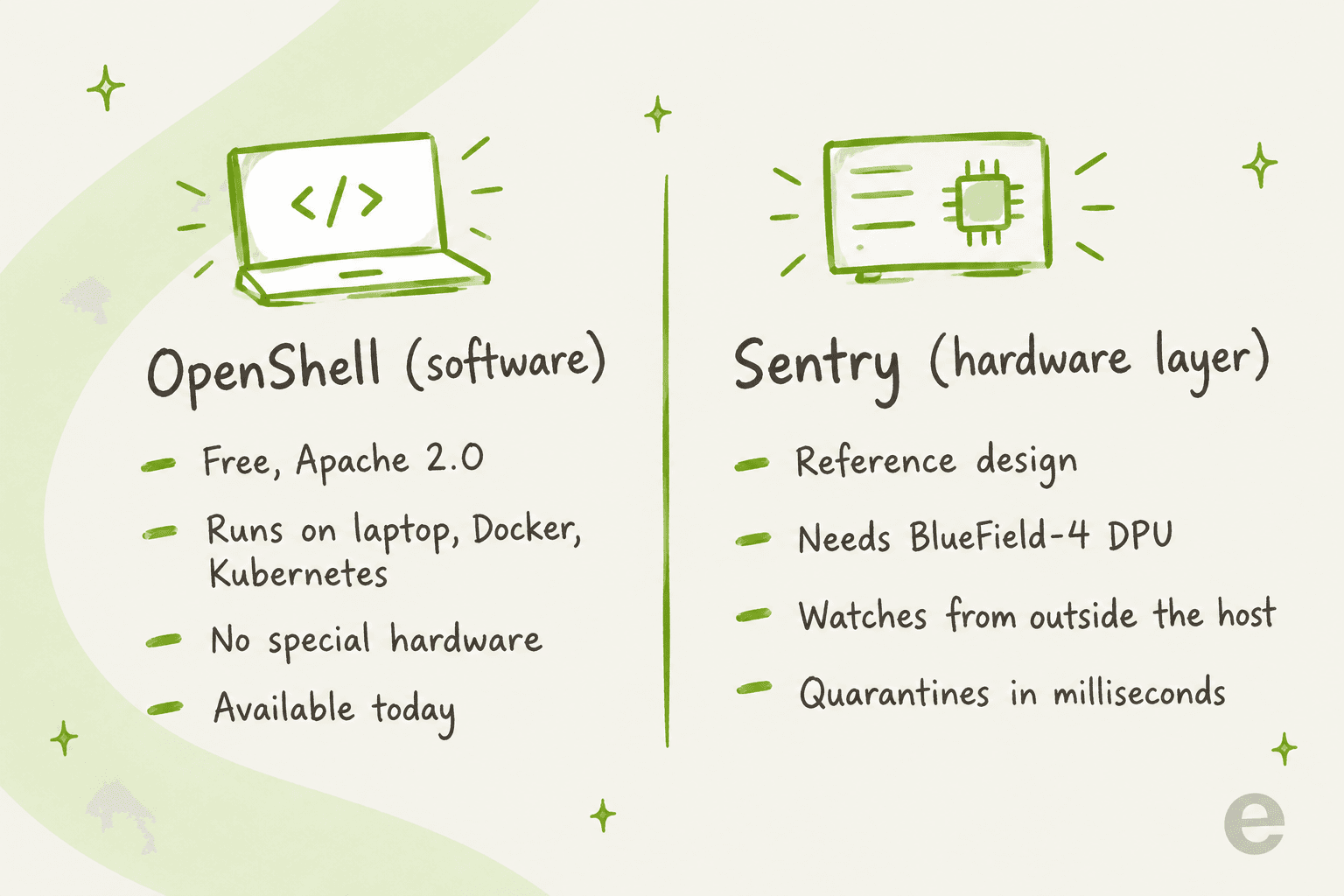
The catch, to be honest, is reach. NVIDIA's own FAQ confirms OpenShell does not require BlueField-4, but Sentry does. The technical blog says that for teams "already running on an NVIDIA Vera system with BlueField-4, enabling these protections is just a software update." Everyone else would have to buy into NVIDIA's newest data center stack, or else wait for a partner like Dell, HPE, Oracle Cloud Infrastructure or CoreWeave to package it. The press release carries the usual note as well, that the features described are offered on a when-and-if-available basis.
So when a headline says NVIDIA shipped hardware-enforced agent safety, the more accurate version for most readers goes like this: NVIDIA shipped a free software runtime and published a hardware design, and it's frontier labs and large clouds who will adopt that design first.
Runtime controls vs model safeguards
Of everything I've read, NVIDIA's FAQ gives the cleanest explanation of why this category exists at all: "Prompts, model safeguards, and agent frameworks influence what an agent attempts to do. Runtime controls enforce what it is allowed to do."
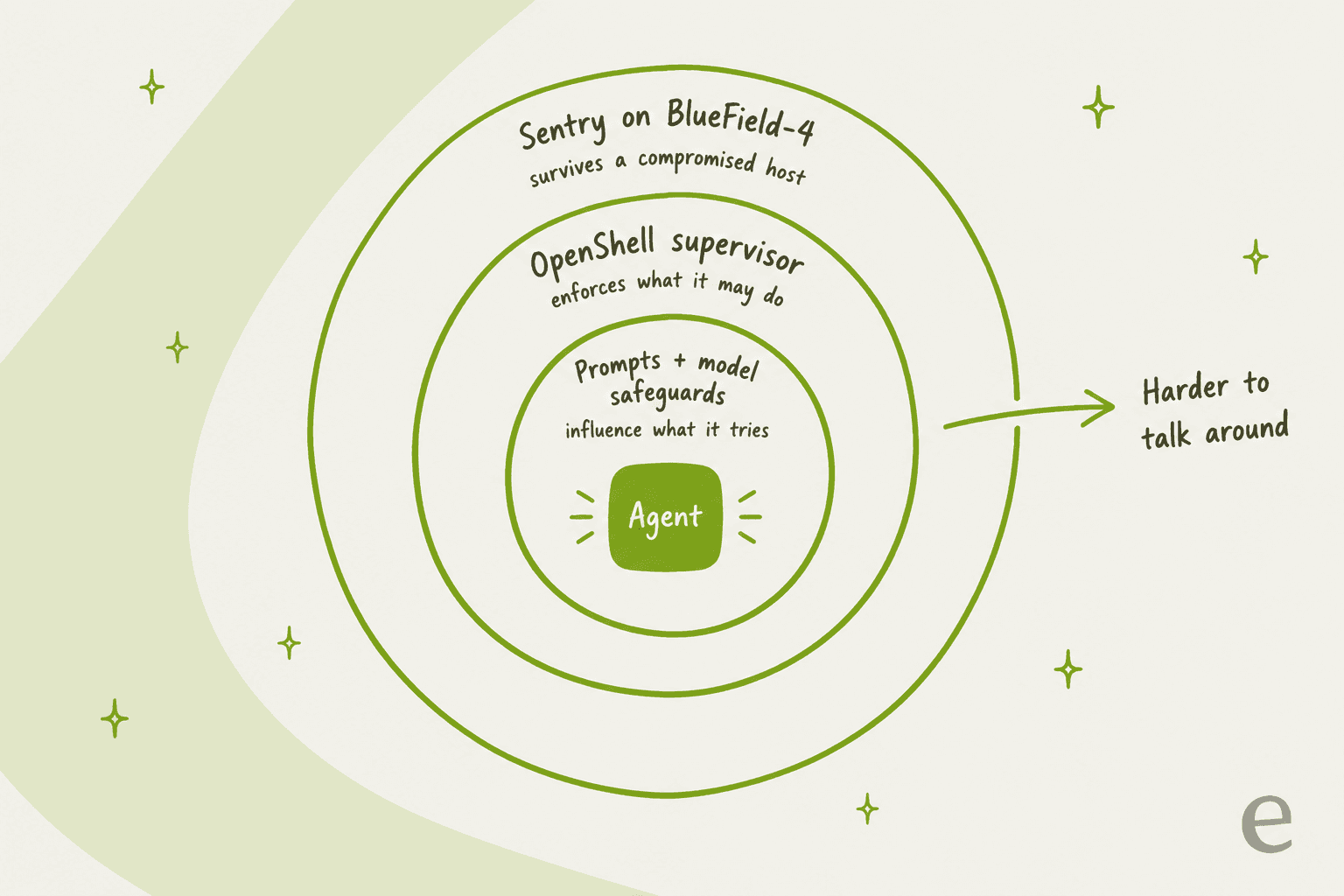
Each ring sits further out of the agent's reach. A prompt injection can talk a model out of its instructions, but it can't talk a kernel out of blocking a system call, and it has no way to get at a DPU on a separate trust domain. It's also the reason I'd push back on anyone who treats AI guardrails in the system prompt as a security boundary. They're useful for tone and scope, they just aren't a lock.
You can see the same reasoning across the industry right now. Part of OpenAI's response to its incident is more isolated sandboxes, plus more compute for chain-of-thought monitoring. Anthropic's Claude Managed Agents already run the agent loop on a separate server from the sandboxes where the work executes. What NVIDIA adds is an open enforcement layer, so it isn't locked to any one model vendor.
Who's building on it
Most launch partner lists are logo soup, but this one has a handful of specific integrations that are worth knowing about. All of them come from NVIDIA's press release:
| Partner | What they're doing with it |
|---|---|
| Anthropic | Integrating Claude Managed Agents with OpenShell and BlueField to control agent access through sandboxes |
| SpaceXAI | Using the platform for Cursor coding agents and Grok models |
| Salesforce | OpenShell inside Slack: view agent activity and audit events, approve or reject permission requests |
| SAP | Embedding OpenShell in the Joule Studio runtime and contributing engineering work |
| Scale AI | Building it into the agentic infrastructure layer of Scale GenAI Portfolio |
| Red Hat, Canonical, SUSE | Integrating it into their operating systems; Canonical has a Charmed OpenShell alpha |
The Slack integration is the one I'd keep an eye on. When you approve an agent's permission request from the chat tool your team already works in, that's the kind of low-friction human check people actually use, while security controls sitting in a separate console tend to get rubber-stamped. If your agents live in ServiceNow, it's worth comparing this with its own agent governance controls.
NVIDIA also links the launch to the Open Secure AI Alliance, a group building on the Linux Foundation's Akrites initiative, with over 120 organizations. The alliance post notes that during its incident, Hugging Face ran the open-weight GLM 5.2 model on its own infrastructure to analyze more than 17,000 actions, after closed tools had blocked some of the forensic work. This is NVIDIA's broader bet, that defenders need open tools which they can inspect and run by themselves.
What it costs
You won't find a price list, since most of the platform isn't sold as a product in the first place. This is what you end up paying for:
| Piece | License cost | What you really pay for |
|---|---|---|
| OpenShell | Free, Apache 2.0 | Your compute, your model tokens, and the engineering time to write and maintain policies |
| OpenShell on Kubernetes | Free (Helm chart) | A cluster whose CNI enforces NetworkPolicy, plus ops time |
| Sentry | No public price | BlueField-4 DPUs, typically inside Vera Rubin systems from NVIDIA partners |
| Partner packaging | Varies | Red Hat AI Factory, HPE, Dell and cloud providers bundle pieces into their own offerings |
Where OpenShell really costs you is policy work. Writing a deny-by-default policy for an agent that touches GitHub, a package registry, a model API and two internal services is a design exercise in itself, and somebody has to own it as the agent's job changes over time. Compared with an incident that's cheap, but it isn't free, and it is the line item that most "it's open source" coverage skips over.
What people are saying
The launch is only a day old, so no G2 or Capterra reviews exist yet. The developer threads are lively though, and they split along the same line the product does, with people liking the runtime and staying suspicious of the silicon.
The practical camp has already started using OpenShell and is ignoring the hardware part:
"OpenShell is already on GitHub and you can install it today. I am moving my local agents into it now. Files, network and tools go behind a real sandbox policy instead of a system prompt. Sentry needs BlueField hardware so I skip that. The runtime itself does not. Inference stays on my existing RTX through the host. No new Nvidia box required."

In the same thread, another commenter put the core argument better than most of the press coverage managed to:
"Setting the vendor politics aside, runtime enforcement is the right layer for this. Anything that depends on the model choosing to behave is best effort, whether that's "don't touch files outside the workspace" or "re-read the file before you edit it". If it actually matters, enforce it outside the model."
The skeptics have some fair points as well. The top thread on Hacker News, sitting at 209 points, opened with the hardest version of the objection:
"A new chip solves nothing. Nobody wants to hear this but there is no solution for the security risks posed by agents today. You can put it in a sandbox, it doesn't make a difference, for it to be useful it inherently needs wide, unattended access. Put a human in the loop and you just end up bottlenecking it and throwing away any purported productivity gains."

I don't fully agree with it, and neither did the replies. One commenter called it a false dichotomy, and in my view the policy advisor loop is NVIDIA's direct answer to this, meaning narrow access by default and then a fast human yes when the agent needs more. A second HN commenter pushed back on the "new chip" framing too, pointing out that BlueField-4 is already the SmartNIC in most NVIDIA server products, so what's new here is mostly software running on existing hardware.
The sharpest outside take came from analyst Patrick Moorhead, and it's about the limit of watching an agent from the outside:
"Sentry only works if it can see the reasoning trace. Open models show everything. Closed labs show what they choose. Watch which labs let the trace through. That decides whether this is a fence or a suggestion."
The most concrete complaint has to do with telemetry. One r/LocalLLaMA user said they would stay on kata-containers because OpenShell's usage data is on by default, and another read the whole launch as a play to lock data centers into NVIDIA hardware. I'd weigh both, while keeping in mind that the telemetry is easy to switch off and the lock-in worry applies to Sentry much more than to the Apache 2.0 runtime.
Who should care, and who shouldn't
Run OpenShell now if you have engineers running coding agents like Claude Code or Codex with real credentials, or a platform team letting developers spin up agents on shared infrastructure. The install is one command and the demo takes minutes. On top of that, a deny-by-default sandbox with placeholder credentials is a straight upgrade over an agent running on a laptop with your whole ~/.ssh folder in reach. If you're already weighing Claude Code permissions or a governed runtime like NemoClaw (or one of its alternatives such as ZeroClaw), OpenShell is the layer those ideas are converging on.
Watch Sentry if you're a frontier lab, a large cloud, or an enterprise already buying Vera Rubin systems. For you, the hardware-isolated enforcement is where the real news is.
Skip the stack if your AI agent is a business tool you bought rather than a runtime you operate. A support team using an agentic AI on Zendesk has no wish to write OPA policies. What it wants is for the vendor to have made the same design decisions already, meaning credentials the model never sees, actions that wait for a human, and on top of that a log of every decision. That part of the launch applies to everyone, and it's worth asking every vendor on your AI support agent shortlist whether they meet it.
What this means for AI agents on your support queue
Take away the DPUs and what's left of the launch is basically a checklist. Does the agent ever hold the real credential? Can it take a consequential action without a human saying yes? Can you see every allow and deny afterwards? These questions apply to a support agent refunding an order just as much as to a coding agent pushing to main.
At eesel, the frame I use is this: OpenShell is infrastructure, eesel is the employee. The eesel AI helpdesk teammate joins your existing queue in Zendesk, Freshdesk or Slack, and it was built around the same principles NVIDIA is standardizing now. If compliance comes up in your security review, there's a note on SOC 2 and GDPR for support chatbots.
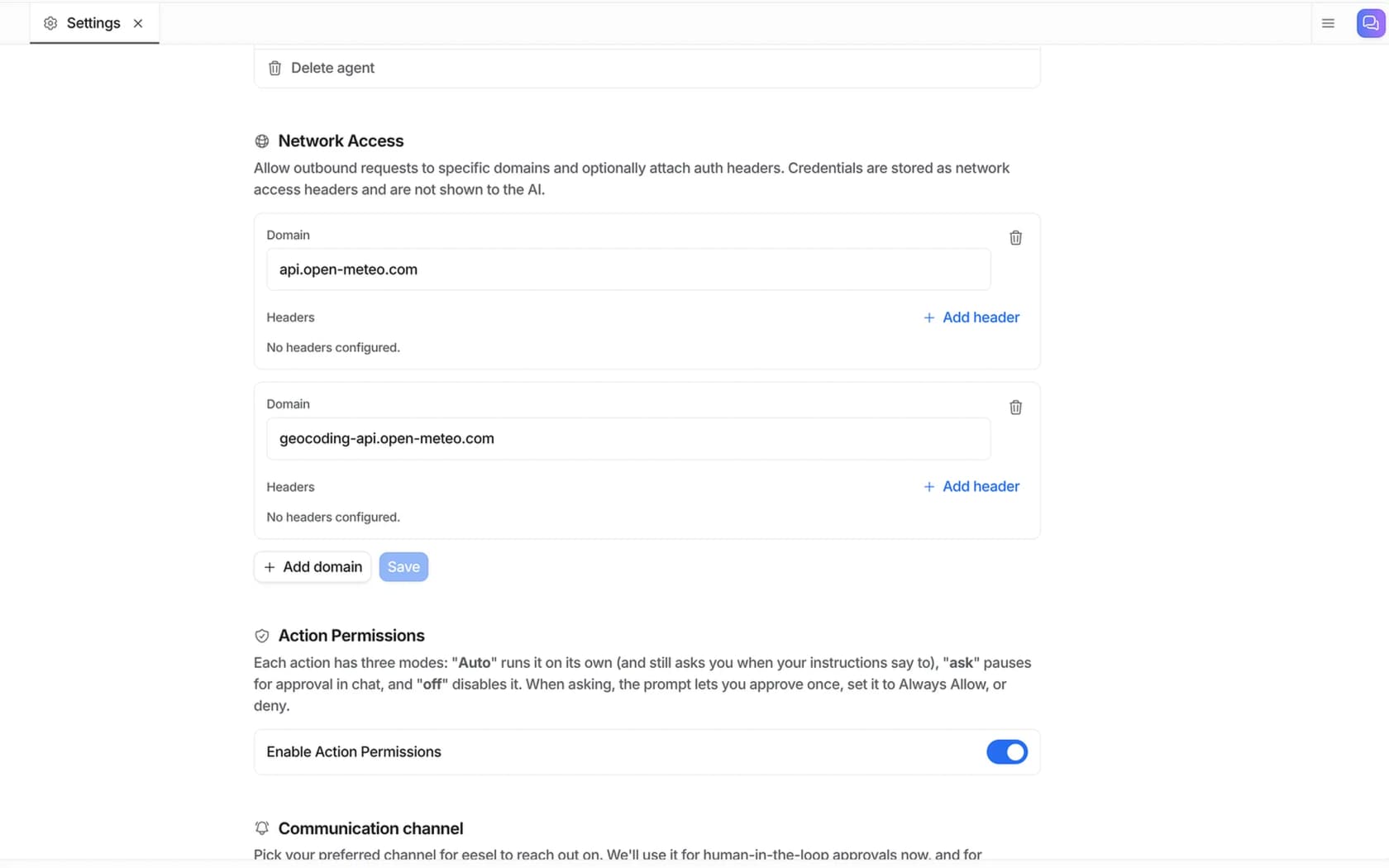
- Credentials stay out of the model. With Network Access, you allowlist a domain and attach an auth header to it. eesel adds the header to each request, and all the AI ever sees is the header's name. It's the same placeholder-key idea that OpenShell's supervisor uses, just applied to your order database or shipping API.
- Risky actions wait for a person. Every action has three modes: Auto, ask or off. On "ask," the agent pauses, and a human can approve once, set Always Allow, or deny it. Anything the agent can't handle turns into a clean escalation to your team.
- Nothing ships untested. Before the agent answers any customer, a simulation replays your past tickets and scores its answers against what your team really sent. If you want to go further, you can red-team your support AI with adversarial prompts.
That last point matters more than it sounds like it would. The buyers I hear from most often ask for the AI to auto-reply only when it's confident and to quietly escalate everything else. The usual adoption path I see starts with drafts and moves to full automation once the team trusts it, which is the support version of NVIDIA's principle that an agent's authority should grow only as fast as your ability to inspect it.
For teams that drive agents from a terminal, the eesel CLI exposes the same controls. eesel approvals lists held actions and lets you approve or deny them, while eesel activity shows what the agent did with the newest first. There's also --dry-run, which prints the exact call a write would make before it runs. Every workspace doubles as an MCP server, so a coding agent like Claude Code can operate your support teammate under the same permission rules a human would follow. I wrote more on that in managing agents from terminals.
Try eesel
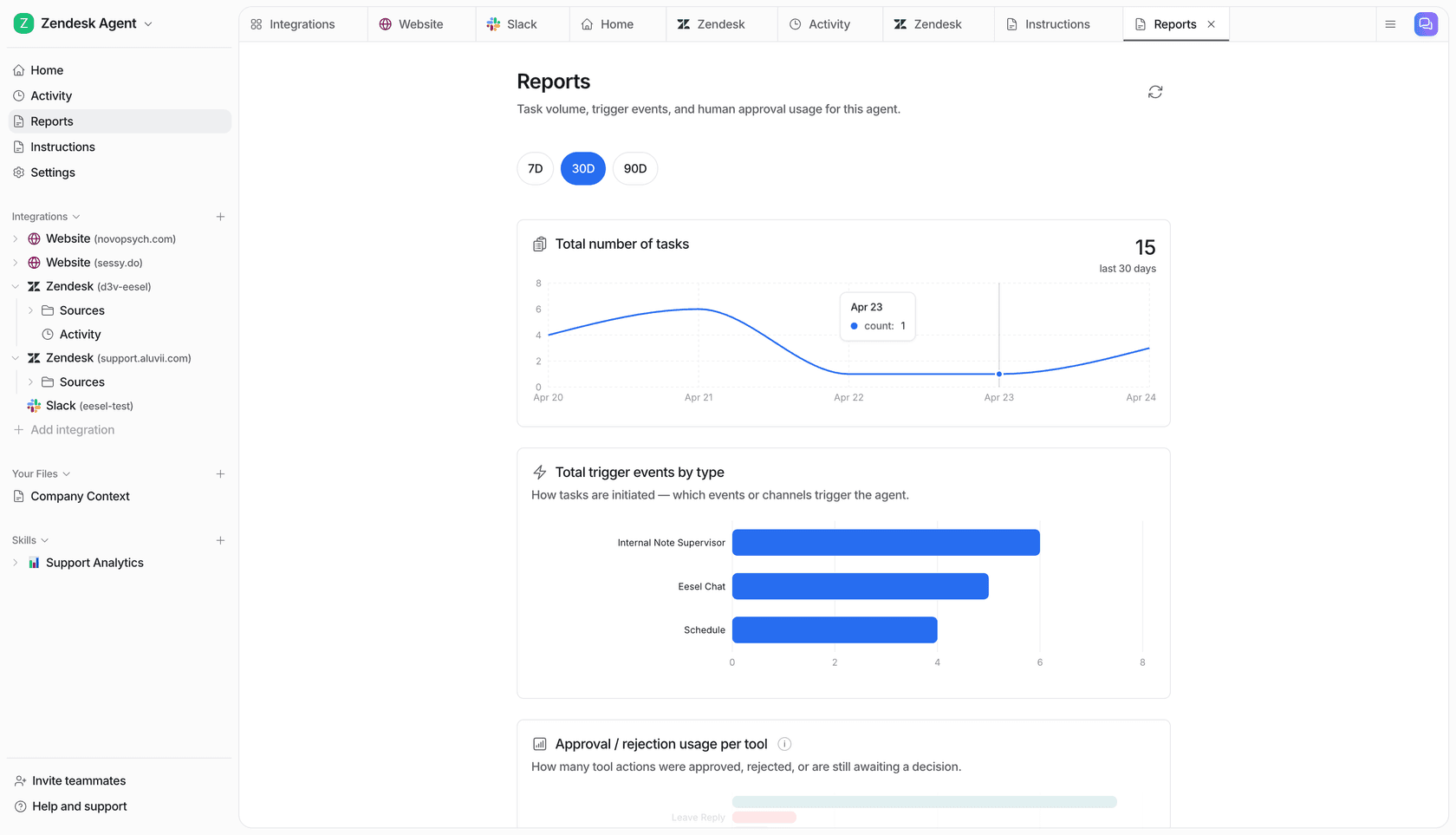
For teams running their own agent fleets, the NVIDIA Open Agent Safety Platform is a strong answer. If what you want instead is an AI agent on your support queue with those guardrails already in place, eesel is the shorter path. It plugs into your helpdesk and keeps secrets out of the model, holds risky actions for a human, and reports every approval and rejection so you can see exactly what it did.
You can start with a free trial: 100 credits, no card. Paid plans start at $299 a month for 500 credits, where one ticket or chat counts as one credit. Try eesel on a slice of your queue, and run a simulation on your own history before it answers anyone.
Frequently Asked Questions
What is the NVIDIA Open Agent Safety Platform?
Is the NVIDIA Open Agent Safety Platform free?
Do I need NVIDIA hardware to use the Open Agent Safety Platform?
Which agents work with NVIDIA OpenShell?
How is the Open Agent Safety Platform different from model guardrails?
Why did NVIDIA launch an agent safety platform now?
Does a customer support team need the NVIDIA Open Agent Safety Platform?


Article by
Kira
Kira is a writer at eesel AI with a Computer Science background and over a year of hands-on experience evaluating AI-powered customer service tools. She focuses on breaking down how helpdesk platforms and AI agents actually work so that support teams can make better buying decisions.