

What NemoClaw is
I build product features and AI agents for a living, and I've spent years watching teams try to stand up their own support automation, so I want to be fair to NemoClaw first, because it earns it.
NemoClaw is NVIDIA's open-source (Apache 2.0) reference stack for running agents "more securely inside NVIDIA OpenShell with managed inference." Strip the marketing and it's this: take a general agent like OpenClaw, Hermes, or a LangChain Deep Agent, and wrap it in a governance layer that controls what the agent can see, do, and where its inference requests go. It sits around 21.8k GitHub stars with 93 releases, and NVIDIA is refreshingly honest that it's an alpha project focused on installation reliability and sandbox hardening.
The reason this shows up in support leaders' searches is a naming collision. Someone hears "NVIDIA shipped an AI agent runtime," pictures a customer service chatbot, and lands on a repo that assumes you're a platform engineer with a rack of GPUs. Both things are called "AI agents." They are not the same job.
How NemoClaw actually works
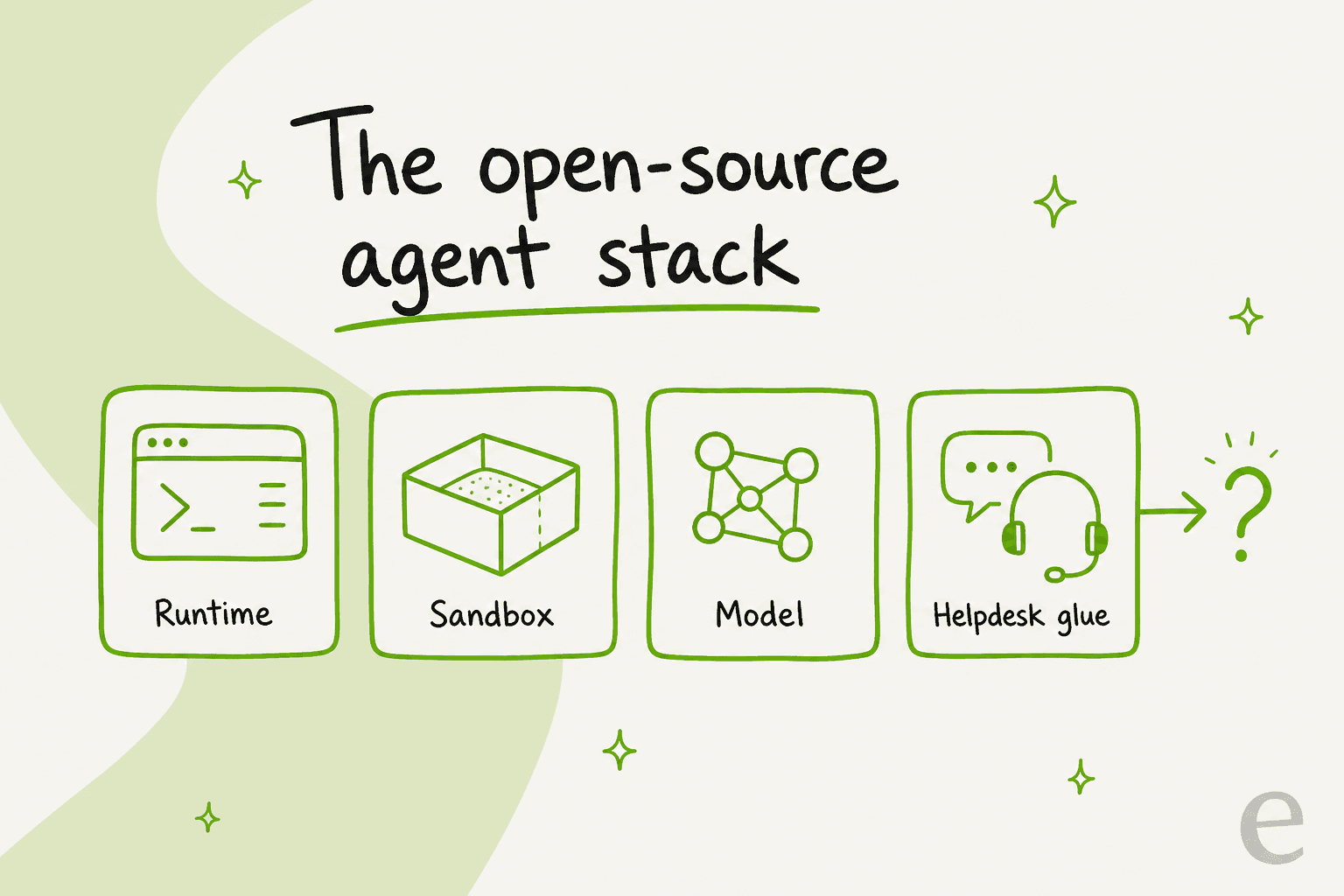
Because I test this kind of stack for a living, here's the mental model that made it click for me. NemoClaw isn't one thing, it's four layers stacked to turn a raw agent into a governed one.
- The agent is the part that thinks and acts. NemoClaw's default is OpenClaw, but it can also run Hermes or LangChain Deep Agents. This is the piece a support person imagines when they hear "AI agent."
- OpenShell is the governance and sandbox layer. It decides what the agent is allowed to touch, isolates what it runs, and is where the "more securely" claim lives.
- Nemotron is NVIDIA's family of local models. High-sensitivity queries can be routed to a Nemotron model running on your own hardware so the data never leaves the building.
- NeMo is the specialization layer for fine-tuning and adapting models to your domain.
Put together, the pitch is "go from agent prototype to governed deployment without shipping your data to a third party." For a platform team on NVIDIA GPUs, that's a real, coherent answer. The catch is what it assumes you already have, and what it leaves you to build.
Where NemoClaw is strong
Credit where it's due. As a governed runtime, NemoClaw does several things well.
- The data-privacy story is legitimately good. Routing sensitive queries to local Nemotron models is a real answer to "we can't send customer data to an external API," and it's more concrete than most vendors' hand-wavy "enterprise-grade security" line.
- The sandboxing is the point, not an afterthought. OpenShell is built to isolate what an agent decides to run, which is exactly the guardrail you want if the agent can execute code or hit internal tools.
- It's genuinely open and free. Apache 2.0, 93 releases, active development. You can read every line, fork it, and run it without asking anyone's permission.
- It's model- and agent-flexible. Swapping OpenClaw for Hermes or a custom LangChain agent means you're not locked into one vendor's idea of how an agent should behave.
If you're an ML-literate platform team that wants to own its agent stack end to end, this is a serious foundation. I'm not damning it. I'm saying it's built for a specific reader.
Where it wobbles (for support teams especially)
Now the honest part. Every strength above assumes a platform-engineering context. Drop NemoClaw into a support team's lap and three problems surface immediately.
1. No helpdesk integration, at all. NemoClaw governs an agent's runtime. It has no native connector to Zendesk, Freshdesk, Gorgias, or Intercom. So the entire "read the ticket, draft the reply, tag it, escalate it" loop is code you write and maintain. That's the 80% of a support AI that no runtime gives you.
2. It needs the hardware. The privacy-routing pitch leans on local Nemotron models, which means RTX or DGX-class NVIDIA GPUs sitting somewhere you own. That's a capex line and an ops burden, not a checkbox in a settings page.
3. There's no way to test against your real tickets. This is the one that would stop me cold. A support AI that sounds confident and is quietly wrong is the nightmare scenario, and NemoClaw gives you sandboxing, not a simulation against your ticket history. You find out how it behaves in production, on real customers. Having watched confident bots give wrong answers, that's exactly the risk we built simulation to kill.
And underneath all three: it's alpha. NVIDIA says so plainly. For a lab or a prototype, alpha is fine. For the tool that talks to your customers, "the security surface is still hardening" is a hard no.
I've sat on the other side of this exact decision with customers. One operations lead at a mid-market order-fulfillment company, weighing whether to keep buying software or roll their own, put it to me plainly:
"Long term we will just build our own, which is so possible now with AI."
Operations lead, mid-market order-fulfillment company (eesel customer interview)
He's right that it's possible. The question NemoClaw really forces is whether it's worth your team becoming the ones who run the stack.
What it really costs to run NemoClaw
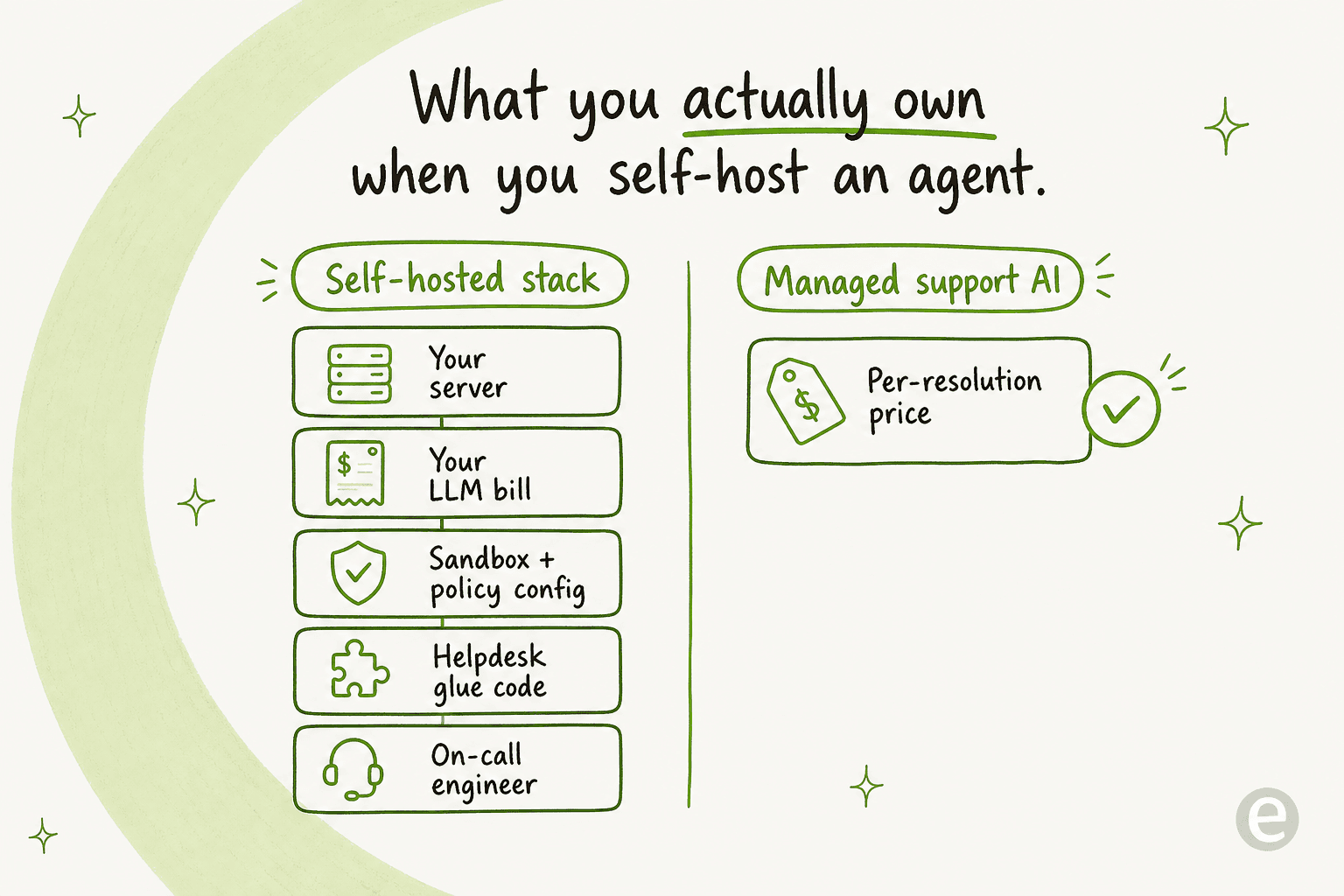
"Free and open-source" is true and misleading at the same time. The license is $0. The bill is not. For a support use case, the real cost is hardware plus inference plus the engineering time to build the helpdesk glue and keep it running. Plug your own numbers in below to see how a self-hosted runtime compares to a managed cost per resolution.
The point isn't that managed always wins, it's that the honest comparison is never "$0 vs paid." It's your fully-loaded cost of running an alpha runtime versus a fixed monthly price sized to your ticket volume.
NemoClaw review scorecard
Here's my read across the dimensions that matter, scored for a team evaluating it as a support option rather than a research platform.
| Dimension | My take | Score |
|---|---|---|
| Governance & sandboxing | OpenShell is the real strength; built for control | 9 / 10 |
| Data privacy | Local Nemotron routing is a legitimate answer | 9 / 10 |
| Openness & flexibility | Apache 2.0, swappable agents, fully forkable | 9 / 10 |
| Production readiness | Alpha, by NVIDIA's own admission | 4 / 10 |
| Hardware barrier | Needs NVIDIA RTX / DGX GPUs you own | 3 / 10 |
| Helpdesk fit | No native connectors, no ticket simulation | 2 / 10 |
| Time to value for support | Weeks-to-months of building before a reply | 2 / 10 |
Read the top three rows and NemoClaw looks excellent. Read the bottom four and you can see why it's the wrong shape for a support queue. Both readings are true, which is the whole point of this review.
Who should run NemoClaw, and who should skip it
Run it if: you're a platform or ML team, you already have NVIDIA GPUs, governance and on-prem data control are hard requirements, and you have engineers who want to own the agent stack. In that world, NemoClaw is a strong, honest foundation and a smart use of open source.
Skip it if: you're a support or CX team that heard "AI agent" and wants tickets answered. You'll spend months rebuilding the helpdesk connectors, guardrails, and testing harness that a purpose-built tool already ships, and you'll still be running an alpha project in production. That's the same fork as AI agent vs rule-based chatbot, one level up the stack: do you want to run an agent, or do you want tickets resolved?
If you're weighing the self-host route more broadly, I lined up the closest options, OpenClaw, ZeroClaw, Hermes, LangGraph, and more, in my NemoClaw alternatives roundup.
The managed alternative: eesel

If NemoClaw is "here's a governed runtime, now go build your support agent," eesel is the opposite bet: the agent is already built for support, and you point it at your helpdesk.
It plugs into Zendesk, Freshdesk, and Gorgias in minutes, trains on your past tickets, help center, and macros, and, the part NemoClaw structurally can't give you, lets you simulate on real history before it ever replies to a live customer. We've spent years putting AI agents on live queues, and the hard lesson baked into the product is that a confident bot giving wrong answers is worse than no bot, which is exactly why simulation comes before go-live, not after.
You keep the data-control story too, EU residency on request and no training on your data, without owning a rack of GPUs. Pricing is one fixed monthly price, from $299/month for 500 credits (1 credit per ticket or chat), with no per-seat fees, so the cost is predictable.
Want an AI agent on your support queue without building and running the runtime? eesel works like a new hire that plugs into your helpdesk in minutes, already knows your help center, and gets simulated on your real tickets before it answers a single customer. Try eesel free, or book a demo to see it run on your own ticket history.
The verdict
NemoClaw is a great answer to a specific question: how do I govern a self-hosted AI agent on my own hardware? NVIDIA built that well, and the openness and privacy story are the real deal. But it's an alpha runtime for platform engineers, not a support product, and it leaves the hardest 80% of a support AI, the helpdesk integration, the guardrails, the testing against real tickets, entirely on your plate. Judge it as what it is and it's impressive. Judge it as a way to answer customer tickets on Monday and it's the wrong tool. Make sure the question you're asking matches the one NemoClaw actually answers.