


Paperclip review: the open-source AI agent runtime, tested

Rama Adi Nugraha
Written by

Rama Adi Nugraha

Katelin Teen
Reviewed by

Katelin Teen

Last edited July 20, 2026

Expert Verified
Illustrated hero banner for a hands-on review of Paperclip, the open-source AI agent control plane

What Paperclip actually is

I ship agent and integration code for a living, so let me describe Paperclip the way I'd describe it to a teammate, not the way its landing page does.

Paperclip is a Node.js server and React UI that orchestrates a team of AI agents to run a business. It's MIT-licensed, sits at roughly 74k GitHub stars, and the whole pitch is governance. You give your agents an org chart, assign monthly budgets that auto-pause at 100%, set goals that trace back to a mission, and route work through a ticket system where "every conversation is traced, every decision explained." Agents wake up on scheduled "heartbeats" and delegate work down the chart.

The clever part is that it's agent-agnostic. Claude Code, Codex, Cursor, OpenClaw, and Hermes all plug in as the actual workers, while Paperclip is the layer that hires, budgets, and audits them. Its own docs are refreshingly honest about the boundary: it's explicitly not a chatbot, not a single-agent tool, and not a support product.

That one line is the most important thing in this whole review, so I put the gap in a diagram.
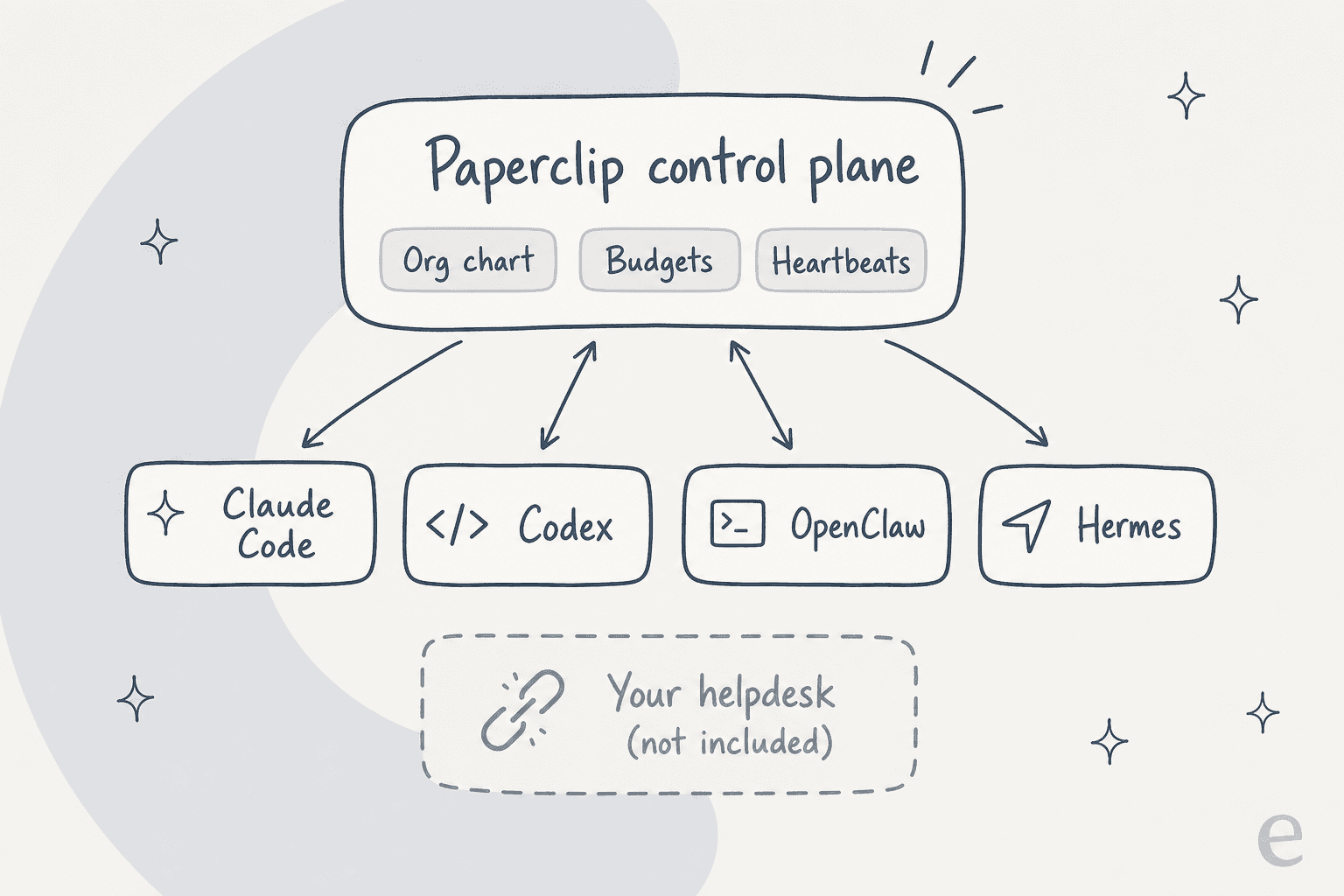
Diagram of the Paperclip control plane sitting above a row of agents, with the helpdesk shown as a missing piece

Paperclip governs the agents. It does not include the thing on the other end that a support team actually needs, the helpdesk where tickets get resolved.

Should you even run Paperclip?

Before the deep dive, answer two quick questions. This is a shortcut, not gospel, but it'll tell you whether the rest of this review is for you or whether you should jump to the alternatives.

1. What's the job?
2. How much do you want to build?
Paperclip is a real contender. This is exactly what it was built for: governing many agents with budgets and audit trails, on infra you own. Read on.
Paperclip will frustrate you. It assumes you'll run Node, Postgres, and the model wiring yourself. Look at a managed workforce tool like Relevance AI or Lindy instead.
Paperclip is the wrong shape. You'd be bolting a helpdesk connector, a support agent, and safety testing onto an ops tool. n8n or Dify get you closer, but it's still a build.
Skip Paperclip. You want a helpdesk-native AI like eesel: plug in, train on past tickets, simulate, launch. No org chart, no server.

What Paperclip gets right

Credit where it's due, because Paperclip earns it. If you're building an agentic AI operation, these are real strengths.

  • Governance is the whole point, and it's done well. Budgets that auto-pause at 100%, goals that trace to a mission, and a full audit trail on every decision. For anyone nervous about a fleet of agents running unsupervised, that's the right instinct baked into the architecture.
  • Truly agent-agnostic. Because it treats the underlying agent as swappable, you're not locked to one model or vendor. Swap Claude Code for OpenClaw without rewriting your org chart.
  • Self-hosted and MIT-licensed. Your data and your agents stay on your infrastructure. For teams with hard data-residency rules, that ownership is worth a lot.
  • The mental model is fresh. "Run agents like a company" is a clearer framing than most orchestration tools manage, and the heartbeat-plus-org-chart design makes long-running, delegated work legible in a way raw scripts don't.

As a piece of open-source engineering, it's a pleasure to read. I mean that.

Where Paperclip falls short

Now the honest part, because a review that only praises isn't a review. Most of these aren't bugs, they're consequences of what Paperclip chose not to be.

  • No helpdesk on the other end. There's no native Zendesk, Freshdesk, or Gorgias connector. Paperclip manages agents; it doesn't sit inside your ticketing tool. For support, that's the whole ballgame missing.
  • No agent of its own. Paperclip is the control plane above the agents, so you still bring, configure, and pay for the actual AI agent and its model. It's an org chart with no employees until you hire them.
  • No way to test on your data. There's no simulation against your past tickets. Here's where the years my team has spent putting agents on live queues matter: we've watched a confident-sounding bot quietly give a wrong answer, which is exactly why eesel now simulates every rollout against real history first. Paperclip's audit log tells you what happened; it can't tell you what will happen before a customer is affected.
  • You run the stack. Node 20+, pnpm, a Postgres database, and a server, all yours to install, patch, scale, and babysit.
  • Cost is hard to forecast. Every heartbeat is an LLM call. Budgets pause work at a ceiling, but they don't lower the per-call price, so a busy org chart can burn tokens faster than you'd expect.

None of this is a knock on the project. It's the difference between a tool that helps you run a company of agents and a tool that is the support agent.

Paperclip pricing: free, but not free

Let me be precise, because "free and open source" hides the real number.

The Paperclip runtime is free under the MIT license, with no account and no seat fees. What you actually pay for is everything around it: the LLM API calls each agent makes (the biggest and least predictable line), the server and Postgres database to host it, and the engineering time to keep the whole thing running. For a support use case, the number that matters is cost per resolved ticket, and a self-hosted agent fleet makes that hard to pin down in advance.

Contrast that with usage-based pricing where you pay per resolution and infrastructure is someone else's problem. Neither is "cheaper" in the abstract, but one gives you a forecastable per-ticket number and the other gives you a variable infra bill. Know which one you're signing up for.

Who should run Paperclip, and who shouldn't

Strip away the hype and it comes down to fit.

Run Paperclip if you're an engineering-heavy team building an autonomous agent operation across many agents, you value owning the stack, and governance (budgets, audit trails, org charts) is a real requirement rather than a nice-to-have. For that job, it's one of the best open-source options going, and my full Paperclip alternatives piece covers the CrewAI and LangGraph crowd you'd compare it against.

Skip Paperclip if your actual goal is to answer customer tickets. You'd spend weeks bolting on a helpdesk connector, an agent, and safety testing, only to reinvent a customer service AI that already exists. That's not what Paperclip is for, and forcing it into that shape is the fastest way to be disappointed by an otherwise excellent tool.

The support-shaped hole, and how I'd fill it

If you read this far because you wanted an AI on your support queue, here's the direct answer: you don't need an org chart, you need a teammate that resolves tickets.

eesel AI helpdesk dashboard overview

eesel is the opposite bet from Paperclip. Instead of building a company of agents, you plug one AI teammate into the helpdesk you already run and let it answer tickets. It connects natively to Zendesk, Freshdesk, Gorgias, and Help Scout in minutes, trains on your past tickets and docs automatically, and, crucially, lets you simulate on your real history so you can see its resolution rate before it replies to a live customer. Paperclip audits what happened; eesel shows you what will happen.

"In the first month, eesel is resolving 73% of our tier-1 requests. We saw results quickly during our 7-day trial."

Kim Simpson, Gridwise (G2 review)

Try eesel free, or book a demo to see it run on your own tickets.

My verdict

Paperclip is a wonderful way to run a company of agents, and as an open-source project it's a genuine standout: thoughtful governance, real ownership, and a mental model that's clearer than most. If that's the job you have, it earns the stars it's collected.

It's just not a support agent, and no amount of org-chart governance changes that. Pick the tool that matches the job you actually have: Paperclip to orchestrate a fleet, a helpdesk-native AI to resolve tickets.

Frequently Asked Questions

What is Paperclip and what is it used for?
Paperclip is an open-source, MIT-licensed control plane for running a whole team of AI agents like a company, with org charts, budgets, scheduled heartbeats, and audited tickets. It's a Node.js server plus React UI you self-host, and it's agent-agnostic (Claude Code, Codex, Cursor, OpenClaw, Hermes). It was built to run business operations with agents, not to be a helpdesk, so a Paperclip review has to judge it as orchestration, not as a support product. For support, most teams pair a real AI agent with their ticketing tool instead.
Is Paperclip free?
Yes, the Paperclip runtime is free and open source under the MIT license, with no account needed to self-host. But free still means you pay for your own LLM API calls, a server, a Postgres database, and the engineering time to keep it running. What matters for a support team is the real cost per ticket, not the sticker price.
Is Paperclip good for customer support?
Not directly. Paperclip has no native Zendesk or Freshdesk connector, no support agent of its own, and no way to simulate on your past tickets before go-live. It manages agents; it doesn't resolve customer conversations. For that job a helpdesk-native tool like eesel is a far shorter path, and you can read the full Paperclip alternatives rundown for the options.
How much does Paperclip cost to run?
The software is free, but total cost is model tokens plus infrastructure plus maintenance. Every agent heartbeat is an LLM call, and a busy org chart can burn through tokens fast because budgets only pause work, they don't lower the per-call price. Compared to usage-based per-resolution pricing, a self-hosted agent fleet is harder to forecast.
Is Paperclip an AI agent, or something else?
Paperclip is not an agent itself, it's the orchestration layer that manages agents. Think of it as the org chart, budget, and ticketing system that sits above tools like Claude Code or OpenClaw. That's why a real AI agent for support still needs a place to actually resolve tickets, which Paperclip does not provide.
What are the best Paperclip alternatives?
For teams that want an AI agent live in the helpdesk without building it, eesel is the pick: it plugs into Zendesk, Freshdesk, and Gorgias, trains on past tickets, and simulates on real history before go-live. For orchestration die-hards, CrewAI, LangGraph, and n8n are closer in spirit. The full list is in my Paperclip alternatives guide.
Can Paperclip integrate with my helpdesk?
Not out of the box. There's no native connector for Zendesk, Freshdesk, or Gorgias, so wiring an agent into your ticketing tool is a build you own. eesel is helpdesk-native by design and handles ticket automation inside your existing tool.

Share this article

Rama Adi Nugraha

Article by

Rama Adi Nugraha

Rama is a software engineer at eesel AI with two years of experience writing about B2B SaaS, AI tools, and customer support technology. Based in Bali, Indonesia, he brings a developer's perspective to product comparisons — cutting through marketing copy to what the integrations and APIs actually do.

Related Posts

All posts →
Illustration of a self-hosted AI agent runtime running as a single binary
Trending

ZeroClaw review: the open-source AI agent runtime, honestly tested

An honest ZeroClaw review: what the open-source, Rust-based AI agent runtime does brilliantly, where its security story wobbles, and who should skip it.

Rama Adi NugrahaRama Adi NugrahaJul 19, 2026
Illustrated hero banner for a hands-on review of NemoClaw, NVIDIA's governed AI agent runtime
Trending

NemoClaw review: NVIDIA's governed AI agent runtime, tested

An honest NemoClaw review: what NVIDIA's open-source governed agent runtime does brilliantly, where its alpha-stage security story wobbles, and who should actually run it.

Alicia Kirana UtomoAlicia Kirana UtomoJul 20, 2026
Illustration of three rising ChatGPT plan tiers from individual to team to enterprise, with people comparing them
Trending

ChatGPT for Work pricing: Business & Enterprise cost (2026)

ChatGPT for Work runs $20-25 per user on Business and custom pricing on Enterprise. Here's the full cost breakdown, the hidden extras, and who each plan is for.

Kurnia Kharisma Agung SamiadjieKurnia Kharisma Agung SamiadjieJul 13, 2026
Illustrated hero banner for a roundup of the best ChatGPT for Work alternatives
Trending

The 8 best ChatGPT for Work alternatives in 2026

A hands-on look at the best ChatGPT for Work alternatives in 2026, from Claude and Gemini to the support-specific tools a general assistant can't replace.

Kurnia Kharisma Agung SamiadjieKurnia Kharisma Agung SamiadjieJul 13, 2026
Illustration of the ChatGPT Work agent turning a goal into a finished doc, deck and spreadsheet
Trending

What is ChatGPT Work? OpenAI's work agent, explained

ChatGPT Work is OpenAI's new agent for teams, bundled into Business and Enterprise. Here's what it actually does, the plan and pricing tangle, and who it's for.

Kurnia Kharisma Agung SamiadjieKurnia Kharisma Agung SamiadjieJul 10, 2026
Hand-drawn illustration with the Grok logomark, a support agent, and benchmark and pricing panels
Trending

Grok 4.5: benchmarks, pricing, and what it means for support

xAI just shipped Grok 4.5. I dug into the real benchmarks, the token pricing, and whether a hot new model actually changes anything for your support queue.

Kurnia Kharisma Agung SamiadjieKurnia Kharisma Agung SamiadjieJul 9, 2026
Illustrated hero banner for a guide to the best Paperclip alternatives for AI agents
Alternatives

8 best Paperclip alternatives for AI agents (2026)

Paperclip is a brilliant open-source way to run a whole company of AI agents, but it was never built to answer a support queue. Here are 8 Paperclip alternatives, and who each one is actually for.

Alicia Kirana UtomoAlicia Kirana UtomoJul 20, 2026
Editorial illustration of a large language model reasoning over a long stream of documents
Trending

Kimi K3 review: Moonshot's open frontier model, tested

A hands-on Kimi K3 review: the 2.8T open model's architecture, benchmarks, real pricing, and what the launch-week community actually thinks.

Alicia Kirana UtomoAlicia Kirana UtomoJul 21, 2026
Illustration of Inkling, Thinking Machines Lab's open-weights AI model under review
Trending

Inkling review: is Thinking Machines' open model worth it?

An honest Inkling review: what Thinking Machines Lab's first open-weights model is genuinely good at, where the price and benchmarks let it down, and who should actually run it.

Kurnia Kharisma Agung SamiadjieKurnia Kharisma Agung SamiadjieJul 20, 2026

Ready to hire your AI teammate?

Set up in minutes. No credit card required.

Get started free