8 best NemoClaw alternatives for support teams (2026)

Rama Adi

Katelin Teen
Last edited July 19, 2026
What NemoClaw is (and why people go looking for something else)
I build integrations and AI agents for a living, so let me be fair to NemoClaw first, because it earns it.
NemoClaw is NVIDIA's open-source (Apache 2.0) reference stack for running agents "more securely inside NVIDIA OpenShell with managed inference." In plain terms: it takes a general agent like OpenClaw, Hermes, or a LangChain Deep Agent, and wraps it in a governance layer that controls what the agent can see, do, and where its inference requests go. High-sensitivity queries can be routed to local Nemotron models so the data never leaves your hardware. It sits around 21.8k GitHub stars with 93 releases, and NVIDIA is upfront that it's an alpha project focused on installation reliability and sandbox hardening.
For a platform team that wants to move "from agent prototype to governed deployment" on NVIDIA GPUs, that's a genuinely good answer. The trouble starts when a support leader hears "AI agent" and hopes NemoClaw will answer customer tickets like a purpose-built customer service chatbot would. It won't, at least not without a lot of building. Three walls come up fast:
- No helpdesk integration. NemoClaw governs an agent's runtime. It has no native connector to Zendesk, Freshdesk, Gorgias, or Intercom, so the whole "read the ticket, draft the reply, tag it, escalate it" loop is code you write and maintain yourself.
- It needs the hardware. The privacy-routing pitch leans on local Nemotron models, which means RTX or DGX-class NVIDIA GPUs sitting somewhere you own. That's a real capex and ops line item, not a checkbox.
- No way to test against your real tickets. A support AI that sounds confident and is quietly wrong is the nightmare scenario. NemoClaw gives you sandboxing, not a simulation against your ticket history, so you find out how it behaves in production.
None of that is a knock on NemoClaw. It's a runtime-and-governance tool doing runtime-and-governance things well. It's just the wrong shape for a support queue. I've sat on the other side of this exact decision with customers. One operations lead at a mid-market order-fulfillment company, weighing whether to keep buying software or roll their own, put it to me plainly:
"Long term we will just build our own, which is so possible now with AI."
Operations lead, mid-market order-fulfillment company (eesel customer interview)
He's not wrong that it's possible. The question every one of these alternatives really answers is whether it's worth your team's time to be the one running the stack.
Which NemoClaw alternative actually fits you?
Before the full list, here's the quick version. Pick the branch that matches your team, then read that section.
The 8 best NemoClaw alternatives at a glance
Here's the whole field on one screen. Read the columns that matter to you, then jump to the write-ups below.
| Tool | Best for | Self-host | Managed option | Helpdesk-native | Governance / sandbox | License | Starting price |
|---|---|---|---|---|---|---|---|
| eesel | Support teams who want AI live in the helpdesk | No | Yes | Yes | Managed, EU residency on request | Proprietary | From $299/mo (500 credits) |
| OpenClaw | Owning a personal / self-hosted agent | Yes | Community hosts | No | DIY | MIT | Free (pay infra) |
| ZeroClaw | Lightweight self-hosted agent runtime | Yes | ZeroClaw Cloud | No | DIY | MIT / Apache | Free; Cloud from $0 |
| Hermes | Open-weights general agent | Yes | No | No | DIY | Open weights | Free (pay infra) |
| LangGraph | Developers composing custom agents | Yes | LangGraph Platform | No | DIY | Open-source core | Free; platform paid |
| E2B | Secure sandbox for agent code | Yes | E2B Cloud | No | Sandbox (Firecracker) | Apache 2.0 | Free; Pro $150/mo + usage |
| n8n | Wiring agents into workflows | Yes | n8n Cloud | No | DIY | Fair-code | Free; Cloud from ~€20/mo |
| Rasa | Enterprise conversational AI | Yes | Rasa Studio | Partial | DIY | Open-source core | Free; Pro ~$35k/yr |
Now the detail, starting with the one I'd actually put in front of a support team.
1. eesel: the managed AI agent for your helpdesk

If NemoClaw is "here's a governed runtime, now go build your support agent," eesel is the opposite bet: the agent is already built for support, and you just point it at your helpdesk.
What it is. eesel is an AI agent for customer support that plugs into your existing helpdesk, trains on your past tickets, help center, and macros, and starts drafting or fully resolving tickets. We've spent years putting AI agents on live support queues, and the hard lesson baked into the product is that a confident bot giving wrong answers is worse than no bot, which is why every rollout gets simulated on real history before it touches a customer.
Best for. Support and CX teams that want the outcome NemoClaw can't give them out of the box: an AI agent live in Freshdesk or Gorgias this week, not a runtime to maintain.
Pricing. One fixed monthly price, from $299/month for 500 credits (1 credit per ticket or chat), with no per-seat fees, so the cost tracks the value (tickets worked) rather than headcount.
Verdict. If your goal is a governed, self-hosted agent platform on your own GPUs, eesel isn't that, and I won't pretend it is. If your goal is fewer tickets in the queue by Friday, this is the shortest path there. You keep the data-control story (EU residency on request, no training on your data) without owning the infrastructure.
2. OpenClaw: the open-source agent NemoClaw actually wraps
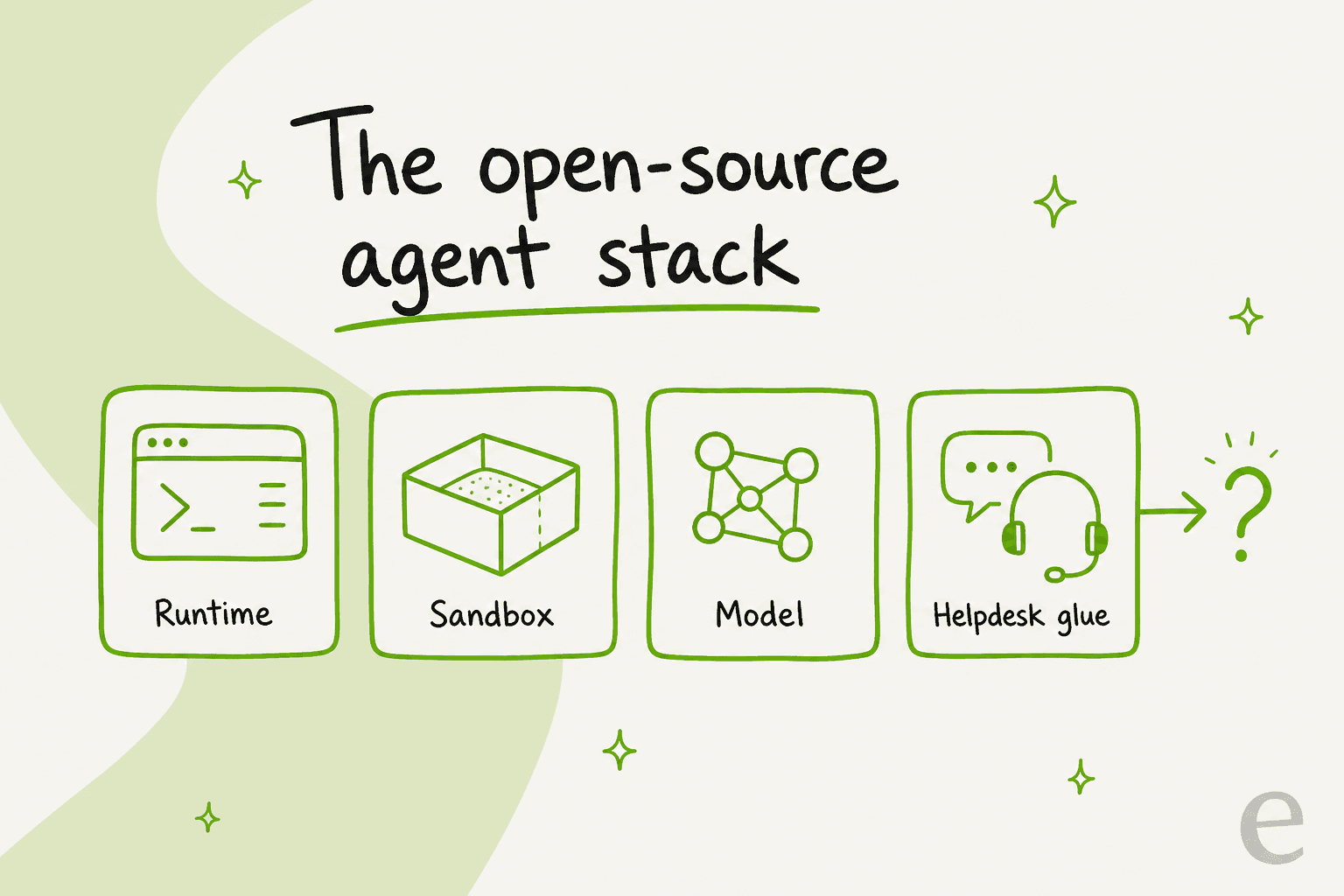
Here's a fun detail most people miss: NemoClaw's default agent is OpenClaw. NVIDIA wraps it in governance; the agent underneath is this project. So if you liked NemoClaw's promise but don't need (or want) the NVIDIA hardware and OpenShell layer, you can just run OpenClaw directly.
What it is. OpenClaw is an MIT-licensed, self-hosted personal AI assistant, roughly 15k GitHub stars and 200+ contributors. It's a gateway that connects chat apps (Discord, Slack, Telegram, WhatsApp, iMessage, and more) to LLM-backed agents, and it's provider-agnostic across Claude, GPT, Gemini, and others.
Best for. Developers and power users who want to own an AI assistant end to end without relying on a cloud vendor.
Pricing. Free under MIT. You pay for your own inference and the box it runs on.
Verdict. The most direct swap for NemoClaw's agent, minus the enterprise governance. Great for tinkerers. For support specifically, you'll still be hand-building every helpdesk connector and the testing harness yourself, which is exactly the work eesel does for you.
3. ZeroClaw: the lightweight self-hosted runtime
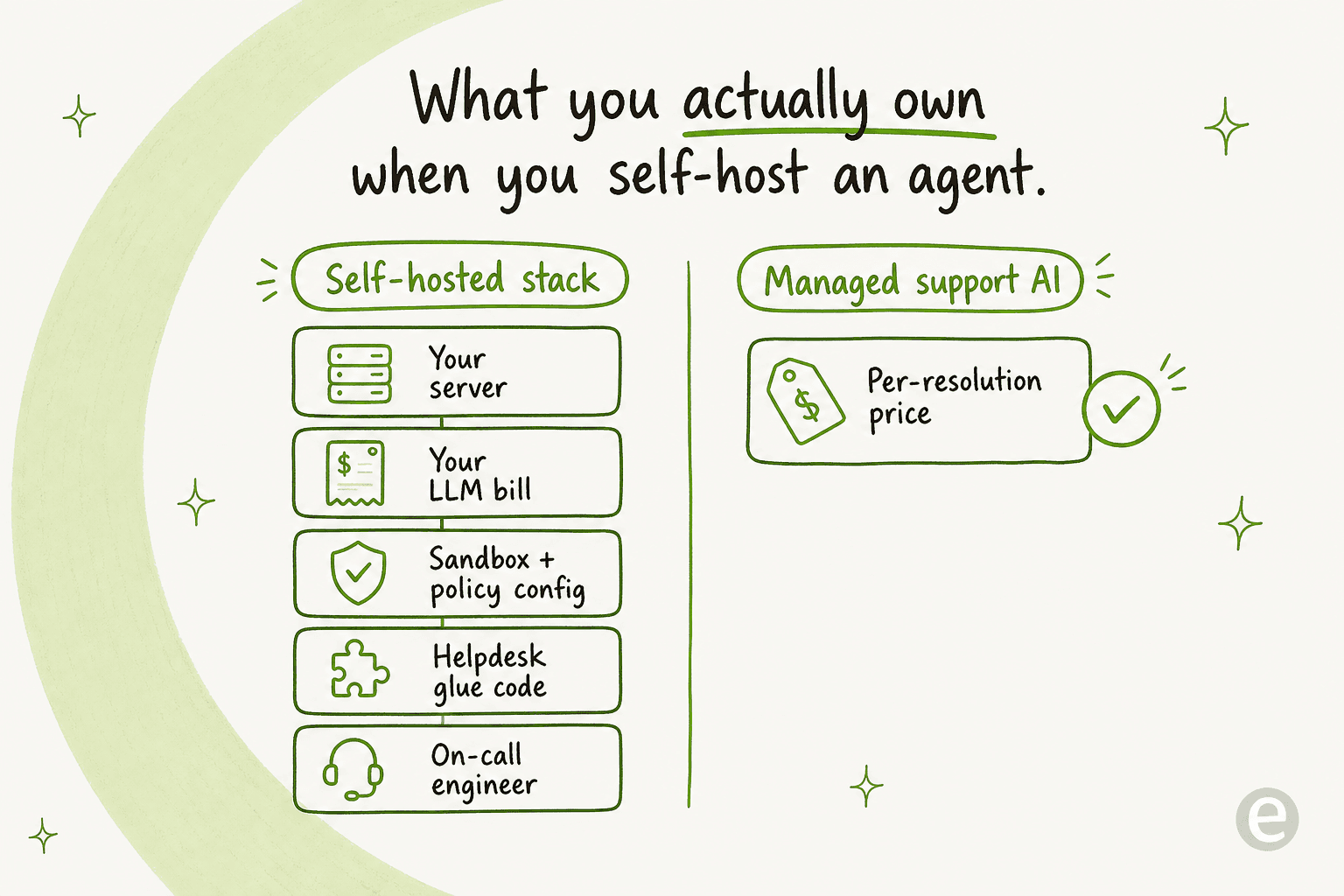
If NemoClaw felt heavy (an alpha project that wants NVIDIA GPUs), ZeroClaw is the featherweight version of the same idea.
What it is. ZeroClaw is an open-source, Rust-based AI agent runtime you self-host as a single small binary, dual-licensed MIT/Apache, sitting around 32k GitHub stars. It speaks 30+ channels (Discord, Telegram, Matrix, email, webhooks) and is provider-agnostic with fallback routing. There's also a managed ZeroClaw Cloud with a $0 starter tier.
Best for. Teams that want NemoClaw's self-host-and-own ethos but on cheap, non-NVIDIA hardware.
Pricing. Free self-hosted; ZeroClaw Cloud starts at $0 (with message caps) and scales up from there.
Verdict. The closest thing to "NemoClaw, but lighter." Same caveat as OpenClaw for support: no native helpdesk integration and no ticket-history simulation, so you're the systems integrator.
4. Hermes: open weights for a general agent
Hermes is one of the three agents NemoClaw is designed to run, so it shows up here for the same reason OpenClaw does: you can take the agent without the wrapper.
What it is. Hermes is Nous Research's open-source, self-hosted general agent, built on open model weights. It's a build-it-yourself foundation, not a product, aimed at people who want maximum control over the model and the agent loop.
Best for. ML-literate teams that want to self-host open weights and shape the agent behavior themselves.
Pricing. Free (open weights); you carry all the inference and hosting cost.
Verdict. The most "roll your own" option on this list. Powerful if you have the ML team, wildly out of scope if you just want to deflect tickets. There's no support-specific scaffolding here at all.
5. LangGraph: a framework for custom agents
NemoClaw can run LangChain Deep Agents, so if the agent framework is what appealed to you, go straight to the source.
What it is. LangGraph is LangChain's framework for building stateful, multi-step agents as graphs. It's an open-source core with a paid LangGraph Platform for hosting and observability. This is code-first: you define the nodes, the state, and the tools.
Best for. Developers building a custom agent with branching logic that no off-the-shelf product covers.
Pricing. Open-source core is free; the managed platform is paid by usage.
Verdict. The right tool if you're building an agent, not buying one. For a support team, it's the same trap as the OSS runtimes: enormous flexibility, and you own every line of the helpdesk glue, the guardrails, and the testing.
6. E2B: a secure sandbox for agent code
If the part of NemoClaw you cared about was the sandbox (safely running what an agent decides to do), E2B is the specialist.
What it is. E2B is an open-source (Apache 2.0) infrastructure for running AI-generated code in isolated cloud sandboxes, each one a Firecracker microVM built to run untrusted workloads. It's the layer that safely executes what an agent writes, used for coding agents, data analysis, and computer use.
Best for. Engineering teams that need a hardened execution sandbox for agent-generated code, similar in job to NemoClaw's OpenShell.
Pricing. Hobby tier is free with a one-time $100 credit and up to 20 concurrent sandboxes; Pro adds a $150/month base plus per-second usage; Enterprise/BYOC is custom.
Verdict. A great match for NemoClaw's sandboxing piece, and nothing like a finished support agent. You'd use E2B as a component inside a larger build, not as an answer to "who's replying to my tickets."
7. n8n: wiring agents into workflows
n8n is where a lot of NemoClaw-curious teams actually land, because it scratches the "self-host and connect everything" itch without writing a runtime from scratch.
What it is. n8n is a fair-code, self-hostable workflow-automation platform with AI-agent nodes. You drag together triggers, tools, and LLM steps to build automations, and you can host it yourself or use n8n Cloud.
Best for. Ops and platform teams that want to connect an agent to many internal tools and keep the whole thing on their own infrastructure.
Pricing. Self-hosted community edition is free; n8n Cloud starts around €20/month billed by workflow executions.
Verdict. Genuinely flexible, and self-hostable like NemoClaw. But a support workflow built in n8n is still a workflow you built and maintain, without ticket-history simulation or a helpdesk-native reporting layer. Good glue, not a finished support AI.
8. Rasa: enterprise conversational AI
Rasa is the veteran here, the option for teams that want serious control over a conversational assistant and have the engineers to run it.
What it is. Rasa is an open-source-core conversational AI framework, long favored in regulated industries for its on-prem deployment and fine-grained control. Rasa Studio adds a more managed authoring layer on top.
Best for. Enterprises that need a self-hosted conversational AI they can audit and control down to the intent level.
Pricing. Open-source core is free; the paid/enterprise tier has historically started near $35k/year.
Verdict. The most enterprise-grade self-host option, and the most work. If NemoClaw appealed because of governance and control in a regulated setting, Rasa is a serious peer, but you're staffing a team to run it, and it still isn't purpose-built for your helpdesk out of the box.
So which one should you actually pick?
Strip away the logos and it comes down to one question: do you want to run an AI agent, or do you want tickets answered? It's the same fork as AI agent vs rule-based chatbot, just one level up the stack.
- You want to run the agent yourself (data on your hardware, full control): NemoClaw's own family is right there. OpenClaw or ZeroClaw for a lighter self-host, Hermes or LangGraph if you're building custom logic, E2B for the sandbox layer, n8n or Rasa to wire it into workflows. All real, all yours to maintain.
- You want tickets answered without becoming the team that runs an agent platform: that's eesel. It's helpdesk-native, it trains on your own tickets, and it lets you simulate on real history before it goes live, which is the one thing none of the self-host options give you.
That churned customer I quoted earlier had it half right: with AI, building your own is possible now. The part that's easy to miss is everything after the demo (the helpdesk connectors, the guardrails, the testing against real tickets, the on-call rota) which is exactly the work a managed tool absorbs for you. NemoClaw is a great answer to "how do I govern a self-hosted agent." Just make sure that's the question you're actually asking.
Want an AI agent on your support queue without the build? eesel works like a new hire that plugs into your helpdesk in minutes, already knows your help center, and gets simulated on your real tickets before it answers a single customer. Try eesel free, or book a demo to see it run on your own ticket history.