
CrowdStrike SafeMind is an agentic cybersecurity system built with NVIDIA, launched at Fal.Con on September 1, 2026. Instead of one general model, it ships two purpose-built ones: Red Tempest attacks, Blue Solano defends, and a pair of harnesses run them against each other in a loop that hardens your environment until the attacks stop working.
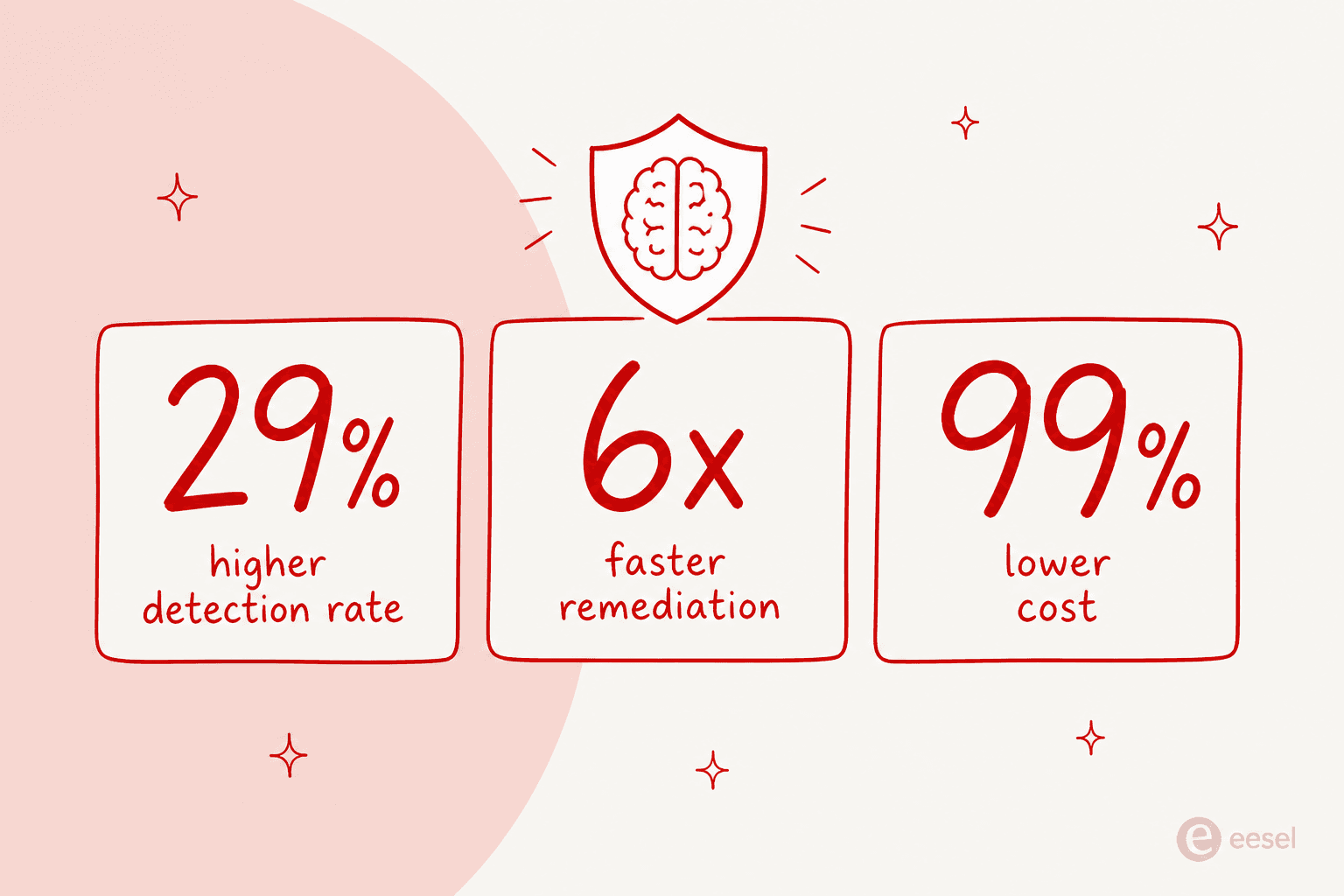
The pitch is that a model post-trained on CrowdStrike's own security data beats a generic frontier model at a fraction of the cost. CrowdStrike's internal evals claim 29% higher detection, 6x faster remediation, and 99% cost savings. NVIDIA's own technical write-up backs the direction but is honest that this is a case study, not a benchmark.
I spend my days building AI agents for a very different job, support, and the SafeMind bet is one I recognize: a specialized model that knows your data will out-work a clever generalist. Here is what SafeMind actually is, what is real in the numbers, and where the fine print sits.
What is CrowdStrike SafeMind?
CrowdStrike SafeMind is a family of purpose-built security models and harnesses from the newly named CrowdStrike Cyber Superintelligence Lab. George Kurtz and NVIDIA's Jensen Huang unveiled it on stage to roughly 10,000 people at Fal.Con in Las Vegas, and it runs natively inside the Falcon platform.
The framing Kurtz used matters, because it is a direct shot at the wave of security copilots on the market. As Kurtz put it, SafeMind "isn't a copilot baked into someone else's intelligence," and it is "not a chatbot with a security skin." That is the distinction between a bolted-on assistant and a system trained from the ground up for one job, and it is the whole reason SafeMind exists as its own thing rather than a Charlotte AI feature.
The training data is the part competitors can't copy. SafeMind learns from Falcon sensor telemetry, which CrowdStrike calls the world's largest pureplay cyber dataset, plus its threat intelligence, Falcon Complete MDR event annotations, and fifteen years of incident-response fieldwork. That last input is the interesting one: real responders stopping real breaches, encoded into a model.
Red Tempest and Blue Solano: two models, two jobs
SafeMind launched with two distinct models, each with a narrow competency rather than one model trying to do everything.
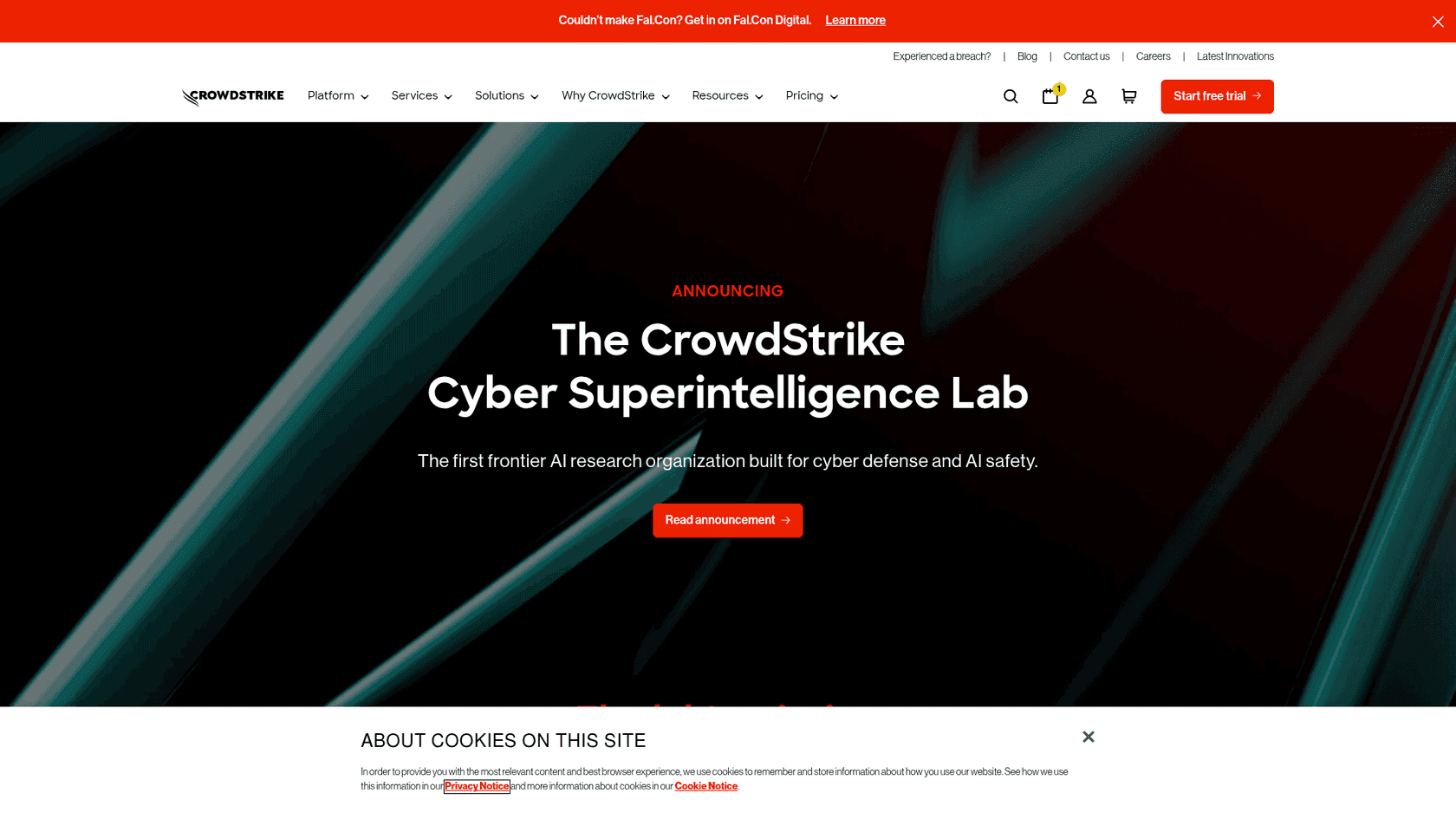
- Red Tempest is the offensive release, built for advanced attack scenarios and tuned to emulate AI adversaries. Its job is to find the path in.
- Blue Solano is the defensive release, built to protect enterprise assets by deploying the same battle-tested measures human defenders use in real life. Its job is to close the path Red Tempest found.
Splitting offense from defense is deliberate. A single model asked to both attack and defend tends to be mediocre at both, so CrowdStrike scoped each one to a measurable task. This is the same instinct behind specialized AI agents generally: a bounded job with clear success criteria is easier to train, test, and trust than an open-ended one.
The models sit on top of NVIDIA Nemotron open models, post-trained on CrowdStrike data, with CoreWeave's AI Cloud handling training and inference. Under the hood of the defensive side, Nemotron 3 Ultra orchestrates the harness while a fine-tuned Nemotron 3 Super writes and repairs the actual detections. Huang's mental model for the split is worth borrowing, as he told the crowd: the model is the brain, and "the harness is essentially the exoskeleton" that turns that brain into an agent.
How the red-vs-blue loop actually works
The headline feature isn't either model on its own, it's the loop between them. SafeMind's harnesses run Red Tempest and Blue Solano against each other in a closed loop, where each side adapts to and strengthens the other until the offense can't find a viable path.
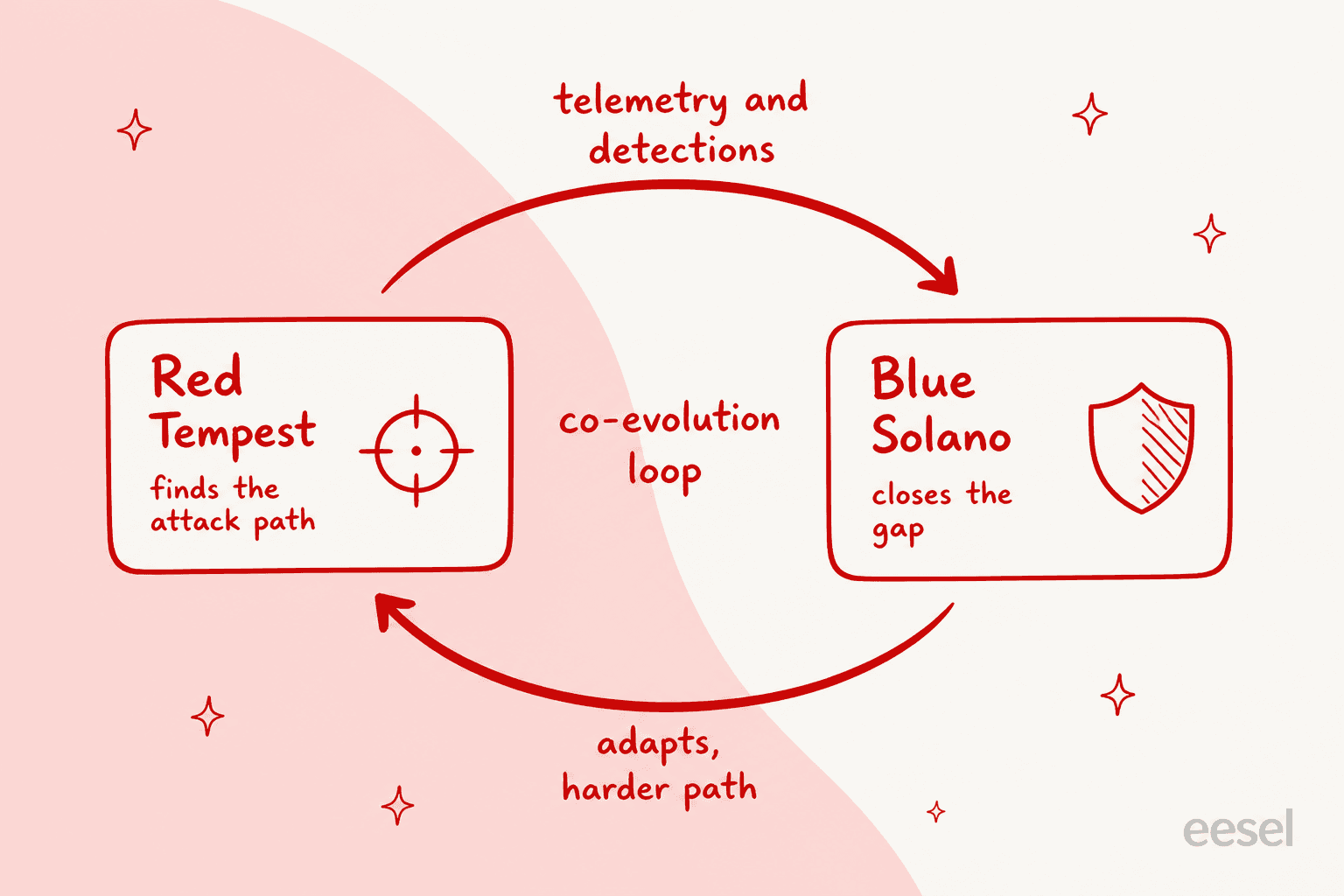
NVIDIA's engineers documented the mechanics in a four-stage cycle that runs inside a digital twin of a real network:
- Execute and capture. The red-agent harness picks an attack path and runs it, while Falcon sensors capture the telemetry.
- Process and reconstruct. The blue-agent harness takes that telemetry, works out which parts it can reconstruct, and finds where visibility gaps remain.
- Generate and validate. It writes candidate detections, then a validation harness backtests each one against the captured telemetry and sends failures back for correction.
- Retest and repeat. A fresh attack retests the same objective, the red agent adapts to a harder path, and the loop starts over.
What keeps this honest is the validation step. Detections aren't trusted because they look plausible; each candidate is linted for environment-specific strings, replayed against real attack telemetry, and reviewed by an independent judge before it ships. For NVIDIA's test, CrowdStrike even built the environment as a sanctioned digital twin of NVIDIA's own accelerated-computing infrastructure, reviewed by NVIDIA's security team for realism.
What the evaluations actually show
Here are the numbers CrowdStrike is leading with, compared against leading frontier models and open-source baselines.
| Metric | SafeMind result | Source |
|---|---|---|
| Detection rate | 29% higher | CrowdStrike internal eval |
| End-to-end remediation | 6x faster | CrowdStrike internal eval |
| Cost of detection and remediation | 99% savings | CrowdStrike internal eval |
| Base models | Nemotron 3 Ultra + Super | CrowdStrike / NVIDIA |
| Availability | Native in Falcon; standalone via Project QuiltWorks | CrowdStrike |
The 99% cost figure is the one to understand rather than just repeat. It comes from post-training an open model instead of paying frontier-model API rates on every detection, and NVIDIA states the Blue Solano defensive model was more accurate than the leading proprietary frontier model tested, at 99% lower cost, in CrowdStrike's internal evaluations. That is a real architectural advantage, not marketing: an open model you host and fine-tune has a fundamentally different cost curve than a metered API.
To CrowdStrike and NVIDIA's credit, the deeper write-up doesn't oversell. In the backtest, the optimized open-model pipeline hit a 41.9% mean detection rate, a 2.5x jump over the base harness. In live-fire testing against eight unseen attacks, 45% of the open-model detections generalized versus 29% for the frontier system, per NVIDIA's own testing, and the open pipeline was the only one to produce "gold" detections. But NVIDIA labels its own results plainly: the evaluation covered one scenario family with small detection sets, the noise test doesn't represent production false-positive rates, and it is "a directional system-level case study, not a general benchmark." Read the 29% and 6x as vendor evals, not as an independent lab result, and you'll set expectations correctly.
Where SafeMind sits in CrowdStrike's stack
SafeMind didn't launch alone. CrowdStrike also announced Falcon IQ, which uses more than 50 agents working as a unified workforce to automate assessment, prioritization, and remediation, running on the Charlotte AI AgentWorks no-code platform. The standalone SafeMind models and harnesses are distributed through the Project QuiltWorks program, CrowdStrike's coalition for closing the frontier-AI vulnerability gap.
The strategic claim underneath all of it came from Dr. Bartley Richardson, CrowdStrike's chief AI officer, in the release: "CrowdStrike is the only company that owns the entire stack, from sensor to harness to model." Whether or not that stays literally true as competitors respond, it is the right frame for judging SafeMind: this is a bet that vertical ownership of data, model, and harness beats assembling best-of-breed parts from different vendors.
The urgency behind it is real, too. CrowdStrike's own threat report puts AI-enabled attacks up 89% over the past year, with the fastest eCrime breakout time down to 27 seconds. At that speed, a human reading an alert is documenting a breach, not stopping one, which is the argument for handing the first response to autonomous agents.
The bigger idea: purpose-built beats a clever generalist
Strip away the security specifics and SafeMind is an argument about how to build useful AI: take an open base model, post-train it on data only you have, wrap it in a harness scoped to a real job, and validate every output against ground truth before you trust it. That is a very different philosophy from pointing a general-purpose frontier model at a problem and hoping the prompt carries it.
I find this convincing because I have watched the same thing play out in customer support. A generic model given a help-center URL sounds fluent and gets the hard tickets wrong. A model grounded in your actual resolved tickets, your macros, and your policies, and tested against your history before it ever answers a customer, behaves like a colleague who has done the job. The domains are worlds apart, but the lesson is identical: specialization and grounded validation are what separate a demo from something you'd put in production.
This is also why "just use a frontier model" is rarely the whole answer. Frontier labs are infrastructure; the value is in the layer that turns a capable model into a worker that knows your environment. SafeMind is that layer for the SOC. In customer service, it is a support teammate.
If you want that idea aimed at your support queue
eesel makes the same bet SafeMind makes, just for a different job. Rather than a general chatbot, you hire an AI helpdesk teammate that plugs into your existing helpdesk, trains on your past tickets and knowledge base, and joins the queue like a new hire, no rip-and-replace required. And because I have learned the hard way that a confident bot can quietly give wrong answers, every eesel teammate is simulated against your real historical tickets first, so you see how it would have handled thousands of past conversations before it touches a live one. That "validate before you trust it" step is exactly what SafeMind's detection harness does, applied to support.

If your team lives in a terminal, the eesel CLI drives the same teammate and workspace the dashboard does: a person can run it by hand, scripts can automate it, and coding agents like Claude Code, Codex, or Cursor can operate it directly. It is the agent-friendly way to inspect a teammate's instructions, send a test message, and review the result before you promote a change. You can try it for free and point it at your own history.
The honest verdict on SafeMind
SafeMind is an ambitious launch, not a rebranded copilot. The two-model, red-vs-blue design is a real architecture, the Nemotron post-training gives it a defensible cost story, and the validation-first harness is the kind of engineering discipline that separates a research demo from a shippable system.
The one thing to keep straight is the evidence. The 29%, 6x, and 99% figures are CrowdStrike's own evaluations, and NVIDIA's more detailed testing, while directionally supportive, explicitly calls itself a case study on a single scenario family. That doesn't make the numbers wrong, it makes them a starting point for your own evaluation rather than a settled benchmark. If you run Falcon, SafeMind is worth a serious look. Just measure it against your environment before you take the launch-day figures as your own.
Frequently Asked Questions
Frequently Asked Questions
What is CrowdStrike SafeMind?
CrowdStrike SafeMind is a family of purpose-built security models and agent harnesses from the CrowdStrike Cyber Superintelligence Lab, announced on September 1, 2026. It runs natively in the Falcon platform and pairs an offensive model with a defensive model in a continuous red-vs-blue loop. If you are new to the underlying idea, a primer on AI agents is a good start.
Is SafeMind built by CrowdStrike or NVIDIA?
Both. CrowdStrike owns the security data, the harnesses, and the post-training; NVIDIA supplied the open base models (Nemotron) and was named CrowdStrike's AI design partner. CoreWeave provided the cloud for training and inference. SafeMind is CrowdStrike's product, created with NVIDIA.
What are Red Tempest and Blue Solano?
They are the two models SafeMind launched with. Red Tempest is the offensive red-team model that emulates AI adversaries and finds attack paths. Blue Solano is the defensive blue-team model that closes those gaps. The harnesses run both against each other so each one keeps improving.
How much does CrowdStrike SafeMind cost?
CrowdStrike has not published a standalone SafeMind price. The agentic system ships inside the Falcon platform, and trusted access to the standalone models and harnesses runs through the Project QuiltWorks program. Pricing follows a sales conversation, as most enterprise security and IT tooling does.
What models does SafeMind use under the hood?
In the evaluated configuration, NVIDIA Nemotron 3 Ultra handles defensive orchestration and a fine-tuned Nemotron 3 Super acts as a bounded expert for writing and repairing detections. The harnesses can also run frontier or other open-source models, so you are not locked to one base. It is a close cousin of retrieval-grounded model design applied to security.
Are the 29%, 6x, and 99% SafeMind numbers independent?
No. The headline figures (29% higher detection, 6x faster remediation, 99% cost savings) come from CrowdStrike's own internal evaluations against leading frontier and open-source baselines. NVIDIA's technical write-up adds more detail and its own caveats, but it is still a directional case study on one scenario family, not a third-party benchmark.
Can I use the SafeMind models on their own?
Yes. CrowdStrike says the models can run independently, and security teams can pair their own models with CrowdStrike's harnesses. That flexibility is the point of separating the model (the brain) from the harness (what CrowdStrike calls the exoskeleton).
Does SafeMind replace human security analysts?
Not on the evidence shown. SafeMind automates detection engineering and remediation at machine speed, but CrowdStrike frames it as a force multiplier for defenders, with security experts still controlling scenarios and guardrails. The same pattern holds for AI in customer service: it handles volume, people own the edge cases.