


What is Tasklet AI?
Let me answer the search first. Tasklet is an AI agent platform that markets itself as "IFTTT for the agentic age" and "agents that own the work." Instead of you clicking through a builder, you type what you want in natural language ("every morning, read my Gmail, summarise anything from a customer, and post it to Slack") and Tasklet spins up an autonomous agent to do it.
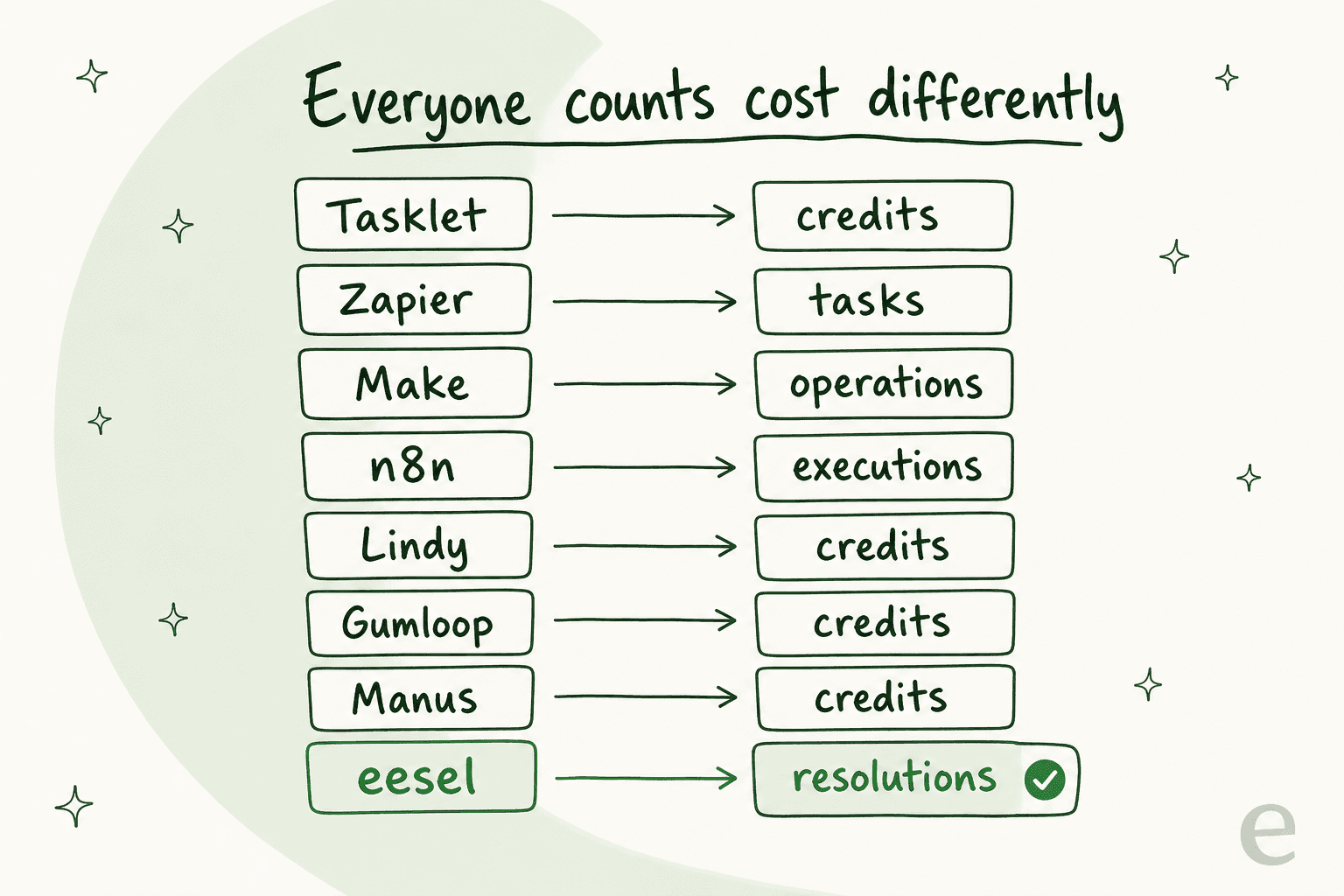
The important framing for this review: Tasklet is a generalist. It's not a helpdesk, not a content tool, not a CRM. It's an automation layer that sits across the apps you already use, closer in spirit to Zapier or Make than to any single-purpose product. That's its biggest strength and, as you'll see, the root of its biggest weakness.
How Tasklet actually works under the hood
Because I build this kind of system, the architecture is where I judge a tool, so let me open it up.
- Isolated sandboxes. Each agent runs in its own cloud sandbox (Tasklet lists 2 vCPU / 14.8 GB), so one agent's browser session can't step on another's. That's the right call for reliability and a sign the team took the "autonomous" part seriously.
- Browser automation. Agents can drive a real browser, which is how Tasklet handles apps that don't expose a clean API. Powerful, but this is also the single most expensive thing an agent can do (more on credits below).
- 15+ native integrations. Gmail, Slack, Salesforce, HubSpot, Asana, QuickBooks, and more, plus custom HTTP and MCP so you can wire in your own tools.
- Multi-model. It runs on Claude, GPT, and Gemini under the hood, and exposes intelligence "levels" (Basic through Genius) so you can trade cost for reasoning depth per task.
- Natural-language task creation. The headline feature. You write the goal, not the steps, and the agent plans the workflow itself.
Here's the honest engineering read: the design is sound, and the natural-language layer removes the single biggest friction in tools like n8n, which is that you have to build the graph yourself. What it can't do is make an autonomous agent's cost predictable, because the whole point of "you write the goal, not the steps" is that Tasklet decides how many steps (and therefore how many credits) a run takes.
Tasklet AI pricing, in one paragraph
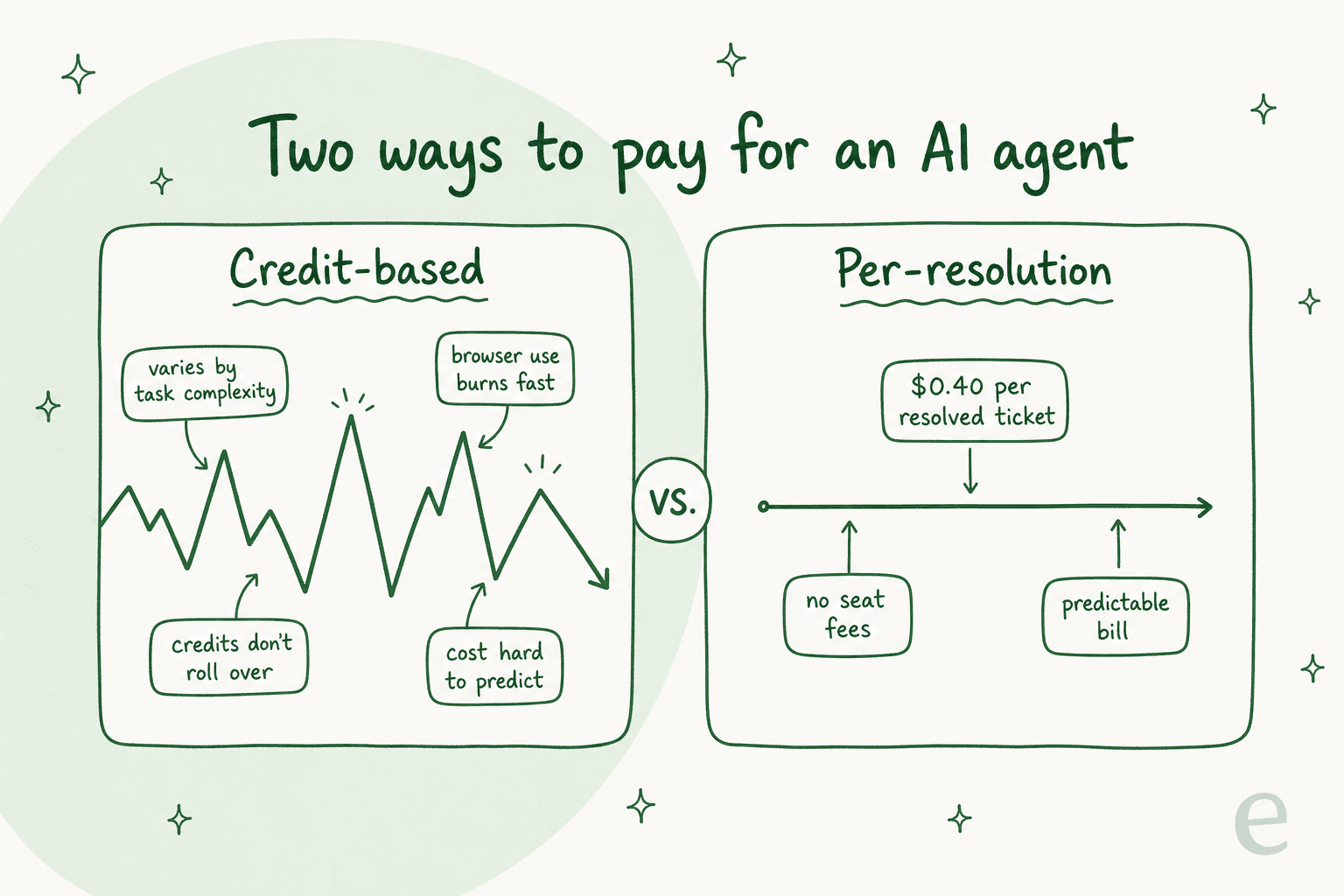
Full detail is in my Tasklet AI pricing breakdown, but the shape you need for a review: a free plan (300 bonus credits/day, 10 executions per trigger), Starter at $25/month (10,000 credits), Pro at $100/month (40,000 credits), and Custom from $250/month (100,000+, scaling to 4 million). Every plan has unlimited agents and integrations, so credits are the only real dimension you buy. The friction: there's no published credits-per-task rate, monthly credits don't roll over, and there's no stated overage policy. You can buy one-time top-ups ($25 up to $10,000, valid a year), but the absence of a clear per-unit rate is the thing that makes budgeting hard.
What Tasklet AI does well
- Fastest setup I've seen for a general agent. Natural-language task creation is not a gimmick here. You can go from idea to a running agent in minutes, with no graph to draw.
- Genuinely autonomous. Sandboxes plus browser automation mean it can complete tasks end-to-end, not just move data between two apps. That's a real step past classic no-code automation.
- Unlimited agents and integrations on every plan. You're never billed per seat or per connected app, which keeps the pricing conceptually clean even if the credit burn isn't.
- Multi-model with intelligence levels. Being able to dial reasoning up for a hard task and down for a cheap one is a smart lever, and most competitors don't expose it.
- Cheap to start. $0 to try, $25 to run something small. For a solo operator automating personal workflows, that's hard to argue with.
Where Tasklet AI falls short
- Unpredictable cost. This is the headline weakness. No per-task rate, no overage policy, no rollover, and browser use plus higher intelligence levels burn credits fastest. You cannot confidently answer "what will this cost me next month?" and that's a problem for anything past hobby use.
- The free tier is a trial, not a plan. The 10-executions-per-trigger cap means you can't actually run a real recurring workload for free; it's there to prove the concept.
- Not built for support. No ticket UI, no historical-ticket simulation, no concept of a resolution. If you found this review while shopping for customer service automation, this is the mismatch to know about.
- GDPR listed as in progress. SOC 2 is in place, which is good, but if you're in a regulated space, verify the current compliance status before you route sensitive data through it.
Is Tasklet AI right for you?
The answer really comes down to what you're automating and how predictable your volume is. I built a quick decision tool so you don't have to read the whole review to get a verdict.
If you landed on the support answer, that's the one job Tasklet's design actively works against, and it's worth explaining why.
The one place I'd steer you away: customer support
I spend my days building AI agents for support queues, so this is the part I can speak to with the most authority. A support agent has a very specific shape that a generalist platform doesn't: it needs to read your knowledge base, sit inside your existing helpdesk, hand off cleanly to a human, and prove itself on your real tickets before it ever touches a customer.
That last point is the one I care about most. At eesel I simulate every rollout against historical tickets first, because I've watched confident-sounding bots quietly give wrong answers, and the only way to catch that before it hits a customer is to replay it against tickets you've already resolved. Tasklet has no concept of that, because it was never built for it.

There's also the cost unit. Support volume is countable: you get X tickets, you resolve Y of them. A tool where 1 credit is 1 ticket or chat, on a fixed monthly price from $299 for 500 credits, lets you multiply and know your bill. A tool that prices per credit, with no per-task rate, means every busy week is a budgeting surprise. That's the difference between eesel AI and a horizontal platform like Tasklet: same underlying models, completely different unit of cost.
Want an AI that actually owns your support queue? eesel plugs into your existing helpdesk in minutes, learns from your past tickets, and charges one fixed monthly price with 1 credit per ticket or chat, so the cost is a number you can predict, not a variable credit balance you watch drain. You can try eesel free with 100 credits.
My verdict
Tasklet is a strong generalist agent platform with the fastest natural-language setup I've used and a fully autonomous execution model. If you're automating personal or light-business workflows and your volume is steady, it's easy to recommend: start free, move to $25 when something proves out.
The one thing to go in with eyes open about is cost. The credit model is flexible but unpredictable, and there's no overage rate to fall back on, so budget conservatively and watch your first month. And if your actual goal is support automation, this is the wrong shape of tool. For the full field of options, my Tasklet AI alternatives roundup lays them out by the job each one is actually best at.
Score: a solid generalist, held back by unpredictable pricing. Great for tinkering and light automation, risky for anything where the monthly bill has to be a known number.