


What you're actually paying for
Before the numbers, it helps to know what Skywork is, because it shapes why the pricing looks the way it does.
Skywork AI is a horizontal super-agent: you type a request in plain language and its in-product agent, SkyClaw, builds slides, documents, spreadsheets, websites, posters, images, or videos, and can run scheduled tasks while you're away. It's closest in category to Manus and Genspark, an AI office worker rather than a chatbot.
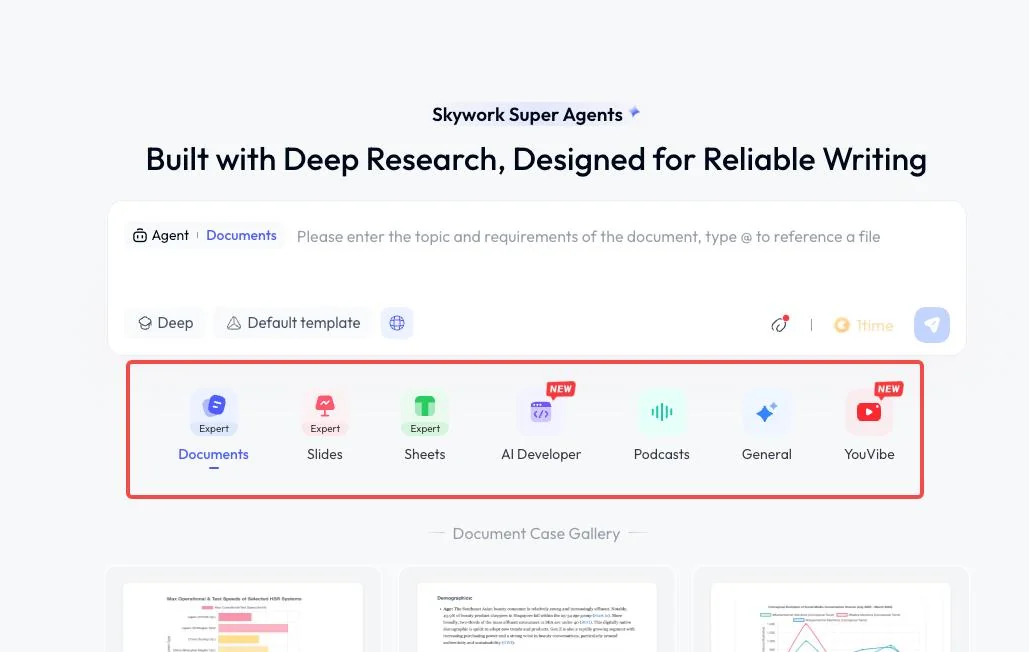
That breadth is the reason Skywork meters in credits instead of seats. A quick chat reply and a full deep-research report cost very different amounts of compute, so Skywork prices the work, not the login. Which is fair in theory, and, as we'll see, hard to predict in practice.
Skywork AI pricing at a glance
Here's the full public ladder. One honest caveat up front: Skywork's real checkout page (skywork.ai/sku) sits behind a Google/Apple/email login wall, so the exact live credit caps per tier can't be confirmed without signing in. The table below combines what's confirmed on the public pricing page with the plan grid from Skywork's own on-domain guide (which is AI-generated and partly stale, so treat the credit figures as directional).
| Plan | Price (USD) | Credits | Key inclusions | Watch out for |
|---|---|---|---|---|
| Free | $0 | ~500 daily (month 1), then ~500/week | Basic generation, standard priority, personal-use license | Credits don't roll over; weekly reset from month 2 |
| $1 trial | $1 / 7 days | 800 daily (advertised) | Unlimited downloads, AI image analysis & editing, faster priority | Auto-converts to a paid plan at day 7 |
| Monthly Pro | $19.99 / month | ~7,000 / month | Full DeepResearch, commercial rights, high priority, DOCX/PDF/PPTX export | Credit caps unconfirmed live; can run dry mid-month |
| Annual Pro | $149.99 / year (~$12.50/mo) | Pro-level allotment | Everything in Monthly Pro, plus priority support and team collaboration | No standalone team/enterprise SKU published |
A few things this table quietly tells you. There is no published per-credit dollar rate, so you can't do clean unit math on what a given deck or report will cost. There's also no public Team or Enterprise plan, no listed credit top-up price, and no clear statement on whether paid Pro credits roll over month to month. All of that lives behind the login wall.
Also note the moving target: the live pricing page now advertises 800 daily credits during the trial, while the older guide still says 500. When a vendor's own pages disagree with each other on the core unit you're buying, that's worth registering before you hand over a card.
How the credit system actually works
If you've only ever paid for software per seat, the credit model is the part that trips people up, so it's worth walking through once.
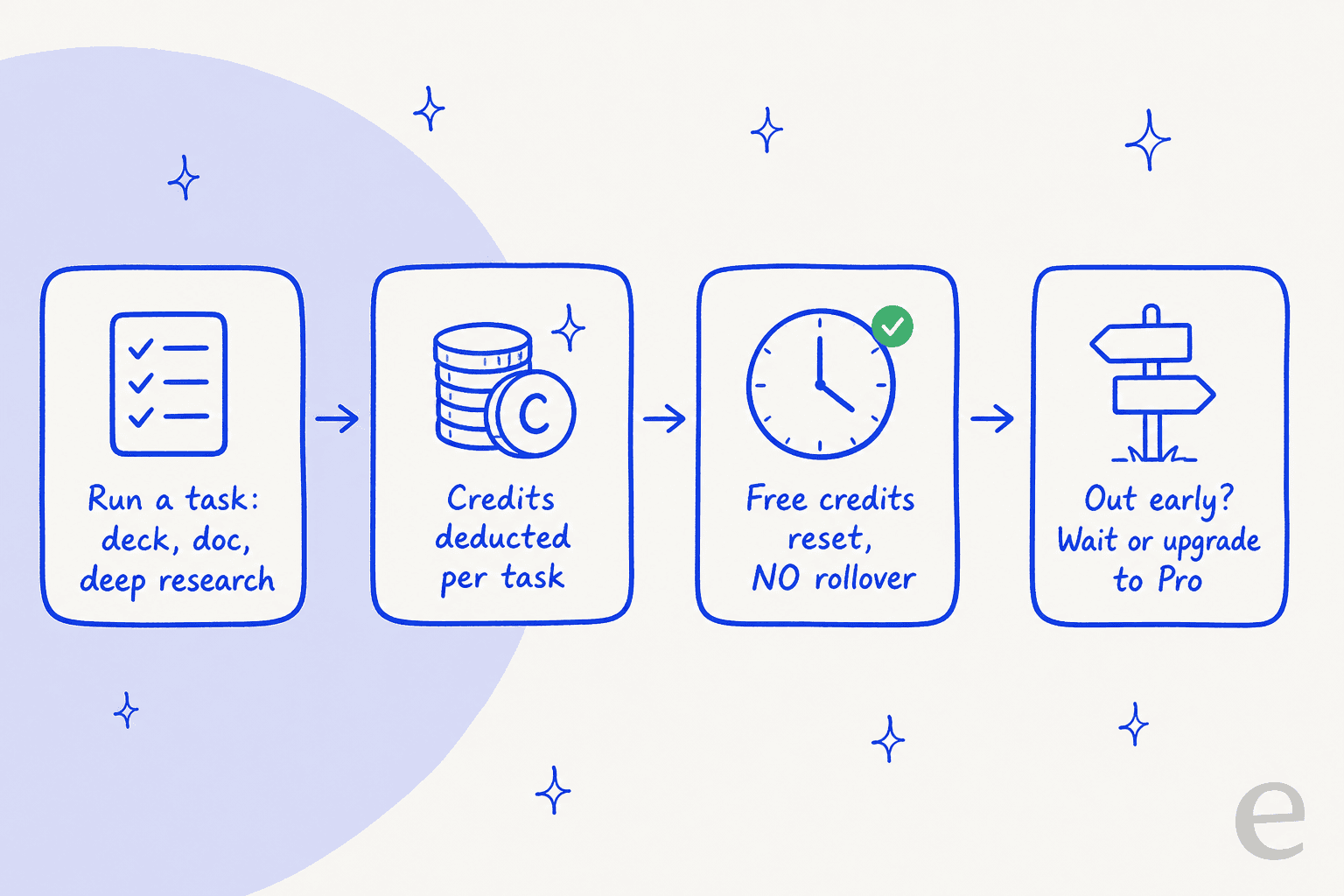
Every action draws down credits, and heavier actions (a full deep-research run that scans hundreds of pages, a long video render) cost far more than a quick edit. On the free tier the credits reset on a timer and expire if unused, so you can't bank a quiet week to fund a busy one. The practical effect: your real monthly cost isn't the plan price, it's the plan price plus however many times you top up when the pool runs dry.
This is also the part of Skywork AI pricing that changed under people's feet. Users describe moving from an older "unlimited" model to credits with no warning:
"They had an unlimited system which worked great with their Skywork 2.0. They released Skywork 3.0 and the rug was pulled out from under customers. It went from Unlimited to credit based and the credits are consumed so fast it would cost an incredible amount to do even the most simple tasks."

Worth flagging: Skywork has since publicly said it's removing the credit system again and introducing an "Ultra Membership," so this mechanic may shift. That's a good sign the backlash was real, and a good reason to check the live model before you commit.
The billing traps to watch
This is where I'd slow you down. Skywork's Trustpilot profile sits at 1.5/5 across 41 reviews, with 91% of them one-star, and the profile is unclaimed with no history of the company soliciting reviews, so these are unprompted. The complaints cluster almost entirely around billing, not the AI's output.
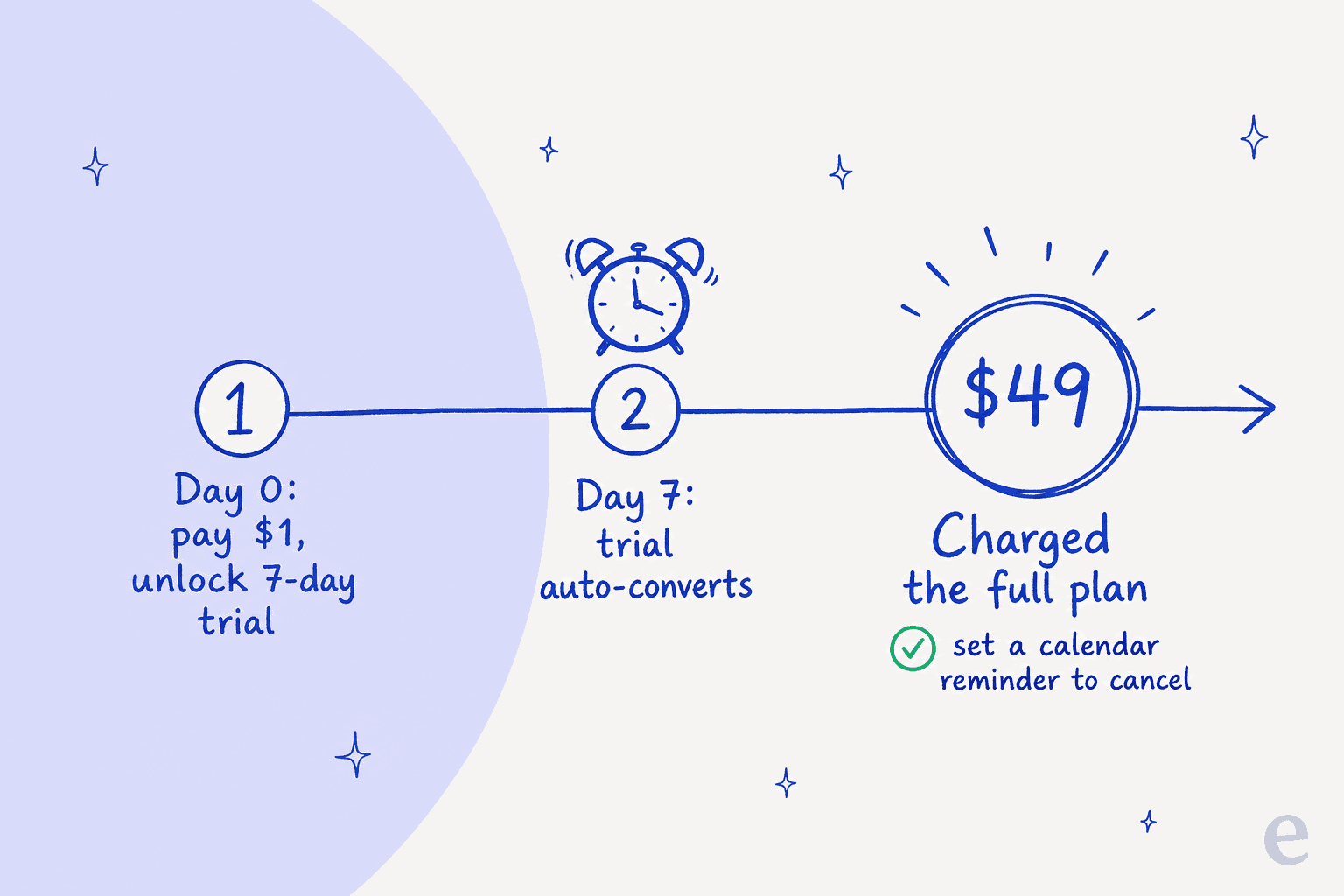
The $1 trial auto-converts. The dominant grievance is that the seven-day trial rolls into a paid plan without a clear heads-up, and the charges people cite are not small, ranging from around $200 up to £400 and beyond:
"They do not explicitly tell you that you will be charged 203.9$ (!!!) after the trial period ends."
Cancellation is reported as hard. Several reviewers say there's no working cancel button and that mobile subscriptions don't show up in the usual app-store managers:
"SCAM! Subscription trap. There is NO cancellation button on the website, which is illegal under EU law."
Credits paid for, not delivered. A smaller but nastier thread: people report paying for credit top-ups and never receiving them:
"I tried to buy credits, I first bought $110.00 and no credits were applied to my account. Then I tried $34.99 and still I couldn't get my credits after the payment had been processed."
None of this makes the product useless. But if you're going to try Skywork, the safe move is to treat the $1 trial as a paid subscription that happens to start cheap: set a calendar reminder to cancel before day 7, and pay by a method you can dispute if the top-up credits don't arrive.
Is Skywork worth the money?
Fairly, yes, for a specific person. The independent voices that aren't about billing are genuinely positive on the core engine. On Reddit, researchers rate its structure and sourcing, even while docking it on visual polish:
"This one is good at organizing your thoughts. What attracts me most is its professional search that helps me gather data to support my ideas... The downside is it looks too structured, sometimes less aesthetic."

So the value question really comes down to how you work, not just the price.
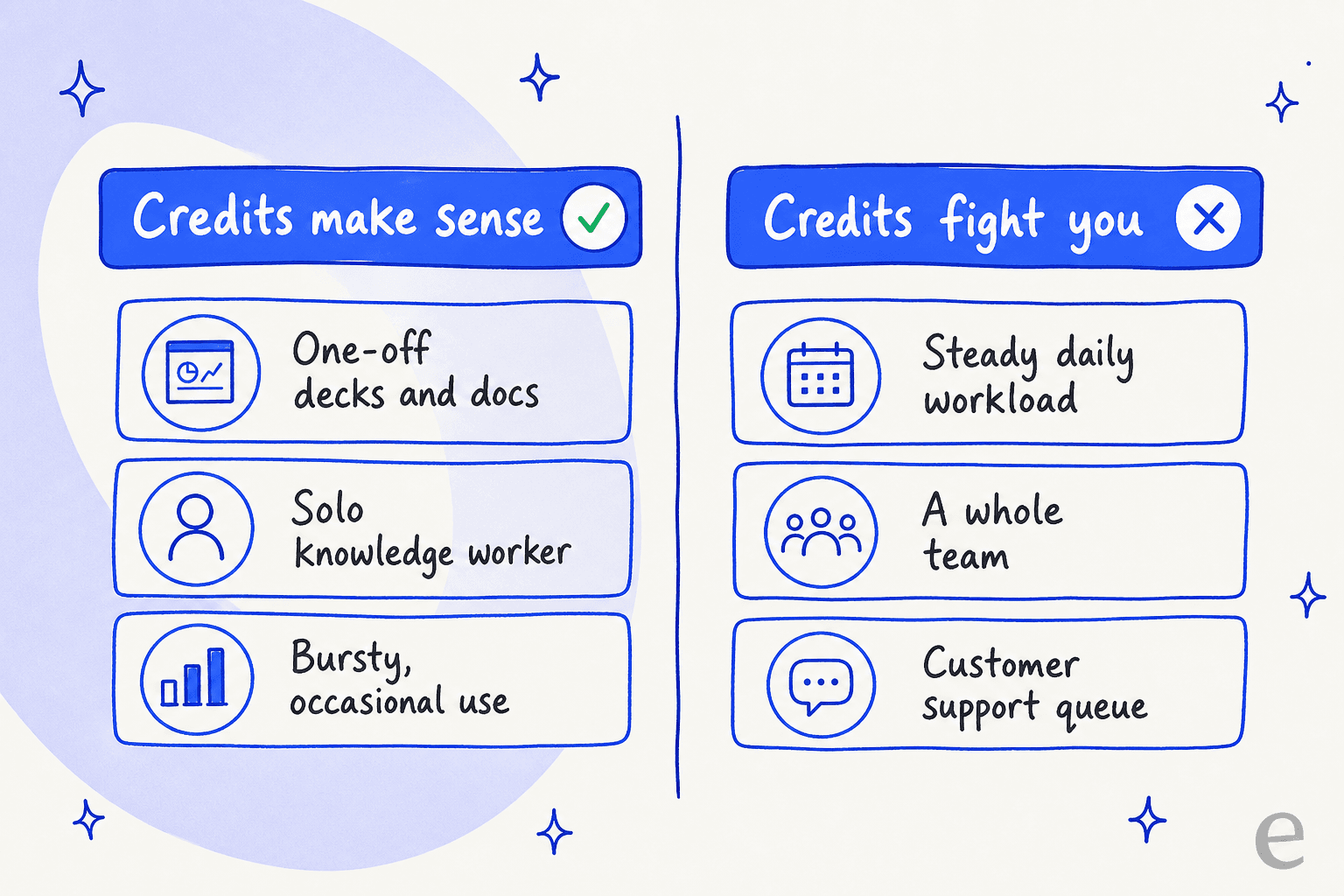
If you're a solo knowledge worker who needs a polished deck or a research brief by tonight, the $19.99 Pro plan is a real time-saver and the credit model rarely bites. If you're running steady daily volume, or you're a team, the unpredictability of credits and the absence of a real team plan start to work against you. Use the quick picker below to see where you'd land.
How do you actually work? Pick one:
One more thing the price hides: Skywork's security posture is actually decent (SOC 2 Type I, ISO 27001, ISO 27701, US data storage), so the hesitation isn't trust, it's predictability. You're buying a metered black box, and for a lot of buyers the inability to forecast next month's bill is the real cost.
Skywork AI vs a purpose-built support agent
Here's the honest handoff. A big share of people searching Skywork AI pricing aren't shopping for a deck generator, they're evaluating AI agents for a support team and Skywork keeps showing up in the "AI super-agent" lists. If that's you, the pricing comparison isn't really $19.99 vs $149.99, it's credits vs outcomes.
A general super-agent charges you for compute whether or not the work landed, which is exactly the complaint in those Trustpilot reviews: credits consumed on tasks that failed. A support-focused agent can charge per resolution, so you only pay when a customer actually got helped. Those are two completely different bets on who carries the risk.
Try eesel AI for customer support
If you came here weighing AI agents for your support queue, this is the part where the tool actually matches the job: a horizontal super-agent like Skywork isn't the right shape, and eesel AI is.

eesel plugs straight into your existing helpdesk (Zendesk, Freshdesk, Gorgias and more), learns from your past tickets and help center, and works like a support hire that already knows your product. Instead of a credit meter you can't forecast, you can simulate it on your historical tickets before it answers a single live customer, so you see the resolution rate and the cost up front. Pricing is per resolution, not per opaque credit, and it's free to try.