


What Skywork AI actually is
Skywork AI (skywork.ai) is a horizontal AI super-agent. Instead of a chat box that answers questions, it's an agent called SkyClaw that takes a goal and works until there's a finished deliverable, pulling from a marketplace of pre-built Experts and Skills along the way. It's the same category as Manus and Genspark: one AI agent, many kinds of output.
The honest framing here matters, because the name gets confusing. Skywork also ships open-weight research models (Skywork-R1V, and the like) that show up on Hacker News, but the product most people mean by "Skywork AI" is the Super Agents office-work platform, and that's what this review is about. If you've read our Manus review, you'll recognise the shape immediately. It is not a customer service or helpdesk tool, and the company doesn't pretend otherwise.
One thing you won't find easily: who's behind it. There's no founder, parent company, or funding surfaced on any public page, and the only contact is a feedback email. That's not disqualifying, but for a tool you'd hand your work (and your card) to, it's worth noting up front.
How Skywork works under the hood
The whole thing hangs off one loop. You give SkyClaw a goal, its deep research mode scans the web and cross-checks sources, and then the agent writes the result straight into whatever format you asked for. The research isn't a separate tab you visit; it's the fuel that feeds the slide, doc, or site agent.
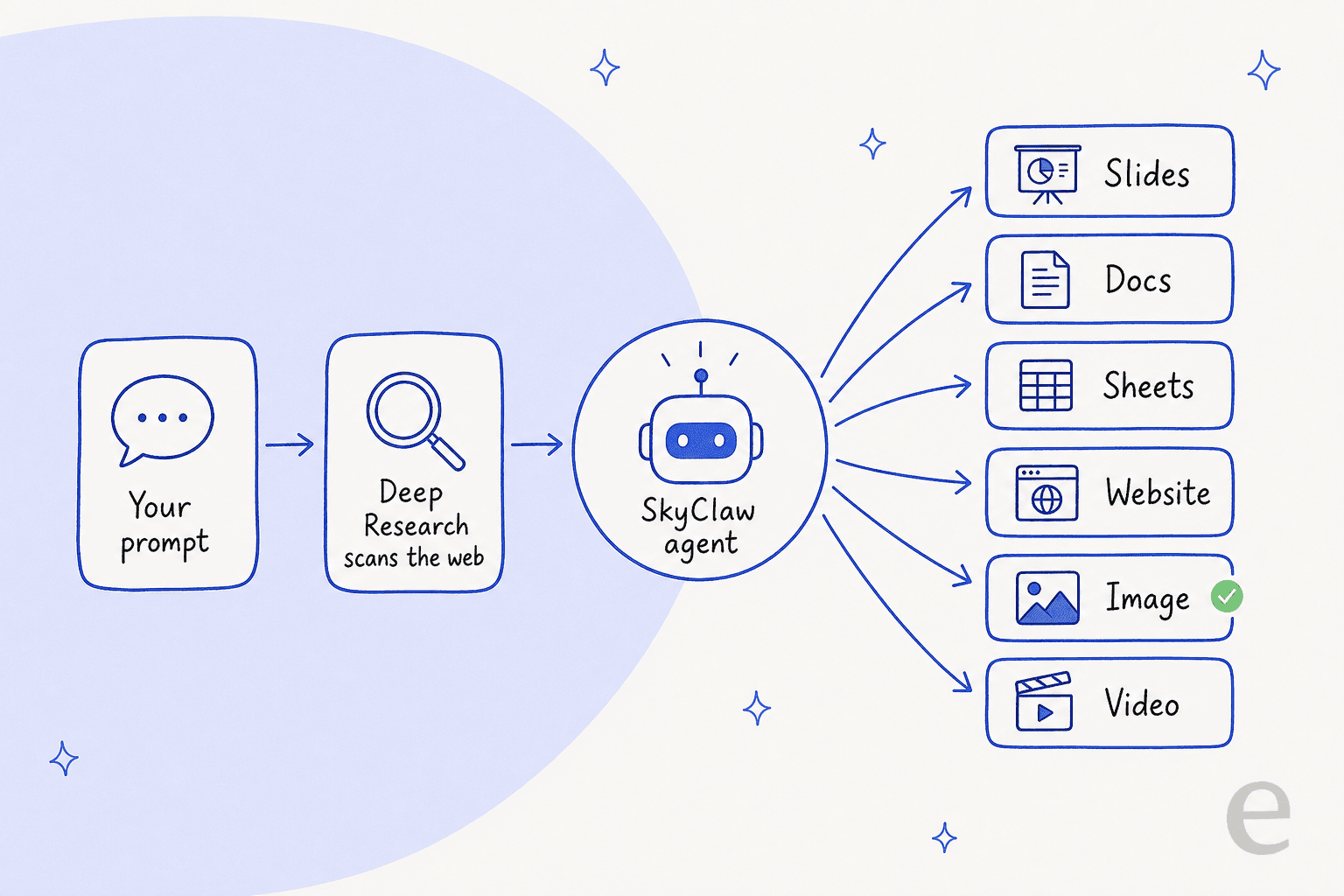
Skywork's marketing puts big numbers on that research engine: it claims DeepResearch dives "10x deeper" than standard retrieval, scans 600+ webpages per task, and generates citations at 98.7% accuracy across 60+ styles. It's the same pitch you see from Agentforce deep research and other agents chasing the research-plus-artifact loop. Treat those as vendor claims, not independent benchmarks, because nobody outside Skywork has tested them. What is real and checkable is the mechanism: during a task you can watch it read files, search the web, and write files in the panel, and you can ground it in your own uploads or a connected Google Workspace / Microsoft 365 account.
Under the surface, each task runs on a cloud sandbox with its own tools (search, browser, file read/write, code execution) plus long-term memory. On the paid tiers that becomes a dedicated 24/7 cloud host instead of a temporary one, which is what lets scheduled and long-running jobs keep going after you close the tab.
What Skywork AI is genuinely good at
This is where Skywork earns its place. The output modes are real, and a couple of them are better than you'd expect from a do-everything tool. If you're comparing it against a shortlist of AI productivity tools or content generators, these are the surfaces that matter.
Slides and deep-research decks
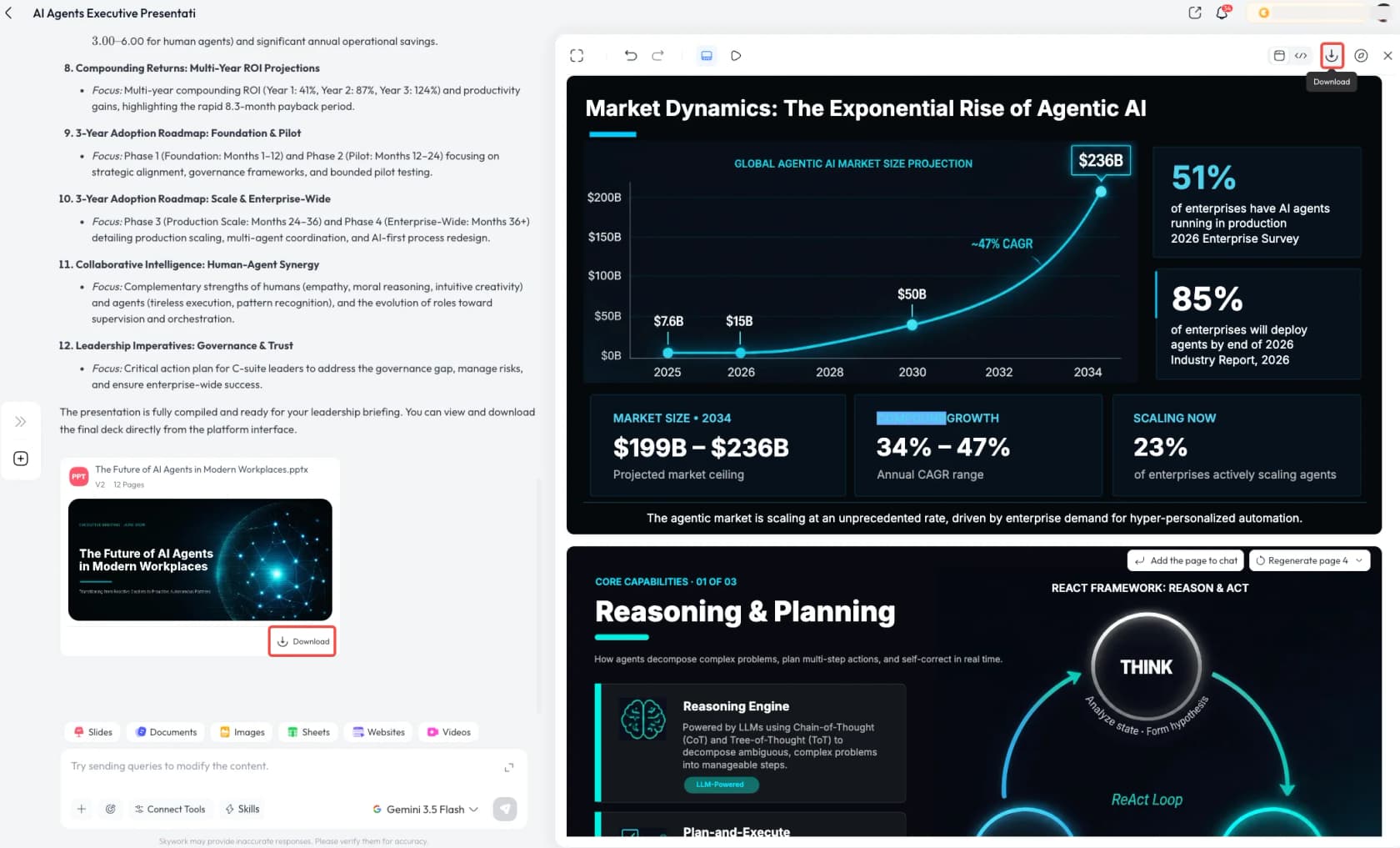
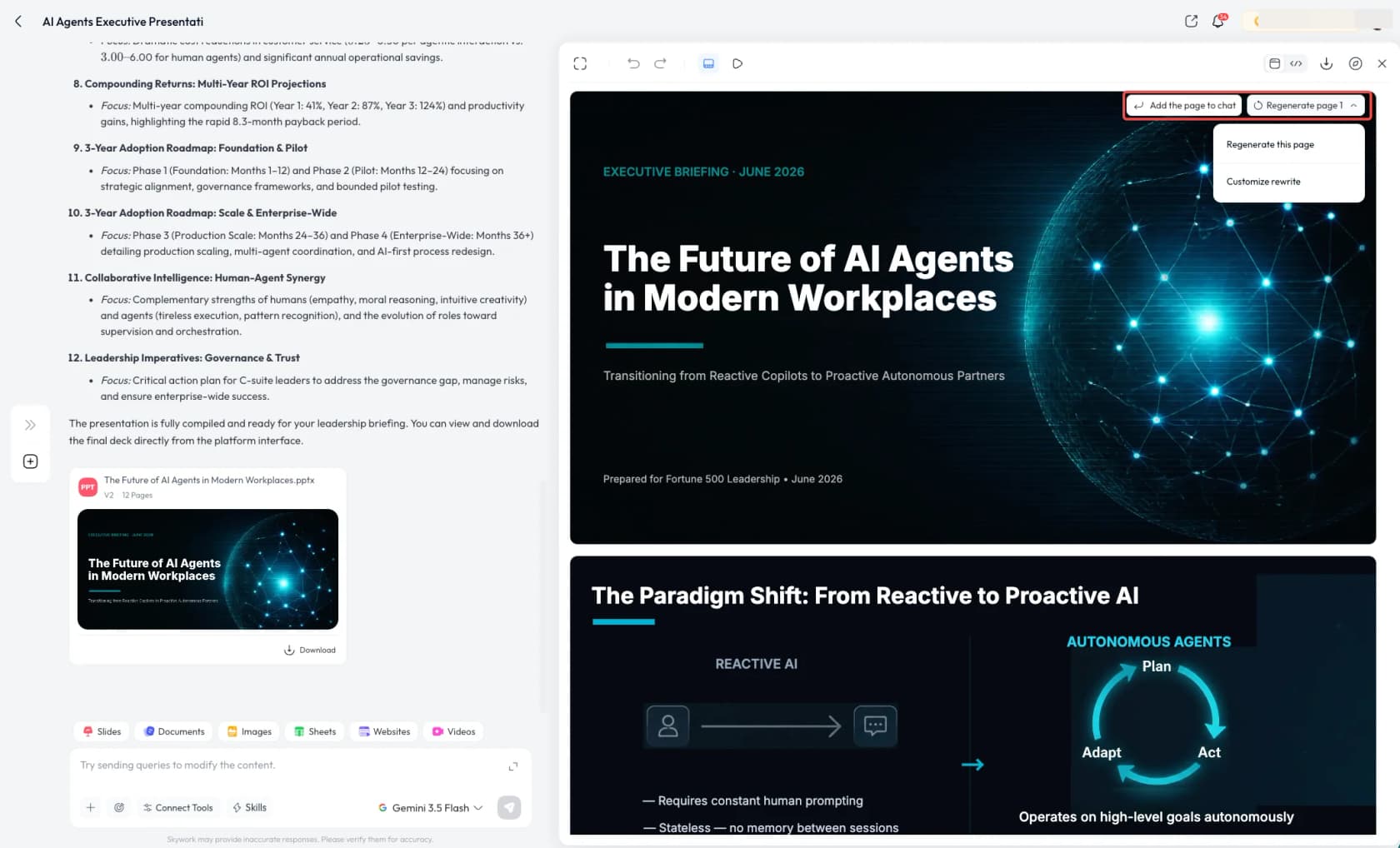
Slides are Skywork's flagship. You give it a topic or dump in a long manuscript, and it researches then builds a full deck you can edit page-by-page or element-by-element in a studio view. The standout is the "Deep Research" visual style, which research-leads the deck instead of designing from your prompt alone. That's exactly why the people who like it, like it.
A PhD user on Reddit put the trade-off better than any spec sheet could:
"Skywork.ai is where I build my knowledge base and handle the constant grind of presentations. It beats tools like Gamma for me because it generates structured, academic-grade charts rather than corporate visuals. Its Slides Agent lets me dump in a research brief or a long manuscript and spits out a draft deck, which is way more appropriate for scientific presentations."

The decks it produces can carry real data and charts, not just bullet points, which is the bit that reads as researched rather than generated.
The flip side, even fans admit, is aesthetics. The same tool that wins on structure loses on polish next to a design-first app:
"This one is good at organizing your thoughts. What attracts me most is its professional search that helps me gather data to support my ideas. It recently integrated Nano Banana Pro and thus created better visuals. The downside is it looks too structured, sometimes less aesthetic."
Docs, sheets, websites, images and video
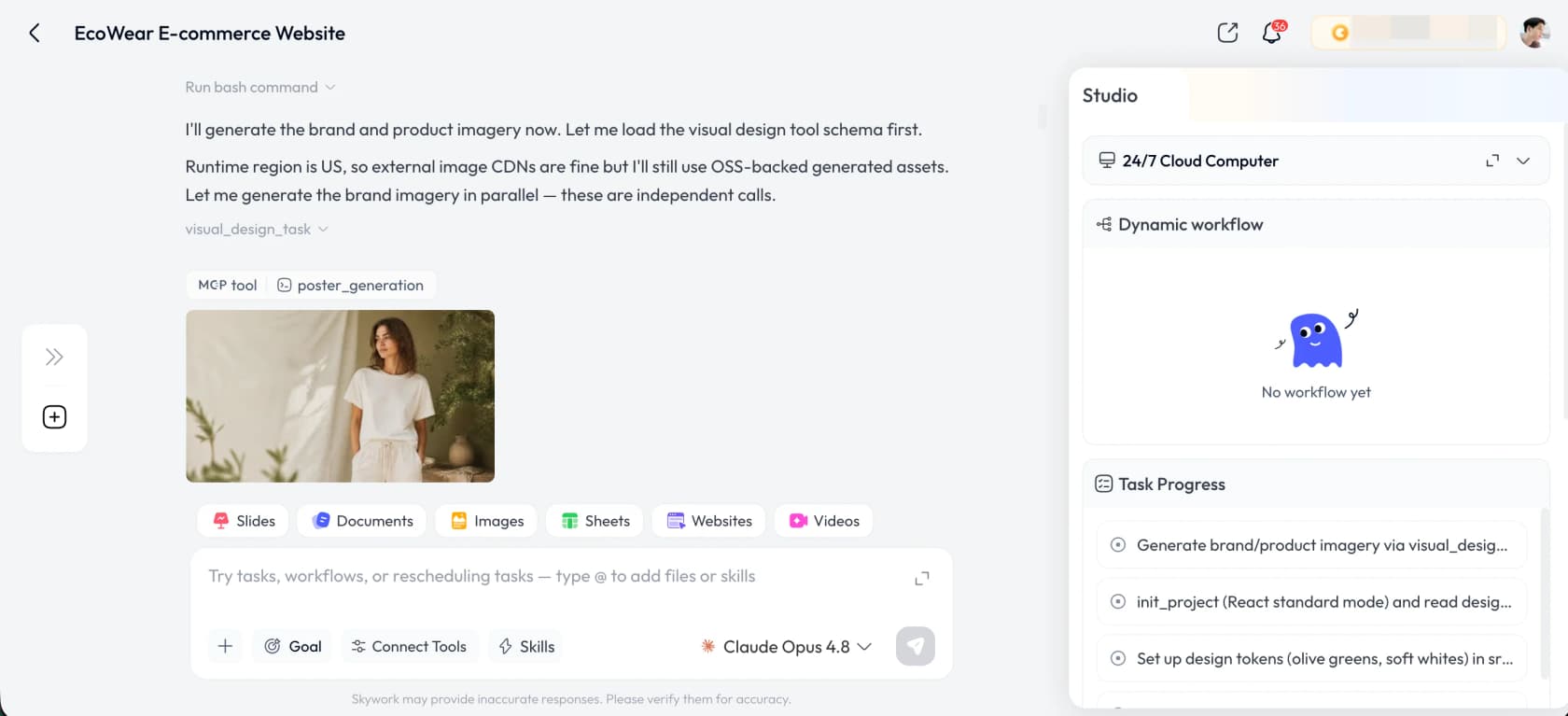
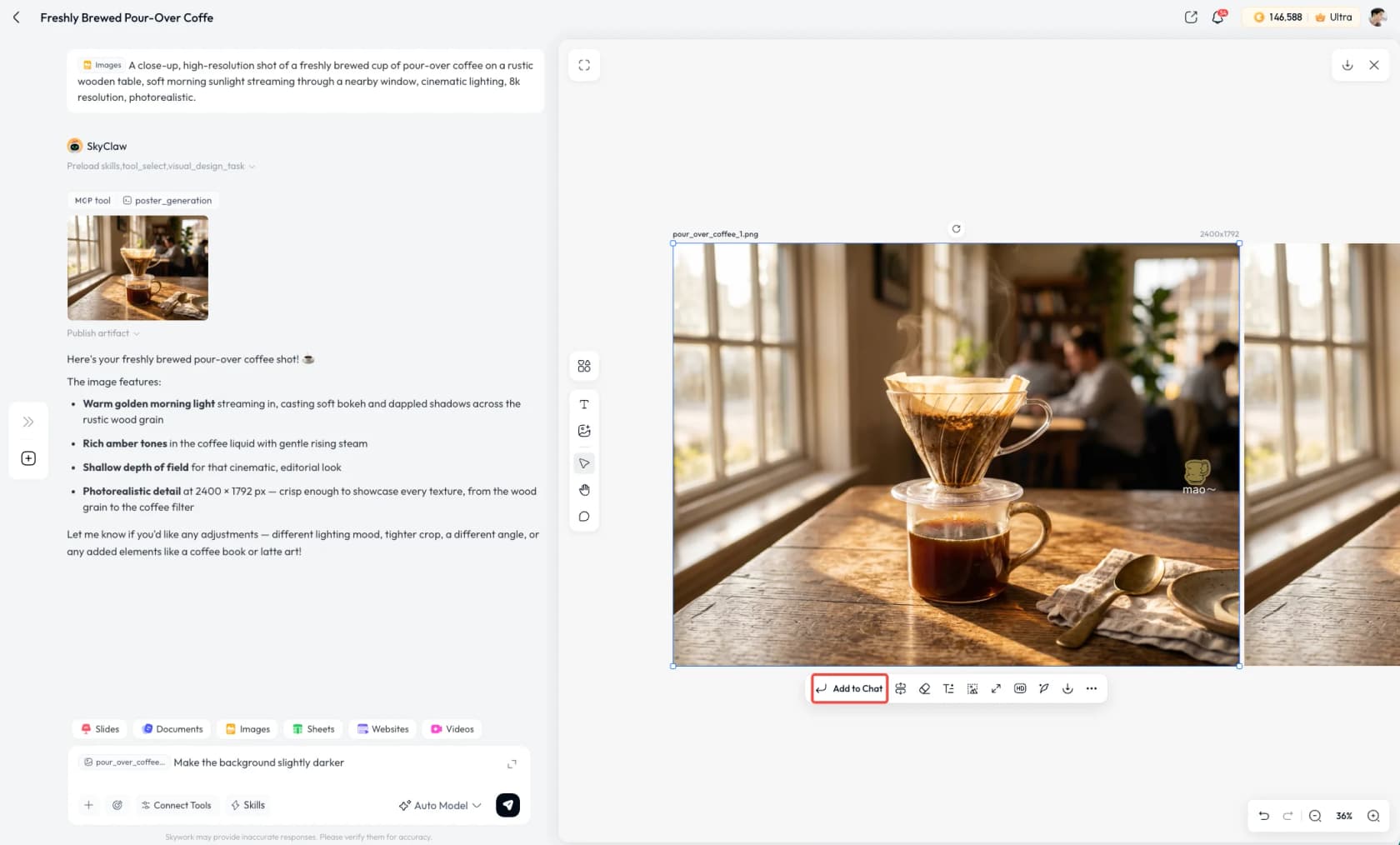
Beyond slides, Skywork covers most of the AI content generation surface, overlapping with dedicated AI writing tools. Documents get a two-panel writer with tone adjustment and version history. Sheets is chat-driven analysis that exports to Excel and Google Sheets. The Websites agent actually generates React code, publishes to a subdomain or your own custom domain, and layers on analytics, SEO diagnostics, and domain management.

Images run on an editable canvas with model choices including GPT Image 2 and Nano Banana Pro, and there's a full video agent with a multi-track timeline. It's a wide toolkit, and for a solo knowledge worker that breadth is the appeal, one login instead of five subscriptions.
Automation and IM control
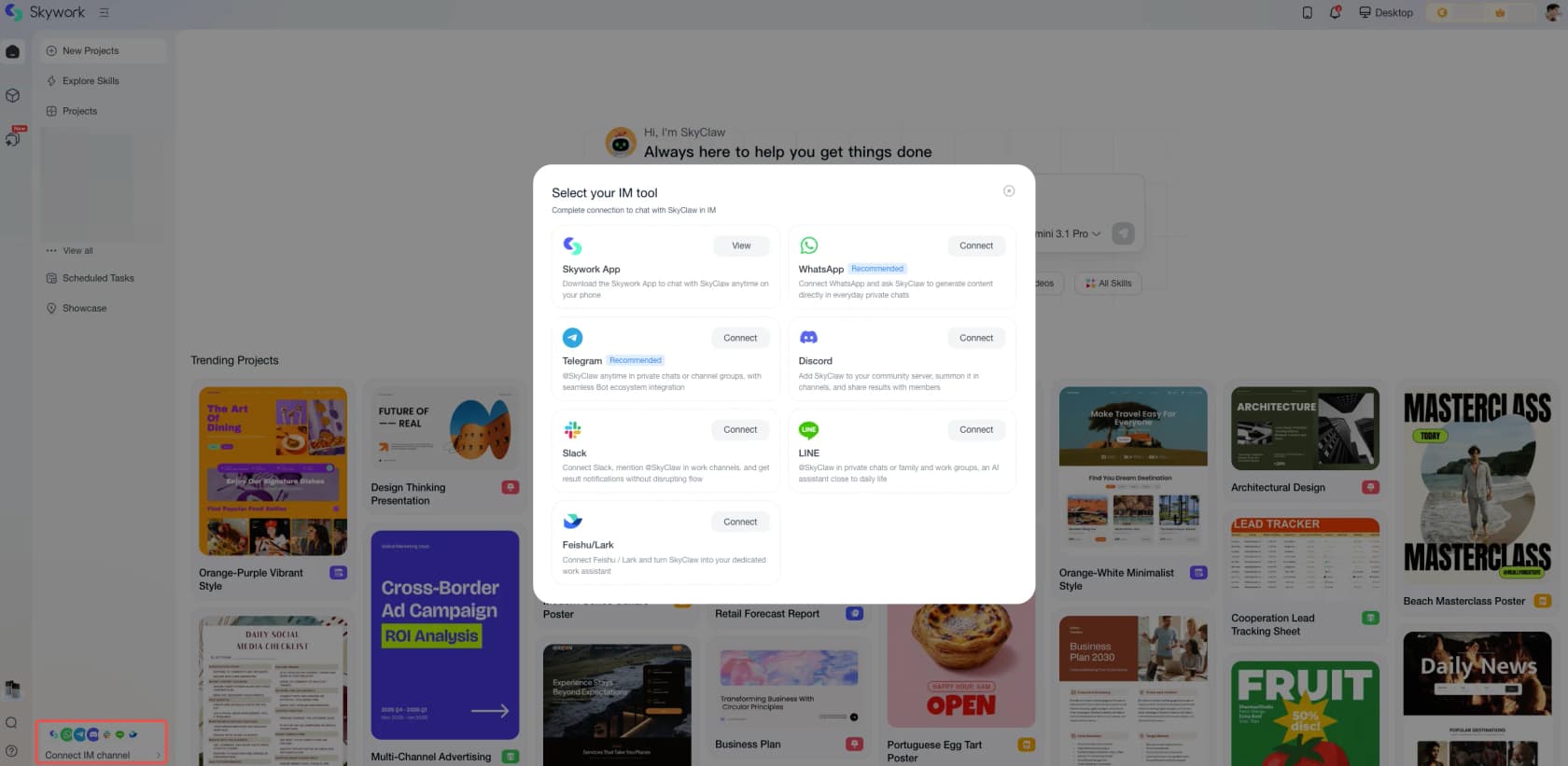
The part that hints at "agent" rather than "generator" is automation. You can schedule tasks to run on a timer, wire up MCP and Google Workspace / Microsoft 365 connections, and even drive SkyClaw from chat apps: Telegram, WhatsApp, Discord, Slack, Line, and Feishu/Lark all get a bot (one per channel). It's the same "AI teammate that lives in your chat" idea you see in AI agent examples across the market.
Skywork AI pricing, and the credit problem
Here's where I have to slow down, because Skywork's pricing is both the reason it's cheap and the reason people are furious.
Everything runs on credits, not seats or a flat "unlimited" bucket. There's no published per-credit dollar rate, and the live paid grid is behind a login wall, so the table below combines the public trial page with Skywork's own on-domain pricing guide. Treat the exact caps as directional.
| Plan | Price | Credits | Notes |
|---|---|---|---|
| Free | $0 | ~500/week after the first month (guide); live page advertises 800/day during the trial | Basic generation, no credit rollover |
| $1 for 7 days | $1 one-off | 800 daily credits | New-user trial, unlocks full downloads; auto-converts to paid |
| Monthly Pro | $19.99/mo | ~7,000 credits/mo | Full DeepResearch, commercial rights, premium exports (PPTX/DOCX/PDF) |
| Annual Pro | $149.99/yr (~$12.50/mo) | ~7,000 credits/mo | Everything in Monthly Pro plus priority support |
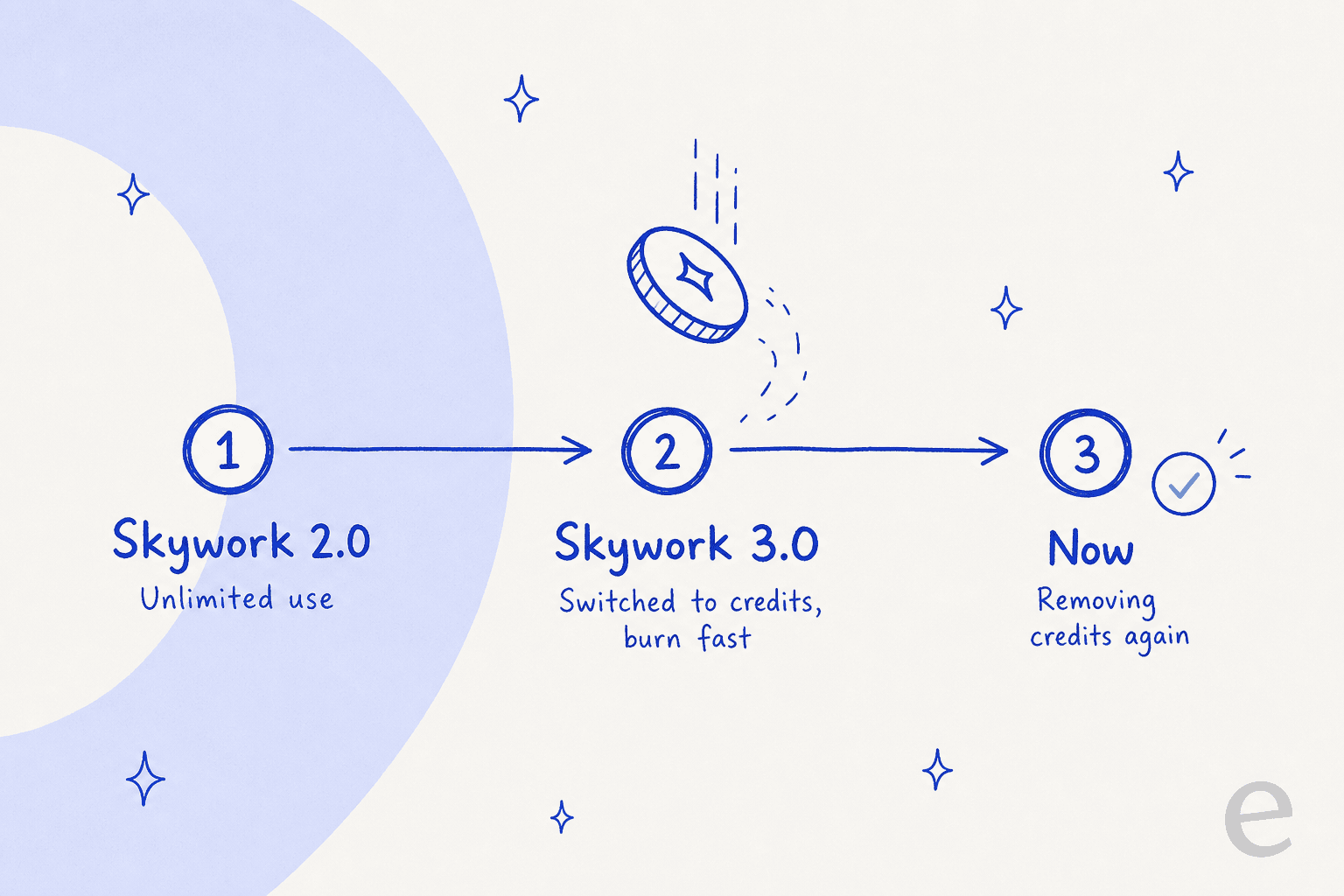
On paper, $19.99/month for research, slides, docs, sites, images and video is a steal, and it undercuts Manus pricing on sticker. The problem is what "credit" means in practice. Skywork moved from an unlimited model (2.0) to credits (3.0) with no notice, users say the credits vanish on even simple tasks, and, tellingly, the company has since announced it's removing the credit system again and adding an "Ultra Membership." That's three pricing regimes in a short window.
A three-star reviewer who liked the old version captured the shift cleanly:
"They had an unlimited system which worked great with their Skywork 2.0. They released Skywork 3.0 and the rug was pulled out from under customers. It went from Unlimited to credit based and the credits are consumed so fast it would cost an incredible amount to do even the most simple tasks."

This is the opposite of how I'd want an AI tool priced. When you're automating work, you need to know what a task costs before you run it. That's the whole reason eesel has one fixed monthly price: from $299 for 500 credits, 1 credit per ticket or chat, no per-seat fees, no surprise meter. You can argue about the number, but you always know the number.
The elephant in the room: billing and trust
I don't usually lead a review with the review site, but with Skywork you have to. The Trustpilot profile is 1.5/5 across 41 reviews, 91% of them one-star, and the pattern is not "the product is bad", it's "the billing is a trap." The profile is unclaimed and unprompted, so these are people who went looking to warn others.
The dominant complaint is the free trial auto-charging without a clear heads-up:
"ai is terrible at making slides, once the free subscription ends you are not notified by email or given a heads up that your free trial period is ending, they straight up charge you, and then ignore your email, i have raised a dispute with my credit card bank."
The second theme is that once charged, people struggle to get out or get refunded:
"SCAM! Subscription trap. There is NO cancellation button on the website, which is illegal under EU law."
And a few report paying for credits that never showed up:
"I tried to buy credits, I first bought $110.00 and no credits were applied to my account. Then I tried $34.99 and still I couldn't get my credits after the payment had been processed. I cannot get any response from this company."
Two things can be true at once here. The product does real work, and the go-to-market around it has burned a lot of people. If you try Skywork, use the trial deliberately: know exactly when it auto-converts, screenshot the terms, and set a calendar reminder to cancel before the charge if you're only testing. That's not advice I'd have to give for a tool with clean billing.
Who Skywork AI is actually for
Strip away the noise and Skywork lands in a clear spot: a broad, do-everything agent with a strong research spine. That's genuinely rare, most tools are either narrow-and-deep or broad-and-shallow.
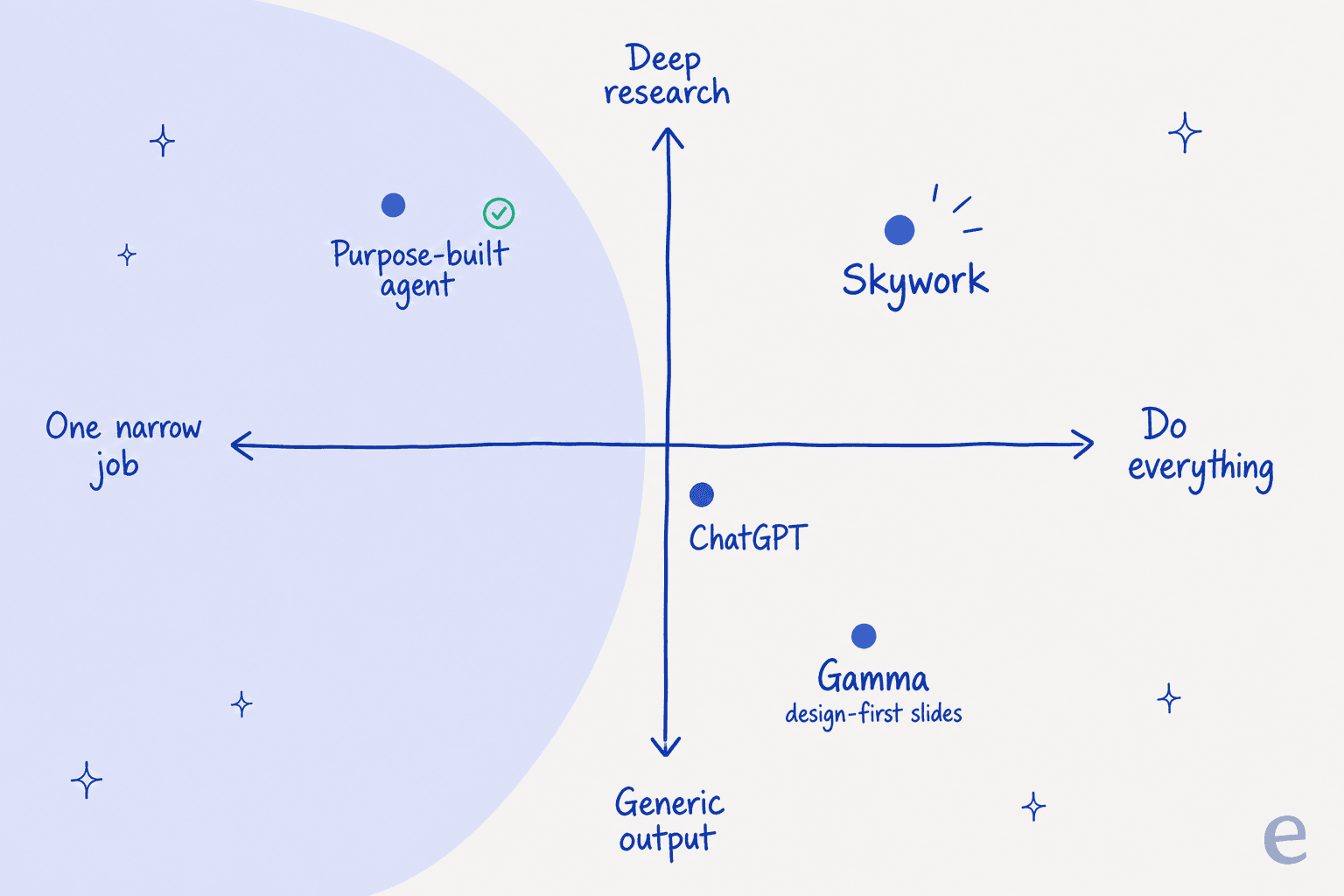
That position is a double-edged sword. Breadth is great when you're a solo researcher, student, or marketer who'd otherwise juggle a slides app, a doc tool, an image generator, and a site builder. It's a poor fit when you have one important job that needs to be done reliably, unattended, at scale, because a jack-of-all-trades agent with a shifting credit meter is exactly what you don't want holding up a real workflow.
Use the quick check below to see where you land.
<div style="background:#fff;border-radius:14px;padding:28px 26px;font-family:inherit;color:#474739;max-width:640px;margin:0 auto;border:1px solid #ececec;">
  <div style="font-weight:700;font-size:1.15rem;margin-bottom:6px;color:#474739;">Should you try Skywork AI?</div>
  <div style="font-size:0.92rem;color:#6b6b5f;margin-bottom:20px;">Pick the line that sounds most like you.</div>

  <details style="border:1px solid #e4e4e4;border-radius:10px;padding:14px 16px;margin-bottom:12px;">
    <summary style="cursor:pointer;font-weight:600;color:#3B5BFF;">I need a research-heavy deck or doc, fast, and I'll manage the trial carefully</summary>
    <p style="margin:12px 0 0;">Good fit. This is Skywork's sweet spot. Start on the free tier, and if you use the $1 trial, set a reminder to cancel before it auto-converts.</p>
  </details>

  <details style="border:1px solid #e4e4e4;border-radius:10px;padding:14px 16px;margin-bottom:12px;">
    <summary style="cursor:pointer;font-weight:600;color:#3B5BFF;">I want one tool instead of five subscriptions for slides, docs, images and a site</summary>
    <p style="margin:12px 0 0;">Reasonable fit. The breadth is real. Just budget for credit burn and expect the pricing to change, since Skywork is mid-way through reworking its credit model.</p>
  </details>

  <details style="border:1px solid #e4e4e4;border-radius:10px;padding:14px 16px;margin-bottom:12px;">
    <summary style="cursor:pointer;font-weight:600;color:#3B5BFF;">I need AI to run a real workflow unattended, at scale, with predictable cost</summary>
    <p style="margin:12px 0 0;">Weak fit. A shifting credit meter and 1.5/5 billing reviews are the wrong foundation for production work. Look at a purpose-built agent instead.</p>
  </details>

  <details style="border:1px solid #e4e4e4;border-radius:10px;padding:14px 16px;">
    <summary style="cursor:pointer;font-weight:600;color:#3B5BFF;">My actual job is customer support, not making office documents</summary>
    <p style="margin:12px 0 0;">Wrong category. Skywork isn't a helpdesk tool. You want an AI teammate that plugs into your existing helpdesk, like <a href="https://www.eesel.ai" style="color:#3B5BFF;">eesel</a>.</p>
  </details>
</div>
The verdict
Skywork AI is more real than the influencer hype and more flawed than the marketing page. The super-agent works, the deep-research decks are legitimately good, and $19.99/month buys a lot of range. If you're a researcher or marketer who reads the fine print, it's worth a trial.
But I can't wave off a 1.5/5 Trustpilot score built almost entirely on billing complaints, or a company changing its pricing model three times in a few months. Capability isn't the question with Skywork; trust is. Go in with your eyes open, your trial dates marked, and no expectation that the credit rules will stay put. If you're still shopping, our roundup of 10 best AI tools for business is a calmer place to compare, and support teams should start with the best AI tools for customer support.
Try eesel
If what pulled you toward Skywork was "I want an AI that actually does the work," but you need it to run a real part of your business rather than spin up one-off decks, that's the gap eesel fills. eesel is an AI teammate that lives inside the apps you already use, so it learns from years of your history on day one instead of starting from a blank prompt.
On the content side, the eesel AI Blog Writer researches, drafts and publishes in your voice, the same research-to-artifact loop Skywork does for slides, but tuned for the content workflow and priced so you know the cost up front. On the support side, it plugs into your helpdesk and resolves tickets automatically. Either way, you get a transparent fixed monthly price, a credit that always means one ticket or chat, and no trial that charges you by surprise. It's free to try with 100 credits.
Frequently Asked Questions
What is Skywork AI and what does it do?
Skywork AI is a horizontal AI super-agent that turns a single prompt into slides, documents, spreadsheets, websites, images and video, backed by a web-scanning research mode. It sits in the same category as Manus and Genspark, not a helpdesk tool. This Skywork AI review covers what it builds well and where it stumbles.
How much does Skywork AI cost?
Skywork AI has a free tier, a $1-for-7-days trial that unlocks 800 daily credits, Monthly Pro at $19.99/month (around 7,000 credits), and Annual Pro at $149.99/year. Everything is metered in credits with no published per-credit rate, so real Skywork AI pricing depends on how heavy your tasks are. Compare that to the fixed monthly credit plans (1 credit per ticket or chat) on the eesel pricing page.
Is Skywork AI a scam?
No, it produces real output, but its Trustpilot score sits at 1.5/5 and most one-star reviews are about the free trial auto-charging and hard cancellation, not the product quality. Read the terms before you enter a card, and treat the credit rules as a moving target since Skywork has announced it is removing the credit system again.
How is Skywork AI different from ChatGPT?
ChatGPT is a general chat assistant; Skywork is an agent built to finish a deliverable end to end, with its deep research feeding directly into a slide deck, doc or site. If you want research plus a finished artifact in one run, Skywork does more; if you just want answers, ChatGPT is simpler.
What are the best Skywork AI alternatives?
For general super-agent work, look at Manus alternatives and Genspark; for design-first decks, Gamma. If your real job is customer support rather than office output, a purpose-built teammate like eesel that plugs into your existing helpdesk is a better fit than a do-everything agent.