


What is Genspark AI?
Genspark is the product; the company behind it is MainFunc, founded in 2023 by two former Baidu executives, Eric Jing (CEO) and Kay Zhu (CTO). It launched in June 2024 as an AI search engine, then pivoted hard in April 2025 into the thing everyone knows it as now: an agentic AI workspace built around the Super Agent.
The traction has been genuinely wild. Genspark reportedly hit $10M in annual recurring revenue in its first nine days, crossed $50M within about five months, and raised a $275M Series B at a $1.25B valuation in November 2025. Anthropic even name-checked it, posting that "Genspark builds the future" of AI agents with Claude.
So this isn't vaporware. It's a fast, well-funded product with real users. The interesting question for this review isn't "is it real," it's "is it worth your money," and that answer depends a lot on what you plan to do with it.
The Super Agent, and how it actually works
The headline feature is what Genspark calls Mixture-of-Agents. Instead of one model doing everything, an orchestration layer routes each sub-task to the best-fit model and tool. Per co-founder Eric Jing, the launch build ran on 9 different LLMs, 80+ in-house tools, and 10+ curated datasets, and by 2026 reviewers describe it orchestrating 30+ models including GPT-5, Claude, and Gemini.
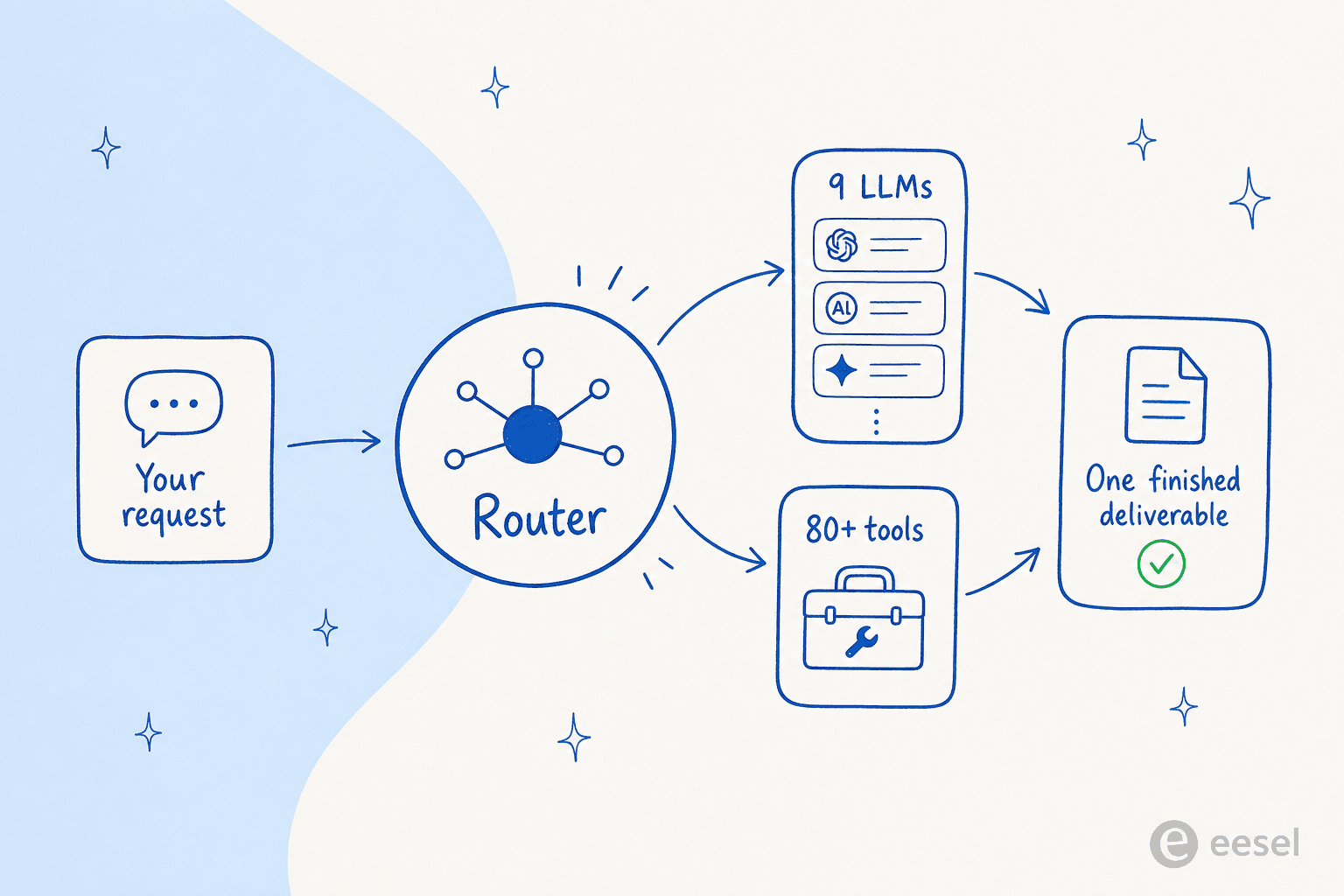
The team's own framing for this is "less control, more tools": rather than hard-scripting the agent, they hand it a big, well-built tool library and let it decide how to chain calls, with a reflection step that checks outputs against each other before moving on. On the GAIA benchmark, which tests agents on real multi-step tasks, Genspark reports 87.8%, edging out Manus's ~86%.
The capability that made it go viral is the AI phone call. Give it a goal like "book a table for four on Friday," and the agent places an outbound call in a synthetic voice and handles the live back-and-forth with a human, powered by OpenAI's Realtime API. Independent testing by AI Tool Analysis reported an 83% success rate across 47 calls, with the misses concentrated on complex phone menus. That's the kind of thing that reads as science fiction until you watch it work.
What Genspark is genuinely good at
Credit worries aside (we'll get there), the praise in real user threads is consistent and specific:
- AI slides. This comes up again and again as best-in-class. Reviewers report a polished 10-slide deck in about 60 seconds, and one r/powerpoint user put it plainly.
- Unlimited top-tier chat. On paid plans, core AI chat runs at zero credit cost, which means effectively unlimited access to models like Claude Opus for the price of a single ChatGPT sub.
- Agentic execution. For turning a prompt into a finished deliverable (a research page, a landing page, a filled spreadsheet), it's fast and it mostly just works.
"After dozens of disappointing AI slide generators, Genspark AI finally blew me away (not sponsored)"

The unlimited-chat angle is the sleeper value. If you mostly want a chatbot and occasionally generate images, several users argue Genspark is a no-brainer next to paying separately for a premium plan elsewhere.
"unlimited Opus 4.5 … if you generally just use the models like a normal chatbot, GenSpark's a no-brainer. $20 a month."
Genspark AI pricing, and where it bites
Here's the real cost. Genspark has three public tiers, and everything is metered in credits. Chat and image generation are free on paid plans as a promo through December 31, 2026, but agent tasks, slide decks, and video all draw down your credit pool.
| Plan | Monthly | Annual (~20% off) | Credits | Storage | Best for |
|---|---|---|---|---|---|
| Free | $0 | $0 | ~100 credits/day | 1 GB | Trying the Super Agent and Sparkpages |
| Plus | $24.99/mo | $19.99/mo | from 10,000/mo | 50 GB | Solo users; unlimited chat + images, all SOTA models |
| Pro | $249.99/mo | $199.99/mo | from 125,000/mo | 1 TB | Power users; priority speed + exclusive image models |
| Team / Enterprise | Not public | Not public | Not public | - | SSO, contact sales |
Prices and plan structure come from Genspark's Help Center; the live pricing page is login-gated. Both Plus and Pro have multiple higher credit tiers, so the listed price is the entry point.
The part the tier grid hides is how differently tasks burn credits. This is the whole game:
| Task | Approx. credit cost |
|---|---|
| AI chat (core) | 0 (promo through end of 2026) |
| AI image generation | 0 (promo through end of 2026) |
| Research Sparkpage | ~5 to 80 |
| AI Slides (full deck) | ~100+ |
| AI phone call | ~1 credit/second (~180 for a 3-min call) |
| Video generation | Highest cost per run |
Two things make this sting more than the numbers suggest. First, there's no rollover, so unused credits expire each cycle. Second, and this is the one that shows up in angry reviews, you get charged even when a task fails or you retry it.
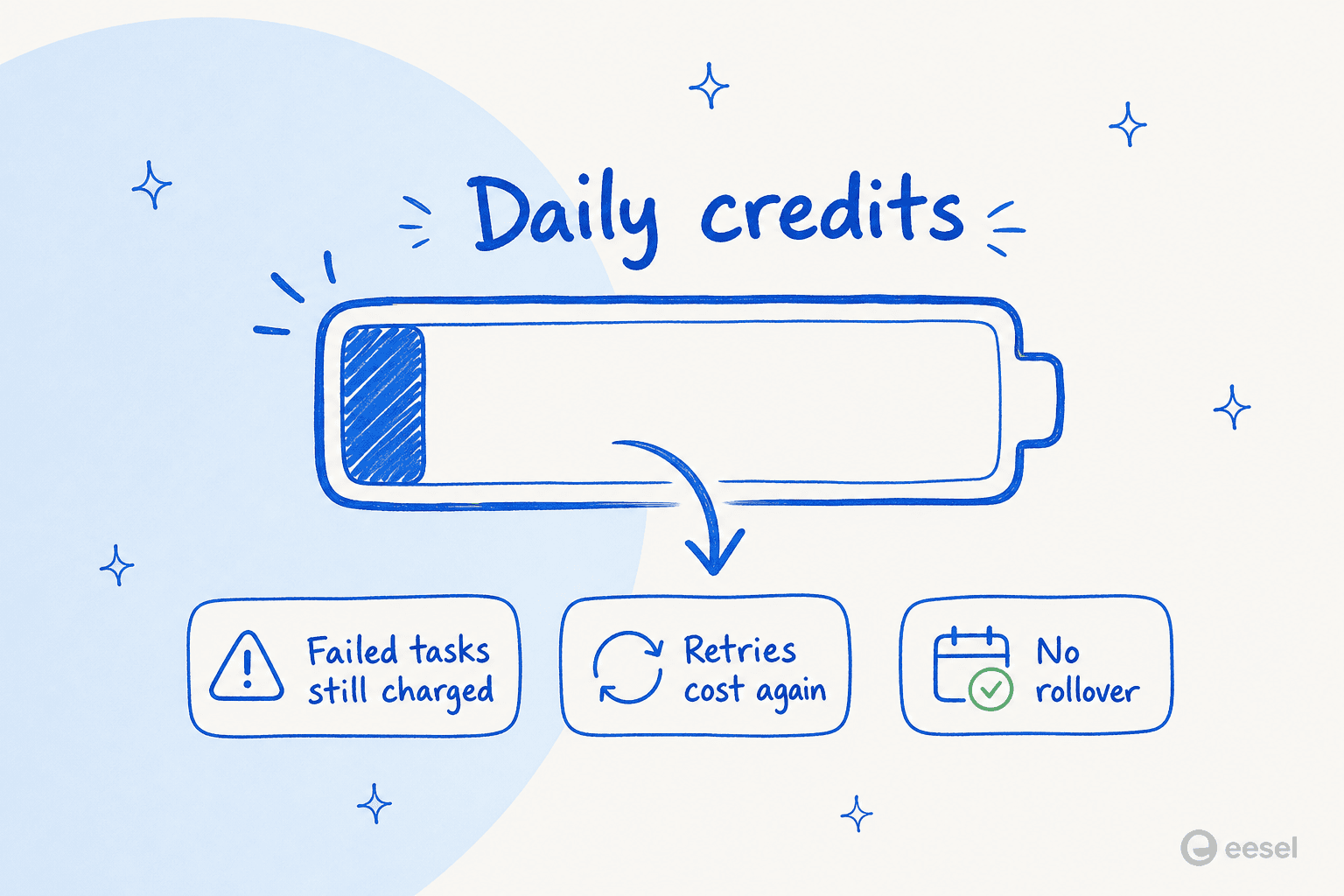
To make this concrete, here's a quick way to sanity-check whether Genspark's credit model fits how you'd actually use it.
What real users complain about
This is where the review gets uncomfortable for Genspark. The social hype and the paid-user sentiment point in opposite directions.
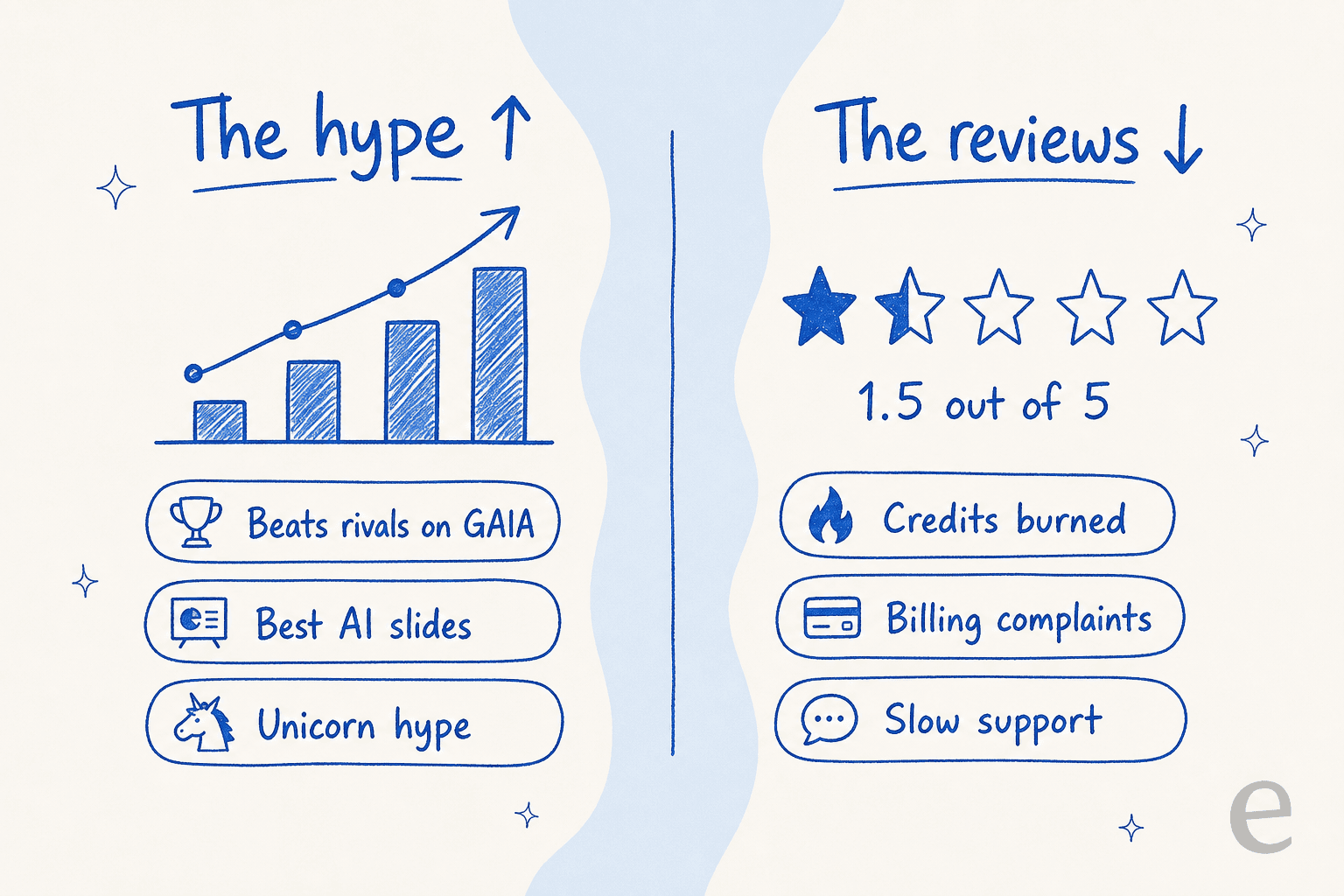
On Trustpilot, Genspark sits around 1.5 out of 5 across ~112 reviews, with roughly 84% of them one-star. For a product that reportedly crossed $100M ARR, that's a striking number, and the complaints cluster into three specific, repeated themes: credit burn on failed tasks, opaque billing (including non-consensual annual charges), and slow or absent support.
The credit-burn story is the loudest, and it's everywhere on r/genspark_ai. The recurring shape is the same: loved it at first, then the same workloads started draining an allowance in hours.
"burnt 42% of my genspark credits in the first hour of subscribing most of it from sora. credits are gone. specific models are burning the most compute"
The "unlimited" label also takes a beating. Several users report supposedly unlimited features either hitting session caps or quietly consuming credits anyway.
"Genspark is draining credits for their UNLIMITED chat and image generation. 3500 credits gone within minutes."
To be fair, most "is this a scam?" threads conclude it's a real product that people find frustrating, not fraud. But the gap between the marketing and the metering is real, and it's the single biggest risk in buying Genspark today.
Genspark vs the alternatives
Genspark doesn't exist in a vacuum. The comparisons users make most often:
| Tool | Best for | Where it wins vs Genspark | Rough price |
|---|---|---|---|
| Genspark | All-in-one agent + unlimited chat | Slides, breadth, unlimited top models | from $24.99/mo |
| Manus | Deep technical agent work | Stronger on hard, exploratory tasks | Higher, usage-based |
| ChatGPT | Consistent general assistant | Reliability, ecosystem | $20+/mo |
| Perplexity | Raw research chat | Pure unlimited chat and citations | $20/mo |
| eesel AI | Customer support automation | Trains on your helpdesk, 1 credit per ticket | From $299/mo (500 credits) |
The Manus comparison is the sharpest. Users see them as close in capability, with Genspark winning on price and speed-to-deliverable and Manus winning on depth.
"Genspark AI is basically the same as Manus but so much cheaper it's ridiculous. manus is still a much stronger ai platform … the dashboard ..."
Against ChatGPT and Perplexity, the read is simpler: for pure chat, Perplexity or ChatGPT are more consistent, but Genspark's unlimited access to premium models plus agentic execution is a different, broader offer.
Where a general super agent falls short for support
Here's the honest limit worth naming. A Swiss-army agent is amazing when the task changes every time. It's the wrong tool when the task is the same thing, thousands of times, with your company's real answers on the line, which is exactly what customer support is.
At eesel, we've spent years putting AI on live support queues, and two lessons show up in every rollout. First, a general agent that sounds confident will happily give a wrong answer, which is why we simulate every rollout against a company's historical tickets before it ever talks to a customer. Second, credit-metered pricing is a nightmare for support, because support is full of retries, follow-ups, and internal steps, and charging for each one turns your bill into a guessing game. That's the exact pain filling Genspark's review pages, applied to your support budget.
Try eesel AI
If you landed here because you want AI to do real work, Genspark is a fair pick for slides, research, and unlimited chat. But if the real job is automating your helpdesk, eesel AI is built for that one job and does it out of the box.
You plug eesel into your existing helpdesk (Zendesk, Freshdesk, Gorgias, and more), it trains on your past tickets and help center, and it starts resolving front-line tickets on day one. Crucially, the pricing is predictable and per-resolution, so you're never charged for a retry, a follow-up, or an internal action, which is the opposite of the credit meter that dominates Genspark's reviews. You can simulate it on your own historical tickets first to see the resolution rate before going live.
For a general agent, Genspark is genuinely one of the better ones. For support specifically, a purpose-built teammate is the safer, more predictable bet.