Karloe pricing 2026: how the credit model actually works

Kurnia Kharisma

Katelin Teen
Last edited August 27, 2026

What Karloe is (before we talk price)
Quick context, because Karloe's pricing only makes sense once you know what you are paying for. Karloe is an AI marketing and growth operator you talk to in Slack. You @mention it like a teammate ("audit last week's Meta spend and tell me what to cut"), it connects to your stack, does the work, and drops a finished artifact back into the channel: an ad-audit PDF, a weekly growth report, drafted ad variants, or a sent outbound sequence. Its own line is "Karloe does not just brainstorm. It ships the artifact."
That "ships the artifact" framing matters for the pricing conversation. Karloe is not a subscription to a chatbot that gives advice; it is closer to hiring one of the AI teammates you delegate real jobs to. And when a tool actually runs the work end to end, someone has to pay for the model calls behind that work. Karloe's whole pricing model is a specific, unusually honest answer to who pays, and how much.
I have spent the last few years building and running AI that does real work on live queues (in our case, support tickets, thousands of them), so the pattern here is familiar. The hard part of pricing an AI operator is never the sticker; it is that the underlying cost is model tokens, and token cost swings wildly with how much you actually use the thing. Every vendor has to decide whether to hide that swing behind a flat fee, mark it up, or pass it through. Karloe passes it through, at cost. That single decision drives everything on the pricing page.
Karloe pricing at a glance
Here is the full picture. There are only two plans, and no enterprise tier as of this writing.
| Free | Team | |
|---|---|---|
| Monthly price | $0 | From $50/month |
| Credits | $50 in credits at signup (20,000) | 20,000/month, slider up to 1.2M/month |
| Credit rate | $0.0025 per credit, at par | $0.0025 per credit, at par |
| Top-of-range cost | n/a (one-time credits) | ~$3,000/month at 1.2M credits |
| Credit reset | None, credits never expire | Monthly credits reset each cycle |
| Card required | No | Yes |
| Dashboard | Slack workspace only | Full dashboard: tasks, outputs, history |
| Top-ups | Not applicable | 10,000 credits for $25, never expire |
| Support | Standard | Priority |
| Human review before sensitive actions | Yes | Yes |
| Change / cancel | n/a | Anytime from billing portal |
Source for every figure: the Karloe pricing page and homepage, checked August 2026.
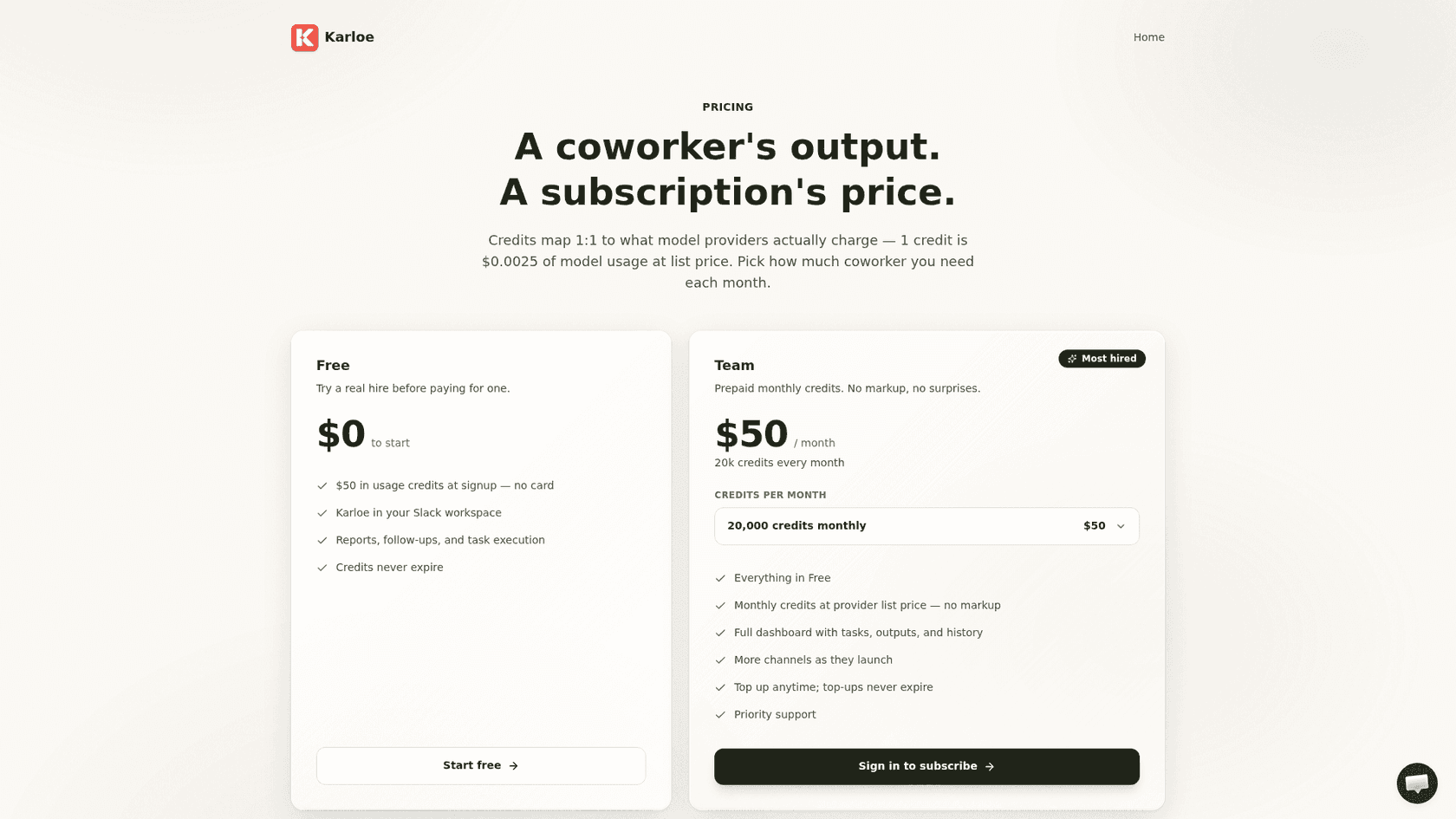
Two things stand out immediately. First, the Free tier is unusually generous for a tool that actually executes work; $50 of real model spend is, in Karloe's words, "enough for a real ad audit or a few weeks of reports". Second, the Team plan's entry price ($50/month for 20,000 credits) is the exact same per-credit rate as the Free credits and the top-ups. There is no volume discount and no volume penalty. A credit costs a credit, wherever it comes from.
The one number that explains everything: the credit
If you remember one thing about Karloe pricing, make it this: 1 credit = $0.0025 of model usage at provider list price, and credits "map 1:1 to what model providers actually charge". There is no markup. The pricing page and the FAQ both repeat it: plans are "prepaid credits billed at provider list price with no markup".
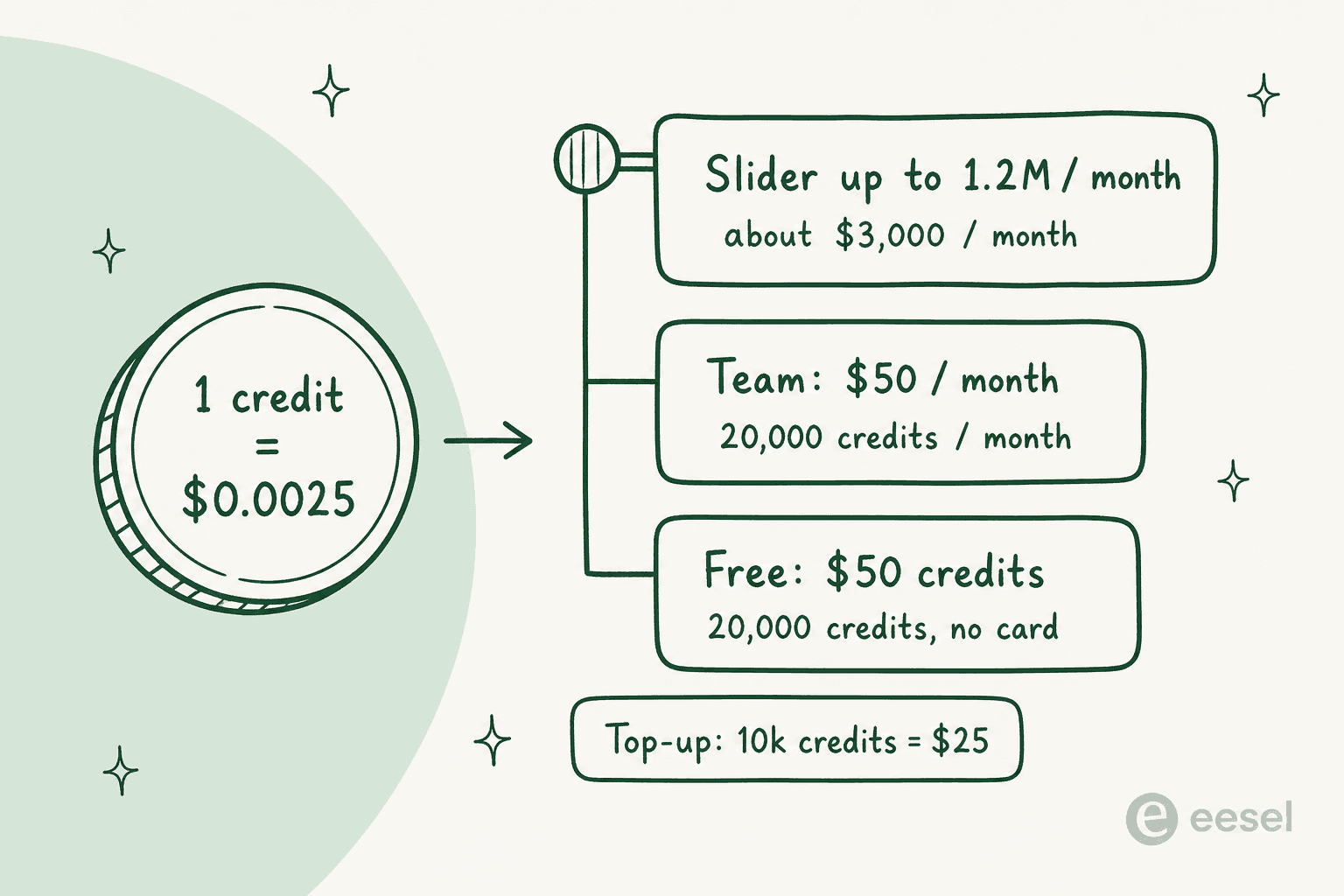
That converts cleanly:
- 20,000 credits = $50 of model spend. That is the Free grant and the Team entry tier.
- 400,000 credits = $1,000/month.
- 1.2M credits ≈ $3,000/month, the top of the Team slider.
- A top-up of 10,000 credits = $25. Same $0.0025 rate, so top-ups carry no premium; they just drain after your monthly credits run out.
There is one more wrinkle that works in your favour. Karloe routes each job to "the best model for each job: Claude, GPT, Gemini, or open models", so you are "never paying premium-model prices for work a cheaper model does just as well." A simple report might run on a cheap model and sip credits; a complex competitive-research task might reach for a frontier model and burn more. Your credit consumption reflects the real cost of the specific work, not a flat blended rate. This is the same dynamic that makes AI blog writer cost vary with length and complexity rather than sitting at one fixed number.
What "at par" actually means for your bill
"No markup" is easy to skim past, so let me make it concrete, because this is genuinely the most interesting thing about Karloe's pricing. Most AI tools you have priced sit somewhere on a spectrum, and Karloe is planted firmly at one end.
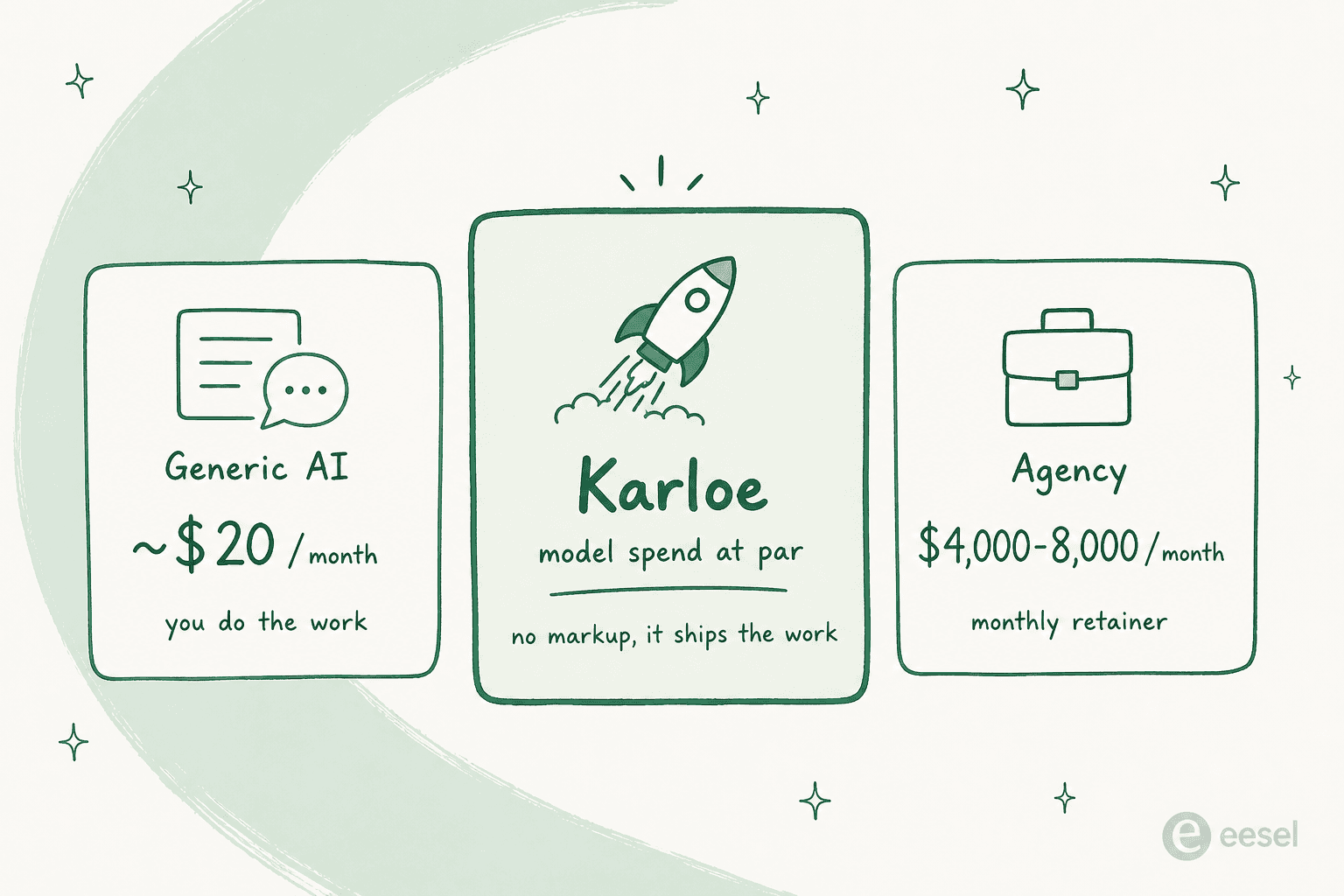
Karloe frames its own pricing against two alternatives on the homepage: a generic AI chatbot ("~$20/mo", where you still do the work yourself) and a marketing agency ("$4,000-8,000/mo" on a retainer). Its pitch is that it lands in between on price while doing the agency's kind of work: it ships the finished deliverable, not advice.
The "at par" part is the clever bit. When Karloe charges you $0.0025 per credit and that is exactly what the model provider charges, Karloe earns essentially nothing on your usage. The company makes its money on the relationship and the subscription structure, not on marking up your tokens. For you as a buyer, that is about as transparent as AI pricing gets. You are not funding a hidden margin every time the operator runs a report.
It is worth being clear-eyed about the flip side, though, and I mean this as a fair observation rather than a knock: at-par pricing is a bet a young company makes to win early users. Karloe is onboarding its "first group of founders and growth teams", a founding cohort, and it is reasonable to expect the pricing structure to evolve as it grows. If you are building a core marketing workflow on top of it, price it for today and keep an eye on the pricing page.
The catch: your bill has no ceiling
Here is the part that does not show up in the sticker price, and it is the single most important thing to understand before you commit.
Because your bill is your model spend, it scales in a straight line with how much you delegate. There is no built-in monthly cap and no flat "all you can eat" ceiling. Run one ad audit a week and a couple of reports, and you might live comfortably inside the Free grant for weeks. Wire Karloe into your daily reporting, your outbound, your lifecycle follow-ups, and your content, and the credits move fast, because every one of those deliverables is a real model call billed at real cost.
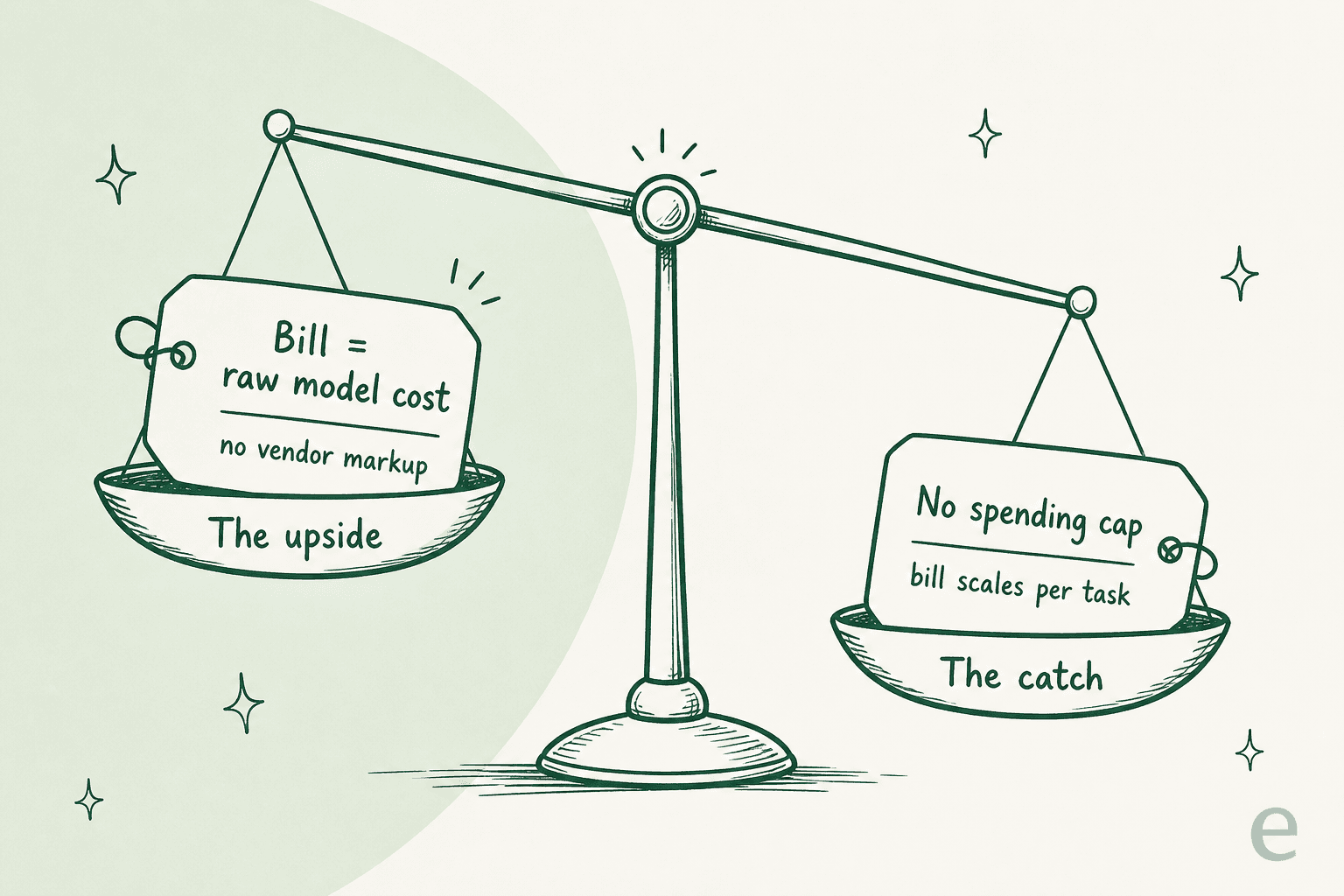
To Karloe's credit, the model does have a natural brake: it is prepaid. You are not going to get a surprise $2,000 invoice, because you buy credits up front and top up when you run low (10,000 for $25) rather than being auto-charged for overages. Running out is a stop, not a bill. That is a genuinely friendlier failure mode than usage-based tools that keep charging past your comfort zone.
But "prepaid" solves the surprise problem, not the predictability problem. You still cannot easily answer "what will Karloe cost me next month?" without knowing exactly how much work you will delegate, and marketing workloads are lumpy. If forecasting matters to your finance team, that is the trade-off to weigh. This is the same tension you will find across AI marketing automation tools: pass-through pricing is transparent but variable, while outcome pricing is predictable but includes a margin.
Play with the numbers yourself:
What actually consumes credits
Every deliverable Karloe ships is a model call, and that call is what spends credits. The pricing page and homepage name three broad buckets of credit-consuming work:
- Reports. Full-funnel numbers (spend, CAC, CTR, ROAS, pipeline) pulled from Meta, Google, GA4 and Stripe into one report, daily or weekly.
- Task execution. Ad audits that quantify wasted spend, content and copy drafting, and competitive research.
- Follow-ups. Outbound sequences, lifecycle chases, and CRM updates in HubSpot.
Karloe connects to Meta Ads, Google Ads, GA4, Stripe, HubSpot, Slack, Notion, Google Sheets and Mailchimp via one-click OAuth, and credentials stay server-side. Sensitive actions (pausing spend, sending outbound, publishing, changing records) wait for explicit human approval, so a credit-burning task never quietly turns into a live change to your ad account without you signing off.
The practical read: if your marketing work is bursty (a big audit here, a quarterly competitive sweep there), the credit model and the free grant will feel cheap and fair. If you plan to run Karloe as an always-on daily reporting engine plus outbound plus content, model out the monthly credit burn before you commit, because that is where a $50 plan quietly becomes a $1,000 one.
How Karloe pricing stacks up against outcome pricing
Karloe's at-par credit is one of two honest ways to price an AI operator. The other is to price per finished outcome, and it is worth understanding the difference because it changes how you budget.
With Karloe, you pay for effort: every model call, at cost. With an outcome-priced tool, you pay for results: a finished deliverable at a fixed rate, and the vendor absorbs the token variance. Neither is universally better. Pass-through pricing wins on transparency and per-unit cost; outcome pricing wins on predictability. If you have ever tried to compare AI employee pricing across vendors, this is the axis that actually matters, far more than the headline number.
Where this lands for a specific job like content: Karloe will draft ad variants and copy as part of its marketing remit, and you pay the credits those drafts burn. A dedicated AI blog writer that charges a flat rate per post gives you a number you can multiply. If you are publishing 20 posts a month, "×$4" is a lot easier to take to finance than "however many credits 20 posts happen to burn." That is not a reason to avoid Karloe; it is a reason to match the pricing model to how predictable you need the bill to be.
Try eesel for the content and support slices
Karloe is a real marketing operator, and if broad growth automation in Slack is what you want, its at-par pricing is one of the fairest models out there. But if the job you actually care about is content or customer support, it is worth knowing where eesel fits, because the pricing philosophy is different in a way that helps budgeting.
eesel is an AI teammate platform: you hire ready-to-work teammates for specific jobs, and the current roster is an AI blog writer and an AI support teammate. The AI blog writer drafts finished, on-brand posts and is priced per post (about $4 for a full post), while the support teammate runs on a fixed monthly credit plan, from $299/month for 500 credits (1 credit per ticket or chat). Both are numbers you can forecast: posts × $4, or one monthly plan sized to your ticket volume. The free plan is 100 credits, no card.
The honest version: eesel is not an ad-audit or outbound tool, and if that is your need, Karloe is the better fit. But for the content and support slices specifically, an outcome-priced teammate is the easier bill to plan around. You can try eesel free and see the per-post number for yourself before committing anything.