9 best Karloe alternatives in 2026 (marketing & growth AI)

Kurnia Kharisma

Katelin Teen
Last edited October 14, 2026

Why people look for a Karloe alternative
First, the fair part. Karloe nails a real pain. Founders and small growth teams live in a dozen tabs (Meta Ads, Google Ads, GA4, Stripe, HubSpot) and the reporting, audits, and follow-ups are exactly the work that slips when you're busy. Karloe's core pitch, "delegate your marketing, get finished work back," is a real draw, and the Slack-native, ~30-second setup is a smart way to lower the barrier. It's model-agnostic too, routing each job to Claude, GPT, Gemini, or an open model, so you're not locked to one vendor.
So why look elsewhere? Two reasons keep coming up.
The bill is your token spend. Karloe's pricing is refreshingly transparent about this: credits map 1:1 to model cost, with no markup. That sounds great, and for light use it is. But it also means there's no fixed price for a job. A weekly report, an ad audit, a batch of outbound, each burns model tokens, and a heavier month quietly costs more. The Team plan slider runs from 20,000 credits ($50) all the way to 1.2M credits (~$3,000/month). You're renting compute, not buying an outcome.
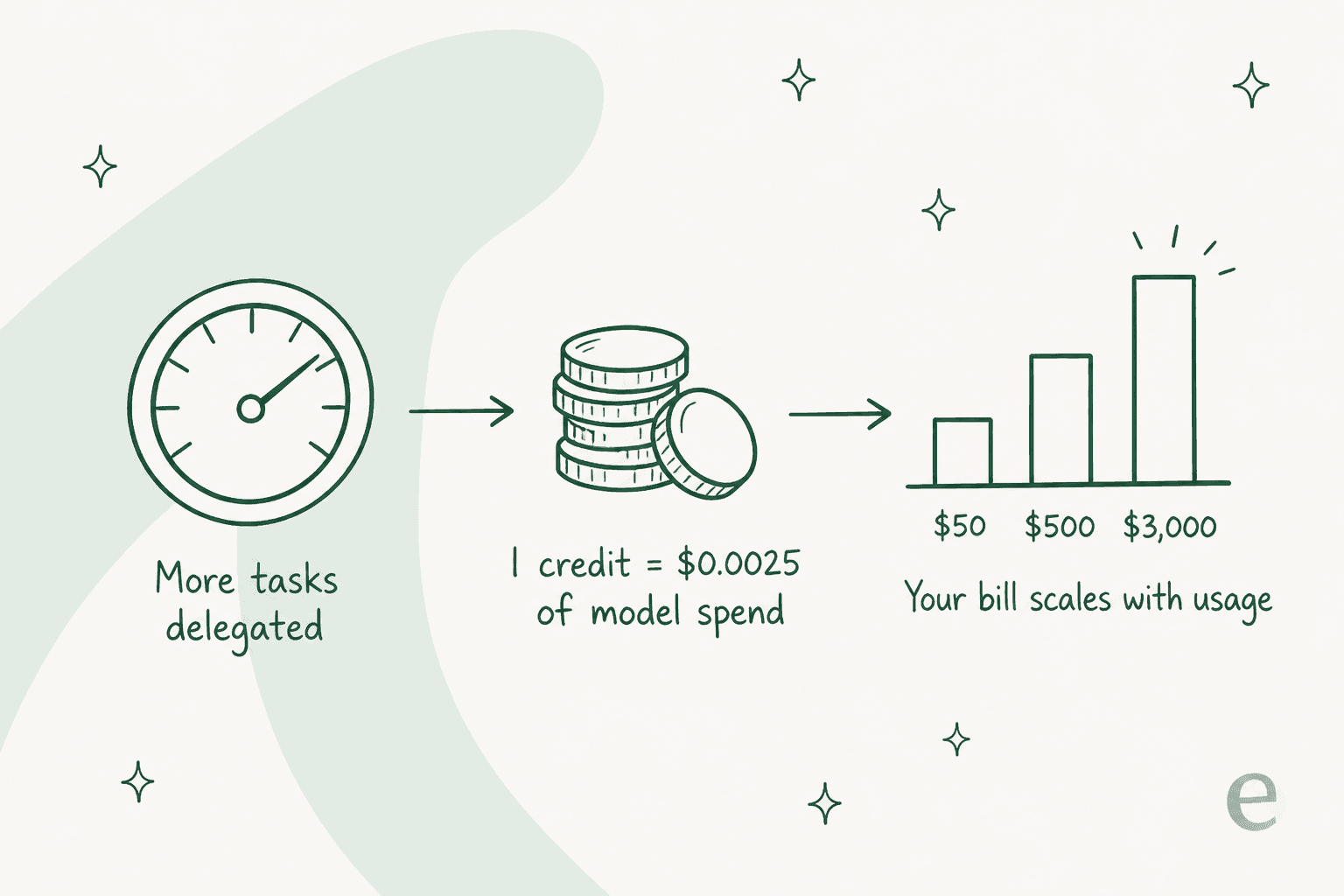
It's very new. Karloe is onboarding a "founding cohort," and I couldn't find public customer numbers, case studies, or third-party reviews on G2, Capterra, or Trustpilot as of August 2026. That's not a knock on the team, every tool starts somewhere, but if you're putting your ad spend and CRM in an agent's hands, a track record matters. It's also Slack-only today, with "more channels as they launch."
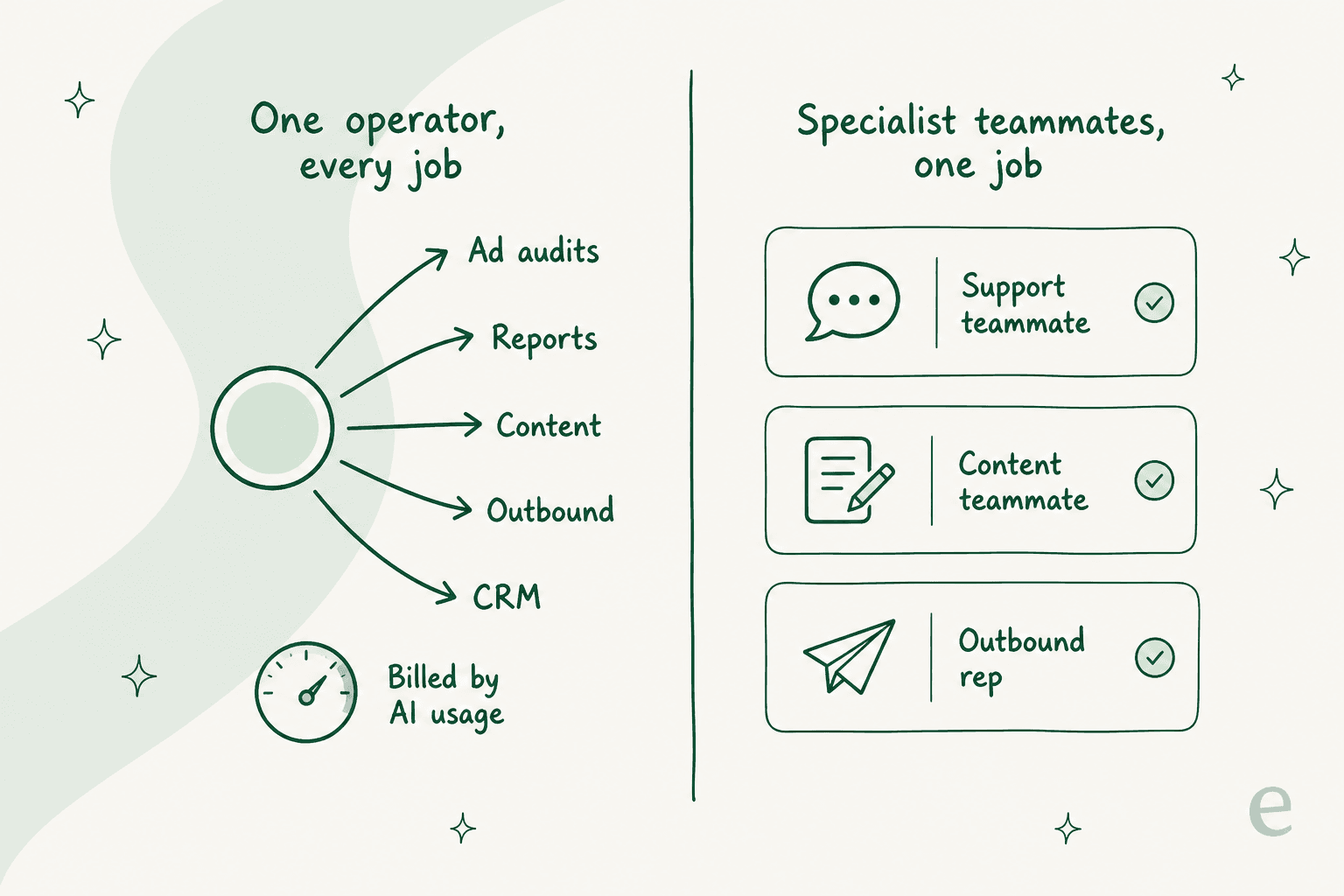
Here's the reframe I'd offer. Karloe is one AI operator trying to do every marketing job. The alternative model that's winning is the opposite: a specialist teammate hired for one job, priced by the outcome it produces. That's the lens the rest of this post uses.
How I picked these alternatives
I stuck to tools that actually do the work and ship an artifact, the way Karloe does, rather than chatbots that just advise. For each one I looked at what it's genuinely best at, the real pricing and billing unit (the part that decides your bill), and where it honestly falls short. I've grouped them by the job they own, because "best Karloe alternative" only makes sense once you know which part of the funnel is your bottleneck.
Karloe alternatives at a glance
Prices are the public starting points as of August 2026. The billing unit is the thing that actually moves your invoice, so I've called it out explicitly.
| Tool | Best for | Starts at | Billing unit | Free to start? |
|---|---|---|---|---|
| Karloe | An all-in-one Slack growth operator | $50/mo (20k credits) | Usage credits (model spend at par) | $50 in credits |
| eesel AI | Hiring a specialist teammate for one job | From $299/mo (500 credits), $4/blog | Fixed monthly credits, or per finished post | 100 free credits |
| Lindy | A general AI teammate inside Slack | $29.99/user/mo | Per seat + shared credits | 7-day trial |
| Copy.ai | A full GTM content + sales platform | $24/mo (Chat) | Workflow credits (variable) | No |
| Jasper | Enterprise on-brand marketing content | $59/seat/mo | Per seat | 7-day trial |
| AirOps | AI-search visibility + content ops | $0 (Insights) | Tasks (workflow steps) | Yes |
| Clay | Outbound data enrichment + prospecting | $167/mo | Actions + data credits | Yes |
| 11x | A fully autonomous AI SDR | Quote only | Undisclosed | No (demo) |
| Gumloop | No-code automations across your stack | $37/mo | Credits + 8% fee | 14-day trial |
| Sintra AI | A cheap all-in-one helper bundle | $15.60/mo (annual) | Flat fee + 250 credits/mo | No (14-day refund) |
Not sure which column is yours? This little picker points you to the right one.
1. eesel AI
Best for: teams whose real bottleneck is one job (customer support or content) and who want it done by a teammate priced per outcome, not per token.

Let me be straight about the fit, because it matters. eesel is not an ad-audit or outbound tool, so it won't cover every job Karloe does. Where it does compete, and win, is the two slices of "growth work" that a lot of teams actually mean when they say they're drowning: support tickets and content.
The idea is that you hire AI teammates rather than configure a platform. Two are shipping today: an AI helpdesk agent that joins your support queue and drafts or auto-sends replies, and an AI blog writer that does keyword research, reads primary sources, writes in your voice, and publishes on a schedule. Both learn from your existing knowledge, so, as the site puts it, "years of history becomes knowledge on day one."
The billing is the real contrast with Karloe. eesel support has one fixed monthly price with no seats and no platform fee: 1 credit per ticket or chat, no matter how many replies it takes, from $299/month for 500 credits. A full blog post run is $4, research and SEO included. It counts tickets handled, not resolutions, and you can turn on overage with a monthly cap you set. Because the price is attached to a finished artifact instead of model consumption, you can actually forecast the bill, which is exactly what the credit model makes hard.
There's earned experience behind this, too. eesel has run AI on live support queues for years, watched confident bots give wrong answers, and now simulates every rollout against your historical tickets before go-live. Smava handles 100,000+ tickets a month through it, entirely in German, and Gridwise resolved 73% of tier-1 tickets in the first month.
Pros:
- Pricing you can predict (from $299/month for 500 credits, $4/post), no seats or platform fee.
- A real free plan: 100 free credits, no card.
- Works in Slack, Teams, or its own dashboard, and plugs into your helpdesk.
Cons:
- Not a marketing generalist: no ad-account audits, paid-media ops, or outbound sequencing.
- Only two teammates are live today (an analyst is "coming soon").
- Deeper security like HIPAA is available on the Enterprise plan with a signed BAA (talk to eesel).
Pricing: Free plan (100 credits), then from $299/month for 500 credits (1 credit per ticket or chat) and $4 per blog post; add-ons include SSO and MFA from $199/mo and HIPAA on the Enterprise plan with a signed BAA.
Verdict: If your Karloe wishlist is really "get my content and support handled," eesel is the sharper, more predictable buy. If you need paid-media audits and outbound, pair it with a specialist below.
2. Lindy
Best for: small teams who liked Karloe's Slack-native, "talk to it like a teammate" feel and want a general-purpose agent for cross-functional work.
Lindy is the closest thing to Karloe in shape: an AI teammate that lives in Slack and iMessage, holds company context, and does multi-step work across thousands of integrations, with approval gates before any outward action. It's the strongest general pick here for "do a bit of everything," and its ease of use is the thing reviewers praise most.
The tradeoff is cost and predictability. Lindy is per-seat and metered on a shared credit pool, so both levers push your bill up. Every active user, including anyone who just @mentions it in Slack, takes a paid seat, and one "Big Build" task (1,000 to 2,500 credits) can drain a Plus seat's monthly allowance. Credits don't roll over. On G2, "expensive" is the single most common complaint tag.
Pros:
- Genuinely lives in your tools (Slack, iMessage, MCP, thousands of integrations).
- Model-agnostic with built-in human approval gates.
- Easiest general agent builder for non-technical users.
Cons:
- Per-seat plus non-rolling credits gets pricey fast.
- The credit unit is opaque; one big task can eat a month.
- A horizontal generalist, not purpose-built for support or content.
Pricing: Plus $29.99/user/mo (3,000 credits), Pro $99.99 (15,000), Max $199.99 (35,000), Enterprise custom. 7-day free trial.
Verdict: The best straight swap if you want Karloe's Slack-teammate experience with a longer track record. Just watch the seat-plus-credit math before you roll it out to the whole team.
3. Copy.ai
Best for: mid-market go-to-market teams that want to codify content and sales processes into repeatable AI workflows.
Copy.ai has repositioned from a solo copywriting tool into a full "GTM platform," running AI across prospecting, content, and lead processing through Workflows, Agents, Tables, and Chat. It's model-agnostic and claims 2,000+ integrations, so it slots into an existing stack. On the content side it's a legitimate Karloe alternative, and Chat words are unlimited on every tier.
Two things to weigh. First, there's a steep pricing cliff: a cheap $24/mo Chat plan, then nothing until Growth at $1,000/month. Second, Workflows burn a variable credit ("a specific amount of computational power" per run), which brings back the same forecasting problem as Karloe. Reviewers are happy overall but note output sometimes needs a human pass:
"This software saves me hours each week, as I am writing about mortgages, insurance, wills and other topics, it can be very difficult to create content with a different perspective or in a way that keeps it fresh."

Pros:
- A real GTM platform, not just a generator; automates multi-step processes.
- Model-agnostic with a large integration library.
- Unlimited Chat words even on the $24/mo entry plan.
Cons:
- Huge gap between $29/mo and the $1,000/mo Growth tier.
- Variable per-run credits make spend hard to forecast.
- No free plan, and long-form output can need editing.
Pricing: Chat $24/mo annual (5 seats), Growth $1,000/mo (20k credits), Expansion $2,000/mo, Scale $3,000/mo, Enterprise custom.
Verdict: A strong pick if you're a funded GTM team ready to operationalize workflows. For a solo founder, the jump to $1,000/month is a lot to swallow.
4. Jasper
Best for: marketing teams that need high-volume, on-brand content with real governance.
Jasper is the incumbent built specifically for marketing: brand voice, company knowledge, and audiences wrapped around purpose-built agents and content pipelines, with GEO (AI-answer-engine) optimization baked in. If your Karloe use is mostly the content engine and you care about staying on-brand at scale, Jasper is the mature option.
It's the least "operator-like" tool here, though: it produces content, it doesn't run your ad accounts or send your outbound. And there's no free plan, with real team pricing gated behind sales. Users echo a familiar caveat about long-form:
"I had the same experience with Jasper, quick drafts are okay, but structure and tone for blogs often felt off. I switched to manually editing..."

Pros:
- Purpose-built for marketing with a genuine brand-governance layer.
- Fast, high-volume generation across 30+ languages.
- Broad platform: agents, pipelines, GEO, API and MCP access.
Cons:
- No free plan; nothing below $59/seat/mo.
- Team features and pricing hidden behind Contact Sales.
- Long-form output can read generic and need editing.
Pricing: Pro $59/mo/seat billed yearly ($69 monthly, 1 seat); Business custom (Contact Sales).
Verdict: The safe enterprise choice for on-brand content volume. If you want researched, cited posts rather than fast drafts, compare it against the eesel blog writer first.
5. AirOps
Best for: content teams that want to win AI search (ChatGPT, Gemini, Perplexity) and run high-volume content ops.
AirOps is the most modern content pick here: it tracks your brand's visibility across AI answer engines and lets you build multi-step content workflows to act on the gaps, an approach it calls "content engineering." Webflow, Ramp, and Carta are named customers. If your growth problem is AI search visibility, it's doing something the others aren't.
It's built for operators, not one-shot output, so expect a learning curve. And the pricing is frustrating: beyond a free "Insights" tier, no dollar amounts are published, and the "tasks" unit (one per workflow step) burns fast on multi-step runs. As one practitioner put it:
"AirOps forces you to break SEO and AEO into atomic tasks, such as SERP analysis, gap finding, briefing, drafting, and optimization."
Pros:
- Ties AI-search visibility tracking directly to content action.
- Structured workflows with approval steps preserve brand voice at volume.
- Deep integrations (30+ models, 10+ CMSes).
Cons:
- No published pricing above the free tier; hard to budget.
- "Tasks" metering is hard to forecast on multi-step workflows.
- Real learning curve; the entry tier tracks ChatGPT only.
Pricing: Insights $0 (1k–10k tasks/mo); Solo and Pro "Start for Free" with no monthly price published; Pages and Enterprise are quote-only.
Verdict: The right call if AI-search visibility is the goal and you have someone to run it. Get a real quote early, because the "tasks" meter is the whole ballgame.
6. Clay
Best for: RevOps and outbound teams building an automated prospecting-and-enrichment engine.
If Karloe's outbound side is what you're after, Clay is the specialist. It's a spreadsheet-like workbench where you pull in leads, enrich them via "waterfalls" across 150+ data providers, run AI research with Claygent, then push to your CRM or sequences. Unlimited seats and a bring-your-own-API-keys option make it flexible.
It's powerful but build-it-yourself: there's a real learning curve, and the dual meter (Actions plus Data Credits) is the top complaint at volume. Operators have found the workaround, which tells you how the pricing bites:
"Clay gets wildly cheaper once you swap out Claygent (native scraper) for GPT, and swapping out Clay credits for API keys."
Pros:
- Waterfall enrichment across 200+ providers in one place.
- AI research agents plus intent signals built in.
- Unlimited seats and BYO-keys to cut data-credit cost.
Cons:
- Credit pricing is hard to forecast and spikes at volume.
- Steep learning curve; it's a toolkit, not turnkey.
- Not a support tool, and coverage varies by segment.
Pricing: Free ($0, 500 actions + 100 data credits/mo); Launch $167/mo annual ($185 monthly); Growth $446/mo annual ($495); Enterprise custom.
Verdict: The best pick if you want to own the outbound engine. If you'd rather someone else run it, look at 11x next.
7. 11x
Best for: teams that want a fully autonomous AI SDR to run outbound execution, not just draft messages.
11x sells "digital workers" for go-to-market. Its flagship, Alice, is an AI SDR that sources leads, researches them, writes personalized email and LinkedIn, follows up, and books meetings around the clock; a second worker, Julian, handles phone. It's backed by $70M+ from a16z and Benchmark, and it overlaps directly with Karloe's outbound job.
The honest catch: there's no public pricing at all. The /pricing page 404s and every CTA routes to a demo. Real users also frame it as leverage, not a full replacement:
"Alice actually handled outbound execution instead of just generating messaging ideas. It took some tuning at the beginning but once it was dialed in the pipeline activity became pretty steady. It works best when you treat it as support for reps rather than a full replacement."
Pros:
- Runs outbound execution end to end, not just messaging.
- Deep native integrations (Salesforce, HubSpot, Gmail, LinkedIn, Calendar).
- Enterprise posture (SOC 2, multilingual, 24/7).
Cons:
- No public pricing; you must book a demo to see numbers.
- Needs upfront tuning before it performs.
- Works best as rep augmentation, not a full SDR replacement.
Pricing: Quote-only, demo-gated. No published seat, lead, or meeting rate.
Verdict: The most "hands-off" outbound option, if you're comfortable going through sales and tuning it in. Budget-conscious builders will prefer Clay's transparency.
8. Gumloop
Best for: non-technical teams that want to build their own AI automations across the stack.
Gumloop is a no-code AI automation platform: you drag together agents and workflows across Salesforce, HubSpot, Gmail, Slack, and Notion, choosing the model per step. It raised a $50M Series B led by Benchmark, and non-developers rate it highly (4.8/5 on G2). Think of it as the "build the operator yourself" option versus Karloe's ready-made one.
It's more construction kit than teammate, so you're doing the wiring. And the pricing has two catches: a credit meter plus an 8% orchestration fee on top, and there's no free plan on the current page. Reviewers are refreshingly grounded about what it is: the honest read from users is that Gumloop won't magically automate your business, but it gives non-developers a solid way to build real AI workflows, which matches the 4.8/5 G2 rating for ease of use.
Pros:
- Genuinely easy for non-developers to build real workflows.
- Broad model choice, selectable per agent.
- Strong connector, trigger, and MCP ecosystem.
Cons:
- Credit plus 8% orchestration fee makes cost less predictable.
- No free plan visible on the current pricing page.
- Less capable than code-first tools for deep branching logic.
Pricing: Pro from $37/mo (20,000 credits, +8% orchestration fee, 14-day trial); Enterprise custom.
Verdict: Great if you want to build and own the automations. If you'd rather delegate the job than assemble it, a ready-made teammate fits better.
9. Sintra AI
Best for: solopreneurs and tiny teams who want a cheap, all-in-one bundle of AI helpers.
Sintra bundles a dozen named "AI employees" (social, SEO, copy, support, sales, data, e-commerce, admin) into one dashboard for a low flat price. You add business context once via "Brain AI," then delegate by chat or one-click use cases. For a founder who wants a little of everything without stitching tools together, it's the cheapest entry on this list.
The catch is depth and the credit ceiling. Every plan includes 250 monthly credits, shared across all helpers, and that's the real limit. Some users report the helpers spending credits on work they didn't ask for:
"The Sintra helpers are trained to drain your credits. They do things that you don't ask them to do and they make frequent mistakes that you have to use credits to tell them to fix."

Pros:
- Broad role coverage at a very low price.
- Fast, no-setup start; 100+ languages.
- One dashboard instead of a dozen subscriptions.
Cons:
- 250 shared credits/month is a real ceiling.
- Breadth over depth; the support helper drafts replies, it isn't a full helpdesk.
- Perpetual-"sale" pricing optics, and no free tier.
Pricing: Sintra X, one product priced by commitment: $48.50/mo (monthly), $23.60/mo (3-month), $15.60/mo (12-month). Each includes all helpers + 250 credits/mo. 14-day money-back guarantee.
Verdict: The budget all-rounder. Good for exploring what an AI helper can do; you'll outgrow the 250-credit cap and the shallow depth as you scale.
So which Karloe alternative should you pick?
The honest answer is that "one operator for all of marketing" is a nice demo but a hard thing to buy well, because the moment it does everything, the bill floats with your usage and the quality is only as good as the weakest job. I'd rather anchor to my actual bottleneck.
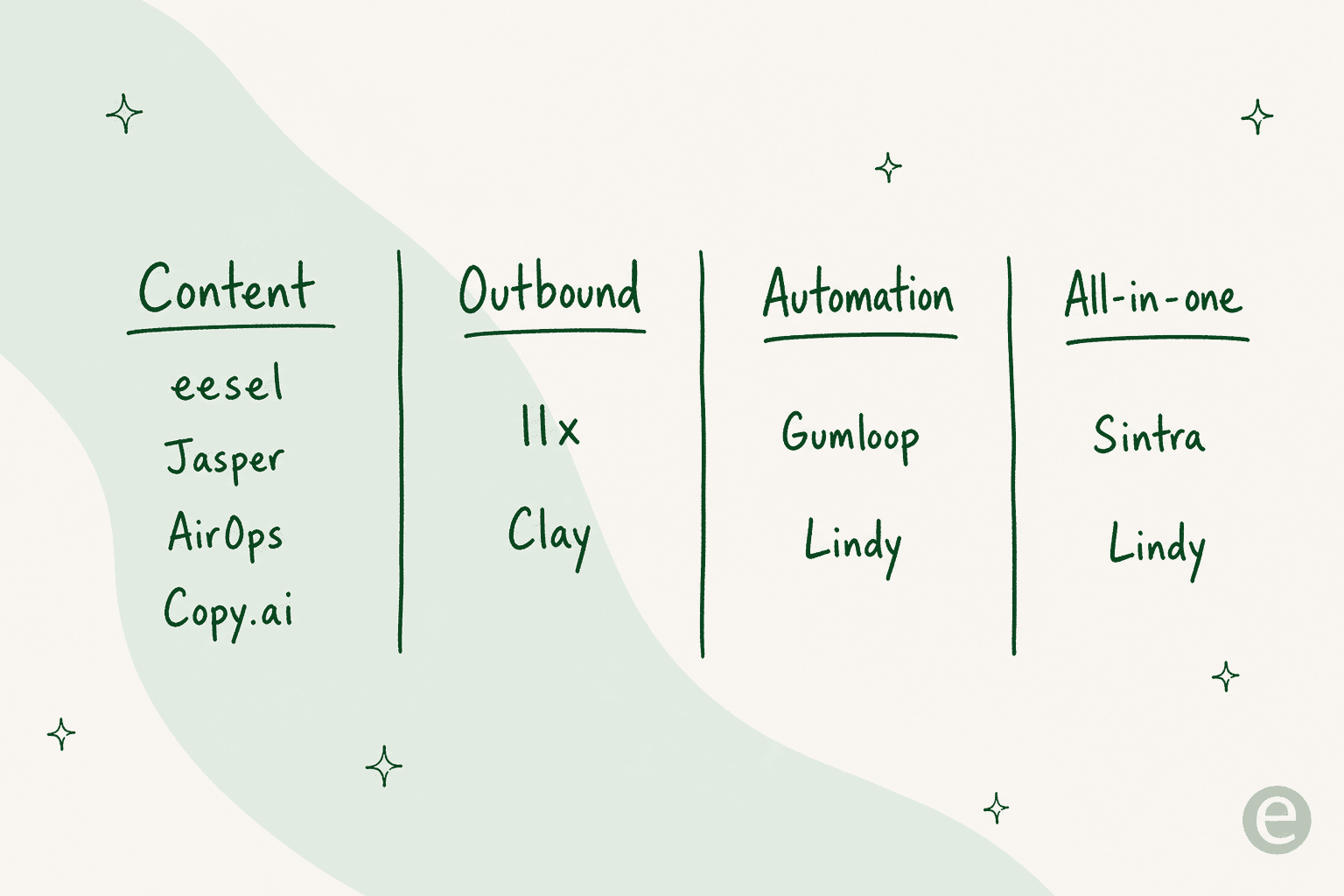
- Want the Karloe experience, more proven? Lindy is the closest Slack-native swap.
- Content is what's slipping? The eesel blog writer for cited posts priced per piece, Jasper for enterprise brand, AirOps for AI search.
- Outbound is the gap? 11x to hand it off, Clay to own it.
- You like building? Gumloop for no-code automations.
- Tiny budget, bit of everything? Sintra.
Try eesel
If the "growth work" you most want off your plate is really content or customer support, that's exactly the shape eesel is built for. Instead of one operator you meter by token, you hire a teammate for a defined job: the AI blog writer that researches and publishes cited posts, or the AI helpdesk agent that joins your queue and handles tickets. Both learn from your history on day one, and the blog writer is $4 a finished post and support is a fixed monthly credit plan from $299/month, so you always know the bill.
The best part is you can prove it before you commit: eesel simulates a rollout against your own past tickets, and the free plan gives you 100 credits with no credit card. Try eesel on one real task this week and see how a specialist teammate compares to a generalist operator.
Frequently Asked Questions
What is Karloe and what does it do?
Karloe is an AI marketing and growth operator that lives in Slack. You @mention it like a teammate and it connects to your ad platforms, analytics, billing, and CRM, then ships finished work back into the channel: ad audits, weekly reports, ad copy, and outbound follow-ups. If you mainly need one job done well rather than the whole funnel, a specialist like the eesel AI blog writer may be a better fit than a generalist operator.
How much does Karloe cost?
Karloe starts free with $50 in usage credits (no card), then the Team plan runs from $50/month for 20,000 credits, scaling up to 1.2M credits (about $3,000/month). One credit equals $0.0025 of model usage at provider list price, so your bill is essentially your token spend. Outcome-priced alternatives like eesel charge a fixed monthly credit price for support (1 credit per ticket or chat) or per finished blog instead of per token.
What is the best Karloe alternative for content?
For content specifically, look at the eesel AI blog writer (researched, cited posts priced per finished piece), Jasper for enterprise brand governance, and AirOps for AI-search visibility workflows. See our roundup of AI content writer tools for more.