8 best Empromptu alternatives in 2026: real prices, real limits

Kira

Katelin Teen
Last edited August 25, 2026

Why teams start shopping for Empromptu alternatives
Let me be fair to Empromptu first. The idea is a good one.
Most AI tooling assumes one of two things about you. Either you have nothing, so here is a builder, or you have a platform team, so here is an SDK. Empromptu aims for the gap in between, and the three-step pitch is honest in terms of what it promises: bring an AI app, they add the accuracy checks and the policies and the monitoring, then your team keeps whatever it learns. The homepage line that made me nod was "Most AI fails in production, not because the model was wrong, but because nothing was in place to catch it." Which is correct. I have watched it happen too.
The founder's own origin story is the same observation:
"We started Empromptu after burning through thousands of credits on AI builders and hitting the same problem: cool looking prototypes or demos that break with real users."

And practitioners say the same thing, without anyone asking them. This one is from a thread about why agent projects stall, and for Empromptu's whole premise it is the best one-line argument I found anywhere:
"Companies need processes, not tools. Once they deploy an agent, it should be boring and reliable. Measurable quality, failure alerts, "report to human" cases. All those wrappers make the enterprise-ready solution much more complicated than building an agent itself."

It is a young company as well. Empromptu raised a $2M pre-seed led by Precursor Ventures, announced in December 2025, with a team of roughly twelve. The founders are credible operators, too: Shanea Leven previously ran CodeSee, and CTO Dr. Sean Robinson built the optimization technology at Madrona Venture Studio.
So here is the part that actually sends buyers looking elsewhere.
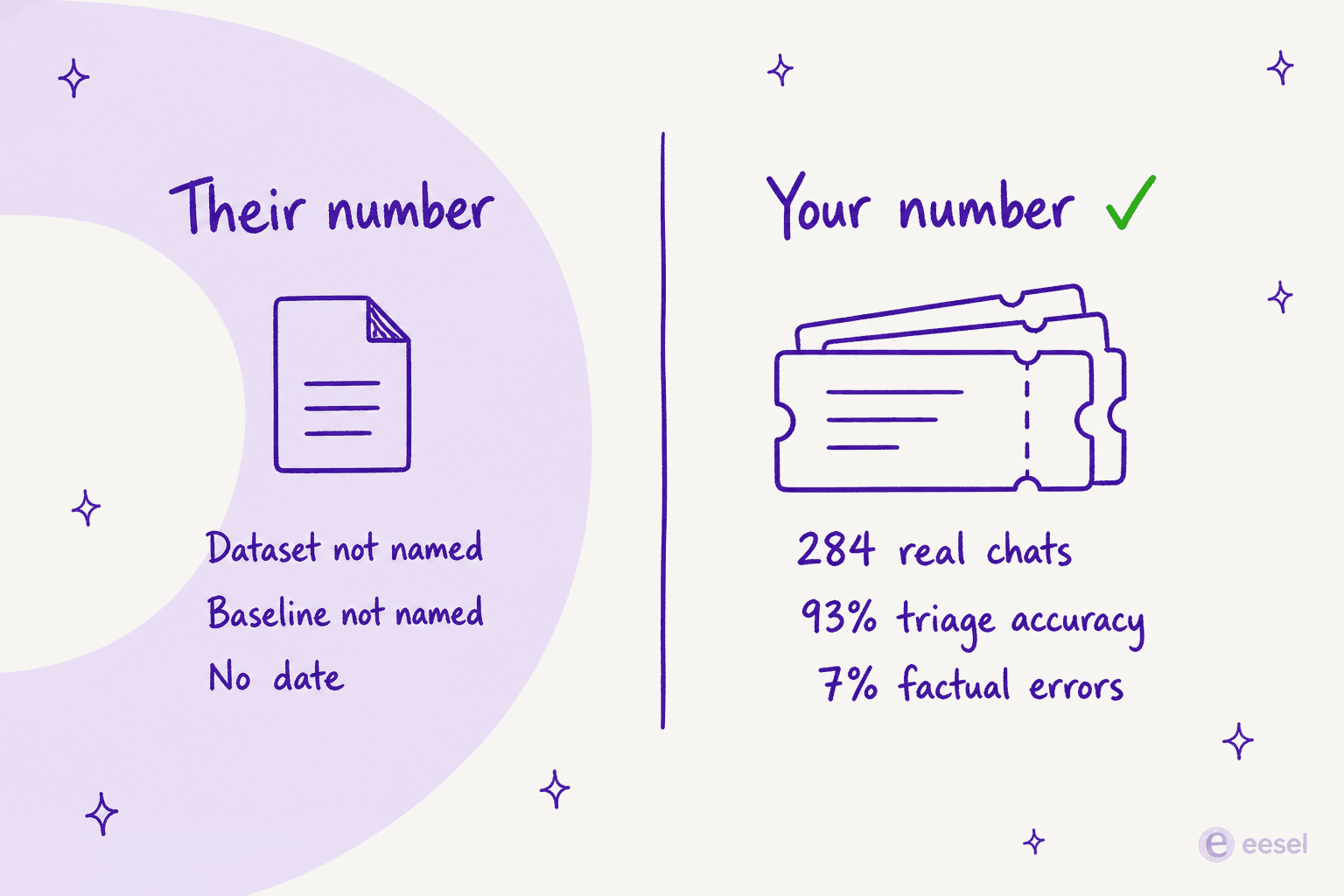
The accuracy number is self-graded, and the docs say so. Four framings sit on the homepage: a hard "98% production accuracy, measured", a hedged "up to 98% accuracy" in the FAQ, a "98% even with 250+ documents while other tools drop to 60-70%" comparison with no source, and a 98.2% figure inside a marketing UI mock. The help center uses "90%+" instead, across six articles, and then it explains the mechanism plainly enough: each active evaluation is a criterion in natural language, a model scores that criterion 0 to 10, then the scores get averaged. Change the criteria, the number changes. There is an Active/Inactive toggle per evaluation, and inactive ones do not affect the current score.
To Empromptu's credit the docs are candid on exactly this point. Evaluations Overview ships a troubleshooting entry titled "High Scores But Poor Real-World Performance", with the causes given as evaluations that do not match real use cases and missing criteria. The published guidance is more modest than the marketing as well: target 6.0 for new tasks, 7.5 once it is in production, and for critical ones 8.5. Nowhere do the docs claim that 9.0+ is typical. The documented optimization journey ends at 8.4.
"RAG included" is claimed but not specified. Four articles say retrieval ships in every app. Not one of the 73 names a chunking strategy, an index, a vector store, a connector list, a top-k setting or a citation config. There is one retrieval primitive documented, the text_embedder, and knowledge gets attached by way of describing it inside the build prompt. The Prompting collection actively advises users to stop naming things like vector databases, which is reasonable prompt engineering advice, though it does leave the retrieval configuration undocumented. If retrieval quality is the thing breaking your accuracy, and with support content it usually is, then that is exactly the part you would want specified. Our RAG versus fine-tuning breakdown covers why.
The compliance surface is thinner than the badges suggest. The hero strip reads SOC 2, HIPAA, Zero vendor lock-in. Their own about-page FAQ describes SOC 2 as in progress. The pricing page badges Enterprise as "Built for regulated industries" and then names no certification at all: no SOC 2, no HIPAA, no ISO 27001, no BAA, no data residency, no SLA. Across the whole set of 73 help-center articles, HIPAA appears exactly once, and it is an unticked box sitting on a pre-build worksheet. /security and /trust both return 404. The on-premise story is also narrower than "on-premise by default" suggests: the docs describe it as an enterprise sales motion and as hybrid by design, where the app runs locally but keeps a connection back to Empromptu for optimization. There is no air-gapped mode documented, and no statement of what crosses that boundary. For a healthcare or a fintech buyer this is not a dealbreaker. It is a security review you want to run before the pilot though, not after it.
The documentation is real but hidden. There is a full help center at docs.empromptu.ai, 73 articles spread across 15 collections, and honestly it is more useful than the marketing site. It is also set to noindex, which means a search engine will never send you there. Zero screenshots in it, as well. One article on model optimization ends mid-list after its Claude 3 Sonnet bullet, delivering none of the five sections its own intro promises, and its model roster still names GPT-4o and Claude 3 Opus in August 2026.
The marginal cost is unknowable. The bundled cost is unusually clear and I give credit for that below. The overage is the missing piece: no top-up price, no rollover policy, and no statement at all about what happens once the credits run out. So the plan you can size. The bill you cannot.
There is almost no third-party signal. Nine self-submitted Show HN and Launch HN posts between June and December 2025 drew 14 points between them and exactly one reply from a non-founder, which was a request to explain the difference from the alternatives in two sentences. G2 says outright that there are not enough reviews there to provide buying insight, and on Capterra or Trustpilot there is no listing at all. For a pre-seed company that is normal, and it is not a criticism from me. It does mean that every claim you end up evaluating is the vendor's own.
How I compared these tools
I am an engineer on eesel's product team, so I read these the way that I read a dependency. What is the unit. What is gated. What breaks once you scale it.
For each of the eight I pulled the vendor's own pricing page plus the docs, and I recorded five things:
- The billable unit, exactly as the vendor defines it. Credits and tokens, trace spans, checkpoints, tickets: these are not interchangeable things.
- Whether the overage rate is published. A published price sitting next to an unpublished overage is half of a rate card.
- Whether accuracy measurement ships built in, versus software testing or security scanning wearing the same coat. The difference between those two is real, and I unpack it in evaluating AI agent performance.
- Whether you can test on your own data before launch, not after.
- The real compliance answer: signed BAA, SOC 2 report type, self-hosting, data residency.
Two things which I deliberately did not do. I did not score anybody on a benchmark that I ran myself, because a benchmark on my data tells you nothing about yours, and that is the whole point of this post. Also I did not include Empromptu as one of the eight, it is the incumbent here.
The one question that sorts this whole list
Every tool below sits inside one of three lanes, and the lane is what decides everything else about the decision.
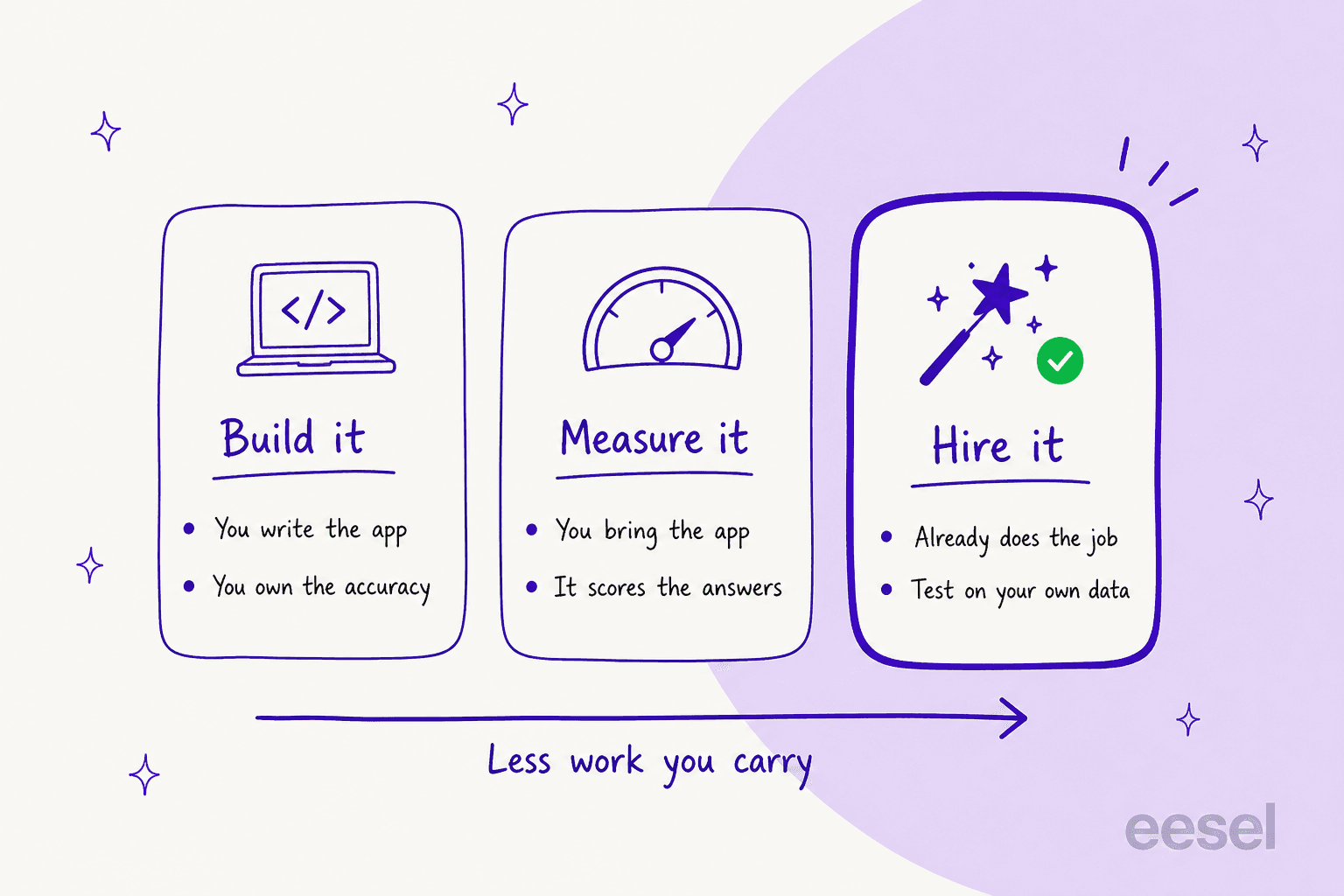
Build it. Lovable, Replit, Bolt and Google's platform hand you a way to produce an application. None of them will tell you whether its answers are right. This is not a flaw, it is just the scope of the thing. What it means is that you own the accuracy problem, and accuracy is where these projects go to die.
Measure it. Arize and Langfuse are the measurement layer, on its own. They are good at it, and honest in terms of the boundary too: Langfuse's docs define a task as "the application code that you want to test", which tells you plainly that the app is yours. Worth knowing: these two run the same underlying method Empromptu does, LLM-as-a-judge against criteria you write, so the mechanism itself is not the differentiator. The difference is whether you can point it at real historical traffic before launch, or only at whatever traffic arrives after.
Hire it. Glean and eesel are the buy lane. Work already done, integrations already there, and the only things you configure are scope and the guardrails. The reason this lane wins for support in particular is that the model was never the hard part, the retrieval and escalation logic were, which is exactly what I found comparing RAG against a raw LLM.
That lane has more names in it than fit here. If the job is customer-facing support and not an internal AI app, then the shortlist looks different, and Decagon or Sierra belong on it too.
The test I keep on coming back to is one that an engineer put better than I would:
"you shouldn't build anything that doesn't make YOUR beer taste better... your CS team buys a COTS solution for their tickets - why should you build an agent when there are multiple startups doing this? What, are you going to be better at it than those startups?"
One caveat that runs in the other direction, and I say it plainly because eesel loses deals to it: for a technical team, building directly on the Claude or OpenAI API is a real alternative, and not always the wrong call. Several eesel customers left to go do exactly that, among them an AR construction-tech firm and a DTC beauty brand that moved to the Claude API directly. Narrow use case, low volume, engineers with spare cycles: build it.
The counterweight comes out when somebody actually costs the build out:
"When I started deep diving into the BRD I realized there were several full startups, charging thousands if not tens of thousands of dollars monthly for what we were trying to build. When I brought this up to my manager and showed them examples, they said ya that BRD probably has to be redone"
Empromptu alternatives compared
| Tool | Best for | Lane | Published entry price | Billable unit | Overage published? | Accuracy evals built in? | Test on your own data pre-launch? | HIPAA / BAA | SOC 2 | Self-host or on-prem | Free tier |
|---|---|---|---|---|---|---|---|---|---|---|---|
| eesel AI | Hiring a support teammate | Hire | From $299/mo (500 credits) | Credit (1 ticket or chat) | Optional capped overage, $0.80 per extra credit | Simulation over past tickets | Yes | HIPAA via add-on, talk to us | Enterprise agreements | No | 100 free credits, no card |
| Gemini Enterprise Agent Platform | Regulated builds with a signed BAA | Build | Consumption only, no seat fee | Tokens plus per-component meters | Yes, full rate card | Evaluation service, synthetic personas | Synthetic only | Yes, BAA covers it | Yes | Google Cloud, VPC-SC, CMEK | $300 credit |
| Glean | Company-wide AI on internal knowledge | Hire | Not published, page now redirects | Flex seat plus FlexCredits | Credit rate not published | Agent evaluation in platform | Limited | HIPAA assessment | Type 2 | Private deployment | No |
| Arize AX | Measuring an app you already run | Measure | $0 free, $50/mo Pro | Trace spans plus GB ingested | No | Yes, LLM-as-a-judge | Offline on your datasets | Enterprise only | From Pro tier | Phoenix, ELv2 | Yes, 25k spans |
| Langfuse | Open-source evals you control | Measure | $0 Hobby, $29/mo Core | Units: traces, observations, scores | Yes, $8 per 100k | Yes, judges and experiments | Offline on your datasets | HIPAA-ready region, Pro+ | Yes | Yes, MIT licensed | Yes, 50k units |
| Lovable | Shipping the prototype fast | Build | $25/mo Pro | Credits | Yes, $0.30 per credit | No | No | No, no BAA signed | Type II plus ISO 27001 | No | Yes, capped |
| Replit | Build and host in one place | Build | $20/mo Core | Effort-based checkpoints | Credit packs only | No | No | Not documented | Type II | Enterprise single-tenant | Yes, limited |
| Bolt | Cheapest first draft | Build | $25/mo Pro | Tokens | Not published | No | No | Worded ready, not certified | Type 2 | Enterprise BYO cloud | Yes, 300K daily |
Two patterns come jumping out of that table. Only three of the eight publish an overage rate, and the three prototype builders which Empromptu positions itself against all publish a price, while shipping nothing that measures whether an answer is even correct. About that gap Empromptu is right. The argument is only over who should fill it.
If you are casting a net wider than these eight, then eesel's roundups of AI apps for work and no-code agent builders cover the adjacent shelves.
Size the Empromptu bill before you compare
Before the list, some arithmetic that is worth doing. Empromptu is one of the few vendors here publishing both the rate card and the credit consumption table, so converting dollars into operations does not need a sales call. A chat completion is 10 credits, a web-research call is 10, an optimization run is 10, and small operations like applying a prompt or creating an evaluation are 1 each.
Plug in your own volumes:
The thing worth staring at: the "Most Popular" Launch tier at $199 has the worst per-credit rate on the whole card, at $0.0796 against the $0.078 on Build. What the $199 actually buys is capability and not volume: production deployment, a custom domain, GitHub export, and then basic evals plus observability, all of it begins at that tier. The only real volume break arrives at Operate, where credits drop about 37% to $0.0499 each.
At 10 credits per chat, the free plan works out to 10 conversations a month and Build to 50, so a conversational workload burns through the allowance ten times faster than build operations do. Worth a check against a flat per-conversation rate before committing, the way that I did in this AI support cost analysis.
One more floor to plan around: Edge Case Detection, the scatter plot that finds your failure clusters, needs roughly 15 to 20 optimization runs before it shows a pattern, by the docs' own statement. At 10 credits each, that is 150 to 200 credits gone before the feature tells you anything, set against a 100-credit free tier. And the feature itself only starts at the $499 Operate plan.
1. eesel AI
Best for: teams who want the support job done rather than a platform to do it with.
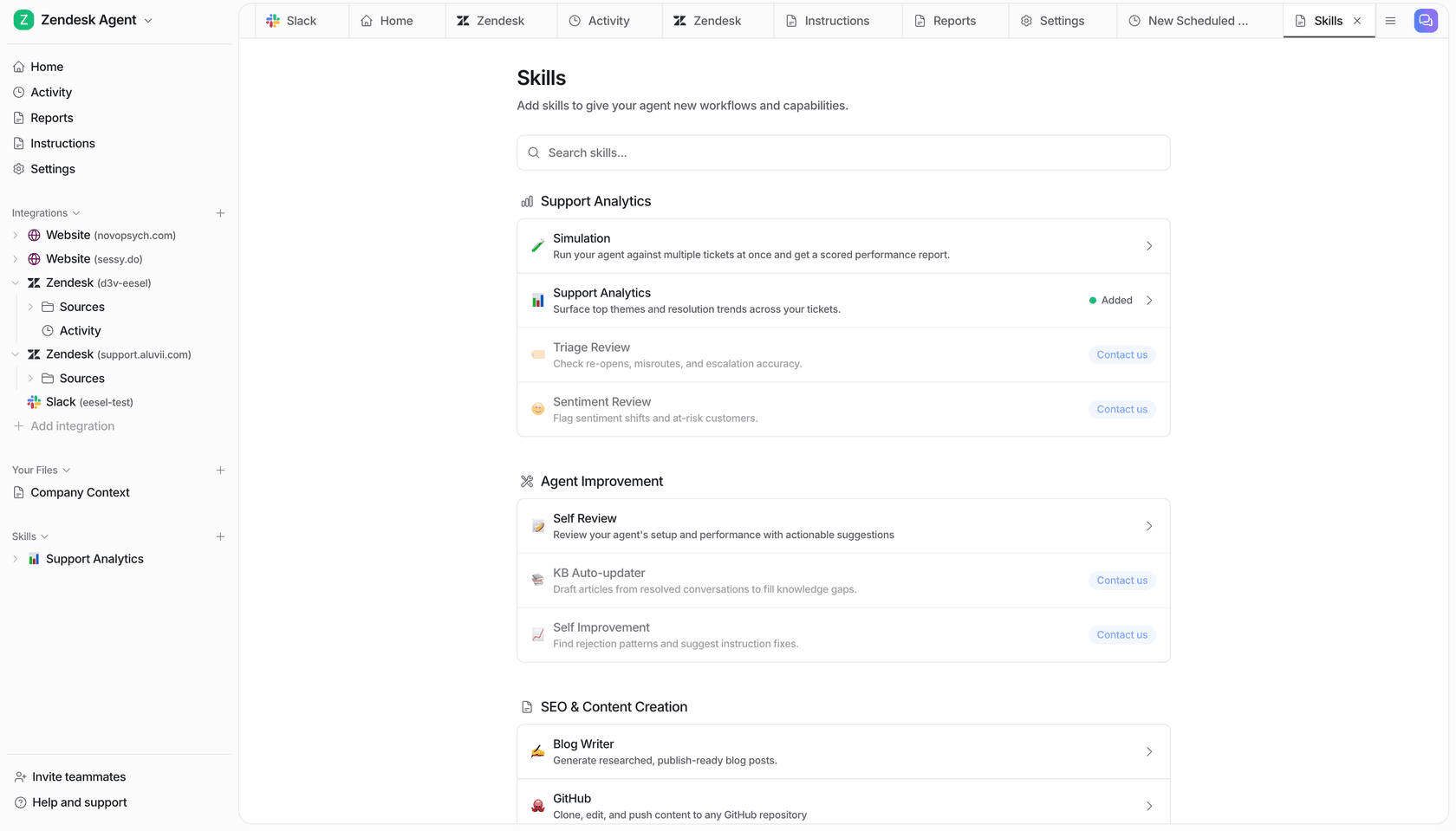
I work on this one, so please read the rest with that in mind. The honest positioning goes like this: Empromptu is the infrastructure, eesel is the employee. eesel is an AI teammate platform, and the current roster is an AI helpdesk agent and an AI blog writer. A teammate is not something you build. You hire one, and it arrives already knowing how to work a queue.
What it does. The helpdesk teammate connects into the helpdesk you already run, ingests the help center and the past tickets and your internal docs, then it drafts or resolves tickets inside the same tool your agents already sit in. Confidence thresholds and ticket-type exclusions decide what it touches. Escalation to a human is the default for anything outside scope.
The part that matters for this comparison. Before go-live it runs a simulation across your historical tickets, then hands a forecast back to you. So the measurement happens on your data. Not on the vendor's. The reasoning behind that design is in our build versus buy analysis, and the guardrails side in hallucination prevention for support.
Pricing
| Plan | Credits per month | Price |
|---|---|---|
| Free | 100 | $0, no card |
| Teammate | 500 | $299/mo |
| Teammate | 1,000 | $499/mo |
| Teammate | 2,500 | $999/mo |
| Teammate | 5,000 | $1,899/mo |
| Blog post draft | Per post | $4 each |
One credit is one ticket or chat, however many replies it ends up taking. There is no platform fee and no per-seat charge. The pricing page publishes the full list of batches, and above 5,000 credits you talk to the team. Paying a year upfront gets two months free. If you run out, you can turn on overage with a monthly cap you set ($0.80 per extra credit). SSO and MFA are add-ons from $199 a month, and HIPAA is available by talking to us. The free plan gives 100 credits with no credit card.
Pros
- Simulation on your own past tickets before launch, and that is the gap in every build-lane option here.
- The unit is one ticket, so the bill tracks the work and not a credit you have to convert first.
- Confidence-based routing and ticket-type exclusion, which is the objection I hear most from support leads.
- Live in a helpdesk in minutes rather than a sprint.
Cons
- HIPAA is an add-on you arrange by talking to the team, and there is no self-serve option. For a small healthcare team, that is a real gate.
- It is scoped down to specific jobs. If building an arbitrary AI application is the goal, this is the wrong lane, and Empromptu fits better.
- You pay for tasks whether the output was perfect or not, same as every credit-billed AI tool.
My take: if the AI app you were about to go build is a support agent, then do not build it. One customer said it better than I can:
"We could try to write our own LLM application but we didn't want to invest our time into that. We wanted something that we would not have to maintain."
Karel, GENERAL BYTES, from our case study
Skip it when the use case is a document-processing pipeline, or a predictive dashboard. Both sit on Empromptu's own buildable list, and neither is what a helpdesk teammate does.
2. Gemini Enterprise Agent Platform
Best for: regulated builds that need a signed BAA and a real compliance paper trail.
Note the rename first, before you go looking: what used to be Vertex AI Agent Builder now redirects over to Gemini Enterprise Agent Platform, which Google describes as "an evolution of Vertex AI". Agent Engine is now Agent Runtime, and Vertex AI Search is Agent Search.
What it does. Everything that Empromptu's Enterprise tier gestures towards, only unbundled and priced per component: model inference, a RAG Engine, Vector Search, grounding, an evaluation service, guardrails, and a managed agent runtime. The assembling part is yours.
Compliance, which is the actual reason to pick it. HIPAA BAA coverage explicitly lists the Agent Platform, Agent Search and generative AI on the platform. SOC 2 and ISO/IEC 27001:2022 both sit in scope, and FedRAMP High is available by way of Assured Workloads. VPC Service Controls and CMEK are supported as well, though RAG Engine is the weak cell here: no residency guarantee, and CMEK only in Spanner mode.
Pricing
| Meter | Rate |
|---|---|
| Gemini 3.1 Pro Preview | $2.00 in / $12.00 out per 1M tokens, under 200K context |
| Gemini 3.7 and 3.6 Flash | $0.75 in / $3.75 out per 1M, rising to $1.50 / $7.50 on 1 Jan 2027 |
| Grounding with Google Search | $14 per 1,000 grounding queries, 5,000 free per month |
| Grounding with your data | $2.50 per 1,000 prompts |
| Vector Search | $3.00 per GiB of data processed, $0.45 per GiB streaming inserts, plus node hours from $0.0938/hr |
| Agent Compute | $0.085 per vCPU-hour, 50 hours free per month |
| New-customer credit | $300 |
Pros
- The compliance answer a regulated buyer actually needs, in writing, with a BAA.
- No seat price and no platform fee. Pure consumption, so a quiet month is a cheap month.
- Every rate is published, including the awkward ones.
- The Gemini 3 pricing ladder gives you a cheap model tier for the boring 80% of traffic.
Cons
- The 200K context cliff reprices the whole request at long-context rates, including the tokens under the limit.
- No helpdesk connectors exist. No Zendesk, Freshdesk, Gorgias or Front. Every integration is code that you write and then maintain.
- The evaluation service simulates synthetic personas, not your own historical tickets, so what it tells you is how the agent handles an imagined customer.
- Several meters have not started billing yet, so today's invoice is not steady state.
- Google markets its packaged app as needing "no IT setup", which is a quiet admission about the platform.
My take: the right answer when you have a platform team plus a compliance officer, and the wrong one if you were hoping to skip both of those. Vector Search costs scale sharply too: Google's own example prices one billion vectors at $5,910 a month. Read our RAG pipeline walkthrough before assuming the retrieval half is the easy half, and weigh up the Gemini alternatives if you are not already on Google Cloud.
3. Glean
Best for: rolling AI across a whole company's internal knowledge, with permissions intact.
What it does. Enterprise search plus agents across 275+ connectors, and the strongest permissions story on this list. The mechanism has a name, "permission mirroring": connectors ingest each source's ACLs and group memberships at crawl time, and Glean evaluates the signed-in user against those mirrored permissions at query time. Agents run with the triggering user's identity, not the author's.
Compliance. SOC 2 Type 2, ISO 27001:2022, ISO/IEC 42001:2023 for AI management, a HIPAA assessment report, GDPR, and TX-RAMP Level 2. FedRAMP is not claimed anywhere, worth noting that, because TX-RAMP reads adjacent to it while not being the same thing at all. For how this compares to lighter options, see our knowledge retrieval tools roundup.
Pricing
| Item | What is published |
|---|---|
| Plan prices | None. glean.com/pricing now returns a 301 to the homepage |
| Billable unit | Enterprise Flex Seats per user per month, plus pooled FlexCredits |
| FlexCredit dollar rate | Not published |
| Fast Mode queries | Unlimited |
| Thinking Mode, standard models | 100 per user per week included, then meters |
| Glean Agent Run | ~7 FlexCredits median, ~114 at p90 |
| Deep Research | ~33 median, ~144 at p90 |
| Platform fees | Two annual site-wide fees: Glean Protect+ and Premium Support |
Pros
- Permission mirroring is the real thing, not a filter bolted on afterwards.
- 275+ connectors, so the integration work is already done.
- Glean publishes its own deployment timeline of roughly 1 to 3 weeks, which is unusually candid.
- Agent creation, testing and sharing do not meter. Only runs do.
Cons
- The pricing page is gone. Every dollar figure now comes from a sales conversation.
- FlexCredits are a full rate card denominated in an unpriced unit, so you can compare operations to each other but not to money.
- Seats are "designed to be deployed to every employee", which sets the floor high.
- Two separate site-wide annual platform fees on top of seats.
My take: the right buy when the problem is company-wide knowledge access and there is a procurement process to match it. If the problem is one support queue, this is a heavy instrument, and our Glean pricing breakdown and Glean reviews go into where it lands. Note also that the p90 on an Agent Run is sixteen times the median, so a workload looking cheap in the pilot can bill very differently once it is in production.
4. Arize AX
Best for: measuring an AI application you already built and run yourself.
Empromptu's founder named this one directly on Hacker News, filing it under tools that "require dedicated teams most startups don't have". Half right. Arize's free tier and the open-source Phoenix project put real evaluation within reach of one solo engineer. The other half of it is fair enough, because this measures rather than builds.
What it does. Tracing and evaluation and observability, for LLM apps. LLM-as-a-judge evaluators, custom evals, then datasets and experiments, online as well as offline. Phoenix is the open-source core under ELv2, self-hostable locally, in Docker or on Kubernetes.
Pricing
| Plan | Price | Included | Retention | Deployment |
|---|---|---|---|---|
| AX Free | $0 | 25k trace spans/mo, 1 GB ingestion | 15 days | SaaS |
| AX Pro | $50/mo | 50k trace spans/mo, 10 GB ingestion | 30 days | SaaS |
| AX Enterprise | Custom | Custom | Custom | SaaS or self-hosted |
| Phoenix (OSS) | Free, ELv2 | No meter | Yours | Your infra |
Pros
- Users, evaluations, experiments and annotation queues are unlimited on every tier. The meter is spans, not people.
- Phoenix is a serious open-source project, and self-hosting keeps sensitive traces on your own infrastructure.
- Offline evaluation against your own datasets, which is the closest the measure lane gets to a pre-launch test.
- Data region choice is identical across all tiers rather than being an upsell.
Cons
- There is no overage rate published anywhere at all. The page says "included 25k/month" and stops.
- HIPAA, SSO, audit logs, custom code evaluators and self-hosting are all Enterprise-gated.
- SOC 2 Type II and GDPR start at Pro, not Free.
- Arize's own table contradicts itself on Signal: the Core Platform row gives Free and Pro an allowance while the Observability section lists failure-mode detection as Enterprise-only.
- It never builds or hosts your app. The docs state the prerequisite flatly: you need data flowing in and an LLM provider configured first.
My take: the right pick when the app already exists and the missing piece is honest numbers about it. Treat it like a complement to a builder and not a replacement for one, alongside the wider set of LLM tracking tools and the tuning loop in LLM optimization. It will not tell you whether to launch. Only what happened after you did.
5. Langfuse
Best for: teams who want the evaluation layer and want to own the box it runs in.
What it does. Tracing, prompt management, datasets, experiments, annotation queues and LLM-as-a-judge scoring. On the boundary the docs are refreshingly literal: a task is "the application code that you want to test". The only things that execute inside Langfuse are the playground and prompt experiments, plus the judge calls.
Self-hosting is the headline. Langfuse OSS is MIT-licensed and free with unlimited usage, and it runs on the same infrastructure as their cloud, no scalability limits. Nine governance features need an enterprise license key: project-level RBAC, protected prompt labels, retention policies, audit logs, server-side data masking, UI customization, organization creators, the org management API with SCIM, and the instance management API. For a regulated team that wants everything sitting in its own VPC, this is the cleanest answer on the whole list.
Pricing
| Plan | Price | Included units | Overage | Users | Data access |
|---|---|---|---|---|---|
| Hobby | Free, no card | 50k/mo | None | 2 | 30 days |
| Core | $29/mo | 100k/mo | $8 per 100k | Unlimited | 90 days |
| Pro | $199/mo | 100k/mo | $8 per 100k | Unlimited | 3 years |
| Teams add-on | +$300/mo | Add-on | - | - | - |
| Enterprise | $2,499/mo, yearly commit | 100k/mo | $8 per 100k | Unlimited | 3 years |
One unit means a trace, or an observation, or a score. The graduated overage runs $8 per 100k up to 1M, and then $7, $6.50 and $6 as the volume climbs.
Pros
- MIT self-hosting with no usage ceiling, which is rare and very generous.
- The overage rate is published, graduated, and easy to model.
- Unlimited users on every paid tier.
- Framework-agnostic, so it sits beside whatever you built rather than replacing it.
Cons
- Every paid tier includes the same 100k units and the same $8 overage. What the $29 to $199 to $2,499 ladder buys is retention and rate limits, security and support. Never volume.
- Its own evals bill you: judge scores, annotation queues and experiments all count as units.
- HIPAA is a "HIPAA-ready region" on Pro and above, which is a deployment option rather than a certification.
- Okta SSO and project-level RBAC on Cloud Pro need the $300/mo Teams add-on, so a Pro team needing Okta is really $499/mo.
- Self-hosted Enterprise pricing is additive to your ClickHouse plan, by Langfuse's own statement.
My take: my default recommendation in the measure lane, and mostly it is because of the license. If what appealed to you about Empromptu was the on-premise deployment and owning your own tooling, Langfuse delivers that half outright, and it costs nothing to try. The other half, which is the app itself, you still have to write yourself. Our LangChain and LangGraph comparison covers what usually goes in that gap.
6. Lovable
Best for: getting a working prototype in front of someone this afternoon.
Empromptu's own comparison page argues that "vibe coding tools get you to demo. They don't get you to production." On the accuracy point specifically, this is a fair reading of what Lovable actually ships.
What it does. Describe an app in the chat, get back a working full-stack application, with hosting and auth and a database. Git sync to GitHub and GitLab comes on every plan, Free included, and the code is yours in writing.
On evaluations, precisely. There is no eval harness, no golden dataset, no accuracy metric and no simulation, on any plan. What it does ship is software testing (browser testing, Vitest, edge-function tests) and security scanning, which are easy to mistake for evals. What they measure is whether the app runs. Not whether the AI is right. RAG is a build target here as well: you get embedding models so that retrieval is yours to build, and there is no managed ingestion or retrieval-quality reporting.
Pricing
| Plan | Price | Credits | Notes |
|---|---|---|---|
| Free | $0 | 5 daily build credits, capped at 30/mo | No code download, no custom domains |
| Pro | $25/mo | 100/mo | Code edit and download unlock |
| Business | $50/mo | 100/mo | Same credits as Pro, adds SSO, RBAC, security center |
| Enterprise | Platform fee plus volume, quote-only | Volume-based | No daily build credits |
The overage is published: $0.30 per credit on Pro and $0.60 on Business. Plan credits expire after two months, top-ups after twelve. Both ladders run to 10,000 credits, at $2,250/mo on Pro and $4,300/mo on Business.
Pros
- Fastest path from an idea to something clickable.
- Overage rate published on both tiers, which not everyone here manages.
- SOC 2 Type II, ISO 27001:2022 and GDPR with a DPA.
- Unlimited members on every plan, and Git sync even on Free.
Cons
- HIPAA is explicitly out. The enterprise docs state Lovable does not sign BAAs and is not HIPAA-compliant, which rules it out for Empromptu's core healthcare buyer.
- No VPC, single-tenant or self-hosted option. It is multi-tenant with logical isolation and region pinning.
- Business is exactly twice Pro for identical credits, so you are paying for governance features.
- Top-ups carry roughly a 20% premium over the subscription-implied credit rate.
My take: use it for the demo, and then decide separately on who owns production. Our Lovable review has the longer version, and Emergent is the closest peer if this shape appeals but the compliance answer does not.
7. Replit
Best for: building, hosting and running the thing in one place.
What it does. A full cloud development environment, with an agent that writes and runs and deploys. Zip download plus two-way GitHub sync plus shell access make the code ownership real, with one wrinkle to it: Enterprise admins get a "Ban source code export" toggle.
On evaluations. I searched Replit's own full docs index, all 412 entries, and there are zero hits for "eval" and no pages on accuracy, RAG, retrieval, embeddings, ground truth, benchmarking or hallucination. Three features do look like evals while not being evals: App Testing drives a real browser but checks whether the app runs, built-in code review checks code quality, and security scanning checks vulnerability posture.
Pricing
| Plan | Price | Unit | Included | Overage |
|---|---|---|---|---|
| Starter | Free | Daily agent credits | Amount never published | Lite builds, 1 app, expires at 30 days |
| Core | $20/mo, $18 annual | Effort-based checkpoints | "$20 towards most powerful models" | Credit packs |
| Pro | $100/mo, $90 annual | Effort-based checkpoints | "$100 towards most powerful models" | Credit packs, roll over 2 months |
| Pro higher tiers | $215 / $425 / $825 / $2,000 | Same | Credit amount not labelled per price point | Same |
| Enterprise | Custom | Seats plus usage | Not published | SSO/SAML, single-tenant, static IPs |
Credit packs are the one overage path there is: $100 for $100, $300 for $290, $500 for $480, $1,000 for $950. They expire in six months.
Pros
- One environment for building, testing, hosting and deploying.
- Genuine code portability through zip download and GitHub sync.
- Model spend passes through at the provider's public API rate rather than being marked up.
- SOC 2 Type II is Replit's own, not inherited.
Cons
- The meter is "effort", and effort has no published rate. Replit's docs link an estimator app instead of a rate card.
- HIPAA is absent entirely from the docs, security whitepaper and trust center.
- ISO 27001 in the compliance list belongs to Google Cloud, listed as infrastructure assurance rather than Replit's own.
- The docs contradict themselves on agent mode names, with Free/Power/Max in some pages and Lite/Economy/Power in others.
- Single-tenant and SSO are quote-only Enterprise gates.
My take: the strongest build-and-host story out of the three prototype builders, and also the hardest one to forecast a bill for. A meter you cannot quote is a real problem on a regulated project, where the budget has to get approved before anything starts. Our Replit pricing breakdown and Replit review have the deeper read.
8. Bolt
Best for: the cheapest possible first draft, with clean code ownership.
What it does. Browser-based prompt-to-app building from StackBlitz, with two-way GitHub sync, repo import and off-platform deploy. Ownership gets stated plainly: all the code you create is your own code. Supabase and Netlify are both documented as alternatives to Bolt Cloud too, so the lock-in seam sits in the infrastructure and not in the code.
On evaluations. None. I read the complete docs index, and there is no page there on evaluations or testing, none on accuracy scoring, benchmarking or RAG. The one measurement-shaped feature is a security audit of the app it built, and for a wrong output the safety net is version-history rollback.
Pricing
| Plan | Price | Tokens | Notes |
|---|---|---|---|
| Free | $0 | 300K/day plus 1M/month | Site goes offline at cap, Discord-only support |
| Pro | $25/mo, $216/yr | 10M/mo | No daily limit, custom domains |
| Pro 50 | $50/mo, $540/yr | 26M/mo | |
| Pro 100 | $100/mo | 55M/mo | |
| Pro 200 | $200/mo | Not published | Confirmed in a billing doc example |
| Teams | $30/mo per member | Per tier, per seat, never pooled | Required for your own design system |
| Enterprise | Quote-only | - | SSO, audit logs, BYO AWS or Azure |
Pros
- Cheapest real entry point in the build lane, with a usable free tier.
- Code ownership and portability are stated clearly and backed by two-way sync.
- Enterprise supports bringing your own AWS or Azure, which matters for data control.
- A documented import path from Lovable, if you started there.
Cons
- The meter is the model's token, and Bolt's own FAQ says most usage comes from syncing your project's file system to the AI, so cost climbs as the codebase grows.
- Plan tokens expire in two months and only survive while you keep paying. Cancel and rollover tokens die at cycle end.
- The top-up rate is unpublished and only visible after login.
- HIPAA and FedRAMP are worded "ready" rather than certified, and only SOC 2 Type 2 carries an actual compliance claim. GDPR appears nowhere in the product docs.
- The annual discount contradicts itself between pages, at "up to 28%" on pricing and 10% in the billing doc.
My take: the cheapest way of finding out whether the idea is worth building, and the least suited to carrying it afterwards. If the parent company is what you are researching, our StackBlitz pricing and StackBlitz alternatives pages cover that side.
What a measured accuracy number actually looks like
I have spent enough time around live support queues to know that the confident-sounding bot is the dangerous one. Which is why every eesel rollout simulates against historical tickets first, before it ever touches a customer.
Here is what came out of one of them, for a German online jewellery retailer that runs about 1,000 tickets a month across Zendesk and Shopify. Across 284 real chats plus a 100-ticket cross-validation, this is what the report said: 93% triage accuracy, 100% spam detection with zero false positives on an inbox that was 22% spam, 88% draft directional accuracy, and a 7% factual error rate. Per category, draft usefulness ran 93.8% on returns and refunds, 96.4% on warranty claims and 100% on product enquiries.
Look at what makes that one different from "98%". The dataset gets named. So does the volume. And the misses get published in the same breath as the wins, because a measurement with no error rate attached is a marketing figure.
That is the standard I would hold every vendor on this list to, eesel included in that. Ask for the dataset, then insist on re-running the thing on yours.
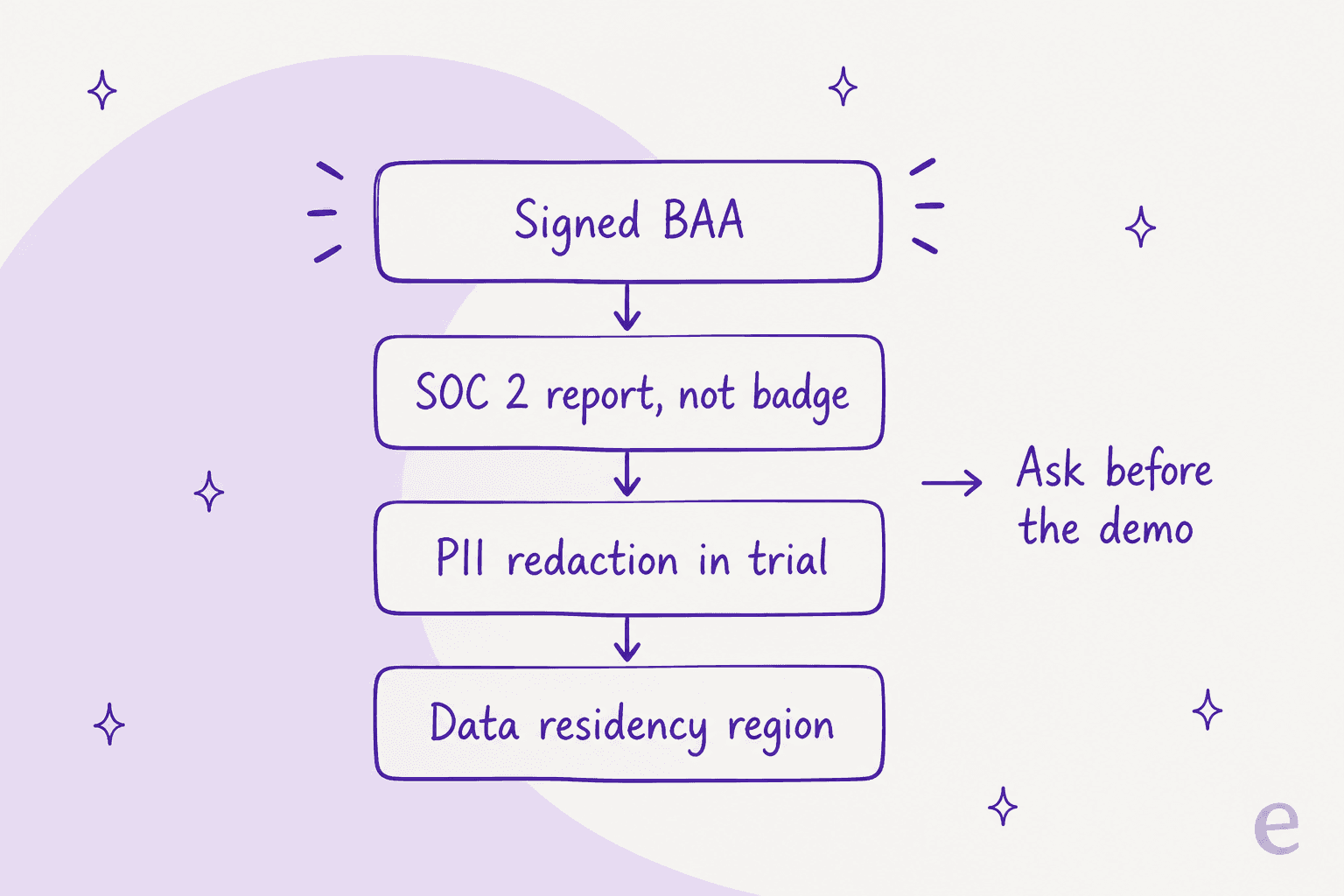
And if the buying is for a regulated team, run the four gates above before the demo, not after it. eesel has lost deals on all four of them. A US healthcare platform on Zendesk hard-blocked on HIPAA and a BAA during the call itself. A podcasting platform on Freshdesk could not proceed without SOC 2. A media company doing about 1,000 tickets a week made PII redaction in the trial its top objection. Those conversations come much cheaper in week one than they do in week six, whichever vendor you end up picking. My notes on HIPAA compliant AI and HIPAA compliant platforms list the questions worth sending ahead.
Try eesel
If the AI application sitting on your roadmap is a support agent, then the fastest route is to not build it. eesel's AI helpdesk teammate plugs into the helpdesk you already run, learns from your help center and past tickets, and starts drafting or resolving inside the queue your agents already live in. Plans start at $299 a month for 500 credits (1 credit per ticket handled), with no platform fee and no seats, plus a free plan of 100 credits to start and no credit card.
The part that is relevant to everything above: you simulate it on your own historical tickets first and you see the forecast before a customer ever does. Confidence thresholds and the ticket-type exclusions decide what it is allowed to touch, which makes the rollout gradual by design instead of an all-at-once switch.
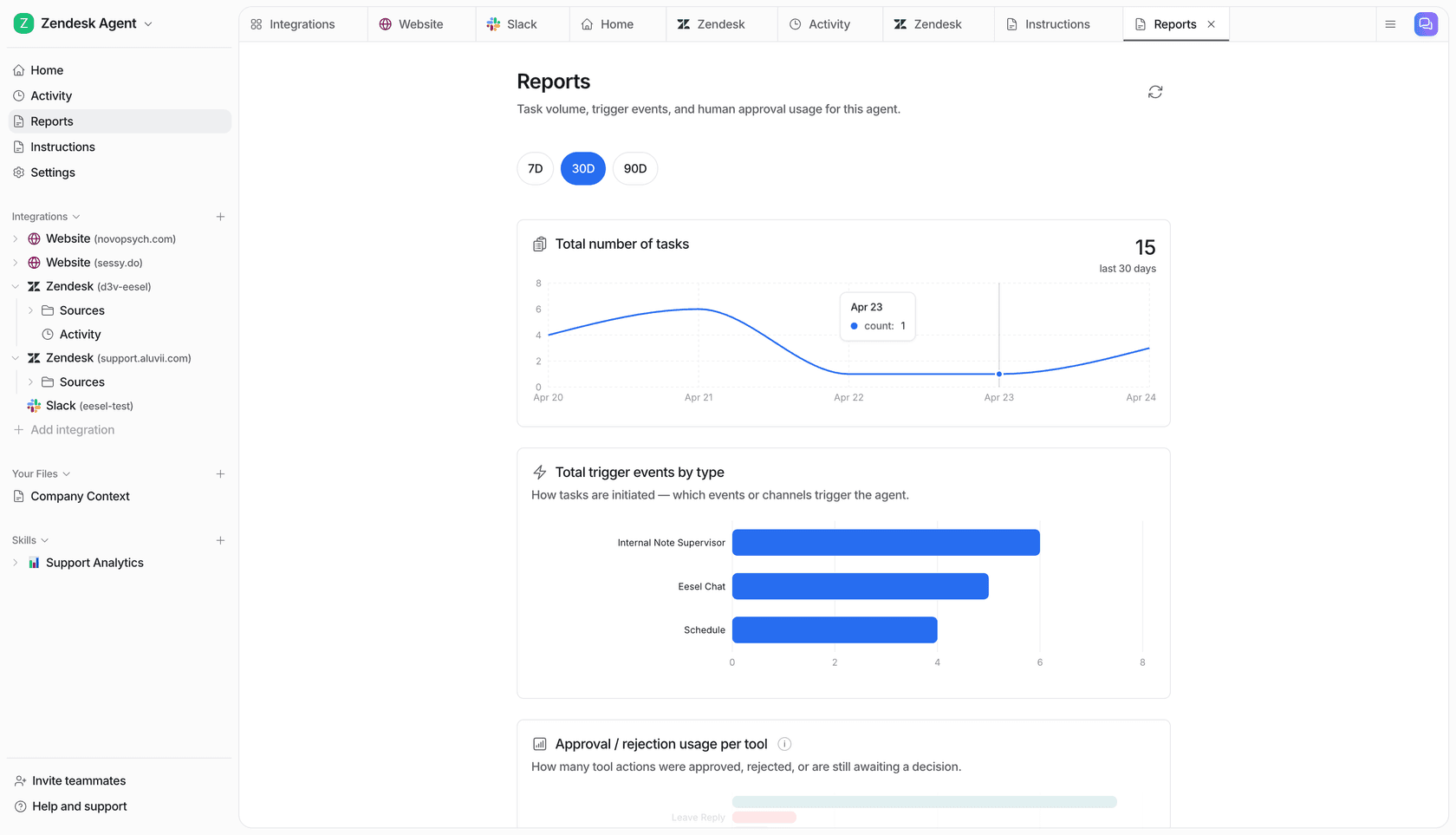
Want the forecast on your own tickets before committing to anything? Try eesel free, or read how eesel measures AI support ROI so you know what to look for in the report.
Frequently Asked Questions
What are the best Empromptu alternatives in 2026?
How much does Empromptu cost?
Is Empromptu HIPAA compliant?
/security and /trust return 404. For a regulated rollout, ask for the signed BAA and the actual SOC 2 report before the demo. Our notes on HIPAA compliant AI and SOC 2 for support chatbots cover what to ask for.What is the difference between Empromptu and Lovable or Replit?
Are there free Empromptu alternatives?
Can I test an AI agent on my own tickets before going live?
What does a 98% AI accuracy claim actually mean?
Which Empromptu alternative is best for customer support specifically?


Article by
Kira
Kira is a writer at eesel AI with a Computer Science background and over a year of hands-on experience evaluating AI-powered customer service tools. She focuses on breaking down how helpdesk platforms and AI agents actually work so that support teams can make better buying decisions.