Empromptu pricing in 2026: every plan, every credit, and the missing rate

Rama Adi

Katelin Teen
Last edited August 26, 2026

What Empromptu actually charges
I ship metered APIs for a living, so with any rate card the first thing I do is skip past the tier names and go straight down the endpoint list. Empromptu's is unusually candid on that front: the credit table is denominated in literal endpoint names, things like builder.chat and optimizer.run_optimization. That amounts to a confession about what the product expects you to call, and about how often. It is the same read I run on any AI agent platform before I trust its tier names.
Here is the published card, as it stands today.
| Plan | Price | Credits/mo | Projects | Seats | Deploy to production? | Evals | Notable gates |
|---|---|---|---|---|---|---|---|
| Explore | $0 forever | 100 | 1 | not stated | No | None | Limited builder messages, limited app preview, Empromptu watermark |
| Build | $39/mo | 500 | 3 | not stated | No | None | Builder access, app preview, basic templates, basic data upload, basic app export, limited AI runs, community support |
| Launch ("Most Popular") | $199/mo | 2,500 | 10 | not stated | Yes | Basic | Custom domain, GitHub export, simple API integrations, basic observability, prompt version history, app usage logs, email support, credit top-ups |
| Operate | $499/mo | 10,000 | 25 | 5 | Yes | Advanced | Edge-case detection, basic optimization, app analytics, shared workspace, role-based permissions lite, priority support, monthly credit reporting |
| Enterprise | Custom | not stated | not stated | not stated | Yes | Advanced | Advanced integrations, SSO/SCIM, custom deployment, Alchemy models, governance and AI policies, security review, expert support |
Every paid tier is billed on a monthly cycle. No annual price, no annual discount, and no currency other than USD appear anywhere on the page. Worth flagging that for anyone who, like a buyer I spoke with recently, wants a contractual price lock after watching a previous vendor's rate more than double: for now there is simply no annual commitment to lock into.
Credit where it is due, though. Publishing a price is common enough. Publishing the price and the unit conversion behind it is the rare part, and Empromptu does both. Most of the AI app builder market leaves you to guess.
The billable unit: a credit is an attempt
This is the part that ends up deciding your bill, and honestly it took me a while to see it properly.
Empromptu's Credit Cost Reference lists a fixed credit cost against each platform action. Read the list once and it looks like an ordinary price sheet. Read it a second time, sorting by what you do once against what you end up doing over and over, and a pattern falls out of it.
| Action | Endpoint | Credits |
|---|---|---|
| Enhance or apply a prompt | builder.apply_prompt | 1 |
| Process and store input data | builder.input_data | 1 |
| Create a new evaluation | optimizer.new_evaluation | 1 |
| Create a new prompt | optimizer.new_prompt | 1 |
| Create test inputs | optimizer.test_inputs | 1 |
| Generate code sample | optimizer.code_sample | 1 |
| Create a new AI agent | builder.create_agent | 2 |
| Run evaluation on test inputs | optimizer.eval_test_inputs | 5 |
| Chat completion with AI agent | builder.chat | 10 |
| Research topic using web browser | builder.research_topic | 10 |
| Run optimization on events | optimizer.run_optimization | 10 |
| Record project (first, plan restricted) | builder.record_project | Free |
| Create project (first, plan restricted) | optimizer.create_project | Free |
| Promote experiment to production | optimizer.promote_experiment | Free |
Look at which side of the table the tens are sitting on.
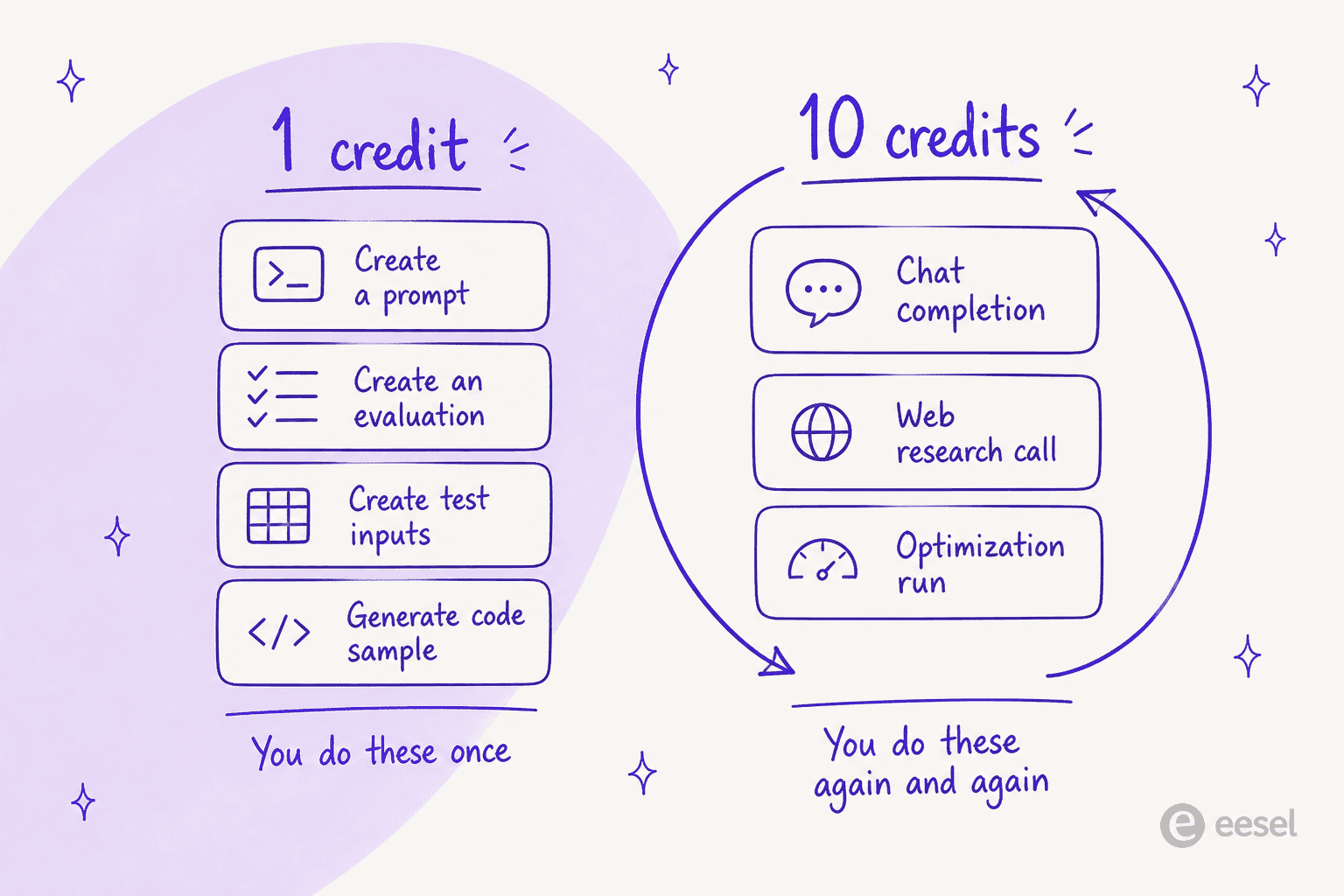
Every cheap action here is setup. You create a prompt once, you write your evaluations once, and the test inputs get defined once too. Every expensive action, by contrast, is a try. A chat completion is one attempt at an answer and an optimization run is one attempt at making the app better. A web research call is one attempt at turning up the fact you needed.
So the credit is not a unit of output, it is a unit of attempt, and the bill scales with how wrong your first draft happened to be. As a way to price a build tool that is perfectly defensible. It is just a very different risk profile from a meter that only charges you when the work actually lands, and the pricing page never spells that out. The same question comes up whenever you compare an AI agent to a human on cost.
Empromptu's own documentation is aware of the tension here. The article explaining why the Builder asks clarifying questions before it builds says they exist "to prevent the system from spending time and credits building the wrong thing", and it lists preventing wasted credits as the first benefit on the list. That is a product feature designed around the meter.
The real cost per agent chat
Now for the arithmetic. Since builder.chat costs 10 credits, every plan converts cleanly into a count of conversations.
| Plan | Price | Credits | Cost per credit | Agent chats/mo | Cost per chat |
|---|---|---|---|---|---|
| Explore | $0 | 100 | n/a | 10 | $0 |
| Build | $39 | 500 | $0.078 | 50 | ~$0.78 |
| Launch | $199 | 2,500 | $0.0796 | 250 | ~$0.80 |
| Operate | $499 | 10,000 | $0.0499 | 1,000 | ~$0.50 |
Two things jump out of that.
First, the free tier works out to ten conversations a month. That is not a criticism of a free plan, which owes you nothing, but it does mean Explore is a look at the Builder rather than a way to evaluate an agent. A buyer I worked with last year burned through 200 interactions in a single day of testing before deciding anything at all; on 100 credits, that day is over after ten messages. That is the sort of number worth knowing before you start measuring deflection.
Second, and this is the one that took me by surprise: the "Most Popular" Launch tier is the worst per-credit rate on the card.
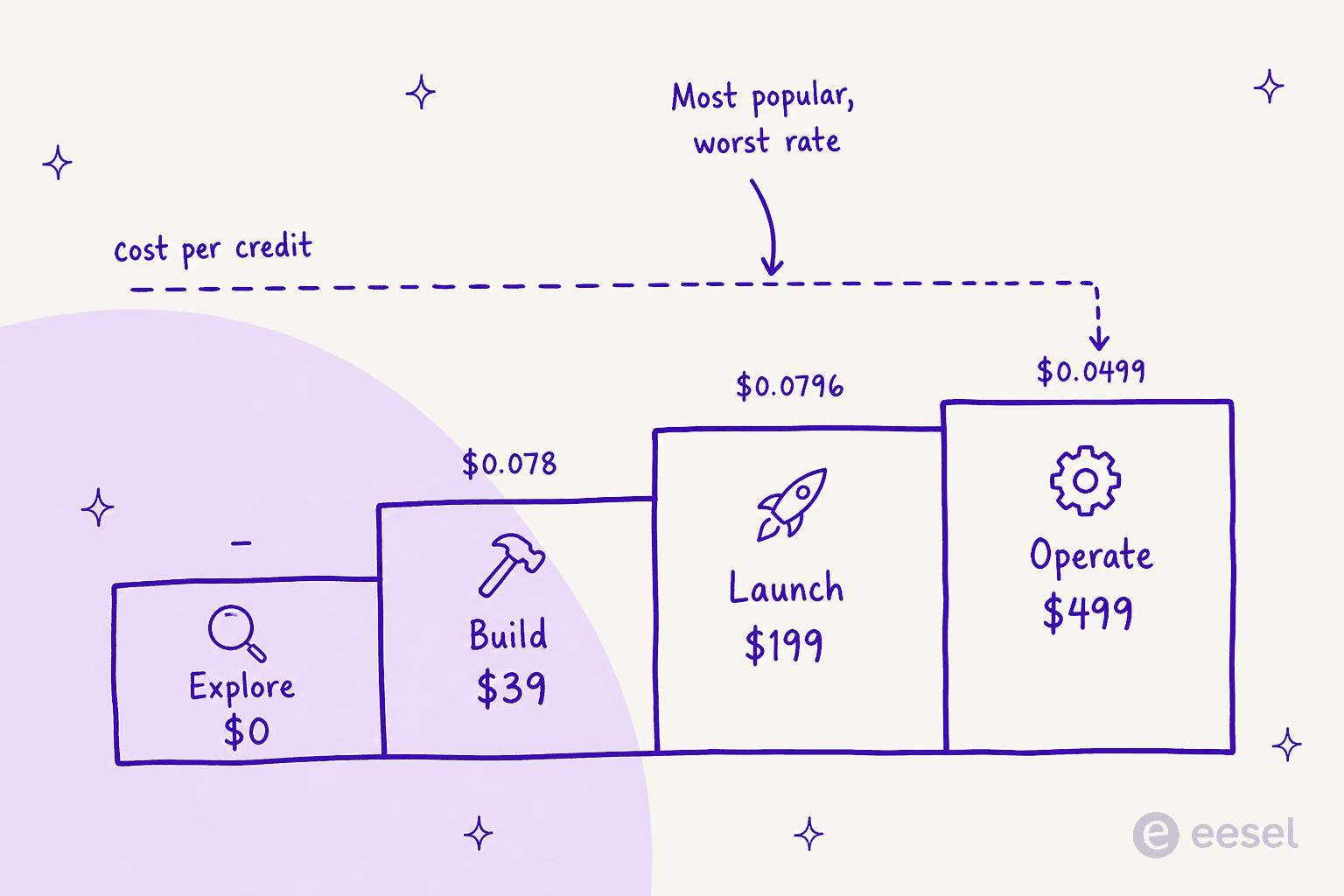
Build works out at $0.078 a credit. Launch, at five times the price, is $0.0796. So you pay marginally more per unit for the privilege of buying more. The only genuine volume discount arrives at Operate, where the rate drops by about 37% to $0.0499.
I want to be fair about what that actually means, because it is easy to read as a gotcha and it is not one. The ladder is not selling you credits. What it sells you is permission. Production deployment, a custom domain, GitHub export, basic evals, and observability all switch on at $199, and none of them exist below that line. You are paying $160 more a month for the right to ship, and the extra 2,000 credits come along as a rounding detail. As SaaS packaging decisions go, that is a normal one. It only reads as confusing because the tiers are labelled by credit count, which makes them look like volume plans when really they are capability plans. Stackblitz pricing and Vellum pricing package themselves the same way.
Size your own credit budget
Since the conversion table is public, this is something you can actually work out yourself before talking to anyone. Plug in a normal month.
The default figures there are a modest single-app month, and even those land you on Launch. Push the optimization runs up, which is exactly what the product keeps asking you to do, and the climb is quick.
The three prices Empromptu does not publish
Here is where I would push back on an otherwise transparent card. Three numbers that decide the real cost of a serious rollout are missing from every public page.
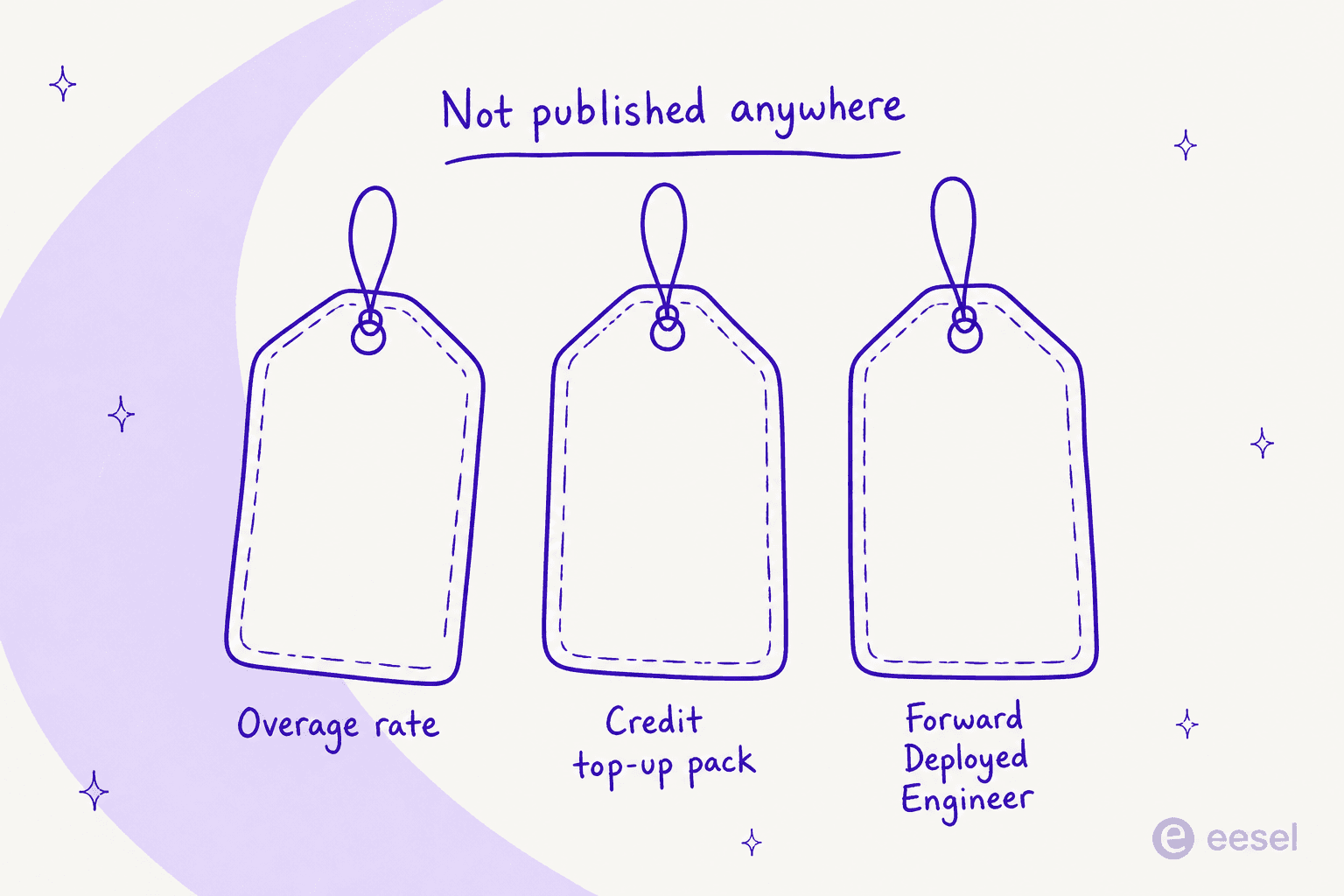
1. The overage rate. Nothing on the pricing page or in the Billing and Usage docs says what happens once the month's credits run out. Requests might fail, they might throttle, or they might bill straight through, and a buyer has no way to tell which.
2. The credit top-up price. "Credit top-ups" turns up as a Launch-and-above line item with no dollar figure attached to it anywhere. The one indirect signal is Empromptu's Builder Fund, which awards runners-up "$500 in Empromptu credits", so credits plainly do carry an internal dollar value; that value is just never published.
3. The Forward Deployed Engineer. A separate block on the pricing page, badged "Included in Enterprise, Premium Add-on for other plans", offers an AI expert who works alongside your team. No price on any tier.
Then add a fourth one that is arguably worse for teams: there is no per-seat rate. Seats show up exactly once on the whole card, as an allowance of five bundled into Operate. A twelve-person team cannot price itself from the public page at all.
None of this makes Empromptu expensive. What it makes Empromptu is unbudgetable past the bundle, which is a different problem altogether. The bundled cost is computable to the cent; the marginal cost is a phone call. And that gap matters most on precisely the workload the product is built for, since optimization is iterative by definition. It is a common enough shape in credit-metered tools, and Gumloop pricing and Emergent pricing run into the same question.
The feature that cannot pay for itself on the plan below it
The clearest illustration of attempt-based billing is Edge Case Detection, which is a scatter plot where every dot is one API call and you drag-select the underperforming cluster to optimize it.
Empromptu's docs are honest about the floor here: the feature "requires approximately 15-20+ API calls (optimization runs) before the visualization becomes useful for pattern identification". At 10 credits a run, that comes to 150 to 200 credits before the chart tells you anything.
Run that against the card. On Explore's 100 credits it is mathematically out of reach. On Build's 500 it would eat 30% to 40% of the month, and Build has no evals to begin with. The feature is gated to Operate at $499, where 200 credits is 2% of the allowance and the arithmetic finally works out. The gating itself is defensible; I just think a buyer deserves to see that number before picking a tier, because it is the difference between a feature you can use and a feature you can only look at.
The same shape shows up in the documented optimization journey. Empromptu's own worked example runs from a first optimization at 4.5, to automatic optimization at 6.8, to manual refinement at 7.9, and then to edge-case fixes at 8.4. That is four rounds, each one of them a paid attempt, and the endpoint of the journey still sits below the 90%+ figure the help center markets. If you want the full picture of how that accuracy score gets calculated, I dug into it in our Empromptu alternatives roundup, and the general mechanics live in our guides to LLM optimization and prompt engineering.
Worth knowing too that the in-product upgrade article is candid about its own job. It opens by telling you that hitting a paid capability "is a useful signal", advises that "more credits should support an active build, not an unfocused loop", and names "buying more credits while repeatedly rebuilding an unfocused project" as a common mistake. That is good advice coming from a vendor whose revenue goes up when you ignore it. The same article is also visibly unfinished in production, with placeholder text reading "the first required capability" and a call to action that still says "Unlock [Blocked Capability]", so treat the specifics in it as provisional.
What Enterprise pricing does and does not say
Enterprise is the only tier without a number on it. The card lists everything in Operate, plus advanced integrations, SSO/SCIM, custom deployment, Alchemy models, governance and AI policies, a security review, and expert support. The call to action there is "Talk to Sales", against "Get Started" on the four self-serve tiers.
What is missing from the pricing page is the compliance surface. The tier is subtitled "Built for regulated industries" and the page's opening line pitches building a healthcare application, and yet no certification is named anywhere on it: no SOC 2, no HIPAA, no BAA, no ISO 27001, no GDPR, no data residency, no VPC or on-prem option, and no uptime SLA. "Custom deployment" and "security review" are as close as it gets, and neither of them is defined.
I want to be precise here rather than sweeping, because the site does make compliance claims elsewhere; those claims just do not agree with one another. The homepage shows a bare SOC 2 badge. The about-page FAQ describes SOC 2 as in progress. Over on the enterprise page, the stat block says SOC 2 Certified and HIPAA ready. And /security, /trust, and /security-and-compliance all return 404. For a regulated buyer the practical move is the same one you would make with any vendor: ask for the report type, the auditor, the audit date, and the signed BAA before the demo, then check them against our checklist for HIPAA compliant platforms.
One more note on the docs themselves. The credit consumption table is dated August 21, 2025 and authored by co-founder Shanea Leven, which makes it about a year old at the time of writing, and the price card carries no date at all. For a company of Empromptu's size that is not unusual; it raised an oversubscribed $2 million pre-seed in December 2025 led by Precursor Ventures and runs around a dozen people. It does mean you should confirm the rates in-product rather than assuming this post, or their help center, is current. The same caution applies to any vendor's LLM tracking tools documentation.
How Empromptu pricing compares to buying the finished job
This is the comparison I think most readers actually need, because plenty of people land on an app builder's pricing page while trying to solve one specific problem rather than build a platform.
The market splits into two ways of charging. One of them bills you for attempts. The other bills you for outcomes. I broke the wider field down in our roundup of the best AI apps.
| Vendor | What you buy | Billable unit | Entry price | Can you price a heavy month? |
|---|---|---|---|---|
| Empromptu | A build surface plus an eval layer | Credit (an attempt) | $0 free, $39/mo | No, overage unpublished |
| Lovable | A prototype builder | Credit / message | Free tier | Partly |
| Replit | A build and hosting surface | Seat plus usage | $0 free tier | Partly |
| Glean | Enterprise search and agents | FlexCredits | Quote only | No, pricing page removed |
| Sierra | A support agent | Per resolution | Quote only | Yes, once quoted |
| eesel | A ready-to-work AI helpdesk teammate | 1 credit per ticket handled | 100 free credits, then from $299/mo (500 credits) | Yes, pick the batch that fits your ticket count |
The distinction is not academic. On a per-attempt meter, a month where the model struggles is a month where you pay more, which is the opposite of how you would want the risk to sit. On a per-outcome meter, a hard month costs you the same as an easy one, and it is the vendor who carries the variance.
That is also the thing buyers ask about first. In one cost analysis I put together for a customer weighing options, the point that landed hardest was not the headline rate at all but the shape of it: per-resolution pricing penalises you for getting better results, and for uncontrollable seasonal spikes too, while a fixed monthly plan keeps November's bill looking much like March's. Worth asking any vendor how their unit behaves when volume doubles. Decagon alternatives and Glean reviews both turn on that one question.
On the build side, the sharpest framing I have come across on this came from a practitioner arguing against assembling your own stack:
"Companies need processes, not tools... All those wrappers make the enterprise-ready solution much more complicated than building an agent itself"

And on the ownership question that app builders sell so hard, this one has stuck with me:
"ownership of code without ownership of the runtime is just a slow lease."
Empromptu does better than most here, in fairness: GitHub export lands at Launch and there is a Download Project button. But the optimization loop, which is the part your credits are actually paying for, stays on their infrastructure. If retrieval is the piece you really need, our comparison of RAG and fine-tuning is a better starting point than a builder subscription.
Community signal on Empromptu specifically is thin, and I am not going to pretend otherwise. The one Show HN thread from July 2025 sits at a single point with two comments, and the only non-founder reply is a reader asking "can u explain in 2-3 sentences why yours is better than the mentioned alternatives?". There is no G2, Capterra, or Trustpilot presence to cross-check pricing complaints against, so everything above comes from the vendor's own published pages.
So is Empromptu worth the money?
Sorted by who you are, which is how I would want this answered myself.
If you are one person building one internal app, Build at $39 is honest value, and Explore is a real way to poke at the Builder before you pay for anything. Just know that 500 credits works out to fifty agent chats, and that on this tier you cannot deploy to production or run a single evaluation.
If you are shipping something customer-facing, Launch at $199 is the actual entry price, because production deployment, a custom domain, and the evals all start there. Budget on capability rather than on the credit count, and expect the credits to be the part you run out of first.
If you are a team, the card stops being much help. Five seats arrive at Operate $499, with no per-seat rate published above that, so anything larger becomes a sales conversation before you even know whether you want one.
If you are in a regulated industry, the pricing page will not answer your compliance questions and the rest of the site contradicts itself. Get the report and the BAA in writing first. Everything else is downstream of that, including whether the app can legally touch a helpdesk like Freshchat at all.
And if the app you were going to build is a support agent, I would stop and reconsider the whole plan, whether the target is Zendesk, Freshchat, or a no-code support agent. The hard part of a support agent has never been the model. It is the helpdesk integration, the ticket history, the escalation logic, and the confidence to let the thing answer a real customer. Building all of that yourself means paying for every attempt at each of the four, and you are still left to solve hallucinations and retrieval on your own.
Try eesel if the app you wanted was a support agent
I have spent the last few years putting AI agents on live support queues, and the pattern is a consistent one: the teams that struggle are not the ones who picked the wrong model; they are the ones who could not tell what the AI would do before it did it.
eesel's AI helpdesk teammate joins the queue you already run, whether that happens to be Zendesk, Freshdesk, Gorgias, Front, or Jira Service Management. It reads the docs you already have, picks up your team's tone from past tickets, and then resolves, drafts, or escalates inside the tool your agents already live in.
The bit that matters for a post about credits: before it touches live traffic, it simulates against your own historical tickets and reports coverage by theme, so you find out that refund questions are only partly covered before a customer finds out for you. That is a dry run over your real history rather than a synthetic persona, and it costs nothing. It is the same discipline behind evaluating agents in Zendesk QA.
Pricing here is one fixed monthly price sized to volume: 500 credits for $299, 1,000 for $499, 2,500 for $999, 5,000 for $1,899, where 1 credit is one ticket or chat handled. No seats, no platform fee, and the overage rate is published ($0.80 per extra credit, with a monthly cap you set). You get a free plan with 100 credits and no card, and questions asked in the eesel dashboard are mostly free.
Start with the free plan, or read what an AI ticketing system changes about a queue before you commit yourself to building one.
Frequently Asked Questions
How much does Empromptu cost?
What is a credit in Empromptu pricing?
Is Empromptu free?
What happens when you run out of Empromptu credits?
Which Empromptu plan do I actually need?
Is Empromptu pricing good value for a small team?
How does Empromptu pricing compare to Lovable and Replit?
Does Empromptu Enterprise pricing include HIPAA or SOC 2?


Article by
Rama Adi
Rama is a software engineer at eesel AI with two years of experience writing about B2B SaaS, AI tools, and customer support technology. Based in Bali, Indonesia, he brings a developer's perspective to product comparisons — cutting through marketing copy to what the integrations and APIs actually do.