


The promise of AI app builders like Emergent is pretty hard to ignore: turn your big idea into a real, working application just by describing it in plain English. For a little while, it feels like magic. You type out a prompt, and a user interface pops into existence. You ask for a new feature, and the code just… writes itself.
But then, reality hits. The app that looked so slick in the demo is actually a buggy mess. That credit-based pricing you thought was a great deal suddenly balloons into a massive bill because the AI got stuck in a loop trying to fix its own code. You quickly realize there's a huge difference between a cool-looking prototype and a reliable application you can actually run a business on.
If this sounds painfully familiar, you're in the right place. We’ve dug into the most dependable Emergent AI alternatives out there. Whether you need to build a whole new app or just automate a business process that’s driving you crazy, this guide will help you find the right tool for the job.
Understanding AI app builders and Emergent AI alternatives
So, what are we even talking about here? At their core, AI app builders are platforms that use large language models (LLMs) to automatically write the code for web and mobile apps. Instead of hiring a developer or spending months learning to code, you can just describe what you want your app to do in simple language. The AI then gets to work, creating the visual parts, the behind-the-scenes logic, and even the database.
The whole point is to make building software easier for everyone. For entrepreneurs, it’s a way to get a first version of a product out the door quickly. For experienced developers, these tools can handle the boring, repetitive parts of coding, freeing them up to focus on the tougher, more interesting problems. You've probably come across some of the well-known names in this space, like Emergent, Replit, and Bubble.
Why people are looking for Emergent AI alternatives
While the idea of an instant app is great, a lot of people find that using platforms like Emergent AI brings on a few common headaches.
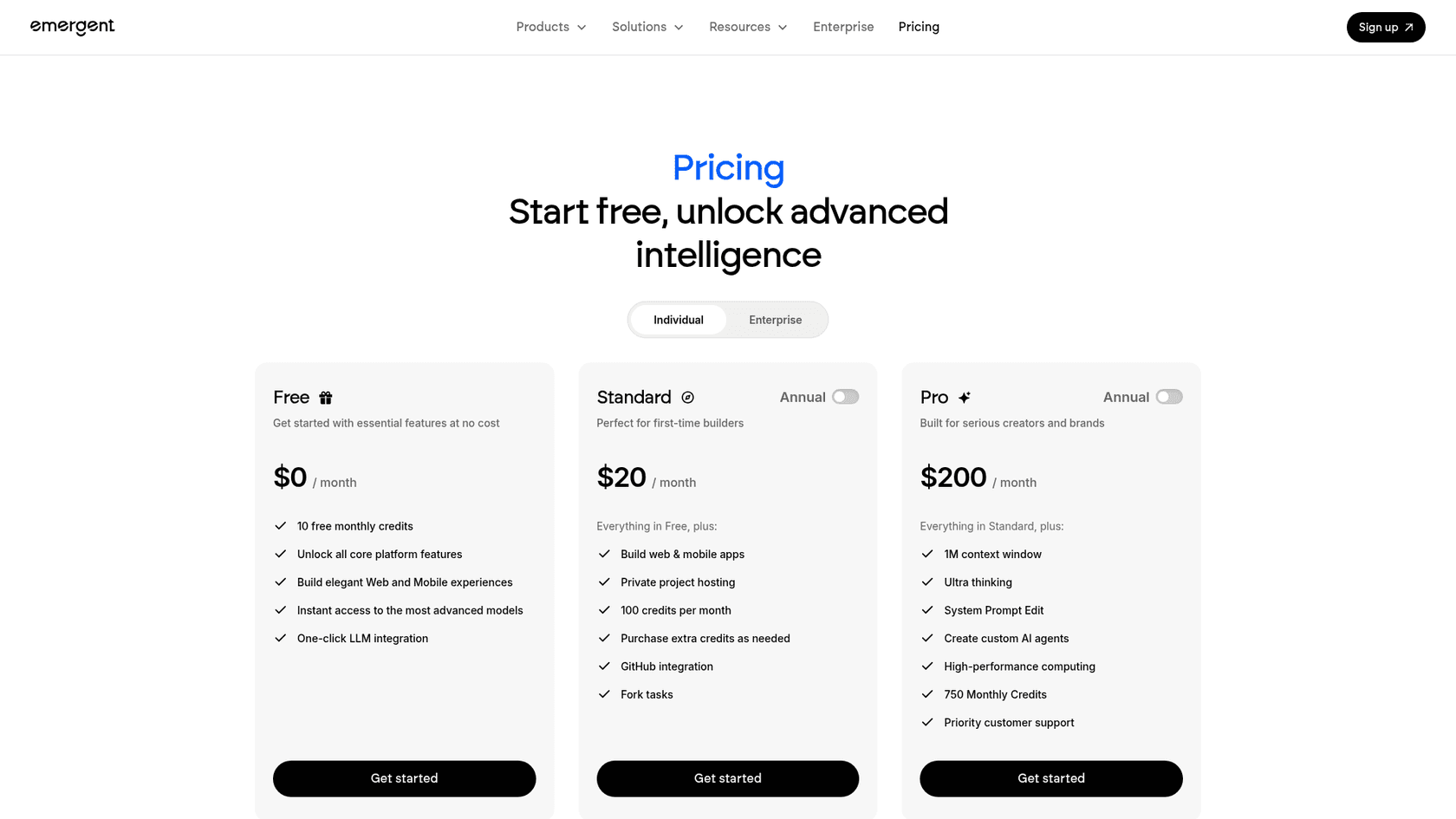
First up is the whole unpredictable cost thing. Many of these tools use a credit system, which seems fine at first. But when the AI agent gets stuck making the same mistake over and over again, it can chew through your credits at a scary pace. You literally end up paying for the AI’s failures, which can lead to some unpleasant surprises on your monthly invoice. Emergent's pricing page lists Free ($0, 10 monthly credits), Standard ($20 a month, 100 credits) and Pro ($200, 750 credits), with extra credits bought as needed.
Then there's the issue of reliability and bugs. You've probably been there: the app works perfectly in the preview window, but when you push it live, you get a blank page or a screen full of errors. Since you didn't write the code, trying to fix it feels like searching for a needle in a haystack, and the platform often doesn't give you any useful clues.
This all points to what we call the prototype vs. production gap. AI builders are amazing for slapping together a quick proof of concept. But they often don't have the security, scalability, or detailed control you need for an app that your business depends on. You might get 90% of the way there in a single afternoon, but finishing that last 10% can feel downright impossible.
Our criteria for choosing the best Emergent AI alternatives
To pull this list together, we focused on what actually matters when you're trying to build something real. We weren't just looking for shiny objects. Here's what we used to judge each tool:
-
Ease of use & speed to value: How quickly can you go from signing up to having something that’s genuinely useful?
-
Reliability & scalability: Is the platform stable enough for a real business? Can it grow with you, or will it fall over once you get real users?
-
Control & customization: How much can you actually change? Are you stuck with their template, or can you fine-tune the design, logic, and integrations?
-
Pricing transparency: Is the pricing straightforward and predictable? Or are you going to get nickeled and dimed with surprise fees?
-
Use case fit: Does the tool actually do a good job of solving a specific, real-world business problem?
Comparison of the top Emergent AI alternatives in 2025
Let's lay it all out. Here's a quick side-by-side of the top Emergent AI alternatives we looked at.
| Tool | Best For | Key Differentiator | Pricing Model |
|---|---|---|---|
| eesel AI | Automating support & internal knowledge | Integrates with existing tools (no rip & replace) | Fixed monthly credit plans (1 credit per ticket or chat) |
| Bubble | Building complex, data-driven web apps | Full visual control over backend logic | Tiered Subscription |
| Glide | Creating apps from existing spreadsheets/data | Data-first approach with instant sync | Credit-based tiers |
| Replit | Developers needing a cloud IDE with AI assist | Full cloud-based coding environment | Free Mode + Core/Pro subscriptions |
| Base44 | Teams building internal tools collaboratively | Balanced no-code/low-code with team features | Tiered Subscription |
| Bolt.new | Rapid prototyping for developers | AI-assisted code generation & debugging | Freemium + Pro Subscription |
| Rocket.new | Startups building an MVP quickly | "Vibe solutioning" from idea to full app | Free + credit tiers |
The 7 best Emergent AI alternatives for your business
Alright, let's get into the details of each platform.
1. eesel AI
A lot of the time, you're not looking to build an app for the sake of it. You have a specific problem to solve, like answering customer questions or giving your team an internal Q&A tool. But why go through the pain of building a buggy, expensive app from the ground up when you can just drop a powerful, reliable AI into the tools you already use?
That’s the whole idea behind eesel AI. It’s made to automate customer support and organize internal knowledge without making you build or move a single thing.
Key Benefits:
-
Go live in minutes, not months: The setup is completely self-serve. You can connect your help desk like Zendesk or Freshdesk, pull in knowledge from Confluence or Google Docs, and link up chat tools like Slack with a single click. No sales calls, no mandatory demos, no waiting around.
-
Unify your existing knowledge: Right away, eesel AI starts learning from your past support tickets, internal wikis, and help center articles. It picks up on your brand’s voice and your team’s specific way of solving problems, which gives it a huge head start over a blank-slate app builder that knows zip about your business.
-
Test with confidence: This is a big one. eesel AI has a simulation mode that lets you test its performance on thousands of your actual past tickets in a safe environment. You can see exactly how it would have answered, get solid forecasts on automation rates, and fix any issues before a single customer ever talks to it. This completely eliminates the "cross your fingers and hope for the best" approach you see with so many other AI tools.
Pros: It’s ridiculously easy to get started, has transparent pricing that won't give you a heart attack, and the simulation feature means you can roll it out with zero risk.
Cons: This is a specialized tool. It's built for customer service, ITSM, and internal knowledge automation, not for creating any random app you can dream up.
Pricing:
| Plan | Monthly Price | Key Features |
|---|---|---|
| Free | $0 | 100 credits, no card needed |
| 500 credits | $299 | 1 credit per ticket or chat, every integration, unlimited agents and seats |
| 1,000 credits | $499 | Same features, larger monthly batch |
| 2,500 credits | $999 | Same features, larger monthly batch |
| 5,000 credits | $1,899 | Same features; above 5,000, talk to sales |
Paying a year upfront gets two months free, and unused credits do not roll over.
2. Bubble
Bubble is pretty much the heavyweight champion of the no-code world. It gives you an incredible amount of visual control over your app's design, workflows, and database. If you can imagine a complex, data-heavy web app, you can probably build it on Bubble without ever looking at a line of code.
Pros: It's extremely customizable, which is perfect for building apps that run on complex data. It also has a huge community that has built tons of plugins and templates.
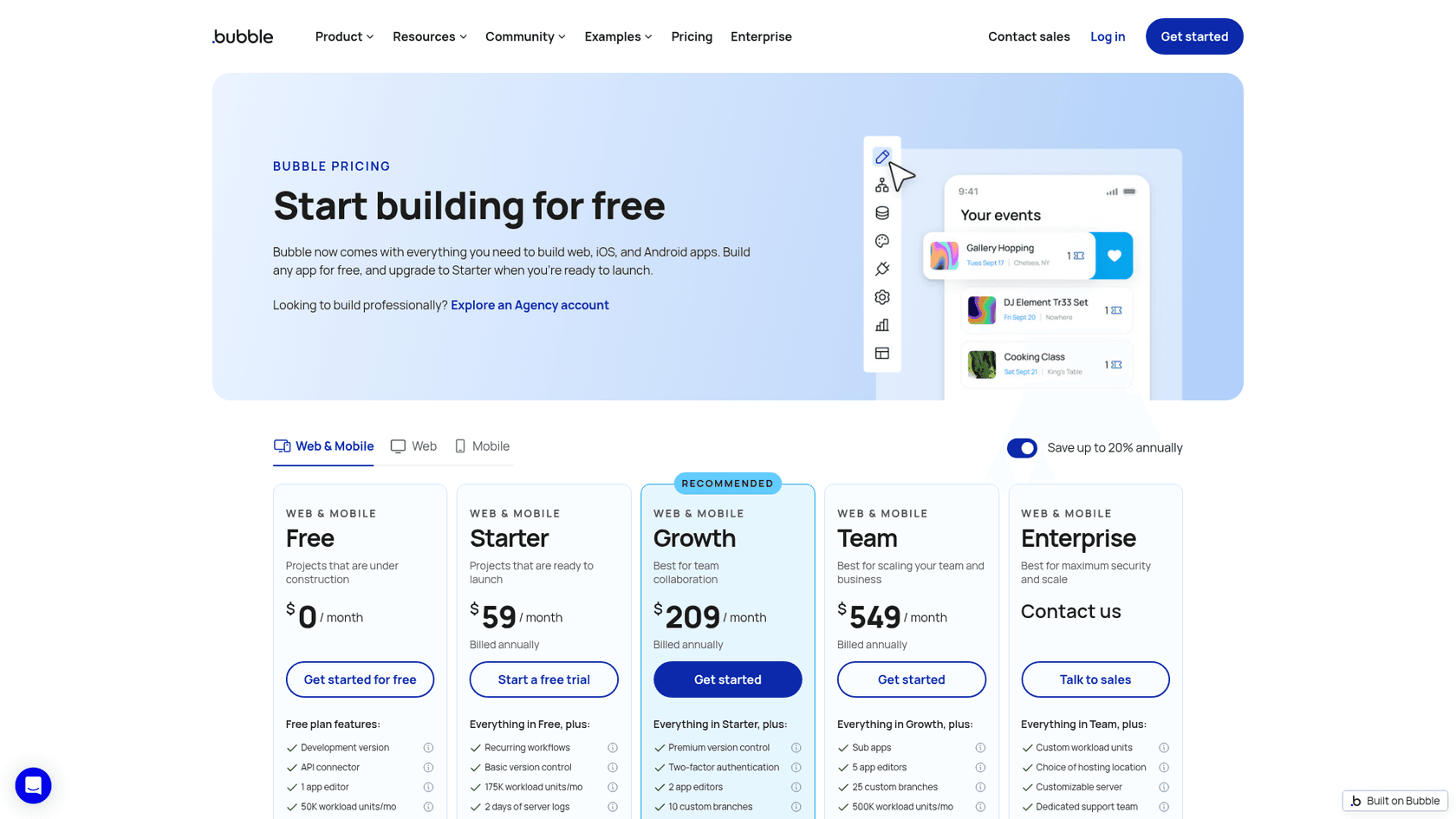
Cons: Bubble has a notoriously steep learning curve. Don't expect to be an expert overnight. Building an app that actually performs well requires a decent grasp of database design. Bubble's pricing page now lists native iOS and Android builds alongside web apps.
Pricing:
| Plan | Monthly Price (Billed Monthly) | Monthly Price (Billed Annually) | Key Features |
|---|---|---|---|
| Free | $0 | $0 | Development version, 1 app editor, 50K workload units/mo |
| Starter | $69 | $59 | Live website, custom domain, basic version control, 175K workload units/mo |
| Growth | $239 | $209 | 2 app editors, premium version control, 250K workload units/mo |
| Team | $599 | $549 | 5 app editors, sub-apps, 500K workload units/mo |
| Enterprise | Custom | Custom | Dedicated support, customizable server, custom workload units |
3. Glide
Glide is a beautifully simple platform for spinning up professional-looking apps directly from data you already have in Google Sheets, Airtable, or Excel. If you need a quick internal tool, a portal for your clients, or a simple directory, you can build it with Glide in a matter of minutes.
Pros: It’s incredibly easy to learn and use. The apps look polished right out of the box, and it automatically syncs with your data source so everything stays up to date.
Cons: It's not the most flexible tool when it comes to custom backend logic. It's a rockstar for data-heavy apps, but you might feel boxed in if you're trying to do something more complex.
Pricing:
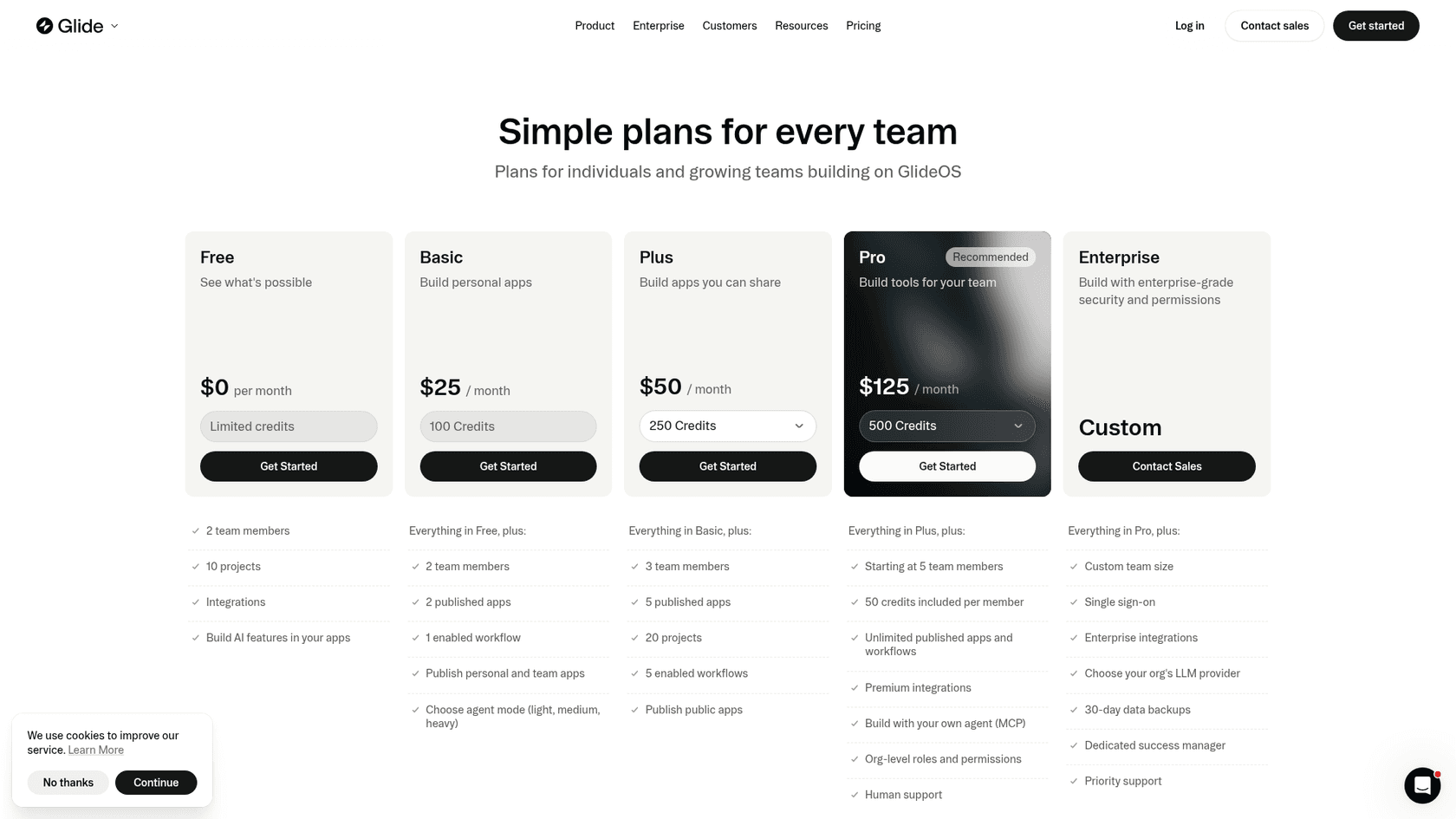
| Plan | Price (per month) | Key Features |
|---|---|---|
| Free | $0 | Limited credits, 2 team members, 10 projects |
| Basic | $25 | 100 credits, 2 published apps, 1 enabled workflow |
| Plus | $50 | From 250 credits, 3 team members, 5 published apps, public apps |
| Pro | $125 | From 500 credits, starting at 5 team members, unlimited published apps, MCP support |
| Enterprise | Custom | SSO, custom team size, dedicated success manager |
4. Replit
Replit is a full-blown coding environment that lives entirely in your browser. It’s built for developers who want to write code, work together on it, and deploy it without the headache of setting up a local machine. Its AI assistant, Replit Agent (the old Ghostwriter page now redirects there), is a genuinely helpful partner for generating, explaining, and fixing code.
Pros: It supports over 50 programming languages, has fantastic real-time collaboration features, and its AI assistant is a massive time-saver for anyone who actually codes.
Cons: This is a tool for developers. If you don't know how to code, this isn't for you. Also, its credit-based AI usage can get pricey, which is the same complaint people have about Emergent.
Pricing:
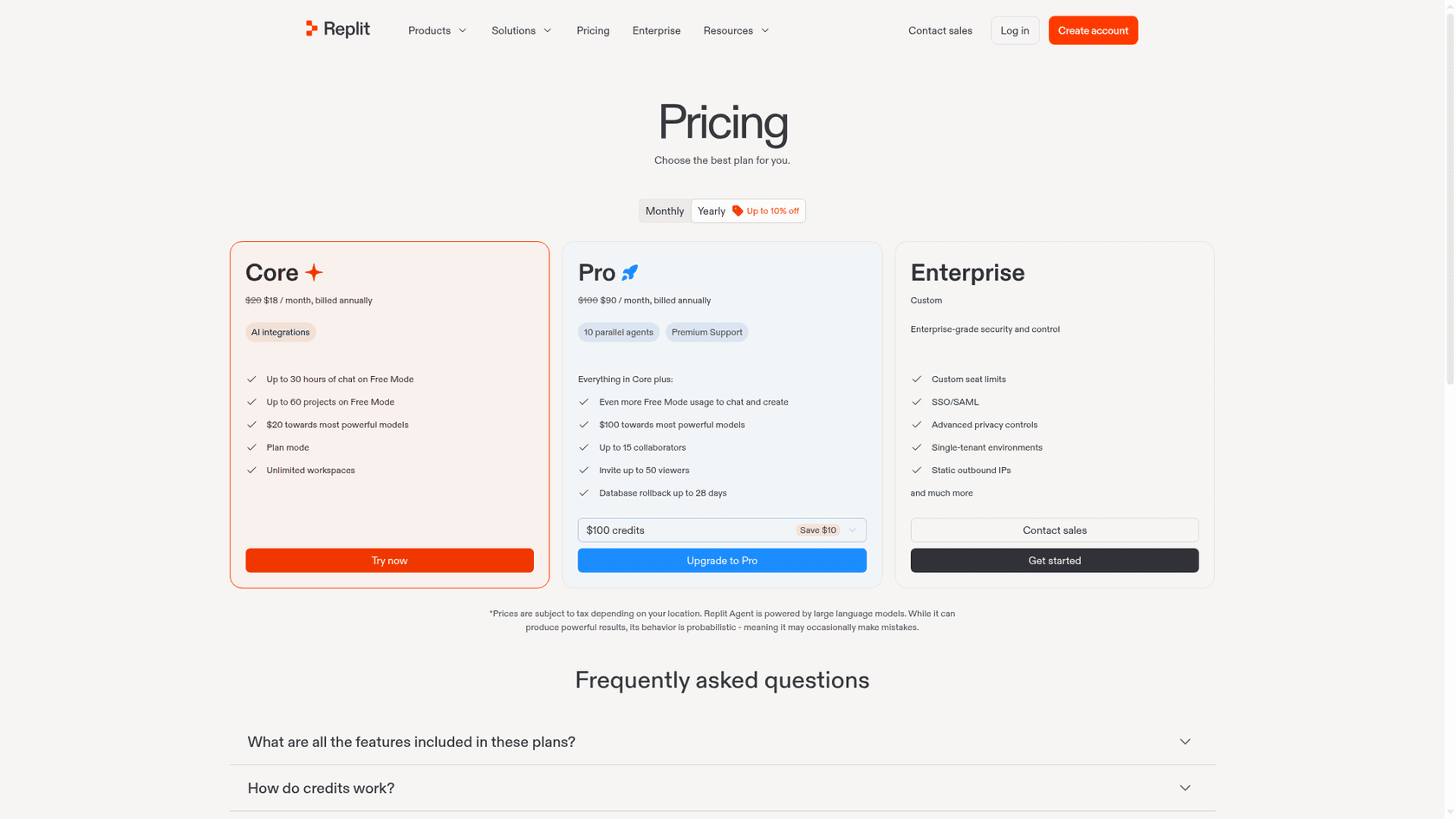
| Plan | Monthly Price (Billed Monthly) | Monthly Price (Billed Annually) | Key Features |
|---|---|---|---|
| Free Mode | $0 | $0 | Up to 60 projects, up to 30 hours of chat |
| Core | $20 | $18 | AI integrations, $20 toward the most powerful models, plan mode, unlimited workspaces |
| Pro | $100 | $90 | Everything in Core, $100 toward models, 10 parallel agents, up to 15 collaborators, premium support |
| Enterprise | Custom | Custom | SSO/SAML, advanced privacy controls, single-tenant environments |
5. Base44
Base44 is an AI-native platform focused on building internal business tools through a chat interface. You tell it what you need, and the AI builds it. It’s trying to find that perfect balance between the simplicity of no-code and the power of low-code.
Pros: It's designed with teams in mind, the conversational building process feels natural, and it comes with useful business integrations right out of the box.
Cons: It’s a newer platform, so its community isn't as big as Bubble's. According to some users, the AI can be a bit hit-or-miss at times and isn't always consistent.
Pricing:
| Plan | Price (Monthly) | Key Features |
|---|---|---|
| Free | $0 | 25 message credits, 100 integration credits |
| Starter | $20 | 100 message credits, 2K integrations, unlimited apps |
| Builder | $50 | 250 message credits, 10K integrations, GitHub sync, custom domains |
| Pro | $100 | 500 message credits, 20K integrations, beta access |
| Elite | $200 | 1.2K message credits, 50K integrations, premium support |
6. Bolt.new
Bolt.new is all about speed. It’s designed to help you pump out and tweak web app prototypes incredibly fast using AI. It generates both the frontend and backend code for you, all from inside your browser.
Pros: It's one of the fastest ways to get an initial concept or some boilerplate code up and running.
Cons: But, and it's a big but, users often complain about the AI using way too many tokens (leading to surprise costs), unstable deployments, and code that's so inconsistent it needs a ton of manual cleanup.
Pricing:
| Plan | Price (Monthly) | Key Features |
|---|---|---|
| Free | $0 | 300K tokens daily limit, 1M tokens/month, Bolt branding |
| Pro | $25 | No daily token limit, starts at 10M tokens/month, custom domain, no branding |
| Teams | $30/user | Everything in Pro, centralized billing, team management |
| Enterprise | Custom | Advanced security, dedicated support, custom workflows |
7. Rocket.new
The idea behind Rocket.new is pretty cool: feed it a simple concept or a Figma design, and it aims to generate a complete, ready-to-deploy web or mobile app. It’s designed to manage the whole process, from the interface and backend logic to AI-powered features.
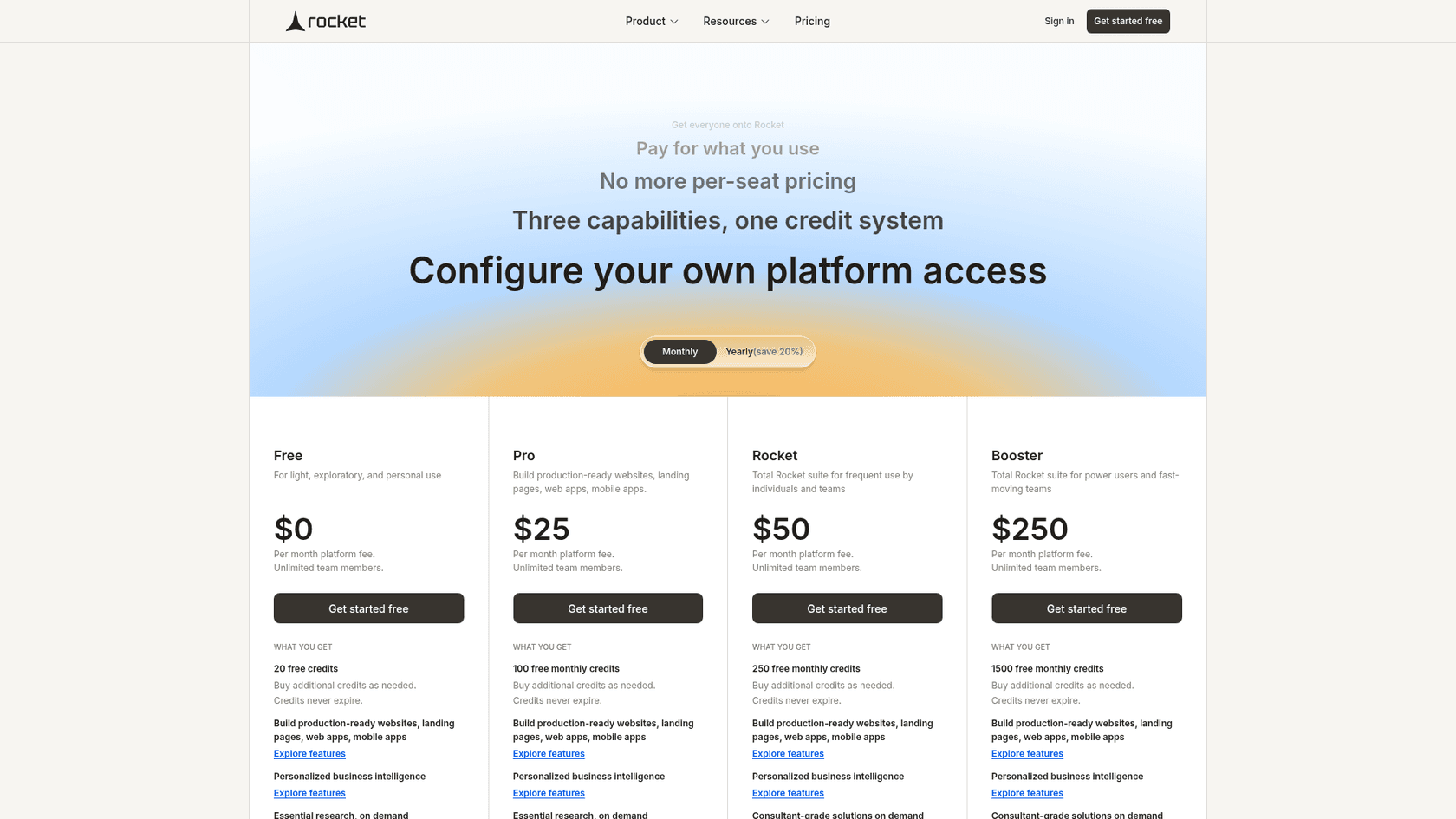
Pros: It handles the entire app lifecycle, which is great for startups that want to build an MVP fast without having to glue a bunch of different tools together.
Cons: It's still a relatively new kid on the block, so it's less battle-tested for long-term, scalable apps compared to a more established platform like Bubble.
Pricing:
| Plan | Price (Monthly) | Key Features |
|---|---|---|
| Free | $0 | 20 free credits |
| Pro | $25 | 100 monthly credits, unlimited team members |
| Rocket | $50 | 250 monthly credits |
| Booster | $250 | 1,500 monthly credits |
How to choose the right Emergent AI alternatives for you
Okay, that's a lot of options. Feeling a bit lost? Here are a few things to think about to help you pick the right one.
Tip 1: First, ask if you really need to build an app. This is probably the most important question you can ask yourself. Many business problems, especially things like customer support or internal Q&A, can be solved way more effectively by adding AI into the systems you already use. An AI agent like eesel AI that connects directly to your helpdesk and knowledge base will deliver results faster, more reliably, and with way less risk than a custom-built app.
Tip 2: Define your primary use case. Get specific. What, exactly, are you trying to do? Are you building an internal tool for your team (Glide or Base44 would be good bets)? A public-facing web app with a bunch of moving parts (Bubble is your friend)? Or just a quick prototype to see if an idea has legs (Bolt might work)? Your specific goal is the best compass you have.
Tip 3: Understand the total cost of ownership. Don't get fooled by the sticker price. Be super cautious with credit- or token-based models, because they can lead to unpredictable, spiraling costs. Platforms with straightforward, flat-rate subscriptions give you much better financial peace of mind.
Tip 4: Prioritize reliability for production apps. If your app is going to be used by actual customers or is important for your business operations, choose a platform with a proven track record. Speed is exciting, but stability and scalability are what really count in the long run.
Move beyond prototypes with reliable Emergent AI alternatives
Look, the dream of typing an idea and getting a perfect app is tempting. We get it. But as we've seen, many AI app builders like Emergent fall short on the reliability, control, and predictable costs you need for real business applications. They're often great for a quick prototype but can't quite make the leap to a production-ready tool.
The good news is that there are some fantastic alternatives out there, whether you need a powerhouse no-code builder like Bubble, a data-first tool like Glide, or a cloud coding environment like Replit.
But for many common business problems, the smartest move isn't to build a new app at all. It's to deploy a specialized, dependable AI that works seamlessly with the tools your team already uses every day.
Ready to see how AI can automate your support workflows without the cost and headache of building a custom app? Start your free trial with eesel AI.
Frequently asked questions
What are the main reasons people start looking for Emergent AI alternatives?
Users often seek Emergent AI alternatives due to unpredictable costs associated with credit-based systems and persistent issues with bugs and reliability in apps built on the platform. They find a significant gap between prototyping success and the demands of a production-ready application.
Do all Emergent AI alternatives use a no-code approach, or are there options for developers?
No, the landscape of Emergent AI alternatives is diverse. While many focus on no-code or low-code development, there are also powerful cloud IDEs and AI-assisted coding environments tailored for experienced developers, such as Replit.
How do I choose the right one among the various Emergent AI alternatives for my project?
To choose effectively, first define your primary use case, whether it's internal tools, public web apps, or specialized automation. Then, prioritize platforms based on reliability, scalability, pricing transparency, and how well they fit your specific technical skill level.
Do Emergent AI alternatives typically offer more predictable pricing than Emergent AI?
Many Emergent AI alternatives, especially those with subscription-based models like eesel AI or Bubble, offer significantly more predictable pricing. While some developer-focused tools might still use credit systems, the best alternatives aim for greater transparency and control over costs.
Can Emergent AI alternatives handle complex, production-ready applications, or are they mostly for MVPs?
Yes, many robust Emergent AI alternatives, such as Bubble, are designed to build complex, scalable, and production-ready applications. The key is to select a platform with strong reliability, customizability, and robust backend capabilities suited for long-term use.
Are there Emergent AI alternatives specifically designed for automating business processes rather than building full apps?
Absolutely. Tools like eesel AI are prime examples of Emergent AI alternatives that specialize in automating specific business processes, such as customer support and internal knowledge management. They integrate with existing systems rather than requiring you to build a new app from scratch.