If your work life is anything like ours, you’re swimming in a sea of audio and video content from meetings, support calls, and webinars. The hard part isn’t just getting through them; it’s making all that valuable info easy to find and use later on. This is where OpenAI Audio Transcription comes into play, offering a pretty slick way to turn all that talk into text automatically.
But having access to the raw tech is only half the battle. In this guide, we'll walk you through what OpenAI's audio transcription is, what it can do for your business, and, crucially, the hidden risks and costs of trying to build a solution yourself. We’ll cover its features, pricing, and why using a platform built for the job is often a smarter, safer, and faster way to get value from your audio.
What is OpenAI Audio Transcription?
So, what exactly is OpenAI Audio Transcription? Think of it as a powerful engine that developers can plug into their own apps. It’s an API (Application Programming Interface) that uses some seriously smart AI models to convert speech into written text.
It's basically running on two key models:
-
Whisper: This is OpenAI's original workhorse. It was trained on a mind-boggling 680,000 hours of multilingual audio from across the web. That massive training makes it fantastic at understanding different accents, dialects, and even filtering out background noise.
-
GPT-4o Transcribe: This is the newer, souped-up version. It taps into the power of GPT-4o for even better accuracy and language recognition, making it the go-to for tasks where you really can't afford mistakes.
The API gives developers two main tools to work with:
-
Transcriptions: This function takes an audio file and converts it into text in its original language.
-
Translations: This one goes a step further by taking audio in another language and transcribing it directly into English.
While it's incredibly powerful, it's definitely built for a technical crowd. It provides the raw text, but it's up to you to figure out how to mold it into something actually useful for your team.
Key features and capabilities
Okay, so what can this tech actually do straight out of the box? Let's look at the core features.
-
Broad language support These models are truly global, with support for dozens of languages from Spanish and German to Ukrainian and Welsh. This makes it a flexible tool for international teams or companies with customers all over the world. Just keep in mind that accuracy can differ based on how much training data the model has for any given language.
-
Supported file types and limits You can throw most common audio and video files at the API, including "mp3", "mp4", "wav", and "m4a". But here’s a little catch you need to know about: files are capped at 25 MB. The official advice is to chop up larger files into smaller pieces. It works, but it's a bit of a pain and you run the risk of cutting sentences in half, which can confuse the AI and make it lose context.
-
Output formats and timestamps You're not just getting a giant block of text. The API can hand you the transcript in a few different formats, like plain text, JSON, or even SRT files, which are perfect for video subtitles. One really cool feature of the "whisper-1" model is its ability to add word-level timestamps. This lets you click on a word in the transcript and jump to that exact moment in the audio, which is amazing for video editing or reviewing support calls.
-
Improving accuracy with prompting If the model keeps tripping over specific words, you can give it a little nudge with the "prompt" parameter. For instance, if it keeps misspelling your company name (it's "eesel AI," not "Easel AI") or messing up a technical term, you can feed it the correct spelling in a prompt. You can even use prompts to get better punctuation by giving it an example like, "Hello, welcome to the meeting."
-
Streaming for real-time transcription For live events or apps, the API can also handle streaming transcription. This means it transcribes audio as it's happening, which is great for things like live captions or voice-activated commands. Setting this up, however, is a much bigger engineering lift that requires managing real-time data connections.
Common business use cases
Once you've got the text, what can you actually do with it? The possibilities are pretty wide-ranging and can help out in a bunch of different departments.
-
Customer service and support Imagine transcribing every phone call and video support session to create a complete, searchable history of customer conversations. Suddenly, you have a goldmine of data you can use to understand customer feelings, spot common problems, and see how your support agents are doing. But the raw text is just the beginning. To really make it work for you, you need to analyze it. A platform like eesel AI connects these transcripts to your helpdesk and knowledge base to help automate replies and find solutions faster.
-
Meeting productivity Let's be real for a second: who actually likes taking meeting minutes? You can automatically transcribe your Zoom or WebEx meetings to get a full record of what was said, including action items and key decisions. It's a lifesaver for anyone who couldn't make the call or just needs a quick reminder without re-watching a whole hour-long recording.
-
Content creation and accessibility For anyone making content, audio transcription is a massive time-saver. You can quickly whip up subtitles and closed captions for videos, making them more accessible and giving them a little SEO boost. It also makes it a breeze to repurpose content, like turning a podcast or an interview into a blog post without spending hours typing it all out.
-
Internal knowledge management So much of a company's know-how is shared verbally in training sessions, workshops, and company-wide meetings. By transcribing these events, you can capture that spoken knowledge and turn it into a searchable library. This stops good ideas from getting lost and helps new folks get up to speed much quicker.
OpenAI Audio Transcription pricing
OpenAI's pricing is pay-as-you-go, calculated by the amount of audio you process (specifically, by "tokens," which are like pieces of words).
At first glance, the pricing seems pretty reasonable. But those numbers don't tell the whole story. They don't account for the hours (and costs) of engineering time you'll need to actually build something useful with it. These "hidden" costs can make a DIY project a lot more expensive than you might think.
| Model | Pricing (per 1M input tokens) | Equivalent per audio hour (approx) |
|---|---|---|
| GPT-4o Transcribe | $6.00 | ~$2.88/hour |
| Whisper | (Varies by use) | ~$0.36/hour |
A little heads-up: Pricing can change. Always check the official OpenAI pricing page for the latest info.
Limitations and risks of OpenAI Audio Transcription
Using the OpenAI Audio Transcription API seems easy enough on the surface, but building a whole business process around it comes with some real challenges that aren't obvious at first.
-
Hallucinations and accuracy issues This is a big one. AI models sometimes "hallucinate," which is a nice way of saying they make stuff up. While it's not super common, one study found that Whisper hallucinates in about 1-2% of sentences. Even worse, a good chunk of these fabrications were labeled as harmful, including things like invented medical advice and violent language. For businesses in sensitive areas like healthcare or finance, even a tiny error rate can lead to huge problems.
-
Lack of business context The API is built to be a general tool. It will give you a word-for-word transcript, but it has no idea what your company does, what your products are, or who your customers are. It can't tell the difference between a simple question and a five-alarm fire. It just gives you text; it can't take action, like tagging a support ticket, flagging an urgent request for a manager, or looking up a customer's order.
-
Data privacy concerns Sending your audio data to a third-party service always requires a bit of caution. While OpenAI's business terms state that your data won't be used to train their models, making sure your setup is fully compliant with rules like GDPR and CCPA takes careful planning and a good grip on data security.
-
Significant implementation overhead This is probably the biggest roadblock for most companies. The OpenAI API is a component for developers, not a finished product. To make it work, you need an engineering team to build an app, handle secure authentication, figure out how to split audio files to get around the 25 MB limit, process the text output, and then hook it all up to your existing systems like your helpdesk or CRM. This isn't a small weekend project; it's a major investment that can take months to build and needs constant upkeep.
Why a platform approach is better for your business
While OpenAI provides the powerful engine, a platform like eesel AI builds the entire car around it, complete with a steering wheel, safety features, and a GPS that connects to all your other tools. eesel doesn't just turn audio into text; it understands, analyzes, and acts on it right inside your existing workflows.
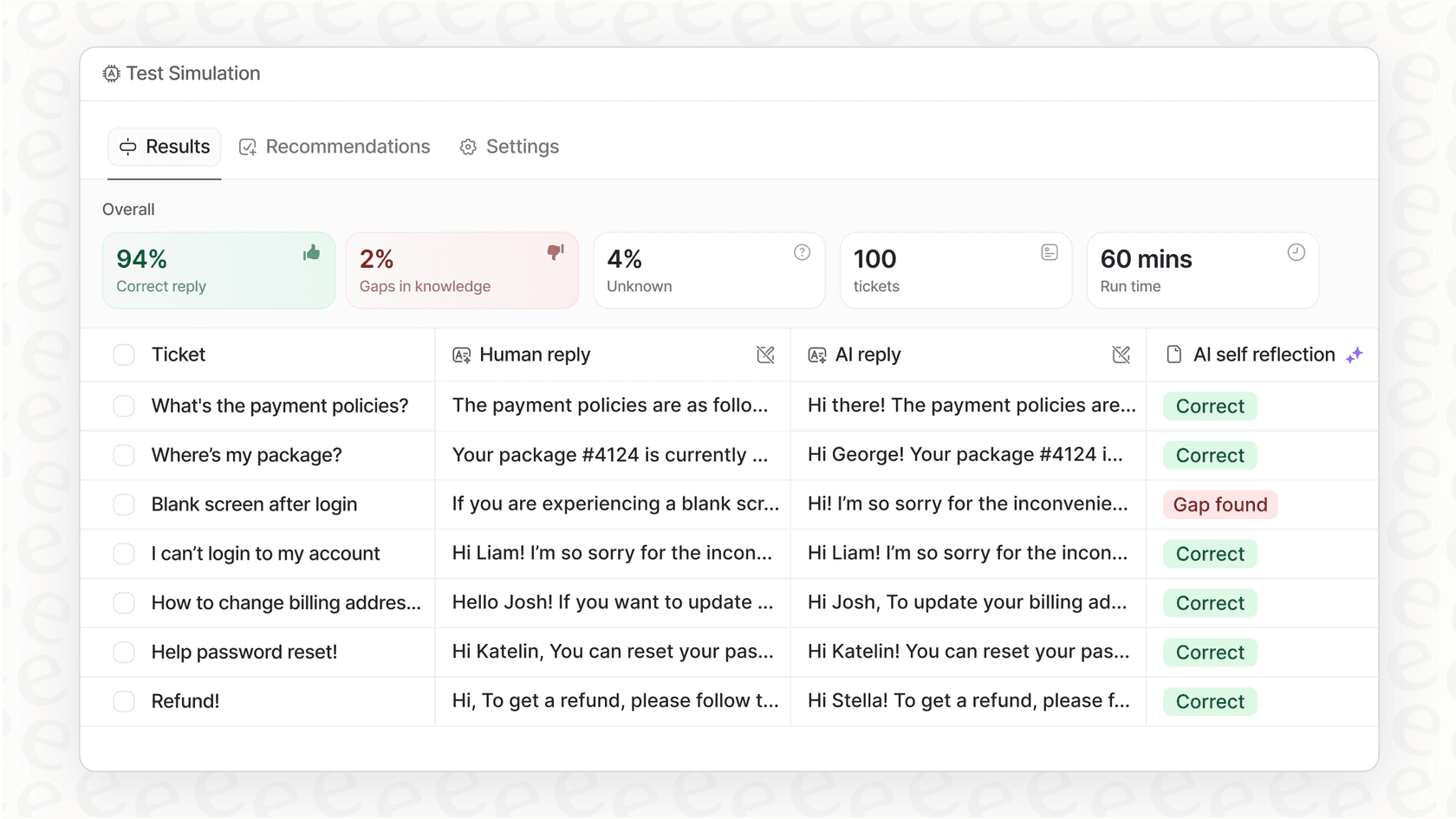
- You can test drive it safely Instead of just hoping hallucinations don't pop up during a customer call, eesel AI gives you a powerful simulation mode. You can test your AI setup on thousands of your own past conversations to see exactly how it will behave. You get a real, accurate forecast of how well it will resolve issues before you ever turn it on for real.
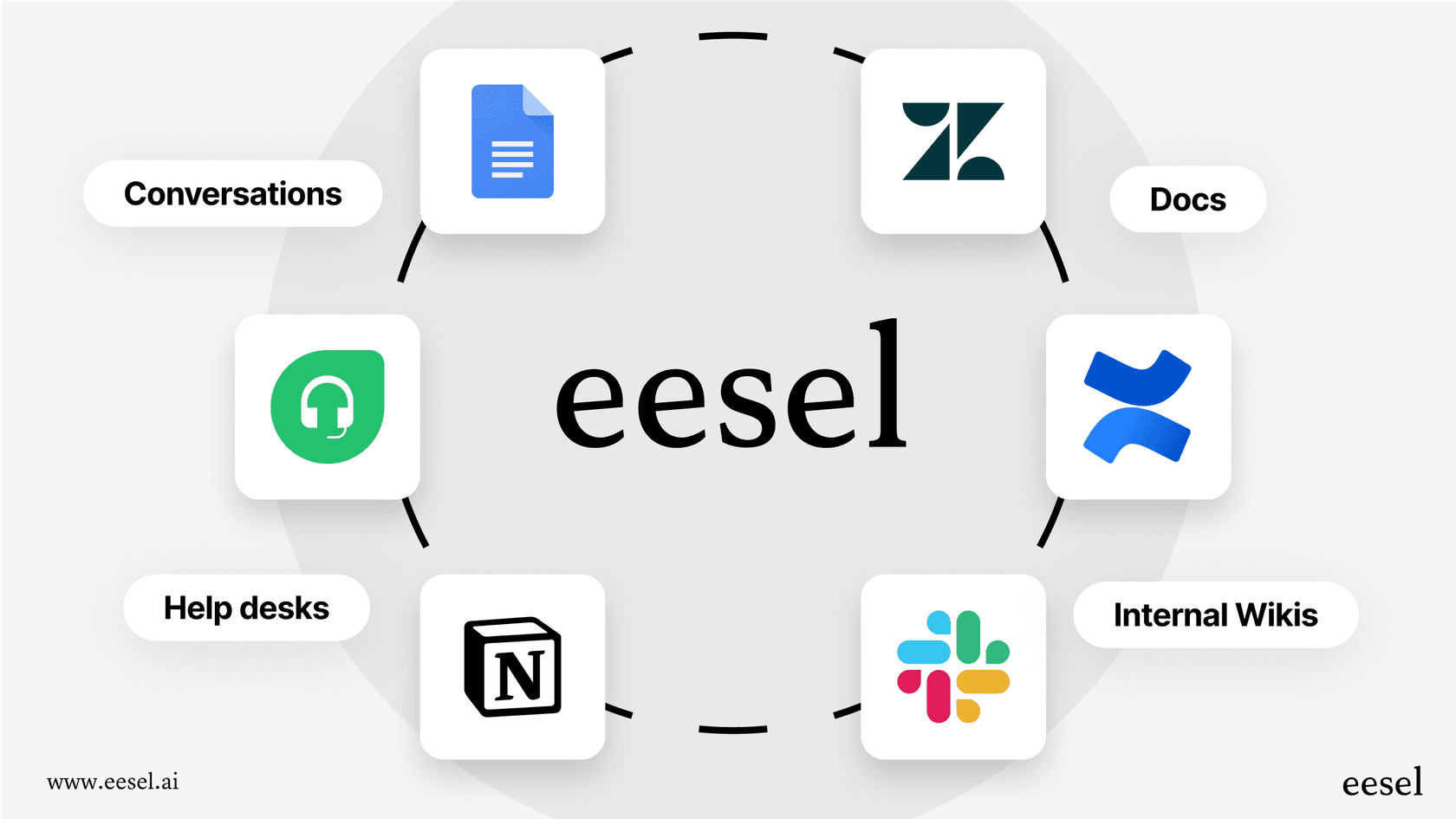
- It connects to your tools in minutes You can forget about spending months on custom development. eesel AI has one-click integrations that hook into your helpdesk (like Zendesk or Freshdesk), knowledge bases (like Confluence and Google Docs), and team chat tools (like Slack) in just a few minutes.
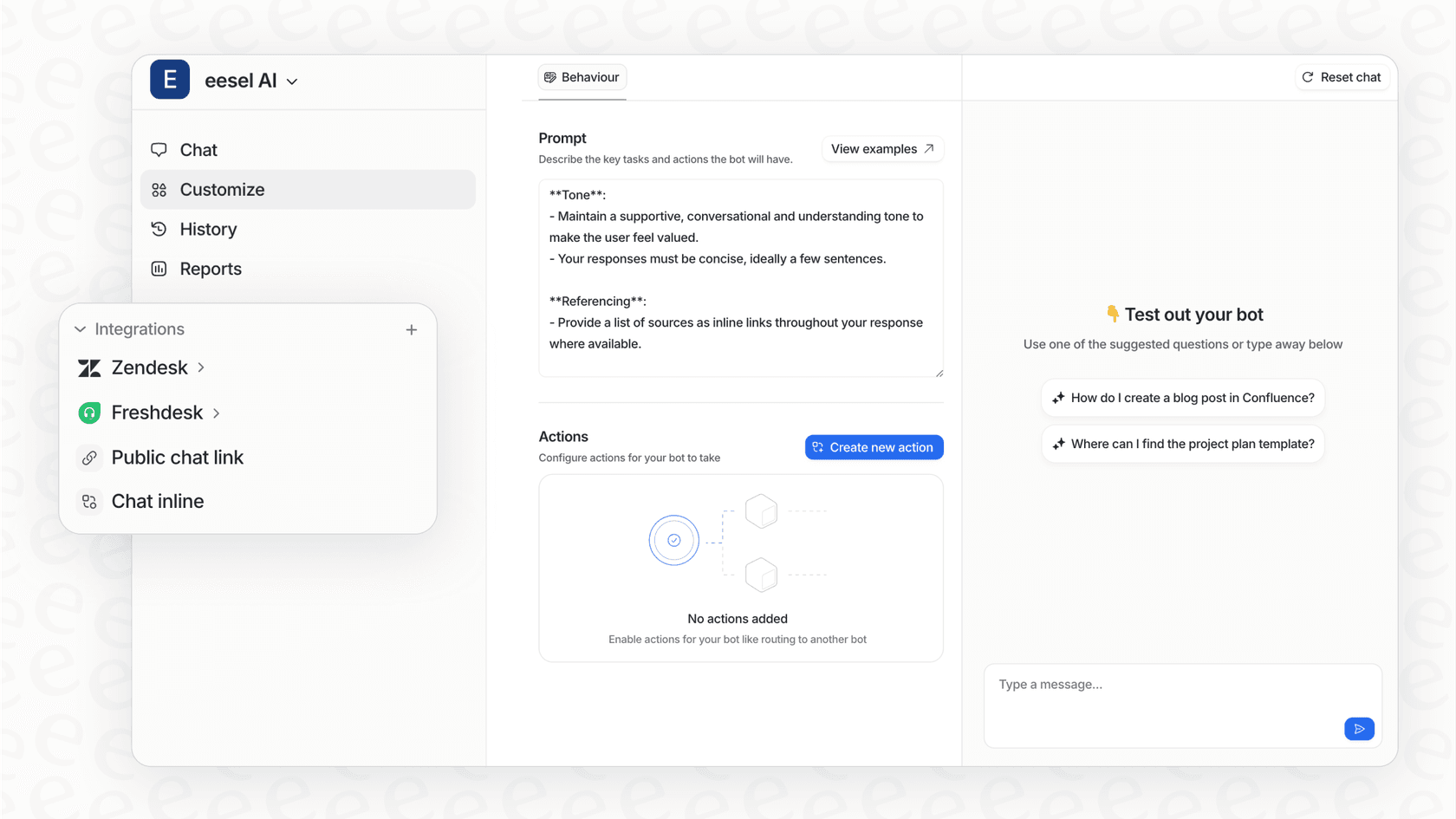
- It pulls knowledge from everywhere eesel AI doesn't just look at one audio transcript. It brings together information from all your connected sources, old support tickets, help center articles, internal guides, to give answers that have real context. On top of that, it offers clear, predictable pricing based on the features you actually use, so you won't get a nasty surprise on your bill after a busy month.
Get started with OpenAI Audio Transcription that works for you
OpenAI's audio transcription tech is incredibly powerful, but turning that raw power into something that actually helps your business takes more than just an API key. A DIY approach comes with real challenges, from the risk of AI making things up to the high cost and time of building it yourself. The real value comes from a platform that gives you control, easy integration, and the smarts to act on information.
So if you're ready to skip the headaches of a DIY project and get straight to the good stuff, eesel AI is the fastest and safest way to put AI to work for your support and knowledge management.
Frequently asked questions
What exactly is OpenAI Audio Transcription and how does it work?
OpenAI Audio Transcription is an API that utilizes powerful AI models like Whisper and GPT-4o Transcribe to convert spoken language into written text. It offers functions for both transcription in the original language and translation directly into English, serving as a core component for developers.
What are the main business benefits of using OpenAI Audio Transcription?
Businesses can leverage OpenAI Audio Transcription for improved customer service by analyzing calls, boosting meeting productivity with automatic minutes, facilitating content creation through subtitles, and enhancing internal knowledge management by transcribing training sessions. It helps transform verbal information into actionable, searchable data.
What are some accuracy issues or limitations I should be aware of with OpenAI Audio Transcription?
A key concern is the potential for AI "hallucinations," where the model generates inaccurate or even harmful information, which can occur in a small percentage of sentences. Additionally, it lacks inherent business context and doesn't perform actions like tagging support tickets without further development.
Can OpenAI Audio Transcription handle different languages and file types?
Yes, OpenAI Audio Transcription supports dozens of languages globally, though accuracy can vary based on training data. It accepts common audio and video formats like MP3, MP4, WAV, and M4A, but individual files are capped at 25 MB, often requiring larger files to be split.
What are the data privacy implications when using OpenAI Audio Transcription?
When sending audio data to OpenAI, it's crucial to be mindful of data privacy. While OpenAI states your data won't be used for model training, ensuring full compliance with regulations like GDPR and CCPA requires careful planning and robust data security measures on your end.
Why might a platform approach be better than a DIY solution for implementing OpenAI Audio Transcription?
A platform approach, like eesel AI, provides a complete solution around the core OpenAI Audio Transcription technology. It offers safety features like simulation modes, one-click integrations with existing tools, and contextual analysis, significantly reducing the implementation overhead and risks associated with building a custom solution.