

What is Fish Audio Drama 3?
I build AI agents at eesel, so I read every speech-model launch with one question: does this change what a team can ship, or only what a demo sounds like? Drama 3 is the more interesting kind, because the change is in the interface. Instead of picking a preset emotion from a menu, you write a stage direction.
Fish Audio describes it as a model built for direction: alongside your script you describe how a line should be performed, add sounds and pauses, and limit an effect to specific words. The technical report adds the machinery. The backbone is a 35B-parameter mixture-of-experts model that activates about 3B parameters per token, initialised from Qwen3.5-35B-A3B (see my Qwen overview if that family is new to you), plus a new audio decoder that predicts ten codebooks per frame.
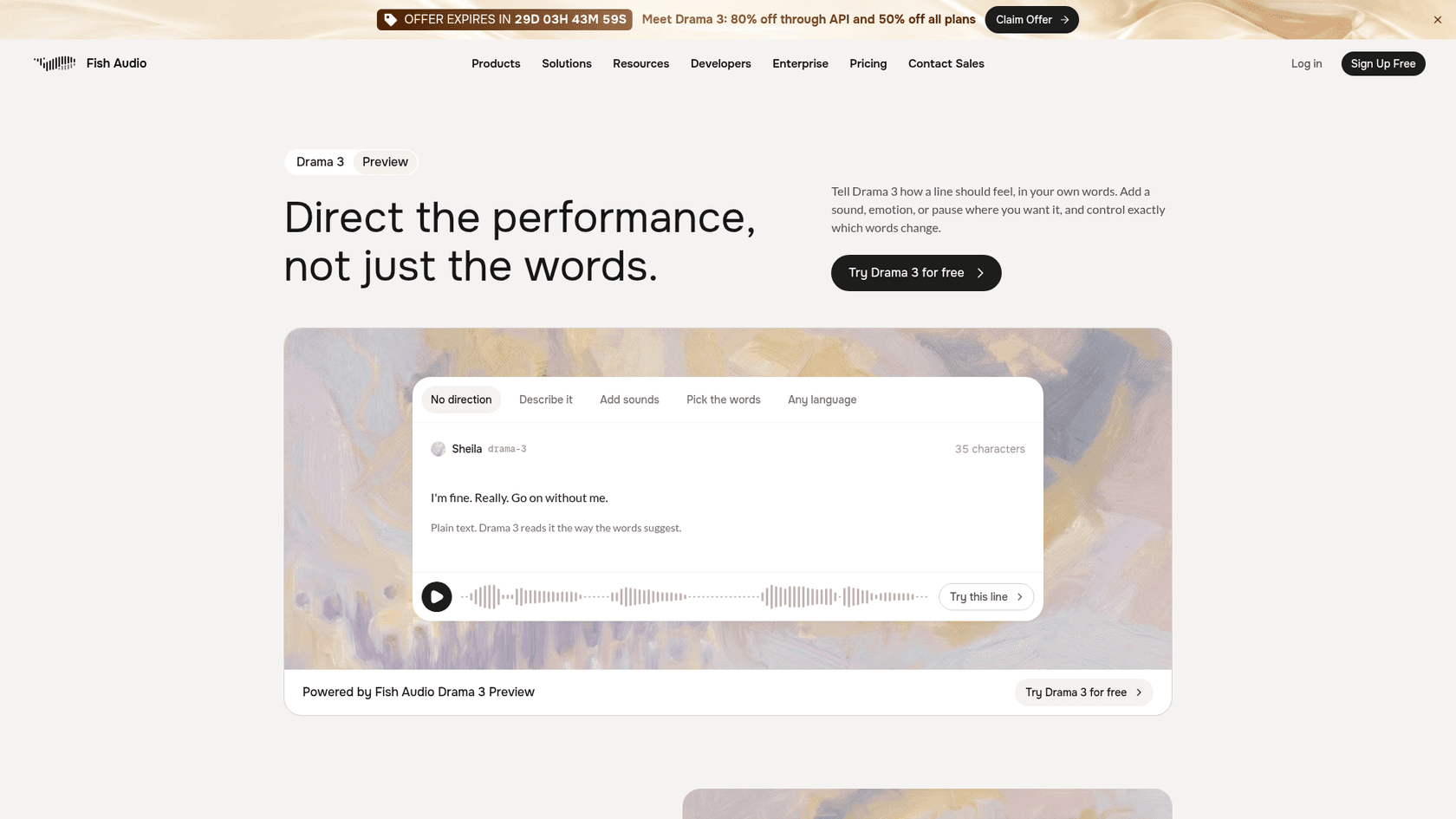
There is a short history too. Fish Audio announced a preview on 23 September, routed through a drama-3-preview model string, and shipped the final model on 13 October. The landing page still carries a "Preview" badge, so expect some polish to land after launch. Fish Audio is not a small lab: its launch press release cites 15 million users and $21 million in annual recurring revenue.
What is new compared with S2.1 Pro?
The honest summary is that the interface stayed and the performance changed. Both models take bracketed direction, both speak 83 languages, and both sit behind the same POST /v1/tts endpoint. What Drama 3 adds is closer adherence to the direction, scoped tags for individual words, and a different training target.
| S2.1 Pro | Drama 3 | |
|---|---|---|
Direction in [brackets] | Yes | Yes, with more feeling per Fish Audio |
Scoped tags (<whisper>, <emphasis>, <slow>...) | Not listed on the models overview | Yes, seven tags |
| Languages | 83 | 83 |
| Pronunciation Robustness (Artificial Analysis) | 88.1% | 93.2% |
| API price per million | $15 | $50 list, $10 until 12 Nov |
| Weights | Hosted API | Open weights, Community License |
Sources: Fish Audio models overview for S2.1 Pro, Drama 3 launch post for the rest.
The training change is the part I find most credible. Fish Audio says most speech models, its own S2 included, are tuned with rewards for being easy to transcribe and for sounding like the reference clip, and those scores mark a laugh or a whisper down. Drama 3 is tuned with a single learned model of which takes people preferred, so a laugh you asked for is not punished. It is a plausible explanation for why a model can be more expressive without getting sloppier on words.
How do you direct a line?
Direction is plain text inside your script, in three layers that you can mix freely. Square brackets before a line set how it is played, written the way you would brief a voice actor. Brackets can also hold a sound or a pause where it should land, such as [shaky breath]. Paired tags scope an effect to a few words: <whisper>, <emphasis>, <soft>, <fast>, <slow>, <stress> and <forceful>.
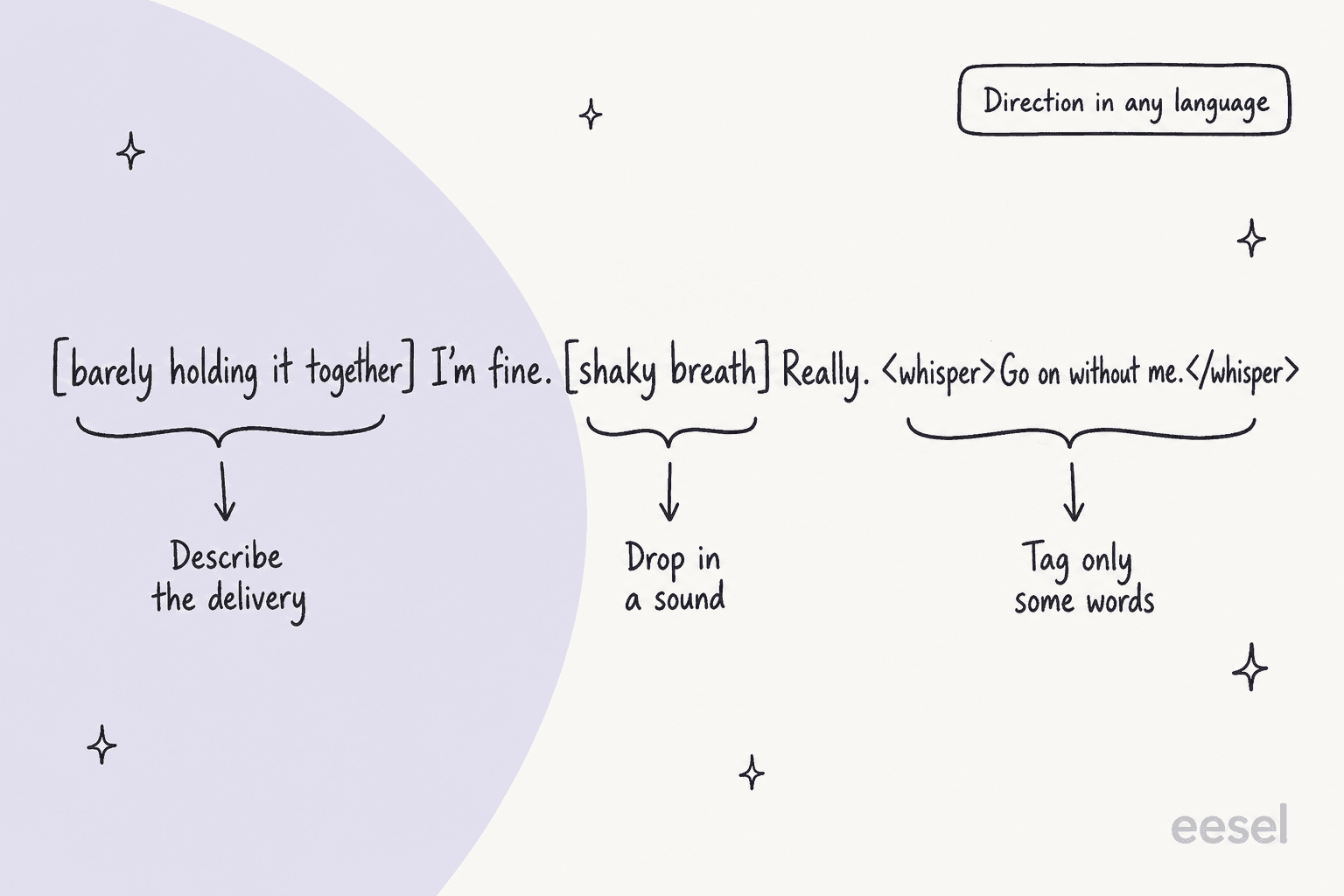
Direction does not have to be English. The Drama 3 docs show a Chinese, a Spanish and a Japanese bracket on the same English line, and Fish Audio says the performance follows the direction whatever language it is written in. A language tag for switching mid-line, such as <french>...</french>, exists but is labelled experimental, with accuracy that varies by language and voice.
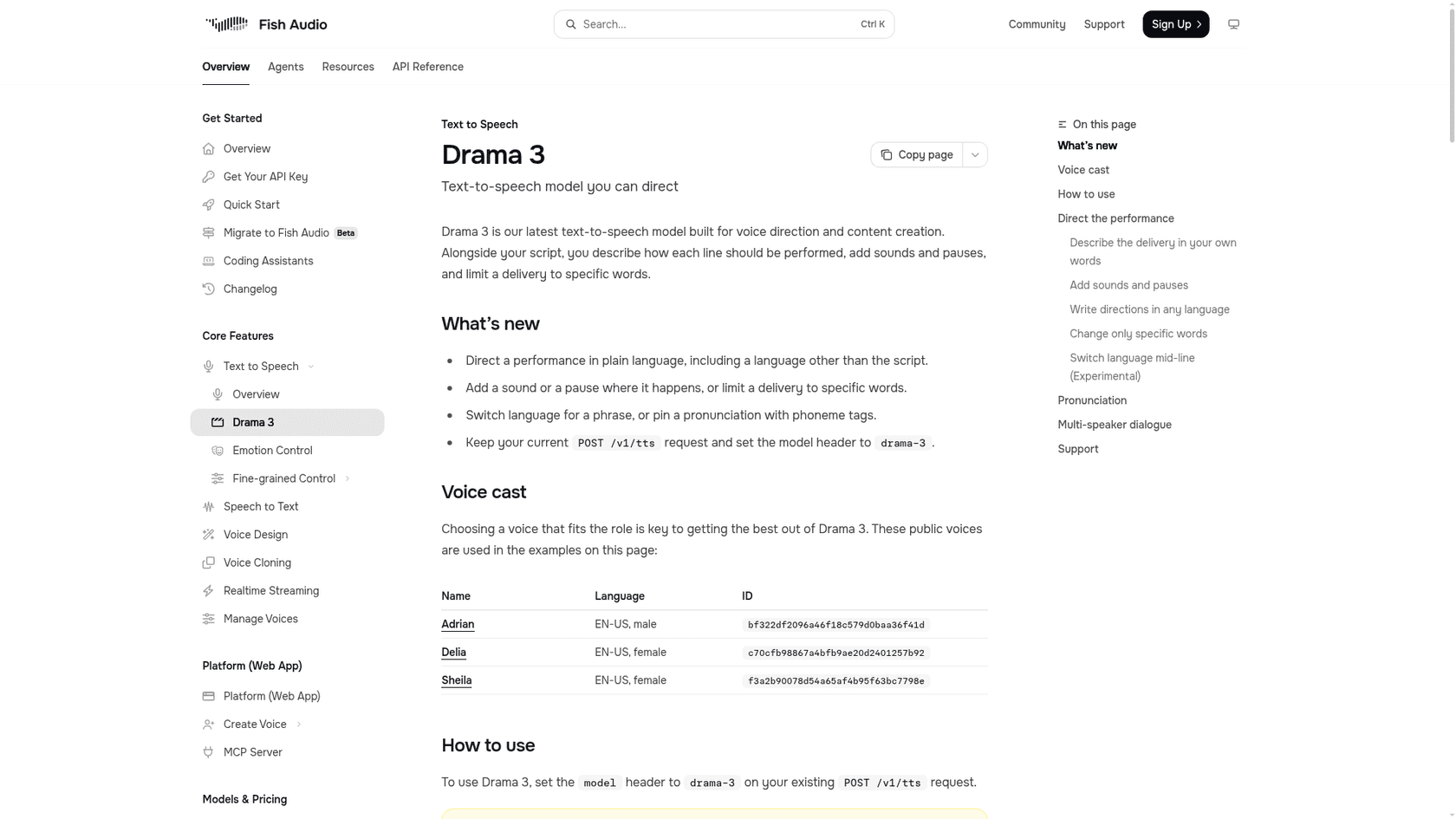
Two details matter if you script this. First, multi-speaker scenes use <|speaker:0|> style tags with one voice ID per speaker passed as an array in reference_id, and the model card on Hugging Face says one text can carry up to 16 characters. Second, a missing or misspelled model header does not fail: the request silently falls back to s2.1-pro. If your audio suddenly sounds flatter than the demos, check the header before you blame the model.
An example worth stealing from the docs is [barely holding it together, forcing a smile] I'm fine. [shaky breath] Really. [small laugh] Go on without me. It is one line with three different jobs, and it is the fastest way to find out whether the model follows direction for your voice.
How good is Drama 3 in independent tests?
Fish Audio's own blog says Drama 3 is first on Artificial Analysis for Pronunciation Robustness. Artificial Analysis confirms it, and its numbers also draw the limits of that claim.
"Drama 3 Preview is the #1 open weights model on all three of our Text to Speech leaderboards."
| Artificial Analysis measure | Drama 3 Preview | Reference point |
|---|---|---|
| Pronunciation Robustness | 93.2%, rank 1 | Eleven v4 91.7%, Eleven v4 Turbo 90.1%, S2.1 Pro 88.1% |
| Provider Voice arena (Elo) | 1,243, rank 10 | S2.1 Pro 1,142 (a 101-point gain) |
| Controlled Voice arena (Elo) | 1,058, rank 14 | n/a |
| Best open-weights rival on pronunciation | n/a | Mistral's Voxtral TTS at 78.1% |
Source: Artificial Analysis thread, 13 October 2026.
Read that table the way a buyer should. The pronunciation lead is real, and the gap over every open-weights model is 15 points, which matters if your script is full of brand names, codes and numbers. Against Eleven v4 the margin is 1.5 points. In blind listening, though, Drama 3 is 10th in the Provider Voice arena, so "most emotive in the world" is Fish Audio's description, not a ranking anyone else has produced yet. The jump from S2.1 Pro is the more useful number: 101 Elo points between two models from the same lab.
Community reaction in the first day matches that split. One user who got the weights running on their own machine wrote:
"It's fast and sounds great."

Another was blunter about the size trade-off:
"barely better than breeze with nearly 10x the size"
That comment compares Drama 3 with Breeze TTS 2, an open model that Artificial Analysis ranks just behind it in the Provider Voice arena (1,221 against 1,243). Both things are true: the lead is small, and so is the room between open models.
How do you access Drama 3?
There are four routes, and they suit different people.
- Web app and mobile apps. Open Text to Speech on fish.audio with
?version=drama-3, or use the iOS and Android apps. The landing page offers Drama 3 free to try, and Uncle Roger's licensed voice is available for roasts. - API. Keep your
POST /v1/ttsrequest and add the headermodel: drama-3. Fish Audio's launch thread lists launch-day partners including ComfyUI, Runway, Pika, OpenRouter and Vercel, though I only checked ComfyUI's announcement, which says it runs as a Partner Node. If you already use Runway, check whether its node exposes the same direction syntax. - Open weights. The model is on Hugging Face, with SGLang-Omni serving from day zero.
- Enterprise. Fish Audio's press release says enterprises switching from another voice provider get their first three months free; it is a sales conversation.
For support and operations teams who already juggle several voice vendors, the voice agent roundup and my AI voice companies list show where a model like this sits next to full agent platforms.
How much does Drama 3 cost?
Start with the API, because the price is the most confusing number in this launch. Fish Audio's launch post says Drama 3 lists at $50 per million characters, and from 13 October to 12 November it is 80% off, which is $10. Fish Audio's own pricing docs and developer page still list only S2.1 Pro at $15 and have no Drama 3 row as of 14 October, and the docs bill in UTF-8 bytes rather than characters. For plain English text the two are close, but check your dashboard before you budget.
"Drama 3 Preview is available via the Fish Audio API at $15/1M characters, the same as S2.1 Pro, compared to Eleven v4 at $80/1M characters and Eleven v4 Turbo at $40/1M characters."
That is a launch-day listing for the preview model, so I would treat it as history. Budget at the $50 list price, and treat the $10 as a one-month discount. ElevenLabs' API pricing page lists v4 at $0.08 per 1,000 characters and v4 Turbo at $0.04, which is $80 and $40 per million.
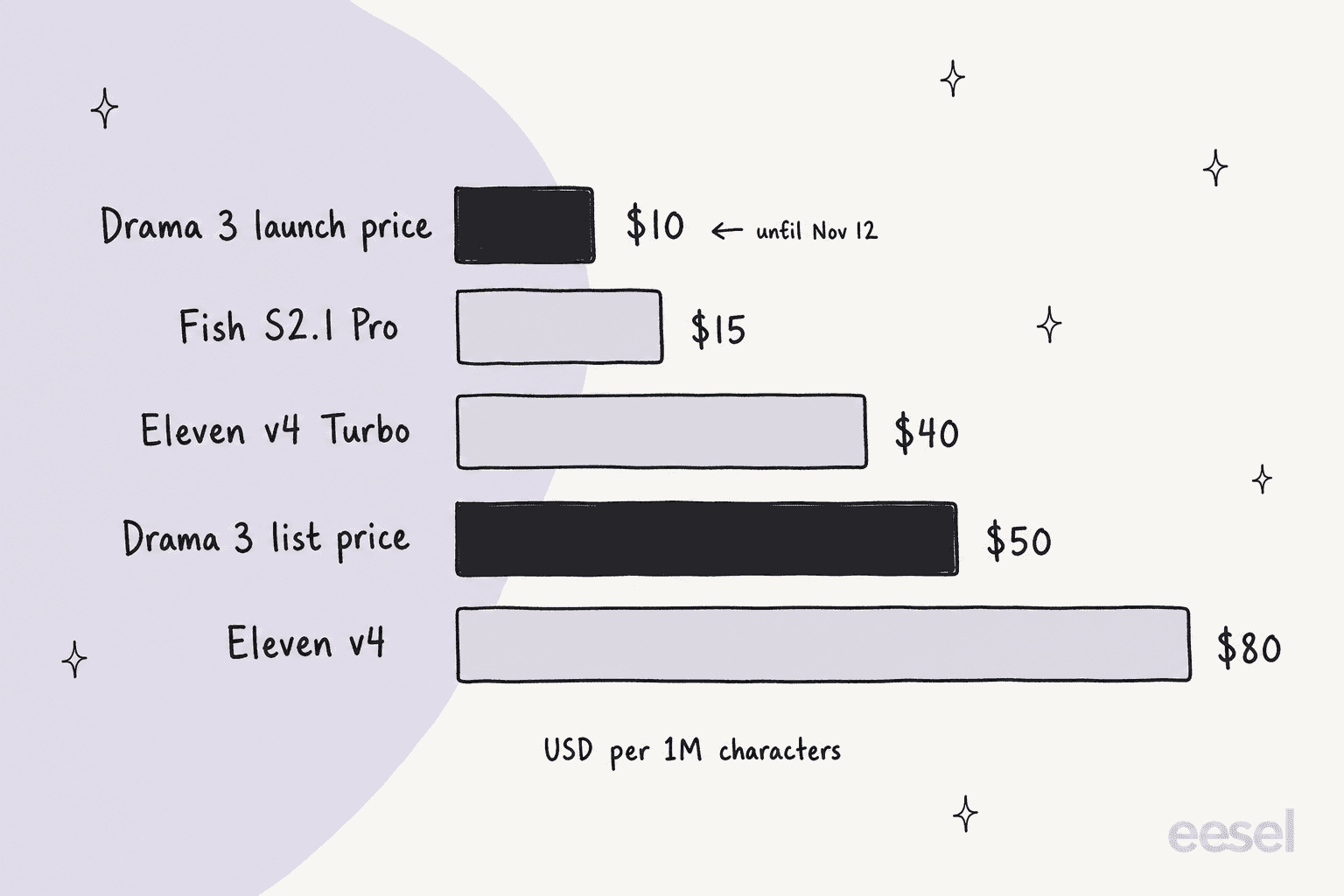
Here is what a 450,000-character job costs, roughly an 80,000-word novel, using the same character count on every row:
| Route | Rate per million characters | Cost for 450,000 characters |
|---|---|---|
| Drama 3, launch price (to 12 Nov) | $10 | $4.50 |
| Drama 3, list price | $50 | $22.50 |
| Eleven v4 Turbo | $40 | $18.00 |
| Eleven v4 | $80 | $36.00 |
| Self-hosted Drama 3 | GPU time only | Free under US$500,000 revenue |
On list price, Drama 3 is cheaper than Eleven v4 but dearer than Turbo, so the choice is about the voice rather than the bill. For deeper breakdowns see my Eleven v4 pricing and ElevenLabs pricing guides, and Gemini 3.8 Flash TTS pricing if you are weighing Google.
The apps work differently. Drama 3 costs the same credits as S2.1 Pro, and until 12 November a new Plus, Pro or Max plan is 50% off for the first month on monthly billing or the first year on annual.
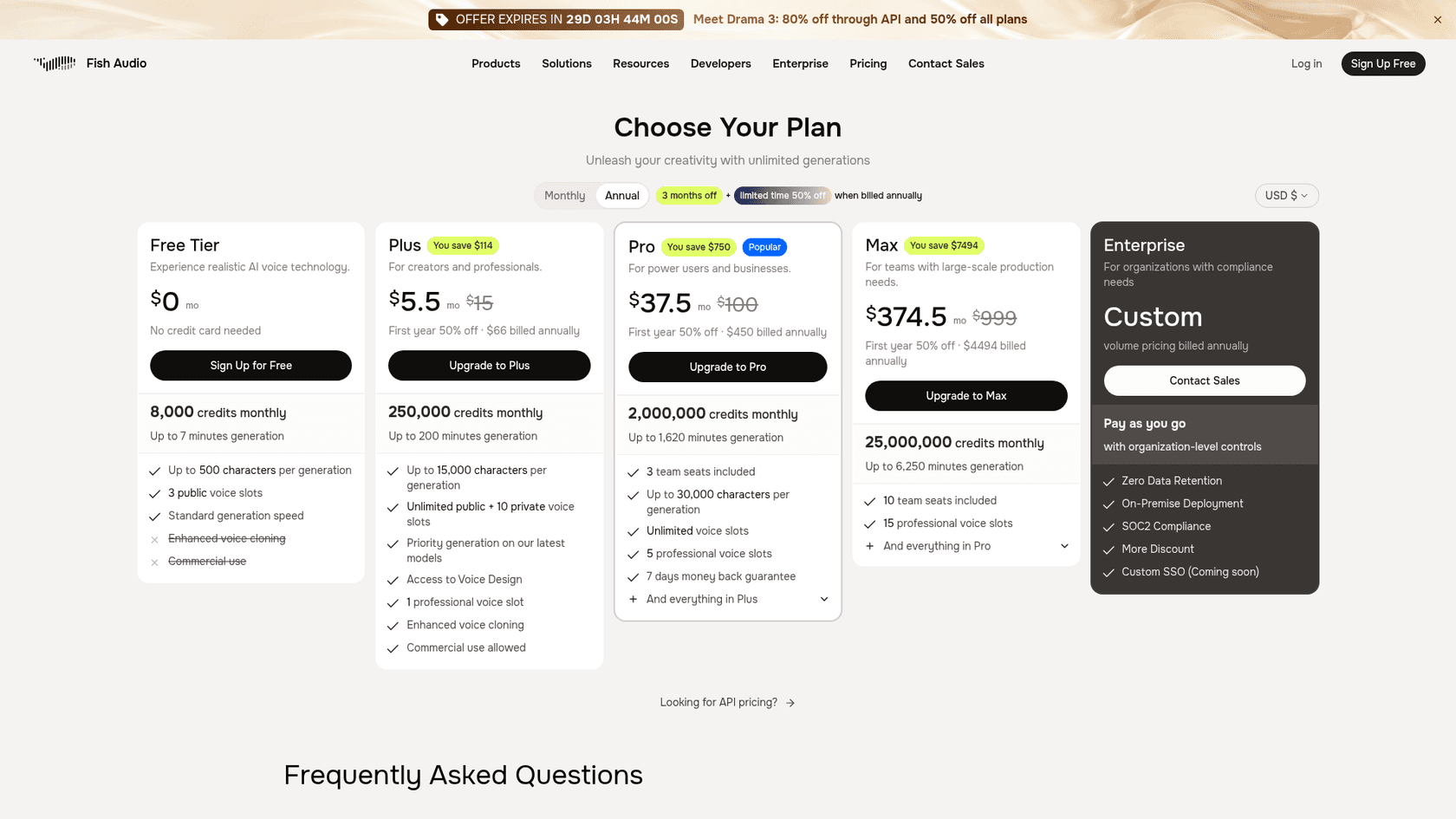
| Plan | Price shown (annual, first year) | Credits per month |
|---|---|---|
| Free | $0 | 8,000, up to 500 characters per generation, no commercial use |
| Plus | $5.50 a month, $15 crossed out | 250,000 |
| Pro | $37.50 a month, $100 crossed out | 2,000,000, 3 team seats |
| Max | $374.50 a month, $999 crossed out | 25,000,000, 10 team seats |
| Enterprise | Custom | Pay as you go, SOC 2, zero data retention |
Source: Fish Audio plans page, captured 14 October 2026. The strike-through prices are the post-offer rates.
Can you run Drama 3 yourself?
Yes, with conditions. The weights are on Hugging Face under the Fish Audio Community License v1.0. It is free for research and non-commercial use, and free for commercial use if you and your affiliates have under US$500,000 in annual revenue. Above that, or to offer Drama 3 to others as a TTS, voice-cloning or inference service, you need a license from Fish Audio. It also bans cloning a real person's voice without their consent. Fish Audio calls the release open-weight rather than open source, and that is the accurate word.
Hardware is the other limit. The model card lists 36B parameters in FP8 and bf16, and community reports on launch day ranged from "needs a 48gb Cuda card" to a run on two consumer GPUs:
"Opus 5.5 was able to get it running on my two RTX 3090s at ~39gb of VRAM."
Fish Audio's own numbers come from NVIDIA H200s. On one H200 with one stream, the Hugging Face card reports a median time to first audio of 88.9 ms, and at 16 concurrent streams the median is 210.1 ms. The license drew some grumbling, and one commenter answered it fairly:
"License is a bit lame but I understand they need to make money too lol"
If you are comparing self-hosting against a managed route, my open-source AI agents roundup covers the same trade-off for agent software.
What are the limits of Drama 3?
Six things to know before you commit a project to it:
- It is aimed at rendered lines. Fish Audio's own launch post says Drama 3 does its best work on scripted lines you render once and keep, such as audiobooks, audio drama, games and short video. Live conversation is a different job; compare Eleven v4 Turbo or Cartesia Sonic 3 for that.
- Takes vary. Fish Audio tells you to render a few and keep the one that plays.
- Editing is not open yet. Interactive editing and audio inpainting are in small invite-only testing, with an editing API "coming soon".
- Language switching is experimental. The
<french>style tags are not guaranteed for every language or voice. - The license has strings. The revenue ceiling and the no-service rule matter for anyone building a voice product on top.
- The price row is not in the docs yet. See above.
I would also not read the 83-language count as 83 equally good languages. Fish Audio's pronunciation numbers are English only, so test the language you actually need, as one Reddit user asked on launch day about German with no answer yet. For multilingual customer-facing work, my multilingual support QA guide covers how to check each language separately.
Who should use Drama 3, and who should skip it?
Use it for audiobooks, fiction podcasts, game dialogue and short video where each line is rendered, reviewed and kept. The scoped tags are the feature that earns the upgrade: fixing one word in a line is cheaper than regenerating a chapter, which Fish Audio's CEO Rissa Cao frames as the point of long-form work. If you script videos or podcasts, AI podcast script generators and AI video script tools pair naturally with it.
Look at the alternatives if you want the most proven voice in blind listening, in which case ElevenLabs and Cartesia are the obvious comparisons, or a Hume AI style emotion layer. My ElevenLabs alternatives post lines them up.
Skip it for now if you need a live phone agent out of the box. Drama 3 is a voice, not an agent, so you still need something to decide what to say and when to hand over. For that, see Retell AI, Vapi, Decagon Voice 3 and Grok Voice Think Fast 2. If you are only comparing speech APIs on cost and simplicity, OpenAI's speech API and Whisper vs the TTS API are the plainer baselines.
What does a voice model mean for a support team?
A voice model changes how an answer sounds, not whether the answer is right. A customer who hears a warm, well-paced refund policy still gets the wrong refund window if the agent behind it guessed. Expressive voices make errors more convincing, which is why I care about the layer underneath.
The pattern I keep seeing on real queues is that teams want voice but start with tickets. One support team using eesel wrote that missing voice-recording support meant agents had to summarise calls by hand for the AI, and that adding it "would significantly increase our usage". That is a feature request, and I will not oversell it: eesel is text-first today, working tickets and chats rather than phone audio. The useful setup is to get the answers right in text first, then pass them to whichever voice model fits.
If you are thinking about voice for support, voice customer support tools and Zendesk voice AI agents are good places to start, and conversational AI for customer service covers the layer before the voice. Keep the voice consistent with your brand too; a model that follows direction is only useful if someone writes the direction down.
Try eesel
If your team is evaluating voice because tickets and chats are piling up, start where the answers are made. eesel's AI helpdesk teammate joins the helpdesk you already use, learns from your past tickets and help center, and replies in your tone. Before it touches a live customer you can run it against historical tickets to see what it would have said, which is how I would test any voice layer's script too.
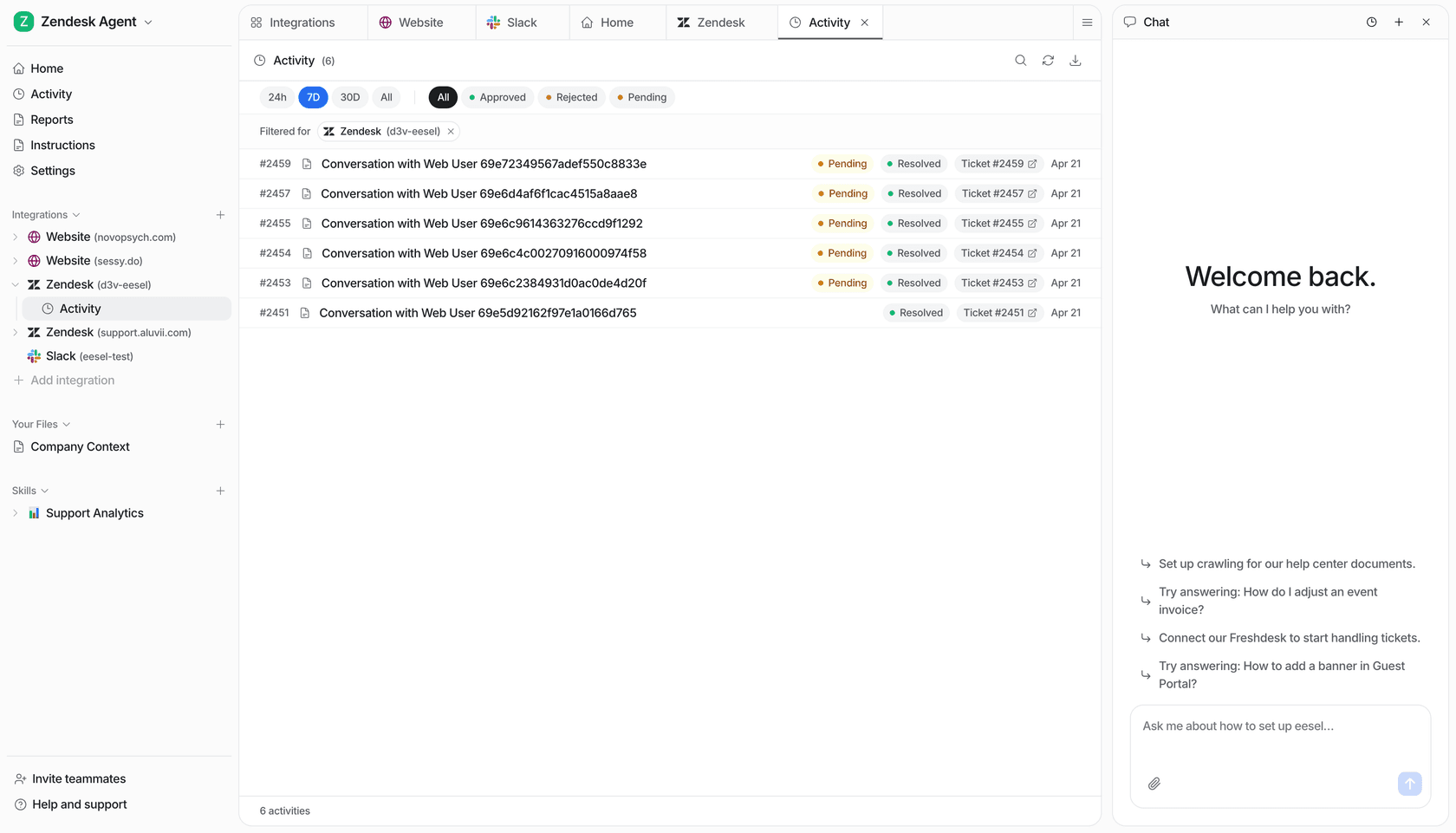
If you prefer a terminal, the eesel CLI lets you, a script or a coding agent such as Claude Code read and change the same teammate's instructions and review its activity, the way you would manage any other service. The free plan includes 100 credits with no card, and the pricing page has the paid tiers. Try eesel on last month's tickets before you decide anything about voice.
Frequently Asked Questions
What is Fish Audio Drama 3?
How much does Fish Audio Drama 3 cost?
Is Drama 3 open source and free for commercial use?
How do I use Drama 3 through the API?
POST /v1/tts request and set the header model: drama-3. A missing or misspelled header falls back to s2.1-pro without an error, so check it first if the audio sounds flat. The same call works from scripts and coding agents, much like the eesel CLI does for a support teammate.