
What an "AI podcast script generator" actually is
When people search for an AI podcast script generator, they're usually picturing a magic box: type in a topic, get a finished episode. That box doesn't exist yet. What does exist falls into two real buckets.
The first is general-purpose chatbots, ChatGPT and Claude, that you prompt to draft or outline a script. This is where most people actually start, and for good reason: it's free or close to it, and it's genuinely good at structure. It's the same engine behind most AI writer tools and AI copywriting tools on the market, just without the podcast-shaped wrapper.
The second is content tools built around a recording. Castmagic calls itself an "AI-powered content operating system" and markets one job: "Turn 1 Recording Into 100 Content Assets", video scripts and show notes among them. Descript's AI layer, Underlord, is pitched as an "all-in-one video agent" that "can write a script based on your prompt, then edit based on your feedback". Both are powerful. Neither is really a blank-page episode writer: Castmagic derives a script from audio you already recorded, and Underlord is a writing partner living inside a video editor.
The mental model that saved me a lot of bad drafts: a podcast script has two halves, and AI is only trustworthy with one of them.
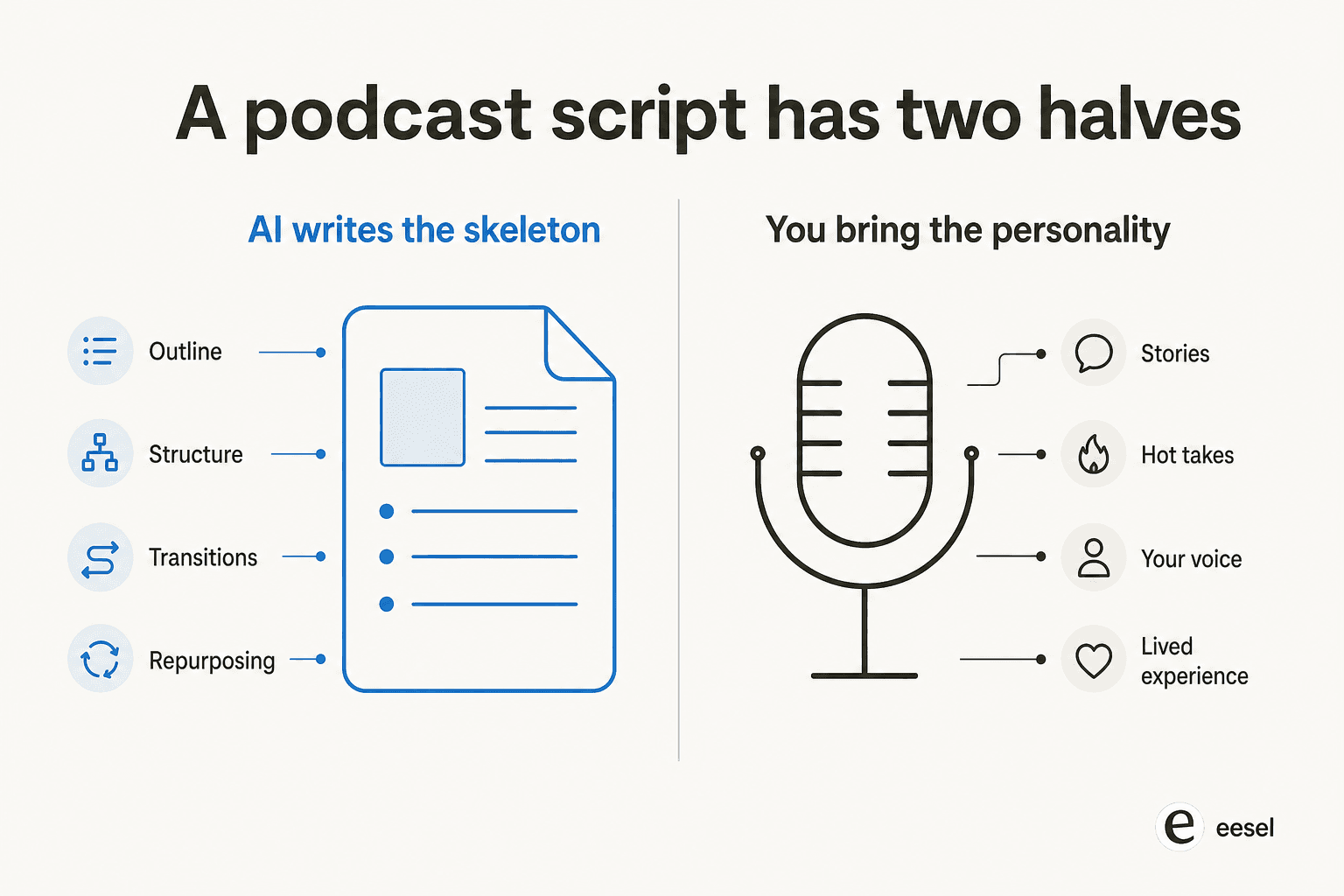
I run content at eesel, where AI drafting is a daily reality rather than a thought experiment, and the split above is the single most useful thing I've learned from it. Hand AI the skeleton and it's a tireless, fast collaborator. Hand it the soul and you get something that's technically a script and emotionally a void.
Why AI-written scripts get caught
The skeptics on this topic aren't luddites. They're working podcasters who tried the shortcut and watched it backfire, and their stories are the most useful research you can read before you start.
The cleanest example is from Noah Kagan, who cloned his own voice and had Claude turn an article into a podcast episode. His editor caught it in about 30 seconds, before being told it was AI:
"At first I thought you were sick. Not yourself. Low mood. Then I was convinced you were reading a script. By the end I'd already twigged before you even said it was AI." "Your personality is the best thing about your show. This just zapped it."
Jason, Noah Kagan's editor, on LinkedIn

That word, "zapped," is the whole problem in one syllable. The script was fluent. It just wasn't him. And listeners feel the difference even when they can't name it.
It's not only a podcast thing, either. In the comments on that same post, one operator described running the experiment on a different format with a hard number attached:
"[I] had a client try to fully automate their email newsletter last month. open rates dropped 40% in two weeks. we pulled back, kept AI on research and formatting, put the human back on writing. rates went back up. [...] automate the process, not the personality."
Alin Dobrin, on LinkedIn
A 40% open-rate drop in two weeks is the kind of number that ends a debate. And it lines up with what listeners are already complaining about on r/podcasts, where the rise of fully-AI shows is landing as "slop":
"It's making it very hard to find good quality podcast episodes on the topics I want! I feel like AI slop is taking over podcasts now too [...] I hate how they sound, how they run, and I am just all around frustrated."
chrisisour, r/podcasts

If you want to avoid being that show, it helps to know what gets a script flagged in the first place. After enough drafts you start to see the same fingerprints every time.
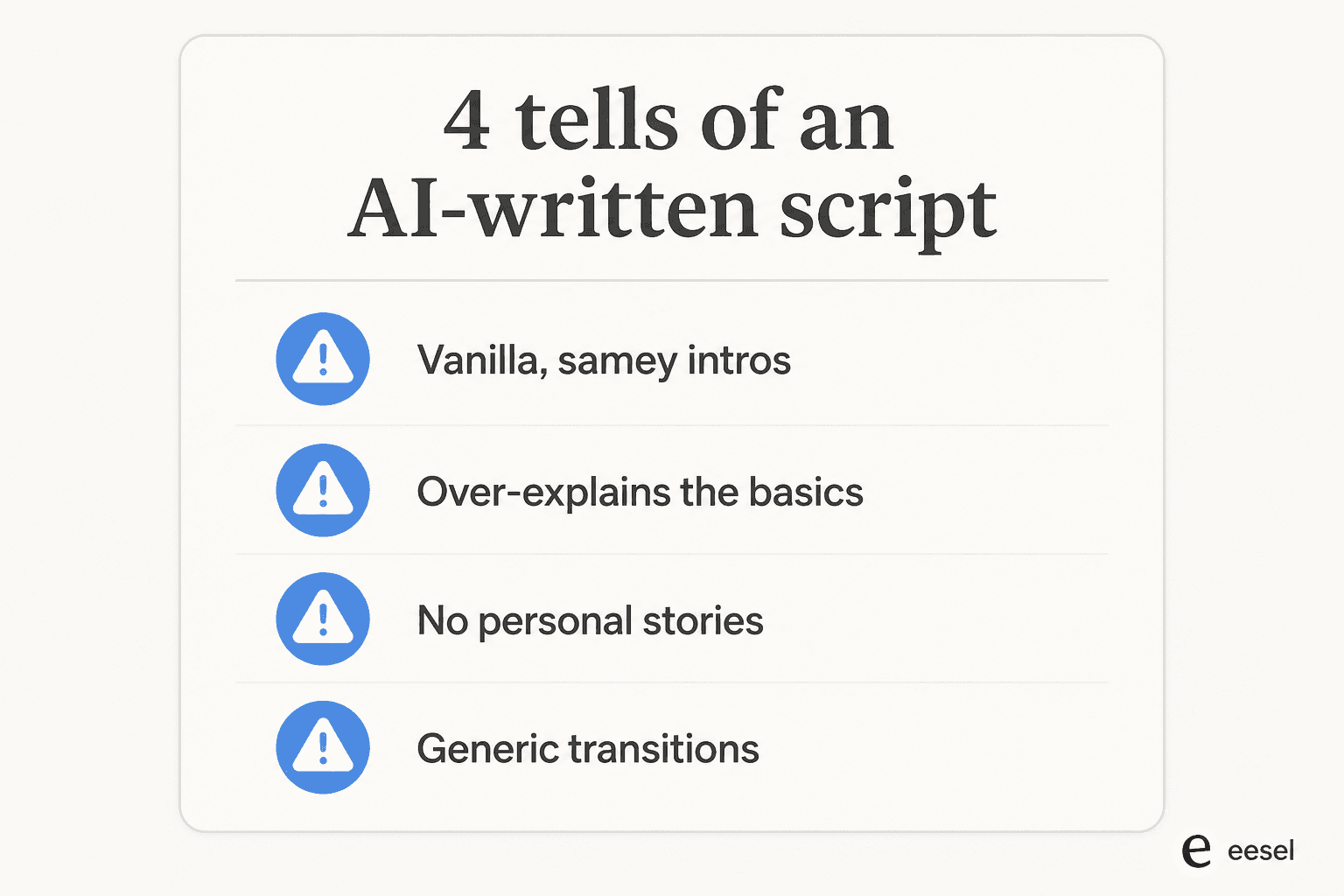
These are the same tells that AI writing detectors hunt for in text, and they survive the trip to audio almost perfectly. The fix isn't a better prompt. It's a better division of labor.
The workflow that actually works
The creators who use AI well don't ask it to be the host. They ask it to be the producer, the researcher, and the editor, and they keep the microphone for themselves. The best summary of this I found came from Justin Peters on LinkedIn:
"Write an episode script yourself, then use AI to proofread it and tighten the language. Develop your own framework or core idea, then ask AI to test whether the structure makes sense. Brain dump your notes into an outline, then use AI to organize them into a clearer story arc. [...] Think of AI like an editor or assistant, not the author."
Justin Peters, on LinkedIn
Here's how I'd turn that principle into a repeatable five-step process you can run for every episode.
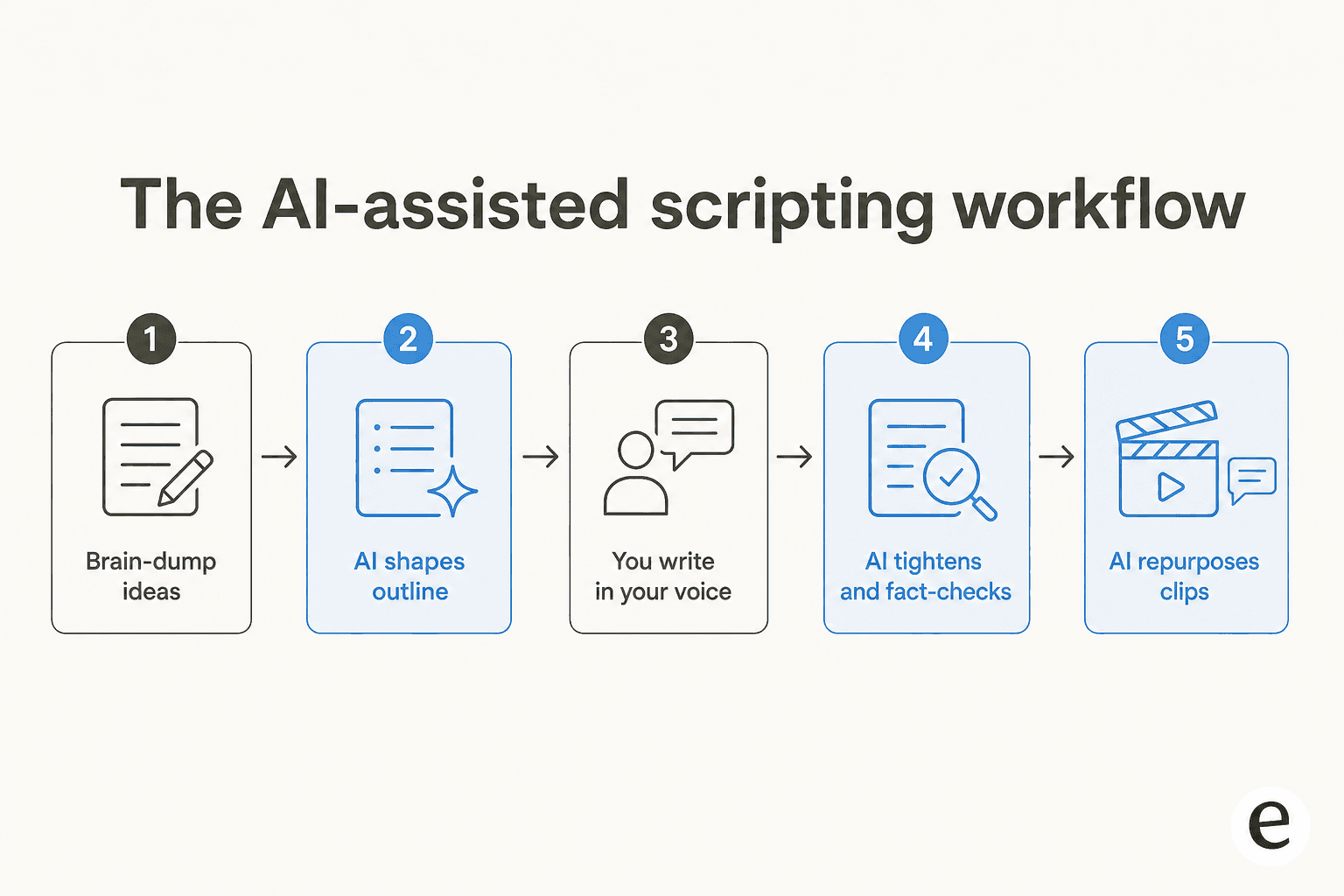
1. Brain-dump first, prompt second. Before you open ChatGPT, talk or type out everything you actually think about the topic: your take, the story you'd tell at a dinner party, the thing you disagree with. This is the raw material AI can't invent, and feeding it in is what keeps the output from averaging the entire internet. As one commenter on Justin's post put it, "all the original content should come from you. Why put out in the world what's already out in the world?"
2. Let AI shape the outline. Now hand the brain-dump over and ask for structure: a cold open, three to five segments, transitions, and a closing. This is the model at its best, taking a messy pile of your thoughts and turning it into a story arc. It's the same job an AI content pipeline does for blog posts, just shaped for the ear instead of the page.
3. Write the voice-y parts yourself. The intro, the personal anecdotes, the hot takes, the jokes: these are non-negotiable. If you outsource them, you get the Noah Kagan result. Write them the way you'd say them out loud, contractions and all.
4. Let AI tighten and fact-check. Paste your draft back and ask it to cut filler, flag anything unclear, and surface counterpoints you missed. Treat every factual claim it touches as unverified until you check it, the same discipline we apply when we fact-check AI content before anything ships.
5. Repurpose, don't regenerate. This is where AI quietly earns its keep. One recording becomes a blog post, show notes, a newsletter, and a week of social clips. As Justin's commenter Jon Goehring summed it up: AI "can help outline, tighten, and then my favorite, repurpose."
The throughline is the same one Alin landed on the hard way, and it's worth repeating because it's the only rule you really need: automate the process, not the personality.
The tools worth knowing in 2026
There's no single "best AI podcast script generator," because the right pick depends on whether you're drafting from scratch, recording video, or repurposing finished audio. Here's how the realistic options stack up.
| Tool | Best for | What it does for scripts | The catch | Starting price |
|---|---|---|---|---|
| ChatGPT / Claude | Brain-dumps, outlines, tightening | Drafts and restructures from your prompt | Generic unless you feed it your own material | Free tier; ~$20/mo |
| Descript (Underlord) | Recording and editing in one place | Writes and edits a script from a prompt, gives feedback | It's a video editor first; AI is metered by credits | From $16/mo |
| Castmagic | Repurposing a recording | Turns one recording into ~100 assets including scripts | Derives from existing audio, not a blank page | $21/mo (Hobby) |
A few honest notes on each.
ChatGPT and Claude are where I'd tell almost anyone to start. They cost nothing to try, they're excellent at outlines, and you're not locked into a podcast-specific tool. The whole AI writing tools category is built on the same models, so skills you learn here transfer everywhere.
Descript is the strongest pick if you record video and want scripting, editing, and AI voices in one place. Underlord "can write a script based on your prompt, then edit based on your feedback", and Descript claims it stays current with the latest models. Just go in knowing it's a full editor with AI on top, not a lightweight script box, and that AI usage is gated by a monthly credit allowance. We dug into the numbers in our Descript pricing guide, and the Descript alternatives roundup if it's not your fit.
Castmagic shines after you've recorded. Its Longform AI engine spins a finished episode into show notes, a script, a newsletter, and social posts, and it offers brand-voice training so the output sounds less like a stranger. It's repurposing-first, which is a different job than drafting.
One word of warning on the "podcast AI" search results: tools rebrand fast. Podcastle, which used to be a go-to podcast studio, now redirects to Async, a general AI video agent with no dedicated script-writing feature anymore. If a recommendation list is more than a few months old, check whether the tool still does what the list says it does. That kind of drift is exactly why we keep refreshing our AI content trends and AI writing comparison coverage rather than letting it go stale.
Where this leaves you
If you take one thing from all the podcasters who tried and got burned, let it be this: AI is a brilliant producer and a terrible host. Use an AI podcast script generator for the research, the outline, the tightening, and the repurposing, and you'll save hours an episode without anyone noticing a machine was involved. Hand it the microphone and your most loyal listeners will be the first to leave.
The most quotable version of that test came from another commenter on Noah's post, and it's a good gut-check for anything you publish: AI-written content "passes with people who didn't know us and fooled nobody who did." Write for the people who know you.
Try eesel for the content around your podcast
Here's where I'll be straight with you: eesel isn't a podcast recording tool, and I'm not going to pretend it scripts episodes. But the hardest part of "AI content that still sounds like me", the exact problem this whole post is about, is what eesel's AI writer is built to solve for the text around your show.
Instead of prompting a blank chatbot every time, you point eesel at your own material, past episodes, transcripts, your help docs, old posts, and it drafts blog versions, show notes, and newsletters that pull from your voice rather than the internet's average. It's the "repurpose, don't regenerate" step from the workflow above, running on autopilot. If turning one recording into a week of written content is the actual job on your plate, that's the part worth automating.
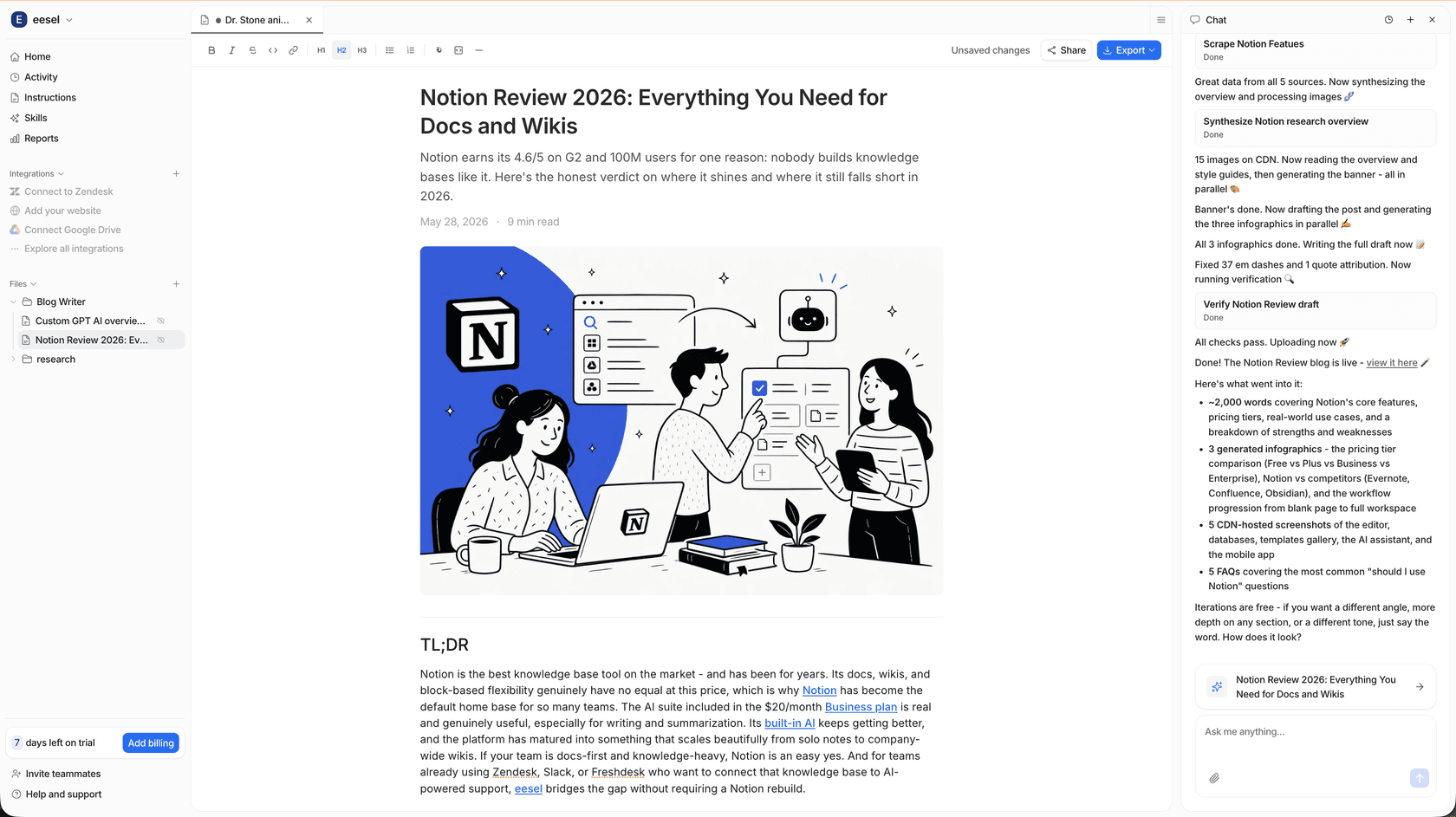
You can try eesel for free and see what it does with one of your own transcripts before you commit to anything.
Frequently Asked Questions
What is an AI podcast script generator?
Can AI write a full podcast script on its own?
What is the best AI for writing podcast scripts?
How do I keep an AI podcast script from sounding generic?
Are AI podcast script generators free?


Article by
Kurnia Kharisma Agung Samiadjie
Kurnia is a software engineer and writer at eesel AI with two years of SEO experience, writing about AI tools, helpdesk software, and customer support. He pairs a developer's understanding of how these products are built with search-driven research into what actually ranks and resonates with the people searching for them.