Let's be honest, the modern content workflow can feel like you're juggling way too many things at once. You have a tool for brainstorming, another for writing, a third for design, and maybe a fourth just to keep everything organized. It's a lot to handle.
Canva and Notion have both tried to solve this by building AI into their platforms, aiming to be your all-in-one workspace. The line between a design tool and a knowledge base is getting blurrier every day. So, the big question is, which one is actually better for your content workflow?
This post will break down the Canva AI writer (part of its Magic Studio) and Notion AI to help you figure out where to put your time and money. But we'll also let you in on a little secret: while these tools are great all-rounders, if you want to scale high-quality, SEO-optimized blog content that actually brings in traffic, you often need something more specialized. That’s where a tool like the eesel AI blog writer can make a real difference.
What is the Canva AI writer?
Canva's AI writer isn't a separate app you download. It's a feature inside Magic Studio, their collection of AI tools built right into the Canva design platform. The main writing tool is called Magic Write, and its job is to help you create text directly within your visual projects, like presentations, social media graphics, and videos.
Think of it as a handy design assistant. You can use it to quickly come up with social media captions, generate an outline for a presentation, or draft some basic text from a prompt. It even works in over 100 languages. Its biggest advantage is convenience. If you're already designing a social post, you don't have to switch tabs to get some copy written.
There is a pretty big catch, though. According to Canva's own help center, its knowledge is only current up to mid-2021. This means you could end up with content that has outdated information, which is a major problem for timely or technical topics. It’s great for quick, creative copy, but not so much for in-depth, factual research.
What is Notion AI?
Notion AI is a smart assistant built directly into the Notion workspace you probably already use. It’s made to boost your productivity and help you manage information more effectively. Notion calls itself an all-in-one AI workspace, and its AI features are a core part of that promise.
Its main functions are all about working with the information you already have stored. You can use it to summarize long meeting notes, brainstorm ideas for a new project, make your writing clearer, translate text, or generate structured content from scratch.
The standout feature is context. Notion says its AI can search across your pages, messages, and files to give you answers that are specific to your work. This turns it into a powerful "thinking partner" for organizing complicated info, sorting out messy ideas, and managing content-heavy workflows all in one spot.
Core capabilities: Canva AI vs. Notion AI
Content creation and ideation
This is where you can really see the difference between the two.
Canva for visual-first content
In Canva, the AI writer is a supporting character; the design tools are the main attraction. It's best at generating short-form copy that goes along with a visual.
For example, you might use Magic Write to create a catchy headline for a flyer, a few bullet points for a presentation slide, or a quick caption for an Instagram post you just designed. It’s fast, easy, and keeps you in your design flow.
But it’s not built for serious writing. It can't do deep research and isn't made for long-form articles. This is why many creators use multiple tools. One Reddit user shared a detailed system where they use GPT for initial drafting before putting the final visuals and text into Canva for the finishing touches. This shows Canva's role perfectly: it’s where you finish a project, not where you start writing it.
For non-technical folks, Notion AI and Canva’s AI tools have been absolute game changers. Notion AI helps streamline workflow by summarizing notes, drafting content, and even automating repetitive writing tasks. Canva’s AI tools make creating graphics ridiculously easy, which is a game-changer for side hustles that require marketing materials. Both are super intuitive—no coding or complex setup needed.

Notion for structured brainstorming
Notion AI, on the other hand, is excellent at the beginning of the process. It's a great partner for thinking, structuring, and organizing your ideas. Its AI can take a jumble of thoughts and turn it into a clean outline, expand on a single idea, or help you build a long-form article from scratch, all inside your knowledge base.
It’s perfect for outlining a blog post, turning meeting notes into action items, drafting internal documents, or creating a detailed project brief.
The main downside? Notion is a blank slate, which can feel a bit overwhelming. You have to create your own systems and workflows.
Even Notion's own comparison page admits that while it's the best for docs and project management, Canva is the top choice for creating visual content. This just confirms that visuals aren't a priority in Notion, just like deep writing isn't in Canva.I heard a lot of people are using Notion to manage ideas, but I found out you can't merge the column in Notion which make it inconvenient for me to use.
Workflow and automation
How do these tools actually fit into your daily work?
Canva’s design-centric workflow
Canva's automation is all about visual production. Features like Brand Kits, which keep your fonts and colors consistent, and Magic Resize, which instantly reformats a design for different platforms, are made to speed up the design process. You can even create variations of a design for different social media channels in bulk.
The whole workflow is focused on one thing: producing a finished visual asset as quickly as possible. It’s not designed to manage the entire content lifecycle, from the first idea to the final blog post.
Notion’s integrated knowledge workflow
Notion AI is built into its databases and project management tools. It can automatically fill in table properties based on your content, generate summaries inside a project card, or create tasks from a block of text.
Besides its own AI, Notion has powerful database automations and integrations with key tools like Slack, Jira, and Google Drive. This lets it act as the central hub for your entire content operation, tracking everything from brainstorming to approval and publication.
Here’s a quick summary:
| Feature | Canva AI (Magic Studio) | Notion AI |
|---|---|---|
| Primary Workflow | Visual Content Design & Creation | Knowledge & Project Management |
| Automation Focus | Design tasks (e.g., resizing, bulk-create) | Process tasks (e.g., database autofill, summaries) |
| Key Integrations | Social media and design apps | Productivity and developer tools (Slack, Google Drive, Jira) |
| Best For | Quickly creating finished visual assets | Managing the entire content lifecycle |
Team collaboration features
Content is usually a team effort, so how do these platforms support collaboration?
Canva for creative teams
This is where Canva shines. It’s made for marketing and design teams who need to create visual assets together. Features like real-time collaboration on a design, shared brand kits to keep everyone on-brand, and built-in approval workflows make it a very strong choice for keeping visual consistency and simplifying creative reviews.
Notion for knowledge sharing
If Canva is the creative studio, Notion is the team library or central "brain." It's consistently ranked by G2 as the #1 knowledge base software, and for good reason. It’s the best place to keep a single source of truth.
Its AI improves this by summarizing long documents for busy team members, making it easier to collaborate on complex written projects, and ensuring everyone is on the same page, whether it's for a project plan or company-wide policies.
Pricing breakdown
Money matters. Here's how the plans for Canva and Notion stack up.
Canva pricing
Based on its official pricing page, Canva's plans are designed for individual creators and teams.
- Free: You get limited access to the premium AI tools, so you can give them a try.
- Pro ($120/year for one person): This plan gives you "High AI access" to tools like Magic Media and Magic Resize.
- Business ($200/year per person): This tier offers "Higher AI access" along with more advanced collaboration features for teams.
It's worth noting that Canva's AI usage is a bit complex. Basic "AI design tools" like Magic Write are generally included with fair use limits, but the more advanced "Premium AI tools" for generating media have monthly credit caps that change depending on the plan.
Notion pricing
According to its pricing page, Notion has changed its model to include AI features more directly in its paid plans.
- Free: Includes a limited trial of Notion AI so you can see what it can do.
- Plus ($10/user/month): Also comes with a limited trial of Notion AI.
- Business ($20/user/month): This is where Notion AI Core features (like Q&A, generate, autofill) are fully included. You also get access to more advanced tools like Agent and Enterprise Search.
This is a shift from their old model where Notion AI was a separate add-on. Now, it's a key part of the Business and Enterprise plans.
A specialized alternative for content marketing
The role of a specialized blog writer
So, we've figured out that Canva is for designers and Notion is for organizers. They are both fantastic all-in-one platforms. However, for teams whose primary goal is to create high-ranking, SEO-optimized blog content at scale to drive organic traffic, a specialized tool may offer more focused features.
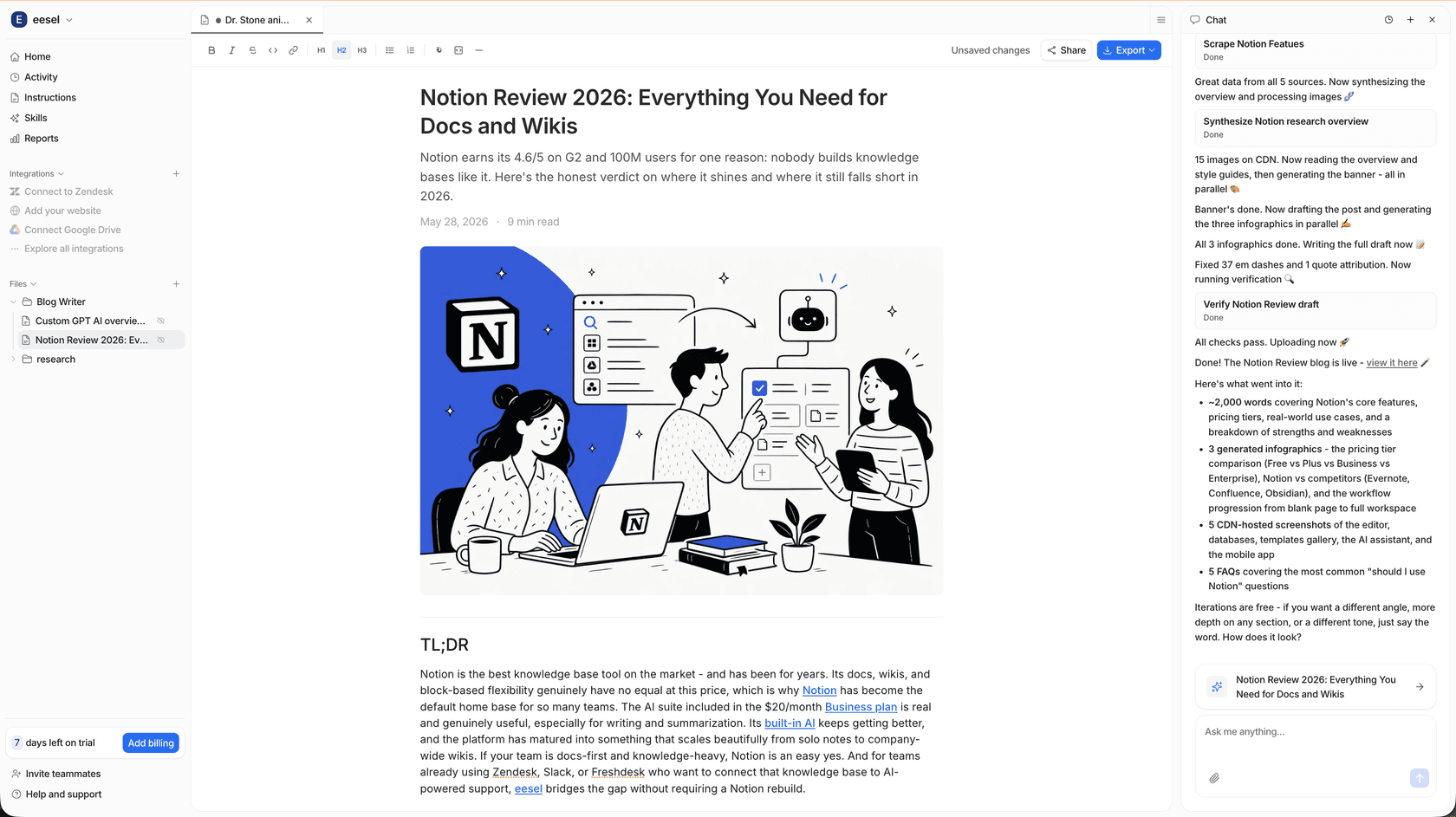
Here are some features that distinguish a specialized blog writer:
- SEO & AEO Optimization: It's built from the start to rank on search engines (SEO) and provide direct answers for AI answer engines like Google AI Overviews (AEO). This level of optimization is a core feature of such tools.
- Automatic Rich Media: The eesel AI blog writer automatically generates relevant images, tables, and infographics to accompany the text, which can save a significant amount of time.
- Social Proof Integration: It pulls in relevant YouTube videos and real Reddit quotes to add credibility, depth, and engagement to posts, a feature specific to this type of content tool.
- Human-Like Tone: The output is refined to sound natural and engaging, creating content that is more readable.
Pro tip
You can [generate your first blog post for free](https://eesel.ai/ai-blog-writer) with the eesel AI blog writer. There’s no reason not to give it a try and see the quality of the content and automated assets for yourself.
While specialized tools offer depth, the trend towards all-in-one platforms continues to evolve. For a look at another powerful tool that aims to replace multiple apps like Canva and Notion, check out the video below.
Making the final call: Canva AI vs. Notion AI
At the end of the day, the right choice really depends on your main workflow.
- Choose Canva AI Writer if... your world is all about creating beautiful visual content. If you need quick, supporting text for designs, social media posts, and presentations, it’s the most convenient option available.
- Choose Notion AI if... your main focus is on organizing ideas, managing knowledge, and working together on structured documents. It’s an amazing tool for building an all-in-one workspace for your team's collective brainpower.
But for teams that are serious about using content marketing to grow, neither tool is a complete solution. They can't replace a dedicated platform built to handle the specific challenges of creating SEO-optimized content at scale.
To scale your blog with publish-ready articles that are built to rank and bring in real organic traffic, start generating blogs with the eesel AI blog writer.