
What I actually tested, and what I could not
I want to be straight about the basis here, because "I tested it" gets thrown around pretty loosely with voice models.
What I worked through: xAI's speech-to-speech documentation end to end, plus the model card with its published limits and the rate card on the pricing page.
On top of that, the launch post and the independent Artificial Analysis run that scored it against 27 other models. Then I read what people building on it are saying.
What I cannot claim: I have not run a thousand production calls through it on a live phone line. Nobody outside xAI has, except Starlink. So when this post says something about behaviour under load, that is coming from a published limit rather than a war story, and I will say which one it is.
I build AI agents at eesel for a living, mostly the parts that sit between a model and a real customer conversation. That is the lens here. The question is not "is this impressive in a demo". It is "what breaks when it is Tuesday afternoon and 40 people call at once".
The scorecard
Here is the whole verdict in one place before the detail.
| Dimension | Score | My read |
|---|---|---|
| Conversational flow | 95.1% Full Duplex Bench | The headline fix. 1.0 scored 77.8%. Interruptions and overlap are no longer the weak spot. |
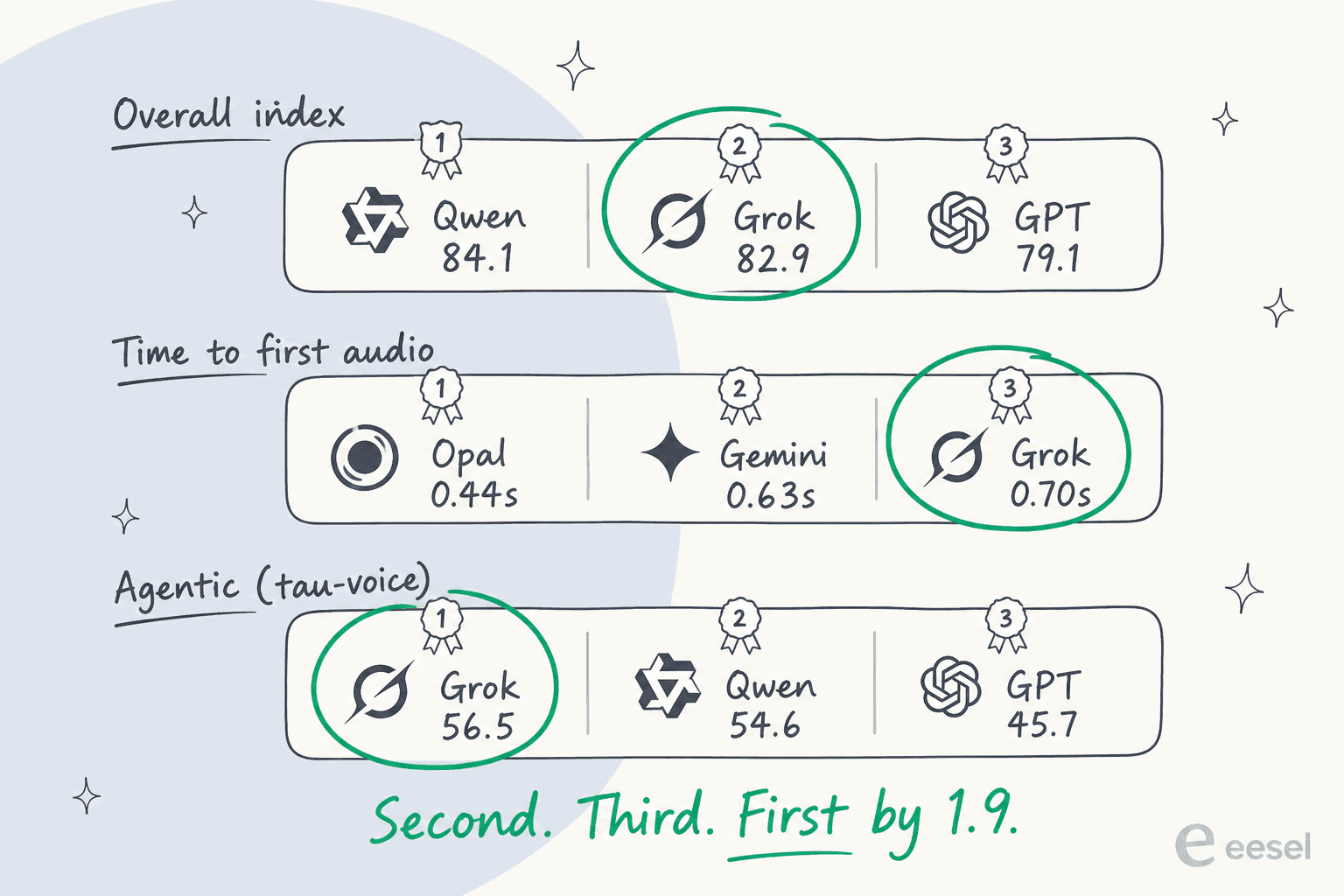
| Raw intelligence | 82.9% AA index | Second overall, behind Qwen at 84.1%. Close enough that it is not the deciding factor. |
| Agentic behaviour | 56.5% τ-voice | Best in the table, but only 1.9 points clear of Qwen at 54.6%. |
| Latency | 0.70s to first audio | Third fastest. Fast enough that a caller does not notice. |
| Transcription | 1.4x better than 1.0 | Real upgrade, and the one xAI undersold. |
| API design | Wire-compatible with OpenAI Realtime | The best part of the product. The extensions read like someone shipped a phone agent first. |
| Cost predictability | $4.80/hr measured, $4.80/hr list | Flat per-minute billing. Rare, and worth more than it sounds. |
| Scale headroom | 10 concurrent sessions | The problem. Everything above is undermined by this one line. |
| Deployment options | us-east-1 only | No EU region. For a lot of teams this ends the conversation. |
Verdict: the model earns a strong recommendation and the platform earns a "check your volume first." Those are two different products and reviews tend to score only the first one.
Where it wins
Four things stood out, and only one of them is the number xAI led the launch with. Taken together they describe a specific kind of model: not the smartest one available, but the one that stays sharp while answering fast enough for a phone line.
Interruptions stopped being the tell
The single biggest change from 1.0 is Full Duplex Bench, which measures how a model handles the messy parts of real conversation: barge-in, overlap, backchannels, someone changing their mind halfway through a sentence. 1.0 scored 77.8%. 2.0 scores 95.1%.
That is the number which separates a voice agent people tolerate from one they forget is a machine. Anyone who has listened to call recordings knows the specific failure: the caller starts to correct themselves, the bot keeps talking over them, and the caller either repeats themselves louder or asks for a human. It sits near the top of every list of chatbot problems that make customers give up, and the handoff patterns in every serious deployment mostly exist to catch that exact moment.
Worth to note fairly: this is the one row where Grok loses to OpenAI. GPT-Realtime-2.1 High scores 95.7%. A 0.6 point gap is not something any caller would ever perceive, but the launch table is not going to volunteer it either.
The agentic score is the real headline
τ-voice measures whether a model can actually finish a task over voice, instead of only sounding good while doing it. Look up an order, check a policy, then call a function and come back with the right answer. Grok Voice Think Fast 2.0 posts 56.5% here, the highest figure in the entire Artificial Analysis table.
This matters more than the overall index for anyone building a real agent, because a voice agent that cannot reliably use tools is a very expensive FAQ reader. It is the same distinction that separates AI agents from AI chatbots in text, and the same reason the useful AI agent examples are always the ones touching a real system rather than reciting an article.
The honest caveat: Qwen Audio 3.0 Realtime Plus sits at 54.6% on the same benchmark. So Grok's lead is 1.9 points, which is not the chasm the framing implies. The gap over OpenAI's best at 45.7% is wider, and that is where the "10 points ahead" line comes from, but Qwen is right there.
The speed and smarts combination
0.70s to first audio, down from the 1.25s in 1.0. Deepslate Opal is faster at 0.44s, and a Gemini Flash variant at 0.63s, so Grok lands third. But Qwen, the model that beats it on the overall index, takes 4.02s to first audio. On a phone line that is a dead pause long enough for the caller to say "hello?
That trade is the actual product. Somebody on Hacker News put it better than the launch post did:
"Grok voice is the best voice AI voice assistant and it's not even close.
The speed + intelligence tradeoff is just right. While GPT voice is smug and unhumanlike despite trying hard to be human."

xAI also says reasoning tokens run at 0.4x its predecessor's P50, which is how it got faster while getting smarter rather than by thinking less.
Transcription is the underrated part
Buried in the launch post: transcription accuracy is 1.4x better than 1.0, and 1.5 to 2.0x better than Deepgram Nova 3 and ElevenLabs Scribe v2 across 24 languages. In noisy or telephony audio the claimed gap is roughly 10x.
Telephony audio is where transcription usually falls apart, and it is exactly the kind of audio a support line runs on all day. If you are evaluating this against ElevenLabs or a dedicated speech-to-text vendor, that noisy-audio figure deserves more weight than the conversational benchmarks. It is also the axis where OpenAI's transcription endpoint has been the default choice, mostly by inertia.
There are 26 voices in the roster now, after 21 were added in July 2026, and any of them can be swapped for a cloned voice ID. If you have ever fought to keep a bot sounding like your company across channels, the brand voice problem does not go away just because the output is audio.
Where the benchmark table oversells it
Three things the launch framing does not tell you.
82.9% is second place. Qwen Audio 3.0 Realtime Plus is at 84.1%. Grok is competitive with it, and faster by a wide margin, but "state of the art" is doing some work in the marketing copy. If you have looked at Qwen's model family or what Alibaba charges recently, you will know they have been shipping hard.
Do not cross-compare xAI's two τ-voice numbers. The July 1 Voice Agent Builder post reports Think Fast 1.0 at 67.3% on its own τ-voice run. Artificial Analysis scores the same model at 52.1%. Different harnesses, different scales. Anyone stacking those two numbers into a "look how much it improved" chart is comparing nothing. The same care applies to the numbers in Voice Agent Builder pricing, which still quote the old rate.
The Starlink numbers belong to 1.0. The widely-quoted 20% sales conversion and 70% autonomous resolution, from the line at +1 888 GO STARLINK with 28 tools wired up, are Think Fast 1.0 results. For 2.0, xAI says A/B testing on that same line showed "a significant increase" in conversion and containment, and publishes no figure. It is also a first-party deployment inside the same ownership structure, which makes it a best case rather than a representative one.
Building on it: the API is the good part
I expected the docs to be the weak spot here and they turned out the opposite. In terms of design, this is the most thoughtful realtime voice API I have read.
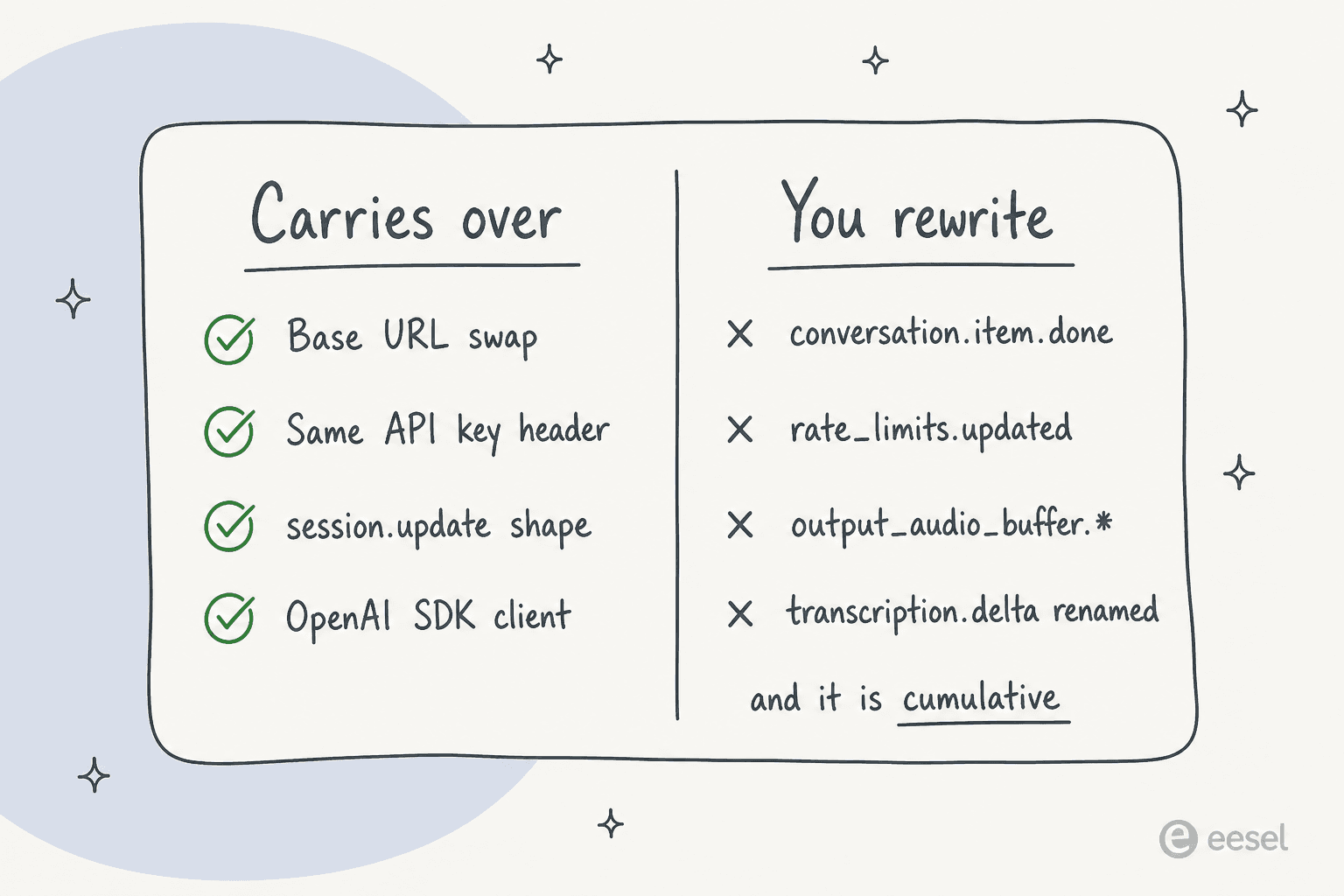
It is wire-compatible with OpenAI Realtime at wss://api.x.ai/v1/realtime, so if you have an existing app the migration is a base URL and a key. You can even keep the OpenAI SDK and just point it at https://api.x.ai/v1. Four things do not carry over: conversation.item.done, rate_limits.updated and most output_audio_buffer.* events are not emitted, and ...input_audio_transcription.delta is renamed .updated and made cumulative, which will silently corrupt your transcript display if you were appending deltas.
The xAI-only extensions are where it gets interesting, and they read like they were written by people who had shipped a phone agent and been burned:
force_messagespeaks a hard-coded line through TTS without involving the model at all. Setinterruptible: falseand caller audio is dropped until it finishes. This is the compliance disclosure problem solved properly, rather than by praying your system prompt holds.replaceis a pronunciation map applied before TTS, so the audio says "Acme Mobull" while the transcript still reads "Acme Mobile". Matching is case-insensitive with whole-word boundaries and longest-match-wins.resumptioncaches turns byconversation_idand replays them on reconnect. Off by default, both sides have to opt in, and history expires after 30 minutes of inactivity.keytermsbiases transcription toward up to 100 domain terms of 50 characters each, updatable mid-session. For a support line full of SKUs and plan names, this is the difference between a usable transcript and a mess.idle_timeout_msre-arms after every response, so the agent can re-engage a silent caller repeatedly rather than sitting there.
The reasoning.effort parameter takes exactly two values: "high" (the default) and "none". There is no middle setting, which is a real gap. Someone raised precisely this on Hacker News about an earlier Grok voice release:
"Grok voice model is also a thinking model. I agree that it's far better than the other voice models
Just give me a option to have a slower response but better model…"
One more thing the docs get right that most vendors leave you to discover in production: they tell you explicitly to wait for audio playback to finish before sending response.create after a tool call, because the server delivers all audio deltas before the function call events. Skip that and you get overlapping speech. They even suggest showing a thinking indicator during the gap. That is a hard-won detail, written down.
The migration guide's own advice is to make your system prompt shorter, not longer, which tells you something about how the model was tuned.
The three limits that will actually stop you shipping
If I was the one evaluating, this is the section I would read first.
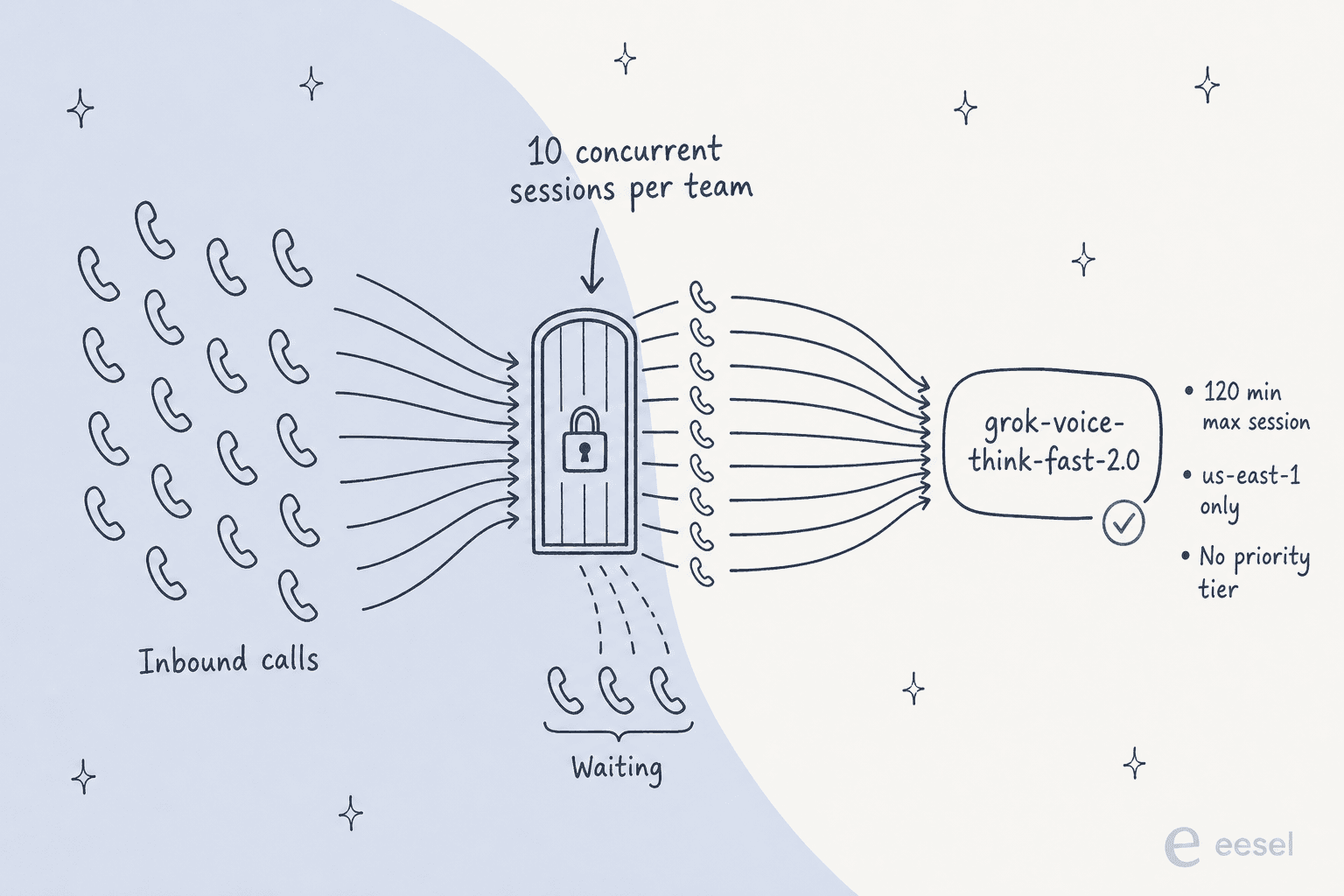
10 concurrent sessions per team. This is the published default on the model card, raisable on request. Ten simultaneous calls is just a small support team's Monday morning. Every benchmark above is irrelevant if call eleven cannot connect, and "raisable on request" is a sales conversation, not a configuration flag. Anyone sizing an AI call center agent should treat this as the first question, not a footnote.
For comparison, the packaged voice products built on top of a helpdesk do not publish a session ceiling at all, because concurrency is the vendor's problem rather than yours. That is true of Zendesk's voice AI agents, of Freshcaller's setup, and of Salesforce's voice agent. You trade flexibility for someone else owning the capacity planning.
us-east-1 only. One region, no EU option. If you have data residency commitments, this decides it for you before you evaluate anything else.
No priority tier and no batch discount. The 2x priority tier is Chat Completions and Responses only. The 20% batch discount is text models only. Voice gets neither a fast lane nor a volume break, so the rate you see is the rate you pay at every scale. There is also a max session duration of 120 minutes, which is generous for support and tight for anything like a monitored line.
Two smaller ones worth knowing. Storage bills separately if your agent does retrieval: collections are $0.10/GiB/day, files $0.025, downloads $0.20/GiB. And there is a $0.05 usage-guidelines violation fee for each Responses request blocked before generation.
Should you take 2.0, or pin 1.0?
The August 5 alias flip means doing nothing is itself a decision. Pick the row that describes you.
What are you running today?
Pick one. The verdict changes a lot depending on which of these you are.
At demo volume the 60% rate rise is a rounding error and the Full Duplex jump from 77.8% to 95.1% is the difference between a demo that lands and one that does not. Let the alias flip carry you.
Your per-minute cost goes $0.05 to $0.08 on August 5 with no deploy on your side. At 2,000 minutes a month that is $100 to $160. The conversational-flow upgrade is worth it, but put the number in front of whoever signs off before the invoice does it for you.
10 concurrent sessions per team is the published default and raising it is a conversation with xAI, not a config change. Get that number agreed in writing before you benchmark anything. A 95.1% Full Duplex score does nothing for call eleven.
Speech-to-speech runs in us-east-1 only, with no EU region published. No score in this post changes that. Evaluate again when xAI publishes a second region.
What people building on it actually say
X is the natural home for xAI reaction and it is currently hard to read at any depth, so the usable signal is on Hacker News. Two threads carry most of it.
The most upvoted comment on the Think Fast 2.0 thread is essentially a complaint about the launch being under-noticed:
"Don't know why this post isn't more popular, this is a SOTA voice model, beating dedicated labs like ElevenLabs"
That is a fair read on capability, and it is worth noting the pricing has now converged too. Every paid ElevenLabs Agents tier works out to almost exactly $0.08 per included minute, which is Grok's new rate to the cent. Until August 5 Grok undercut it by 37.5%.
The more measured take, from a few months earlier, holds up well:
"Grok voice is surprisingly good, actually. It's still a dumber model than the thinking modes of frontier models, but it's less dumb than the voice modes of other providers."
That is roughly where I land too. A voice model is always a compromise against a text model which gets to think for ten seconds, and Grok makes a better compromise than the rest of the field does. Read the consumer-side reviews and you will see the same verdict phrased less carefully.
The recurring frustration in these threads is tool use in voice mode, and it is worth clearing up because it cuts both ways:
"What I'm missing from this announcement is the capability to use connectors and tools. I don't really get it - NONE of the frontier assistants can use tools / connectors while in voice mode"
That is about consumer voice assistants, and on the the API side it is not true of Grok: sessions support function, file_search, web_search, x_search, and remote mcp tools, with the server-side ones executed for you. Server tools bill per invocation, at $5 per 1,000 for web and X search, $2.50 per 1,000 for collections, and $10 per 1,000 for attachment search. The gap the comment describes is real in the consumer Grok app, not in what you would build against. It is the same split that runs through the ChatGPT voice rollout: the API has been ahead of the app for a while now.
Who should pick this up, and who should wait
Pick it up if you are building a phone or voice agent that has to do things, not just talk. The τ-voice score, the tool support, the force_message and keyterms extensions, and the flat per-minute meter add up to the most builder-friendly voice stack currently shipping. Migrating off OpenAI's realtime audio is close to free.
Pick it up if cost predictability matters to your finance team. Artificial Analysis measures Grok's real cost at $4.80 per hour of input audio, identical to list, because the meter is flat per minute. GPT-Realtime-2 lists $1.15/hr input and measures $4.14 all-in. Voice bills that match their sticker are rarer than they should be, which is half the reason the agent versus human cost question is so hard to answer honestly.
Pick it up if you want to build the orchestration yourself. If you would rather drag boxes around, Voiceflow's pricing and the Voice Agent Builder alternatives are the no-code end of the same market.
Wait if your volume goes past ten simultaneous calls and you have not already got a raised limit in writing. Wait if you need an EU region. Wait if you were relying on the $0.05 rate and had not noticed the alias moving underneath you, in which case pin grok-voice-think-fast-1.0 today and decide on your own schedule.
Do not buy it as a support solution. This is a model and an API, not a helpdesk agent. It has no concept of your ticket history, your macros, your escalation rules, or which questions your team has already decided the AI should not touch. Everything above is about the voice layer, and the voice layer is maybe 20% of what makes a support automation actually work. The rest is the boring part: knowing your product, knowing when to stop, and handing off cleanly.
A CX lead at a DTC supplements brand put the constraint better than any spec sheet:
"The AI will never be able to answer 100% of the questions... I need an AI who is only handling the tickets that it's confident to handle and all the other ones, leave them alone."
No voice benchmark measures that. It is a policy question, and it is the one that decides whether a rollout survives its first month.
Voice is the loud half of a support queue
Most of the tickets that turn into phone calls were answerable in text an hour earlier. First-response automation and a knowledge base chatbot the AI can actually read kill more calls than any voice model will. That is the thing worth fixing before you shop for one.
eesel is an AI agent that plugs into the helpdesk you already run, trains on your past tickets and help center rather than a system prompt you have to hand-write, and lets you simulate the whole thing against your real ticket history before a single customer touches it. That last part is deliberate. I have spent years watching confident-sounding bots give wrong answers, and a dry run over tickets you have already resolved is the only honest way to find out what yours will do. It is also the step that separates a real AI agent from a rule-based bot once the scripted paths run out.
It is the same build-versus-buy call a lot of teams land on once they have read a docs page like xAI's and understood how much of it they would be maintaining:
"We could try to write our own LLM application but we didn't want to invest our time into that. We wanted something that we would not have to maintain."
Karel, GENERAL BYTES
If you want the voice layer too, keep reading about Grok's Voice Agent Builder and the wider AI voice companies field. If you want the queue behind it handled first, eesel is free to try and takes a few minutes to point at your helpdesk. Teams running Gorgias or Zendesk usually have it answering real tickets the same afternoon.
Three things worth reading next, depending on which part of this you are stuck on:
- Still deciding on the model: the Think Fast 2.0 overview covers the mechanism in more depth.
- Working out the bill: the full pricing breakdown does the arithmetic at four volumes.
- Comparing the field: ElevenLabs alternatives is the closest head-to-head at the same rate.
Frequently Asked Questions
Is Grok Voice Think Fast 2.0 good enough for production voice agents?
us-east-1 region. Read the Grok Voice Think Fast 2.0 breakdown for the full mechanism, and AI call center agents for what a production deployment usually needs.What is new in Grok Voice Think Fast 2.0 compared to 1.0?
How much does Grok Voice Think Fast 2.0 cost per minute?
grok-voice-latest alias. Compare it against ElevenLabs pricing and the wider AI voice companies field before committing.Can I migrate an OpenAI Realtime app to Grok Voice?
wss://api.x.ai/v1/realtime, so the base URL and key swap covers most of it. Four event types behave differently, which the migration section below lists. If you built against the OpenAI audio API, budget an afternoon rather than a sprint.Is Grok Voice Think Fast 2.0 better than ElevenLabs for support calls?


Article by
Alicia Kirana Utomo
Kira is a writer at eesel AI with a Computer Science background and over a year of hands-on experience evaluating AI-powered customer service tools. She focuses on breaking down how helpdesk platforms and AI agents actually work so that support teams can make better buying decisions.