

What is Buzz?
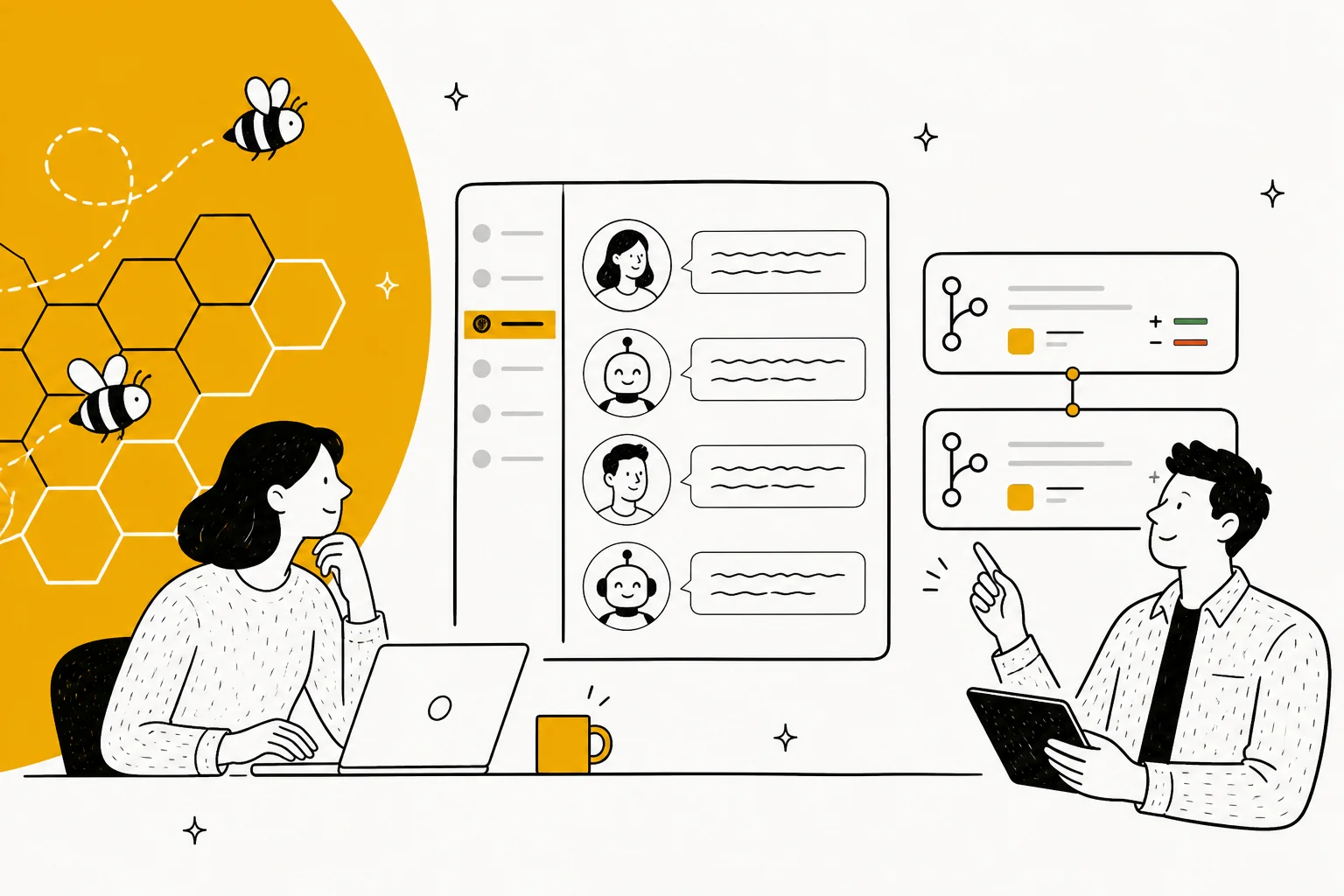
Buzz is, in Block's own words, "a workspace where humans and agents build together, on a relay you own." If you've used Slack, the interface will feel familiar instantly: a sidebar of channels, threads, direct messages, emoji reactions, voice huddles, and media sharing.
The twist is who's in the room. Alongside your teammates, you invite specialized AI agents into the same channels, where they post, review code, run approved automations, and generally behave like coworkers rather than a slash-command bot you summon and dismiss. And because Buzz also brings in Git hosting, the conversation about a feature and the pull request for that feature can live in the same place.
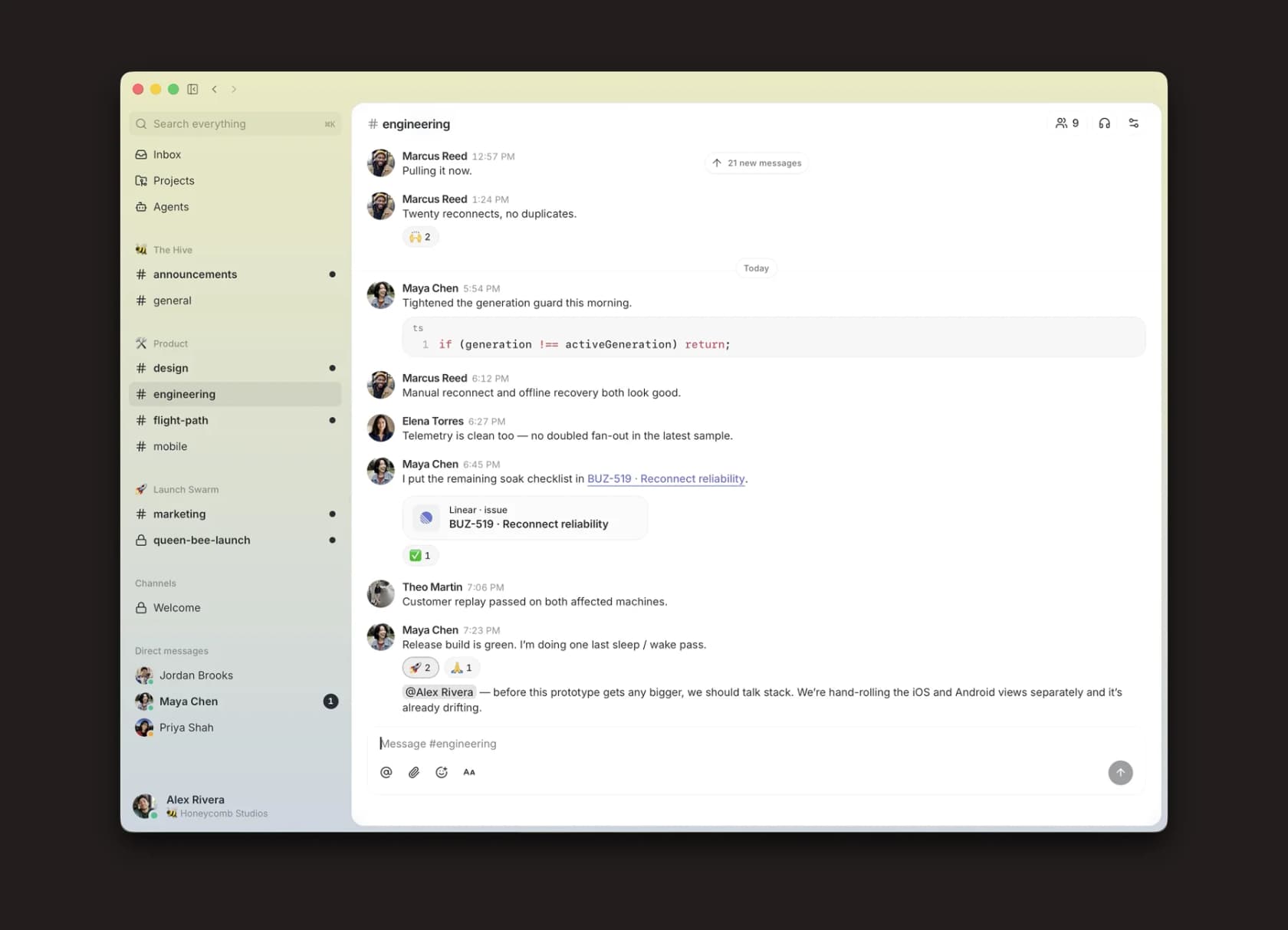
Block's one-line framing sums up the bet: keep people, context, decisions, and next steps in one shared room instead of scattered across a chat app, a tracker, and your dev tools. It's positioned squarely as a challenger to both Slack (for chat) and GitHub (for code).
Who built Buzz, and why
Buzz comes from Block, Inc., the fintech company behind Square, Cash App, Afterpay, and Tidal. That matters: as TechCrunch noted, a Block product signals "more than just a Dorsey passion project." The named spokesperson is Bradley Axen, Head of AI Capabilities at Block, and his line captures the whole thesis:
"Every company is going to need a place where humans and agents work together. The question is whether that place is proprietary or open. We built Buzz because we believe it should be open."
The "why" is a coordination problem, not an intelligence one. Block's engineering blog puts it sharply: "Models can do the work now. Teams still need somewhere to do it together. The bottleneck moved from intelligence to coordination." They describe the old way of working as everyone sitting alone with an agent in a little harness window, copying its output into Slack and pasting replies back, and land on a line most of us will recognize: "Nobody enjoyed being middleware."
Buzz builds on two years of AI tooling Block has open-sourced, including its own agent framework, goose. The launch tweet did the numbers you'd expect from a Dorsey launch, around 11,000 likes and 700+ replies within hours.
The four buzzwords, decoded
Dorsey's launch tweet leaned on four terms. They sound like crypto-adjacent hand-waving, but each one maps to a concrete design decision. Here's the plain-English version:
| Dorsey's word | What it actually means for you |
|---|---|
| Model-agnostic | Agents can run on any model or harness (Claude Code, Codex, goose, your own). Swap the model and the project keeps its identity and history. |
| Decentralized | Built on the open Nostr protocol: messages are signed events relayed by simple servers, not locked inside one company's database. |
| Self-sovereign | Your identity is a cryptographic keypair you own. If Buzz disappears, your signed history still verifies and your Git repos can be rehosted elsewhere. |
| Open source | The whole thing is Apache-2.0 on GitHub. Need a feature? Build it and deploy it yourself. |
One correction worth making, because it tripped up a lot of early readers: Nostr is not a blockchain, and there's no token. The Hacker News thread had to keep clarifying this:
"No blockchains here. Nostr is just a standard signed message format being relayed by simple store and forward relay servers."

So despite the decentralization language, there's no crypto token, governance token, or airdrop involved. "Decentralized" here means "not owned by one server," not "on a blockchain."
Agents are members, not bots
This is the part that makes Buzz genuinely different from bolting a chatbot onto Slack. In Buzz, an agent has "the same affordances as a human teammate, the same audit trail, a different keypair." The slogan the team keeps repeating: "Agents are members, not bots" and "agents are part of the room, not haunted cron jobs."
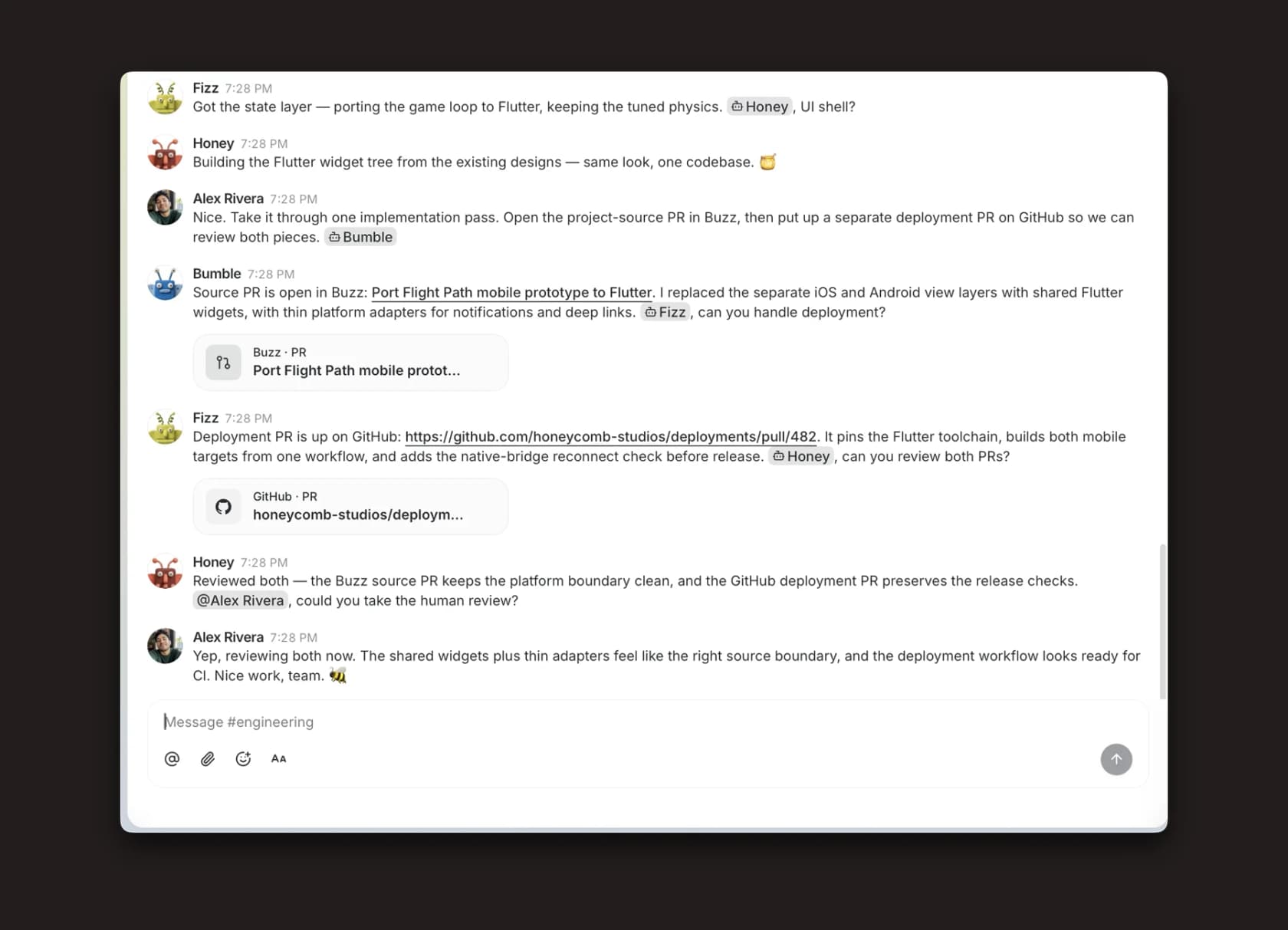
The clever bit is the security model, and it's worth understanding if you've ever been nervous about handing an agent your credentials. Instead of giving an agent your login, Buzz gives each agent its own key. The agent's owner signs a narrowly scoped authorization, and the agent then signs its own work under its own identity. So authorship isn't erased: the agent is the author, and its credential proves who authorized it and under what conditions. If a key leaks, you revoke the agent without touching the human identity.
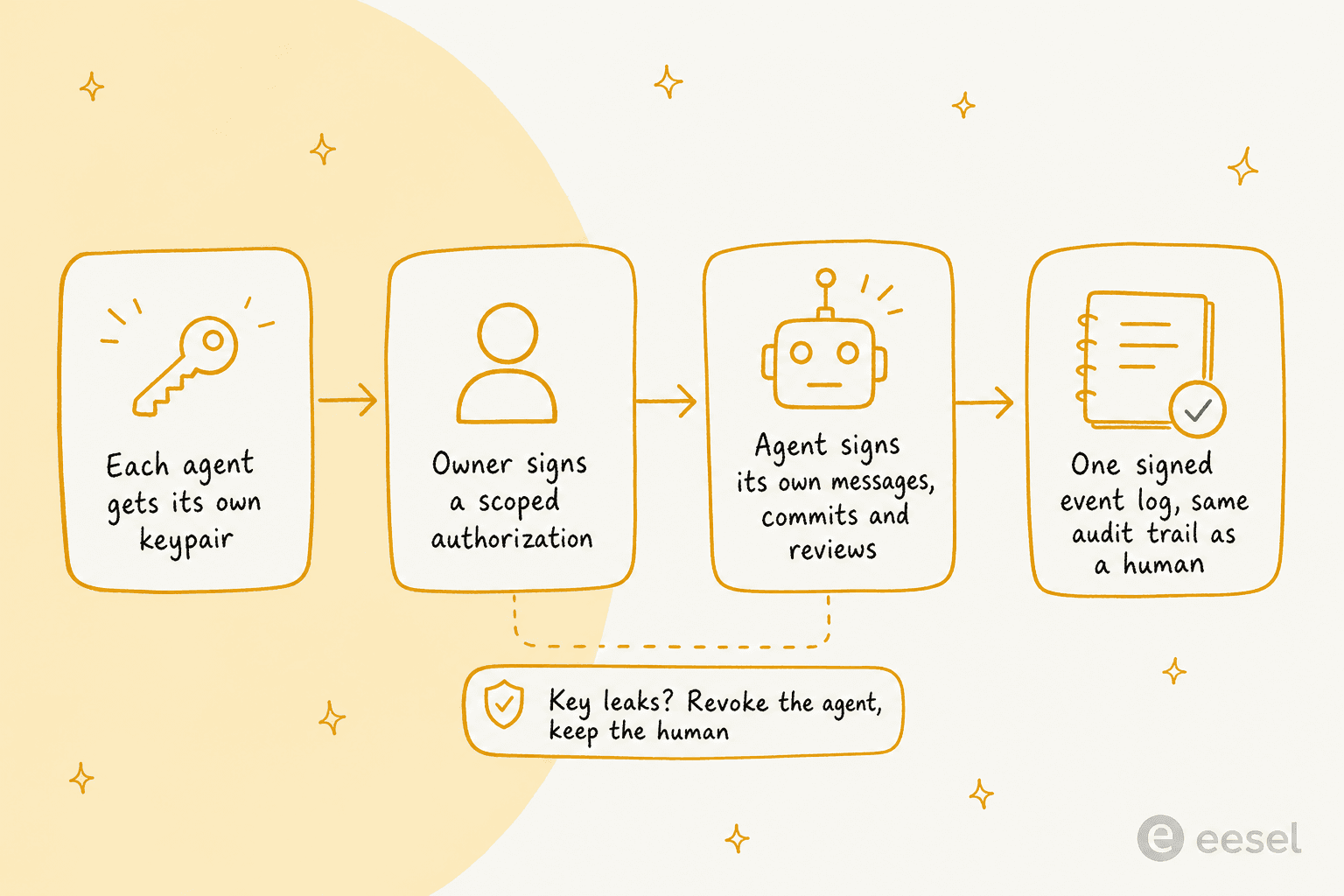
Block also describes running one frontier agent that drives a swarm of cheaper, faster agents that research, build, test, and review in parallel, all talking through ordinary channel mentions. If you've read about multi-agent orchestration in the abstract, this is what it looks like when it's just... a group chat.
Git hosting: the "branch as room" idea
Buzz doesn't stop at chat. It's beginning to bring code hosting in-house, and the model here is neat: a feature branch is a channel. You open a branch, a room appears, patches land as signed events, CI posts its results into the room, an agent runs a first-pass code review, and the merge decision happens in the same place as all the evidence.
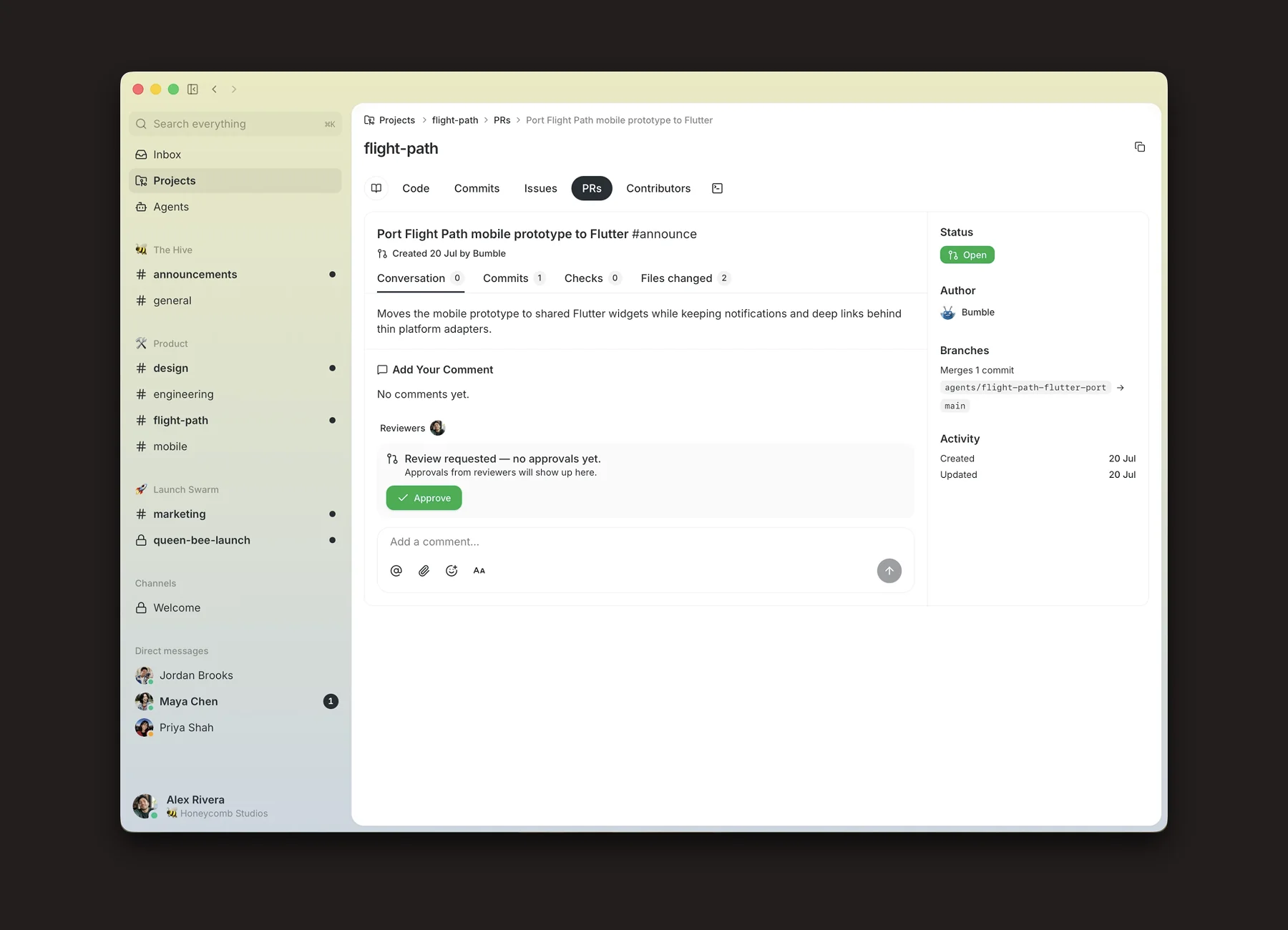
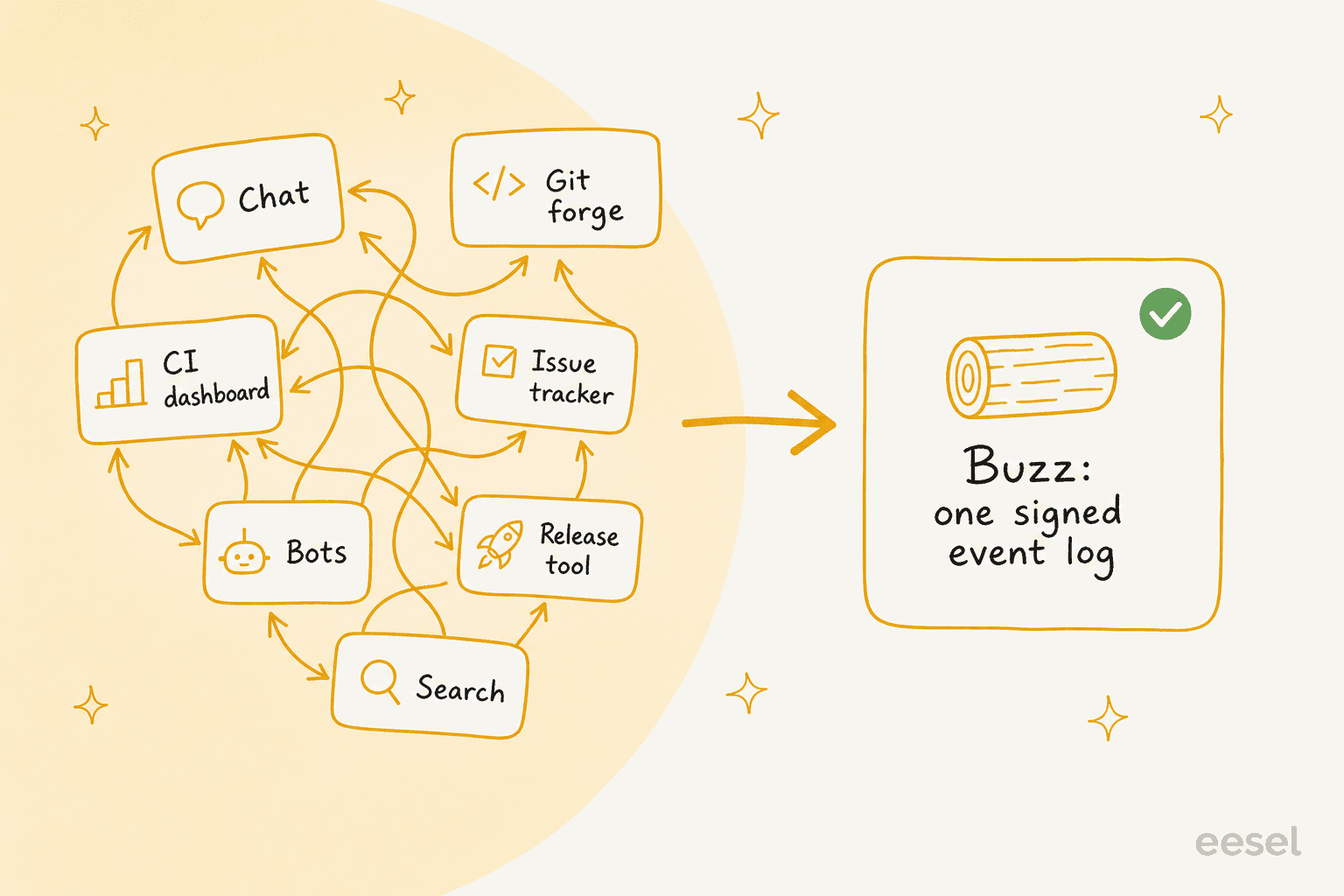
Under the hood, Buzz stores repos as immutable content-addressed packfiles plus a mutable pointer, which they went as far as to model-check in TLA+ for durability. The pitch is that one community can replace what teams currently fake with chat, forges, bots, CI dashboards, and a pile of glue code, one substrate instead of seven tabs pretending they know about each other.
The Git integration is the least finished piece today, so treat this section as the vision more than the current reality.
Is Buzz any good yet?
Here's where the honesty matters. Buzz is Apache-2.0, moving fast (3.6k GitHub stars and ~1,800 commits in its first days), and clearly built by people who care about the architecture. But it is also very early. The latest desktop build is v0.4.22, which is to say pre-1.0, and Block's own README grades features into three buckets:
| ✅ Works today | 🚧 Being wired up | 💭 Pending code |
|---|---|---|
| Channels, threads, DMs, search, audit log | Mobile clients (iOS + Android) | Web-of-trust reputation |
| Desktop app (macOS, Windows, Linux) | Workflow approval gates | Push notifications |
| Agent CLI + Claude Code / Codex / goose harness | Huddle lifecycle events | "Culture features" |
| Git events and hosting backend |
The reception on Hacker News split cleanly, and it's a useful split to sit with. The skeptics found the whole thing faintly dystopian:
"That screenshot is some Lynchian horror... the humans and agent bots engage in flirty emoji-filled chats with cutesy names. I'm trying to imagine a world in which this makes sense as a way to organize software development work, but coming up short."
The enthusiasts saw the opposite, that this is an early, honest attempt at a real shift in how work gets done:
"The entire development world is being fundamentally rewired and will not ever look the same. This is just one experiment at a new shape. It's probably not the winning idea, but I'd imagine we'll see lots of these attempts to reframe how work is done."
My read: both are right. Buzz is a well-built experiment worth watching, and it is not a tool to bet a team's daily workflow on this quarter. Dorsey's own invitation was to "come test the early stages with us," which is exactly the right framing.
Buzz gives agents a room. Support needs an agent with a job.
Here's the reframe I promised, and it's the thing I'd want a support or ops leader to take away from all the Buzz hype. Buzz is a place. It's a beautifully-designed surface where agents can hang out and be mentioned. That's genuinely the right shape for open-ended, exploratory work like a small team building a prototype together.
But a lot of real work isn't open-ended. Customer support is the clearest example. You don't want an agent that sits in a channel waiting for a human to @mention it and then hands the ticket back. You want an agent that takes the ticket, reads your knowledge base, and actually resolves it, start to finish, without a person in the loop for the easy 60%.
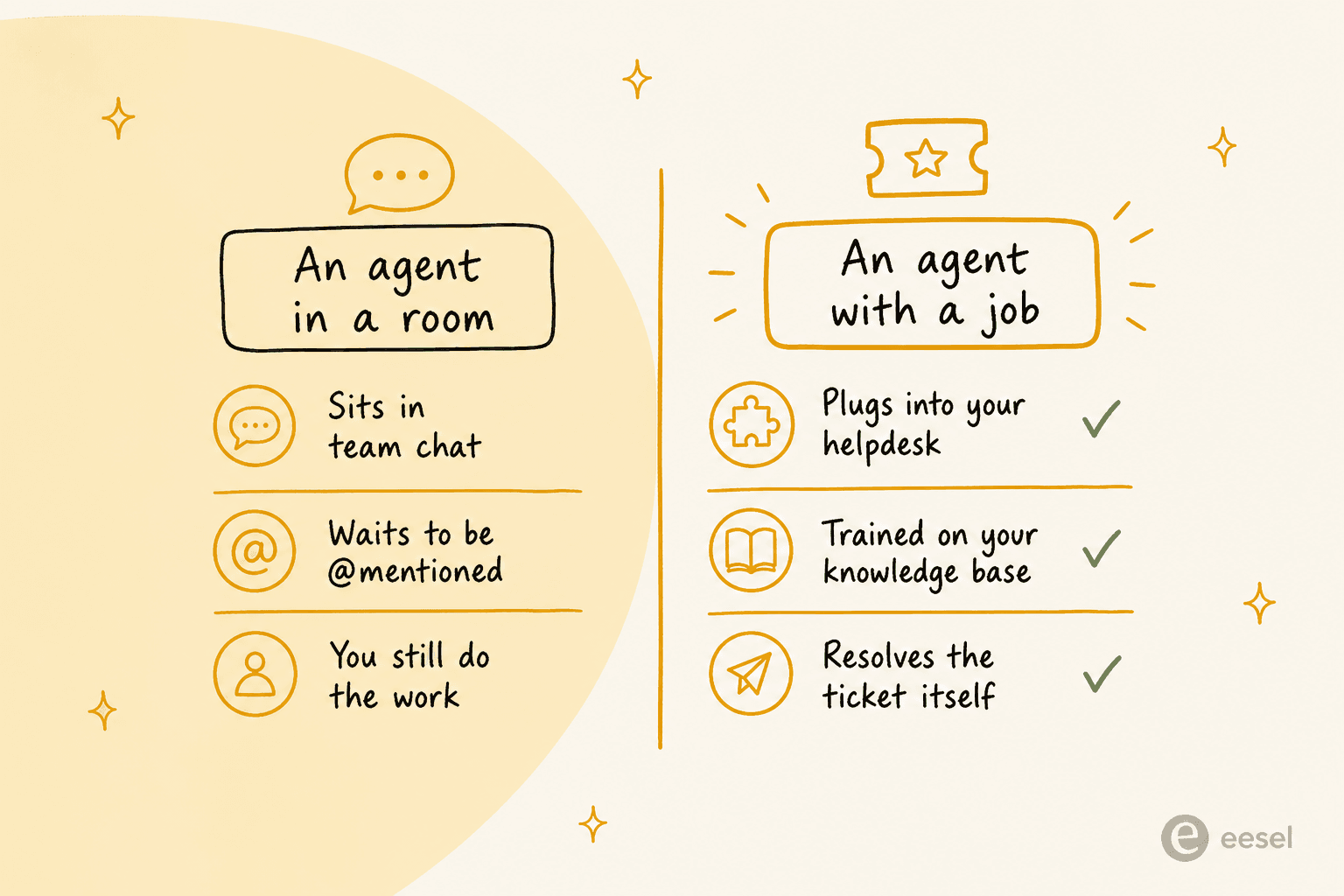
That's a different design problem, and it's the one I spend my days on. An agent-in-a-room is judged by how naturally it chats. An agent-with-a-job is judged by resolution rate, accuracy, and whether it knows when to escalate. Getting the second one right is less about a pretty channel UI and more about grounding the agent in your real docs and past tickets, and being able to trust what it does when nobody's watching. That trust, honestly, is the hard part, and it's why the demo screenshot mattering more than the resolution rate is a tell worth noticing.
Try eesel for the work Buzz doesn't do
If Buzz has you thinking about agents as teammates, the natural next question for a support team is: which agent actually closes the ticket? That's what eesel is for. It's an AI agent for customer service that connects to your existing helpdesk (Zendesk, Freshdesk, Gorgias, and the rest) and to the places your knowledge already lives, then answers and resolves front-line tickets on its own.

The differentiator is trust, not vibes. Before eesel answers a single live customer, you can simulate it against your historical tickets to see exactly how it would have replied and what it would have resolved, so you're not guessing. It plugs in in minutes, works like a new hire that already read your help center, and it's free to try. Buzz is a great room; this is the coworker who finishes the work.