

Voxtral 3 pricing is per minute of audio: $0.0035 a minute to transcribe recordings, $0.008 for live transcription, $13 per 1M characters for the voice, and $0.04 a minute for the all-in voice agent with Mistral Small 4 ($0.08 with a larger model). For a support line taking 20,000 call minutes a month, the agent comes to $800.
The number most posts skip: that $0.04 minute costs about 2.7x what its parts cost bought separately, roughly $0.015. You're paying the difference for turn-taking, transport and tool plumbing you'd otherwise build. That's a fair trade for most teams. The bigger catch is the phone: SIP calls are enterprise-only with no list price, and a Voxtral phone agent can't transfer a caller to a person.
eesel has spent years putting AI agents on live support queues, and in that time the per-minute rate is never the line that decides the bill. What matters is how many of those calls the agent can actually answer. B2B supplier Beautek staffs its phone on weekday hours and lets eesel take the website questions day and night, in German, from 6,700 pages and documents.
How much does Voxtral 3 cost?
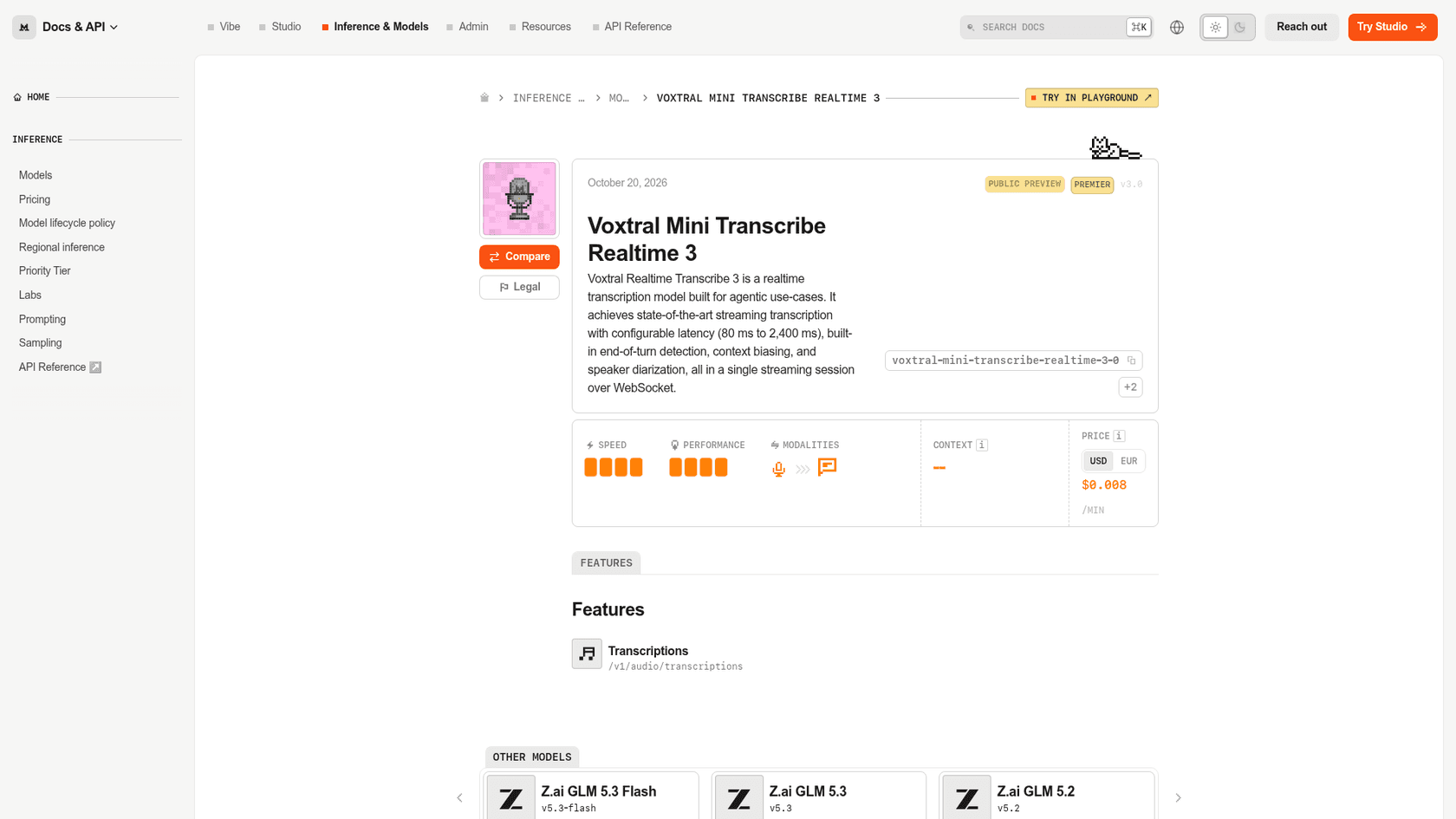
Voxtral 3 costs between $0.0035 and $0.08 a minute depending on the job, plus $13 per 1M characters when you only need the voice. Mistral launched the family on October 20, 2026, and every model is still a public preview. I rechecked every price below against Mistral's own pages on October 28.
| What you buy | Model ID | Billing unit | Price |
|---|---|---|---|
| Batch transcription, small model | voxtral-mini-transcribe-3-0 | per audio minute | $0.0035 |
| Batch transcription, best accuracy | voxtral-small-transcribe-3-0 | per audio minute | $0.004 |
| Live (streaming) transcription | voxtral-mini-transcribe-realtime-3-0 | per audio minute | $0.008 |
| Text to speech (the voice) | voxtral-mini-tts-3-0 | per 1M input characters | $13 |
| Voice agent API, Mistral Small 4 | Voice Agents SDK | per conversation minute | $0.04 |
| Voice agent API, larger model | Voice Agents SDK | per conversation minute | $0.08 |
| Phone lines (SIP) | Telephony | contract | No list price |
| On-prem or private cloud | All models | contract | No list price |
Sources: the Voxtral 3 launch post, and the Mini Transcribe 3 and TTS 3 model cards.
Three things about the billing units trip people up. Transcription bills on minutes of audio, not minutes of compute, so a two-hour recording is 120 minutes whether it takes the API ten seconds or two. The voice bills on characters of text you send it, not seconds of audio it plays. And the agent bills on minutes of conversation, which covers the time the caller talks, the time the agent talks, and the pauses in between.
I've been doing SEO for two years, and the search behind "voxtral 3 pricing" is almost never "what's the per-minute rate". The rate is on the launch page, and the Mistral AI pricing guide covers the chat models. What people want is the monthly bill for their own volume, so that's what the rest of this post works out.
What do the Voxtral 3 prices mean for a real support line?
For one stated buyer, a support line taking 4,000 five-minute calls a month (20,000 minutes), the bill ranges from $70 to $1,600. Which end you land on depends on whether you're transcribing calls people already take, or having an AI take them.
| Job | Rate | 20,000 minutes a month |
|---|---|---|
| Transcribe recorded calls for QA, Mini | $0.0035/min | $70 |
| Transcribe recorded calls for QA, Small | $0.004/min | $80 |
| Live captions or agent assist | $0.008/min | $160 |
| AI agent answers the calls, Mistral Small 4 | $0.04/min | $800 |
| AI agent answers the calls, larger model | $0.08/min | $1,600 |
The gap between the top and bottom of that table is the whole story. Listening is cheap; thinking and talking are the bill. If all you want is searchable transcripts for call center quality assurance, Voxtral costs less per month than one team lunch. If you want an AI call center agent to pick up, plan on 10 to 20 times that.
To see how your own volume lands, plug it in here. Every rate is Mistral's or the rival vendor's list price; the "build it yourself" line uses the assumptions I explain in the next section.
What does the $0.04 voice agent minute actually buy?
The $0.04 minute buys the whole pipeline: live transcription, Mistral Small 4 writing the answer, the Voxtral voice speaking it, and the audio transport in between. Mistral's voice agent docs describe it as an SDK that "runs the whole pipeline for you", built on LiveKit, with interruptions, end-of-turn detection and tool calls handled for you.
You can also buy every one of those parts separately from the same price list. Here's what one conversation minute costs that way:
- Live transcription:
$0.008, because you stream the caller's audio for the full minute. - The voice: about
$0.005. Cartesia's pricing FAQ puts a minute of speech at 750 to 800 characters. If the agent speaks half the call, that's 400 characters at$13per 1M. - The model: about
$0.001. Mistral Small 4 costs$0.15per 1M input tokens and$0.60per 1M output. I assumed four turns a minute, each sending 2,000 tokens of instructions and history and getting 60 back.
That adds up to roughly $0.015 a minute. The talk share and token counts are my assumptions, not Mistral's, so move them in the calculator above. But even if you double the model cost, the parts stay well under half the bundle.
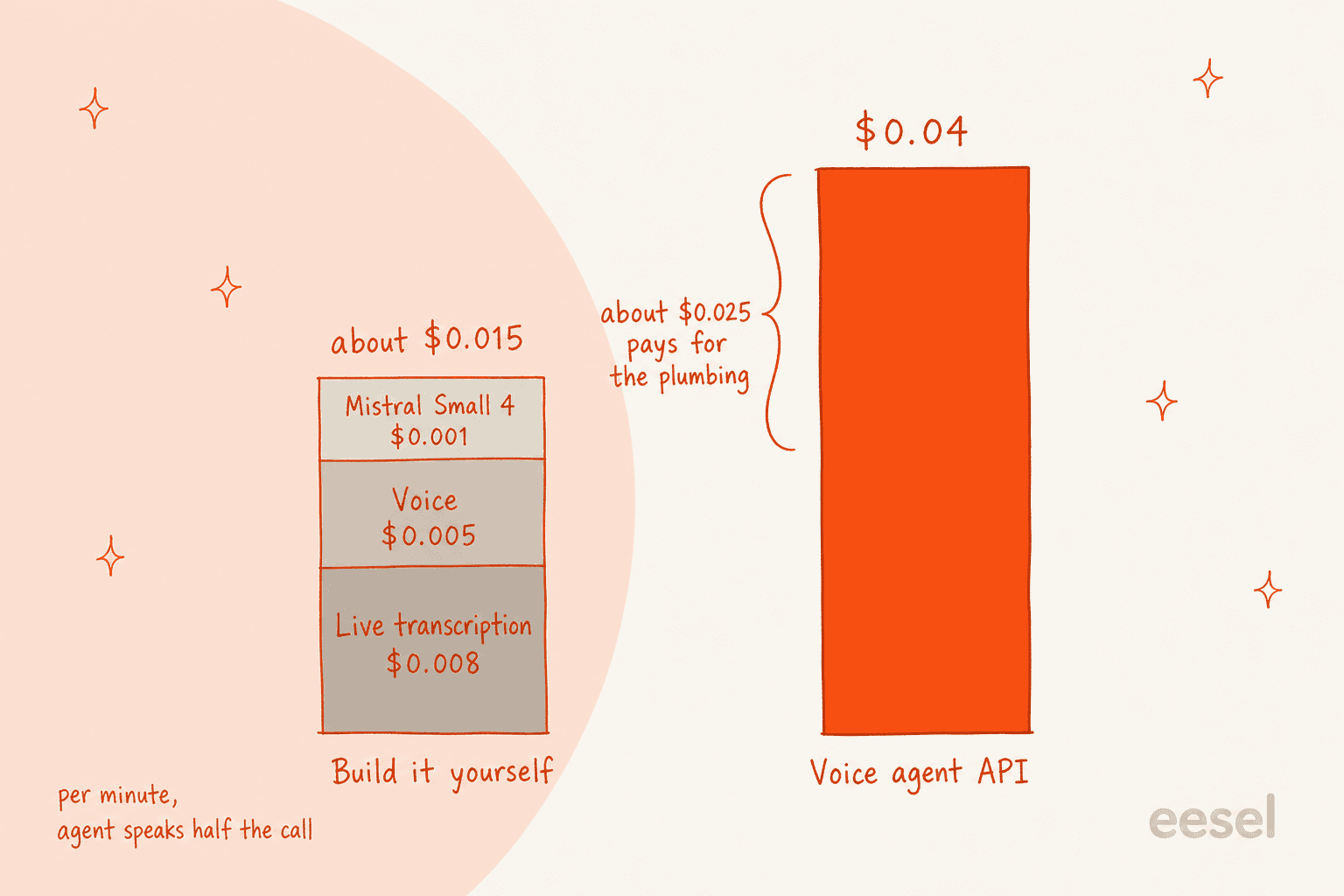
So the bundle costs about 2.7x its parts, and the roughly $0.025 gap pays for the plumbing. At 20,000 minutes a month, that's about $500. My honest take: for most support teams that's cheap. The hard parts of a voice agent are exactly what the SDK does, deciding when a caller has finished talking, letting them interrupt, and filling the silence while a tool runs. The docs even ship "fillers", short spoken clips like "Checking your order…" that play while a lookup runs.
Building it yourself makes sense in two cases: you already run your own real-time audio stack, or you're past roughly 100,000 minutes a month, where the gap is worth an engineer's time. Mistral's own docs list "full control over every stage" as the reason to take that path. If neither is true, buy the bundle.
How does Voxtral 3 pricing compare with other voice agents?
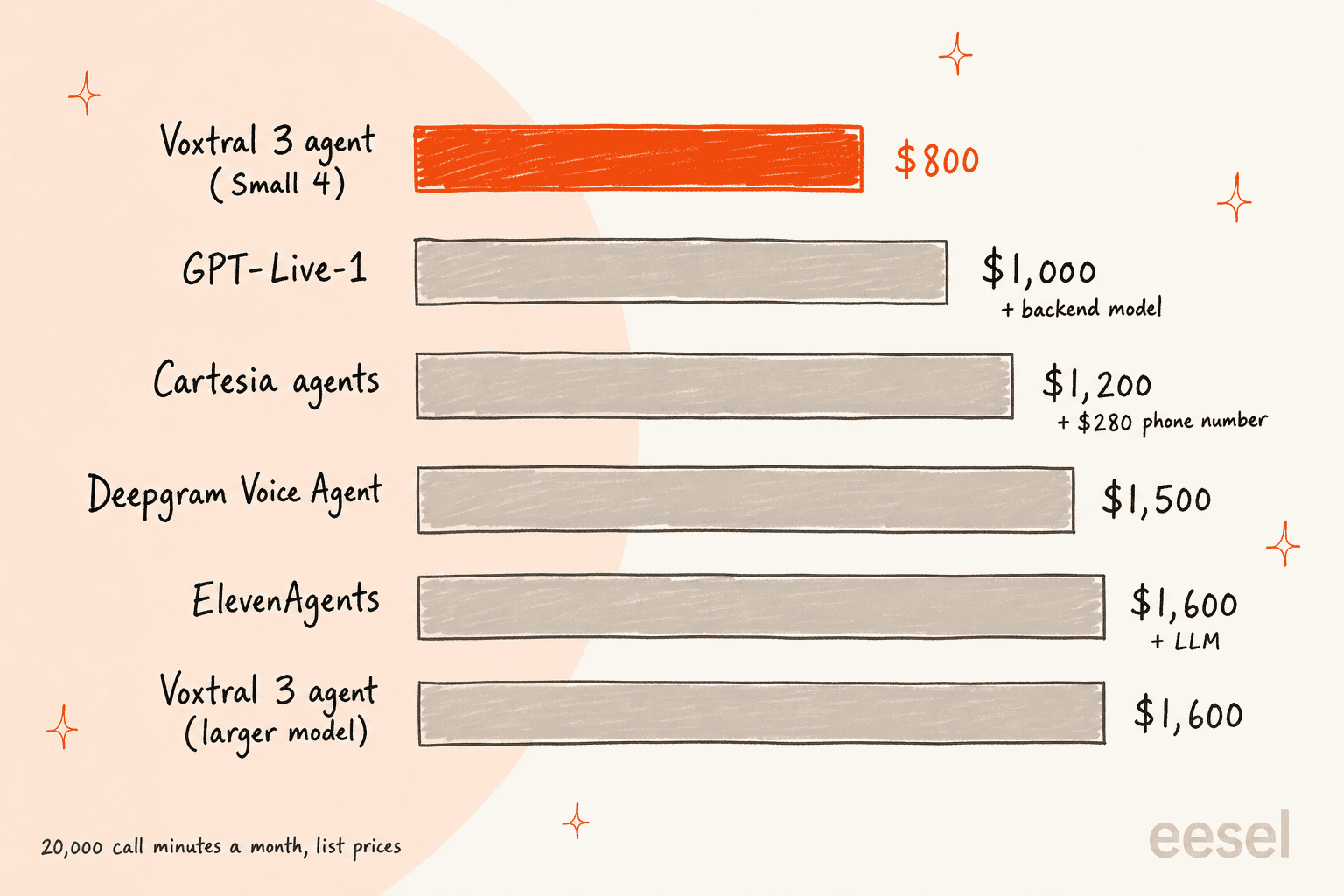
On list prices, Voxtral 3's $0.04 agent minute is the cheapest bundled voice agent I could find from a major vendor. For the same 20,000 minutes a month, here's where the main rivals land:
| Voice agent | Per minute | 20,000 minutes | What's not included |
|---|---|---|---|
| Voxtral 3, Mistral Small 4 | $0.04 | $800 | Phone lines (enterprise only) |
| OpenAI GPT-Live-1 | $0.05 | $1,000 | Backend model and tools |
| Cartesia agents | $0.06 | $1,200 | $0.014/min on a Cartesia number |
| Deepgram Voice Agent, Standard | $0.075 | $1,500 | Nothing extra listed; $0.068 on Growth |
| ElevenAgents | $0.08 | $1,600 | LLM usage |
| Voxtral 3, larger model | $0.08 | $1,600 | Phone lines (enterprise only) |
Two caveats before you take the cheapest row. First, Google's Gemini 3.8 Live is cheaper still on raw audio ($0.005 a minute in, $0.018 out), but it's a model, not a bundled agent, so the orchestration is yours to build. Second, every rival in that table lets you point a phone number at the agent on a self-serve plan. Voxtral doesn't yet. For full platforms rather than APIs, my best AI voice agents roundup is the better list.
I go through each of these properly, with what they're good at, in my Voxtral 3 alternatives post. For older generations, see GPT Realtime mini pricing and ElevenLabs pricing.
Is Voxtral 3 transcription the cheapest?
Not really. Voxtral Mini at $0.0035 a minute sits in a tight pack with the other big transcription APIs, so price alone won't decide it:
| Batch transcription | Price | Per minute |
|---|---|---|
| Voxtral Mini Transcribe 3 | $0.0035/min | $0.0035 |
| AssemblyAI Universal-3.5 Pro | $0.21/hr | $0.0035 |
| ElevenLabs Scribe v2 | $0.22/hr | about $0.0037 |
| Voxtral Small Transcribe 3 | $0.004/min | $0.004 |
| Deepgram Nova-3, pre-recorded | $0.0043/min | $0.0043 |
| OpenAI GPT-Transcribe | $0.0045/min | $0.0045 |
When five vendors land within a tenth of a cent, the deciding factor is accuracy on your audio. On Mistral's own 45-language test, Voxtral Small scores a 4.0% word error rate, tied with Microsoft AI Transcribe 2. That's a vendor-run chart, so I'd rerun it on a sample of your own calls. My Voxtral 3 review goes through each benchmark, including where Voxtral isn't on top.
One pricing wrinkle worth testing: Mistral's batch API accepts /v1/audio/transcriptions, and Mistral's pricing page says batch processing "reduces the price by 50%". Mini's $0.0035 is already labelled the batch rate, and Mistral's pages don't say whether the 50% stacks on top. Run a small batch job and check your usage dashboard before you budget on it.
The voice is a clearer win. At $13 per 1M characters, Voxtral TTS undercuts Deepgram Aura-2 ($30), Google's Chirp 3: HD ($30) and ElevenLabs Flash ($40). Speechmatics lists $11 and AssemblyAI $15, so it isn't alone at the low end. If voice quality is the deciding factor, my Gemini 3.8 Flash TTS pricing post covers the Google side.
What hidden costs come with Voxtral 3?
The hidden costs aren't fees; they're gaps you pay for some other way. Here's the map of which bill you're on, and the one that has no price at all:
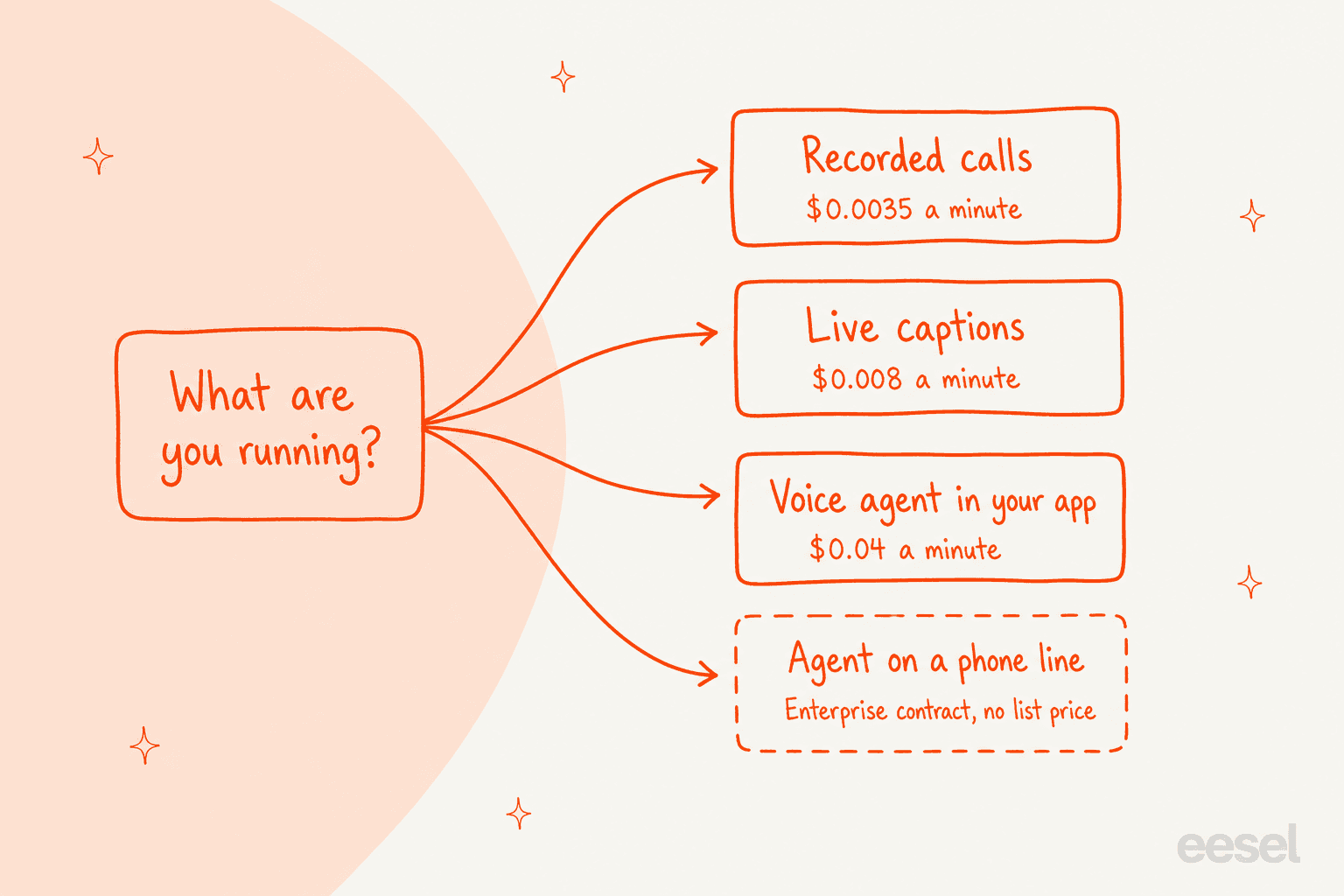
The phone line has no price. Telephony is "available to enterprise customers, and it isn't self-serve". You bring your own number and SIP system, and the Mistral team sets it up with you. Until you have that contract, the $0.04 rate only applies to voice in your own app or browser. If a phone number is the whole point, the best AI for phone support tools are live today.
The phone agent can't hand off. This is the one that matters for support. Mistral's telephony docs say plainly that the agent "can't transfer the call to a person", and it handles inbound calls only. Every caller the agent can't help needs a callback from your team, so the real cost includes that callback queue. The docs suggest telling the agent what to say when a request is out of scope. Good AI agent handoff design matters even more when the handoff is a promise to call back.
Tools can cost extra. Mistral's pricing page says "tool APIs are priced per call". If your agent runs web search or connectors on every call, check those rates too. Client-side tools also fail on phone calls, because no code of yours runs there, so anything a phone agent needs has to be a server-side tool.
Preview prices can move. Every Voxtral 3 model is labelled Public Preview. One Hacker News reader spotted that the Mini rate has already gone up between versions:
"Hmm..the price has increased from 0.003 to 0.0035 dollars. That's 16%. Voxtral Mini ."

Mistral's current pages only list the Voxtral 3 rates, so treat the old figure as that reader's. Either way, the lesson is the same: budget preview pricing with headroom.
Migration takes engineering time. If you're on Voxtral 2, the migration guide lists breaking changes: word timestamps are gone (segment timestamps only), realtime sessions lock their settings at the first audio chunk, and diarized segments can now overlap. None of that is billed, but someone has to rewrite the code.
Self-hosting is a sales call. Voxtral 1 and 2 shipped open weights. Voxtral 3 doesn't (my Mistral alternatives list covers open models), and Mistral says to talk to its team to run the stack on-prem. If EU data residency is the reason you're looking at Mistral, the API itself is hosted on European, US and global endpoints, which may be enough for the EU AI Act work your legal team is doing.
Is Voxtral 3 worth the price for customer support?
For transcription, yes, easily. At $70 to $80 a month for 20,000 minutes, there's no reason not to transcribe every call for QA, PII redaction and search.
For an AI that answers calls, the price is good and the product is early. $800 a month for 20,000 minutes beats every bundled rival on list price. But you can't put it on a phone number without an enterprise deal, it can't transfer callers, and it's a preview. In Hacker News's launch thread, one reader put the bar for an AI phone agent well:
"If a call could be answered without waiting in a queue for 30 minutes by a competent AI agent, I think I would prefer that."
The key word there is "competent", and no speech model gives you that. Voxtral gives an agent ears and a voice for $0.04 a minute. Whether it answers correctly depends on what it knows about your products, orders and policies, and that's the same problem on the phone as in chat. I'd compare the bill against your AI agent versus human cost and your current call center ROI maths, not against other speech APIs. Your cost per ticket today is the fairest baseline.
If you're mapping out call center automation, my order of work would be: automate the written channels first, where answers are cheap to test, then give the same knowledge a voice. Mistral's own telephony docs list after-hours coverage as a main use case. A lot of after-hours support can be handled in chat and email for far less than a per-minute phone agent.
Try eesel for the answers behind the voice
Voxtral is infrastructure; eesel is the employee. eesel's AI helpdesk teammate joins the helpdesk you already run, such as Zendesk or Freshdesk, learns from your past tickets and help center, and gets tested against your real conversations before it replies to a customer.
That's the piece a voice agent still needs. Beautek, a German supplier of studio equipment, answers its phone 8:30 to 16:30 on weekdays. eesel answers product and order questions on its website in German day and night, and in one month it drafted 110 Zendesk tickets for the team and turned 20 chats into tickets for a person to pick up. smava runs it on 27,000 German Zendesk tickets a month across its two brands.
If you're pricing Voxtral 3 because your support queue is growing, try eesel on the written queue first. It's free to start, and you'll know which questions an agent can answer before you pay per minute to have it say them out loud. Try eesel.