

MAI Realtime 1 pricing is $0.01 per audio minute, plus reasoning billed per token ($1 per million in, $5 per million out). That $0.60 an hour is the floor, not the bill: Microsoft's own benchmark run cost $1.35 an hour, so more than half the cost sits in the token line. Even at $1.35 it's the cheapest voice model per completed task on Microsoft's chart, about a third of Grok Voice 3.0. It's free during the limited preview, so test it now on real calls.
A cheap voice still needs your policies to say the right thing. That's where eesel fits, working the ticket queue behind your phone line. With the eesel CLI, a coding agent can load your call scripts and refund policy into it and test answers before go-live.
How much does MAI Realtime 1 cost?
MAI Realtime 1 is Microsoft's first speech-to-speech model, launched at Ignite on November 17, 2026. It costs $0.01 per minute of base speech-to-speech usage, and reasoning is billed separately at $1 per million input tokens and $5 per million output tokens. That's the whole published rate card, sitting in a footnote of the launch post.
I build AI agents at eesel, and the first thing I do with any voice price is ask what the meter actually counts. The answer here is two things, and only one of them is in the headline.
| Line item | Price | Notes |
|---|---|---|
| Speech-to-speech audio | $0.01 per minute | $0.60 per hour. Microsoft calls it "base" usage |
| Reasoning, input tokens | $1 per 1M tokens | Billed separately from audio |
| Reasoning, output tokens | $5 per 1M tokens | Billed separately from audio |
| Limited preview | $0 | Not billed until public preview begins |
| Seat or platform fee | None listed | Pay as you go through Microsoft Foundry |
| Phone numbers / carrier | Not mentioned | Bring your own carrier |
| Dynamics 365 Contact Center | Not published | Coming, pricing not announced |
Two things the rate card doesn't say. It doesn't say whether "per audio minute" counts only the caller's audio or both sides of the conversation, and it doesn't say how many reasoning tokens a typical turn uses. The second one turns out to matter more, as the next section shows.
Access is the other half of the price. You can talk to the model in MAI Labs today, and developers can register for the limited-access preview in Microsoft Foundry. Microsoft says preview customers won't be billed until public preview begins.
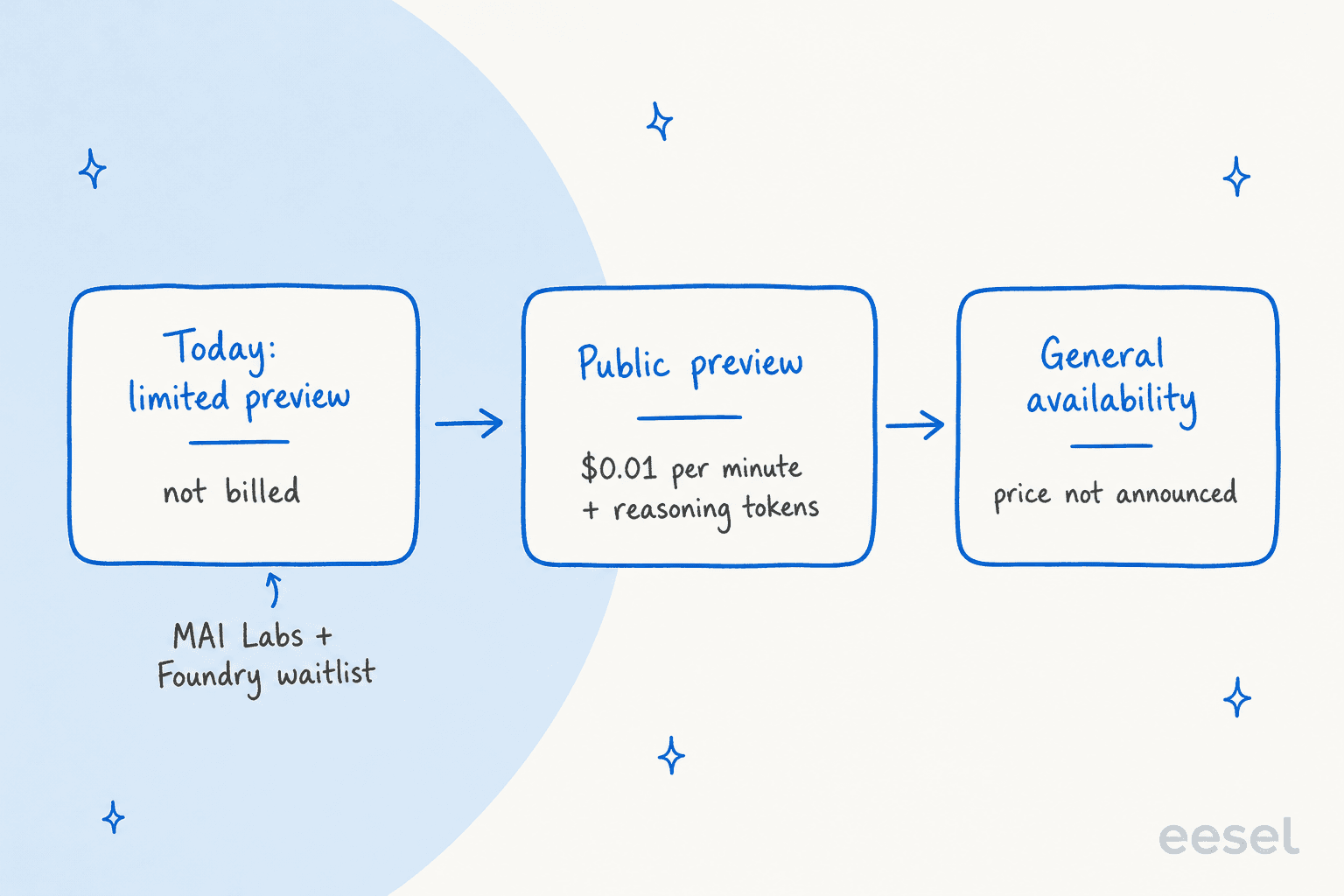
Microsoft hasn't said whether the rate changes at general availability. Its Ignite recap only says the model "starts at" $0.01 per audio minute, and "starts at" is doing some work in that sentence.
What does an hour of MAI Realtime 1 really cost?
About $1.35, on Microsoft's own numbers. The launch post charts every model's "cost per hour of input audio" on two benchmarks, and MAI Realtime 1 lands at $1.3548 an hour on both. The minute rate explains $0.60 of that. The other $0.75 is the part the minute rate doesn't cover, and the separately billed reasoning is the obvious candidate.
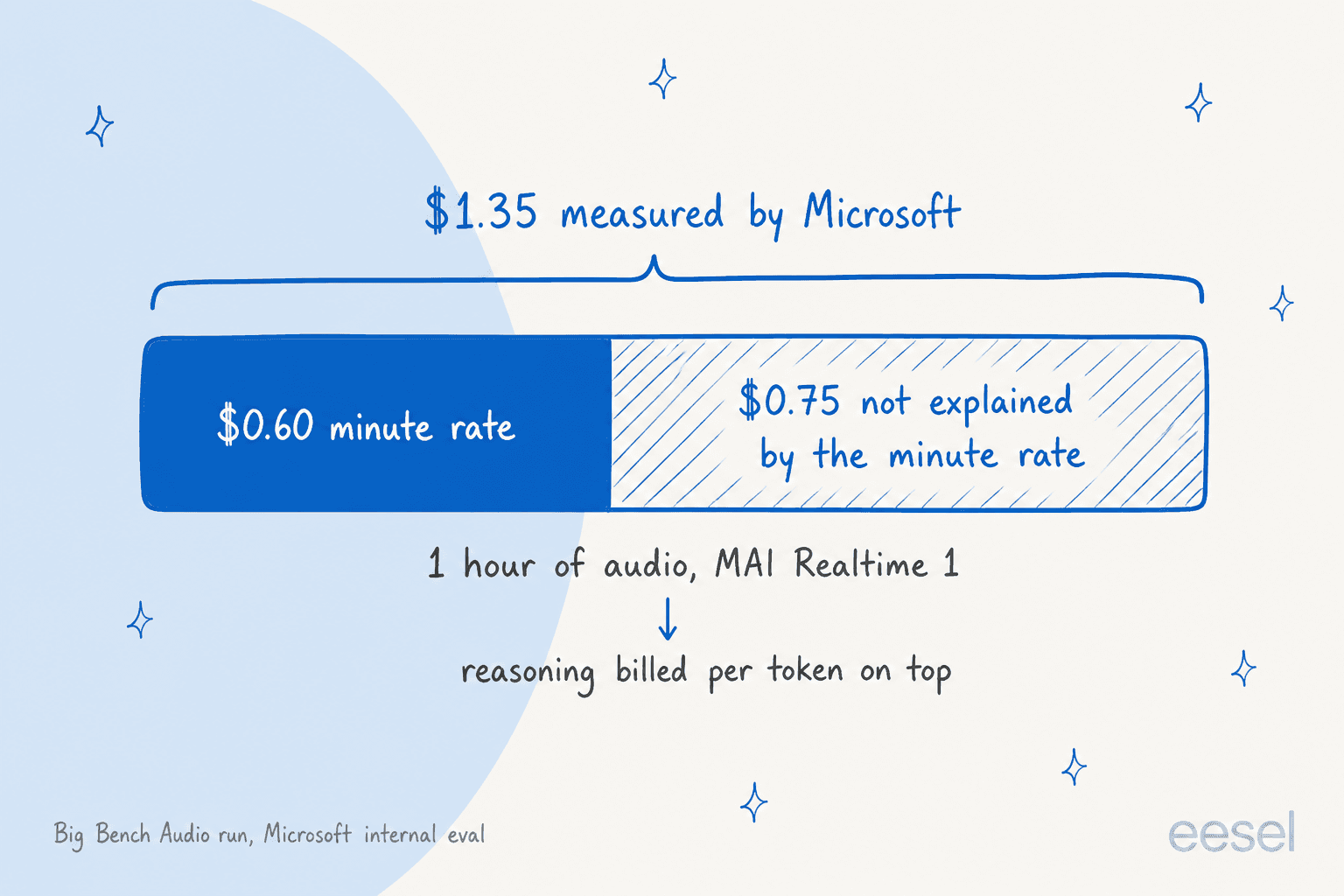
So the honest per-minute figure for a model that's thinking is closer to 2.3 cents than 1 cent. That's still cheap. But if you put $0.01 into a budget spreadsheet, you'll be off by more than 2x on the first invoice.
The reasoning split makes sense once you see how Microsoft describes the model. It says a fast system "keeps the conversation flowing," and when a task needs deeper thinking, it taps "a more powerful reasoning engine." The fast part is the minute rate. The thinking part is the token line. A support call full of order lookups and policy questions will lean on the second one more than a call that just books a time slot, which is the usual split in an AI call center agent.
Here's how I'd price a four-minute support call, before carrier fees:
| Scenario | Per minute | Four-minute call | 10,000 minutes a month |
|---|---|---|---|
| Minute rate only, no reasoning | $0.010 | $0.04 | $100 |
| Microsoft's benchmark mix | $0.0226 | $0.09 | $226 |
| Twice the benchmark's reasoning | $0.035 | $0.14 | $352 |
The third row is a guess at a heavy, tool-driven support line, and it's still under 15 cents a call. The point of the table isn't the exact number. It's that the minute rate is the stable part and reasoning is the part you have to measure on your own traffic before any call center ROI case goes to finance.
How does MAI Realtime 1 pricing compare to other voice models?
The launch post compares MAI Realtime 1 against 12 other speech-to-speech models, with competitor costs and scores taken from Artificial Analysis. On raw hourly cost, only Gemini 3.8 Live is cheaper.
| Model | Cost per hour of audio | Big Bench Audio | τ-Voice task completion |
|---|---|---|---|
| Gemini 3.8 Live | $0.84 | 91.7% | 30.1% |
| MAI Realtime 1 | $1.35 | 98.9% | 57.5% |
| GPT-Realtime-2.1 Mini High | $3.45 | 74.7% | 29.4% |
| Gemini 3.8 Live Extended Thinking (High) | $3.50 | 97.7% | 68.6% |
| Phonic 1 (High) | $4.20 | n/a | 79.9% |
| GPT-Live-1 (Sol, low) | $4.47 | 89.0% | 59.3% |
| Grok Voice 3.0 | $4.80 | n/a | 71.6% |
| Eleven Realtime v1 Max | $4.80 | 98.8% | 47.6% |
| GPT-Live-1 (Astra, medium) | $5.83 | 90.1% | 74.5% |
| GPT-Realtime-2.1 High | $10.75 | 95.8% | 45.7% |
Costs and scores from Microsoft's launch post. Competitor figures are Artificial Analysis measurements; MAI Realtime 1 figures are Microsoft's internal evaluation.
For support, τ-Voice is the column I care about. It tests whether a voice agent actually completes a customer-service task (change a booking, process a return) over a spoken conversation, which is much closer to a phone queue than a reasoning quiz. MAI Realtime 1 is mid-pack there: ahead of every GPT-Realtime and ElevenLabs model, behind Grok Voice 3.0, Phonic 1 and GPT-Live-1 Astra.
So I divided each model's hourly cost by its τ-Voice completion rate. That gives a rough "dollars per hour of successful work," which is closer to what a support leader pays for.
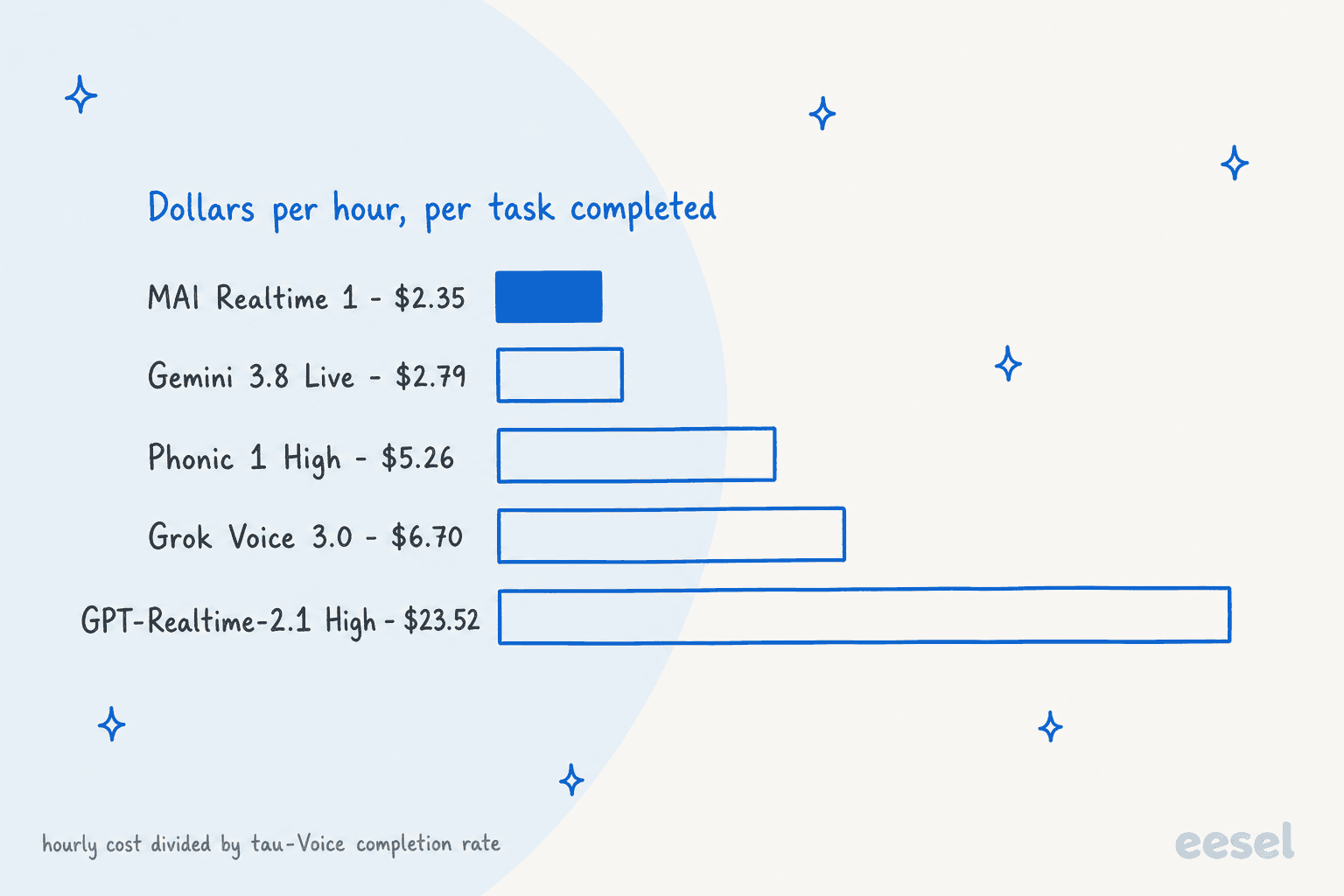
On that measure, MAI Realtime 1 comes out cheapest per completed task at about $2.35, against $6.70 for Grok Voice 3.0 and $23.52 for GPT-Realtime-2.1 High. Gemini 3.8 Live is cheaper per hour but completes about half as many tasks, which pushes it to $2.79.
Two fair caveats before anyone builds a business case on that chart. First, the MAI scores come from Microsoft's own evaluation, while every competitor score comes from Artificial Analysis, so it isn't a like-for-like test until an independent run lands. Second, a 57.5% completion rate means roughly four in ten benchmark tasks didn't finish. On a real phone line, a failed task becomes a transfer to a person, and that transfer costs far more than the minutes. If completion matters more than cost, the models above it in the τ-Voice column are still the safer pick.
What will MAI Realtime 1 cost at your call volume?
Plug in your own numbers. The reasoning setting is the one to play with: "benchmark mix" uses the $0.75 an hour gap from Microsoft's own run, and the comparison models use their measured hourly costs from the same chart.
At the default 2,500 four-minute calls, MAI Realtime 1 lands around $310 a month with carrier fees, against about $885 for Grok Voice 3.0 and about $1,880 for GPT-Realtime-2.1 High. The carrier line barely moves between models, which is a good reminder that once your voice model is this cheap, call length is the lever, not the rate.
What doesn't the $0.01 a minute cover?
Everything around the model. That's normal for a voice API, but it's worth listing because the sticker is low enough to make people forget it.
- Your phone line. Nothing in the launch post mentions phone numbers, so plan on a carrier like the one in a Twilio chatbot setup. A local inbound minute is usually under a cent; toll-free costs more.
- Tools and data. Microsoft says the model "connects to enterprise systems and tools." The API calls it makes to your order system, CRM or knowledge base bill wherever those systems bill.
- Transfers to people. Every call the agent can't finish goes to a human. At 57.5% task completion on τ-Voice, budget for the AI agent handoff more than for the minutes.
- The ticket after the call. Most support calls end in a follow-up: a refund to process, an email to send, a note on the account. Someone has to write the call summary and open the ticket.
That last one comes up on our own calls with support teams. One team running a voice line told us their agents were writing call summaries by hand just so our AI could see what happened on the phone:
"The lack of voice recording support requires agents to summarize voice interactions for Eesel. Implementing this feature would significantly increase our usage."
A cheap voice model doesn't remove that step. It just makes the voice part cheaper. The ticket work behind it is a separate cost line that a phone budget usually forgets.
Is MAI Realtime 1 worth it for a support line?
For a pilot, yes, and the timing is the best part. If you're still asking whether AI can answer support calls at all, this is a cheap way to find out. Billing doesn't start until public preview, so you can run your real call flows through it for nothing and measure the one number the rate card can't give you: how many reasoning tokens your calls burn.
Three things make it an easy test:
- It speaks the OpenAI Realtime format. Microsoft says it's "compatible with the OpenAI Realtime API," so if you've built on the OpenAI Realtime API or wired up realtime tool calls, switching is mostly a new endpoint and key. My note on Realtime API vs WebRTC covers the transport side.
- The price gap is large. At
$1.35an hour against$10.75for GPT-Realtime-2.1 High, the savings show up even on a small line. - Customers are already trying it. Microsoft names Agoda and Reservations.ai as early testers, and it's bringing the model to Dynamics 365 Contact Center and Dragon Copilot.
Where I'd hold back: if your line handles complex tasks and completion matters more than cost, Grok Voice 3.0 (71.6%) or GPT-Live-1 Astra (74.5%) finished more τ-Voice tasks, and my roundups of best AI voice agents and GPT-Live-1 pricing cover those. If you're inside Dynamics 365, wait for Microsoft to publish how it meters the model there. And if your helpdesk already ships voice, like Zendesk voice AI agents, price that first. And if you want a no-code platform with analytics rather than an API, look at Retell AI pricing or Vapi, which put their own platform fee on top of a model like this one.
Microsoft is clearly pricing its whole lineup against the market. The same week it shipped MAI Code 2 on a promo rate, and earlier it put MAI Transcribe 2 out as its cheapest speech recognition model. A cent a minute fits that pattern, and so does the "starts at."
eesel for the queue behind your phone line
A voice model prices the conversation. It doesn't know your refund window, which orders qualify for a replacement, or when a caller should go straight to a person. That knowledge has to come from somewhere, and for most teams it lives in years of past tickets.
eesel is an AI helpdesk teammate that joins your helpdesk and learns from those past tickets and your help center. It works the email and chat queue every phone call eventually spills into. Swiftreg, a UK number plate seller, runs it on Zendesk: in one month it handled about 2,100 tickets, sent 1,494 public replies from live order lookups, and left 1,055 internal notes where a step belonged to staff.
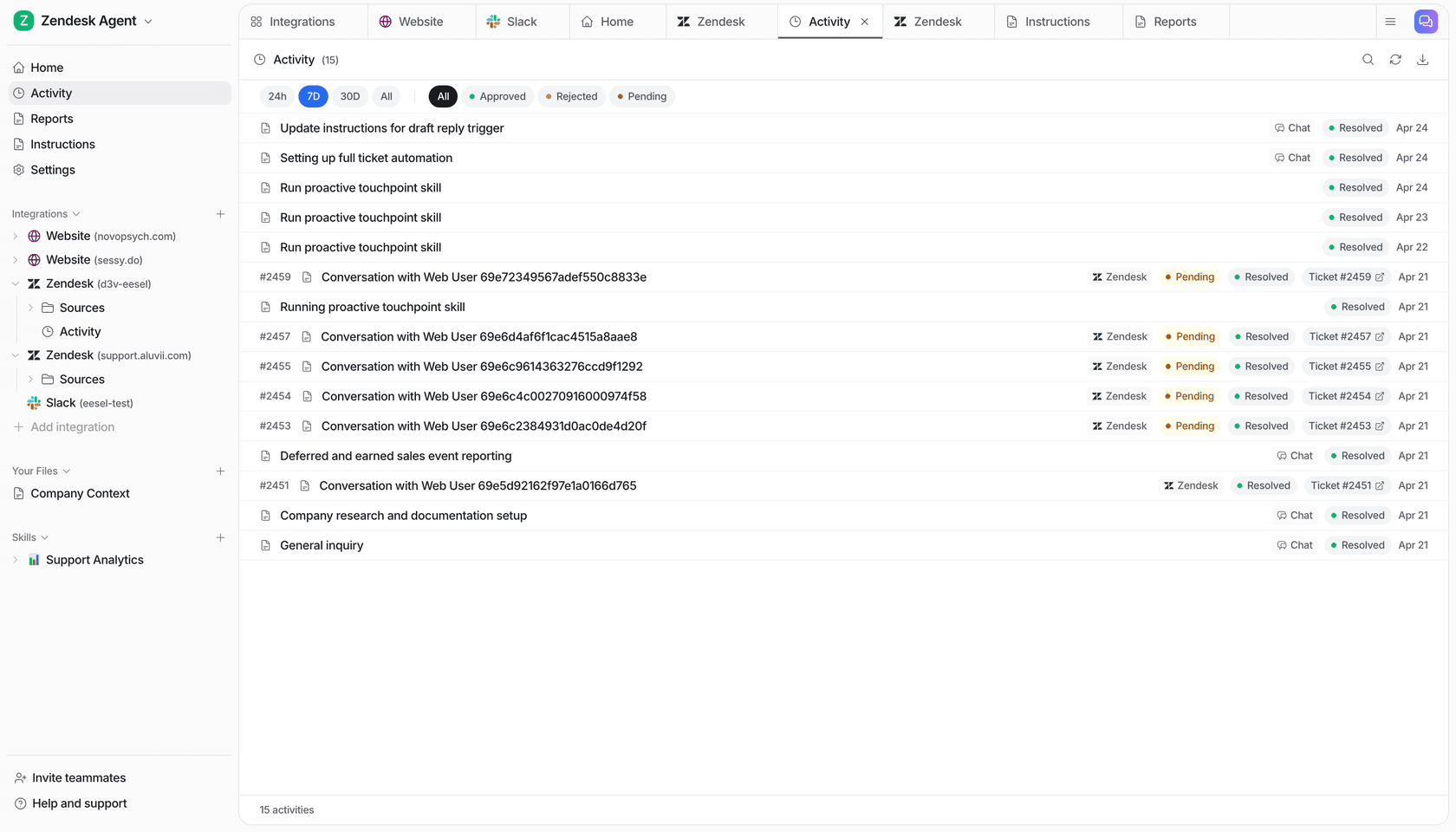
Before it goes live, you can run it against your past tickets to see what it would have said. Pricing is a different shape from a voice API: a fixed monthly credit plan, $299 a month for 500 credits, where a ticket counts as one credit. You pay per ticket handled, not per minute of talk.
If you're piloting MAI Realtime 1 this month, try eesel on the tickets those calls create, so the answers on the phone and in the inbox come from the same source.