


Qwen 4 Max has no per-token price. The preview (qwen4-max-preview) is sold only through Alibaba's Token Plan, credits from $6 a month for 20,000 ($3 for new users until November 30). Until November 25 it bills at 20% of the standard credit rate, and 8% overnight in Beijing, the US workday. Alibaba hasn't published that standard rate, so it's cheap to try and impossible to budget. Buy Lite for a two-week test. Token Plan bans app backends, so for support, eesel bills one credit per ticket, and the eesel CLI lets a coding agent load and test its knowledge.
How much does Qwen 4 Max cost?
Qwen 4 Max costs whatever your Token Plan subscription costs, because there's no other way to buy it. Alibaba's model docs say the preview "is available through Token Plan only. Pay-as-you-go access is not supported." So unlike Qwen 3.8 Max, which lists $2 input and $6 output per 1M tokens, there's no per-token line to put in a spreadsheet.
I build agent features at eesel, and the first thing I check on any model launch is the billing unit, because that's what decides whether it can ever run inside a product. Here, the unit is a credit, and credits come in four Individual plans. These are the prices from QwenCloud's Token Plan Individual docs, checked on November 12, 2026:
| Plan | List price | New-user price | Monthly credits | Concurrent agents | Price per 10,000 credits |
|---|---|---|---|---|---|
| Lite | $6/month | $3/month | 20,000 | 1-2 | $3.00 ($1.50 new user) |
| Essential | $10/month | $5/month | 45,000 | 2-3 | $2.22 ($1.11 new user) |
| Standard | $18/month | - | 80,000 | 3-4 | $2.25 |
| Pro | $43/month | - | 200,000 | 6-8 | $2.15 |
| Credit Pack | $15/pack | - | 20,000 per pack, up to 5 | - | $7.50 |
The new-user price runs until 23:59 on November 30, 2026 (UTC+8) for accounts that have never bought an Individual plan. Unused credits don't roll over, and when both the plan quota and any Credit Packs run out, the service pauses until the next subscription month.
Why the plans got bigger two days before launch
Those quotas are new. On November 9, Alibaba's price reduction notice raised every Individual plan's credits and cut Pro from $68 to $43:
| Plan | Before Nov 9 | After Nov 9 | Change |
|---|---|---|---|
| Lite ($6) | 11,500 credits | 20,000 credits | +74% |
| Essential ($10) | 25,500 credits | 45,000 credits | +76% |
| Standard ($18) | 45,000 credits | 80,000 credits | +78% |
| Pro | $68 for 180,000 | $43 for 200,000 | 37% cheaper, +11% credits |
That's the "78% more Credits" line on the pricing page banner. Two days later, Qwen 4 Max went live on the same plans. If you read an older Qwen pricing breakdown that quotes 11,500 credits for Lite, it's describing the old quota.
What is a Token Plan credit actually worth?
This is the question Alibaba doesn't answer directly, and it's the one that matters. The docs say credits per request are "dynamically determined by model type, token usage, thinking mode, and tool calls," and that you check the real number on the usage page after the call.
But there's one worked example in the docs, and it's enough to back out an exchange rate. The Team Edition overview prices a single qwen3.6-plus request:
| Token type | Tokens | Credits (Alibaba's example) | Same tokens at the qwen3.6-plus list price |
|---|---|---|---|
| Input | 8,349 | 1.67 | $0.0042 (at $0.50 per 1M) |
| Cached | 40,794 | 0.82 | - |
| Output | 573 | 0.69 | $0.0017 (at $3 per 1M) |
| Total | about 3.18 |
Divide the dollars by the credits and both lines land on the same number: one credit is worth about $0.0025 of pay-as-you-go usage, or 400 credits per dollar. That's my maths from a single example on one model, not a rate Alibaba publishes, but the input and output lines agree to within a rounding error, which is a good sign the credit is pegged to list price.
If that ratio holds, the plans look like this:
- Lite at $6 buys 20,000 credits, roughly $50 of list-price usage.
- Pro at $43 buys 200,000 credits, roughly $500 of list-price usage.
- A $15 Credit Pack buys 20,000 credits, the same $50, at 2.5 times Lite's price per credit.
So the subscription is a large discount on list price, as long as you stay inside the plan quota. Overflow into Credit Packs and most of that discount disappears.
How does the Qwen 4 Max preview discount work?
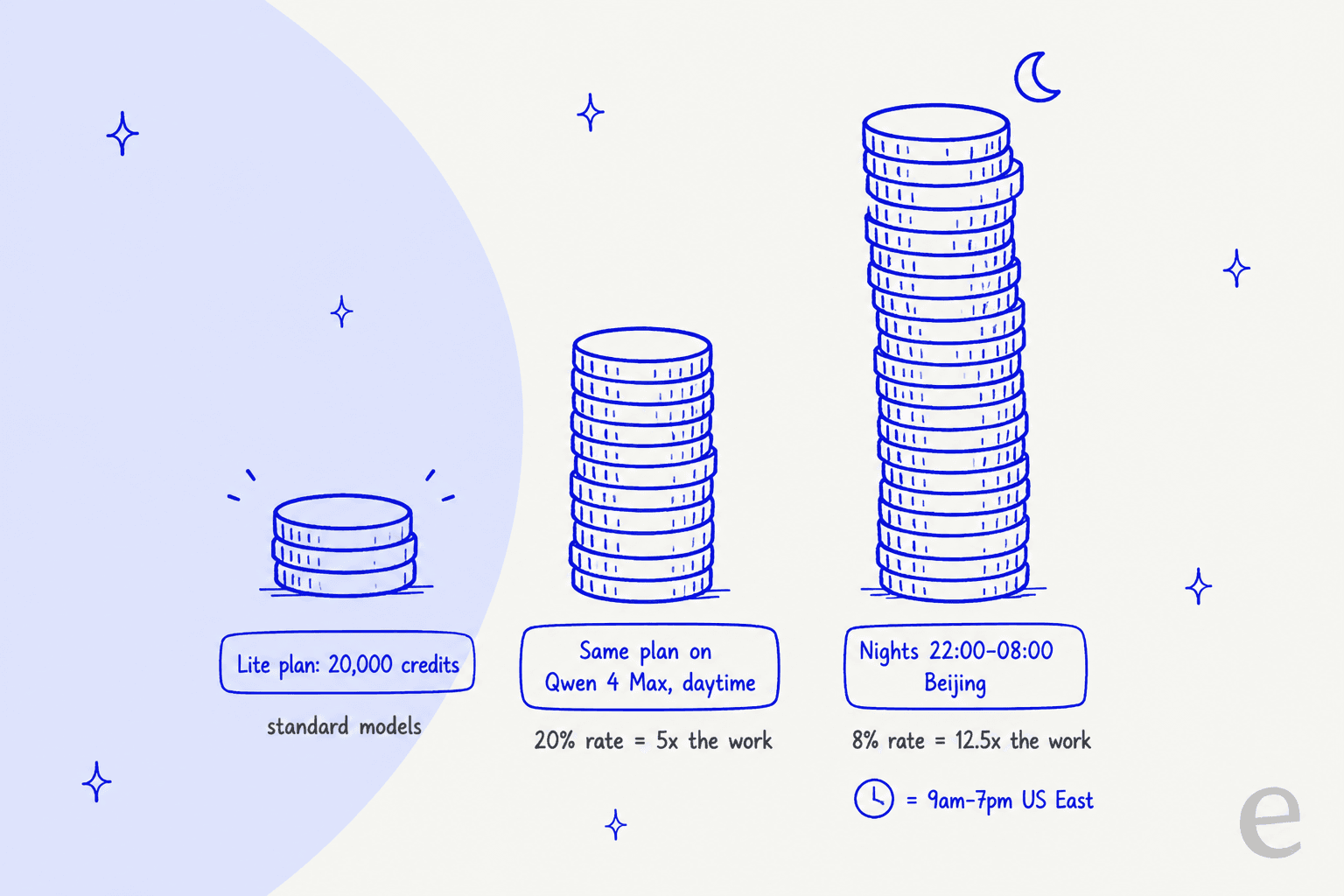
During the preview, Qwen 4 Max uses credits at 20% of the standard rate, which Alibaba describes as "5x usage." Between 22:00 and 08:00 Beijing time, there's another 60% off, so 8% of the standard rate. Both offers end when the model retires at 24:00 on November 25, 2026 (UTC+8).
The night window is the part I'd plan around. 22:00 to 08:00 in Beijing is 14:00 to 00:00 UTC, which is 9am to 7pm on the US East Coast. If you work from the Americas, your whole day is on the cheapest rate. One early tester on Hacker News spotted the same thing:
"By November 25th, Beijing time daytime (8am-22pm) -80%, and at night (Western daytime) even -92%!"

Qwen 4 Max isn't the only model with a night rate. The Individual plan docs give qwen3.8-max and qwen3.8-flash 60% off in the same hours, and most DeepSeek models on the plan, including DeepSeek V4.1 Flash, 50% off.
A worked example, with the assumption spelled out
Here's where the missing standard rate bites. To give you a feel for the numbers, I'll assume Qwen 4 Max's standard rate matches Qwen 3.8 Max's list price, $2 per 1M input and $6 per 1M output, and that the $0.0025 credit holds. Alibaba hasn't confirmed either, so treat this as a range finder, not a quote.
Take one chunk of agent work: 1M input tokens and 100,000 output tokens, a long Claude Code session or two.
| Scenario | List-price cost | Credits used | Chunks per Lite plan (20,000 credits) |
|---|---|---|---|
| Standard rate (after preview) | $2.60 | 1,040 | about 19 |
| Preview, daytime (20%) | $0.52 | 208 | about 96 |
| Preview, night in Beijing (8%) | $0.21 | 83 | about 240 |
On those assumptions, a $6 plan covers a lot of testing in two weeks. If Qwen 4 Max's real standard rate turns out to be double Qwen 3.8 Max's, halve every number in the last column. That uncertainty is why I'd only spend testing money here.
Why does Qwen 4 Max burn more credits than you expect?
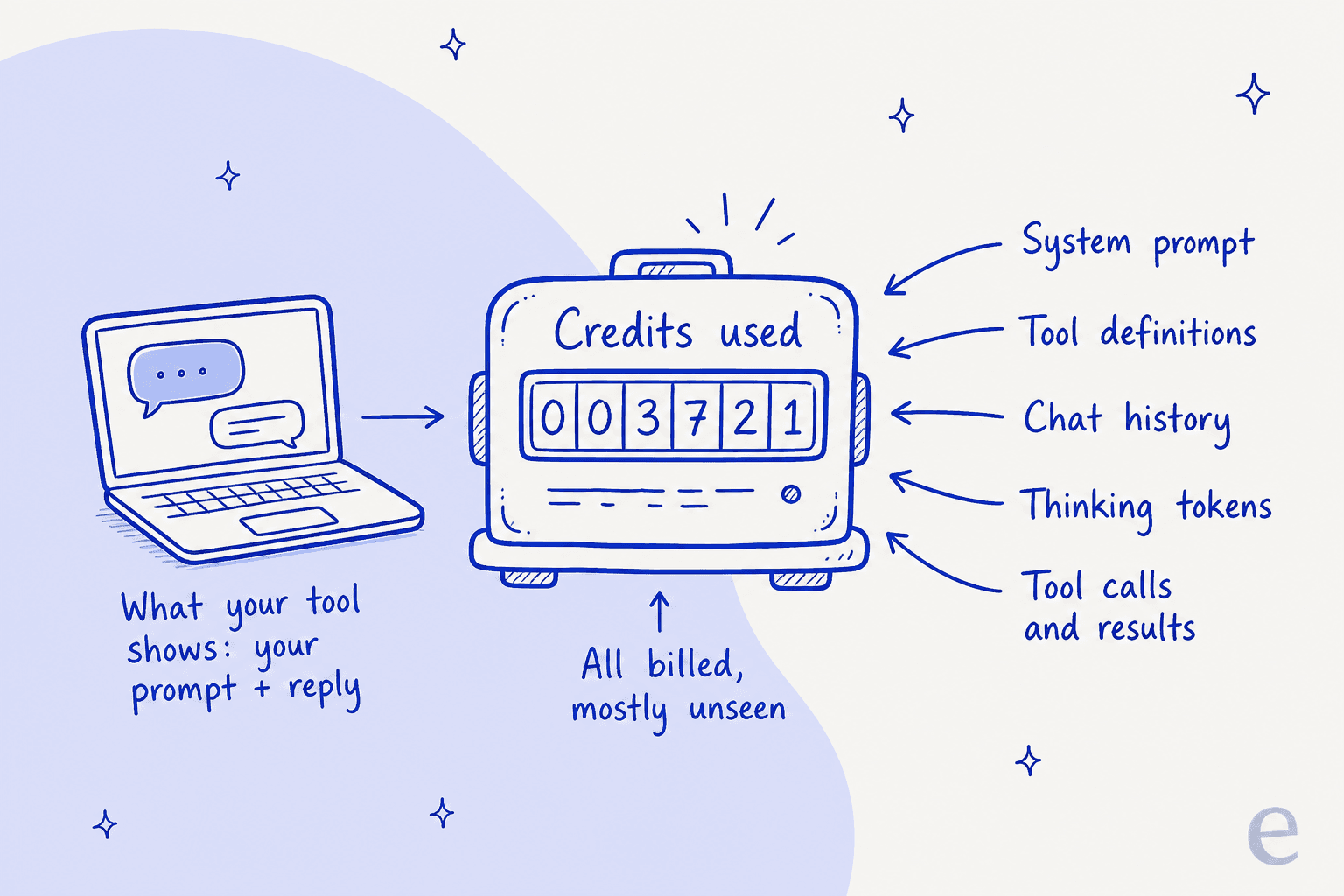
Because your coding tool shows you a fraction of what gets billed. Alibaba's Individual FAQ lists what counts toward credits but doesn't show up in tools like Claude Code: system prompts, tool definitions, project conventions, the full multi-turn history, tool call parameters and results, and the model's internal reasoning.
Qwen 4 Max makes two of those bigger than usual:
- Thinking is on by default at
xhigh. Every request pays for reasoning tokens before the answer. The FAQ's own tip for saving credits is to turn thinking off, and the model docs let you picklowormediuminstead. - The context is 1M tokens. A long session can carry an enormous history into every call. Alibaba's advice is to start a new session when you switch tasks and use
/compactor/clearin your tool. My Claude Code context window guide covers how that history builds up.
There's also a max_tokens change to watch. From this model on, max_tokens caps thinking and the answer together, with a ceiling of 393,216 tokens. A high limit plus xhigh thinking is how one request quietly eats a chunk of your month.
One more trap from the Individual quick start: Token Plan keys start with sk-sp- and use their own endpoint. Put a regular pay-as-you-go key or the general Model Studio URL in your tool by mistake, and calls get charged to your pay-as-you-go balance instead. And since qwen4-max-preview isn't on pay-as-you-go at all, a wrong setup simply won't reach the new model. If you're wiring this up, the Qwen 4 Max setup guide has the exact Claude Code environment variables.
Does Token Plan Team Edition make sense for Qwen 4 Max?
For most teams trying the preview, no. Team Edition sells seats instead of plans, from the Team Edition overview:
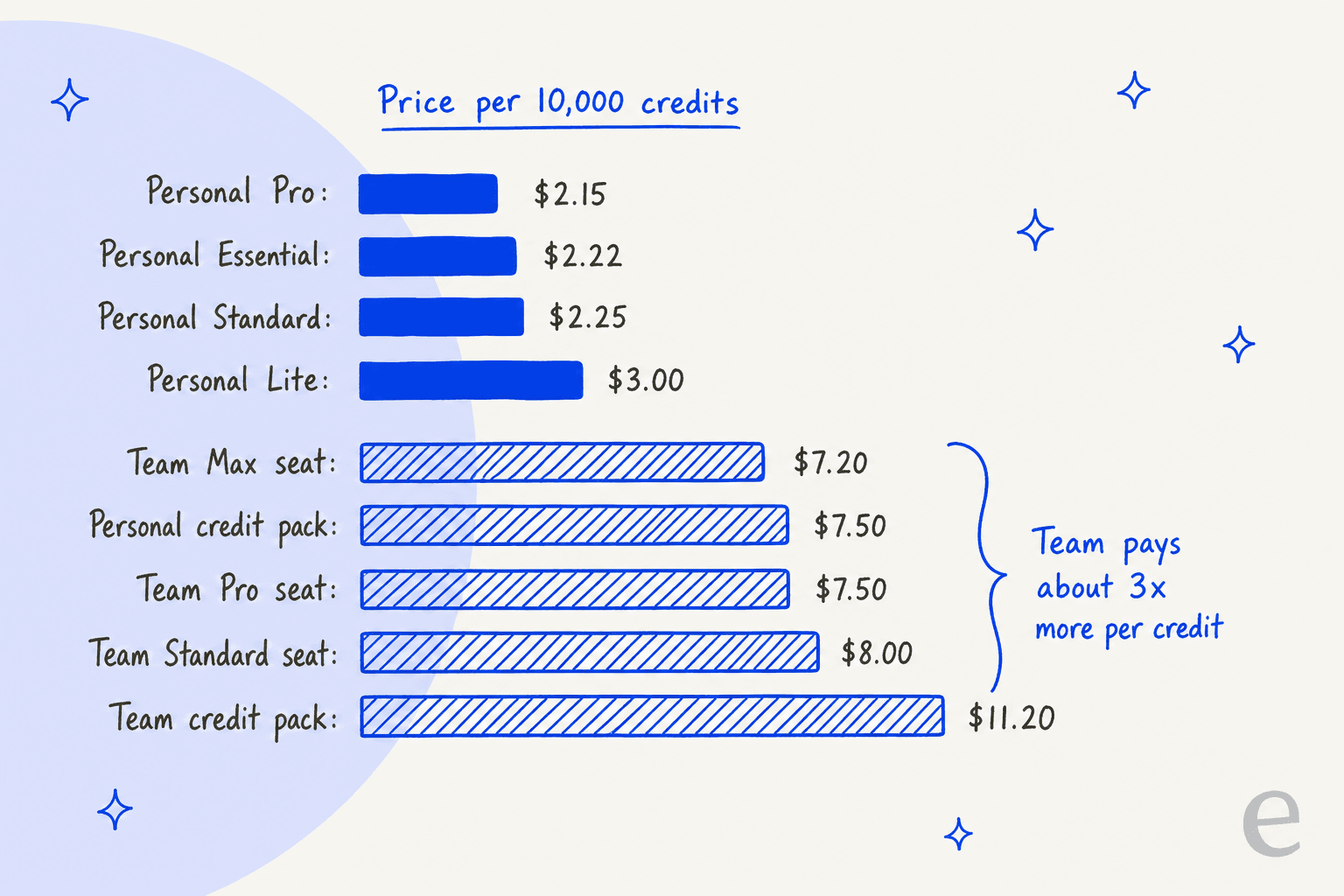
| Seat or pack | Price | Credits | Price per 10,000 credits |
|---|---|---|---|
| Standard seat | $20/seat/month | 25,000 | $8.00 |
| Pro seat | $75/seat/month | 100,000 | $7.50 |
| Max seat | $180/seat/month | 250,000 | $7.20 |
| Credit Pack (shared across seats) | $700/pack | 625,000 | $11.20 |
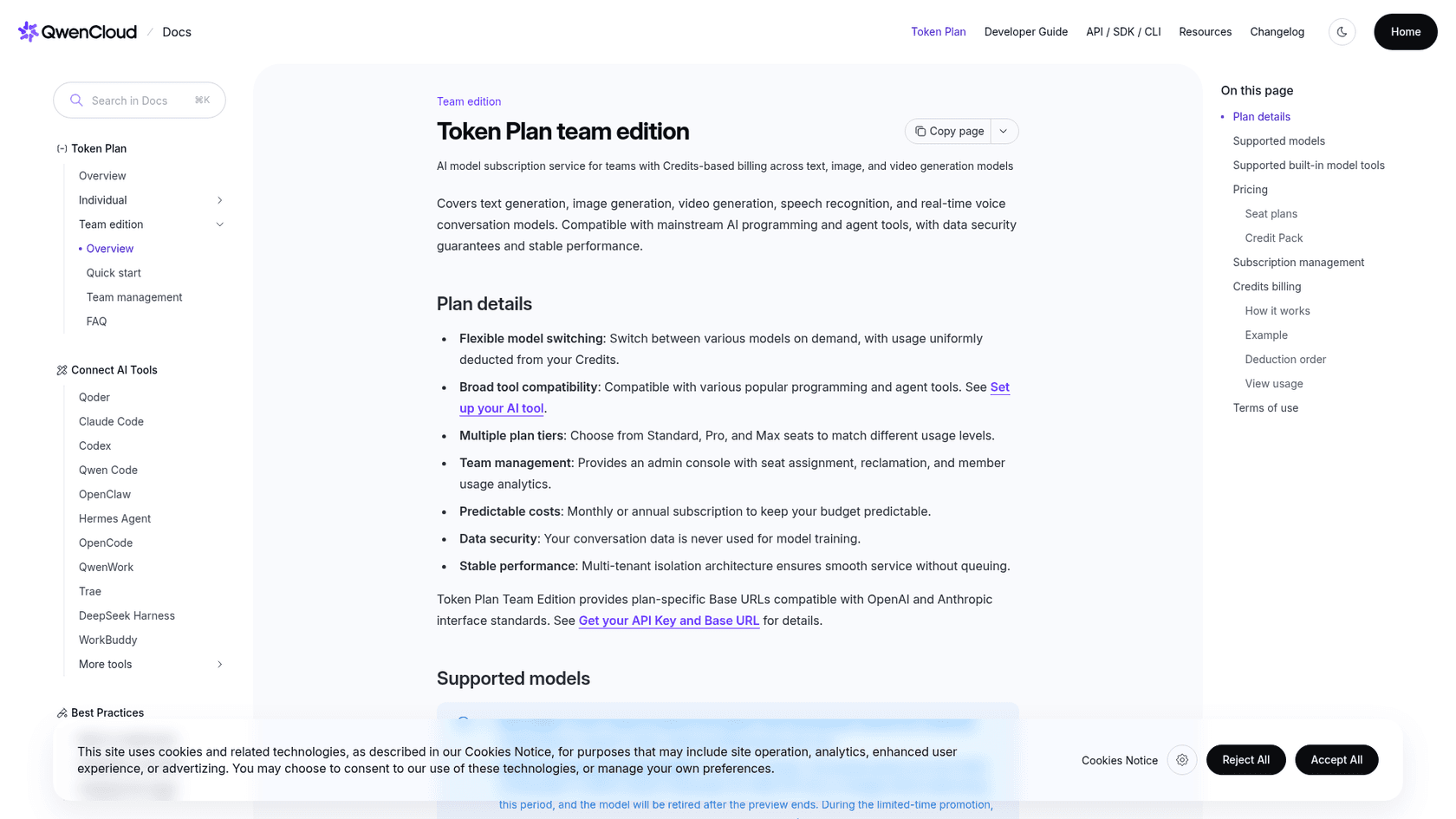
Per credit, a Team seat costs about three times what an Individual plan costs. What you get for that, per the Team FAQ:
- A no-training commitment. Team Edition promises conversation data isn't used for model training. Individual data use is "governed by the service agreement."
- No queuing. Individual plans "may experience queuing during peak hours." Team runs on isolated capacity.
- An admin console. Seat assignment, per-member usage and caps on how much of the shared Credit Pack each person can draw.
Qwen 4 Max preview is on both editions with the same 20% and 8% rates. One difference: the Team overview lists the night discount only for DeepSeek models, while the Individual docs also give Qwen 3.8 Max and Flash 60% off at night. If your company's policy needs the no-training promise for any code going to a model, Team is the only option, and you pay for it. For a two-week evaluation, I'd let one or two engineers test on Individual Lite and decide after November 25.
Both editions share the same hard rule. The Team terms put it as "for interactive use within compatible AI tools only. Not for automated scripts or application backends." So it can't be your production bill either way.
Which Token Plan should you buy for Qwen 4 Max?
Pick by how you'll actually use the two weeks, not by the biggest number on the page.
Which Token Plan fits your Qwen 4 Max test?
Pick the one closest to how you'll use the preview.
Whichever you pick, remember the subscription outlives the model. After November 25, your remaining credits still work on Qwen 3.8 Max, GLM 5.3, DeepSeek V4.1 Flash and the other supported models. Individual subscriptions can't be unsubscribed, so a monthly Lite plan is the low-regret way in.
How does Qwen 4 Max pricing compare with other models?
Here's the uncomfortable truth for comparison shoppers: you can't line Qwen 4 Max up per token against anything, because it has no token price. What you can compare is how each model is sold.
| Model | How you pay | Published per-token price | Can it run your app backend? |
|---|---|---|---|
| Qwen 4 Max preview | Token Plan credits only | No | No (interactive tools only) |
| Qwen 3.8 Max | Pay-as-you-go or Token Plan | $2 in / $6 out per 1M | Yes, on pay-as-you-go |
| Claude Fable 5.2 | API or Claude plans | $8 in / $40 out per 1M | Yes, on the API |
| Claude Opus 5.5 | API or Claude plans | $4 in / $20 out per 1M | Yes, on the API |
| GPT-6.1 Terra | API or ChatGPT plans | See the pricing breakdown | Yes, on the API |
| Kimi K3 | API | See the pricing breakdown | Yes, on the API |
The pattern Token Plan follows is the same one as Claude Code pricing, Cursor pricing and OpenAI Codex pricing: a flat monthly subscription for interactive coding, subsidised against API rates, with a rule against putting it behind a product. That's a good deal for a developer at a keyboard and no deal at all for a business that needs a cost per transaction.
The Hacker News launch thread made the same point about Max-tier Qwen in general:
"No benchmarks yet. The smaller Qwen models are extremely popular for people running things locally, yet I don't know absolutely anyone running Qwen Max."
If you're weighing Qwen against others for a real workload, my Qwen 3.8 Max alternatives list and Qwen alternatives roundup start from models you can actually price.
What does Qwen 4 Max pricing mean for customer support teams?
It means Qwen 4 Max can't be your support bot's model, on price alone. A support agent is exactly the "custom application backend" Token Plan's terms forbid, and the model retires on November 25 anyway. Even after a full release, a credit whose value you learn after the call is hard to turn into a cost per ticket, which is the number a support lead actually budgets with. My AI customer service cost breakdown covers how teams usually land that number.
This is the gap eesel's AI helpdesk teammate is built to fill. Its credit is a whole job, not a slice of tokens: eesel pricing says "a ticket or a chat is 1 credit," with plans from $299 a month for 500 credits and no per-seat fee. A long, messy ticket with ten replies is still one credit, so a support lead can multiply monthly ticket volume by a known price and be done.
smava, a German loan comparison company, runs that at scale on Zendesk: about 27,000 tickets in a month across two brands, with 14,600 categorised and 15,300 draft replies prepared from 820 synced macros and help center articles.
On Freshdesk, OroSoft uses eesel as a copilot that drafts replies from 6,100 past tickets when a support agent asks for one. Neither team has to guess what next month's model bill will be, or swap models when a preview expires.
If you want to see how it would answer your own tickets first, eesel runs a simulation against your past tickets before going live. With the eesel CLI, a coding agent like the Claude Code session you might be testing Qwen 4 Max in can upload approved knowledge, such as exported help articles and macros, and ask test questions to check the answers. Connecting the helpdesk itself still needs someone with admin access to approve it.
Try eesel
Testing Qwen 4 Max in your editor this week is a good use of $6. Putting AI in front of customers needs pricing you can predict and a model that won't retire in 14 days. eesel's AI helpdesk teammate joins your Zendesk, Freshdesk or Gorgias queue, learns from your past tickets and help center, and bills one credit per ticket or chat however long the conversation runs.
Try eesel free, or read the Zendesk AI pricing and Freshdesk AI pricing breakdowns to see how the helpdesks' own AI add-ons charge.
Frequently Asked Questions
How much does Qwen 4 Max cost?
qwen4-max-preview, is only available on Alibaba's Token Plan subscription, which starts at $6 a month for 20,000 credits ($3 for new users until November 30, 2026). During the preview it uses credits at 20% of the standard rate. My Qwen 4 Max review covers what you get for that money.Is there a Qwen 4 Max API price per million tokens?
How many credits does a Qwen 4 Max request use?
What is the Qwen 4 Max night discount?
Which Token Plan should I buy to try Qwen 4 Max?
Can I use Qwen 4 Max Token Plan credits for my app or chatbot?
Is Qwen 4 Max cheaper than Claude or GPT for coding?
What happens to my Token Plan after the Qwen 4 Max preview ends?
qwen4-max-preview is retired after 24:00 on November 25, 2026 (UTC+8). Your credits still work on the other supported models, such as Qwen 3.8 Max, GLM 5.3 and DeepSeek V4.1 Flash, until the subscription month resets.