

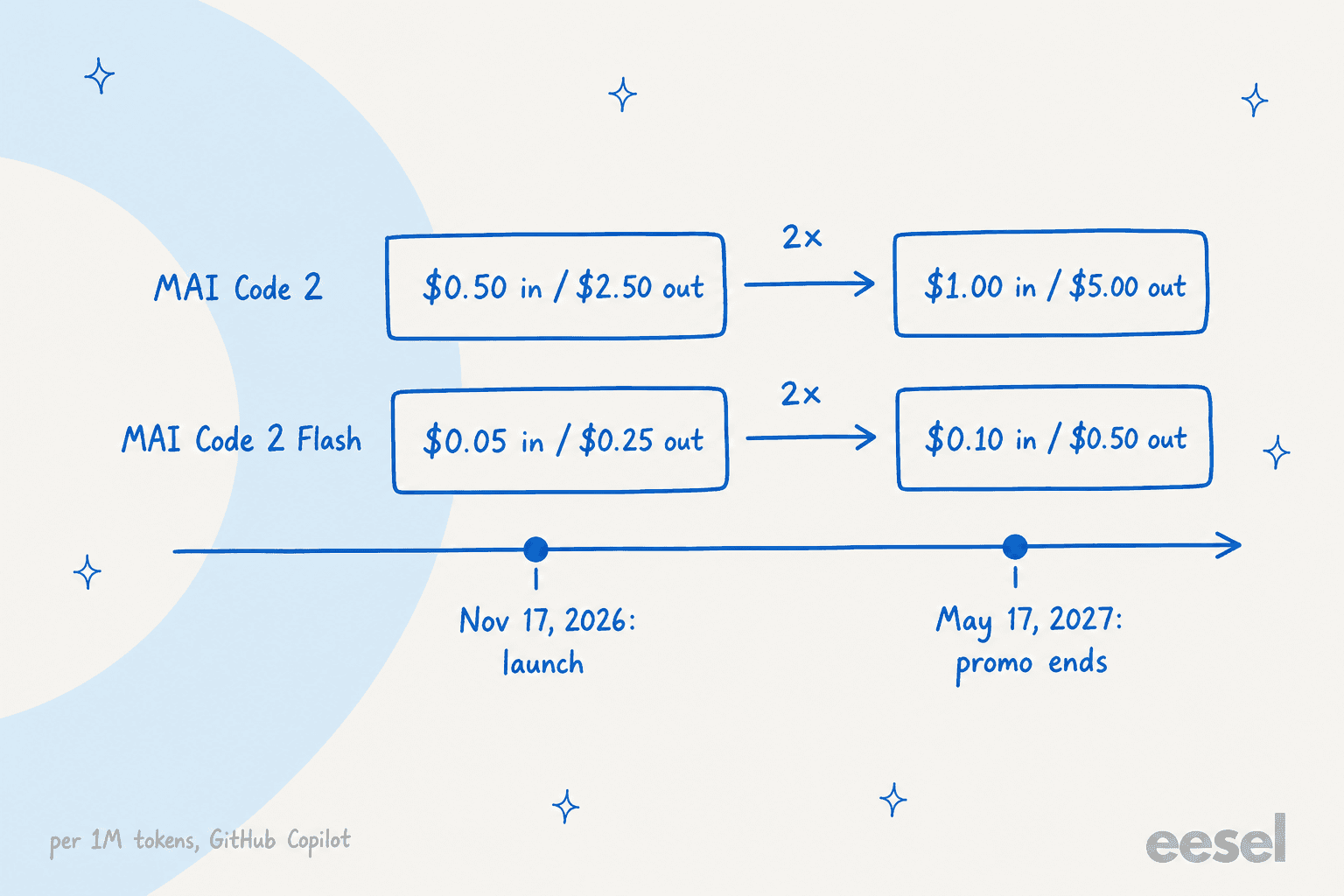
MAI Code 2 costs $0.50 per million input tokens and $2.50 per million output tokens in GitHub Copilot, a 50% launch promo that runs until May 17, 2027. After that it's $1 and $5. MAI Code 2 Flash is a tenth of that: $0.05 and $0.25 now, $0.10 and $0.50 later.
The promo carries Microsoft's headline claim. At promo prices, a benchmark task costs about 41% of GPT-6.1 Sol's; at list it's about 81%, for a score a point behind. Budget on the list price and treat the next six months as a discount.
How much does MAI Code 2 cost?
MAI Code 2 costs $0.50 per million input tokens, $0.025 per million cached input tokens, and $2.50 per million output tokens until May 17, 2027. Microsoft launched it at Ignite on 17 November 2026 alongside a smaller sibling, MAI Code 2 Flash, and the announcement frames both as "everyday coding at scalable prices." If you want the model itself rather than the bill, the MAI Code 2 overview covers what it does and how it benchmarks. If the code you're writing is support tooling, eesel is the off-the-shelf helpdesk teammate, and an agent running Flash in Copilot CLI can drive the eesel CLI to load help articles and test answers before anything goes live.
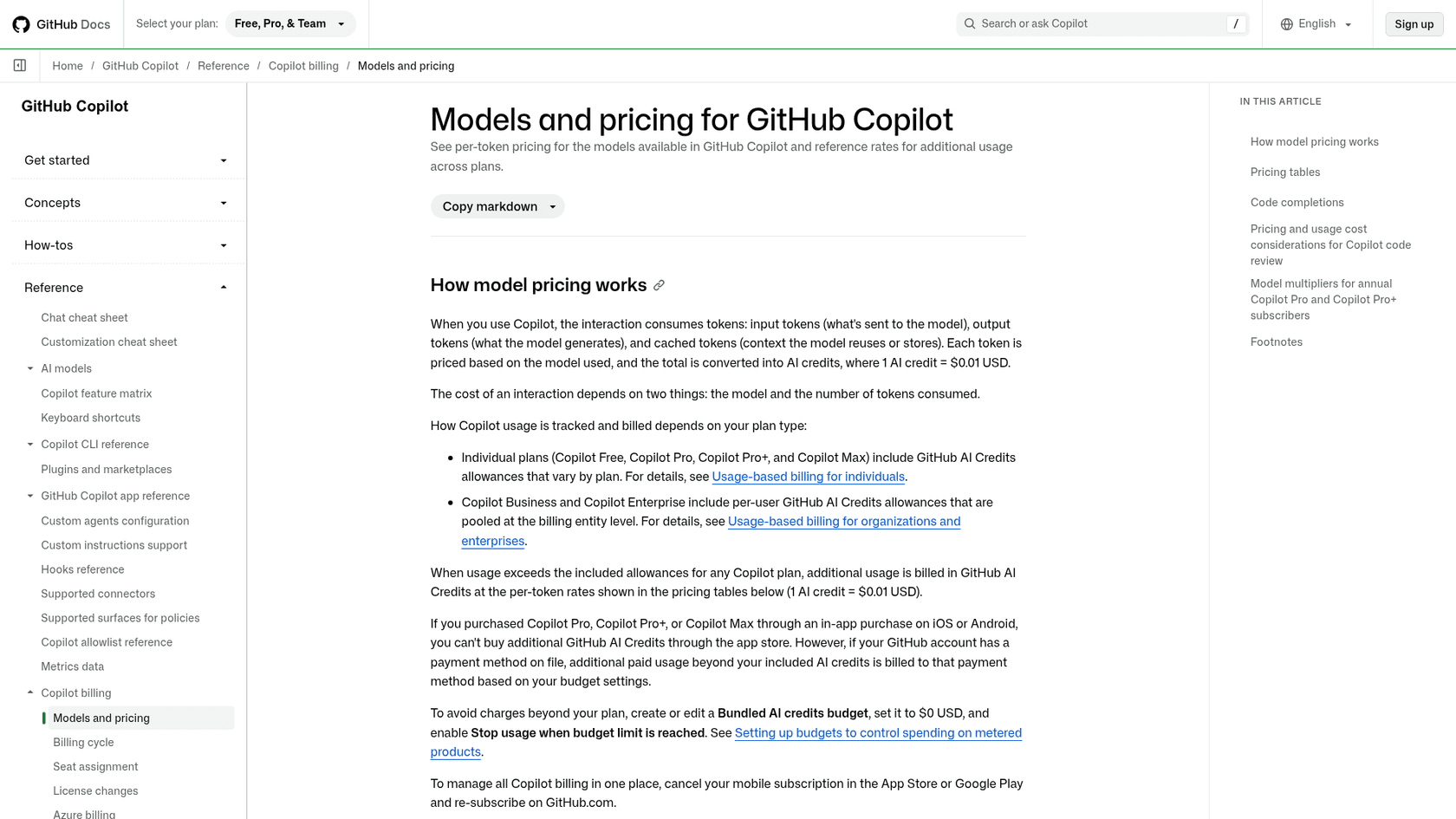
I build integrations for eesel, which means I spend a lot of time asking what a model costs per finished job, not per token. So I've priced MAI Code 2 that way below. Here's every published rate, from GitHub's models and pricing page, per million tokens:
| Model | Input | Cached input | Output | Rate until |
|---|---|---|---|---|
| MAI Code 2 (promo) | $0.50 | $0.025 | $2.50 | May 17, 2027 |
| MAI Code 2 (list) | $1.00 | $0.05 | $5.00 | From May 17, 2027 |
| MAI Code 2 Flash (promo) | $0.05 | $0.005 | $0.25 | May 17, 2027 |
| MAI Code 2 Flash (list) | $0.10 | $0.01 | $0.50 | From May 17, 2027 |
| MAI-Code-1.1-Flash (older) | $0.20 | $0.02 | $1.20 | No promo |
Three things about this table are easy to miss:
- There's no cache-write charge and no long-context tier. GPT and Claude rows on the same page carry both. MAI Code 2 keeps one rate across its full 1,050,000-token context, per the model card.
- Flash at list is still cheaper than the model it replaces. MAI-Code-1.1-Flash costs $0.20 in and $1.20 out with no promo, so Flash moving to $0.10/$0.50 next May is still a cut.
- This is a Copilot price, not an API price. I'll come back to that, because it's the biggest catch in the whole launch.
How does Copilot actually bill MAI Code 2?
Copilot bills MAI Code 2 in GitHub AI credits, where 1 credit is $0.01. Every chat turn, agent run, or CLI session is priced on the tokens it uses at the rates above, then converted to credits. GitHub moved every plan to usage-based billing on 1 June 2026, and the launch changelog confirms both MAI models are billed this way.
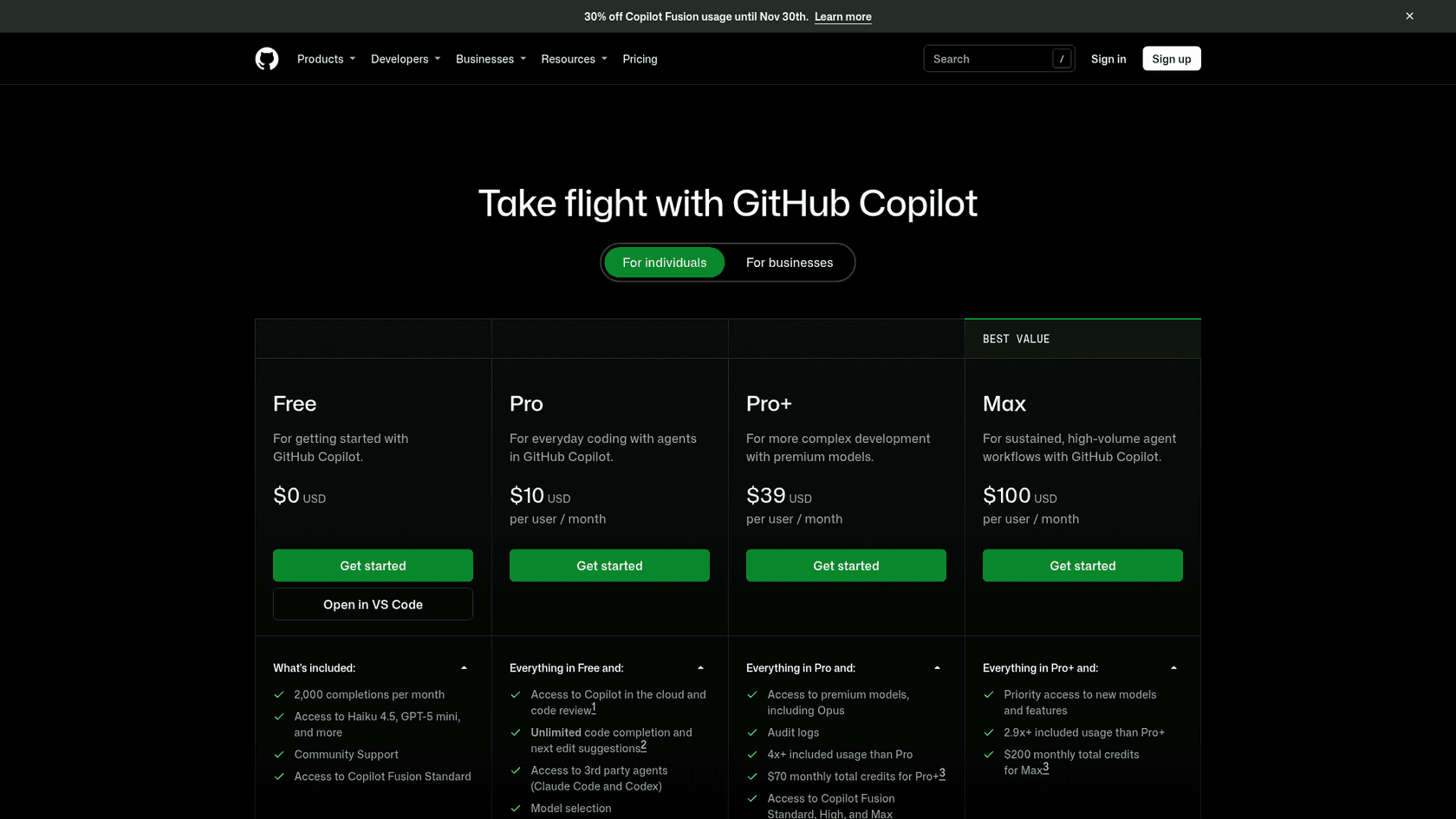
Each plan includes a monthly allowance. Usage comes out of that first, then out of any extra budget you've set. Here's the full lineup from the Copilot plans page and GitHub's plan docs:
| Plan | Price | Monthly AI credits | Credit value | MAI Code 2 | MAI Code 2 Flash |
|---|---|---|---|---|---|
| Free | $0 | Not published | n/a | No | Auto selection only |
| Student | $0 (verified) | Not published | n/a | No | Auto selection only |
| Pro | $10/month | 1,500 | $15 | Yes | Yes |
| Pro+ | $39/month | 7,000 | $70 | Yes | Yes |
| Max | $100/month | 20,000 | $200 | Yes | Yes |
| Business | $19/seat/month | 1,900 per seat, pooled | $19 per seat | Yes | Yes |
| Enterprise | $39/seat/month | 3,900 per seat, pooled | $39 per seat | Yes | Yes |
The details that change what you actually pay:
- Code completions are free. "Code completions and next edit suggestions are not billed in AI credits," per GitHub's pricing page. MAI Code 2's price only touches chat, agent mode, Copilot CLI, the cloud agent, and code review.
- Part of the individual allowance floats. Pro, Pro+, and Max credits split into base credits that match the plan price and a "flex" allotment on top. GitHub's plans page says "Flex allotments will vary over time," so Pro+'s $70 isn't a fixed number.
- Business and Enterprise overage is on by default. The org billing docs say additional usage "is enabled by default," billed at the same per-token rates. If you want a hard cap, an admin has to switch it off.
- Credits reset on the 1st and don't roll over. A quiet month doesn't bank anything.
- MAI Code 2 isn't in auto model selection. The supported models table lists Flash for auto selection and Copilot Fusion, but not MAI Code 2. Paid plans get 10% off model costs in auto mode, so among the MAI models, only Flash gets it.
The GitHub Copilot pricing guide goes deeper on plans, and the Microsoft 365 side lives in Copilot pricing, a different product with a confusingly similar name.
What does a coding task cost on MAI Code 2?
About $0.31 at the promo price, by Microsoft's own numbers. The announcement publishes a cost per task across four benchmarks it says reflect "everyday enterprise coding tasks we see in GitHub Copilot": DeepSWE 1.1, Terminal-Bench 2.1, SWE Atlas, and FrontierCode v1.1. All models ran at max reasoning effort through Copilot CLI, and Microsoft notes that MAI Code 2 is "shown at its 50% promotional price."
| Benchmark | MAI Code 2 pass rate | MAI Code 2 cost/task | GPT-6.1 Sol pass rate | GPT-6.1 Sol cost/task | Claude Opus 5.5 pass rate | Claude Opus 5.5 cost/task |
|---|---|---|---|---|---|---|
| Average | 63.2% | $0.309 | 64.1% | $0.761 | 65.3% | $6.306 |
| DeepSWE 1.1 | 73.2% | $0.618 | 74.6% | $1.212 | 69.0% | $10.717 |
| Terminal-Bench 2.1 | 84.6% | $0.081 | 85.0% | $0.265 | 78.7% | $1.842 |
| SWE Atlas | 43.1% | $0.228 | 47.4% | $0.605 | 57.5% | $4.234 |
| FrontierCode v1.1 | 52.0% | $0.310 | 49.4% | $0.960 | 56.0% | $8.430 |
That's where Microsoft's headline claims come from: 98% of GPT-6.1 Sol's performance at 40% of the cost, and 96% of Claude Opus 5.5's at 5%. The arithmetic checks out. $0.309 is 41% of $0.761, and 4.9% of $6.306.
Here's what the promo hides. Every MAI token price exactly doubles on May 17, 2027, so every cost per task doubles with it:
| Promo cost/task | List cost/task | Share of GPT-6.1 Sol | Share of Claude Opus 5.5 | |
|---|---|---|---|---|
| MAI Code 2 (promo) | $0.309 | 41% | 4.9% | |
| MAI Code 2 (list, from May 2027) | $0.618 | 81% | 9.8% |
Against Opus 5.5 the gap barely matters. Against GPT-6.1 Sol it shrinks from "less than half" to "a bit cheaper." The interesting part is why: at list, MAI Code 2's per-token rate is exactly half of GPT-6.1 Sol's ($1/$5 against $2/$10 in Copilot's table), yet the task costs 81% as much. That means MAI Code 2 uses roughly 60% more tokens to finish the same job. Half the sticker, most of the bill.
Per solved task it still comes out ahead: $0.978 for MAI Code 2 at list (dividing $0.618 by a 63.2% pass rate) against $1.187 for GPT-6.1 Sol. And Opus 5.5 is in a different price league either way, as the Claude Opus 5.5 pricing breakdown shows.
One more caveat from Microsoft's own fine print: "Performance and cost comparisons vary by workload, model configuration, reasoning effort, and pricing assumptions." These are max-effort runs. Your tasks at medium effort will cost less, and a 200-file refactor will cost more.
Is MAI Code 2 Flash really cheaper than GPT-6 Luna?
Today, yes. After May 17, 2027, not on Microsoft's own numbers. Flash competes with GPT-6 Luna and Claude Haiku 5.5, and the announcement publishes a three-benchmark comparison, again with Flash "at 50% promotional price":
| Benchmark | Flash pass rate | Flash cost/task | GPT-6 Luna pass rate | GPT-6 Luna cost/task | Claude Haiku 5.5 pass rate | Claude Haiku 5.5 cost/task |
|---|---|---|---|---|---|---|
| Average | 61.0% | $0.052 | 55.1% | $0.080 | 53.9% | $0.319 |
| DeepSWE 1.1 | 59.9% | $0.098 | 59.6% | $0.159 | 46.0% | $0.668 |
| Terminal-Bench 2.1 | 78.3% | $0.023 | 69.3% | $0.028 | 73.4% | $0.067 |
| SWE Atlas | 44.8% | $0.034 | 36.4% | $0.051 | 42.1% | $0.223 |
Double Flash's $0.052 and you get $0.104 per task at list, which is 30% more than GPT-6 Luna's $0.080. That lines up with the per-token prices: Flash at list ($0.10/$0.50) is the exact same rate Copilot charges for GPT-6 Luna and Claude Haiku 5.5. Once the promo ends, the only price difference left is how many tokens each model spends.
Flash's case after May is quality, not price. It averages 61.0% against Luna's 55.1%, so per solved task the two land close: about $0.170 for Flash at list against $0.145 for Luna. Against Haiku 5.5, Flash stays far cheaper either way ($0.104 against $0.319).
A small oddity worth knowing: Flash scores 44.8% on SWE Atlas, higher than the bigger MAI Code 2's 43.1%. For that style of task, the cheap model is the better one.
What do Copilot's credits buy on each model?
Here's the useful version of all those numbers: how many tasks of Microsoft's average size each plan's allowance covers. I divided each plan's credit value by Microsoft's average cost per task.
| Plan (credit value) | MAI Code 2 promo | MAI Code 2 list | Flash promo | Flash list | GPT-6.1 Sol | Claude Opus 5.5 |
|---|---|---|---|---|---|---|
| Pro ($15) | 48 | 24 | 288 | 144 | 19 | 2 |
| Business ($19/seat) | 61 | 30 | 365 | 182 | 24 | 3 |
| Enterprise ($39/seat) | 126 | 63 | 750 | 375 | 51 | 6 |
| Pro+ ($70) | 226 | 113 | 1,346 | 673 | 91 | 11 |
| Max ($200) | 647 | 323 | 3,846 | 1,923 | 262 | 31 |
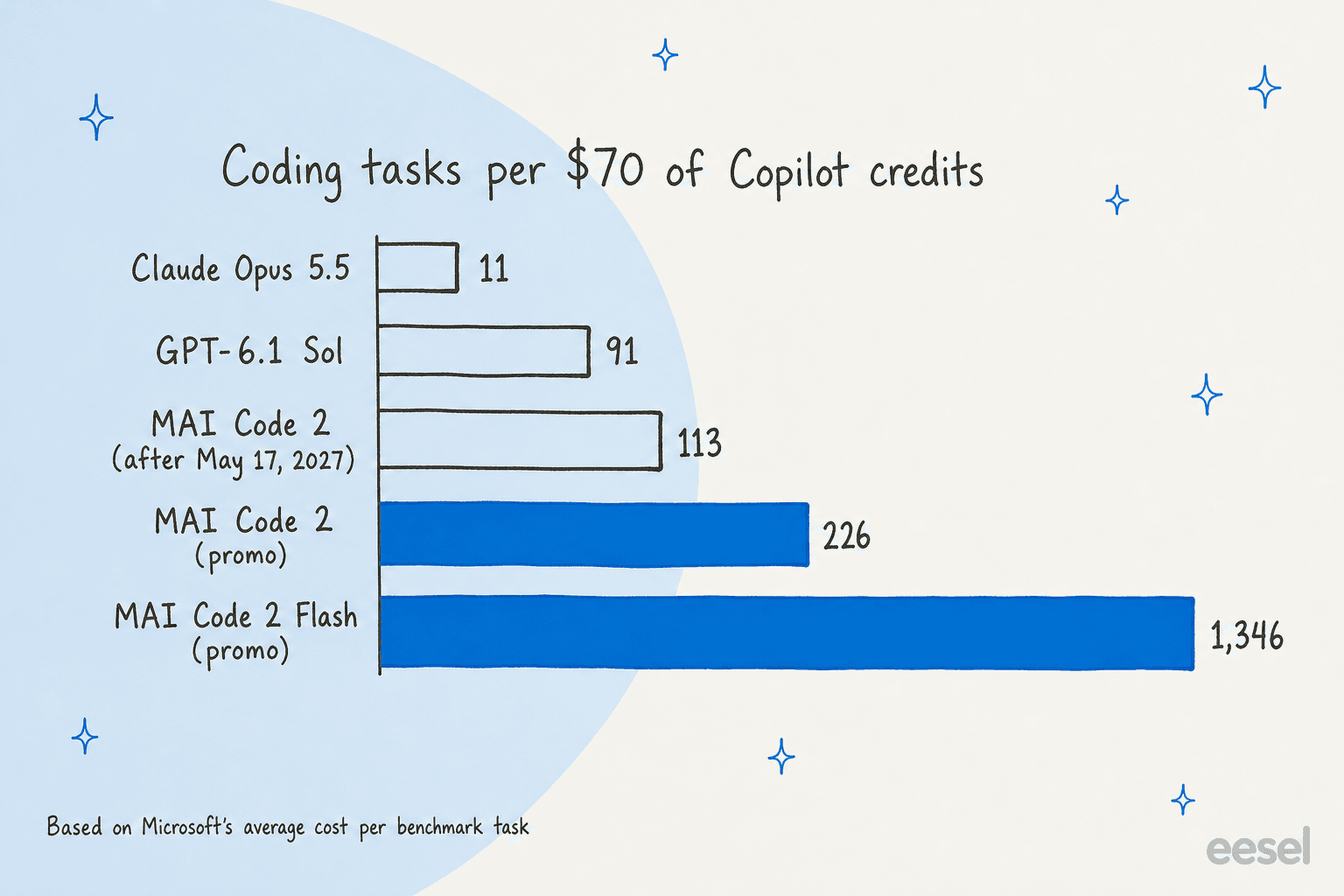
The pattern I'd take from this: on Pro, MAI Code 2 is a "couple of agent tasks a workday" model, about 48 a month now and 24 after the promo. If you lean on GitHub Copilot's agent mode all day, Pro+ or Max is where it starts to feel unlimited, and Flash is the model that makes Pro workable at all.
For a sense of real usage, the calculator below takes your own task count. It uses Microsoft's average task, so treat the result as an order of magnitude rather than an invoice.
At 20 tasks a day on Pro+, MAI Code 2 comes to $129.78 of usage a month at the promo price. That's $59.78 of extra usage on top of the $39 plan, so $98.78 in total, which is about the price of Max. At list, the same month is $259.56 of usage.
Can you use MAI Code 2 outside GitHub Copilot?
Barely, for now. This is the part of the pricing story that matters most if you build products rather than use an editor. The model card lists exactly two channels: GitHub Copilot for both models, and Microsoft Foundry for MAI Code 2 Flash only.
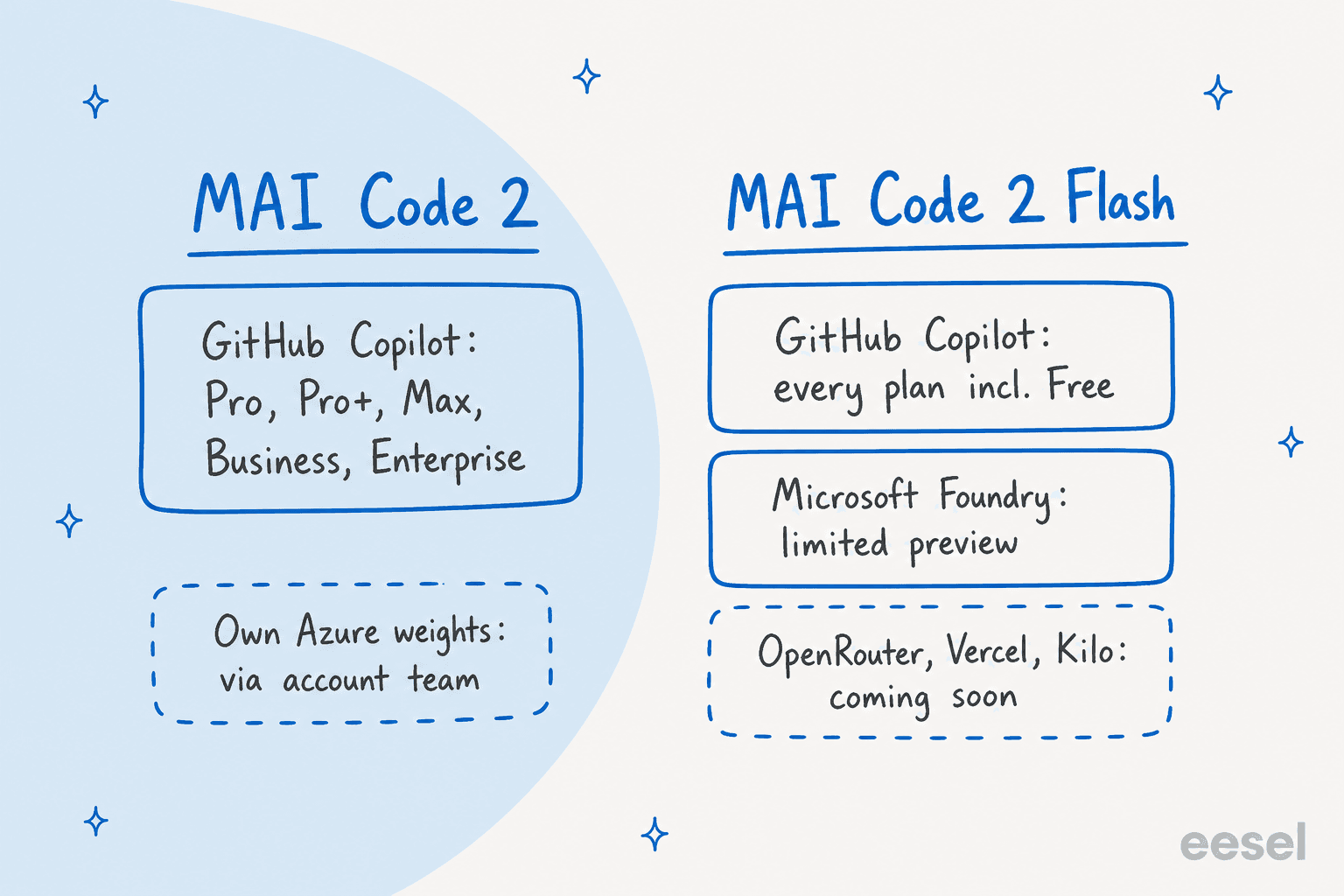
What each route looks like today:
- Microsoft Foundry (Flash only). "Code 2 Flash is in limited-access preview in Microsoft Foundry," per the announcement. You call it through an OpenAI-compatible Responses API. The Foundry pricing page had no MAI Code 2 Flash row when I checked on 18 November 2026, so there's no published API price yet.
- Third-party routers (coming). Microsoft says it'll release Flash "on Open Router, Vercel, Hermes, Open Code, and Kilo." No dates or prices yet.
- Your own Azure environment. MAI Licensed Weights is "coming soon through our Frontier Company engagements," through your Microsoft account team. That's a sales conversation, not a price list.
- Weights on your laptop. No. The model card says "model weights are not distributed."
So if you were hoping to put MAI Code 2 behind your own product at $0.50 per million tokens, the way you'd call one of the Azure OpenAI models, you can't, at least not yet. The per-token rates in this post are Copilot rates for Copilot usage. That's a change from Microsoft's other recent models: Microsoft Decision-1 and MAI-Thinking-1 both have rows on the Foundry price list.
What are developers saying about MAI Code 2's price?
Mostly, that the promo is carrying the chart. The launch got a 281-point Hacker News thread and a busy thread on r/GithubCopilot, and a recurring complaint in both is the same footnote I flagged above:
"Most of the blog is about price/performance ratio, and then you have to read the fine print to see that all these numbers are deceiving, because: [...] MAI-Code-2 cost is shown at its 50% promotional price. Feels a bit dishonest. edit: the promotional price is valid till may 2027?! Half a year?"

The early hands-on reports are kinder on cost. One tester put a real task well under Microsoft's $0.31 average:
"Early testing with MAI Code 2 is promising. I know it's on 50% discount but it was able to complete a small-medium task with only a few things a review had it revisit all for ~7 ai credits."
Seven credits is about $0.07. That fits the pattern in Microsoft's table, where a Terminal-Bench task cost $0.081 and a DeepSWE task $0.618: small, well-scoped jobs are cheap, and the average is pulled up by big ones.
The other thread running through both discussions is credits running out. People already rationing Copilot's allowance see Flash as a swap for their current cheap model, and some see the whole credit system as the real problem:
"We just cancelled our Github Copilot subscription. It was hard to even justify the 19,- dollar tier. All it gave us was some credits (at API prices) which most people burned through in days, some in hours [...] These two models might help, I will definitely give it a try but while they're cheap they still do not compare to what feels like nearly unlimited usage offered by Claude Code and Codex (if you stick to the lower tier models)."

That's a fair read of the trade. A cheaper model stretches the same credits further, but it doesn't change that Copilot bills chat and agent work at per-token rates. If your team's real complaint is the meter, the Copilot alternatives are worth a look alongside MAI Code 2.
Is MAI Code 2 worth paying for?
For the work it's built for, yes, and the promo makes it an easy model to try. If you're on Pro+ or Max and run Copilot's agent mode for bug fixes, multi-file changes, and terminal work, MAI Code 2 gets you close to GPT-6.1 Sol's results for less than half the credits until May. On Terminal-Bench 2.1 it's 84.6% at $0.081 a task, against Sol's 85.0% at $0.265.
Three cases where I'd think twice:
- Hard, long problems. Microsoft says outright that both models are "explicitly not yet tuned for harder problems, like fundamental science research and very long horizon agentic work." For those, the Claude Opus 5.5 premium buys a higher SWE Atlas score (57.5% against 43.1%).
- Budgets set on the promo. If you're picking a team plan, do the maths at list. The 2x step on May 17, 2027 turns a comfortable Pro+ month into an overage month.
- Non-English code work. The model card says the model "is optimized for English code production only" at release.
If you're comparing coding tools rather than models, start with the best AI coding assistant tools roundup. Claude vs Copilot is the head-to-head most teams end up running.
The subscriptions MAI Code 2 competes with are priced very differently. Cursor pricing and Codex pricing bundle usage into the plan, and Claude Code pricing works the same way through a Claude subscription.
What if you're building a support agent on a cheap model?
Plenty of the teams pricing coding models are really pricing the build behind something else, and support bots are the usual suspect. A cheap model makes the tokens cheap, and tokens are the small line in AI customer service cost. It doesn't make the support agent cheap, because the cost of an AI support agent sits mostly in retrieval, escalation rules, testing, and upkeep.
That's the build vs buy trade in one line.
There's a middle path that suits a team already living in Copilot CLI. The eesel CLI lets a coding agent set up an eesel helpdesk teammate from the terminal: upload approved help articles and saved replies, edit the agent's instructions, then ask it test questions and read the answers before anything goes live. MAI Code 2 Flash is cheap enough to run that loop all afternoon. Connecting the helpdesk itself still needs someone with admin access to approve it.
Developer tools are a good example of why the "buy" side exists. SE Ranking, which makes SEO software, runs one eesel agent per product across three Zendesk connections, and handled 4,650 conversations in one month. Questions about its API, white label, and Looker Studio connector become Tier 2 tickets with the evidence already collected. That routing logic is the expensive part to build, whatever model runs underneath. The best AI for devtool support guide covers the wider field.
Try eesel
If you're weighing MAI Code 2 because you want AI on your product's support queue, eesel's AI helpdesk teammate does that job without a token meter or a promo cliff. It joins the helpdesk you already use, learns from your past tickets, docs, and help center, and you can run it against historical tickets to read every answer before it touches a customer. Plans are fixed credit bundles starting at $299 for 500 credits, so a model's price doubling next May doesn't show up on your bill.

You can try eesel free on a slice of your queue, or set it up from your terminal with the eesel CLI and let your coding agent do the clicking.