


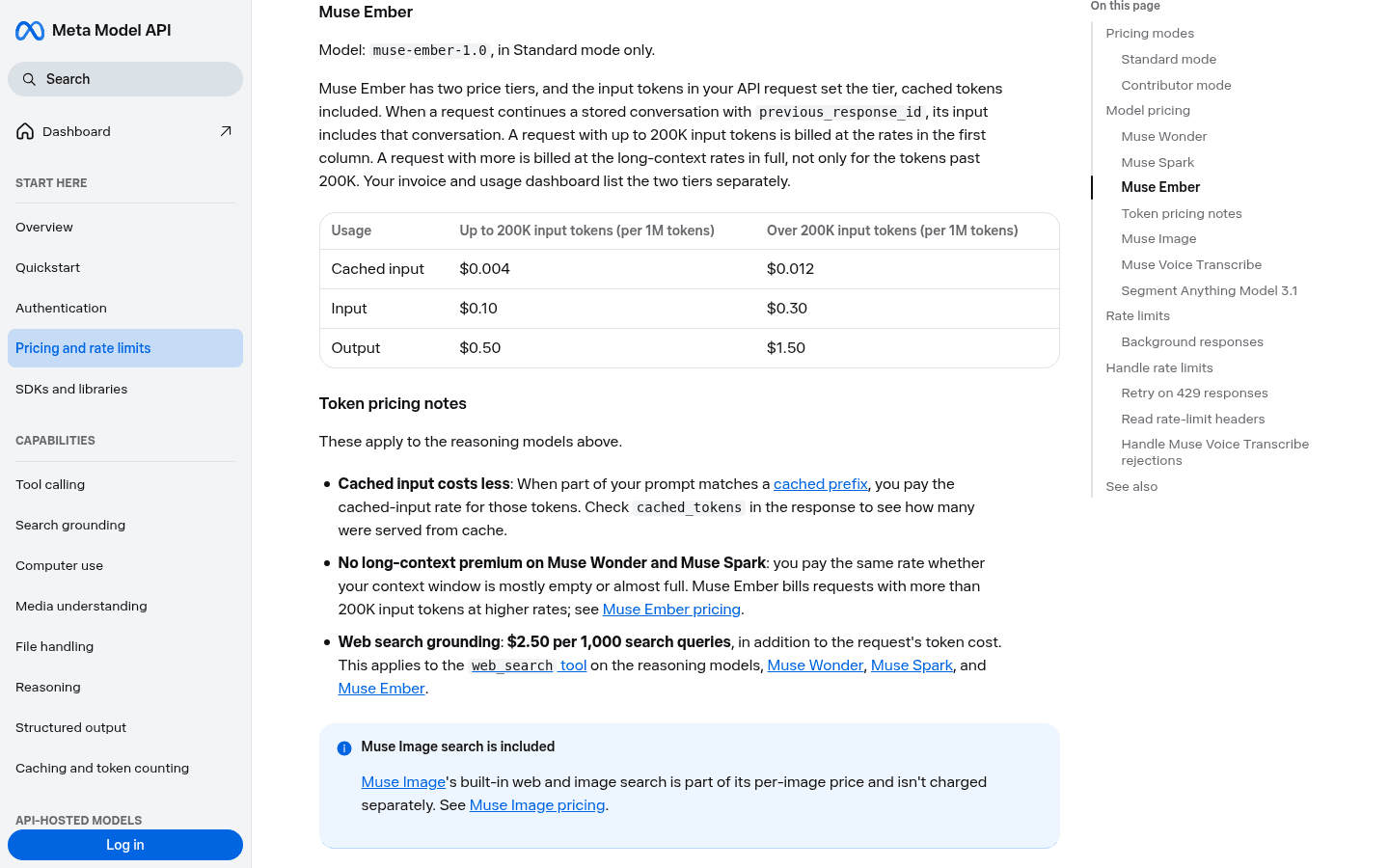
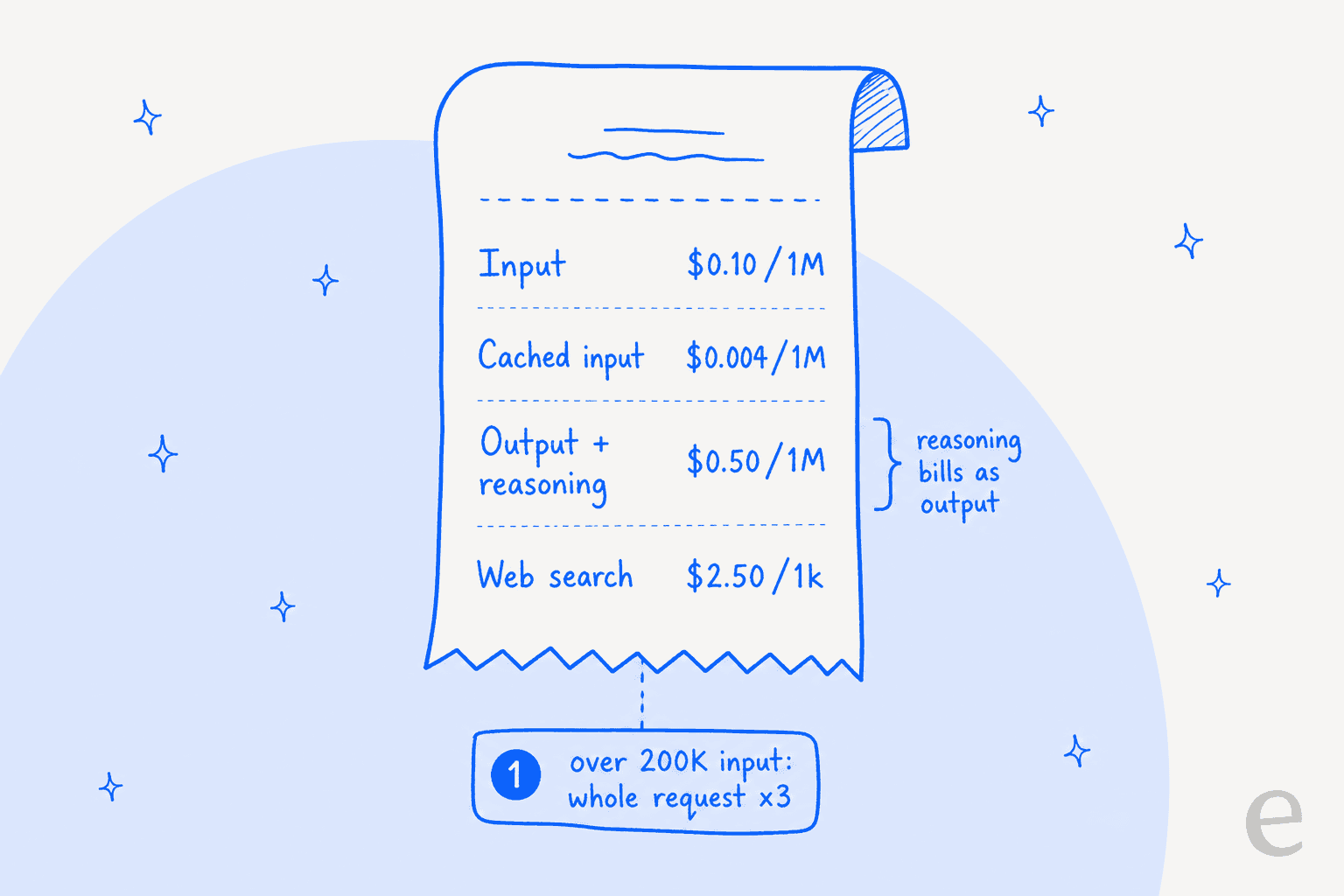
Meta Muse Ember costs $0.10 per million input tokens and $0.50 per million output, the same sticker as Claude Haiku 5.5 and GPT-6 Luna. What makes the bill cheap or not is three settings Meta ships on the expensive side: effort defaults to max, conversation history counts toward a 200K line that triples the price of the whole request, and there's no batch tier.
Set effort low for simple steps, keep agent loops under 200K input, and Ember is about the cheapest capable model you can call today. For support teams, the token bill is the small part. eesel runs triage and drafts on your helpdesk for a fixed plan, and the eesel CLI lets a coding agent upload your routing rules and test them on sample tickets first.
How much does Meta Muse Ember cost?
Muse Ember launched on 9 November 2026 as muse-ember-1.0, and it's sold in Standard mode only. Here's the full rate card from Meta's pricing page:
| Line item | Up to 200K input tokens | Over 200K input tokens |
|---|---|---|
| Input | $0.10 / 1M | $0.30 / 1M |
| Cached input | $0.004 / 1M | $0.012 / 1M |
| Output (reasoning included) | $0.50 / 1M | $1.50 / 1M |
| Web search | $2.50 / 1,000 queries | $2.50 / 1,000 queries |
| Rate limit | 3,000 RPM, 4M TPM per team | same |
I spend most of my time on what buyers actually type into search, and the pattern with every cheap model launch is the same. People search the price, see a number that rounds to zero, and stop reading. With Ember, the number on the sticker is real, but it isn't the number you get billed unless you change three defaults. I'll go through each one.
A few things on the card are worth knowing before the switches:
- Caching is very cheap.
$0.004is 4% of the input price. Haiku 5.5 and Luna both cache at 10% of input. - Meta's own steering tokens are free. Meta injects a small system prompt into every request and says those tokens "are not billed and are excluded from the token counts."
- Ember has a long-context premium; Meta's bigger models don't. Muse Wonder and Muse Spark bill the same rate at any context length. Ember is the only Meta reasoning model with a price step.
Which three settings decide a Muse Ember bill?
Each one ships on the expensive side, and each one is a single line of config to change.
1. Effort defaults to max
Meta's reasoning docs say that when you omit the effort setting, the model reasons at "max" on Muse Wonder and Muse Ember. Reasoning tokens are "billed at the same rate as visible output tokens," so every hidden thought costs $0.50 per million.
You can't turn reasoning off. Effort none returns an HTTP 400 on every Muse reasoning model, so minimal is the floor. On Chat Completions it's the top-level reasoning_effort; on the Responses API it's nested as reasoning.effort.
How much does it matter? On Artificial Analysis's index, Ember at xhigh cost $0.116 per task and scored 33.9, while max cost $0.136 and scored 35.8. That's a 17% saving for two points. For a short classification task, the gap is far bigger, because the visible answer is a few tokens and the reasoning is most of the bill. Simon Willison's effort test showed how little the top settings can add on simple prompts:
"Wow, minimal seems to be the best here interestingly. Only 10 reasoning tokens so basically none?"

My rule: set minimal or low for ticket classification, tagging and field extraction, and leave max for the steps where a wrong answer costs more than the tokens.
2. Stored history counts toward the 200K line
This is the one that catches agent builders. Meta's wording: "the input tokens in your API request set the tier, cached tokens included. When a request continues a stored conversation with previous_response_id, its input includes that conversation." And once you're over: "billed at the long-context rates in full, not only for the tokens past 200K."
So a long agent session gets more expensive per turn in two ways: the input grows, and at some point the whole request flips to 3x. I modelled a 40-turn sub-agent session that starts at 20K input and adds 6K per turn, with the earlier context cached and 1,500 output tokens a turn:
| Turn | Input tokens | Cost of that turn |
|---|---|---|
| 31 | 200,000 | $0.0021 |
| 32 | 206,000 | $0.0065 |
Turn 32 costs three times turn 31 for 3% more input. Across the session, the last nine turns are over half the bill ($0.061 of $0.117). Cap the context at 150K by summarising older turns and the same session costs $0.073, about 38% less. The same loop on Haiku 5.5, whose 5x step starts at 100K, comes out at $0.43.
The fix is a context budget: summarise or drop old tool output before the request crosses 200K. If you run Ember inside Claude Code as a sub-agent, the Claude Code sub-agents pattern already keeps each child's context short, which is exactly what this price card rewards.
3. There's no batch tier
Anthropic halves Haiku 5.5 to $0.05 / $0.25 on its Batch API, and OpenAI has batch and flex rates for Luna at $0.05 / $0.25 too. Meta's rate card has no batch line for Ember. It has background responses, capped at 600 new submissions a minute, but they bill at normal rates.
"Batch pricing is two times cheaper with Haiku. Benchmarks are nearly tied."
For real-time work this doesn't matter. For overnight jobs that can wait, like re-tagging a year of tickets or summarising an archive, batched Haiku or Luna can come in under Ember on the same token counts. I'd still test Ember on a sample first, because Artificial Analysis measured it finishing tasks with far fewer tokens than Haiku, and a 50% discount on three times the tokens is still more money.
How does Ember compare with the rest of Meta's lineup?
Ember is the cheapest Meta model you can use without giving Meta training rights. The one Meta option that undercuts it is Muse Spark 1.3 in Contributor mode, and that comes with a catch.
| Model | Input / 1M | Cached / 1M | Output / 1M | Long-context premium | Trains on your data |
|---|---|---|---|---|---|
| Muse Wonder | $4.00 | $0.20 | $20.00 | No | No |
| Muse Spark 1.3 | $1.25 | $0.15 | $4.25 | No | No |
| Muse Spark 1.3 Contributor | $0.10 | $0.002 | $0.20 | No | Yes |
| Muse Ember | $0.10 | $0.004 | $0.50 | 3x over 200K | No |
Contributor Spark is cheaper per output token than Ember, but Meta runs it at 150 requests a minute against Ember's 3,000, and it lets Meta "use your content to train future Meta models." For anything with customer data in it, that rules it out. Contributor mode "isn't available for Muse Wonder or Muse Ember on Model API," per Meta.
Against standard Spark 1.3, the gap is large. Meta's own launch table puts Spark 1.3 at 37 on the Artificial Analysis index for $2.39 a task, and Ember at 36 for $0.14. That's a point of score for 17 times the cost. Meta's guidance is to let Wonder or Spark plan and hand the volume to Ember, and the price card makes that the obvious split.
How does Muse Ember pricing compare with Haiku 5.5 and Luna?
Same sticker on all three, different bills at the edges.
| Muse Ember | Claude Haiku 5.5 | GPT-6 Luna | |
|---|---|---|---|
| Input / output per 1M | $0.10 / $0.50 | $0.10 / $0.50 | $0.10 / $0.50 |
| Cached input | $0.004 | $0.01 (plus cache writes) | $0.01 |
| Price step | 3x over 200K | 5x over 100K | Higher long-context rate |
| Batch discount | None listed | 50% | Yes |
| Default effort | max | medium | medium |
| AA cost per task (max) | $0.136 | $0.411 | $0.152 |
The Artificial Analysis figures come from Meta's launch chart, which notes Ember costs were estimated "at proposed pricing" that matches the list price. So treat them as Meta-published until you measure your own traffic. If you're weighing the wider cheap tier, Gemini 3.8 Flash pricing and DeepSeek V4 Flash pricing are the other two I'd check, and the Haiku 5.5 alternatives roundup lines them all up.
"Notable cache cost of 4% input, compared to Luna/Haiku's 10% of input."
What does Muse Ember cost for real jobs?
Here are three worked examples. The token counts are my assumptions for typical jobs, not Meta figures, so swap in your own numbers in the calculator below.
Ticket triage, 20,000 tickets a month. Each call sends a 2,000-token cached system prompt plus a 1,000-token ticket, and returns a label.
- At
minimaleffort, say300output tokens:$2.00input +$0.16cached +$3.00output = about$5.16a month. - At the default
max, say2,000output tokens with reasoning: about$22.16. Same job, four times the bill. - Standard Spark 1.3 for the minimal version: about
$56.50.
A 250K-token contract pack, one call. All of it bills at the long rate: $0.075 input. Split it into two 125K calls and the input costs $0.025. Three times cheaper for one extra request, as long as the task doesn't need the whole pack in one context.
A 40-turn coding sub-agent. From the table above: $0.117 a session uncapped, $0.073 with a 150K context budget. At 1,000 sessions a month, that's $117 against $73.
Plug in your own volume:
Is Muse Ember included in a Muse Code subscription?
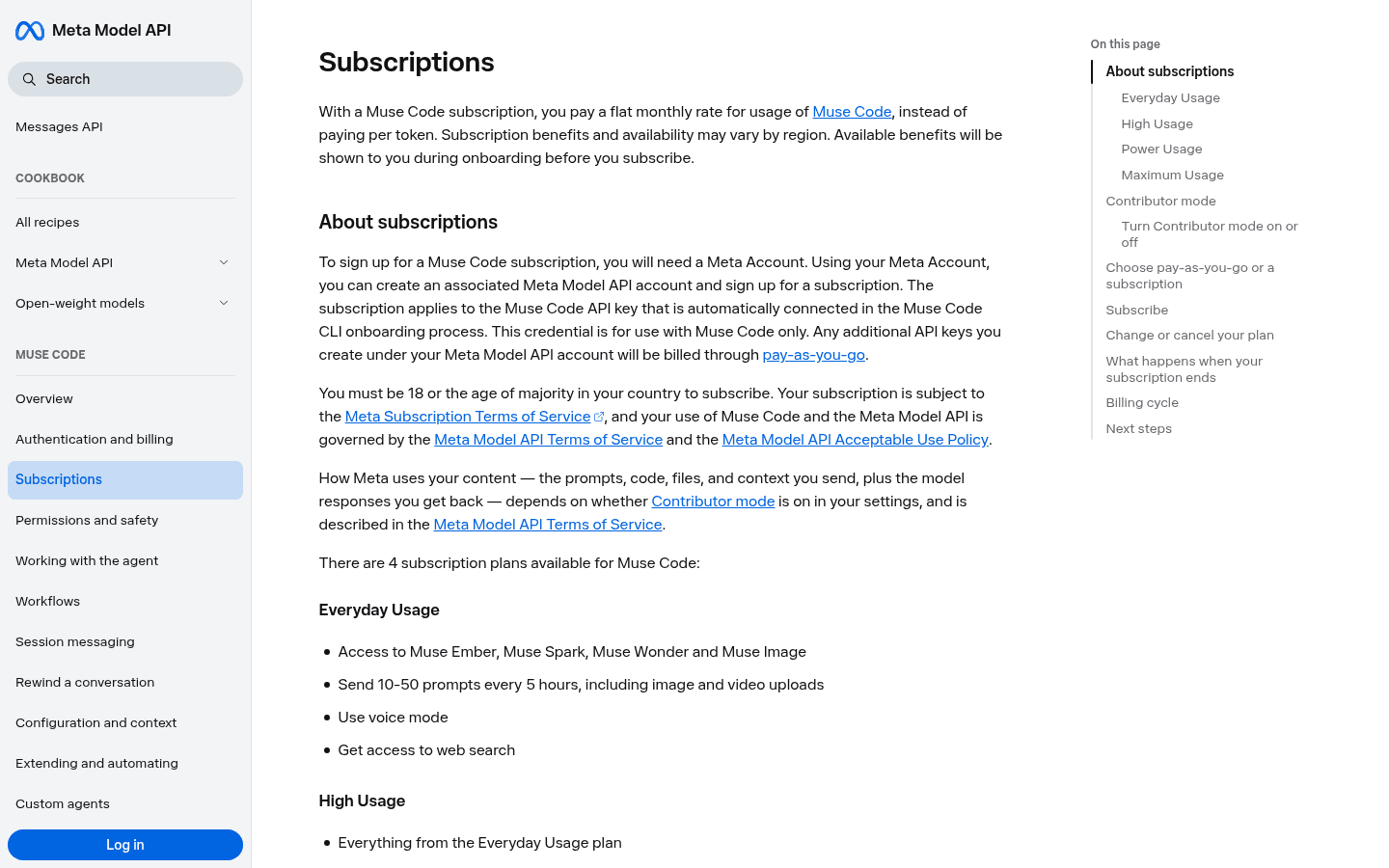
Yes, on every plan. Meta's subscription docs list Ember on the $5 Everyday Usage plan alongside Spark, Wonder and Muse Image.
| Plan | Price | Usage | Ember |
|---|---|---|---|
| Everyday Usage | $5/month | 10-50 prompts every 5 hours | Yes |
| High Usage | $15/month | 5x Everyday | Yes |
| Power Usage | $50/month | 20x Everyday, adds Wonder Full | Yes |
| Maximum Usage | $200/month | 80x Everyday | Yes |
Two rules limit what a plan is worth for Ember specifically. The subscription key "is for use with Muse Code only," so a plan can't power your own app; any other key bills pay-as-you-go. And plans default to Contributor mode, which lets Meta train on your prompts and code until you switch it off in /settings. For a full breakdown, see my Muse Code pricing guide, or compare against Claude Code pricing and Cursor pricing.
Is Muse Ember worth the price?
For high-volume, bounded steps, yes. It's the cheapest model at its quality level that doesn't train on your data, and the long-context premium is gentler than Haiku's. It's the wrong pick when:
- Your job is mostly overnight batch work. Batched Haiku or Luna can come in lower.
- Your agent sessions run long and you can't trim them. Every turn past
200Kcosts 3x. - The task is the hard part. Meta points hard coding and planning to Muse Wonder or Spark, and Haiku leads Ember on FrontierCode 2.0 (
34.9vs27.2). My Muse Ember review has the full benchmark split.
What does Muse Ember pricing mean for support teams?
The token line is the smallest number in an AI support budget. Twenty thousand tickets tagged for about five dollars is real, and it's why models like Ember suit ticket triage, ticket summarization and ticket prioritization. But a model on its own doesn't connect to Zendesk or Freshdesk, doesn't know your refund policy, and doesn't hand off to a person.
That other work is where the money goes. At eesel, I've watched a Dutch web-hosting company on Zendesk leave us for an in-house build after our setup felt too complex for them. That's a fair call for a team with engineers to spare, but building in-house means owning the helpdesk sync, the knowledge, the testing and the handoffs yourself. The per-token rate is never the hard part of that list. My Muse for customer support and Muse for ticket triage guides walk through that wiring if you're building, and the build vs buy breakdown helps decide whether to.
For a real comparison point, SamCart runs one eesel agent on Freshdesk tickets and another on its website chat, answering from 280 help center articles on a plan of 8,000 interactions a month. And Timengo prepared 300 Freshdesk tickets in a month, with 180 draft replies written in Danish from more than 5,000 past tickets and docs. Neither team writes a context budget or picks a reasoning setting.
Hire eesel instead of pricing tokens
If you're pricing Muse Ember for support work, the question underneath is usually "how cheaply can I get tickets triaged and answered?" eesel's AI helpdesk teammate does that inside your existing helpdesk: it tags, routes and drafts on Freshdesk, Zendesk and others, learns from your past tickets and help center, and is simulated on historical tickets before it replies to anyone.
You pay a fixed monthly plan on the eesel pricing page, where a ticket or chat counts as one credit, rather than a token bill that moves with effort settings and context length. If you'd rather drive it from a terminal, the eesel CLI lets Claude Code or Codex upload your macros and policies, adjust the agent's instructions, and run test questions before go-live. Connecting the helpdesk itself still needs an admin to approve it.