


Meta Muse Ember is the cheapest way to get Claude Haiku 5.5-level results right now. Both score 36 on the Artificial Analysis Intelligence Index and both list at $0.10 input and $0.50 output per million tokens, yet Ember finished the average index task for $0.14 against Haiku's $0.41. It also caches at less than half Haiku's rate and holds its base price up to 200K input tokens instead of 100K.
My verdict: use it for routing, tagging, extraction and sub-agent steps, not the hard thinking. It trails Haiku on FrontierCode, has no batch discount on the rate card, and has no open weights. For support teams, eesel runs that triage step on your helpdesk, and with the eesel CLI a coding agent can upload your tagging rules and test them on sample tickets before anything goes live.
What is Meta Muse Ember?
Muse Ember is the smallest model in Meta's Muse family, released on November 9, 2026. Meta Superintelligence Labs describes it in the launch post as built for "the work agents repeat all day": tool calls, coding subtasks, routing, extraction and long document parsing. It's also the first model Meta says it trained using Muse Wonder Full, the big model it locks inside Muse Code.
It now sits under two siblings:
- Muse Wonder: the frontier model for long coding and agent runs,
$4/$20per million tokens. - Muse Spark 1.3: the mid-tier coding and agent model,
$1.25/$4.25. - Muse Ember: the execution model,
$0.10/$0.50.
Meta's own model guide is blunt about the split: "the larger model plans, and Muse Ember handles the volume." It even tells Claude Code users to map the haiku alias and the sub-agent model to muse-ember-1.0. So this is a direct shot at Claude Haiku 5.5 and GPT-6 Luna, and that's how I've reviewed it.
I spend most of my time at eesel building the AI agents that sit on support queues, and the small-model slot is where most of our tokens actually go. A support agent doesn't think hard on every step. It reads a ticket, decides what it is, tags it, pulls an order, and only then writes something. The first four steps are exactly the work Meta built Ember for.
What are the Muse Ember specs?
Here's the spec sheet from Meta's Muse Ember docs and pricing page:
| Spec | Muse Ember |
|---|---|
| Model ID | muse-ember-1.0 |
| Input | Text, image, video, audio, PDF |
| Output | Text |
| Context window | 1,048,576 tokens |
| Max output | 524,288 tokens |
| Reasoning effort | minimal to max, default max |
| Endpoints | Responses, Chat Completions, Messages |
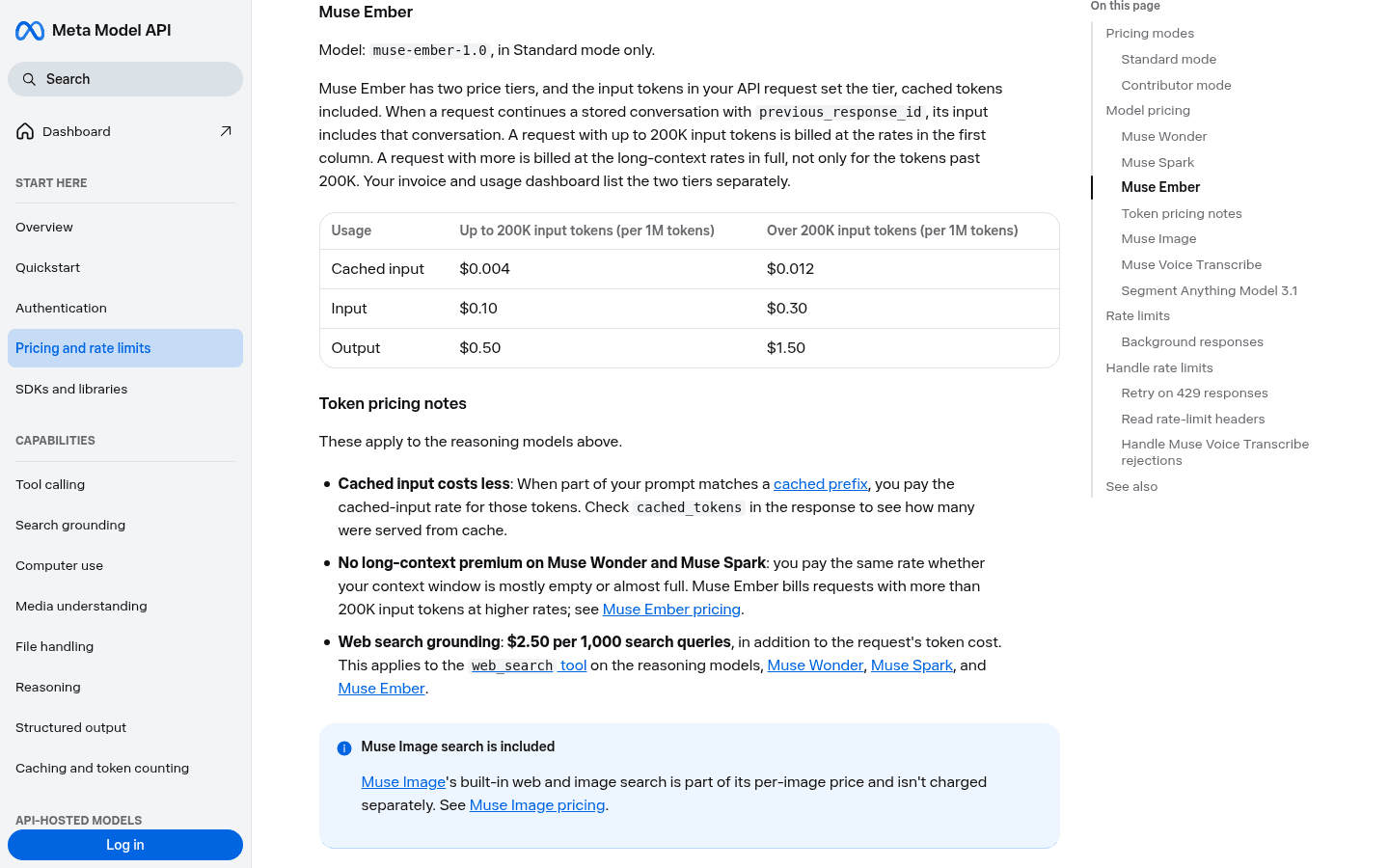
| Price (up to 200K input) | $0.10 in / $0.004 cached / $0.50 out per 1M |
| Price (over 200K input) | $0.30 in / $0.012 cached / $1.50 out per 1M |
| Rate limits | 3,000 RPM, 4M TPM |
| Where | Meta Model API, Muse Code, Google Cloud, Oracle Cloud |
| Contributor mode on API | Not available |
| Open weights | No |
Two lines matter more than they look. First, the default effort is max. Haiku 5.5 defaults to medium. If you swap model IDs and leave effort unset, Ember will think as hard as it can on every call, which is what Meta benchmarked but not always what a tagging job needs. Second, the 512K output ceiling is four times Haiku's 128K, which matters if you run it over large document sets.
The Messages endpoint is the quiet win. Ember accepts Anthropic-style requests, so teams already on Claude Code subagents can test it without rewriting their harness.
How does Muse Ember perform on benchmarks?
Meta compared Ember against Haiku 5.5 and GPT-6 Luna, all at max effort. Here's the full table from the launch post:
| Benchmark | Muse Ember | Claude Haiku 5.5 | GPT-6 Luna |
|---|---|---|---|
| AutomationBench-AA (business workflows) | 37.8% | 13.9% | 20.2% |
| Agents' Last Exam (Meta internal) | 61.6% | 57.0% | 57.1% |
| Personal Superintelligence Index (Meta internal) | 46.8% | 36.1% | 37.0% |
| Terminal-Bench 4.0 | 40.9% | 39.2% | 16.4% |
| Coding Agent Index-AA | 46 | 37 | 31 |
| FrontierCode 2.0-AA (mergeable code) | 27.2% | 34.9% | 25.2% |
| GDP.pdf-AA (long documents) | 22.8% | 20.8% | 22.8% |
| OSWorld 2.1 (computer use, binary) | 33.8% | 27.8% | 17.0% |
| PerceptionBench (with tools) | 80.6% | 78.6% | 62.8% |
| Artificial Analysis Intelligence Index | 36 | 36 | 28 |
Ember leads or ties on nine of ten rows. The standout is AutomationBench, where it nearly triples Haiku on end-to-end business workflows. That is the closest benchmark to "pull a record, call a tool, update another system", which is most of what a support agent does between messages.
Three things to read into that table before you trust it:
- Four rows are Meta's own tests. Agents' Last Exam, the Personal Superintelligence Index, OSWorld 2.1 and PerceptionBench are Meta internal evaluations. The Artificial Analysis rows are the independent ones.
- The harnesses differ. Meta's footnote says Terminal-Bench 4.0 used each model's best published harness: mini-swe-agent for Ember, Claude Code for Haiku, Codex for Luna. One Hacker News reader spotted it straight away.
- The one clean coding loss matters. FrontierCode 2.0 judges whether real engineering changes are mergeable, and Haiku wins it by almost eight points. Meta's own docs agree: "for hard single-shot coding problems, knowledge-heavy questions, or visual coding, use Muse Spark or Muse Wonder."
The headline index score tells the honest story. Ember and Haiku tie at 36. Ember isn't a smarter model than Haiku 5.5. It's an equally capable one that gets there with fewer, cheaper tokens.
Is Muse Ember actually cheaper than Haiku 5.5?
Per token, no. Per task, by about three times. This is the most interesting part of the release, and the part most launch coverage glosses over.
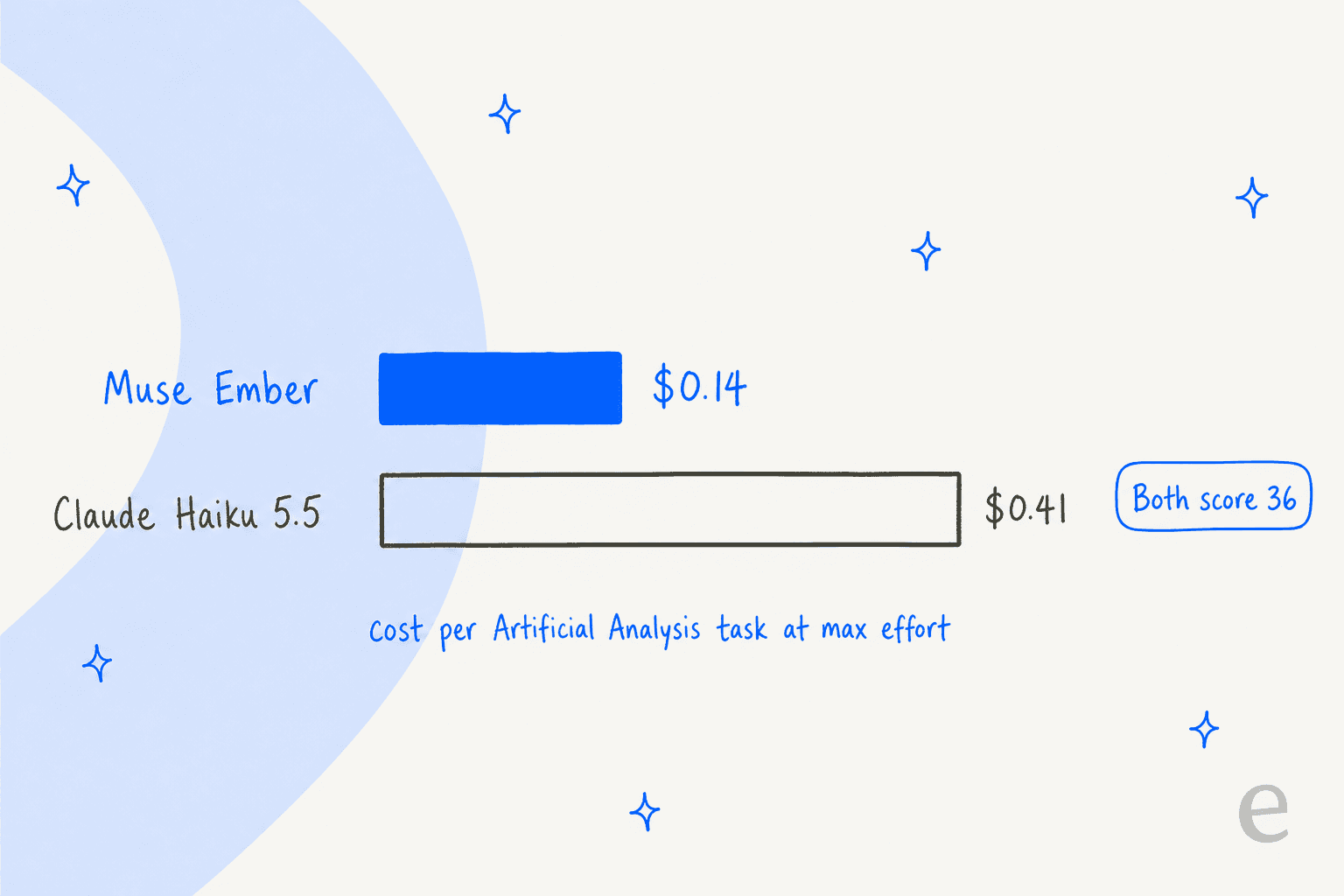
Here are Artificial Analysis' cost-per-task figures from Meta's launch chart, at each effort level:
| Model and effort | AA Index score | Cost per task |
|---|---|---|
| Muse Ember, xhigh | 33.9 | $0.116 |
| Muse Ember, max | 35.8 | $0.136 |
| Claude Haiku 5.5, medium | 24.6 | $0.092 |
| Claude Haiku 5.5, high | 29.6 | $0.159 |
| Claude Haiku 5.5, xhigh | 34.3 | $0.248 |
| Claude Haiku 5.5, max | 36.2 | $0.411 |
| GPT-6 Luna, max | 27.8 | $0.152 |
Same sticker price, so where does the gap come from? Three places:
- Fewer tokens per task. At equal per-token prices, a third of the cost means roughly a third of the billed tokens. You.com, one of Meta's launch partners, reported Ember used "36–48% fewer output tokens" than leading open-weight models on its coding tests.
- Cheaper cache reads. Ember charges
$0.004per million cached tokens, 4% of its input price. Haiku 5.5 charges$0.01, which is 10%. - A later price cliff. Ember's base rate holds up to
200Kinput tokens. Haiku's holds to100K.
"Notable cache cost of 4% input, compared to Luna/Haiku's 10% of input."

One fair caveat: Meta's chart notes that Ember's costs were estimated "at proposed pricing," with a later footnote saying list pricing. The list price matches what was proposed, so the numbers should hold, but these are still Meta-published figures until you measure your own traffic.
Where's the catch in Muse Ember pricing?
There are two, and both are on the rate card if you read it closely.
The 200K cliff reprices the whole request. Over 200K input tokens, Meta bills "the long-context rates in full, not only for the tokens past 200K." Cached tokens count toward the line, and so does any stored conversation you continue with previous_response_id. A long agent loop that slowly grows past 200K jumps from $0.10 to $0.30 input and from $0.50 to $1.50 output on every call after that point.
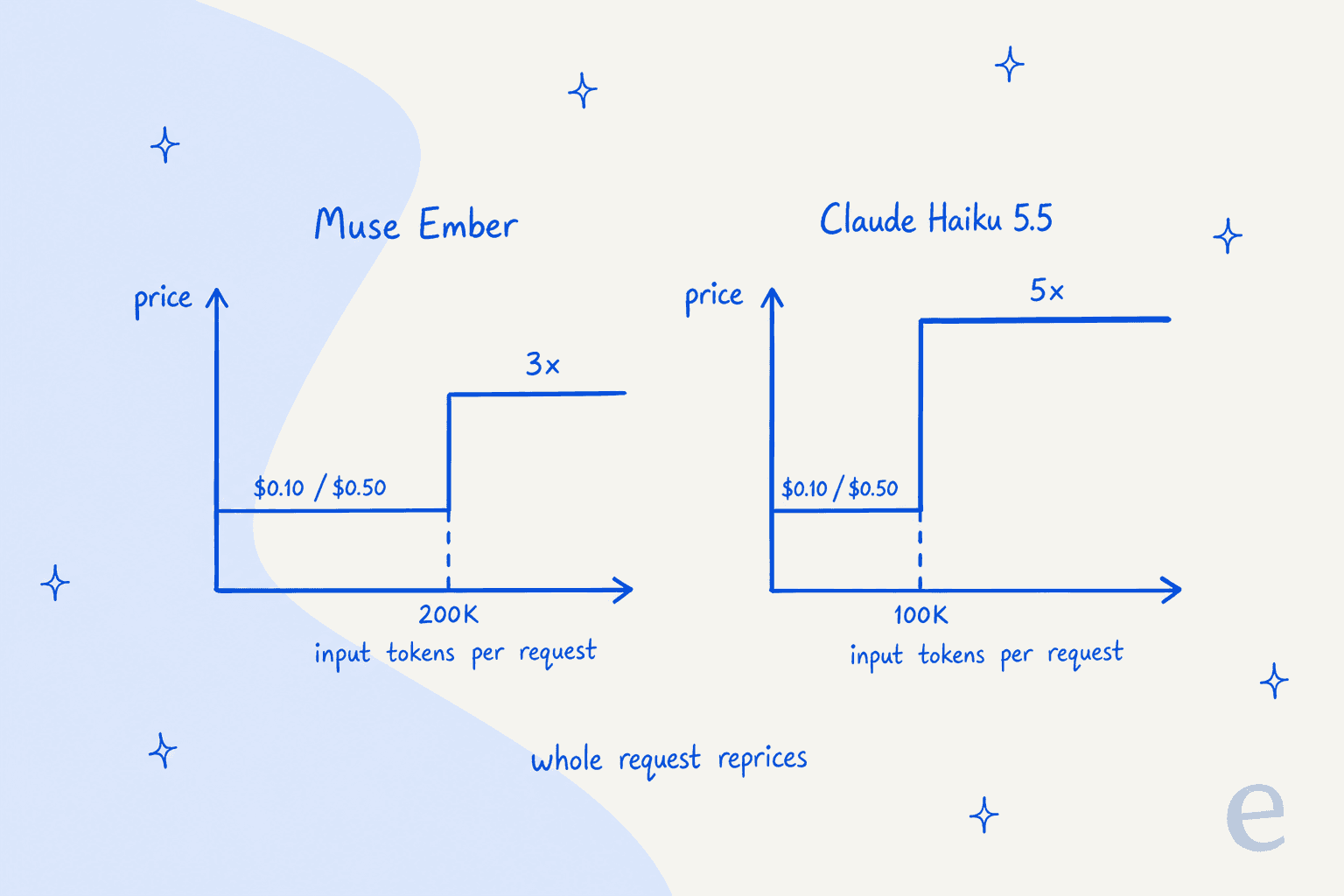
Haiku 5.5 has the same kind of cliff, just earlier and steeper: 5x on every line once a prompt crosses 100K, as I covered in the Haiku 5.5 pricing breakdown. So Ember's cliff is the gentler of the two. But Meta's bigger models, Wonder and Spark, have no long-context premium at all, so it's a real change if you're moving work down from Spark.
There's no batch discount on the rate card. Anthropic's Batch API halves Haiku 5.5 to $0.05 / $0.25. Meta's pricing page lists no batch tier for Ember, only background responses with a submission cap. For overnight jobs that can wait, like re-tagging a year of tickets, that narrows the gap a lot.
"Batch pricing is two times cheaper with Haiku. Benchmarks are nearly tied."
There's also no Contributor mode for Ember on the API, so no data-for-discount route like Muse Spark has. That's a fair trade for most businesses: your content isn't used for training at standard prices.
To see where the cliffs land on your own volume, plug in your numbers:
What does Muse Ember look like for support work?
This is where I can speak from the queue rather than the spec sheet. In a support agent, most model calls aren't the reply. They're the small, structured steps around it: what is this ticket about, which product, is it urgent, who should get it, what fields can I pull out. Those are the jobs Meta's docs list for Ember, down to the sample request in its quickstart, which classifies a ticket as "billing, bug, or feature request."
Two eesel customers show what that step looks like at real volume:
- Dokument 24, a Danish online legal documents company, gets every new Zendesk ticket prepared before a person opens it. In one month that was
680tickets,670Danish draft replies left as internal notes, and430tickets tagged by product. - Rúngne, a climbing apparel brand on Gorgias, had
2,100tickets handled in a month, with880tagged from a fixed list of topic, VIP and B2B tags, "nothing invented."
That "nothing invented" part is the real requirement. A small model that tags fast but makes up a new tag one time in fifty creates more cleanup than it saves. Cheap models live or die on structured output and a fixed label list, and Ember supports both. I'd still run it against a few hundred historical tickets before trusting it, the same way we test every support agent before it goes live.
For teams setting up ticket classification or intelligent routing themselves, the setup Meta recommends maps cleanly onto a helpdesk:
- Ember on the front step. Tag, route, extract order numbers, summarize long threads for the human.
- A bigger model on the reply. Spark or Wonder (or Sonnet, or Opus) writes answers to anything that isn't routine.
- A human on the edge cases. Your handoff rules decide when the agent stops.
I've written up how this looks on specific stacks in my notes on Muse for Zendesk and Muse for ticket triage, and the broader best AI model for support tickets comparison shows where the small models sit against the big ones.
What are people saying about Muse Ember?
The Hacker News launch thread reached 228 points in its first day. Reactions split three ways: people who run small models for side tasks and like the price, people who wanted batch or open weights, and people stress-testing the effort dial.
"I use haiku and luna for support on most my SWE tasks since they are cheap and fast. I find them enough for most things if you are patient, and the fact an even cheaper model for comparable intelligence is out there now is great news!"
Simon Willison ran his usual pelican-on-a-bicycle test at all six effort levels and noticed something unusual: the drawing didn't get clearly better with more reasoning.
"There's usually a reasonably strong correlation between thinking level and visual quality of the pelican. This is the first time I've seen that correlation appear to break - more reasoning tokens doesn't seem to produce an obviously better SVG."
That's one drawing, not a benchmark. But paired with Ember's max default, it's a good nudge to test lower effort settings on your own tasks. If low or medium does the job, you pay for far fewer thinking tokens.
The skeptics had fair points too. Several commenters pointed out there are no weights to download, and one summed up the batch problem in four words: "No batch. Pass."
Pros and cons
Pros
- Ties Claude Haiku 5.5 on the Artificial Analysis index (
36) at about a third of the cost per task - Leads or ties on 9 of 10 rows in Meta's comparison, with a big lead on business-workflow automation
- Cache reads at
$0.004per million, 4% of input - Base price holds to
200Kinput tokens, twice Haiku's threshold, and the jump is3xrather than5x 1Mcontext,512Koutput, five input types, and Anthropic-compatible Messages endpoint
Cons
- Trails Haiku 5.5 on FrontierCode 2.0 (
27.2%vs34.9%), and Meta itself steers hard coding to bigger models - No batch discount on the rate card, so Haiku batch can be cheaper for jobs that can wait
- Over
200Kinput tokens, the whole request reprices at3x, cached tokens included - Defaults to
maxeffort, so a straight model swap can burn more thinking tokens than you need - No open weights and no Contributor-mode discount; several benchmark rows are Meta-internal
Who should use Meta Muse Ember?
Use Ember if you run lots of small, repeated model calls in real time: tagging, routing, extraction, summaries, and the sub-agent half of a coding agent. At the same per-token price as Haiku 5.5 and a third of the per-task cost in Artificial Analysis' runs, it's the default I'd test first for that slot. Pair it with Muse Wonder or Spark for planning, as Meta suggests.
Stay on Haiku 5.5 if most of your volume can go through the Batch API, if you need its stronger FrontierCode result, or if you're already deep in Anthropic's stack. The Haiku 5.5 alternatives post covers the other cheap options, including DeepSeek V4 Flash and Gemini 3.8 Flash.
Look elsewhere if you need open weights you can host yourself. Inkling 2 Small and Meta's own Muse Spark Open are the closer fits.
And if you're a support lead, the model choice is the smaller decision. Ember can tag a ticket for a fraction of a cent, but somebody still has to connect it to your helpdesk, give it the right label list, decide what happens after the tag, and prove it's right before customers see the result. That's the gap between a model and an AI helpdesk agent.
Hire eesel for the triage step instead of wiring it yourself
Muse Ember is infrastructure; eesel is the employee. eesel is an AI teammate platform where you hire ready-to-work teammates for specific jobs, and for support that's the AI helpdesk teammate. It joins your existing queue in Zendesk, Freshdesk or Gorgias, learns from your past tickets and help center, and does the exact jobs Ember was built for: tagging from your fixed list, routing, and drafting replies for your team to send.
SE Ranking runs three products through one Zendesk support team, with a separate eesel agent per product, and handled 4,650 conversations in a month that way. Before any of that goes live, you can simulate the agent on your historical tickets and see what it would have tagged and said. I've watched a confident bot make a wrong call on a live queue, which is why that test run exists. Plans start at $299 a month for 500 credits, per the eesel pricing page.
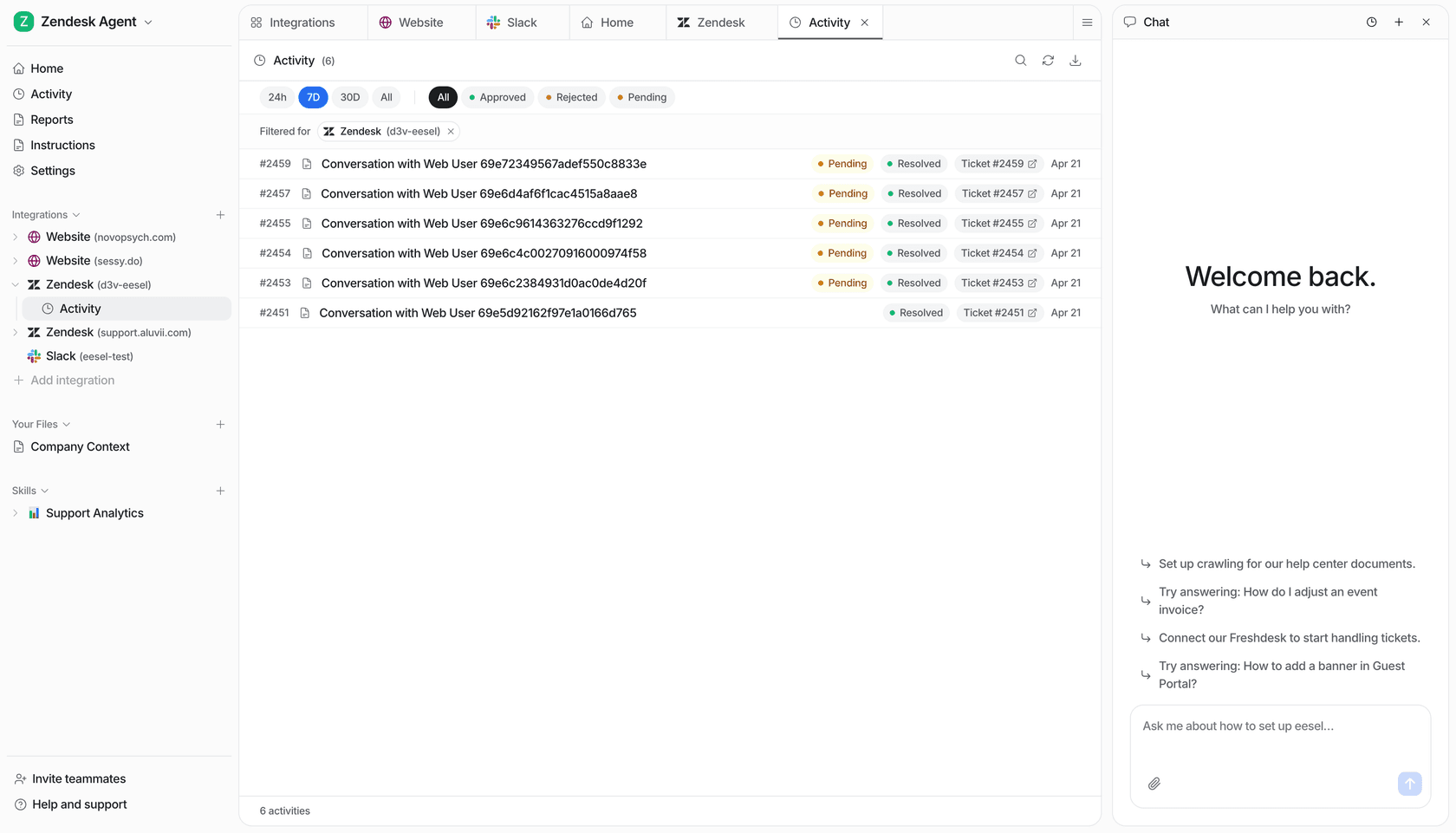
If you were pricing out Muse Ember to tag and route your own tickets, you can skip the harness work. Try eesel free and watch it tag your real tickets first.