

MAI Code 2 is Microsoft's new coding model inside GitHub Copilot, priced at $0.50/$2.50 per million tokens until May 17, 2027. Microsoft's own tests give it 98% of GPT-6.1 Sol's score at 40% of the cost per task, but that cost uses the promo price. At the $1/$5 list price, the same tasks cost about 81% of what Sol charges.
So it's a good default for routine, multi-file Copilot work today. Keep a bigger model for long, hard repo tasks, where it trails Claude Opus 5.5 by 14 points on SWE Atlas.
What is MAI Code 2?
MAI Code 2 is a coding model that Microsoft AI trained from scratch and launched at Ignite on November 17, 2026. The launch post pitches it for "everyday enterprise coding tasks" and says it "excels in taking code to production, deep debugging, multi-file implementation, repo wide reasoning, and UI." A smaller sibling, MAI Code 2 Flash, shipped the same day for routine, high-volume edits.
It's the second generation of Microsoft's in-house coding line. MAI-Code-1-Flash arrived in GitHub Copilot in June, and MAI Code 1.1 Flash followed in August. The jump this time is size and range. Per the model card, both new models get a 1,050,000-token context window (922,000 in, 128,000 out) and five reasoning effort levels, from low to max.
I'm an engineer on eesel's product, and most of my day is integrations and API work, so I live in an editor with an AI model in the side panel. I also work on eesel's AI agents that run on live support queues, and with the eesel CLI, a coding agent in that same editor can upload approved help articles to an eesel agent, tweak its instructions, and run test questions before anything goes live. So when a new coding model lands, the question I care about is simple: what does a normal task cost, and where does it break?
What's the difference between MAI Code 2 and MAI Code 2 Flash?
The two models split the work by difficulty. Microsoft's GitHub changelog describes MAI Code 2 as a general-purpose model "ideal for complex tasks like deep debugging, multi-file implementation, refactoring, and repository-wide reasoning." Flash is "a lightweight, cost-efficient coding model optimized for everyday development workflows."
| MAI Code 2 | MAI Code 2 Flash | |
|---|---|---|
| Built for | Multi-file changes, deep debugging, repo-wide reasoning | Quick edits, code explanations, routine fixes |
| Active parameters | 77 billion (about 2.8 trillion total) | 12 billion (about 398 billion total) |
| Context window | 1,050,000 tokens | 1,050,000 tokens |
| Promo price per 1M tokens (in / out) | $0.50 / $2.50 | $0.05 / $0.25 |
| Copilot plans | Pro, Pro+, Max, Business, Enterprise | Same, plus Free and Student |
| Microsoft Foundry | Not yet | Limited-access preview |
| Microsoft's comparison | GPT-6.1 Sol, Claude Opus 5.5 | GPT-6 Luna, Claude Haiku 5.5 |
Parameter counts come from section 1 of the model card. The card's own summary table says "80B active" for MAI Code 2, so treat the exact number as approximate. Either way, both are sparse mixture-of-experts models, which means only a slice of the network runs for each token. That design helps keep the price down.
One detail I didn't expect: Flash beats its big sibling on one benchmark. On SWE Atlas, Flash scores 44.8% against 43.1% for MAI Code 2, per the launch post. It's a small gap, but it says the bigger model's edge isn't uniform.
How much does MAI Code 2 cost?
In GitHub Copilot, MAI Code 2 costs $0.50 per million input tokens and $2.50 per million output tokens until May 17, 2027. After that, the price doubles to $1.00 and $5.00, per GitHub's pricing docs. Copilot bills these in AI credits, where one credit is one cent.
| Model | Input (per 1M) | Cached input (per 1M) | Output (per 1M) |
|---|---|---|---|
| MAI Code 2, promo until May 17, 2027 | $0.50 | $0.025 | $2.50 |
| MAI Code 2, from May 17, 2027 | $1.00 | $0.05 | $5.00 |
| MAI Code 2 Flash, promo | $0.05 | $0.005 | $0.25 |
| MAI Code 2 Flash, from May 17, 2027 | $0.10 | $0.01 | $0.50 |
| GPT-6.1 Sol (up to 272K) | $2.00 | $0.10 | $10.00 |
| GPT-6.2 Sol (up to 272K) | $2.00 | $0.10 | $10.00 |
| Claude Opus 5.5 | $4.00 | $0.20 | $20.00 |
| GPT-6 Luna (up to 272K) | $0.10 | $0.01 | $0.50 |
| Claude Haiku 5.5 (up to 100K) | $0.10 | $0.01 | $0.50 |
All rows come from the same GitHub page. If you're on an annual Copilot Pro or Pro+ plan still on the old request billing, the legacy multipliers are 1x for MAI Code 2 and 0.33x for Flash. The full plan line-up is in the GitHub Copilot pricing guide.
What does a coding task actually cost?
Per-token prices are only half the bill. The other half is how many tokens a model burns to finish a task, and Microsoft published that too. At max reasoning effort, averaged over four benchmarks, the launch post lists these costs per task:
| Model | Average pass rate | Cost per task (Microsoft) | Cost per task at list price (my maths) |
|---|---|---|---|
| MAI Code 2 | 63.2% | $0.309 (promo price) | $0.618 |
| GPT-6.1 Sol | 64.1% | $0.761 | $0.761 |
| Claude Opus 5.5 | 65.3% | $6.306 | $6.306 |
| MAI Code 2 Flash | 61.0% | $0.052 (promo price) | $0.104 |
| GPT-6 Luna | 55.1% | $0.080 | $0.080 |
| Claude Haiku 5.5 | 53.9% | $0.319 | $0.319 |
The Flash rows average three benchmarks, not four, since Microsoft's small-model table leaves out FrontierCode. My list-price column doubles Microsoft's figure, because every MAI rate doubles on May 17, 2027 and the token count per task doesn't change.
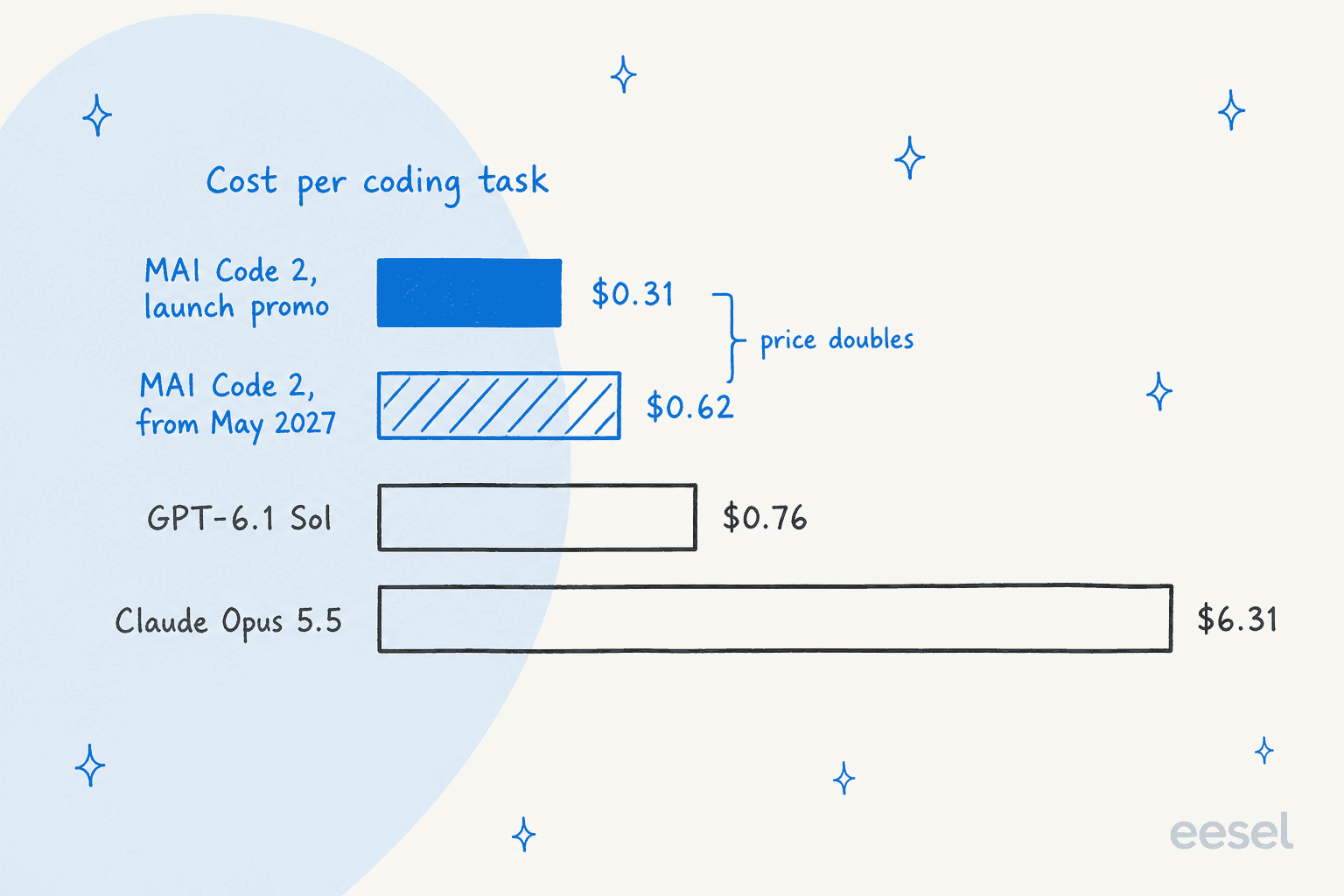
This is the part most launch coverage skips. MAI Code 2's per-token rate is a quarter of GPT-6.1 Sol's during the promo, but its cost per task is 40% of Sol's. That gap means MAI Code 2 used roughly 1.6 times as many tokens per task as Sol in Microsoft's own runs. Once the promo ends, that token appetite eats most of the discount, and the "40% of the cost" headline becomes about 81%.
Flash has the same catch, and it flips the result. At list price, Flash costs $0.104 per task against $0.080 for GPT-6 Luna, so it gets more expensive than Luna per task, though it still scores six points higher. Against Opus 5.5, MAI Code 2 stays far cheaper either way: about a tenth of the cost per task at list.
One commenter on Hacker News asked the obvious question about the promo:
"The promotional period lasts until May 2027. Why not just make the price lower if they'll be irrelevant by the time the "real" price kicks in?"

It's a fair point. Six months is a long time in this market, and the model you compare against in May 2027 probably won't be GPT-6.1 Sol.
Do the MAI Code 2 benchmarks hold up?
Mostly, with three caveats worth knowing before you trust the 98% headline. Here's Microsoft's full table, all at max reasoning effort, from the launch post:
| Benchmark | MAI Code 2 | GPT-6.1 Sol | Claude Opus 5.5 | Who ran it |
|---|---|---|---|---|
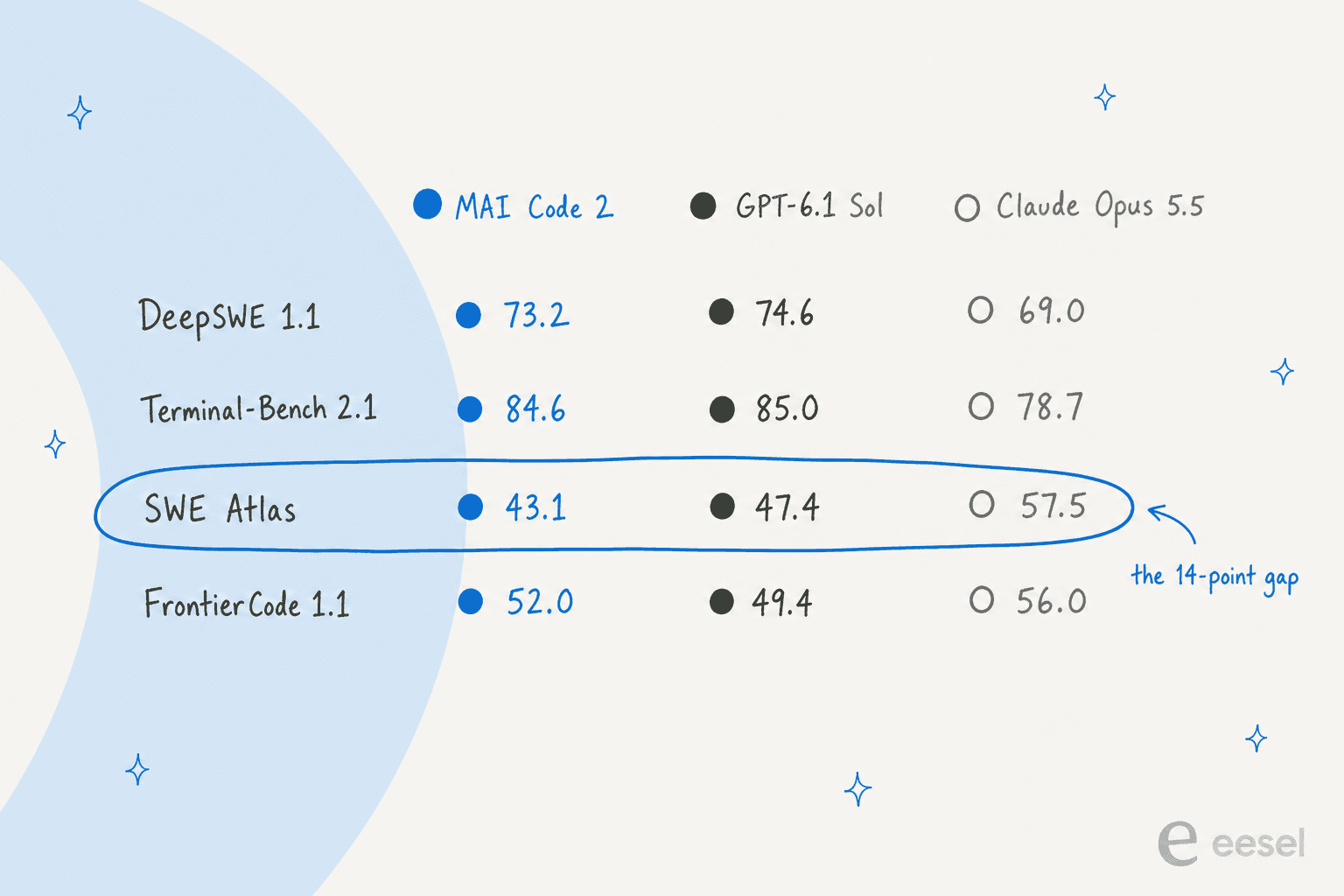
| DeepSWE 1.1 | 73.2% | 74.6% | 69.0% | Microsoft |
| Terminal-Bench 2.1 | 84.6% | 85.0% | 78.7% | Microsoft |
| SWE Atlas | 43.1% | 47.4% | 57.5% | Microsoft |
| FrontierCode v1.1 | 52.0% | 49.4% | 56.0% | Artificial Analysis |
| Average | 63.2% | 64.1% | 65.3% |
Caveat 1: Microsoft ran three of the four tests itself. DeepSWE, Terminal-Bench and SWE Atlas ran on MSBench, Microsoft's internal evaluation platform, using the Copilot CLI without subagents. Only FrontierCode came from an outside party. That doesn't make the numbers wrong, but nobody independent has rerun them yet. When I checked on November 18, Artificial Analysis didn't have a model page for MAI Code 2.
Caveat 2: the average hides a real gap. MAI Code 2 beats Opus 5.5 on DeepSWE and Terminal-Bench. On SWE Atlas, it scores 43.1% against 57.5% for Opus, a 14.4-point gap. If your work looks like long, sprawling repo changes, that row matters more than the average.
Caveat 3: the comparisons are a little dated. Microsoft compared against GPT-6.1 Sol on the same day OpenAI shipped GPT-6.2 Sol. The GPT-6.2 Sol guide covers that release. Hacker News noticed:
"They are comparing to Sol 6.1's API prices. With Sol 6.2, and especially if you consider subsidization from Codex subscriptions, it's probably no longer on the Pareto frontier."
Others pointed at the benchmark versions. One commenter noted that Terminal-Bench is "currently at 4 (which is substantially harder)" and FrontierCode "at 2.0," while Microsoft reported 2.1 and 1.1. All three models were scored on the same versions, so the ranking holds, but the absolute numbers will look lower on the newer tests.
There's one result I'd take at face value: on frontend work, blind reviewers preferred MAI Code 2's output over GPT-6 Sol's 64% of the time, across 258 annotators. UI quality is hard to fake with a benchmark choice, and it's the kind of everyday task Microsoft says it built for.
How do you get access to MAI Code 2?
Right now, through GitHub Copilot and nowhere else. Both models are generally available, not in preview, per the GitHub changelog.
- Plans: MAI Code 2 is on Copilot Pro, Pro+, Max, Business and Enterprise. Flash adds Free and Student, but those plans only reach it through automatic model selection.
- Where: the model picker in VS Code, Visual Studio, JetBrains, Xcode, Eclipse, the Copilot CLI, the cloud agent, the Copilot app, github.com and GitHub Mobile.
- Admins: on Business and Enterprise, new models are switched on by default unless an admin has turned off the global default. That's a change from MAI Code 1.1 Flash, which was off by default in August.
- API: only Flash is in Microsoft Foundry, as a limited-access preview with no published price yet. MAI Code 2 itself isn't there.
- Coming soon: Microsoft lists OpenRouter, Vercel, Hermes, Open Code and Kilo, without dates.
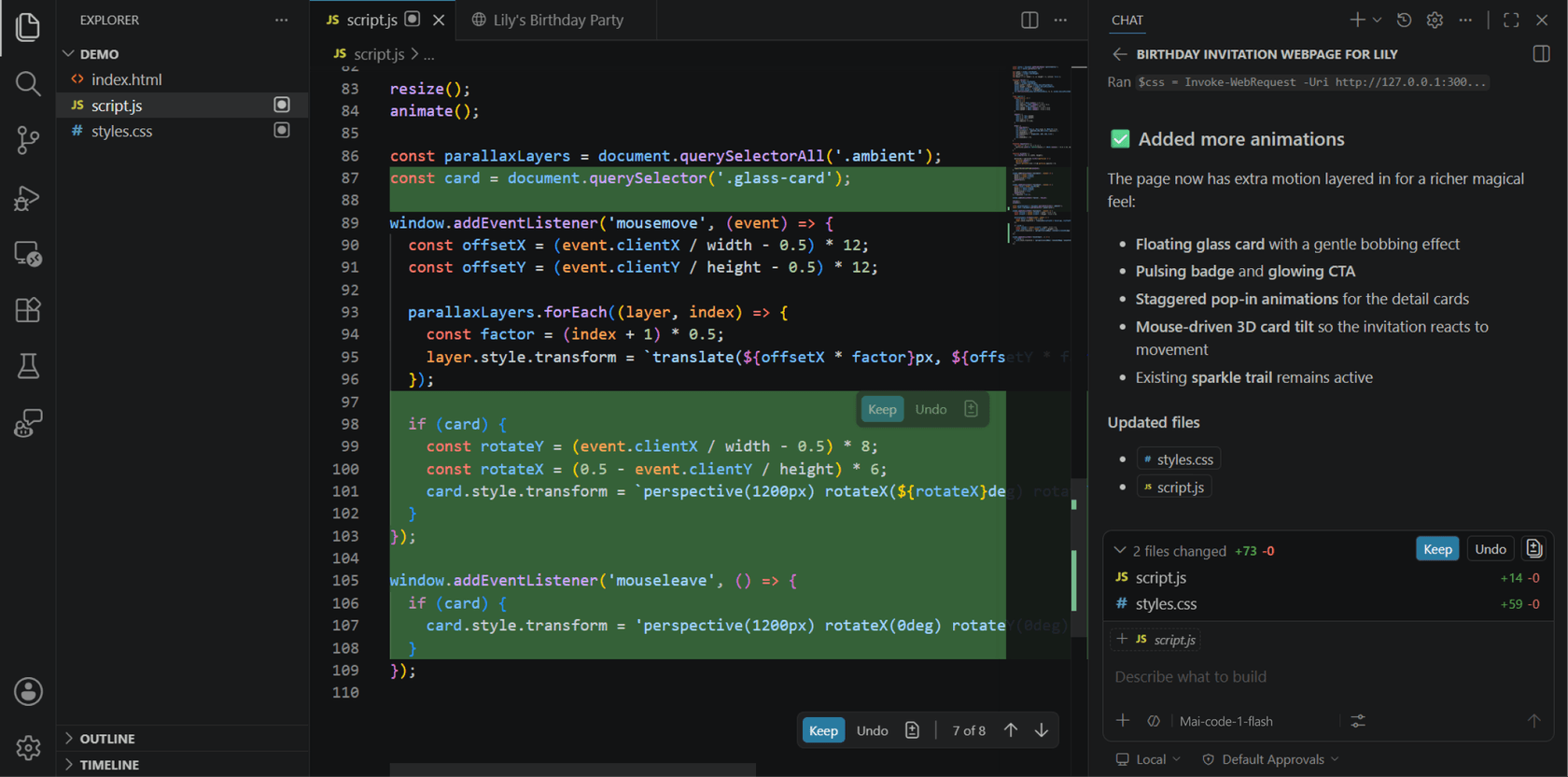
That screenshot is from the earlier MAI-Code-1-Flash launch, but the flow is the same for MAI Code 2: open Copilot chat, pick the model at the bottom, and work as usual. If you're an admin, check your model policy now. A model your team hasn't vetted turning up by default is worth a five-minute look.
The access story is the weak spot for anyone outside Copilot. If you build on raw APIs, or live in Claude Code or OpenAI Codex, you can't plug MAI Code 2 in yet. One Hacker News user put the frustration plainly:
"What annoys me a lot about MSFT releases are, that is not possible to find how to use these models and where to try them. I didn't hear anyone in my circle using MAI models, none."
Is MAI Code 2 open source?
No. The model card says "model weights are not distributed, and the models are served on Microsoft Azure GPU infrastructure." Some early write-ups called it a small open-weights model under an MIT license. That seems to come from the microsoft/MAI-Code repo, which is MIT-licensed but only holds a README and issue templates for feedback.
For enterprises that want control of the weights, Microsoft announced MAI Licensed Weights the same day. It lets a company run and fine-tune MAI models in its own Azure environment, and it's "coming soon" through Microsoft account teams. The partner quotes on the model page come from this route. AT&T says its custom version of Flash beat GPT-6.1 Sol on standard 5G network analysis "while being 50x cheaper," per the model page. Those are tuned models, though, not the one you'll pick in Copilot.
What are developers saying about MAI Code 2?
The launch thread on Hacker News hit 278 points and 131 comments in a day. Most of the heat was about benchmarks and billing, not the model itself, since almost nobody had real time with it yet.
The most common complaint was the comparison setup:
"While showing MAI Code 2 at a 50% promotional discount, and comparing to Max reasoning effort for Opus 5.5 and 6.1 Sol..."
The second was Copilot's billing. Since GitHub moved to usage-based billing in June, a cheap model only helps if your credits last:
"I think they won't help if they're billed at the announced rate on your Copilot quota. Microsoft would need to do something like Devin does and offer its own models with separate limits."
The interest was real, though, mostly from people already routing routine work to small models:
"Price and performance look good based on benchmarks. Am definitely interested in trying this to see given a lot of my workload of actual coding is handed over to Haiku/Luna right now."
That last one matches my read. The people who gain most are the ones who already treat model choice as a cost lever. If you're picking between Copilot, Cursor and a terminal coding tool, MAI Code 2 is a reason to look at Copilot again, not a reason to switch on its own.
What should you watch out for?
Microsoft is unusually open about the limits, which I appreciate. The launch post says both models are "explicitly not yet tuned for harder problems, like fundamental science research and very long horizon agentic work." The model card adds a few more:
- Long sessions drift. "In long agentic sessions the models can repeat tool calls, under-use the existing code base, drift from instructions or stop before fully verifying their work." If you run long autonomous agents from a coding CLI, check the output.
- English only. "At release the model is optimized for English code production only." Comments and docs in other languages may come out weaker.
- More effort isn't always better. The card says higher reasoning effort "does not always improve results." Start at medium and step up only when a task fails.
- Alignment. Microsoft rates both models "similar in alignment to GPT-5.6 Sol but less aligned than GPT-6." Keep your usual review gates on anything it commits.
- Your prompts may have trained it. Per the data card, post-training used conversation contexts from Copilot Free, Pro and Pro+ users who hadn't opted out. If that matters to you, check your Copilot data settings.
The card also rates both models "High" risk for offensive cyber use and chemical, biological, radiological and nuclear misuse, and says they ship with a classifier that screens for those requests. That's standard for a frontier-adjacent model now, and it won't touch normal coding work.
Should you use MAI Code 2?
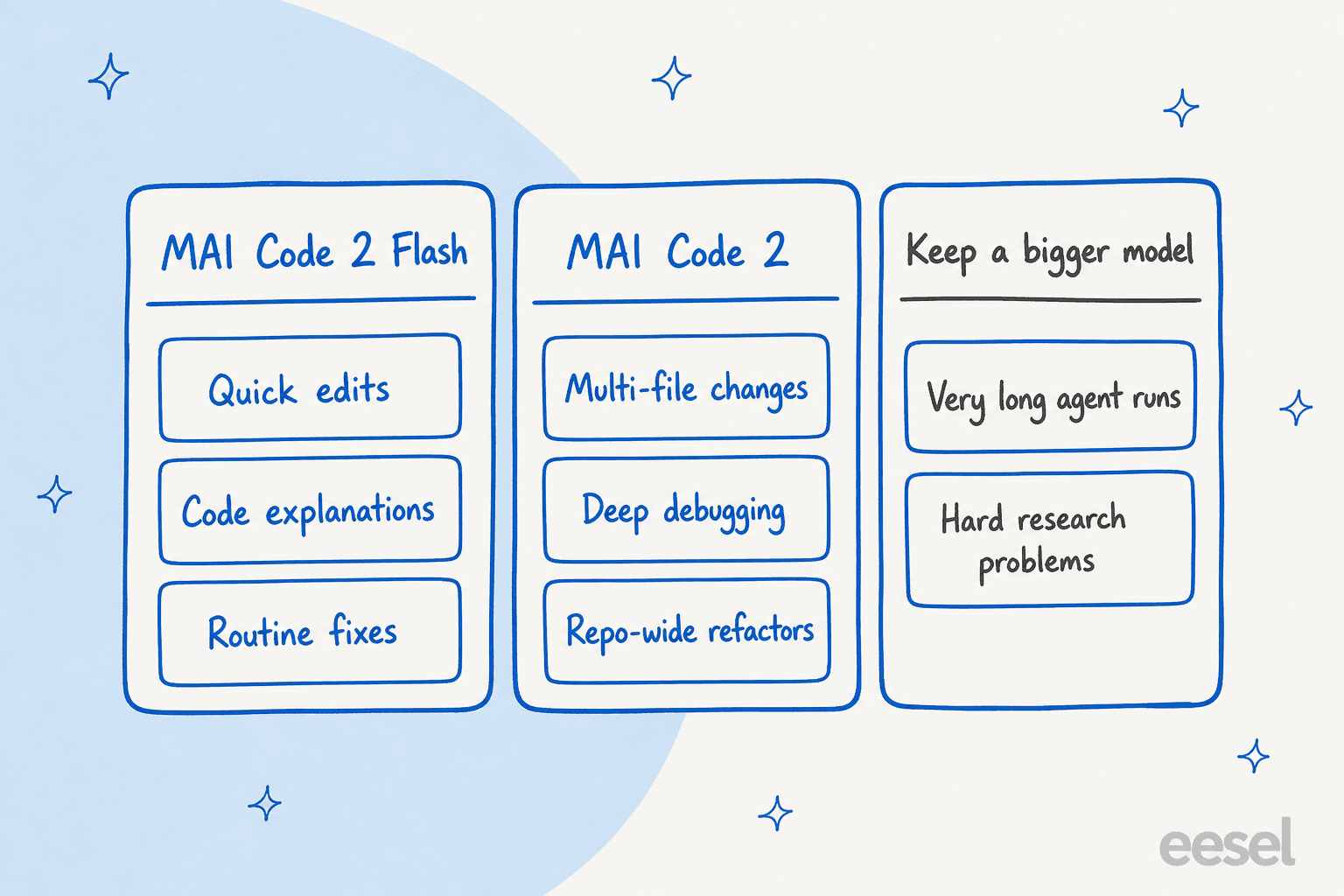
If you're on Copilot and most of your work is scoped changes, yes, at least while the promo runs. Here's how I'd split the work:
| If you use | My take |
|---|---|
| GPT-6.1 Sol or GPT-6.2 Sol in Copilot | Try MAI Code 2 for routine multi-file work. Similar scores at about 40% of the cost per task until May 2027. Re-check after the price doubles. |
| Claude Opus 5.5 | Keep Opus for long, hard repo tasks, where it leads SWE Atlas by 14 points. Move the scoped fixes to MAI Code 2 and save about 95% on them. |
| GPT-6 Luna or Claude Haiku 5.5 | Try Flash. It scored six to seven points higher and costs less per task during the promo. At list, it costs more per task than Luna. |
| Claude Code, Codex, or raw APIs | Wait. MAI Code 2 isn't reachable outside Copilot yet, and Flash is preview-only in Foundry. |
| Long autonomous agents | Stay on a bigger model. Microsoft says it isn't tuned for very long agentic work. |
If you're weighing coding tools more broadly, the best AI coding assistants roundup and the Copilot alternatives guide go wider than one model. Microsoft's other in-house models, like MAI-Transcribe-2 for speech and Decision 1, follow the same playbook: a narrow job at a low price.
What does MAI Code 2 mean for a support team?
A cheaper coding model is cheaper infrastructure. It isn't a support agent. MAI Code 2 doesn't know your refund policy, can't see your helpdesk, and Microsoft tuned it for writing English code, not for answering customers. If you're building support automation, the model is one piece of the job. The rest is knowledge, tone, guardrails and hand-off rules, which a model comparison for support can't settle on its own.
That's the layer eesel builds. MAI Code 2 is infrastructure; eesel is the employee. You hire an AI helpdesk teammate for your queue, or an AI blog writer for content, and each one arrives with the integrations, company knowledge and limits for its role. Where a coding model does help is building around it: a developer can point Copilot or Claude Code at the eesel CLI to load approved knowledge and test answers, while connecting the helpdesk itself still needs an admin to approve it.
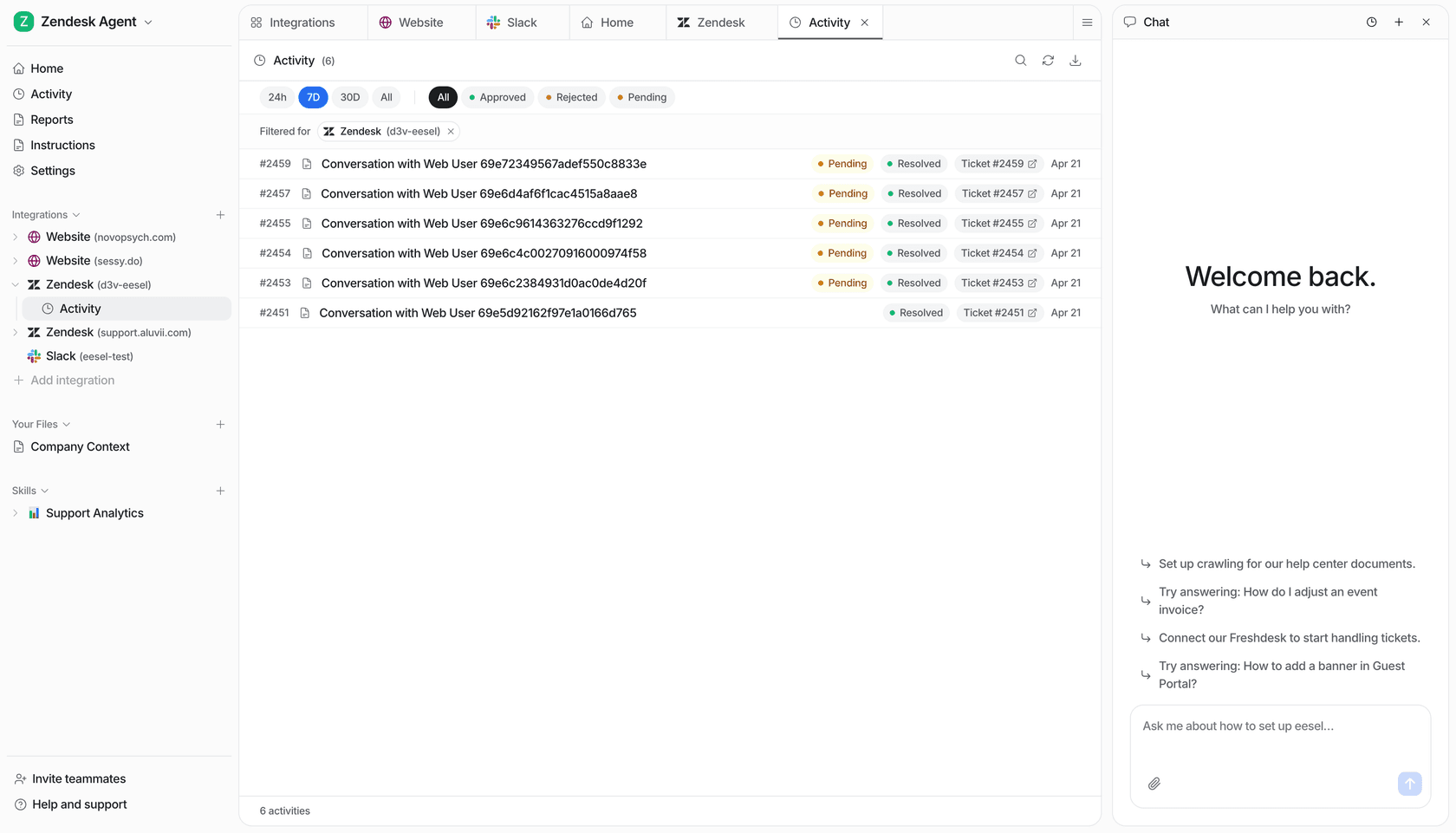
SE Ranking shows what that looks like at scale. The SEO software company runs three products from one support team, so it runs three eesel agents, one per product, on three Zendesk connections. Between August 8 and September 8, 2026, those agents handled 4,650 conversations, answered 2,100 live chats first, and drew on about 16,800 pages of knowledge. None of that depends on which model is hot this week, and that's the point: the model underneath can change without the customer noticing.
If you're comparing tools for that job, the best AI helpdesk software roundup covers the field, and cost per ticket benchmarks put model prices next to the full cost of a ticket.
Try eesel
If MAI Code 2 has you thinking about what cheap models can do for your support queue, start with the part that decides whether it works: the teammate around the model. eesel plugs into the helpdesk you already use, learns from your past tickets and help center, and lets you run it against real historical tickets so you can read its answers before a customer sees one. Plans are fixed credit bundles starting at $299 for 500 credits, so your bill doesn't swing when a model's token price doubles in May.
You can try eesel free on a slice of your queue, or compare it with using ChatGPT directly if you're still deciding whether to build it yourself.