


GPT-6.2 Sol is the best-value model OpenAI sells right now: $2/$10 per million tokens, 57 on Artificial Analysis, level with the old GPT-6 Astra, and about three times faster per task than GPT-6.1 Sol. The criticism is real but narrow: developers say it still overengineers code, and Artificial Analysis measured a 3-point coding drop.
In my 77 test runs it never invented a company fact. Its habit is adding things the data never contained, like FedEx tracking links and day counts. That's harmless in a draft and risky in a customer reply. For support, a grounded AI helpdesk teammate like eesel matters more than the model underneath.
What is GPT-6.2 Sol, and how did I test it?
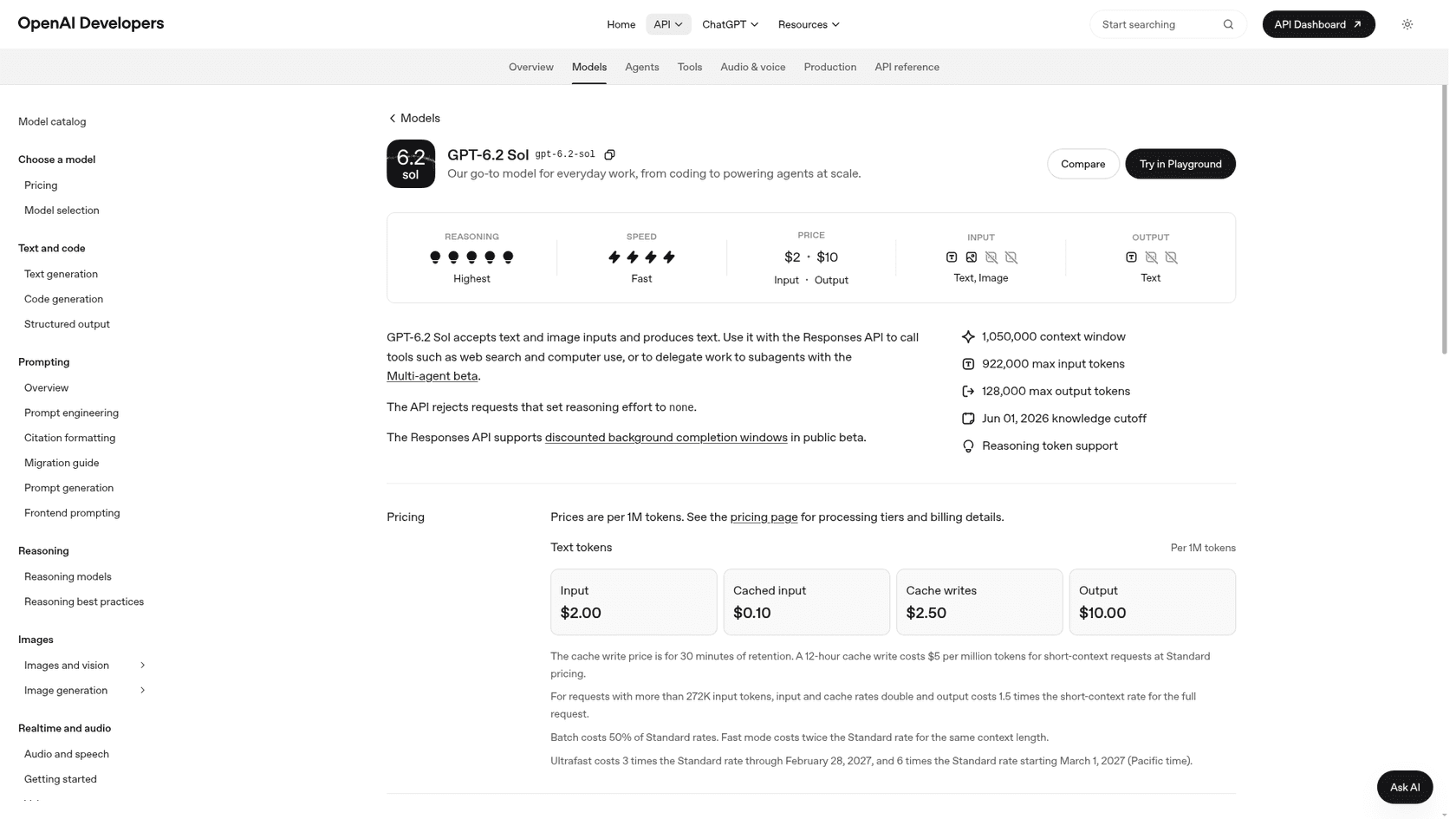
GPT-6.2 Sol is OpenAI's everyday model, released on 17 November 2026 alongside GPT-6.2 Astra. OpenAI's launch post calls it "our efficient, versatile model for everyday work." It replaces GPT-6.1 Sol at the same price, and the GPT-6.2 Sol overview has the full launch details.
I build integrations and API plumbing at eesel, so I read a model review the way I read an API changelog: what does it actually do when my code calls it? The launch charts can't answer that, so I ran 77 GPT-6.2 Sol calls through the Responses API across three small tests this week, all at medium effort unless noted:
- 15 support tickets, at low and medium effort, scored by hand against a refund policy (30 runs). The results are in the GPT-6.2 Sol overview.
- 19 runs on the complaints people raised about Astra: short writing, quiet tool failures, and invented company facts. These ran next to Astra in the GPT-6.2 Astra review.
- 28 new runs for this review, against 28 on GPT-6.1 Sol: six policy questions that each need two or three facts to answer fully, repeated three times, plus two order-tracking tickets repeated five times.
That's a small, hand-read test, not a benchmark. If you want to repeat it on your own setup, the eesel CLI lets a coding agent ask an eesel helpdesk agent the same kind of test questions and check the answers before anything goes live. Every run goes through one fictional SaaS company's policy doc and a canned lookup_order tool built with function calling. It tells you how the model behaves on clean, everyday support work, which is most support work.
What's my verdict on GPT-6.2 Sol?
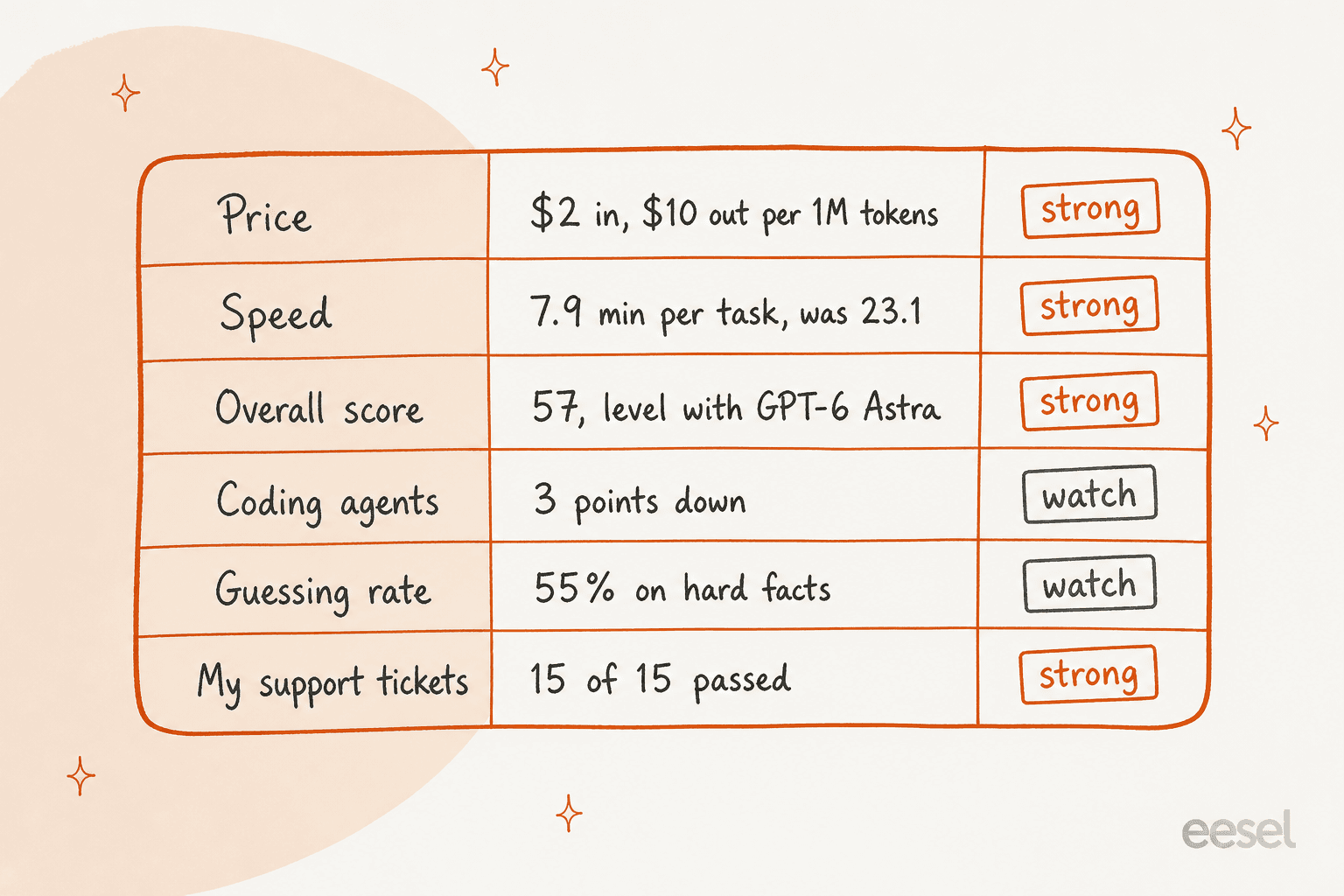
GPT-6.2 Sol is a very good default for routine work at a price nothing in its class matches, with two habits to manage: it overbuilds code, and it adds details around the facts. Here's the scorecard:
| What I checked | GPT-6.2 Sol | Source |
|---|---|---|
| Price per 1M tokens | $2 in, $0.10 cached, $10 out | OpenAI pricing |
| Intelligence Index (max effort) | 57, up from 55 | Artificial Analysis |
| Cost per benchmark task (max) | $1.01, down from $1.27 | Artificial Analysis |
| Time per benchmark task (max) | 7.9 min, down from 23.1 | Artificial Analysis |
| Coding Agent Index | 3 points below GPT-6.1 Sol | Artificial Analysis |
| Hallucination rate (AA-Omniscience) | 55% | Artificial Analysis |
| My 15 support tickets | 15/15 at low and medium | My test |
| Multi-fact policy answers | 18/18 complete | My test |
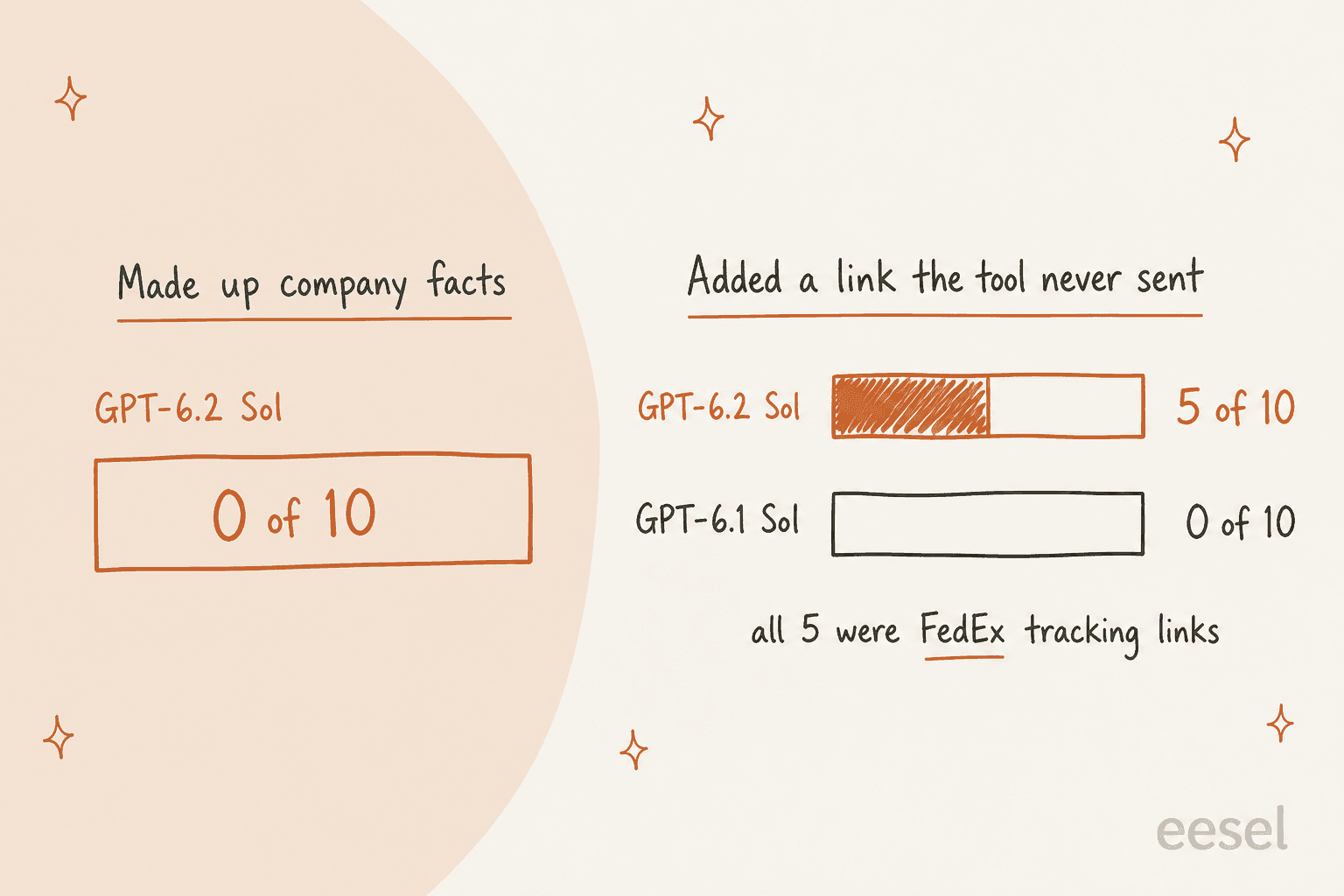
| Invented company facts | 0 of 10 | My test |
| Added links the tool never sent | 7 of 14 order replies | My tests |
The upgrade from 6.1 is easy to recommend. Same price, a slightly higher score, and the max-effort runs that used to take 23 minutes now take 8. If you already pay for GPT-6.1 Sol, there's little reason to stay.
What do people like about GPT-6.2 Sol?
The price-to-score ratio. On the Hacker News launch thread, which passed 600 comments, the people defending the release were mostly defending Sol, and mostly because of cost:
"Whatever you’re doing, it’s unlikely to be what most users are doing. Fable and Astra aren’t in my price range so I’m paying attention to Sol."

The other recurring point is that the top effort levels close most of the gap to the bigger, older model:
"6.2 Sol xhigh and max show the results comparable to Astra 6 max, and Astra 6.2 only shows any improvement on 'max' reasoning effort level."
That matches Artificial Analysis, which has Sol at 57 against 57 for GPT-6 Astra, at roughly 15% of the cost per task. A few developers also described a split I'd copy: a stronger model plans, and Sol does the volume.
"I have hilariously started to just have an opus thread maintain Sol subagents to get the best of both worlds."
What do people complain about?
Overengineering, mostly, and almost all of it in code. The complaint isn't new to this release, which is what makes it sting:
"It's still overengineering especially Sol. This was the biggest complaint by everybody who has been using Sol since GPT 5.6. OpenAI is not listening to us."
On a large codebase, one developer measured the gap to Astra in cleanup work:
"I have a 1.5 MB C++ codebase, and at least a third of the tasks that Sol completed required cleaning up by Astra."
The numbers back the direction, if not the size. Artificial Analysis says Sol "loses 3 points relative to GPT-6.1 Sol" on its Coding Agent Index, driven by a 14-point fall on SWE-Atlas-QnA-AA, where the model is "more likely than its predecessor to omit key facts in its responses." One practical tip from the thread: another developer found the overengineering gets worse as effort goes up, so if your coding agent keeps building scaffolding nobody asked for, try a lower setting before switching models.
Then there's the louder reaction from people with early access. Matt Shumer said on X he found the pair "essentially unusable" and would not review them. Most of the detailed early criticism, about writing that's too terse and coding runs that stop early, was about Astra. I tested those claims in the Astra review, and on Sol the writing was fine: its customer help article ran 168 to 170 words and covered every policy.
Does GPT-6.2 Sol leave facts out?
Not in my tests. Because Artificial Analysis flagged omissions, I wrote six questions that each need two or three policy facts to answer fully. Can an admin restore a deleted workspace? (Yes within 14 days, but only the owner can.) Do removed seats get refunded? (No, they become a credit on the next invoice.)
Both Sols answered all 18 runs completely, after I read each one by hand. The keyword check I scripted first flagged 11 misses on 6.2 and 9 on 6.1, and every single one was a false alarm from wording like "14-day window" or a curly apostrophe. That's a fair warning about automated evals in general: a string-matching grader would have told you 6.2 Sol omits more facts, and it doesn't. Reviewing AI support conversations by hand is still the only check I trust on a small set.
The quiet-failure test went the same way. When one of three order lookups returned an empty {} with no error, Sol flagged that order and escalated it in 5 of 5 runs. OpenAI's system card warns that both new models "were more likely to omit known obstacles when reporting their work," so I'd still keep observability on any agent running it. On short support work, I couldn't make it skip one.
Does GPT-6.2 Sol make things up?
It didn't invent facts. It did add things. That's the most useful thing I learned about this model.
Artificial Analysis puts Sol's hallucination rate at 55%, the share of hard factual questions it answers wrongly instead of saying it doesn't know. In my test, with a policy that covered none of the question, I asked about SOC 2 audits, EU data residency, phone hours, API rate limits, and a HIPAA agreement. Sol invented none of it in 10 runs, with a strict prompt or a loose "be helpful" one. With the loose prompt, it said "I don't have verified information" and offered general advice instead.
The extras showed up around the facts:
- Tracking links. My
lookup_ordertool returns a carrier and a tracking number, no URL. When a customer asked how to follow a FedEx order, GPT-6.2 Sol built afedex.comtracking link in 5 of 5 runs. GPT-6.1 Sol printed the number on its own every time. On the plain "where is my order" UPS ticket, 6.2 mentioned the UPS tracking page without a link. In my earlier ticket test it builtups.comlinks on both order tickets at medium effort, and none at low. Across both tests, that's 7 links in 14 order replies, against none from 6.1. - Arithmetic nobody asked for. On the deleted-workspace question, 6.2 Sol added "about 5 days left" in all three runs. That's right (14 minus 9), and helpful. In my first test it also stated a refund as "10/12 of what you paid" without checking how the policy counts a partial month, which was a guess dressed as a fact.
None of the links I checked were wrong. The trouble is the pattern: a model that builds a carrier URL from a tracking number will, one day, build a returns-portal or payment link from something else. In a customer reply, any link your tools didn't return is an unsourced claim. The fix is a line in the instructions that limits links to ones from tool results or your help center, plus a test that checks for it. AI support agent permissions covers the same idea for actions. For money, see refund guardrails.
Is GPT-6.2 Sol worth the price?
Yes, and it isn't close inside OpenAI's lineup. Here's what my support runs cost at Standard rates:
| Test (medium effort) | GPT-6.2 Sol | GPT-6.1 Sol | GPT-6.2 Astra |
|---|---|---|---|
| 15 support tickets, per 1,000 | $1.42 | $1.35 | $5.79 |
| Policy and tracking questions, per 1,000 | $1.55 | $1.49 | not run |
| Avg. reply length (policy questions) | 44 words | 40 words | not run |
| Avg. reasoning tokens (policy questions) | 4 | 9 | not run |
6.2 Sol costs about 4% to 5% more than 6.1 per ticket on these runs, because its replies run slightly longer. It reasons less on easy questions and writes a little more, and output tokens are where the money goes. Against GPT-6.2 Astra, it's about a quarter of the cost for the same pass rate on routine tickets.
Two things move the bill more than the model choice. Effort comes first: Artificial Analysis counted 14.6 million output tokens at medium against 60.9 million at max, for 53 points against 57. Then the discount routes: Batch halves the price, but there's no Flex tier for this model yet. The GPT-6.2 Sol overview has the full price grid, including the long-prompt surcharge past 272,000 input tokens.
Who should use GPT-6.2 Sol, and who should skip it?
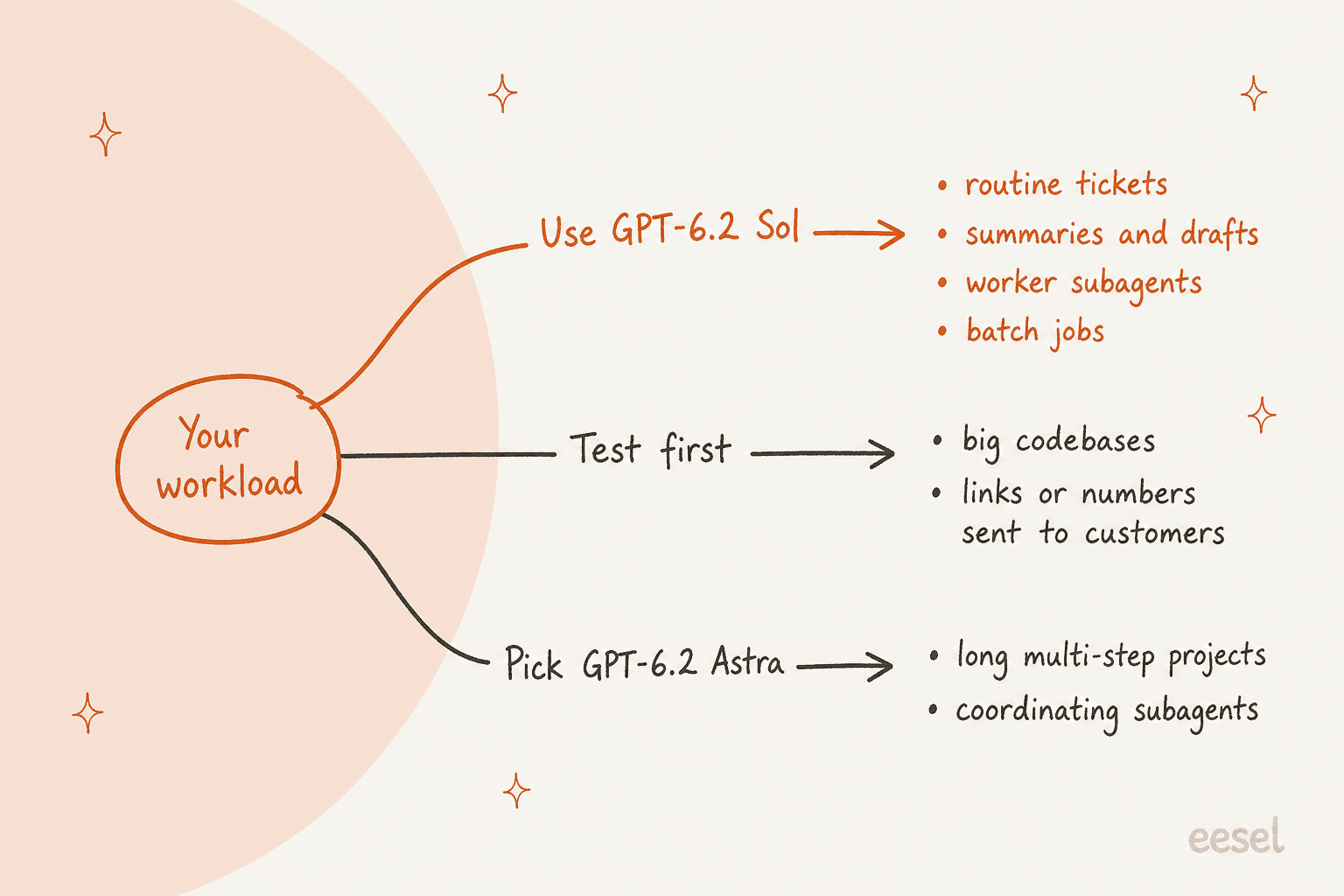
Most teams should make it their default and carve out the exceptions:
| If you are | My take |
|---|---|
| On GPT-6.1 Sol or GPT-6 Sol | Switch. Same price, faster, a little smarter. Rerun your coding evals first. |
| Running a coding agent on a large repo | Test before switching. The coding index dropped and the overengineering complaints are consistent. Keep Codex on Astra for the hard tasks. |
| Running support replies or drafts | Use it, with a rule on links and numbers and a test set from your own tickets. |
| Building an orchestrator and workers | Sol as the worker, a stronger model as the planner. |
| Comparing with Claude Sonnet 5.5 or Claude Opus 5.5 | Run your own tickets through both. Benchmarks won't tell you about tone or policy-following. |
| Price-first and open to other labs | See the GPT-6.1 Sol alternatives roundup and DeepSeek V4 Flash. |
The best LLM for customer support post compares the wider field if Sol isn't the right fit.
What does this mean for a support team?
A cheaper, faster model is better infrastructure, not a better support agent. My test shows the gap clearly: Sol knows not to invent your SOC 2 status, but it will still hand a customer a link your systems never produced. What closes that gap is the layer around the model: what it may look up, what it may say, and what it hands to a person.
STIL Classics, a planner and stationery brand on Gorgias and Shopify, runs eesel with that rule written in. Before drafting, eesel looks up the Shopify order, its fulfilment status, and live inventory, and it never states a ship date, delivery estimate, or product spec it hasn't looked up. If it can't find the order, it flags that for the team instead of telling the customer. In one month it prepared about 320 Gorgias tickets and looked up about 230 Shopify orders, and every draft goes to a person to check and send.
That's what eesel builds: AI teammates you hire for specific jobs, an AI helpdesk teammate for your queue and an AI blog writer for content. The model underneath can change from 6.1 to 6.2 without your rules changing with it. From a terminal, a coding agent like Claude Code or Codex can upload approved macros and help articles through the CLI and tighten the agent's instructions (say, "only share links returned by a lookup"). Connecting the helpdesk itself still needs someone with admin access to approve it.
If you're picking a model for support, test it on your own past tickets before it touches a live one. The model comparison for support tickets puts the numbers in context. The cost per ticket benchmarks show where model spend fits in a full ticket, and the best AI helpdesk software roundup compares the tools that let you run that test.
Try eesel
If GPT-6.2 Sol has you thinking about AI on your queue, the part that decides whether its extras reach a customer is the teammate around it. eesel plugs into your helpdesk, learns from your past tickets and help center, and lets you run it against your historical tickets so you can read its answers, links included, before it goes live. Plans are fixed credit bundles starting at $299 for 500 credits, so the bill doesn't move with token prices or reply length.
You can try eesel free on a slice of your queue, or read how it compares with using ChatGPT directly if you're still weighing a build.