


GPT-6.2 Astra is a very capable model that can be hard to work with. It ranks second on Artificial Analysis at 62, costs $4.00 per benchmark task, and passed every one of my 57 short support tests, writing tighter replies than GPT-6 Astra at less than half the cost.
The loud complaints from testers are real, but they live in long, open-ended runs: odd questions mid-task, summaries nobody can follow, and early stops. If your work is short and scoped, use it (or the cheaper GPT-6.2 Sol). If it runs for hours, test it first. For support queues, a grounded AI helpdesk teammate like eesel keeps that risk away from customers.
What is GPT-6.2 Astra, and how did I test it?
GPT-6.2 Astra is OpenAI's top model, released on 17 November 2026 alongside GPT-6.2 Sol. The launch post pitches it for "your hardest projects," and the model page lists a 1,050,000-token context window, 128,000 max output tokens, and a knowledge cutoff of 18 May 2026. My GPT-6.2 Astra overview covers the launch, pricing grid, and API changes in full. This post is the verdict.
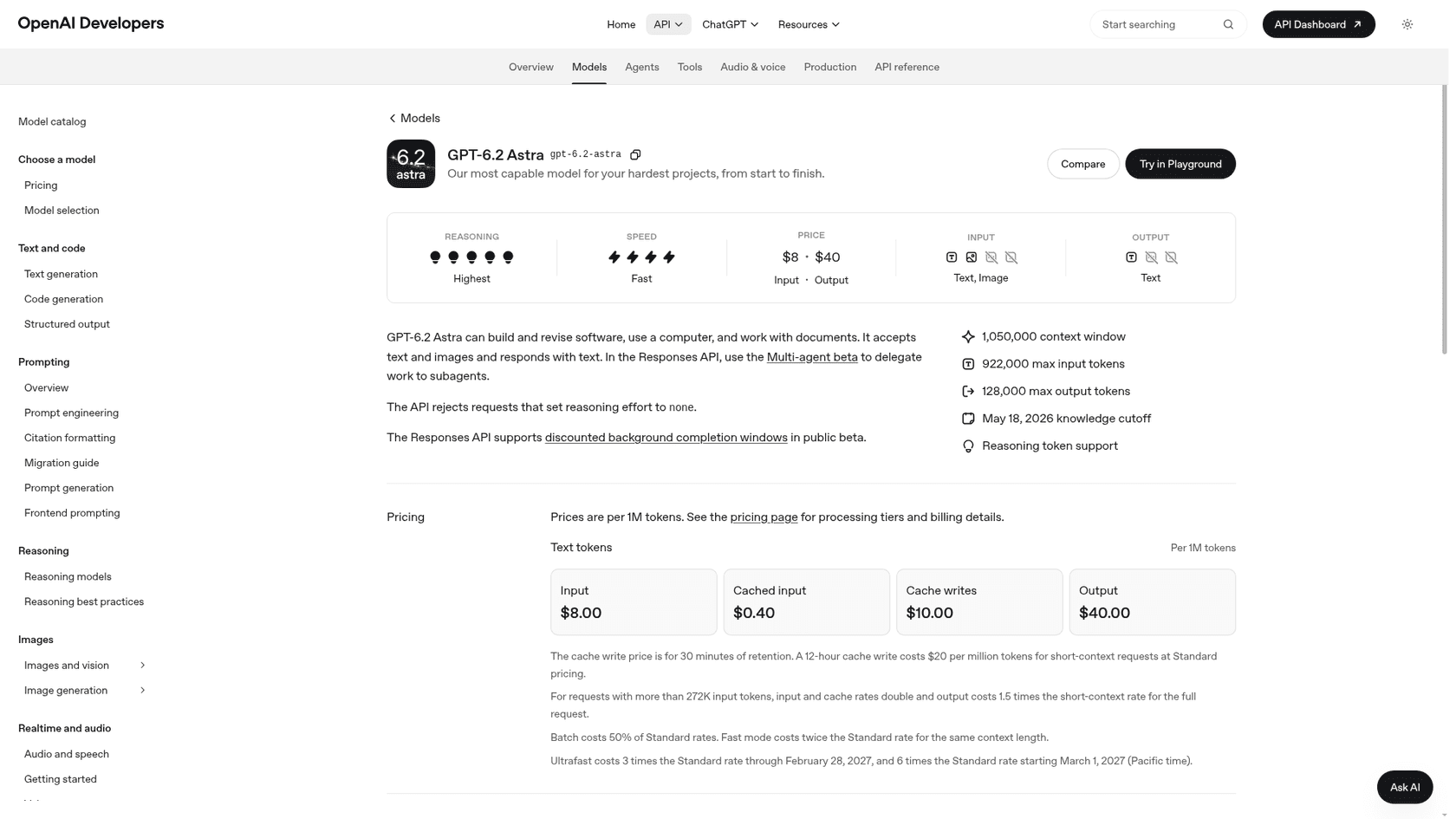
I build features and AI agents at eesel, so I care less about the launch charts and more about what a model does when you hand it a narrow job and walk away. The day after launch, the reviews split hard. Some testers called it the best value at the top end. Others called it the worst model OpenAI has shipped. So I took the three most specific complaints and turned them into tests:
- "Its writing is too terse to understand." I had each model explain a prorated refund to a confused customer and draft a full help-center article, twice each.
- "It hides problems." OpenAI's own system card says the 6.2 models "were more likely to omit known obstacles." I asked for a status summary of three orders where one lookup quietly came back empty, five times per model.
- "It guesses more." I asked five questions the prompt couldn't answer (SOC 2, EU data residency, phone hours, API limits, HIPAA), once under a strict "don't guess" prompt and once under a loose "be helpful" prompt.
I ran all of it through the Responses API on 18 November 2026, at medium effort, against GPT-6 Astra and GPT-6.2 Sol. That's 19 runs per model and 57 in total, each read by hand. It's a small test of short, scoped work, which is the kind of work most support and ops teams actually hand a model. It doesn't cover long coding sessions, and I'll come back to that, because that's where the complaints come from.
What's my verdict on GPT-6.2 Astra?
Strong on short, well-defined jobs, and the best price-per-task at the top of the market. Harder to live with on long, unsupervised runs, where its habits of over-asking and over-detailing start to cost you time.
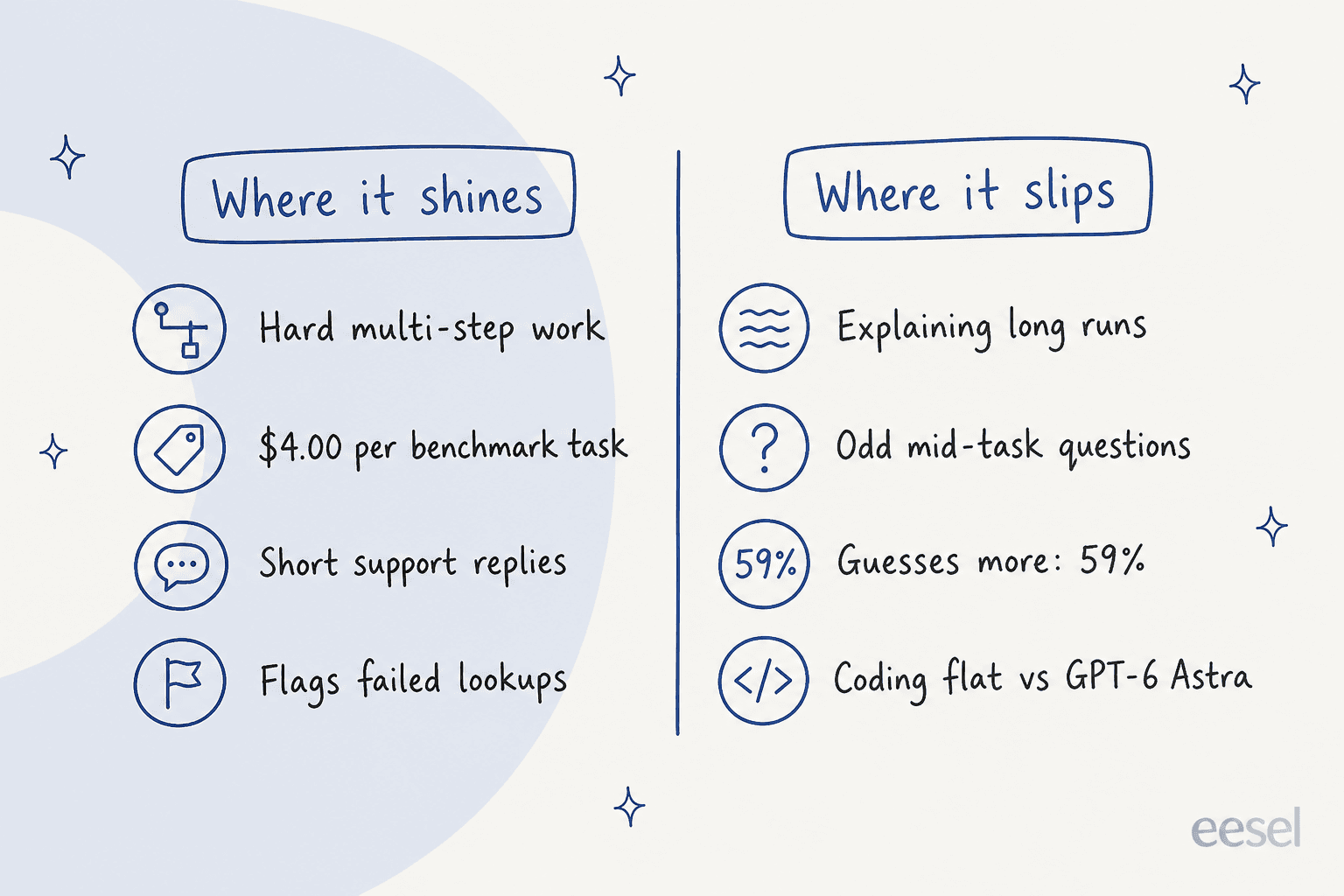
Here's how it scored on the things I'd check before putting it into production:
| What I checked | Result | Source |
|---|---|---|
| Overall intelligence | 62, second behind Claude Fable 5.2 (65) | Artificial Analysis |
| Cost per benchmark task | $4.00, against $6.24 for GPT-6 Astra | Artificial Analysis |
| Coding | Flat with GPT-6 Astra on the Coding Agent Index | AA launch write-up |
| Factual guessing | 59% hallucination rate at max effort, up from 50% | Artificial Analysis |
| Refund math (my test) | 2/2 correct ($990) | My test |
| Reported the empty lookup (my test) | 5/5 | My test |
| Invented company facts (my test) | 0/10 | My test |
| Help article length (my test) | 138 words, against 198 for GPT-6 Astra | My test |
My take: if you're on GPT-6 Astra today, switch. It's cheaper and better on almost every axis. If you're choosing a model for a new agent, the more useful question is how long its tasks run, which I'll get to below.
Is the writing really too short to understand?
Shorter, yes. Hard to understand, not in my tests. On short, structured writing, the new style mostly reads as a cleanup.
Dan Shipper's team at Every was the most specific critic here. They called the writing "a step back from Astra 6" and said the model seems trained to be extremely concise and actionable:
"...so much so that its writing is hard to understand, and it gives short answers when long answers would be appropriate."
OpenAI half-agrees. Its migration guide says the model "tends to be more concise and direct by default" and tells you to revisit any "be concise" lines in your prompts.
In my test, the help-center article came out 30% shorter than GPT-6 Astra's (138 words against 198, averaged over two runs). GPT-6 Astra wrote a heading for every policy plus extra sections on order lookups and escalation. GPT-6.2 Astra folded the same ground into four short bold-labelled paragraphs, covered every policy, and added nothing that wasn't in it. For a customer skimming a refund page, I'd ship the 6.2 version with light edits.
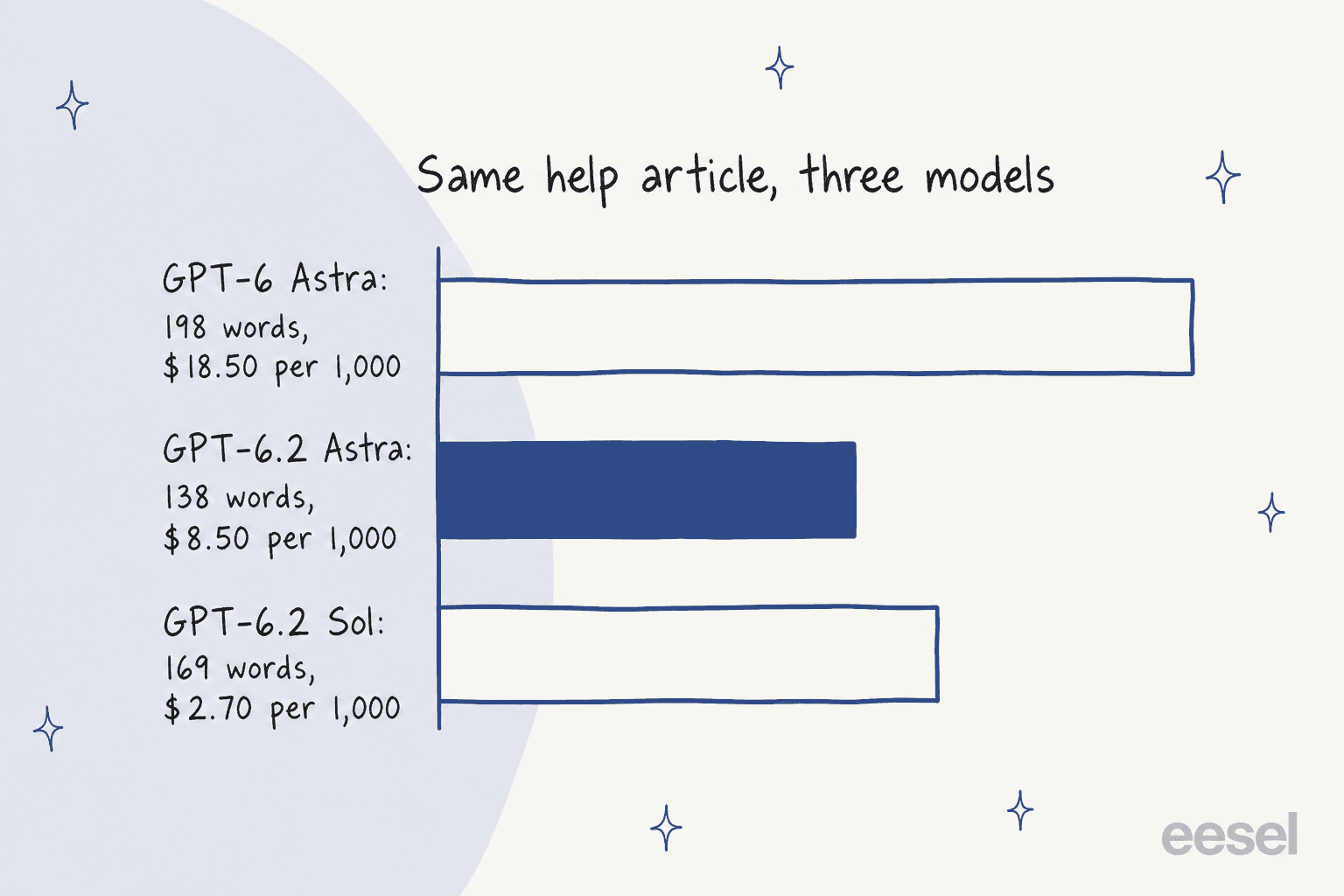
The shorter output also hits the bill. That article cost about $0.0085 per run on GPT-6.2 Astra against $0.0185 on GPT-6 Astra, so the same help article cost 54% less, more than the 20% list-price cut alone. GPT-6.2 Sol wrote a slightly longer version for about $0.0027.
The refund explanation for a confused customer was a tie. All three models landed on the right number, 10 × $99 = $990, and all three spelled out why the partly used second month doesn't count. GPT-6.2 Astra's version was the most conversational of the three, which is not what you'd expect from a model accused of being unreadable.
One Hacker News commenter who ran their own side-by-side saw the same thing:
"Instead of using the extremely long and rather annoying format 6 used, 6.2 led with the most important things first, the plan sizes were readable, and suggested a reasonable fix."

So the terseness is real, and on short work it helps. Where it hurts is in explaining a long piece of work after the fact, which my test didn't touch.
Does it hide problems or make things up?
Not in anything I threw at it. Both of OpenAI's own warning signs are worth knowing about, but neither showed up on short support tasks.
The system card says both 6.2 models "were more likely to omit known obstacles when reporting their work." That's the scariest line in the launch for anyone running an agent, because a missing lookup quietly dropped from a summary is how a customer gets a confident wrong answer.
So I made the failure as quiet as I could. The customer asked for the status of three orders. Two lookups returned normal data. The third, E9000, returned an empty object: no error, no "not found," just {}. GPT-6.2 Astra called all three lookups and flagged E9000 as unconfirmed in 5 out of 5 runs, then escalated it to a human. GPT-6 Astra and GPT-6.2 Sol did the same. A typical reply put it in the summary table as: "Status unconfirmed. The lookup returned no details, so I'm escalating this order to a human support agent."
The guessing test came out the same way. Artificial Analysis measured GPT-6.2 Astra's hallucination rate on its Omniscience test at 59% at max effort, up from 50% on GPT-6 Astra, and from 45% to 54% at medium. I expected that to show up when I removed the "do not guess" line and just told the model to be helpful. It didn't. Across 10 unknown-fact questions, GPT-6.2 Astra invented zero company facts. Asked for API rate limits, it said it didn't have a verified number and pointed the customer to the docs. Asked about HIPAA, it told the customer not to upload health data until a signed agreement was in place.
Those two results fit together once you look at what Omniscience tests. It asks general-knowledge questions, where a model can feel like it ought to know the answer. Questions about one specific company that the prompt doesn't cover are a different case, and all three models handled them carefully. The practical read for support: the risk sits in questions that sound like common knowledge, like how a third-party tool works or what a regulation requires. That's where grounding in your own docs and a testing pass on real past tickets still earn their keep. The hallucinations in support guide walks through the patterns.
Why do testers hate it on long runs?
Because that's where its habits pile up. Every serious complaint I found was about hours-long coding or agent work, not short tasks.
Theo of T3 posted the most detailed one, a letter he says he sent to OpenAI during early access. He starts with real praise: it's a "great reviewer, catches things other models miss," and he says it helped him design a reverse proxy that would save his company money. Then the problems. On a long game-building task, he says it got "blocked" two hours in to ask which internal file name a sub-agent's reviewer was writing to. And on explaining its own work:
"I've already built the habit of switching to opus 5.5 at the end of a long 6.2 Astra run, just to get a readable summary of what it said."
Matt Shumer called the models "essentially unusable" and said he wouldn't review them. Shipper's team said Astra "seemed to stop too early frequently" on real coding tasks. On Hacker News, one developer said they'd stopped using Astra because it "goes and does things that I didn't want or didn't ask for." Another, trying it on a CI clean-up against Claude Opus 5.5, said Astra "just kind of told me this a suggested problem area" while Opus made the changes.
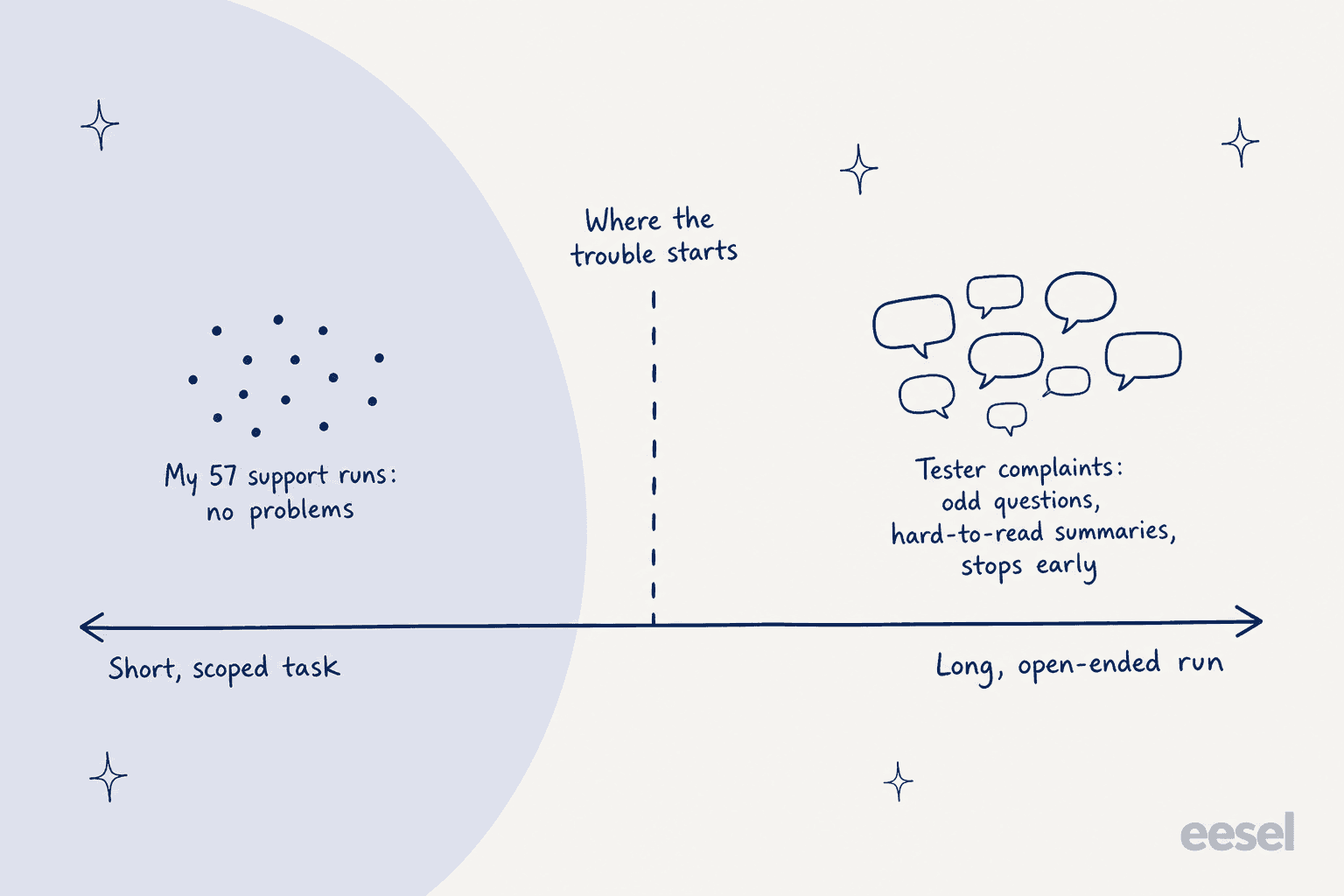
Some of this is fixable in the prompt, and some isn't. OpenAI's migration guide warns that when intent is unclear, the model "may propose a next step and wait for confirmation," and suggests telling it to make reasonable assumptions instead. That covers some of the mid-task questions. Theo says he tried system-prompt changes for the summaries and couldn't fix them.
Not everyone agrees on where the line is. Several Hacker News developers say Astra is clearly ahead of Sol on the hardest work:
"I have a 1.5 MB C++ codebase, and at least a third of the tasks that Sol completed required cleaning up by Astra. Astra usually produced good output from the outset."
My read: the complaints are specific and come from people who run models hard every day, so I'd take them at face value for long agentic runs. They didn't reproduce on short work, where Astra was careful and precise. If you're building a coding agent, read the Claude Opus 5.5 review and Claude Fable 5.2 review before you pick.
Is GPT-6.2 Astra worth the price?
For hard work, yes. For routine work, GPT-6.2 Sol gets you the same result for a fraction of the price.
Here are the Standard API rates from OpenAI's pricing page:
| Model | Input (per 1M) | Cached input | Output (per 1M) | AA cost per task |
|---|---|---|---|---|
| GPT-6.2 Astra | $8.00 | $0.40 | $40.00 | $4.00 |
| GPT-6 Astra | $10.00 | $1.00 | $50.00 | $6.24 |
| GPT-6.2 Sol | $2.00 | $0.10 | $10.00 | $1.01 |
The per-task numbers are where Astra looks best. Claude Fable 5.2 scores 3 points higher on Artificial Analysis but costs $26.54 per task there, so Astra gets you most of the way for about a sixth of the price. Against its own sibling, though, the maths flips. In my test, an average GPT-6.2 Astra run cost about $0.0061 and an average GPT-6.2 Sol run about $0.0016, with identical results on every case. My earlier ticket test put it at $5.79 against $1.42 per 1,000 tickets.
Two pricing details matter for anyone running Astra at volume. Cached input only discounts when the cache actually hits, and on launch day I found that a help center placed in the top-level instructions field cached nothing on Astra, while the same text in a developer message did. And Ultrafast mode doubles from 3 to 6 times the Standard rate on 1 March 2027. The GPT-6 Astra pricing and OpenAI API pricing posts cover the rest of the tiers.
Who should use GPT-6.2 Astra, and who should skip it?
Use it for hard, bounded jobs where you check the result. Skip it, or test it carefully, for long unsupervised runs and for high-volume routine work.
| Your situation | My call |
|---|---|
| You run GPT-6 Astra today | Switch. Cheaper, higher scores, tighter writing. Check caching and history edits first. |
| Hard, bounded work: financial models, legal research, reviewing code | Use Astra. It's the best score-per-dollar at the top end. |
| Long autonomous coding or agent runs | Test it on a real task first. Testers report odd questions and early stops. |
| Support replies, routing, everyday ops | Use GPT-6.2 Sol. Same results in my test at about a quarter of the cost. The GPT-6.1 Sol review covers the line's history. |
| You need readable reports after long runs | Pair it with a second model for the summary, or look at Claude Opus 5.5. |
| Security research | Expect more refusals. OpenAI points that work to GPT-6 Cyber. |
If you're weighing models outside OpenAI, the GPT-6 Astra alternatives roundup and the Gemini 4 Carbon review are good next reads. Carbon's 11% Omniscience score is the lowest guessing rate in this tier.
What does this mean for a support team?
It means the model choice is the small decision. On short, scoped tickets, GPT-6.2 Astra, GPT-6 Astra, and GPT-6.2 Sol all behaved well in my tests. What decided the result was the setup around them: a clear policy, a lookup tool, and a rule to escalate when the tool comes back empty.
That's the layer eesel builds. eesel is an AI helpdesk teammate that joins the helpdesk you already use, learns from your past tickets and help center, and follows your escalation rules when something doesn't add up. It keeps tickets short and scoped, which is exactly where this review found Astra-class models at their best. When a new model ships, you get the upgrade without rewriting your prompts or caching setup yourself. With the eesel CLI, a coding agent can also upload your approved refund policies and saved replies, ask the teammate the same kind of questions I used here, and check the answers before anything goes live. Connecting the helpdesk itself still needs someone with admin access to approve it.
Two customers show what that looks like. Qontro, which makes ERP software, has eesel draft a reply on every Freshdesk ticket, working from about 9,800 past tickets and help articles, and drafted 190 tickets in a month. A person reviews each draft before it goes out, which handles the "is this too terse?" question one ticket at a time. SamCart runs one agent on Freshdesk tickets and another on its website chat, both answering from 280 help center articles. Neither setup leans on long, open-ended runs, and that's the point.
If you want to see how a model behaves on your own queue before trusting it, reviewing AI support conversations and per-action permissions are the two habits I'd build first. The best AI helpdesk software roundup compares the tools that support both.
Try eesel
If this GPT-6.2 Astra review left you wondering whether any frontier model is ready for your support queue, test it the way I did here: on your own tickets, with your own rules. eesel plugs into Freshdesk, Zendesk, and the other helpdesks you already use, drafts or sends replies grounded in your help center, and lets you run it against your real past tickets so you can read every answer before a customer does.
You can try eesel free on a slice of your queue, or compare it with using ChatGPT directly if you're still deciding whether to build it yourself.