


GPT-6.2 Sol is OpenAI's everyday model, released 17 November 2026 at the same $2/$10 per million tokens as GPT-6.1 Sol. It scores 57 on Artificial Analysis, two points up, at about 20% lower cost per task and a third of the time, which puts it level with the old GPT-6 Astra. The exception is coding, where Artificial Analysis measured a 3-point drop.
On my 15 support tickets it passed everything GPT-6.1 Sol did, for about 5% more per ticket. If you run 6.1 Sol, switch. For customer-facing answers, a grounded AI helpdesk teammate like eesel matters more than the model underneath.
What is GPT-6.2 Sol?
GPT-6.2 Sol is the mid-tier half of OpenAI's November release, the successor to GPT-6.1 Sol. The launch post calls it "our efficient, versatile model for everyday work," and says many OpenAI employees use it as their default model for both technical and non-technical tasks. Its bigger sibling, GPT-6.2 Astra, shipped the same day for the hardest projects.
I build AI agents at eesel, so my first move with any new model is to call it from code and see what it does on real work. The gpt-6.2-sol ID worked on my API key within hours of launch, and I ran it against the same support tickets I used for the GPT-6.1 Sol review. The results are further down.
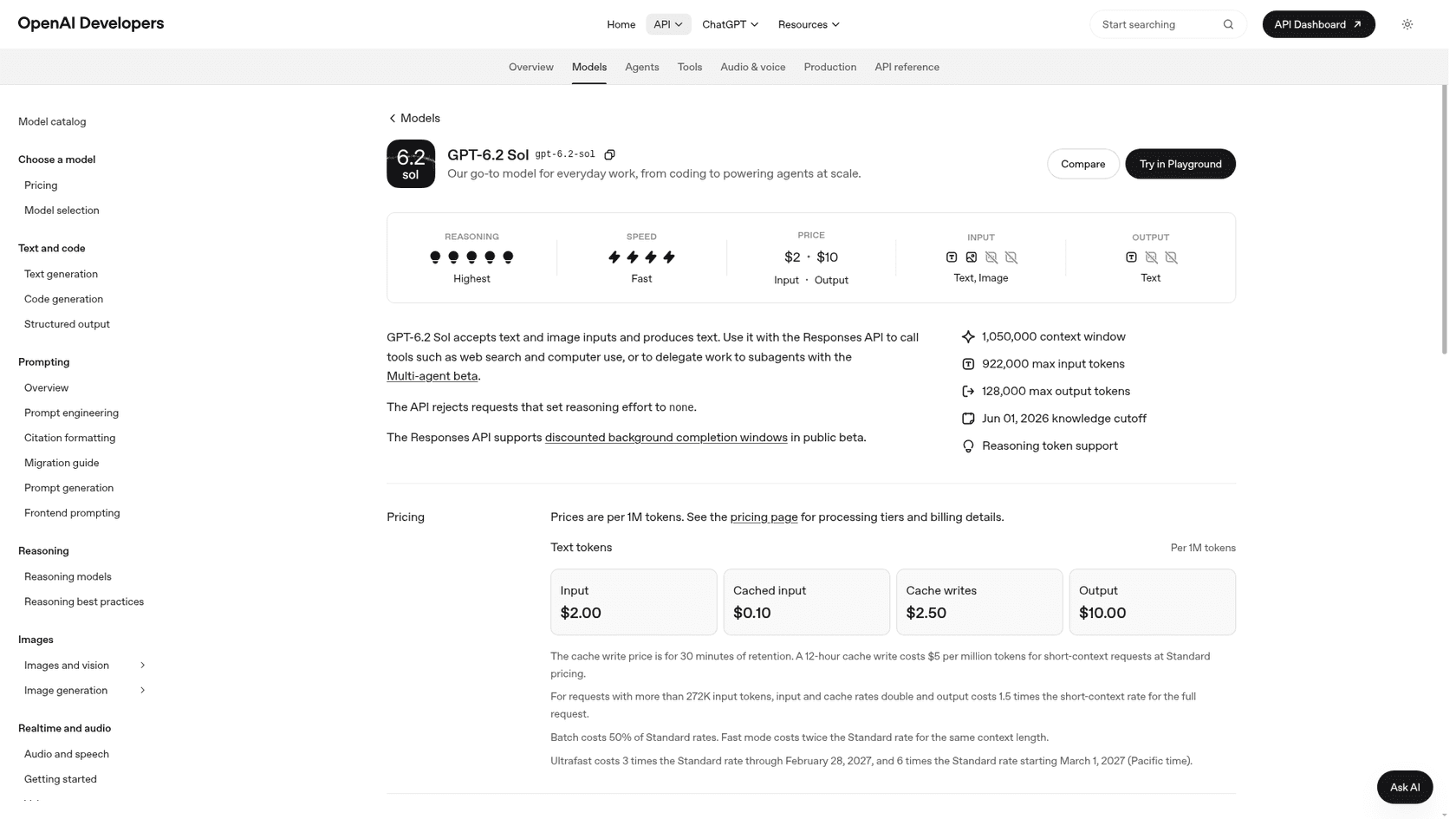
On availability, OpenAI says both models are live for Plus, Pro, Enterprise, and Edu users in ChatGPT Work and Codex, and on the API. Enterprise and Edu users get access once a workspace admin enables it. Pro 500 subscribers can run either model in Ultrafast mode, and for the first time Ultrafast comes to Pro 200, starting with Sol. The ChatGPT pricing guide covers what each plan costs.
What changed from GPT-6.1 Sol?
The price stayed put, so the question is what the same money buys now. OpenAI says GPT-6.2 Sol is "smarter, more efficient, and lets you complete more tasks on the same paid plan." On its internal GDPval v2 benchmark, which tests long professional workflows, Sol improved by 5.3 points over GPT-6.1 Sol.
Here are the specs from the model page and Artificial Analysis, next to the old model:
| GPT-6.1 Sol | GPT-6.2 Sol | |
|---|---|---|
| Launch | 29 September 2026 | 17 November 2026 |
| Input / output (per 1M) | $2 / $10 | $2 / $10 |
| Cached input (per 1M) | $0.10 | $0.10 |
| Context window | 1,050,000 tokens | 1,050,000 tokens |
| Max input / max output | n/a | 922,000 / 128,000 |
| Knowledge cutoff | n/a | 1 June 2026 |
| Lowest reasoning effort | low | low (none is rejected) |
| AA Intelligence Index (max) | 55 | 57 |
| AA cost per task (max) | $1.27 | $1.01 |
| AA time per task (max) | 23.1 min | 7.9 min |
| AA coding agent index | baseline | 3 points lower |
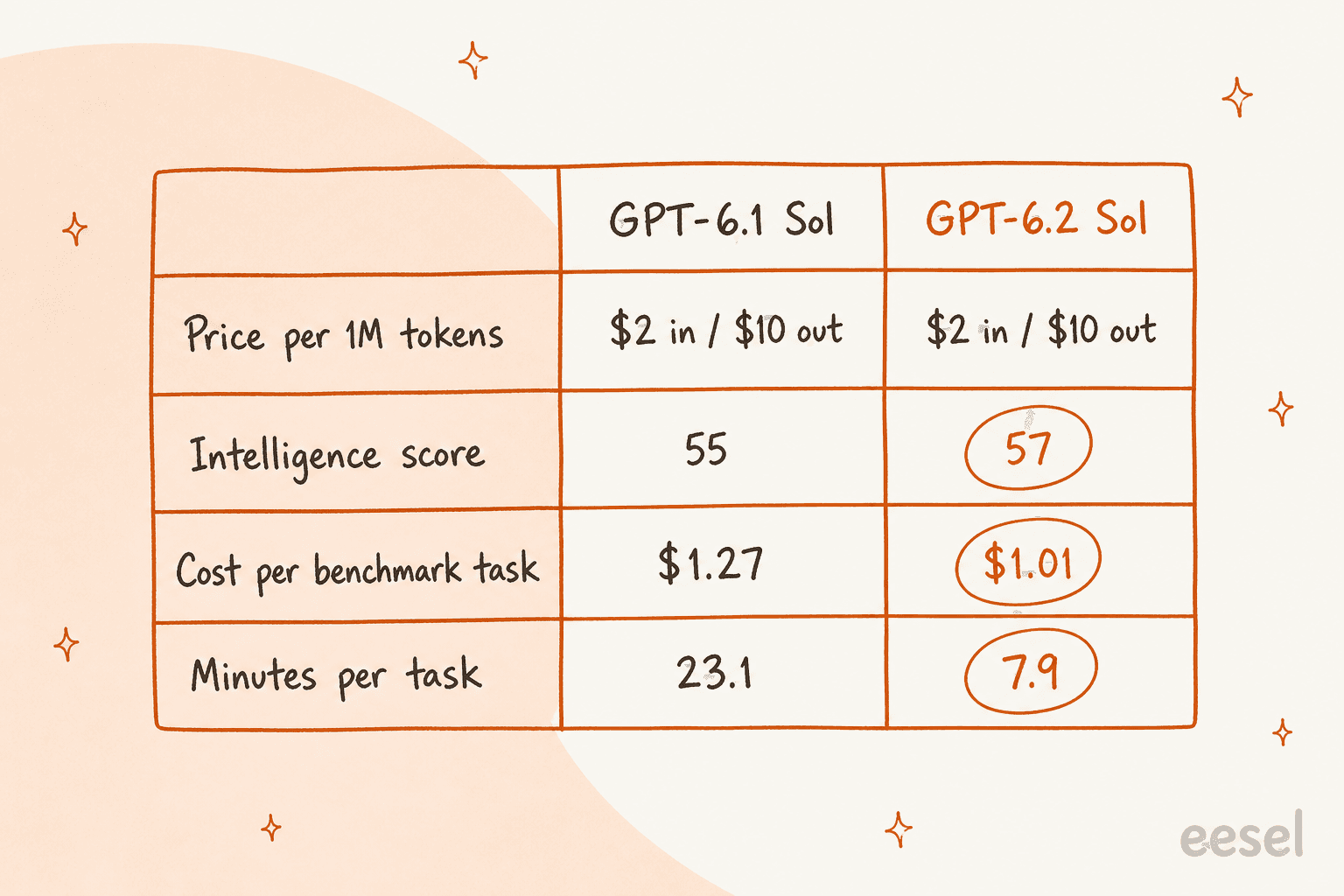
The speed gain is the one you will feel. At max effort, Artificial Analysis clocked 7.9 minutes per benchmark task, against 23.1 for the old model, and a time to first answer token of 57.6 seconds against 156.2. Max effort is a slow mode either way, but the old model was among the slowest in its price tier and this one is quicker than average.
How much does GPT-6.2 Sol cost?
GPT-6.2 Sol costs $2 per million input tokens, $0.10 cached, and $10 per million output tokens at the Standard tier. OpenAI says it "carries forward GPT-6.1 Sol's rates." Here is the grid from OpenAI's pricing page:
| Tier | Input | Cached input | Output |
|---|---|---|---|
| Standard | $2.00 | $0.10 | $10.00 |
| Batch | $1.00 | $0.05 | $5.00 |
| Fast | $4.00 | $0.20 | $20.00 |
| Ultrafast (to 28 Feb 2027) | $6.00 | $0.30 | $30.00 |
| Ultrafast (from 1 Mar 2027) | $12.00 | $0.60 | $60.00 |
A few lines on that page change the real bill:
- Cache writes cost more than plain input. A 30-minute cache write is $2.50 per million tokens and a 12-hour write is $5. Reads are where you save.
- Long prompts cost more. Past 272,000 input tokens, input and cache rates double and output costs 1.5 times as much, for the whole request.
- Ultrafast doubles on 1 March 2027. It is 3 times Standard until 28 February 2027, then 6 times.
- Background requests are cheaper. Eligible requests run 30% below Standard on a 2-hour window and 40% below on an 8-hour window.
- Flex is missing. The page lists Flex at $1/$5 for GPT-6.1 Sol, but not for GPT-6.2 Sol. Batch and background requests are the discount routes for now.
At Standard rates Sol is a quarter of GPT-6.2 Astra's $8/$40. The wider OpenAI API pricing guide covers how the rest of the catalog stacks up.
Do the benchmarks hold up?
Mostly, with one clear exception that OpenAI left out of its charts.
OpenAI says that in Cognition's FrontierCode 2.0, Sol "comes within 0.5 points" of Astra at about one-fifth the cost, and that on its LifeVal everyday-tasks test, Sol outscores GPT-6 Astra at about one-seventh the cost. Artificial Analysis, which runs its own tests, mostly agrees. Its numbers at max effort:
| Model | AA Intelligence Index | Cost per task | Hallucination rate |
|---|---|---|---|
| Claude Fable 5.2 | 65 | $26.54 | 59% |
| GPT-6.2 Astra | 62 | $4.00 | 59% |
| Gemini 4 Carbon (high) | 60 | n/a | 11% |
| Claude Opus 5.5 | 59 | n/a | 50% |
| GPT-6.2 Sol | 57 | $1.01 | 55% |
| GPT-6 Astra | 57 | $6.24 | 50% |
| GPT-6.1 Sol | 55 | $1.27 | n/a |
The line to underline: GPT-6.2 Sol now matches the old flagship's score at roughly 15% of its cost per task, per Artificial Analysis. OpenAI's mid-tier keeps closing on its flagship, and this one sits level with September's top OpenAI model for a fraction of the cost.
Two results are less flattering:
- Coding went backwards. In the Artificial Analysis Coding Agent Index, which uses the Codex harness at max effort, GPT-6.2 Sol "loses 3 points relative to GPT-6.1 Sol." AA says the drop comes from a 14-point fall on SWE-Atlas-QnA-AA, where the model is "more likely than its predecessor to omit key facts in its responses." OpenAI reports gains on its own coding tests, so treat coding claims as unproven until your own repo says otherwise.
- It still guesses. On AA-Omniscience, Sol's hallucination rate is 55% at max effort. That is the share of questions it answers wrongly rather than admitting it does not know. Gemini 4 Carbon sits at 11% on the same test.
That second point is the one I'd weigh before putting this model in front of customers. A model that guesses needs to be grounded in your own docs and told when to stop, which is the whole job of hallucination prevention in support.
Which effort level should you use?
For most work, medium. Artificial Analysis publishes scores for all five effort levels, and the curve flattens fast:
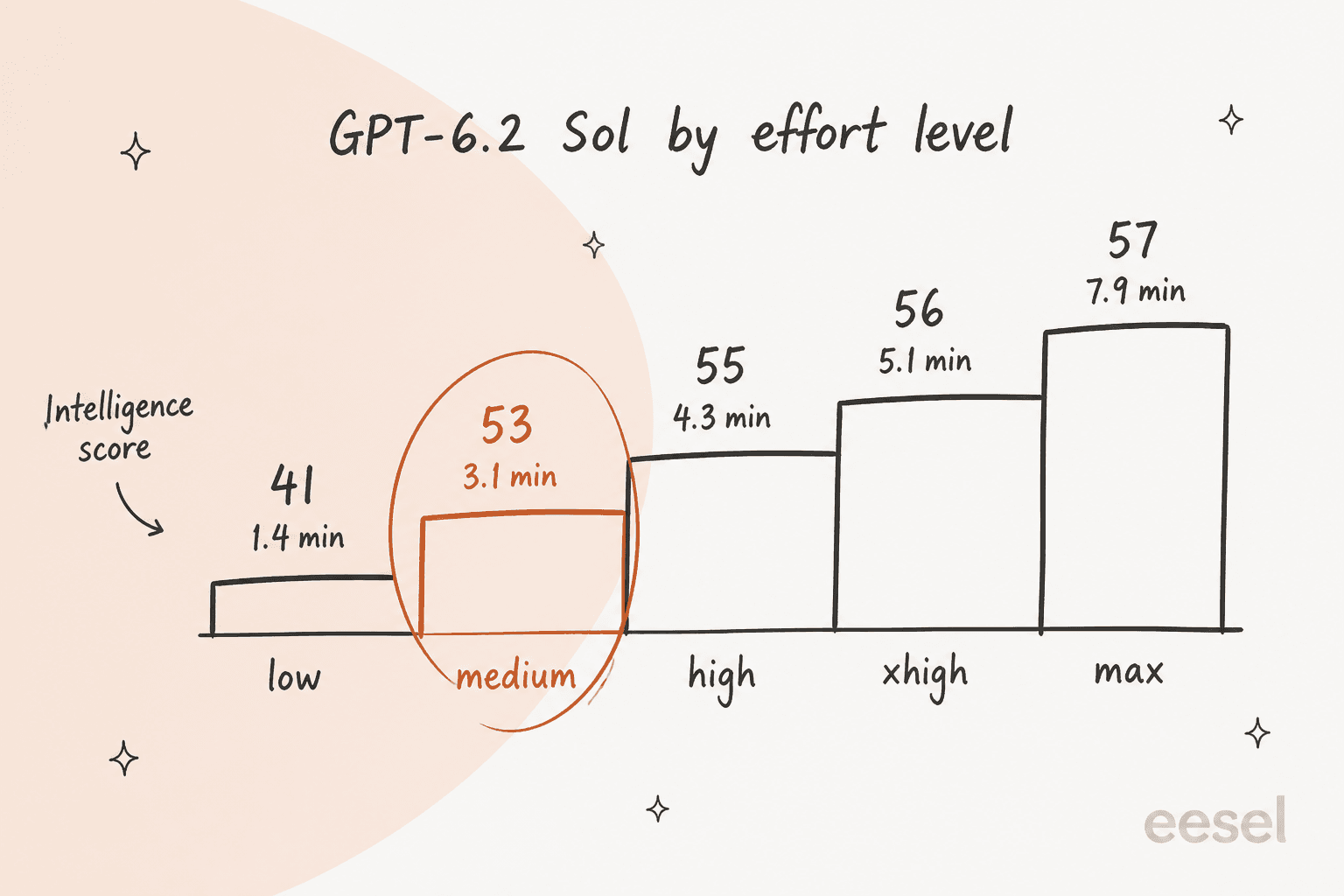
Medium gets you 53 of the max effort's 57 points in 3.1 minutes per task instead of 7.9. Low drops to 41, which is where the real quality loss starts. OpenAI's own migration guide says to start new integrations at medium, and the API rejects none, so low is the floor.
Output tokens follow the same shape. Artificial Analysis counted 60.9 million output tokens at max, 14.6 million at medium, and 7.2 million at low, against 63.7 million at max for GPT-6.1 Sol. Because output is billed at five times input, the effort setting moves your bill more than the model choice does.
What are early testers saying?
The reaction to the pair split hard. OpenAI's launch page carries enthusiastic quotes from early customers. Several well-known testers who had early access said the opposite, loudly:
"I will not be writing a full review of GPT-6.2 Astra / Sol. I had a terrible experience testing them. They were essentially unusable."
Dan Shipper's team at Every was more specific, though about Astra. They said real coding tasks "seemed to stop too early frequently," and that the writing was trained to be so concise it was "hard to understand."
On Hacker News, where the launch thread ran past 500 comments, developers spent most of their time on the Sol-versus-Astra question. One user called Sol a daily workhorse:
"Happy for the new Sol. It's my workhorse on company account."

Others found the gap in specific places:
"I have a 1.5 MB C++ codebase, and at least a third of the tasks that Sol completed required cleaning up by Astra."
"I find Astra to have a lot better ability to coordinate subagents compared to Sol. I haven't found a distinction in the complexity of work they can handle."
That lines up with the numbers: Sol matches the old flagship overall, but the new Astra leads on the long, hard work where a mistake compounds. For a refund request, the gap doesn't show up.
How did GPT-6.2 Sol do on real support tickets?
Both Sol models scored 15 out of 15 against my policy checks, and the new one cost about 5% more per ticket. The differences showed up in small behaviors, not in pass rates.
I reran the eval from my GPT-6.1 Sol review on 18 November 2026 through the Responses API:
- A policy doc for a fictional SaaS company: refund windows, a 5-business-day rule for duplicate charges, no address changes after shipping, no discount codes from agents, and "escalate anything not covered."
- One tool,
lookup_order, wired up with function calling. It returns canned order data, "not found" for unknown IDs, and a deliberate 503 timeout for one order. - 15 tickets covering refund math, an angry duplicate charge, a prompt injection, Spanish and German tickets, a vague "I want a refund," a broken tool, and an order ID with a typo (the letter O instead of a zero).
- Four setups: GPT-6.2 Sol and GPT-6.1 Sol, each at low and medium effort. That is 60 runs, each read by hand against the policy.
This is a small hand-built test, not a benchmark, and each setup ran once. It tells you how these models behave on clean support work, which is most support work. OpenAI's agent evals tooling does the same job at a larger scale.
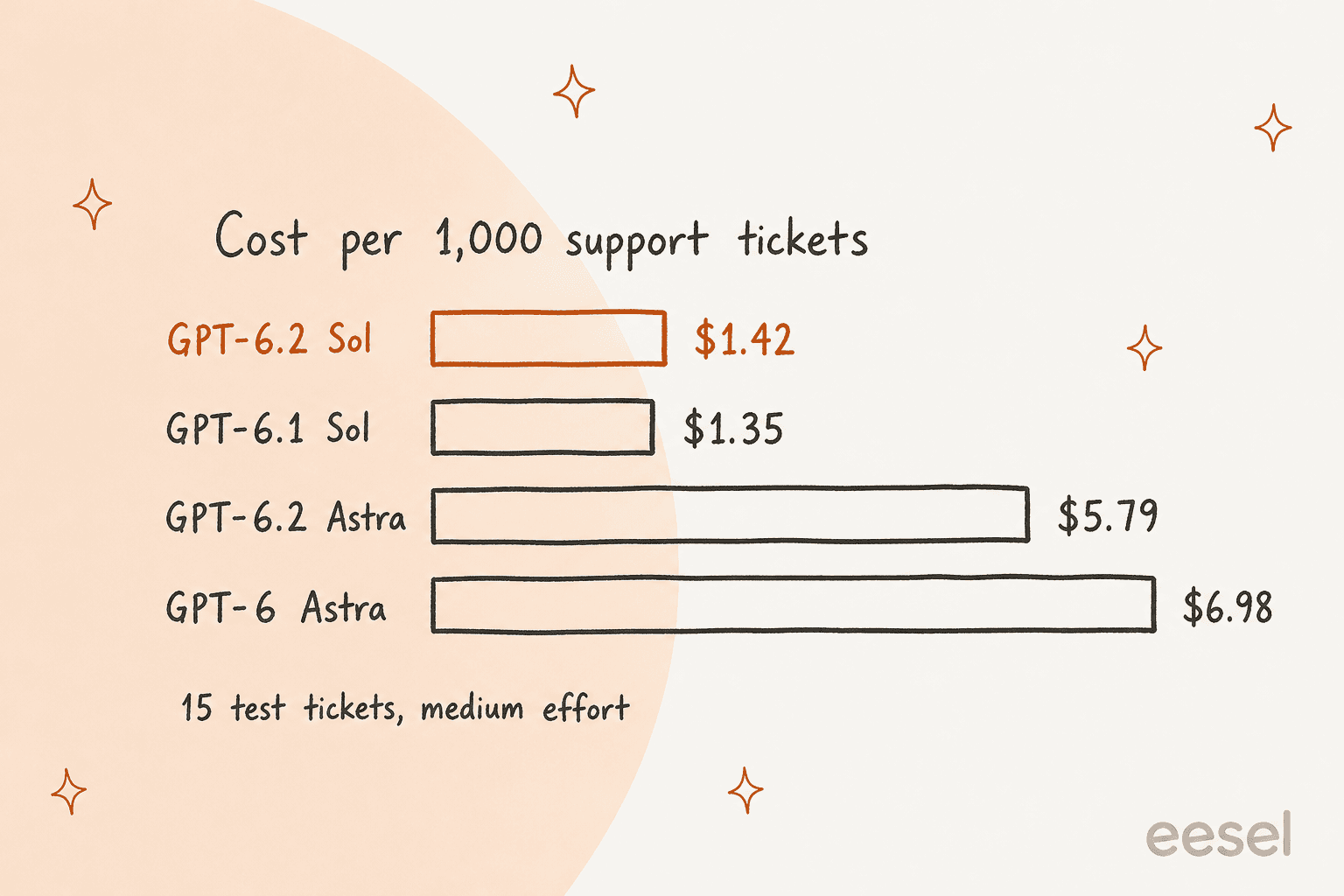
| Setup | Score | Cost per 1,000 tickets | Avg. response time | Avg. output tokens |
|---|---|---|---|---|
| GPT-6.2 Sol, medium | 15/15 | $1.42 | 3.6s | 60 |
| GPT-6.2 Sol, low | 15/15 | $1.41 | 3.2s | 58 |
| GPT-6.1 Sol, medium | 15/15 | $1.35 | 3.8s | 55 |
| GPT-6.1 Sol, low | 15/15 | $1.32 | 3.8s | 52 |
For context, the same tickets cost $5.79 per 1,000 on GPT-6.2 Astra at medium and $6.98 on GPT-6 Astra, in my earlier run.
Three things stood out once I read the replies side by side.
Same price, slightly longer replies. Sol 6.2 averaged 60 output tokens per ticket against 55 for 6.1. That accounts for the whole 5% cost difference. With the price unchanged, slightly longer replies cost slightly more. Response time was about the same.
It built links the tool never gave it. On both order-status tickets, GPT-6.2 Sol turned the tracking number into a ups.com/track link. GPT-6.1 Sol printed the number on its own. The link format was right, but nothing in my tool data contained a URL. In a real helpdesk, I'd write a rule about which links an agent may create, because the next invented link might not be a harmless one. GPT-6.2 Astra did the same thing in my Astra test.
It committed to an answer the policy left open. On "I paid for an annual plan 41 days ago, what do I get back?", GPT-6.1 Sol asked for a charge ID. GPT-6.2 Sol answered straight away: 10 unused full months, so 10/12 of what you paid. That counts the second month as already used, which the policy never says. It's a reasonable reading, but it's an assumption stated as fact, and in a refund flow I'd want the model to look it up instead.
The rest, from the $990 prorated refund math (correct in every setup) to refusing a fake "admin mode" discount request and escalating when the order service timed out, was the same across all four. Neither Sol model asked the customer to double-check the typo'd order ID, which GPT-6.2 Astra did. For support, the score doesn't separate these setups; behavior and cost do.
What should developers know before switching?
If you call the API directly, the migration guide has a short list of changes worth reading before you flip the model ID:
- Tool calling needs the Responses API. The model supports Chat Completions, but tools only work through Responses. Many integrations were built the other way.
noneeffort is rejected. If you usednoneorminimal, move tolow.- Sampling settings are gone. Drop
temperature,top_p,logprobs, andtop_logprobs. - Reasoning gets dropped if you edit history. OpenAI recommends keeping prompt prefixes unchanged and appending new instructions, to improve cache reuse and preserve reasoning across turns.
- Caching changed. If you're coming from GPT-5.5 or earlier, replace
prompt_cache_retentionwithprompt_cache_options.ttlset to"30m", and review the cache-write billing. - Zero Data Retention works. Both models support it for approved organizations, and both support US and EU data residency on Standard, Fast, and Batch.
The caching point is the one that costs money. In my Astra test I found that a help center prompt in the top-level instructions field wasn't cached on the new Astra, while the same text in a developer message was. Check your own cached_tokens on Sol before you assume the 95% cached-input discount, since I haven't verified Sol separately. The GPT-6.1 Sol post covers the earlier API changes in the same family.
What about safety and the cyber limits?
Both models keep the "Critical" cybersecurity rating that GPT-6 Astra was the first to get, plus a "High" rating for biological and chemical capability. In practice, that means tighter guardrails. OpenAI says it launched both models "with tighter safeguards for higher-risk cybersecurity assistance," and that these "also restrict some legitimate vulnerability research." Security teams that need fewer refusals are pointed to OpenAI Daybreak and GPT-6 Cyber.
The system card is candid about one regression that matters for support: both models "were more likely to omit known obstacles when reporting their work," such as a missing file or an unavailable tool. An agent that quietly skips over a failed lookup is how a customer gets a confident wrong answer. In my test, both Sol models did say when the order service timed out, but that was one ticket with a loud error. I'd put observability on any agent running this model, so you can see what it tried and what failed.
Should you switch to GPT-6.2 Sol?
For most teams already on an OpenAI model, yes, with a short checklist first.
| If you use | My take |
|---|---|
| GPT-6.1 Sol | Switch. Same price, higher score, much faster at max effort. Test coding workloads first, since AA measured a drop. |
| GPT-6 Sol | Switch. The jump from GPT-6 Sol is two releases of gains at the same $2/$10. |
| GPT-6 Astra | Try Sol first. It matched the old Astra's AA score at about 15% of the cost per task. Keep Astra for the long, hard projects. |
| GPT-6.2 Astra | Keep Astra for hard multi-step work. Move routine tickets and everyday agent calls to Sol. |
| Claude Sonnet 5.5 or Opus 5.5 | Run your own tests on your tickets. Sol is cheap, but a score gap on a benchmark rarely predicts how a model handles your tone and policies. |
| Any model, for customer-facing answers | Weigh the 55% guessing rate. Grounding and escalation rules matter more than the upgrade. |
If you're shopping outside OpenAI, the GPT-6.1 Sol alternatives roundup still applies, and best LLM for support covers the wider field.
What does GPT-6.2 Sol mean for a support team?
A cheaper, faster model is better infrastructure. It isn't a better support agent on its own. The model doesn't know your refund policy, can't see your helpdesk, and still guesses on more than half of the factual questions Artificial Analysis throws at it. Everything that makes it useful on a real queue sits around the model, and a model comparison for support tickets only gets you the first step.
That layer is what eesel builds. eesel is a set of AI teammates you hire for specific jobs, an AI helpdesk teammate for your queue and an AI blog writer for content, and each arrives with the integrations, knowledge, and guardrails for its role. The model is the engine; the teammate is who you hire to drive it. You can also drive it from code: with the eesel CLI, a coding agent such as Claude Code, Codex, or Cursor can upload approved help articles and macros, adjust the agent's instructions, and run test questions against them before anything goes live. Connecting the helpdesk itself still needs an admin to approve it.
SamCart, which sells digital products to more than 75,000 businesses, shows how that works on a Freshdesk queue. It runs a separate eesel agent for each channel: one for email tickets, which replies only until a teammate picks the ticket up, and one for the website chat bubble, which asks for a name and email first. Both answer from about 280 help center articles, link only public ones, and hand off to a person when a seller asks or the question is beyond the help center. That scoped, hand-off-first design is the opposite of letting the smartest model answer everything, and it means the model underneath can change without the customer noticing.
If you're weighing this release for support, the more useful question than "Sol or Astra?" is whether you can test the agent on your own past tickets before it goes live. A benchmark can't tell you that, and neither can a launch post. The best AI helpdesk software roundup compares the tools that do this, and the cost per ticket benchmarks put model spend in the context of the full ticket cost.
Try eesel
If GPT-6.2 Sol got you thinking about AI on your support queue, the part that decides whether it works is the teammate around the model. eesel plugs into the helpdesk you already use, learns from your past tickets and help center, and lets you run it against your real historical tickets so you can read its answers before it touches a live customer. Plans are fixed credit bundles, starting at $299 for 500 credits, so the bill doesn't move with the model's token prices or reply length. When a new model lands, you get the upgrade without rebuilding your prompts, caching, or escalation rules yourself.
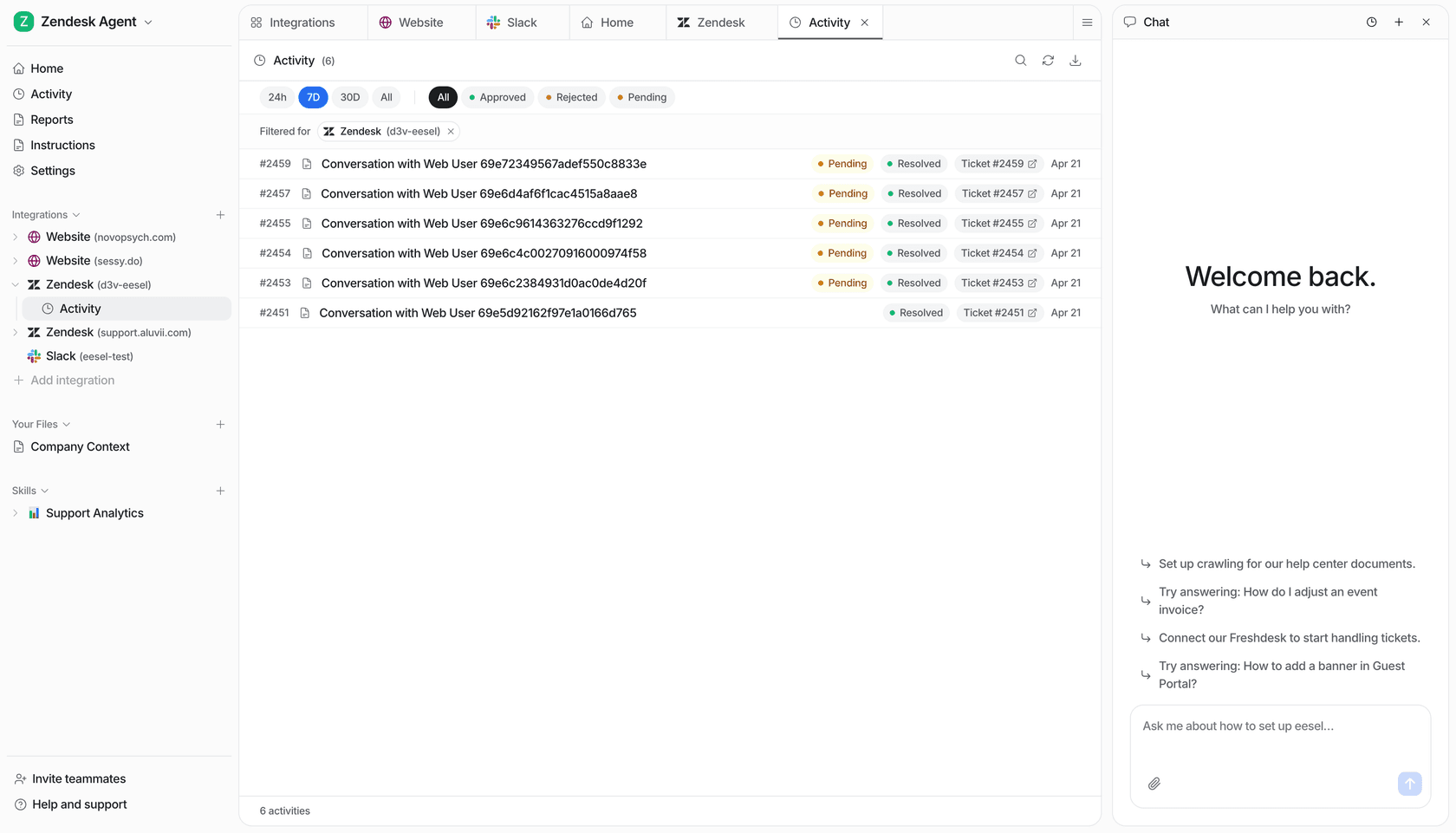
You can try eesel free on a slice of your queue, or compare it with using ChatGPT directly if you're still deciding whether to build it yourself.
Frequently Asked Questions
What is GPT-6.2 Sol?
gpt-6.2-sol, and the OpenAI models list shows where it sits in the lineup.How much does GPT-6.2 Sol cost?
GPT-6.2 Sol vs GPT-6.1 Sol: what changed?
Is GPT-6.2 Sol better than GPT-6.2 Astra?
Is GPT-6.2 Sol good for customer support?
Does GPT-6.2 Sol have a Flex tier?
How do I get access to GPT-6.2 Sol?
gpt-6.2-sol. Enterprise and Edu users get it once a workspace admin turns it on. OpenAI is also bringing Ultrafast to Pro 200 subscribers for the first time, starting with Sol. Tool calling on the API needs the Responses API.