

The short answer, in a table
If you only want the numbers, this is the post. Every figure is transcribed from OpenAI's ChatGPT pricing page, because GPT-Live's cost is the ChatGPT plan cost.
| Plan | Price (per user / month) | GPT-Live model | Voice access |
|---|---|---|---|
| Free | $0 | GPT-Live-1 mini | Yes |
| Go | $8 | GPT-Live-1 | Expanded |
| Plus | $20 | GPT-Live-1 | Expanded |
| Pro | From $100 | GPT-Live-1 | Unlimited* |
| Business | Per user, from 2 users (sales) | GPT-Live-1 | Not at launch |
| Enterprise | Custom (sales) | GPT-Live-1 | Not at launch |
* "Unlimited subject to abuse guardrails." Business, Enterprise, and Edu workspaces don't get GPT-Live at launch. All figures from OpenAI.
The headline that matters for most readers: you can try the full-duplex experience for $0 on GPT-Live-1 mini, and the jump to the full model is only $8. That's cheaper than the coffee you'd drink while testing it.
What you actually pay: pick your plan
Since "GPT-Live pricing" really means "which ChatGPT plan should I be on," here's the decision as a quick picker rather than a wall of caveats.
The pattern the picker makes obvious: the voice quality is the same from $8 up. Moving to Plus or Pro buys you smarter background reasoning and more usage, not a better-sounding conversation. That's a genuinely useful thing to know before you spend $100 chasing a better voice that doesn't exist.
Why "GPT-Live pricing" is a bundle, not a line item
This trips up almost everyone searching the term. There's no product page with a GPT-Live price on it, and there's a reason for that.
GPT-Live is a feature of ChatGPT, the same way Advanced Voice Mode was. When OpenAI introduced GPT-Live on July 8, 2026, it replaced Advanced Voice Mode as the default voice experience for everyone, so it inherited ChatGPT's existing plan structure instead of getting its own. The ChatGPT pricing page doesn't even name "GPT-Live" as a model you buy; it lists voice as a graded feature (Yes / Expanded / Unlimited) and lists the chat models (GPT-5.5 Instant, GPT-5.6 and friends) separately.
So the mental model is: you're not buying a voice model, you're buying a ChatGPT plan, and GPT-Live comes with it. The only "tier" for the voice itself is which model you get, mini on Free, the full model on paid, and how much you can use it.
The API price everyone actually wants (and can't have yet)
Here's the number that matters for anyone building on GPT-Live, and the honest answer is that it doesn't exist.
OpenAI has said GPT-Live-1 and GPT-Live-1 mini are "coming soon" to the API and opened a notification form, but has published no rates. That's the door to phone lines, voice agents, and any real business use case, and it's shut for now. A developer who tested it put the gap plainly:
"This model and a smaller version — GPT-Live-Mini — will be available soon in the API, meaning anyone can build apps or agents using this conversational system, including to answer or make phone calls. For now there's no pricing."
Until that lands, voice apps get built on the existing audio and speech API wired into the Assistants API, which is a different (cascaded) architecture than GPT-Live's full-duplex one. If you're pricing out a voice project, budget for that stack, not for GPT-Live, which you literally can't buy programmatically today.
What a voice agent actually costs (the part the model price hides)
This is where I'd caution any support leader reading a "GPT-Live pricing" post with a calculator open. Even once the API ships with a per-minute rate, that rate is the smallest line in a real voice-agent bill. I've seen teams anchor on the model price and get surprised by everything stacked on top of it.
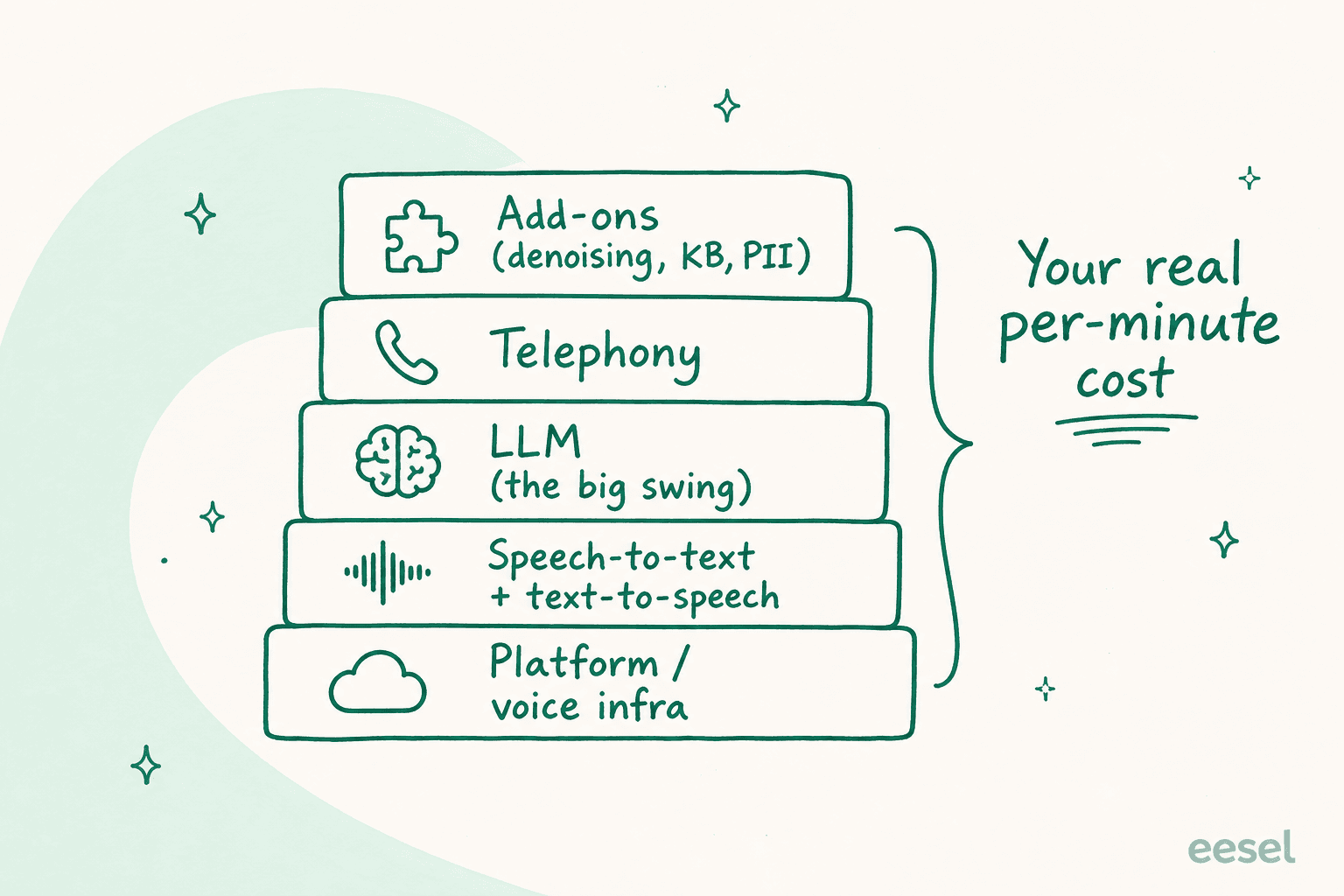
A per-minute voice bill is a stack: the platform/voice infra, speech-to-text and text-to-speech, the LLM itself (the big swing), telephony, and add-ons like denoising, knowledge-base lookups, and PII handling. The model is one layer of five. That's why "what does the voice model cost" is the wrong question for support, and why the cost savings from AI support come from resolution rate, not from a cheap per-minute token price.
It's also why most support volume, still overwhelmingly email and chat tickets, is where the money is today, long before anyone picks up a phone. A CX lead put the real bar to us on a call, and it has nothing to do with voice:
"The AI will never be able to answer 100% of the questions, but if it tries and just answers 'sorry I don't know this,' I cannot go and check all my 7,000 tickets to see if the AI actually made a good answer, then the point is a little bit gone. I need an AI who is only handling the tickets that it's confident to handle and all the other ones, leave them alone."
a CX lead at a DTC brand handling ~7,000 tickets a month
Is GPT-Live worth the plan cost?
For consumers, the answer is easy and cheap. The free tier is enough to judge it, and the full-duplex feel is a real upgrade over the walkie-talkie turn-taking of the old mode. A launch-day tally from Digg put reaction at 78% positive across 482 reactions. If you talk to ChatGPT often, the $8 Go plan is a small ask.
"Old voice AI worked like a walkie-talkie. GPT-Live works more like a real conversation. It can listen and speak at the same time. So you can pause, interrupt, think out loud, or change direction without the whole thing feeling awkward."
The one thing to price in mentally: it's a better interface, not new intelligence. The IQ is GPT-5.5 delegated in the background. So you're paying for a nicer conversation, not a smarter one, worth it for hands-free chat, language practice, and multitasking, less so if you expected a leap in answers. If you're weighing it against other assistants, our ChatGPT vs Gemini piece and the GPT-Live alternatives roundup have the wider view.
GPT-Live pricing vs building AI support
So if the voice model is (for now) free-to-cheap for consumers and unbuyable for developers, where does that leave a support team doing the math?
The practical answer is that the tool you'd actually deploy isn't priced per voice-minute at all. An AI helpdesk agent works your existing email and chat queue, and the pricing question that matters is cost-per-resolution, not cost-per-model. That's the lens the best customer service AI tools are judged on, and it's why a conversational AI platform that can't tell you its resolution rate is hiding the expensive part.
This is the space I build in, so here's the honest comparison. eesel is an AI for customer service that plugs into the helpdesk you already run (Zendesk, Freshdesk, Gorgias, Help Scout, and more), trains on your past tickets and help center, and only auto-replies when it's confident, leaving the rest for your team. Its pricing is one fixed monthly price (from $299/month for 500 credits, where 1 credit is one ticket or chat), so you know the cost before you commit, no per-seat surprise, no quote-gated voice rate. And before it answers a single customer, you can simulate it on thousands of your real past tickets to see exactly what it would have said.

When GPT-Live's API does land with a real price, a model-agnostic AI agent for customer service is what lets you plug it in on evidence instead of hype. Until then, the smarter spend is automating the tickets you already have. Try eesel free with 100 credits, no card and no sales call needed.
The bottom line on GPT-Live pricing
To answer the query straight: there is no GPT-Live price to pay on its own. You pay $0 on Free (GPT-Live-1 mini), $8 on Go or $20 on Plus for the full GPT-Live-1, and from $100 on Pro for unlimited voice, all as part of a normal ChatGPT plan. The API price developers want isn't out yet, and for support teams the number that actually moves the budget is resolution rate on the email and chat tickets you're already getting, not a per-minute voice charge that doesn't exist. Price the outcome, not the model.