GPT-5.6-Cyber alternatives: 9 options you can use in 2026

Alicia Kirana Utomo

Katelin Teen
Last edited August 10, 2026
Everyone gated the cyber model
I build AI agents for a living, so the thing I noticed first about the GPT-5.6-Cyber launch was not the capability claim. It was how familiar the shape was.
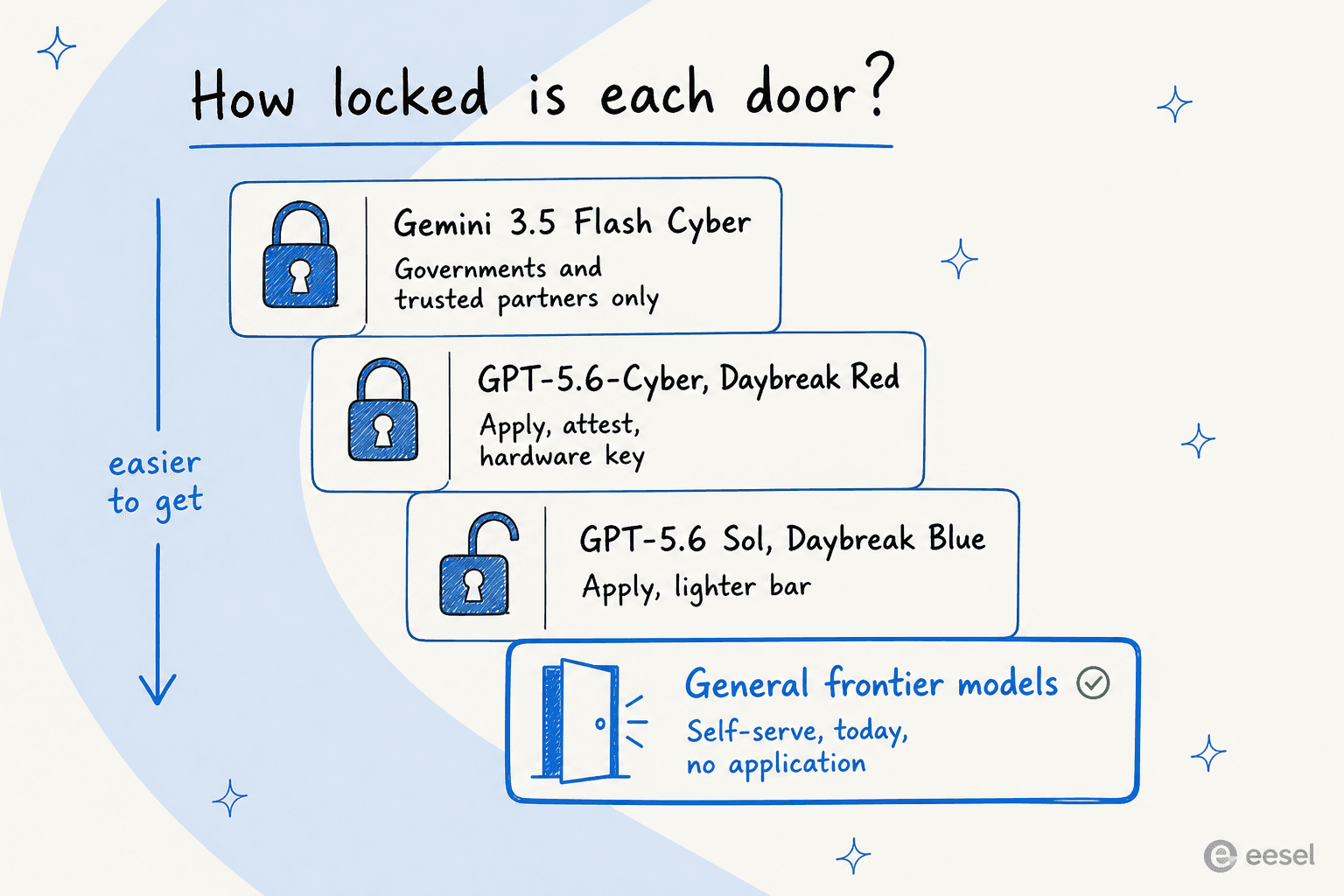
Every frontier lab has now built the same thing: a specialised cyber model, locked, with a lighter tier underneath it for everyone else. The differences are in the details, and the details are where the actual advice lives.
Two of them matter enough to state plainly before the list.
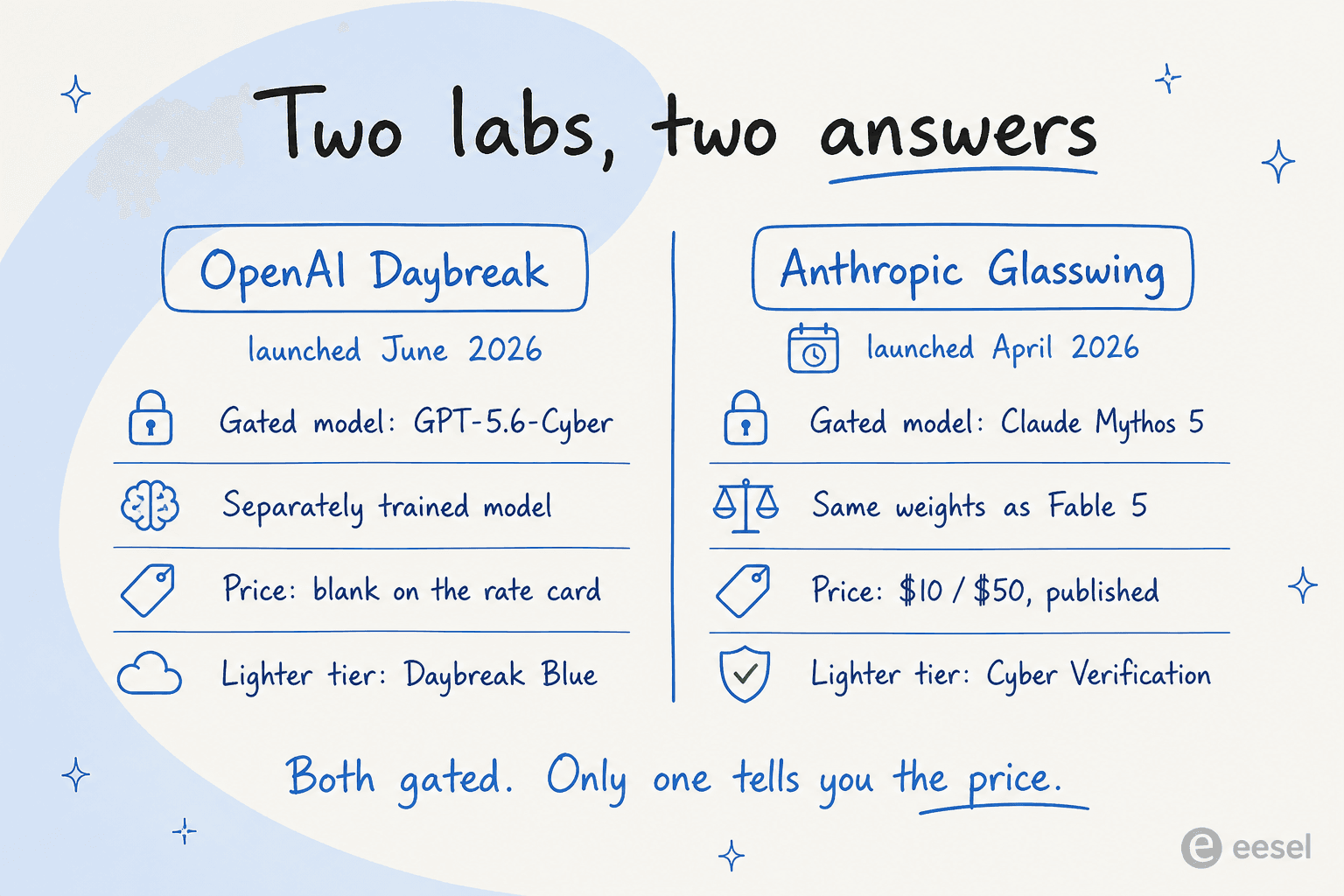
Anthropic's architecture is cleaner. Claude Mythos 5 and Claude Fable 5 are the same underlying weights, per Anthropic's product page; only the safeguards differ. OpenAI trained GPT-5.6-Cyber separately, which is why it beats Sol on zero-day discovery and loses to it on report writing. One approach gives you a different model with different tradeoffs. The other gives you the same model with the brakes off.
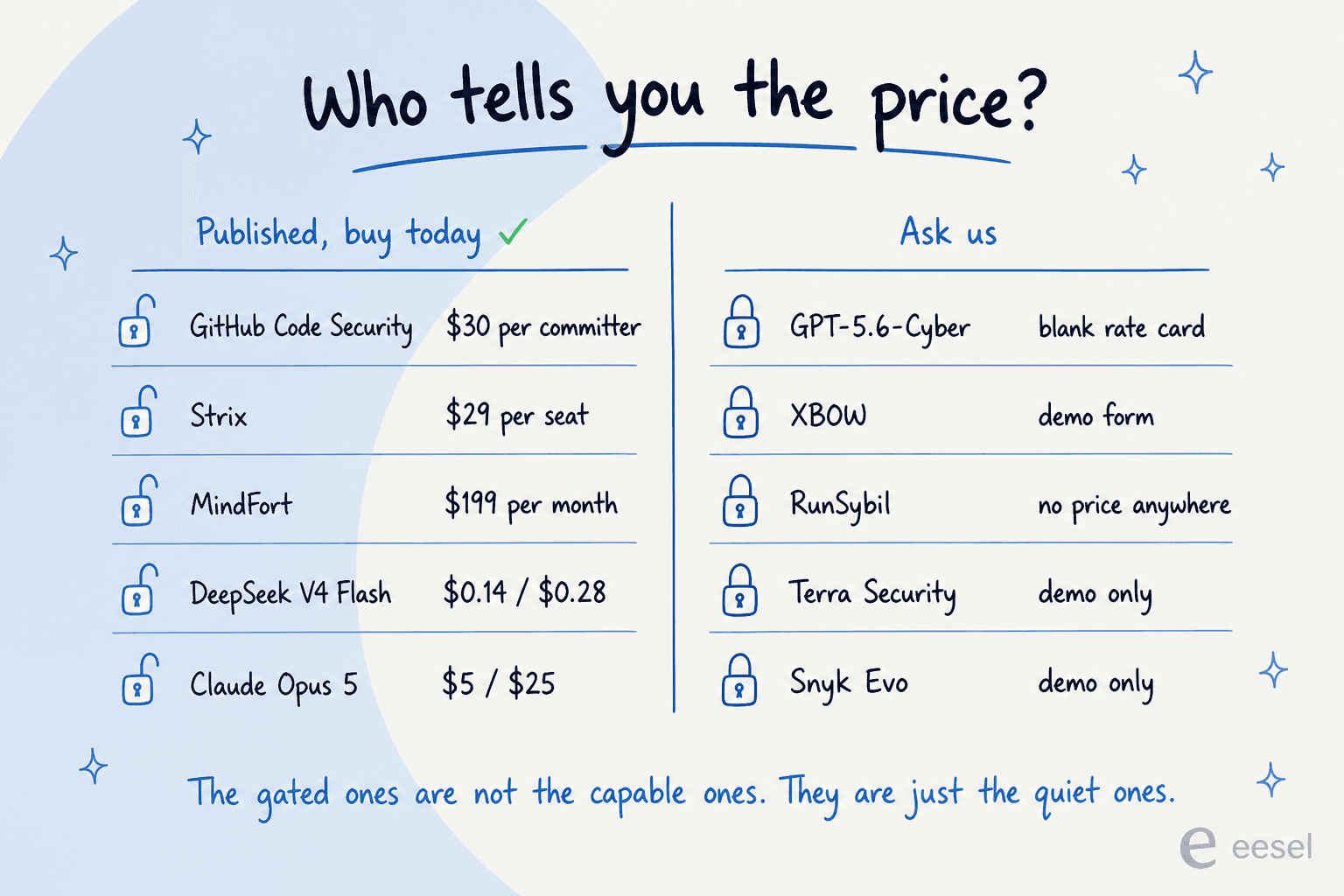
Only one of them tells you the price. Anthropic publishes Mythos 5 at $10 and $50 per million tokens. OpenAI's rate card carries a Cyber row with literal dashes in it, which we dug into in the Cyber pricing breakdown.
How I picked these nine
Three filters, applied honestly.
It has to be reachable. Either you can pay for it today, download it today, or apply through a process with a published turnaround. "Contact sales" with no price and no timeline did not make the list as a recommendation, though I have named the ones that work that way so you know to skip them.
The price has to be checkable. Every number below comes from the vendor's own pricing page, model card, or marketplace listing, checked on 11 August 2026.
The capability claim has to be the vendor's own. I have not run these against each other. Where a cyber benchmark exists I have quoted it and named the source; where none exists I say so rather than implying one.
The comparison table
| # | Option | Type | Self-serve? | Entry price | Price published? | Self-host? | Vendor cyber score | Best for |
|---|---|---|---|---|---|---|---|---|
| 1 | Daybreak Blue | Gated model tier | Apply | Sol at $5 / $30 per 1M | Yes, Sol's rate | No | ExploitBench 73.5% | Staying on OpenAI |
| 2 | Anthropic CVP | Free access program | Apply, 2 business days | Opus 5 at $5 / $25 per 1M | Yes | No | Cyber fallbacks down 85% vs Fable 5 | Most defenders |
| 3 | Claude Mythos 5 | Gated model | Invitation only | $10 / $50 per 1M | Yes | No | ExploitBench Cap% 78 | Glasswing partners |
| 4 | Gemini 3.6 Flash | General model | Yes | $1.50 / $7.50 per 1M | Yes | No | Not published | Cheapest frontier-ish |
| 5 | DeepSeek V4 Flash | Open weights, MIT | Yes | $0.14 / $0.28 per 1M | Yes | Yes, ~167 GB | Cybergym 76.7 | No vendor at all |
| 6 | Strix | Autonomous pentest | Yes, card | $29 / seat / month | Partly | Yes, Apache-2.0 | Not published | Small teams |
| 7 | MindFort | Continuous pentest | Yes | $199 / month | Yes | No | Not published | Lowest published floor |
| 8 | GitHub Advanced Security | Scan and autofix | Yes | $30 / committer / month | Yes | No | Not published | Already on GitHub |
| 9 | Horizon3 NodeZero | Autonomous pentest | Via AWS Marketplace | $25,000 / 12 months | On marketplace only | No | Not published | Enterprise procurement |
Interactive
What is actually blocking you?
Pick the constraint that bites hardest. The rest of the list is noise until this one is solved.
The high-risk dual-use bucket is exactly what is blocking you, and it is the bucket CVP adjusts. Free, decided in two business days, on Opus 5 at $5 and $25 per 1M.
Also apply for: Daybreak Blue, if you are already on OpenAI. Different vendor, same fix, no reason not to run both applications at once.
Check first: CVP needs data retention enabled, is unavailable on Google Vertex AI, and is unavailable on Opus 5 via Amazon Bedrock.
<div class="altpick-card ap-b">
  <span class="altpick-tag">Go with: GitHub, Strix or MindFort</span>
  <p>All three publish a number you can quote today: $30 per committer, $29 per seat, $199 per month. No call, no scoping meeting.</p>
  <p class="altpick-alt"><strong>Cheapest real change:</strong> GitHub Code Security, because the code is already there and CodeQL plus Copilot Autofix are free on public repos.</p>
  <p class="altpick-warn"><strong>Watch:</strong> Strix bills pentests per test on top of the seat fee, and that per-test rate is not published.</p>
</div>

<div class="altpick-card ap-c">
  <span class="altpick-tag">Go with: DeepSeek V4 Flash</span>
  <p>MIT licence, roughly 167 GB on disk, servable on a single 4-way GB300 node. No acceptable-use policy, no field-of-use restriction, nothing about dual use anywhere in the licence.</p>
  <p class="altpick-alt"><strong>Also consider:</strong> GLM-5.2 on an 8-way H200 node, also MIT. Strix's Apache-2.0 CLI runs locally against your own model key.</p>
  <p class="altpick-warn"><strong>The trap:</strong> the licence only frees you if you self-host. Several of these labs' hosted APIs ban vulnerability scanning outright, with no authorisation carve-out.</p>
</div>

<div class="altpick-card ap-d">
  <span class="altpick-tag">Go with: GitHub Advanced Security</span>
  <p>Your bottleneck is remediation, not discovery. Copilot Autofix generates fixes for 90% of alert types in JavaScript, TypeScript, Java and Python, and ships them as reviewable changes.</p>
  <p class="altpick-alt"><strong>Free option:</strong> Trail of Bits Buttercup is AGPL-3.0 and costs nothing beyond your own model bills.</p>
  <p class="altpick-warn"><strong>Not this:</strong> a more permissive frontier model. More findings is the opposite of what you need right now.</p>
</div>

<div class="altpick-card ap-e">
  <span class="altpick-tag">Go with: MindFort or Strix</span>
  <p>Both run autonomous pentesting with proof-of-exploit, and both let you start without a sales call. MindFort publishes up to 2 pentests a month at $199; Strix bills per test on a $29 seat.</p>
  <p class="altpick-alt"><strong>At enterprise scale:</strong> Horizon3 NodeZero is $25,000 for twelve months at 500 assets on AWS Marketplace, which is a real published contract price.</p>
  <p class="altpick-warn"><strong>Skip for now:</strong> XBOW, RunSybil and Terra Security. All capable, none will tell you a price without a meeting.</p>
</div>
A note on that "vendor cyber score" column, because it is the most misreadable thing here. These numbers are not comparable to each other. They are different benchmarks, run by different labs, under different safeguard settings. Anthropic's Cap% 78 in particular is a 16-flag capability ladder, not a success rate, and it was run with all safeguards off. Anthropic says so itself and warns the results "may not be directly comparable to public leaderboard entries." Use the column to see whether a vendor publishes anything at all, not to rank them.
1. Daybreak Blue (GPT-5.6 Sol)
Best for: teams already standardised on OpenAI who want the friction removed without changing vendor.
What it is. The other half of the same programme. Daybreak Blue gives you frontier general-purpose models, Sol included, with the system-level cyber guardrails removed. OpenAI calls it "the recommended starting point for most defenders" and names the workloads: vulnerability discovery, secure code review, malware analysis, incident response, patch validation.
Access. Individuals verify identity at ChatGPT's cyber page; organisations use the enterprise form. No published turnaround. Hardware security keys become mandatory for individual accounts on 1 September 2026.
Pricing. Sol's standard rate, $5 in and $30 out per million tokens short-context, doubling to $10 and $45 on long context. Batch halves it. Full breakdown in our GPT-5.6 pricing guide, and the flagship on its own in the Sol pricing post. Cheaper tiers exist if the workload allows: Terra at $2 and $12, Luna at $0.20 and $1.20.
Verdict. Take it if you are staying on OpenAI, and understand what it does and does not change. On OpenAI's advanced-cyber prompt set, Blue moves the completion rate from 1.5% to 2.0%, so it will not unlock exploit-chain work. What it unlocks is the ordinary defensive work that was getting caught by the screening layer. That is a real problem solved, just a smaller one than the tier name suggests.
2. Anthropic Cyber Verification Program
Best for: almost everyone reading this. It is the recommendation.
What it is. Anthropic splits blocked cyber work into two buckets. Prohibited use covers things "almost always used maliciously and have little to no legitimate defensive application such as mass data exfiltration or ransomware code development", and it is not adjustable. High Risk Dual use covers work with "legitimate defensive applications, such as vulnerability exploitation or offensive security tooling development", and that bucket is adjustable through the Cyber Verification Program.
Access. Free application against your existing organisation, with a decision by email "within 2 business days". It covers Opus and Sonnet class models, not Mythos 5. Anthropic also publishes an appeals path and admits the error rate outright: "We expect to occasionally decline eligible applications incorrectly, and approved users may still experience blocks on legitimate work."
Pricing. The programme is free. You pay the normal model rate: Claude Opus 5 at $5 in and $25 out per million tokens, or Sonnet 5 at $2 and $10. One thing to diary: Sonnet 5's rate is introductory and goes to $3 and $15 after 31 August 2026. Our Opus 5 review covers what you actually get for it.
Verdict. This is the answer for most people, and it is not close. Two business days against an open-ended Daybreak review, a free application, and a published price on a model that is already excellent. Anthropic also reports that Opus 5 traffic "ran into cyber fallbacks 85% less than Fable 5", which is the closest thing anyone publishes to OpenAI's completion-rate table. The real catches are coverage gaps you should check first: CVP requires data retention enabled, it is not available on Google Vertex AI at all, and it is not available on Opus 5 through Amazon Bedrock.
3. Claude Mythos 5 via Project Glasswing
Best for: organisations large enough to be invited, which is the honest framing.
What it is. The true Daybreak Red equivalent, and the one that launched first. Glasswing began on 7 April 2026 with 12 named partners including AWS, Apple, Cisco, CrowdStrike and the Linux Foundation, and expanded in June to roughly 150 more organisations. Partners have found "more than 10,000 high- or critical-severity security flaws".
Access. Invitation only. There is no self-serve route, which makes it a harder gate than OpenAI's individual path.
Pricing. $10 in and $50 out per million tokens, stated on both the launch post and the Mythos product page. Mythos Preview was $25 and $125, so the gated cyber model got 60% cheaper between April and June.
Verdict. Worth understanding even if you cannot get it, because it reframes the whole debate. Anthropic gates a model whose price it publishes and whose weights are identical to a generally available model. That is a policy decision wearing very thin clothing, and it makes the "the capability is the secret" framing harder to sustain. If you are comparing the two labs generally, Claude against GPT-5.6 covers the non-cyber side.
4. Gemini 3.6 Flash
Best for: teams who want a capable general model with cyber-tuned refusal behaviour and no application at all.
What it is. Google's workhorse model, shipped 21 July 2026. The relevant detail is in its safety note: 3.6 Flash ships with enhanced Frontier Safety safeguards covering cyber offence misuse, and Google says "the model has been trained to minimize refusals for beneficial uses." That is the same problem Daybreak is solving, addressed in the base model rather than behind an application.
Access. Fully self-serve through Google AI Studio and the Gemini API. No form, no attestation.
Pricing. $1.50 in and $7.50 out per million tokens, which undercuts Sol by more than half on input. The Gemini 3.6 Flash breakdown has the full picture, and GPT-5.6 against Gemini 3 covers the head-to-head.
Verdict. The best no-friction option if you do not want to apply for anything. Two honest limits. Google publishes no cyber benchmark for 3.6 Flash, so you are trusting the refusal claim without a number behind it. And the specialised model, Gemini 3.5 Flash Cyber, is locked to governments and trusted partners inside CodeMender, which is a tighter gate than anything OpenAI or Anthropic operates. Also worth knowing: Gemini 3.1 Pro's own model card says cyber "has reached the alert threshold" and that Google continues "to deploy mitigations in this domain", so friction may increase rather than decrease.
5. DeepSeek V4 Flash
Best for: teams who want no vendor relationship, no acceptable-use policy, and no one reading their prompts.
What it is. The only model on this list that is cheap, downloadable, MIT-licensed, and carries a vendor-published cyber number. Its model card reports Cybergym 76.7, against Claude Opus 4.8's 83.1 on the same row.
Access. Download the weights. About 167 GB on disk, servable on a single 4-way GB300 node using DeepSeek's own published command.
Pricing. $0.14 in and $0.28 out per million tokens on the hosted API, roughly 107 times cheaper than Sol's output rate. One warning that changes the maths: DeepSeek's pricing page now says a "significant increase" is expected, with no date given. Any budget built on these numbers has an announced expiry.
Verdict. The strongest genuine escape hatch here, with one large caveat about which door you walk through. MIT means MIT: no field-of-use restriction, no acceptable-use policy, nothing about dual use anywhere in the licence. That is categorically different from every hosted option above. But that freedom only exists if you self-host. Route through DeepSeek's own API and you are back under terms of service, and the 6.4-point Cybergym gap to Opus 4.8 is the honest measure of what you give up.
Our DeepSeek V4 Flash review covers the general capability picture, and the head-to-head against GPT-5.6 is the closest like-for-like anyone has published.
6. Strix
Best for: small security teams who want autonomous pentesting today for the price of a lunch.
What it is. Autonomous pentesting across APIs, web apps, code and pull requests, infrastructure and cloud, with proof-of-exploit for every finding and merge-ready autofix pull requests. It ships a real offensive toolkit: an HTTP interception proxy, browser exploitation for XSS and auth bypass, shell execution, and a Python sandbox for proof-of-concept exploits.
Access. Both doors are open. Card checkout with a 7-day free trial, or clone it. The Strix repo is Apache-2.0 with 50,707 stars and was last pushed on 10 August 2026. Running the CLI locally needs Docker and your own model key.
Pricing. Pro is $29 per seat per month with "pentests billed separately, pay per test". Enterprise is custom and adds VPC or on-prem deployment plus bring-your-own-model support.
Verdict. The most genuinely self-serve product in the category, and the open-source path means you can evaluate it with no vendor conversation at all. Be clear-eyed about the pricing though: the per-test price is not published, so $29 is a seat fee, not the bill. That is a real gap in an otherwise unusually transparent listing, and it is the first question to ask on the trial.
7. MindFort
Best for: teams who want a published monthly number they can put in a budget line without a call.
What it is. AI agents running continuous pentesting, security code review, pull-request review, and patching, with every finding shipped as a validated, re-tested, ready-to-merge PR. It also puts security agents in Slack.
Access. Self-serve sign-up on both paid tiers, with an initial assessment offered free. Only Enterprise routes to a demo.
Pricing. Growth starts at $199 a month for 400 credits and up to 2 pentests. Scale starts at $999 a month for 800 credits and up to 4 pentests. Credit packs carry volume discounts up to 30%, and overage billing is optional so assessments keep running past zero.
Verdict. The lowest published floor in the category, and the clearest answer to "what can I get for under $250 a month." Two caveats worth stating. The homepage claims of under 1% false positives and first results in hours are vendor claims, not independently verified. And the Growth tier's own description says "scope and usage are tailored in the demo", so the self-serve sign-up may still funnel into a conversation. The price is published, which already puts it ahead of most of the field.
8. GitHub Advanced Security
Best for: anyone whose code already lives on GitHub, which is most people.
What it is. Now unbundled into two separately priced add-ons. Code Security covers CodeQL and Copilot Autofix on private repositories, dependency review, and Dependabot auto-triage rules. Secret Protection covers validity checks, Copilot secret scanning for unstructured secrets like passwords, and push-protection controls.
Access. Fully self-serve. Enable it from repository settings, no call required, with a 30-day trial available.
Pricing. $30 per active committer per month for Code Security, $19 for Secret Protection. CodeQL and Copilot Autofix are free on public repositories on every plan, and GitHub says Autofix generates fixes for 90% of alert types in JavaScript, TypeScript, Java and Python.
Verdict. The cheapest credible AI-assisted vulnerability fixing on this list, and the one with the least adoption friction because the code is already there. It is not a pentesting product and will not chase an exploit chain, so it solves a different part of the problem than Strix or MindFort. If your gap is "we find things and never fix them", this is the direct answer, and it starts at zero on public code.
9. Horizon3.ai NodeZero
Best for: enterprises who need a real contract and have AWS Marketplace spend to burn down.
What it is. Autonomous penetration testing at enterprise scale, sold on assets rather than seats.
Access. Demo-gated on its own website, but fully priced on AWS Marketplace. That back door is worth knowing about generally, because it is where several vendors in this category publish numbers they will not put on their own sites.
Pricing. From the marketplace listing: $25,000, $32,500 and $42,500 for twelve months of Core, Pro and Elite at 500 assets, plus $15,000 for a one-time Flex test.
Verdict. Include it in a shortlist only if your problem is enterprise scale and procurement rather than access. The reason it earns a spot is the pattern it demonstrates: when a vendor's site says "contact sales", check the cloud marketplaces before you assume the price is a secret. XBOW publishes $50,000 for twelve months of Enterprise attack credits the same way.
The cautionary tale: XBOW
Worth a section on its own, because it is the sharpest illustration of where this market is going.
XBOW is the vendor that publicly argued against gating frontier cyber capability. Its April 2026 post on GPT-5.5 makes the case directly: "Capability doesn't vanish when you gate it. It gets rediscovered, leaked, replicated." It calls restricted access a "private club" and names who gets locked out, "the mom-and-pop business, the regional hospital, the mid-market company with a part-time security lead."
In November 2025, XBOW launched Pentest On-Demand as explicitly "self-serve, on-demand, self-explanatory", with "no scoping meeting required" and a price in the $4,000 to $6,000 range depending on which of its two announcement pages you read.
Today, the URL both of those posts point to as the place you buy it redirects to a demo lead form, and the pricing page is a "Request Pricing" form whose only pricing language is "Pricing is scoped to your environment."
I want to be fair here, because XBOW's argument is a good one and the company is doing real work: it claims 14,000+ zero days found in customer applications and a first-place HackerOne ranking. But the vendor making the loudest case for democratised access removed its own self-serve tier in nine months. That tells you something about the economics of this category that no amount of position-taking will change.
What people get wrong: "just use Kimi K3"
This is the most common advice on Hacker News threads about cyber gating, and it is half right in a way that matters.
The licence argument is completely right. Kimi K3's custom licence, DeepSeek V4's MIT, and GLM-5.2's MIT contain no acceptable-use policy, no field-of-use restriction, and no mention of cyber or dual use at all. The only conduct language in Kimi K3's entire licence file is "must comply with applicable laws." Against a hosted model with prompt scanning and human review of flagged content, that is a categorical difference, not a marginal one.
The execution advice is wrong in two specific ways.
First, the licence only frees you if you actually self-host, and the hosted API path is worse than what you left. Moonshot's terms ban "providing programs or tools specifically designed for engaging in activities that endanger network security, such as network intrusion", with no authorisation carve-out. Alibaba's QwenCloud terms ban any attempt to "probe, test, or scan the vulnerability of any System", also with no carve-out. Both are stricter on offensive tooling than Google's policy. Cancelling a ChatGPT subscription for Moonshot API credits escapes nothing.
Second, Kimi K3 is the wrong model to name. At $3 and $15 per million tokens it is the most expensive open-weight option, twice Gemini 3.6 Flash on output and inside Sol's band. Its weights are 1.56 TB, and Moonshot's own serving recipe calls for "at least 8x GB300. Multi-node for real production traffic." It gets recommended for being newest, not for being practical, as our Kimi K3 review and the K3 pricing post both bear out. DeepSeek V4 Flash at 167 GB is the version of this argument that survives contact with a hardware budget.
Third, and least comfortable: nobody can actually measure the gap to GPT-5.6-Cyber, because OpenAI has published no system card for it. Every "open weights are close now" claim is measured against Sol, not against the model behind the gate.
What I would actually do
Ranked, on the assumption you have a real security programme and a budget cycle that will not wait.
- Apply to Anthropic's Cyber Verification Program today. Free, two business days, published model price. There is no reason not to have this running while you decide everything else.
- Apply for Daybreak Blue in parallel if you are already on OpenAI. Also free, and it removes the screening layer that blocks ordinary defensive work.
- Turn on GitHub Code Security if your code is on GitHub. At $30 per committer it is the cheapest thing on this list that changes anything, and it is free on public repos.
- Trial Strix or MindFort depending on whether you want per-seat or per-month. Both are self-serve, both publish a floor, and Strix has an Apache-2.0 path if you want to evaluate with no vendor at all.
- Only then consider self-hosting. DeepSeek V4 Flash or GLM-5.2 are real options with permissive licences, but this is a capex decision and a staffing decision, not a subscription swap.
The thing not on that list is waiting for Daybreak Red. If your work genuinely needs it, apply. But do not treat it as the plan, because it is an application with no published turnaround for a model with no published price and no system card.
Try eesel
Wrong problem, same lesson. I spend my days building AI agents that touch real customer data, and the pattern in this post is the one I run into constantly: the capability is rarely the bottleneck, the control surface is.
That is what eesel is built around. Before an AI agent answers a single real customer, you simulate it across thousands of your own past tickets and see exactly what it would have said. Then you scope it to the ticket types you trust and escalate the rest.
Every tool action is logged, and the sensitive ones sit behind human approval, which is the support-queue version of the sandbox-and-scope discipline every lab in this post recommends. It is also what makes a security review survivable, and the same logic scales up to HIPAA-grade work when you need it.
No application, no attestation, no waiting list. You can be running a simulation this afternoon.
Frequently Asked Questions
What is the best GPT-5.6-Cyber alternative?
Can I use GPT-5.6-Cyber without Daybreak Red approval?
Is there an open-source alternative to GPT-5.6-Cyber?
Does Anthropic have an equivalent to OpenAI Daybreak?
How much does Claude Mythos 5 cost?
Is Gemini a good alternative for security work?
Should I just self-host an open-weight model instead?


Article by
Alicia Kirana Utomo
Kira is a writer at eesel AI with a Computer Science background and over a year of hands-on experience evaluating AI-powered customer service tools. She focuses on breaking down how helpdesk platforms and AI agents actually work so that support teams can make better buying decisions.