
The short answer, and why the question keeps getting asked
I have spent a couple of years watching what people actually type into search, and "gpt 5.6 cyber pricing" is a very specific kind of query. It is not idle curiosity. It is someone with a budget line to fill in, who has been asked how much this thing costs, and who needs a number by Thursday.
So here is the honest version: you cannot get one from OpenAI today. GPT-5.6-Cyber is reachable only through Daybreak Red, the applicant-vetted tier of the Daybreak program. Access is granted, not purchased. There is no plan page, no model ID you can call, and no rate.
That is a different commercial shape from the rest of the family. Sol, Terra, and Luna are self-serve: you get an API key and you are billed per token. Cyber is an approval with terms attached, and OpenAI has not made those terms public.
It is worth being clear this is not the same as the model being unreleased. The GPT-5.6 review covers a family you can call today. Cyber is shipped, in use at named firms, and still unpriced.
Katelin, our editor, made the call to ship this post now rather than wait for OpenAI to publish. I agree with the reasoning. Someone budgeting this quarter is better served by a clear "nobody knows, and here is exactly what is known instead" than by a page that does not exist.
The Cyber row exists, and it is empty on purpose
This is the part that makes me confident the missing price is deliberate rather than an oversight.
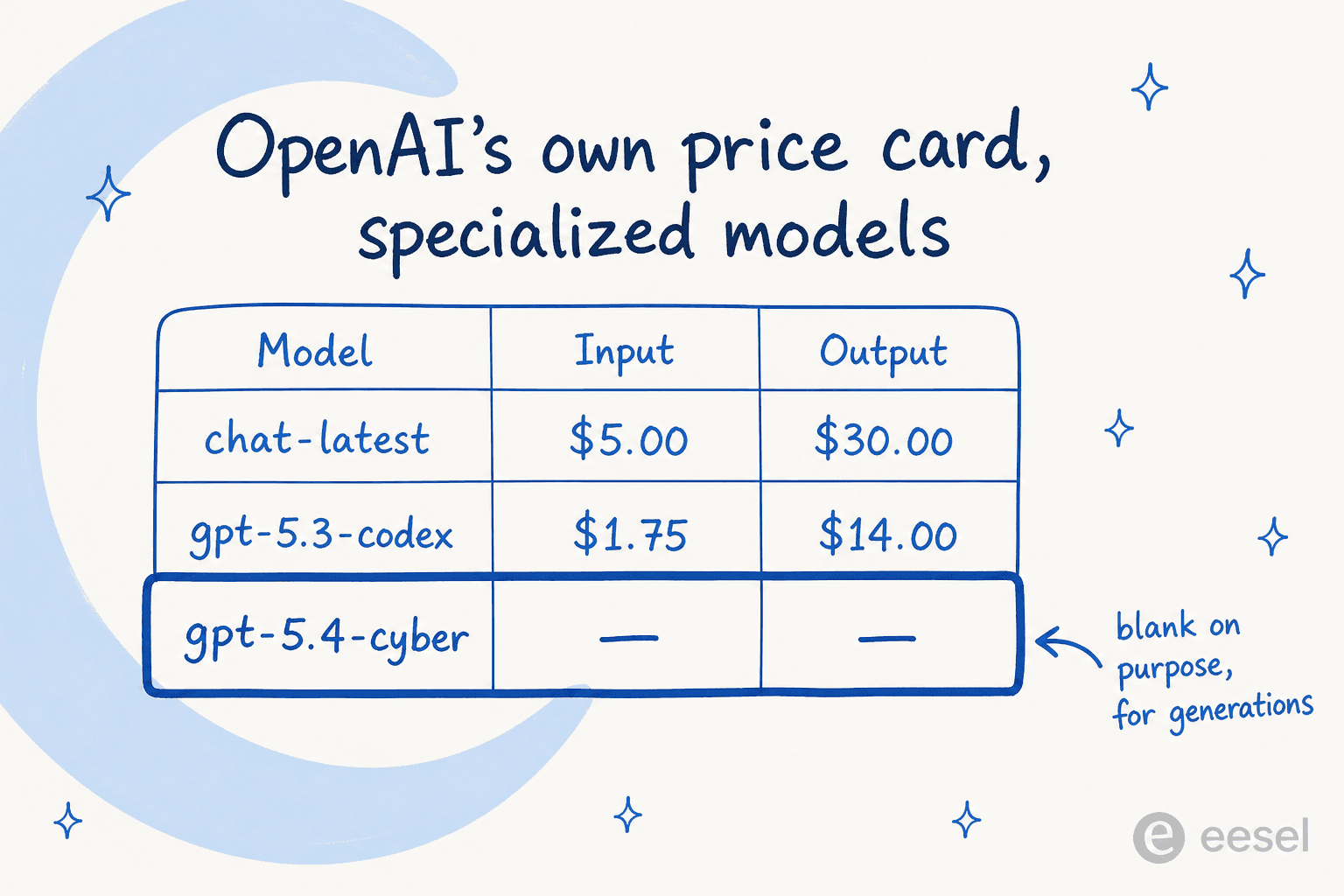
Scroll to the "Specialized models" section of OpenAI's price card and you find three rows. chat-latest is priced. gpt-5.3-codex is priced. The Cyber row is not.
| Category | Model | Input | Cached input | Output |
|---|---|---|---|---|
| ChatGPT | chat-latest | $5.00 | $0.50 | $30.00 |
| Codex | gpt-5.3-codex | $1.75 | $0.175 | $14.00 |
| Cyber | gpt-5.4-cyber | not published | not published | not published |
Three things follow, and each one is checkable on that page right now.
The row names gpt-5.4-cyber. Not the 5.5-Cyber that shipped in June, not the 5.6-Cyber that shipped yesterday. OpenAI has cycled through at least three cyber models while leaving a two-generations-old ID sitting on the card.
The columns are blank rather than absent. OpenAI could have omitted the category entirely. Instead it lists the row and declines to fill it, which reads as "this exists, and it is not something you buy here."
And the pattern is stable across generations. If a Cyber price were coming, there was already a row waiting for it, and it has stayed empty through two model releases.
Compare that with how OpenAI handles every other specialised model. Codex got a published rate. So did AgentKit and the Assistants API. Cyber is the exception, not the backlog.
What the rest of GPT-5.6 costs
Since Sol is the base model GPT-5.6-Cyber is built on, its rate card is your reference point. It is also the tier you get through Daybreak Blue, which is the one most defenders will actually end up using.
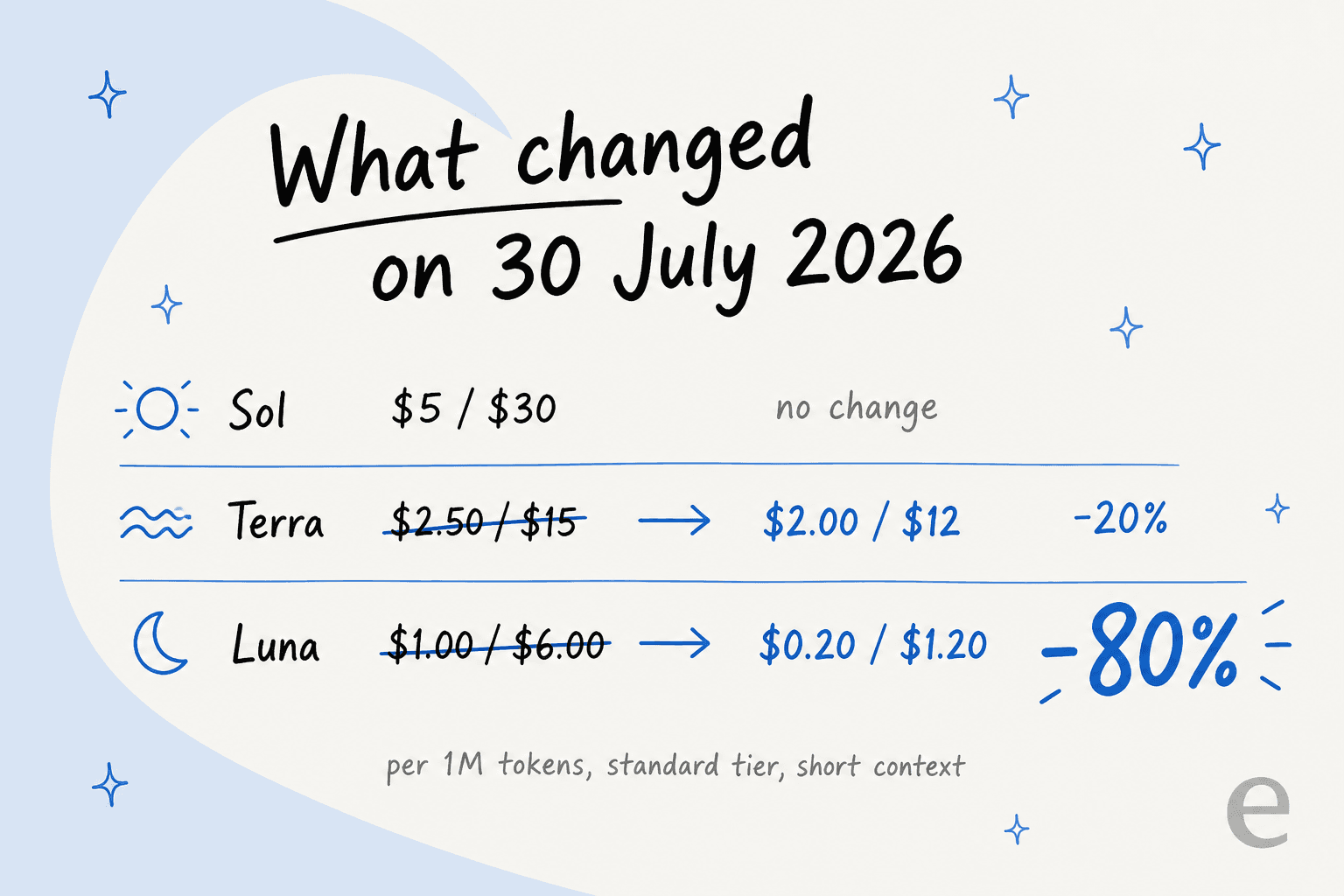
Before the table, one correction worth making loudly, because a lot of coverage still gets it wrong. On 30 July 2026 OpenAI cut Terra by 20% and Luna by 80%. Sol held. If you see $2.50/$15 quoted for Terra or $1/$6 for Luna, including in the body of OpenAI's own July launch post, those are the old numbers. Luna is now five times cheaper than that.
The price card also split into short-context and long-context columns, which it did not have in July. Use the widget to see what your combination actually costs.
Interactive
GPT-5.6 rate card, by service tier
Per 1M tokens. Pick a service tier to see how far the same workload moves.
The default. Real-time responses, list price.
| Model | Short in | Short out | Long in | Long out |
|---|---|---|---|---|
| Sol | $5.00 | $30.00 | $10.00 | $45.00 |
| Terra | $2.00 | $12.00 | $4.00 | $18.00 |
| Luna | $0.20 | $1.20 | $0.40 | $1.80 |
| Cyber | Not published, at any tier | |||
500M in and 100M out on Sol: $5,500 a month.
<div class="pxcalc-panel px-batch">
  <p class="pxcalc-note">Half the standard rate. You trade latency for it, which suits overnight scans and bulk triage.</p>
  <table class="pxcalc-t">
    <thead><tr><th>Model</th><th>Short in</th><th>Short out</th><th>Long in</th><th>Long out</th></tr></thead>
    <tbody>
      <tr><td>Sol</td><td>$2.50</td><td>$15.00</td><td>$5.00</td><td>$22.50</td></tr>
      <tr><td>Terra</td><td>$1.00</td><td>$6.00</td><td>$2.00</td><td>$9.00</td></tr>
      <tr><td>Luna</td><td>$0.10</td><td>$0.60</td><td>$0.20</td><td>$0.90</td></tr>
      <tr class="pxcalc-cyber"><td>Cyber</td><td colspan="4">Not published, at any tier</td></tr>
    </tbody>
  </table>
  <p class="pxcalc-take"><strong>Same 500M in and 100M out:</strong> $2,750 a month. Half.</p>
</div>

<div class="pxcalc-panel px-fast">
  <p class="pxcalc-note">Double the standard rate. Renamed from Priority processing on 30 July 2026; both service_tier values still work.</p>
  <table class="pxcalc-t">
    <thead><tr><th>Model</th><th>Short in</th><th>Short out</th><th>Long in</th><th>Long out</th></tr></thead>
    <tbody>
      <tr><td>Sol</td><td>$10.00</td><td>$60.00</td><td>$20.00</td><td>$90.00</td></tr>
      <tr><td>Terra</td><td>$4.00</td><td>$24.00</td><td>$8.00</td><td>$36.00</td></tr>
      <tr><td>Luna</td><td>$0.40</td><td>$2.40</td><td>$0.80</td><td>$3.60</td></tr>
      <tr class="pxcalc-cyber"><td>Cyber</td><td colspan="4">Not published, at any tier</td></tr>
    </tbody>
  </table>
  <p class="pxcalc-take"><strong>Same 500M in and 100M out:</strong> $11,000 a month. Four times the Batch bill.</p>
</div>
Rates from OpenAI's API pricing page, checked 11 August 2026. Cached input reads keep a 90% discount; cache writes bill at 1.25x the uncached input rate with a 30-minute minimum cache life.
Why Sol's rate is still the wrong number to budget with
Take the reference point, then adjust it in the right direction. Everything below pushes the real cost up, not down.
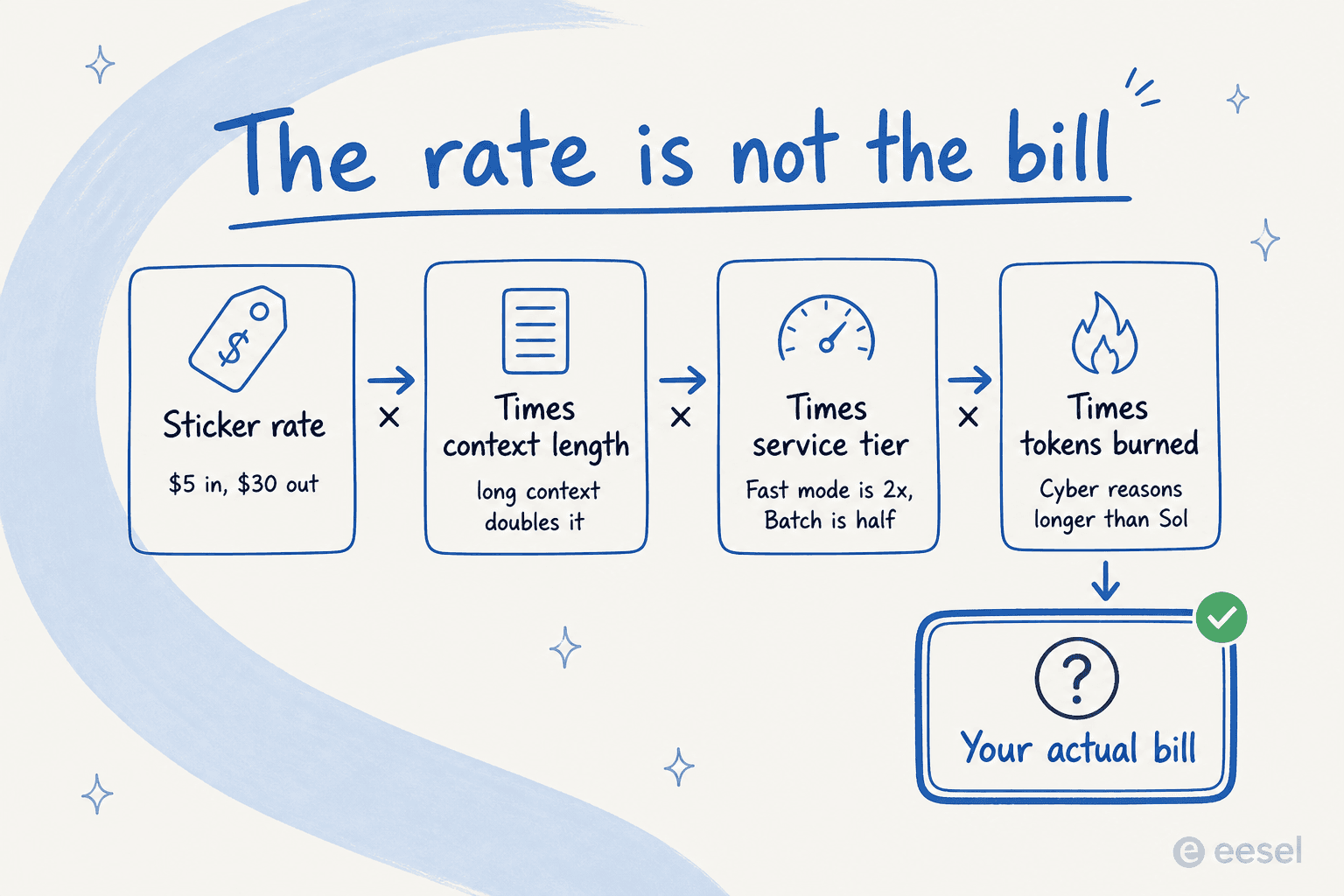
Cyber burns more tokens than Sol. OpenAI states it in a footnote: the model "tends to be more extensive and comprehensive than GPT-5.6 Sol in its reasoning budget, leading to higher token usage." Output bills at six times input on Sol, so a longer reasoning trace is the expensive kind of extra.
Security work is long-context work. Reading an unfamiliar codebase to trace whether vulnerable code is reachable is exactly the workload that tips into the long-context tier, where Sol's input doubles to $10 and output goes to $45. That is a 50% jump on output before you have changed anything else.
Agentic work multiplies turns. ExploitBench's standard setting caps agents at 300 turns, and OpenAI ran an extended comparison at 600. Every turn is tokens. A benchmark that needs hundreds of turns per task is not a cheap workload at any per-token rate. The same dynamic shows up in Sol Ultra, which coordinates four agents in parallel by default and bills for all of them.
Put those together and the honest guidance is: whatever you would budget for Sol on the same task, assume Cyber costs more, and do not let a hypothetical rate parity fool you into thinking otherwise. Our Sol review goes deeper on where the token spend actually goes.
What access actually costs, in things that are not tokens
The invoice is not the only cost, and for most teams it is not the first one they hit.
Vetting time. Every route into Daybreak goes through identity verification, approved-use restrictions, and legal attestations. OpenAI's partner page carries a line worth quoting to anyone building a plan around this: submitting interest "does not guarantee program inclusion, model access, or a production timeline."
Hardware keys, with a deadline. From 1 September 2026, hardware security keys are mandatory for every individual Daybreak account. If your team is on TOTP, that is procurement with a date attached. OpenAI has arranged preferred Yubico pricing for accounts that need them, which softens the unit cost but not the lead time.
Sandbox infrastructure. OpenAI's own guidance is to run these workflows in controlled environments with no access to production systems or the open internet, and to test the sandbox boundaries regularly. That is real infrastructure and real engineering time, and it is not optional in the way it might be for a general coding model.
Existing contracts do not carry over. A ChatGPT Enterprise agreement is not Daybreak access, and neither is reaching OpenAI models through Azure. Daybreak is a separate approval sitting on top of whatever you already pay for.
The partner shortcut has a catch. Going through Accenture, IBM, CrowdStrike, or another Daybreak partner is genuinely faster than applying yourself. But OpenAI is explicit that model access stays with the partner and is "not transferred directly to the customer." You are buying a service engagement, priced like consulting, not an API key priced like tokens.
A worked example you can actually use
Since Cyber has no rate, price the thing that does. Here is a month of Daybreak Blue work at Sol rates, holding the token budget fixed at 500M input and 100M output.
| Setup | Input cost | Output cost | Monthly total |
|---|---|---|---|
| Batch or Flex, short context | $1,250 | $1,500 | $2,750 |
| Standard, short context | $2,500 | $3,000 | $5,500 |
| Standard, long context | $5,000 | $4,500 | $9,500 |
| Fast mode, short context | $5,000 | $6,000 | $11,000 |
| Fast mode, long context | $10,000 | $9,000 | $19,000 |
Same model, same token budget, same work. The bill ranges from $2,750 to $19,000, a factor of nearly seven, entirely on billing choices.
That is the number I would take to a budget conversation, because it is the one you control. Whether OpenAI eventually charges $5 or $8 per million for Cyber matters less than whether your team is running long-context Fast mode when Batch would have done.
For comparison, our Sol pricing breakdown runs the same exercise for general engineering work. If the number comes back too high, Terra clears most of the same bar at 40% of the rate, and the GPT-5.6 alternatives roundup covers what to reach for outside OpenAI entirely.
Worth pricing rival labs at the same time. The OpenAI versus Anthropic API comparison is the closest like-for-like, and GPT-5.6 against Claude covers the capability side of that trade.
When this is likely to change
Two things would need to happen, and only one of them looks close.
OpenAI has committed to publishing a system card for GPT-5.6-Cyber "at a later date." System cards cover evaluations and safeguards, not commercial terms, so that will not answer the pricing question, but it is the next scheduled disclosure and it will tell you how seriously to take the capability claims.
Commercial terms are a harder call. The empty Cyber row has survived at least two model generations, which suggests OpenAI is treating cyber access as a negotiated relationship rather than a product SKU. My read is that this stays quote-based for as long as the vetting requirement stands, because publishing a rate implies anyone can buy it, and the whole architecture is built on the premise that they cannot.
I will update this page when either lands. If you want the movements as they happen, the GPT-5.6 pricing guide is the page we keep current for the whole family, and the Sol alternatives piece tracks what rivals charge for comparable work.
If the wait itself is the problem, that is a fair conclusion to reach. We put together GPT-5.6-Cyber alternatives for exactly that reader.
What I would do instead this quarter
If you have a security programme and a budget cycle that will not wait:
- Apply for Daybreak Blue, not Red. It is free to apply, it is OpenAI's own recommended starting point, and it runs on Sol, which has a published rate you can put in a spreadsheet today. The tier differences are smaller than the names suggest.
- Budget at Sol's standard short-context rate, then add a contingency for long context. That gets you a defensible number without inventing one for Cyber.
- Move anything asynchronous to Batch. Halving the rate on overnight scans is the single biggest lever on this list, and it needs no approval from anyone.
- Start the hardware key procurement now. The 1 September deadline is not far, and it gates access rather than sitting next to it.
- Price a partner engagement in parallel. If your need is outcomes rather than model access, a partner may be both faster and cheaper than staffing this yourself.
Try eesel
Different problem, same frustration. If you have ever tried to budget an AI project against a rate card that does not exist, you know the feeling, and it is one we deliberately designed out.
eesel bills per ticket the AI actually resolves, not per token it happens to burn thinking about one. Before you commit to anything, you can run a simulation across thousands of your own past tickets and see both the resolution rate and the cost, on your real ticket mix rather than a vendor's benchmark.
Then you scope the AI agent to the ticket types you trust and escalate the rest. Every tool action is logged and the sensitive ones can sit behind human approval, which is the part that gets you through a security review rather than stuck in one.
Frequently Asked Questions
How much does GPT-5.6-Cyber cost per token?
Is GPT-5.6-Cyber free if I get approved for Daybreak?
What is the current GPT-5.6 pricing after the July 2026 cut?
Why is GPT-5.6-Cyber pricing not on the OpenAI pricing page?
Will GPT-5.6-Cyber cost more than GPT-5.6 Sol?
What is the cheapest way to run GPT-5.6 for security work?
Do I need to pay for a hardware key to use Daybreak?


Article by
Kurnia Kharisma Agung Samiadjie
Kurnia is a software engineer and writer at eesel AI with two years of SEO experience, writing about AI tools, helpdesk software, and customer support. He pairs a developer's understanding of how these products are built with search-driven research into what actually ranks and resonates with the people searching for them.