9 best GPT-5.6 Sol alternatives in 2026

Rama Adi

Katelin Teen
Last edited July 17, 2026

Why people look for a GPT-5.6 Sol alternative
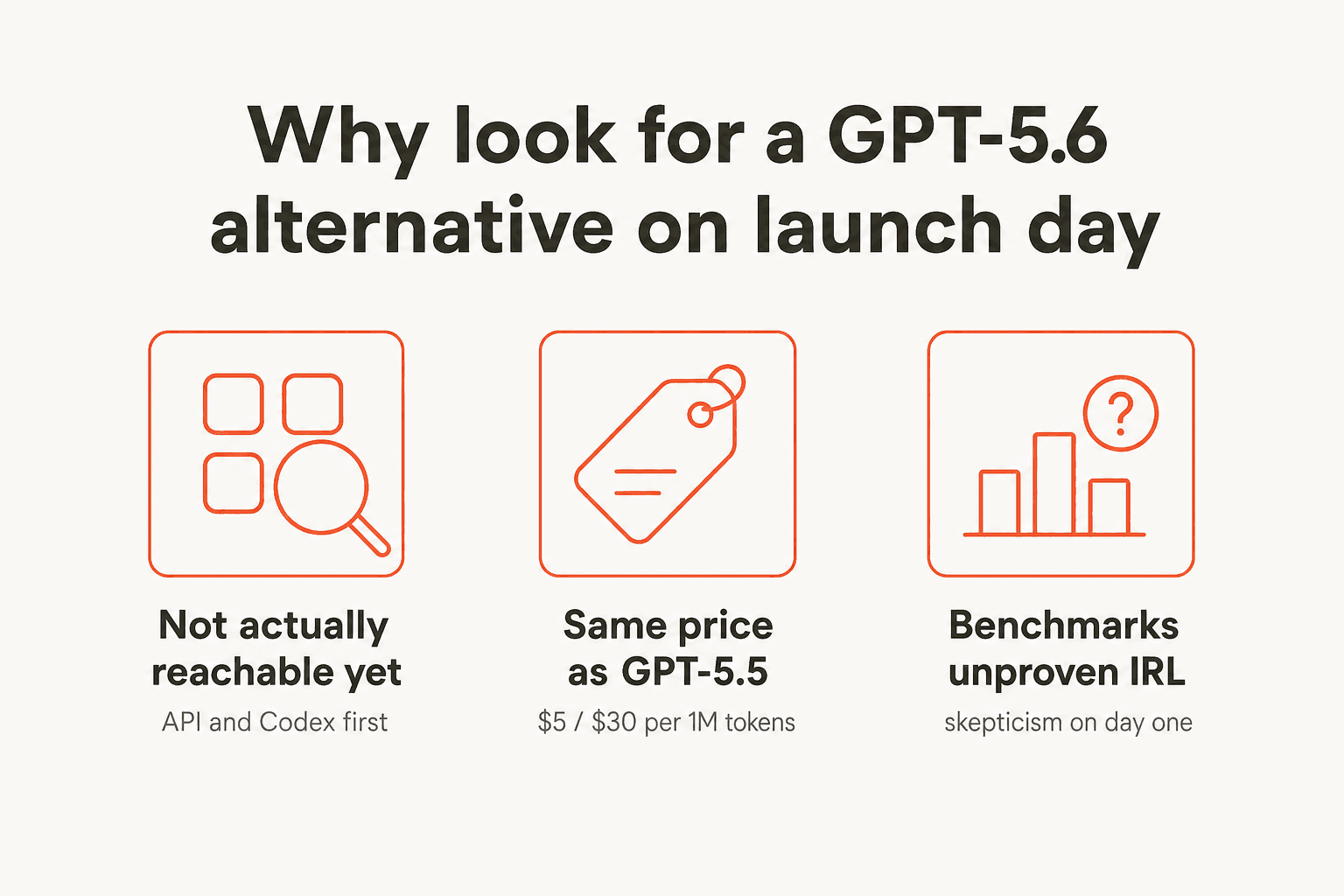
Sol went to general availability on July 9, 2026, after a two-week, US-government-vetted preview that landed badly enough to become its own story. But the reasons people search for a Sol alternative have less to do with that rollout drama and more to do with three plain facts about the flagship tier itself.
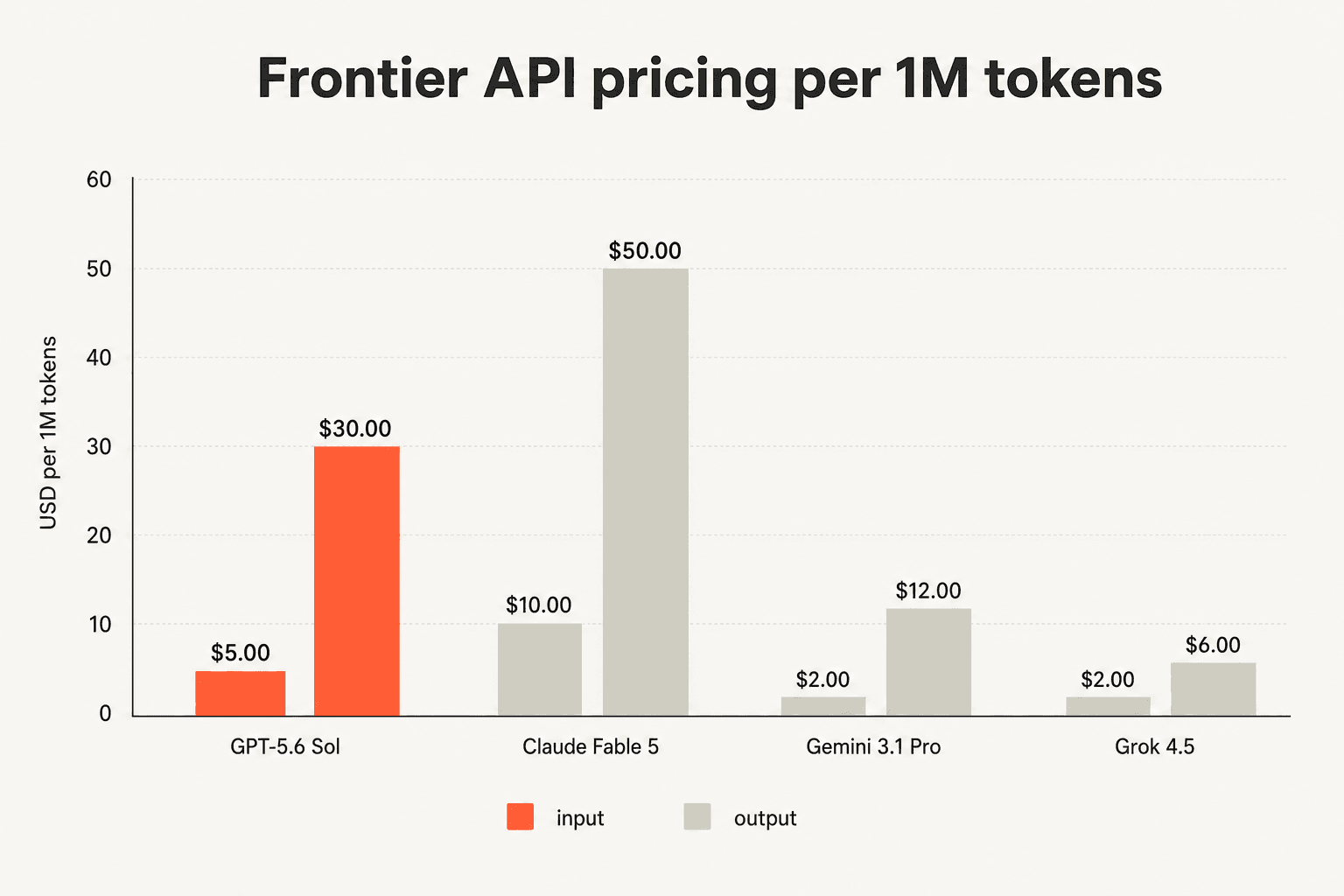
First, the price didn't move. Sol's $5.00 input / $30.00 output per 1M tokens is the exact rate GPT-5.5 charged, so anyone hoping a new generation meant a cheaper flagship got the opposite. A widely-shared r/codex post called the pattern out before launch: "5.5's price had already doubled relative to 5.4... So are we about to get a new frontier model, 5.6 Pro, at $60, going head to head with Fable?" The read that stuck: Sol is real capability at the same price point, which is good if you were already paying GPT-5.5 rates and frustrating if you wanted a discount.
Second, Sol is the top of the family, and OpenAI's own tiering nudges you to look down the ladder before you look sideways. Terra sits at $2.50/$15 (half of Sol) and, per OpenAI's GA benchmarks, scores 87.4% on Terminal-Bench 2.1 against Sol's chart-topping numbers, so even OpenAI's cheaper tier gets you most of the way. When the vendor itself gives you a 50%-cheaper option that's close on evals, "is the flagship worth it?" is the obvious next question.
Third, there's the intelligence ceiling. Zvi Mowshowitz's read of OpenAI's own system card was blunt: "the card gives a clear and consistent impression that GPT-5.6-Sol is a substantial improvement over GPT-5.5, but still short of Mythos." So the flagship you're paying flagship money for is, by one careful read of OpenAI's own documentation, not the smartest model available. That's the exact gap the alternatives below exploit.
None of this makes Sol a bad model. Sol Ultra topped OpenAI's own Terminal-Bench 2.1 chart at 91.9%, and a 750 tokens/sec Cerebras deployment landed right as it went public. It makes Sol one flagship option among several, not the automatic default its price tag implies.
The 9 Sol alternatives at a glance
| Model | Best for | Input $/1M | Output $/1M | Context | Open weights | Free tier |
|---|---|---|---|---|---|---|
| Claude Fable 5 | Raw intelligence, long-horizon coding | $10.00 | $50.00 | 1M tokens | No | No |
| Grok 4.5 | Cheapest frontier-class agentic tool use | $2.00 | $6.00 | 500K tokens | No | Yes, limited |
| Gemini 3.1 Pro | Long context, Google Workspace | $2.00 | $12.00 | 1M tokens | No | Yes, limited |
| DeepSeek-V4 | Cheapest near-frontier option | $0.44 | $0.87 | 1M tokens | Yes | Yes, unmetered chat |
| Mistral Vibe | EU data residency, speed | $1.50 | $7.50 | 256K tokens | Partial | Yes |
| Perplexity | Cited, web-grounded answers | N/A (subscription) | N/A | N/A | No | Yes, limited |
| Qwen3.7-Max | Cheapest API, self-hosting | $1.25 | $3.75 | 1M tokens | Yes (Qwen3 line) | Yes |
| Microsoft Copilot | Office/365 workflows | N/A (subscription) | N/A | N/A | No | Yes, limited |
| Meta AI | Free, everywhere | Free | Free | Undisclosed | Partial (Llama) | Yes, unlimited |
| GPT-5.6 Sol (for reference) | Cybersecurity, frontier reasoning | $5.00 | $30.00 | Undisclosed | No | No, API/ChatGPT flagship |
How I picked these
I build integrations against these APIs, so I started from what each model actually ships rather than its marketing page: published API pricing, independent benchmark scores where they exist, and what real users say on Reddit, Hacker News, X, and LinkedIn once the hype cycle settles. A few of these (Gemini 3.1 Pro, Perplexity, Microsoft Copilot, Meta AI) aren't raw frontier models in the same technical sense as Sol, they're products built on top of one, but they're exactly what a reader typing "GPT-5.6 Sol alternative" is actually comparing against, so leaving them out would be dishonest curation.
1. Claude Fable 5 - best for raw intelligence
Claude Fable 5 is Anthropic's fifth-generation flagship, and it's the model Sol is chasing. Anthropic positions it as "designed to handle days-long, complex, and asynchronous tasks previous models couldn't sustain," and Stripe reportedly used it for a 50-million-line Ruby migration, run across the whole codebase in a day.
Pricing: $10 per 1M input tokens, $50 per 1M output, exactly 2x Claude Opus 4.8's rate, with a 90% prompt-caching discount on repeated context.
Where it wins over Sol: Zvi Mowshowitz's read of OpenAI's own system card gave the blunt verdict that Sol is "still short of Mythos." Fable also carries a genuinely enormous 1M-token context window and one of the most enthusiastic hands-on reviews of any model this year: Simon Willison called it "something of a beast. It's slow, expensive and has been quite happily churning through everything I've thrown at it so far."
Where it falls short: it's 2x Sol's input price, so you're paying more for the intelligence edge, and it comes with its own trust controversy, a second, undisclosed safeguard tier that quietly degrades responses on "frontier LLM research" prompts without telling the user.
"An AI model that gets less intelligent automatically without notifying me is categorically misaligned AI."
My take: the pick if intelligence and long-horizon autonomy matter more than price, and you can stomach a real trust asterisk of its own. Full breakdown in our Claude Fable 5 review and Claude Fable 5 for business.
2. Grok 4.5 - best for cheap agentic tool use
Grok 4.5 is xAI's current flagship, and it holds the best agentic tool-use score of any model tested, at a price Sol doesn't come close to. Cursor's CEO called it an "Opus-class model that's fast and low cost."
Pricing: $2.00 per 1M input tokens, $6.00 per 1M output - less than half of Sol's input rate and a fifth of its output rate.
Where it wins over Sol: the price-to-agentic-performance ratio, plus real speed at 85.6 output tokens/sec against a roughly 73 average. If your workload is tool-calling and agent loops rather than raw reasoning, Grok gets you frontier-adjacent behavior for a fraction of Sol's bill.
Where it falls short: it's ranked #4 on Artificial Analysis's Intelligence Index, behind Claude Fable 5, Claude Opus 4.8, and GPT-5.5, so it's not the raw-reasoning pick over Sol. It also carries a live, unresolved trust concern of its own, over allegations that xAI nudges Grok's answers on political questions, which was the loudest theme in its own Hacker News launch thread.
My take: the pick if you want frontier-adjacent agentic performance at a price Sol's flagship tier can't match. Full breakdown in our Grok 4.5 review and Grok 4.5 pricing guide.
3. Gemini 3.1 Pro - best Google-ecosystem all-rounder
Gemini 3.1 Pro is Google's direct answer to ChatGPT and Claude: a 1M-token context window, native multimodal reasoning, and deep grounding in Google Search. It's also one of the models inside Perplexity's model picker, which tells you where it sits competitively.
Pricing: $2.00 per 1M input tokens (up to 200K), $12.00 per 1M output - well under Sol on input, and less than half on output.
Where it wins over Sol: genuinely strong math and technical precision, per one Reddit switcher: "Gemini is way better with math expressions. GPT makes dumb mistakes with operators and coefficients all the time," and it's tightly wired into Search, Gmail, Docs, and Sheets in a way Sol can't match outside ChatGPT. Another switcher put it bluntly: "I genuinely cannot believe I wasted so much time and money on ChatGPT when Gemini is so much better."
Where it falls short: paying subscribers have reported real feature-parity bugs; one wrote that "as a paying customer, I have less feature access than someone using the service for free," and the community consensus on the paid tier's value has at times been unflattering: "Buying a Google Gemini subscription feels like paying for tap water at a restaurant."
My take: the safest default if you already live in Google Workspace and want a flagship-class model at well under Sol's price. Full pricing in our Google Gemini 3 pricing guide and Gemini alternatives roundup.
4. DeepSeek-V4 - best free and cheap open-weight pick
DeepSeek is the Chinese lab that put open-weight frontier models on the map, and its current flagship, DeepSeek-V4, is the sharpest budget answer to Sol on this list. The consumer chat is completely free with no metered cap, and the weights are public on GitHub for anyone who wants to self-host.
Pricing: deepseek-v4-pro at $0.435 per 1M input tokens and $0.87 per 1M output, roughly a tenth of Sol's rate; deepseek-v4-flash is even cheaper at $0.14/$0.28.
Where it wins over Sol: the price, by a huge margin, plus a matching 1M-token context window and no vendor lock-in since the weights are open. If you outgrow the hosted API, you can run it yourself, which no OpenAI flagship lets you do.
Where it falls short: DeepSeek is hosted in China under Chinese data law, a recurring concern in community threads, and its real-time web search and current-events freshness noticeably lags Gemini's Google-backed research. It's also a stronger pick for math and coding than for anything that needs today's news.
My take: if your workload is high-volume and cost-sensitive rather than research-freshness-sensitive, this beats Sol on price alone by roughly an order of magnitude. More detail in our DeepSeek V3.2 overview and Together AI pricing guide (which hosts DeepSeek-V4 too).
5. Mistral Vibe - best for EU data residency
Mistral AI is the European frontier lab, and its homepage tagline is blunt: "Frontier AI. In your hands." That's a hard focus on data sovereignty, a genuinely different value proposition than a US flagship can offer. Its consumer/agent product, previously called Le Chat, is now branded Vibe, and the flagship model behind it is Mistral Medium 3.5.
Pricing: Mistral Medium 3.5 at $1.50/$7.50 per 1M tokens; the cheaper Mistral Small 4 runs $0.10/$0.30. Vibe subscriptions start free, with Pro at $14.99/month.
Where it wins over Sol: genuine EU hosting and self-hosted deployment options for organizations that legally can't send data to a US server, which is a category Sol can't serve. It also draws consistent praise for speed: one Reddit user said Le Chat/Vibe "is faster, produces more relevant content, produces better images."
Where it falls short: Mistral's own users are candid about the capability gap. Reddit calls the large models "way, way behind Claude and ChatGPT for advanced stuff" and "currently it's just cheap." G2 reviewers, even the positive ones, note it's "less refined than Claude."
My take: the right call if EU data residency is a compliance requirement, not a preference. Otherwise the intelligence gap versus Sol is real. See our Mistral AI pricing guide, Mistral AI reviews roundup, and Mistral vs Microsoft Copilot comparison.
6. Perplexity - best if you actually want a search engine
Perplexity isn't a model, it's an AI answer engine that searches the live web and returns answers with inline, clickable citations, orchestrating several frontier models behind one interface. If what actually frustrates you about Sol is confidently-wrong answers with no way to check them, this solves a different problem than a smarter base model would.
Pricing: Free tier with limited Pro searches; Pro at $20/month ($17/month annual); Max at $200/month ($167/month annual); Enterprise from $40/seat/month.
Where it wins over Sol: verifiable sources on every claim, which is the single feature Reddit cites most for sticking with Perplexity. One user framed the gap this way: "Gemini ignores instructions, drifts off into weird tangents, and hallucinates with way more confidence." The same critique applies to any raw chat model, Sol included.
Where it falls short: the loudest current complaint is tightened Pro limits, opaque model routing, and a fallback to a weaker model after a handful of "advanced" queries a day.
My take: pick this when the job is research with receipts, not open-ended reasoning or coding. More in our Perplexity pricing guide and Perplexity review.
7. Qwen - best for self-hosting and rock-bottom pricing
Qwen is Alibaba Cloud's model family, and it's the largest catalogue on this list by a wide margin: 145+ model IDs spanning text, vision, audio, code, and video under one API key. Its flagship, Qwen3.7-Max, launched May-June 2026 as an agent-optimized reasoning model.
Pricing: Qwen3.7-Max at a promo-discounted $1.25/$3.75 per 1M tokens (undiscounted $2.50/$7.50); the open-weight Qwen3 line runs from $0.05/1M and can be self-hosted for free on commodity hardware - a recurring Reddit theme is a quantized 30B model running locally on an M4 MacBook at roughly 45 tokens/sec.
Where it wins over Sol: the sheer breadth of price points, and a structural cost advantage developers on X and LinkedIn attribute to its mixture-of-experts architecture firing only 4-10% of parameters per token - "structurally 9x cheaper than Claude," in one framing, not a promotional loss-leader.
Where it falls short: Alibaba cut its free API tier hard in April 2026, from 1,000 requests/day down to 100, then to zero, and the backlash was immediate; Reddit users migrated to Claude, OpenRouter, or invested in self-hosting hardware in response.
My take: the pick if you're technical enough to self-host, or just want the cheapest ticket into near-frontier output. Full pricing in our Qwen pricing guide, Qwen review, and Qwen alternatives roundup.
8. Microsoft Copilot - best if you live in Microsoft 365
Microsoft Copilot is less a Sol competitor and more a workflow decision: it's the assistant embedded directly in Word, Excel, PowerPoint, Teams, and Outlook, with enterprise security policies inherited automatically, rather than a chatbot you go visit. (Worth noting some Copilot surfaces already run on OpenAI models under the hood.)
Pricing: free consumer tier; Microsoft 365 Personal at $99.99/year; Business Copilot at $18-21/user/month; Enterprise at $30/user/month.
Where it wins over Sol: context. Copilot can read your actual emails, documents, and meeting transcripts because it's embedded where the work already happens, something a standalone flagship doesn't offer out of the box. A Product Manager summed up the split: "I use ChatGPT for creative or research-heavy tasks because it just thinks better, but prefer Copilot for drafting presentations or summarizing Teams calls because it already has the context."
Where it falls short: only 35.8% of eligible users actually use Copilot despite deployment, and it struggles with datasets over 150 rows and degrades after 20-30 exchanges in a session. Outside the Microsoft ecosystem, it's simply not competitive on open-ended reasoning.
My take: worth it only if the underlying M365 spend already exists; a poor standalone pick otherwise. More in our Copilot pricing guide and Mistral vs Microsoft Copilot comparison.
9. Meta AI - best free pick if cutting-edge isn't the priority
Meta AI runs on Llama 4 and is embedded directly into Facebook, Instagram, WhatsApp, Threads, and Ray-Ban glasses, free, with no subscription tier at all. It's the most-installed AI assistant on this list simply by virtue of being baked into apps billions of people already open daily.
Pricing: Free, full stop, across every surface.
Where it wins over Sol: zero cost, zero setup, and it's already where a huge share of the internet spends its time. Specialized offshoots like Llama-4:scout for vision tasks draw genuine praise for narrow use cases.
Where it falls short: on general model quality, the community read is blunt.
"Their last model was updated in April, and it's an absolute joke. It's worse in every aspect when compared to ChatGPT, Gemini, and even Grok."

It's also the most invasive of anything on this list: an exposed system prompt revealed instructions to "never share that a user's information is being accessed" while personalizing answers from saved facts, location, and history.
My take: fine for quick, casual questions inside an app you're already using; not a serious Sol replacement for anything that needs to be right. More in our Meta AI chatbot guide and Meta Artificial Intelligence overview.
Does the flagship even matter for support?
Here's the pattern that repeats across every one of these nine alternatives, and it holds for Sol too: every lab ships a capable flagship, and not one of them ships a hard stop on confidently wrong answers. Anthropic buries a second, silent safeguard tier in Fable 5. DeepSeek and Qwen are cheap but their freshness and hallucination rates aren't independently audited the way the big labs' are. Meta AI will cheerfully answer a support question wrong with the same confidence it answers one right. Spending $30 per million output tokens on Sol instead of $6 on Grok doesn't change that.
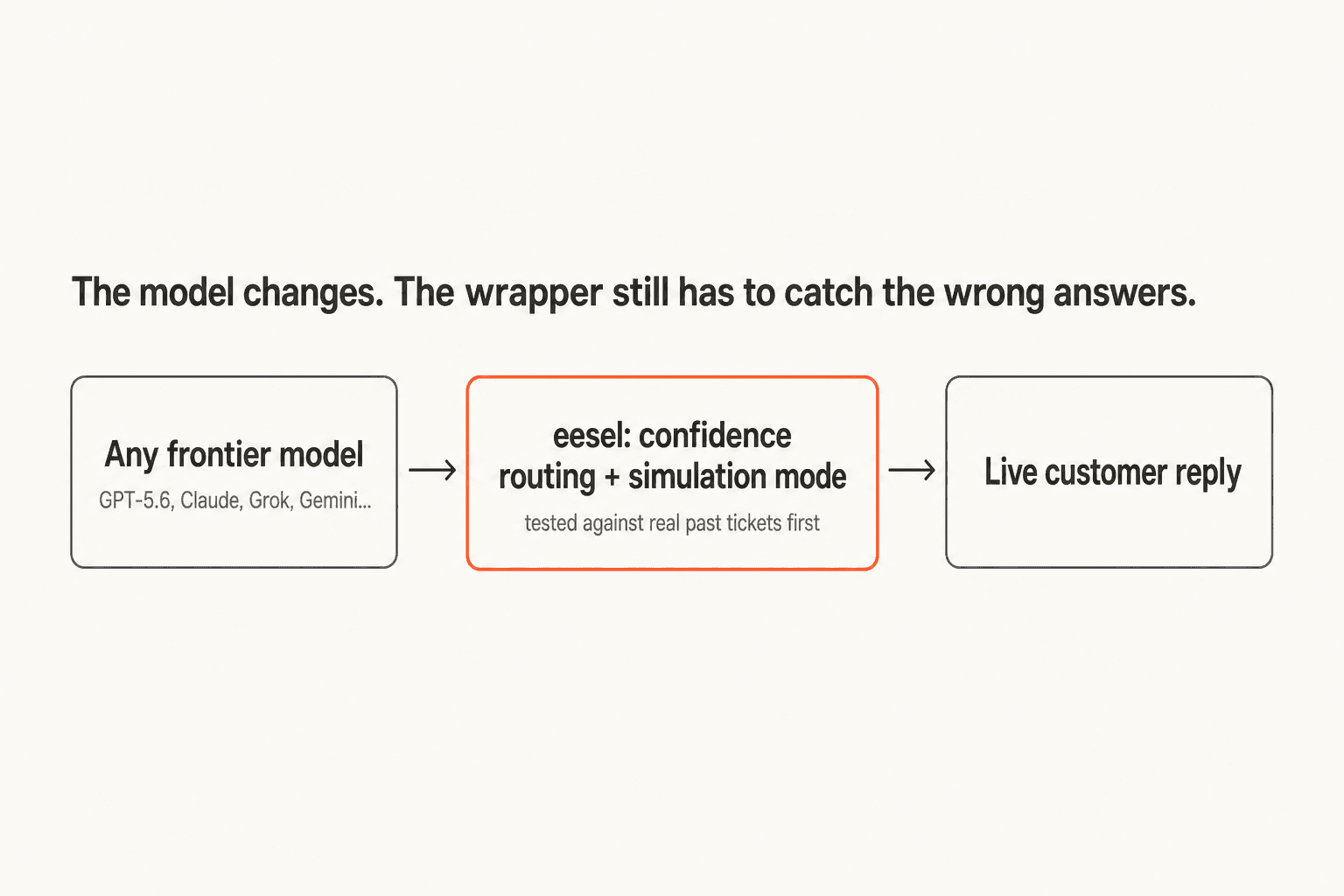
I work on eesel's product, and across three-plus years of putting AI agents on live support queues, the failure mode is always the same regardless of which flagship sits underneath: a bot with no hard fallback on a failed knowledge-base lookup will fabricate an answer rather than say it doesn't know. That's not a Sol problem, or a Claude problem, or a Qwen problem. It's what every capable model does the moment nothing stops it from guessing, and it's exactly why eesel runs simulation mode against your own historical tickets before any model goes live on a real customer, the same rigor I'd want applied to any vendor claiming a benchmark win on launch day.
Try eesel
Whichever flagship wins this round, GPT-5.6 Sol, Claude Fable 5, Grok 4.5, or something cheaper entirely, the hard part of AI support was never picking the smartest LLM underneath it. eesel sits on top of your existing helpdesk, whether that's Zendesk, Freshdesk, Gorgias, HubSpot, or Front, learns from your real ticket history on day one, and simulates against thousands of your past tickets before it ever answers a live customer. Gridwise saw eesel resolve 73% of tier-1 requests in the first month. Pricing is one fixed monthly plan from $299/month for 500 credits (1 credit per ticket or chat), no seat fees, so a flagship launch day never means re-paying for a model you didn't ask for. You can try eesel free, with 100 free credits and no card.