


Update — July 8, 2026: Anthropic is extending Fable 5 access. Per Claude on X: "We’re extending access to Claude Fable 5 on all paid plans through July 12." — @claudeai
What is Claude Fable 5?
Claude Fable 5 is Anthropic's fifth model generation and the public half of a two-model pair (the other, Mythos 5, is the same model with safeguards removed, gated to vetted research partners). Anthropic pitches it as "a Mythos-level model built for your most ambitious, long-running projects", designed to handle "days-long, complex, and asynchronous tasks previous models couldn't sustain."
Here's what matters once you strip away the launch-day noise:
- It's the top of the ladder. Fable 5 sits above Opus 4.8, which sits above Sonnet 4.6. If you've read our Claude overview, this is the new ceiling.
- It's twice the price of Opus. $10 per million input tokens, $50 per million output, exactly 2x Opus 4.8's $5 / $25. Cached input tokens get a 90% discount, and US-only inference carries a 1.1x surcharge.
- It's big. A 1,000,000-token context window, 128,000 max output tokens, and a January 2026 knowledge cut-off.
- It's everywhere. Available on claude.ai, the Claude API, Amazon Bedrock and Claude Platform on AWS, and Microsoft Foundry, plus Claude Code and Claude Managed Agents.
The benchmark story backs up the hype, at least on paper. Anthropic's own comparison puts Fable 5 well ahead of the rest of the frontier:
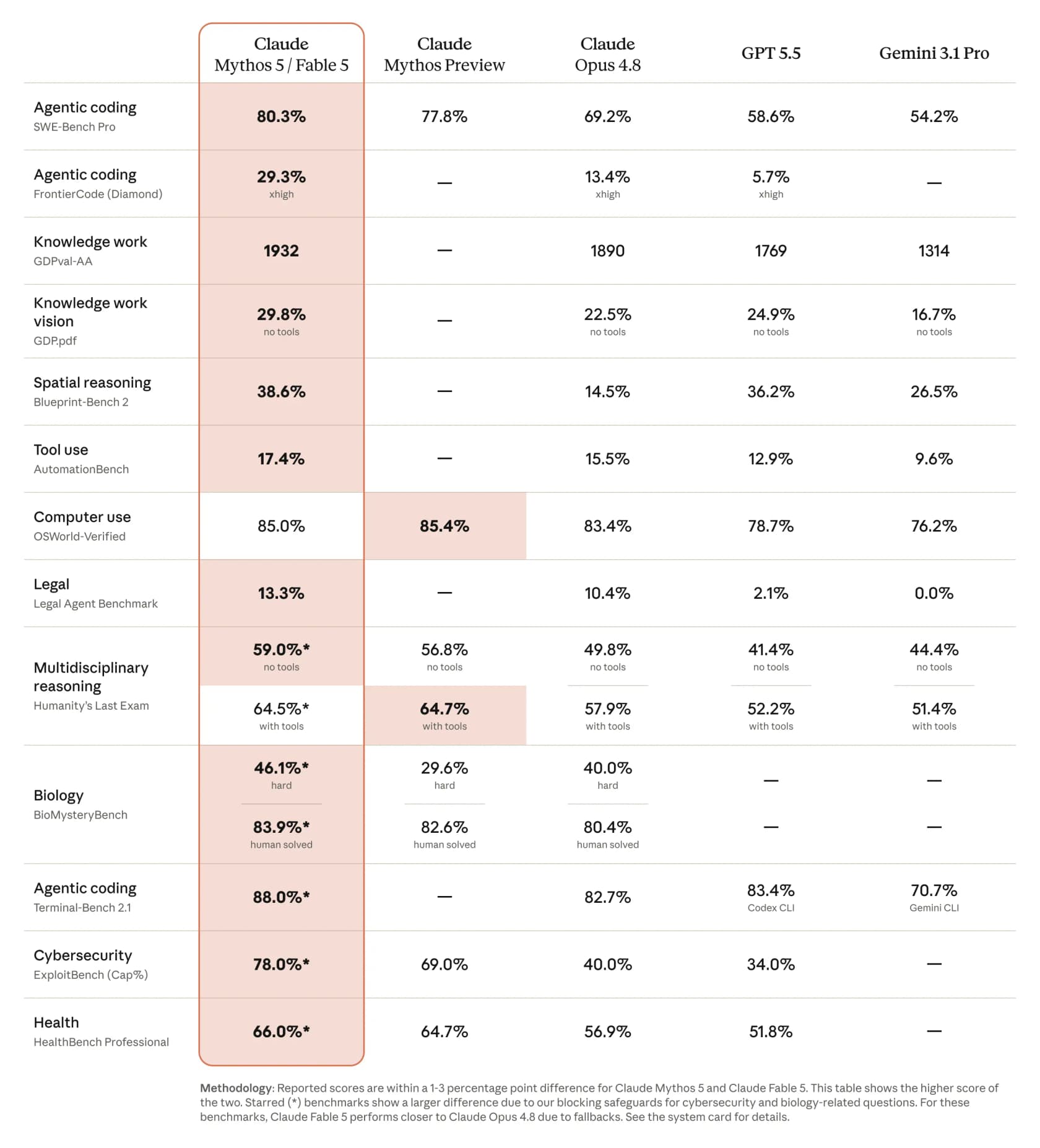
On SWE-Bench Pro (agentic coding), Fable 5 scores 80.3% against Opus 4.8's 69.2%, with GPT 5.5 at 58.6% and Gemini 3.1 Pro at 54.2%. CNBC reported the gap as "more than 10% higher than Claude Opus 4.8" on some benchmarks. Real numbers, real lead. The catch is what it costs to get them, which we'll come back to.
What actually makes it different for business
Plenty of model launches are a few benchmark points and a press release. Fable 5 is doing something more specific: it's built to run for a long time without falling apart. That's the capability businesses should care about, not the leaderboard.
It can work for days, not minutes
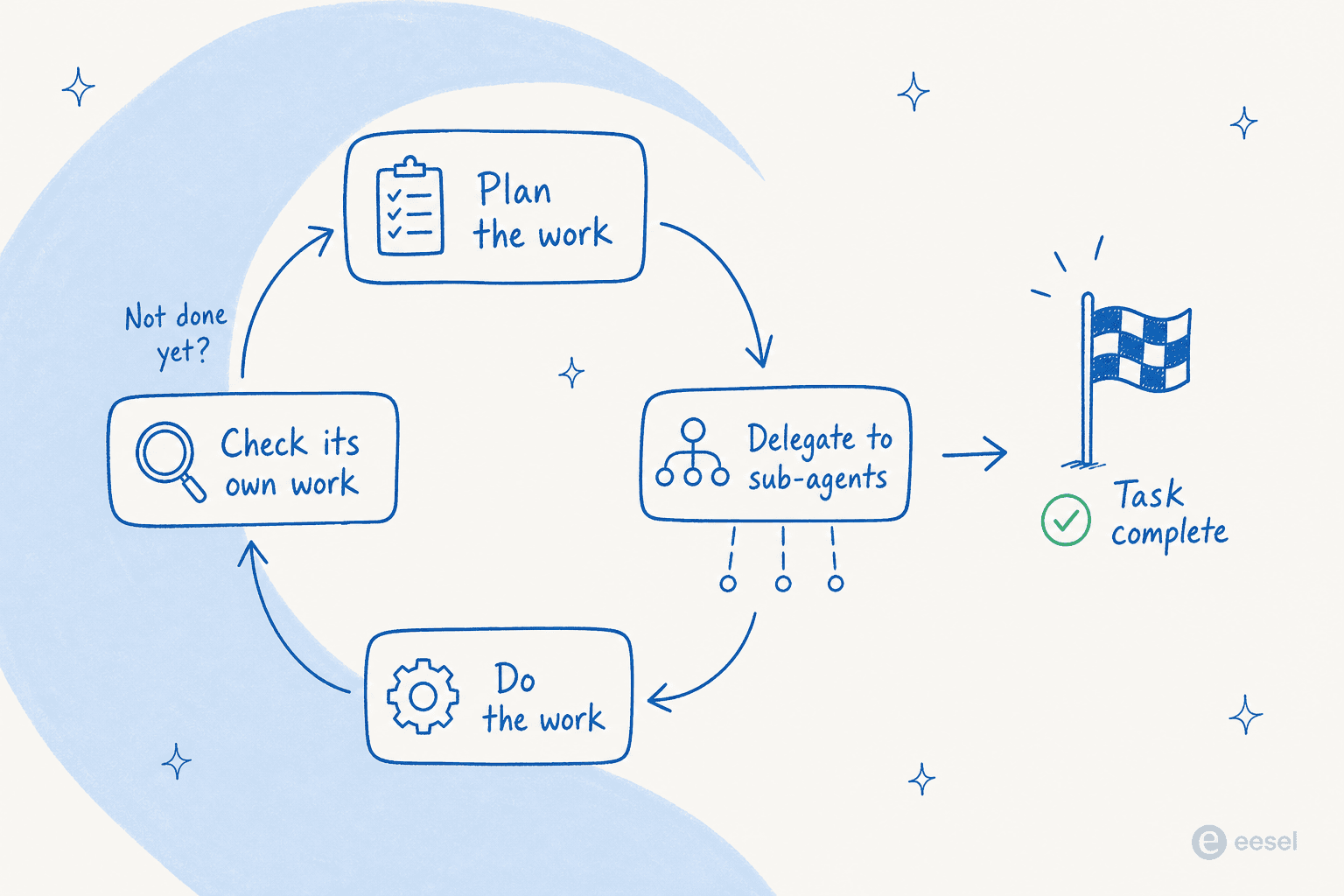
The headline use case is long-horizon autonomous work. Run Fable 5 inside an agent harness like Claude Code or Claude Managed Agents and, in Anthropic's words, "it can work for days at a time: planning across stages, delegating to sub-agents, and checking its own work." Stripe pointed it at a 50-million-line Ruby codebase and ran a migration across the whole thing in a day.
That loop, plan, delegate, work, check, repeat, is the part that's genuinely new. Earlier models tapped out on multi-stage tasks; this one keeps its footing.
Independent testing matches the marketing. Developer Simon Willison spent five and a half hours with it and concluded:
"This is something of a beast. It's slow, expensive and has been quite happily churning through everything I've thrown at it so far. As is frequently the case with current frontier models the challenge is finding tasks that it can't do."
It reads the messy documents your team actually has
Fable 5 "understands diagrams, charts, and tables nested in files and PDFs," which Anthropic frames around finance, legal, and analytics work. One Hacker News user reported it correctly flagging "done / somewhat done / missing" across a 50-page PDF of dense interconnected specs. For any business sitting on a pile of contracts, spec sheets, or policy docs, that's more useful than another point on a coding benchmark.
It tests its own work
Anthropic markets Fable as "thorough, proactive, and tests its own work," and the cloud providers describe a plan / check / refine loop baked in. Self-correction is the difference between an agent you babysit and one you can leave alone, which is exactly what matters when you're automating real work.
The catch nobody puts on the landing page
Here's where we'd pump the brakes. Fable 5 is powerful, but the first 24 hours of real-world use surfaced some very practical problems, and they all cost money.
It burns through budget fast. Simon Willison tracked a single day of testing at $110.42 of token spend. One Max-plan user maxed their 5-hour usage limit in 20 minutes running 1,000 subagents; another burned an entire 5-hour window in under 8 minutes plus $15 of overage. When a model is twice the price and works much harder per task, the bill adds up quickly.
To be fair, there's a counter-narrative worth holding onto: Canva's evaluations lead found Fable used about half the tokens of Opus 4.8 in their internal agentic harnesses, so real-world cost can land roughly the same once you account for efficiency. The lesson isn't "Fable is unaffordable," it's "your costs depend entirely on how you run it."
Its safety routing can misfire. For cybersecurity, biology, and chemistry topics, Fable runs classifiers that silently route the response to Opus 4.8 instead. Anthropic says at least 95% of sessions run entirely on Fable without any fallback, but the 5% includes false positives, one user in laboratory automation got refused on a basic liquid-handling protocol with nothing risky in it. If your business is in a technical vertical, test before you commit.
The price you see today may not last. Fable is free on Pro, Max, Team, and seat-Enterprise plans only until June 22, 2026, after which it moves to usage credits. Build your workflow assuming the metered price, not the launch promo.
None of this makes Fable 5 a bad model. It makes it a frontier tool with frontier-tool economics, and that has direct consequences for how you'd actually deploy it.
What Claude Fable 5 means for customer support
This is where we live, so let's be specific. If you run a support team, should you care about Fable 5?
Mostly: not as much as the hype suggests. Here's the uncomfortable truth about AI for customer service: for tier-1 tickets, the model is rarely the bottleneck. A well-grounded Opus 4.8 or even Sonnet 4.6 already answers the overwhelming majority of "where's my order," "how do I reset my password," "what's your refund policy" questions correctly. Paying double for Fable 5 to answer them is like renting a Formula 1 car for the school run.
What actually decides whether your AI helpdesk agent works is everything around the model:
- Does it know your business? A model is only as good as what it's grounded in. The win comes from training on your past tickets and help docs, not from a smarter base model.
- Does it know when to shut up? Raw models answer confidently even when wrong, which is precisely why chatbots give bad answers. Production agents need confidence-based routing so low-confidence questions get drafted or escalated, not auto-sent.
- Can you trust it before it goes live? You need to see the error rate on your own tickets first, not discover it in front of customers.
That last point is the one buyers care about most. The support leaders we talk to don't ask for an AI that answers everything; they ask for one that knows its limits. As one DTC supplements CX lead put it in a customer interview, the AI will never answer 100% of questions, so what they actually want is an agent that only handles the tickets it's confident about and leaves the rest alone. That's a product capability, not a model capability.
Fable 5 doesn't solve any of that for you. A raw model with no retrieval, no routing, and no testing is a confident intern with access to your reply button. The model tier is the least of your worries.
Build vs buy: should you wire Fable 5 in yourself?
This is the real decision for a business, and it comes up constantly. "Anthropic just shipped an incredible model, why don't we just build our support bot on the API?"
You can. It's also a bigger project than it looks. The model gives you intelligence. It does not give you the connection to your helpdesk, the guardrails, the simulation environment, the reporting, or the ongoing maintenance. All of that is yours to build and own.
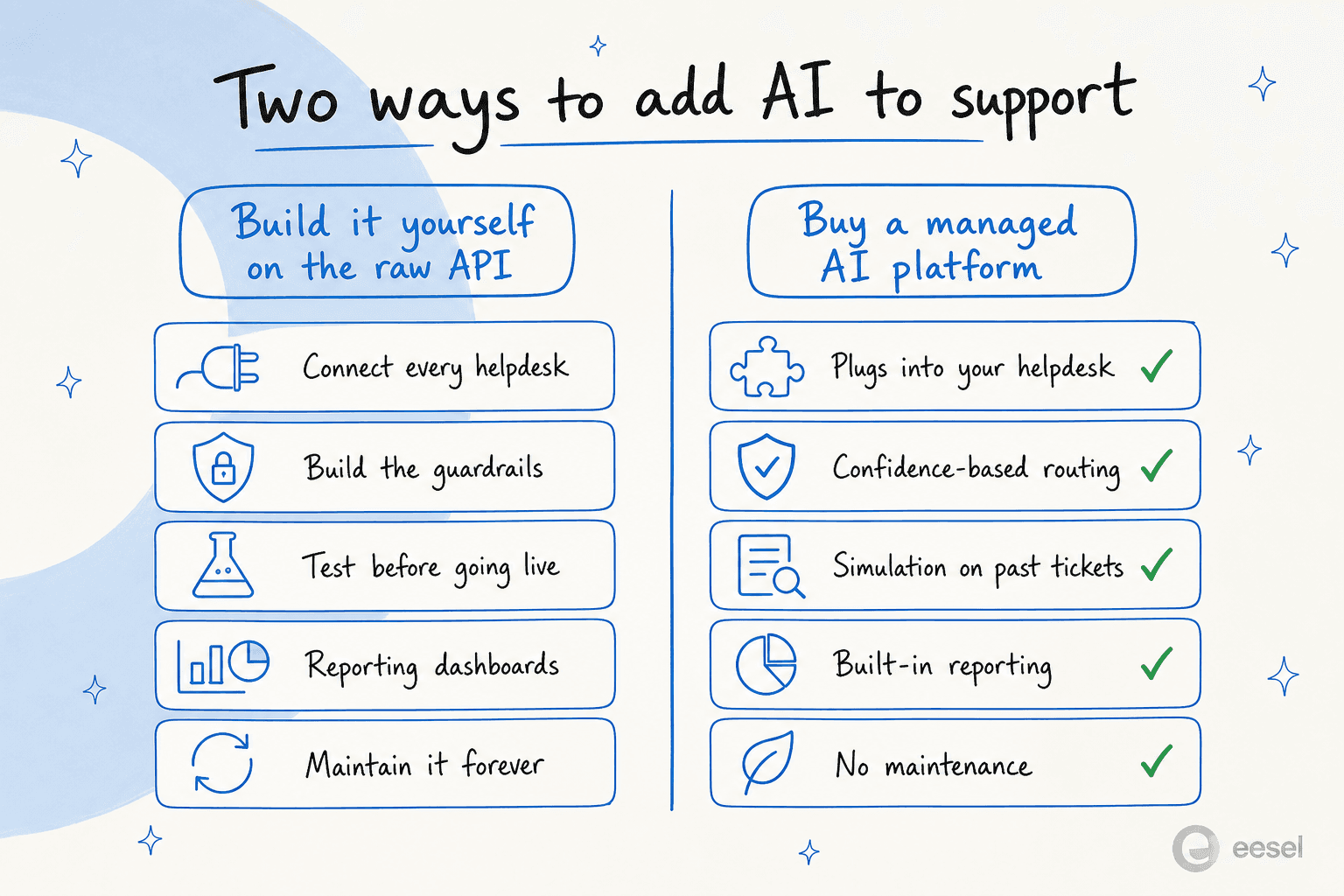
We see how this plays out, because "we'll just build it on the Claude API" is one of the most common reasons technical teams give before they buy. Some genuinely do it. Several who tried later switched to buying instead, because maintaining a homegrown LLM app turned out to be a job nobody wanted. One customer summed up the calculus:
"We could try to write our own LLM application but we didn't want to invest our time into that. We wanted something that we would not have to maintain."
The way to think about it: a frontier model is the bottom layer of the stack, not the whole stack. Everything that turns it into a customer-ready agent sits on top, and that's the part that takes the time.
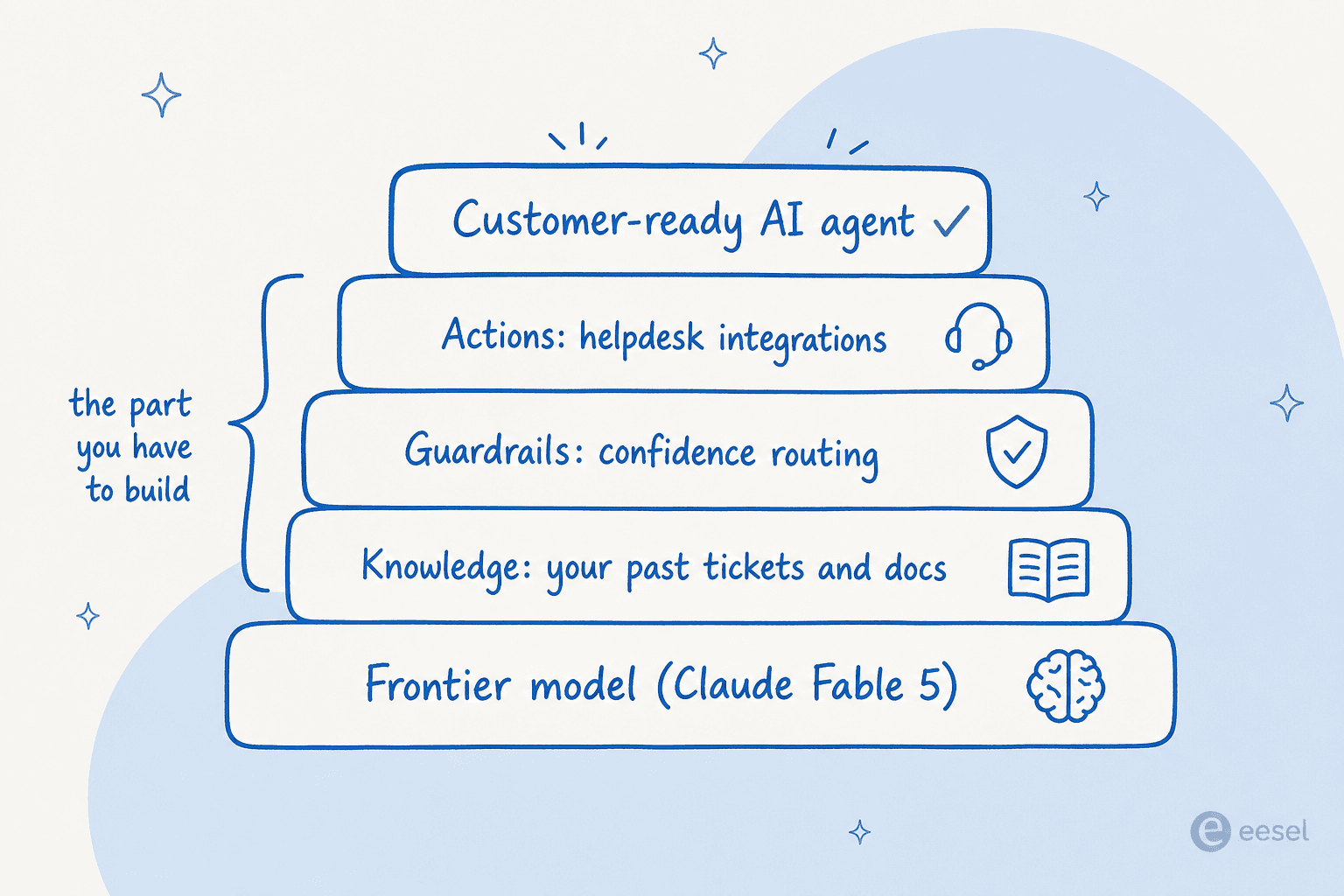
If your team's core product is AI, by all means build. If your core product is anything else, and you just want tickets answered well, buying the layers above the model is almost always faster, cheaper, and less fragile. It's the same logic behind picking any AI agent over a rule-based chatbot: you want the outcome, not the maintenance contract.
Try eesel
eesel AI is the layer that sits on top of frontier models like Claude so you don't have to build it. It plugs into your existing helpdesk (Zendesk, Freshdesk, HubSpot, Gorgias, Front and 100+ integrations), learns from your past tickets and help docs on day one, and answers in 80+ languages, all on usage-based pricing that starts at $0.40 per ticket with no per-seat fees.
The differentiator that matters here is the part Fable 5 can't give you on its own: a simulation mode that runs the agent against thousands of your past tickets so you see exactly how it would have responded, and what your resolution rate would be, before a single customer talks to it. That's how Gridwise got to 73% of tier-1 requests resolved in their first month, with results showing up during a 7-day trial.
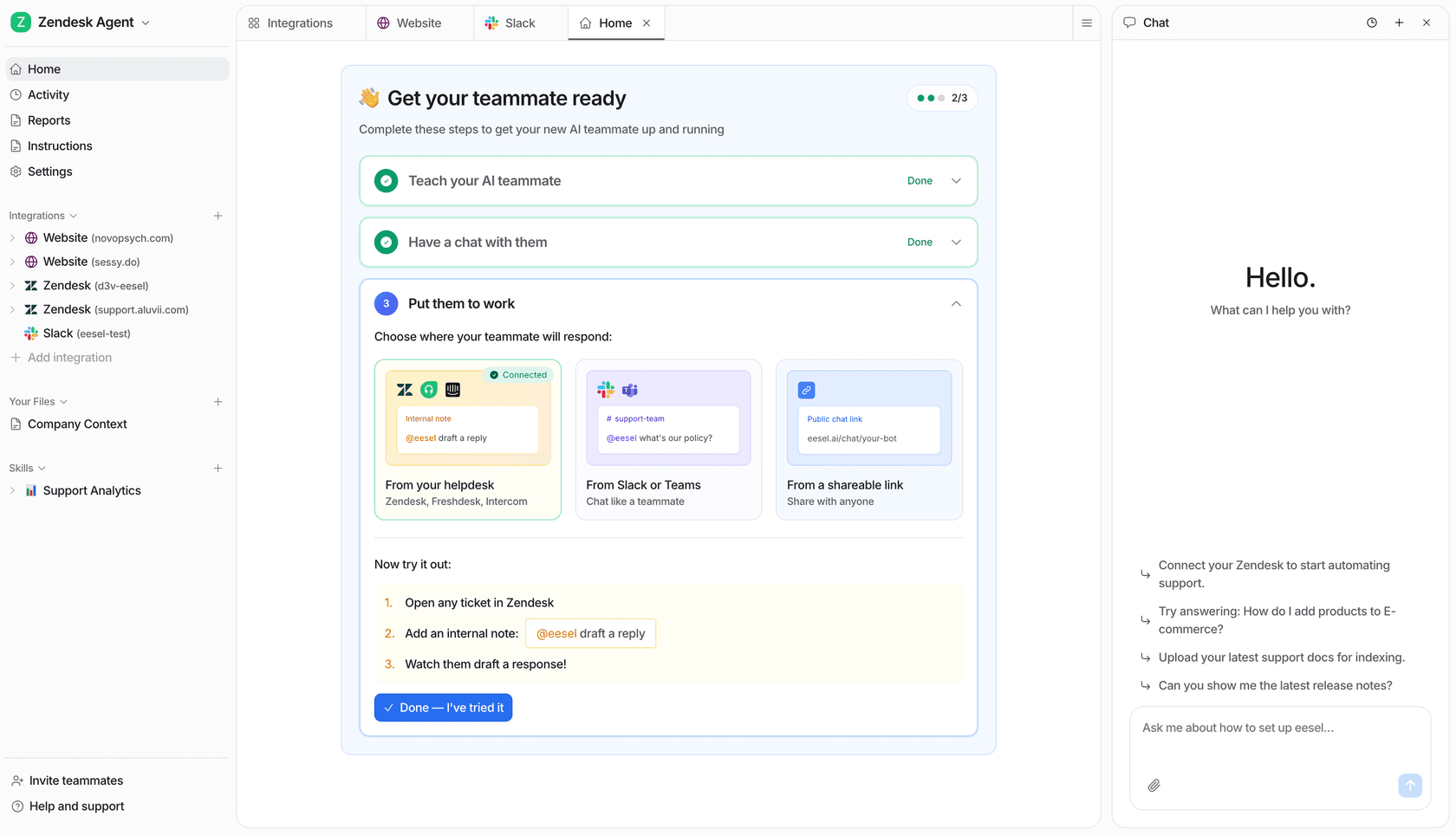
You get the intelligence of the frontier, without the engineering project. You can start free with $50 of usage and no credit card.
Frequently Asked Questions
What is Claude Fable 5 and is it good for business?
How much does Claude Fable 5 cost?
Should I build my own support agent on the Claude Fable 5 API?
Is Claude Fable 5 better than Claude Opus 4.8 for customer support?
What happens when Claude Fable 5 gets a support question wrong?


Article by
Alicia Kirana Utomo
Kira is a writer at eesel AI with a Computer Science background and over a year of hands-on experience evaluating AI-powered customer service tools. She focuses on breaking down how helpdesk platforms and AI agents actually work so that support teams can make better buying decisions.