
How I reviewed Aside
I build AI agents for a living, including the parts that drive browsers and apps, so when a new "AI browser" ships my first question is always the same: what does the agent actually do once you get past the launch video? For this review I went through Aside's own product pages, its browser agent and memory docs, the privacy policy, and the benchmark repository it points to, plus the early hands-on reactions from the days right after its launch around June 23, 2026. If you want the full plain-English explainer of what it is, I wrote that up separately in the Aside AI browser post; this piece is the verdict.
One honesty note up front: Aside is days old, so this is a review of a very fresh product, not a tool I've run in production for months. Where something is a vendor claim, I'll say so.
What Aside gets right
The headline idea is sound. Most agents work "from the outside," reaching into apps through APIs and asking you to approve every step. Aside flips that: the agent lives in the browser and operates the sites you're already logged into, the way a person would. That's a much bigger surface area than any integration list, and it's the whole reason AI browsers are having a moment.
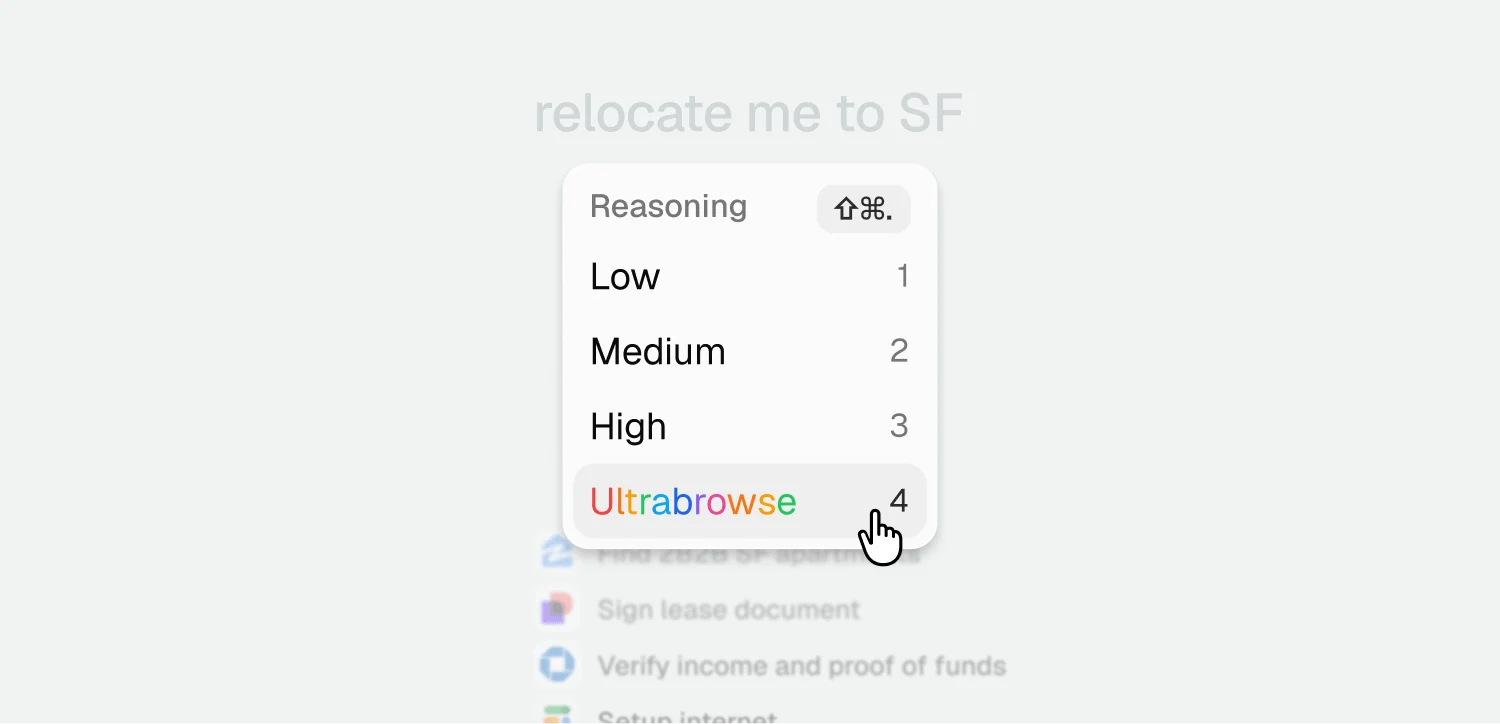
The agent itself has a nice touch in how you dial up effort. You pick a reasoning level per task, and the top setting, Ultrabrowse, runs a long-horizon job autonomously, pulling context and handling follow-ups until it's finished.
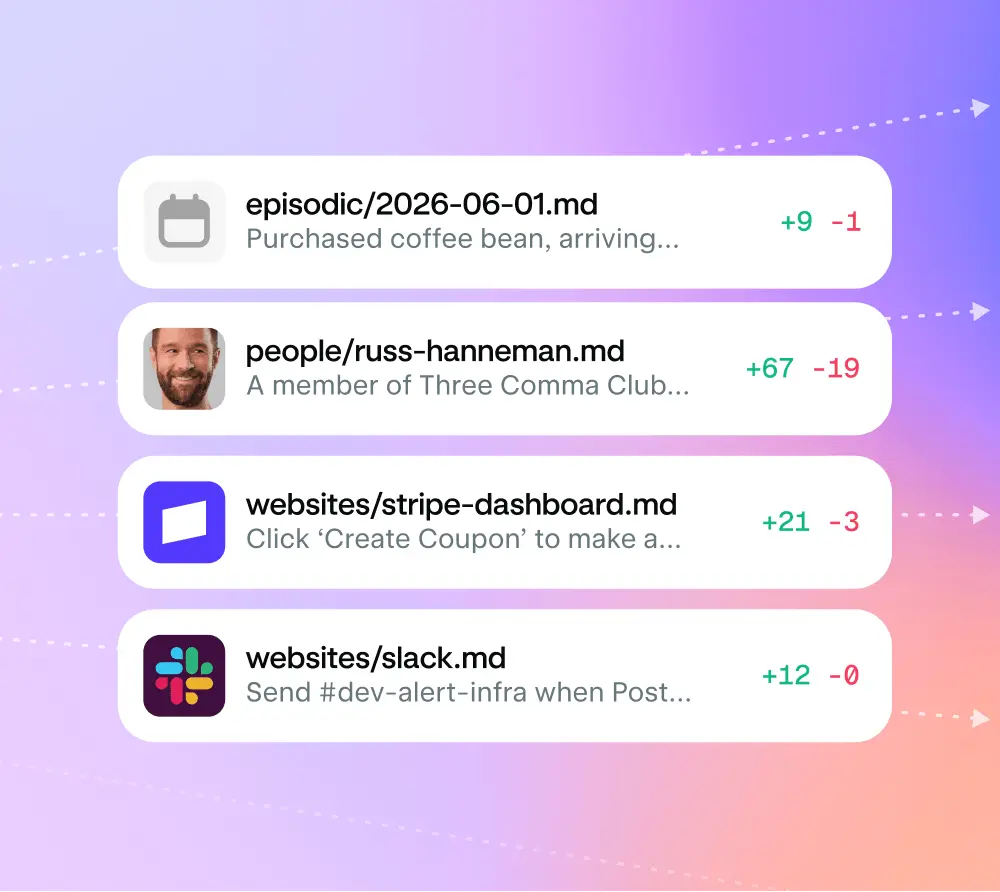
The feature I came away most impressed by is the memory. Aside turns your browsing into memory so you don't re-explain context every time, and it keeps learning after each task through a process it calls "Dreaming." What sets it apart is that the memory is plain markdown stored on your device, organized into files you can open and edit. Most agents treat memory as an opaque blob, so when it remembers something wrong, you find out only when it acts on it. Letting you read and correct the file is a real answer to that.
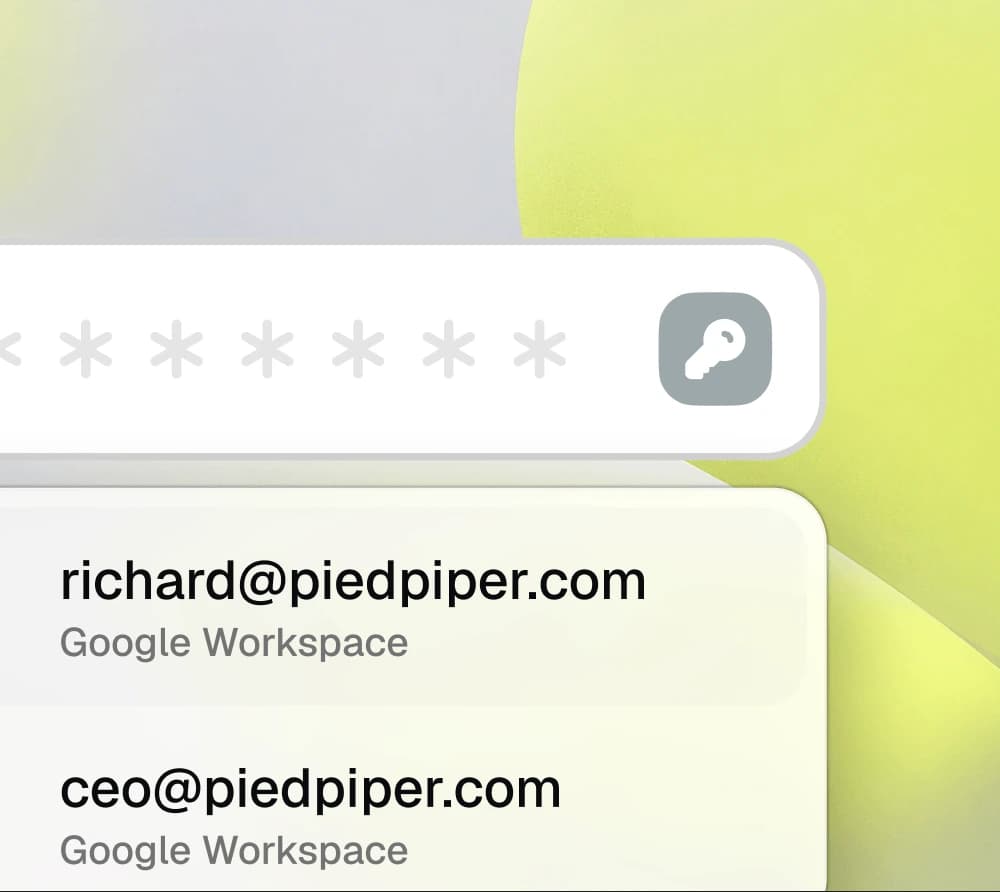
Then there's the part I didn't expect to like: a password manager built for agents. Once an AI is driving your browser, you want it to log into things, but you really don't want your passwords sitting in the model's context. Aside autofills credentials straight into the page so they're "autofilled into websites, not exposed to the agent," and adds scoped per-task access, an audit log, and hardware-backed encryption. It's the kind of detail that signals a team thinking about how to run agents safely, not just fast.
Tying it together is the local-first posture. Per the privacy policy, task transcripts and artifacts live in a local directory on your machine, and hosted model providers only get the context needed to run a task. You also get a per-task choice of where it runs. In a market full of cloud-routed AI browsers, that's the differentiator people actually repeat back.
Where Aside falls short
Now the other side of the ledger, because a fair review has to name it.
First, there's no public pricing, which I'll come back to in its own section. For a product asking you to trust it with your logins, "we'll tell you the price later" is a real gap.
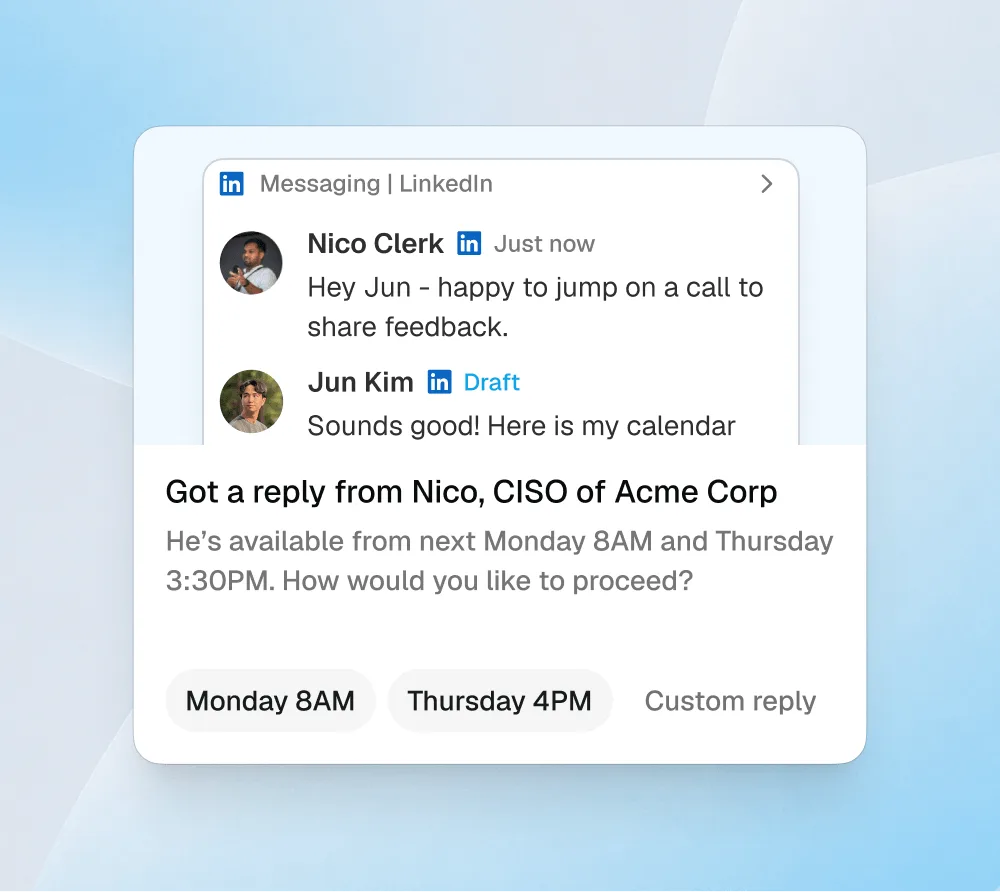
Second, the autonomy cuts both ways. The marketing says sensitive actions like payments and messages "wait for user approval," and you can see that approval-style checkpoint in the product. But that human-in-the-loop gate isn't spelled out in the privacy policy text, and the browser-agent page describes Ultrabrowse as running on its own "until it's done." For your own browsing that's a fine bet. The moment an agent is acting toward other people, I'd want that gate to be explicit and enforced, not implied in the copy.
Third, it's new, and it shows. The clearest first-hand reaction I could verify was warm but already catching rough edges:
"loved the demo video on X and did try it. amazing work! some little bugs with the side ai but overall i like the experience."
pranshu54, Hacker News

And the sharpest skepticism wasn't about the product so much as the gap between its launch buzz and the quiet on more critical forums:
"5k likes on X and not a single comment here"
swah, Hacker News
On Reddit, the reflexive take every new agentic browser gets showed up too, that it "feels a lot like Comet" in how it drives the page. None of this sinks the product. It just puts Aside squarely in the "promising, unproven" bracket, and Aside's privacy pitch reads as a deliberate answer to the unresolved privacy complaints people have about cloud-routed browsers.
About those #1 benchmark numbers
Aside leans hard on benchmarks, claiming first place on Online-Mind2Web, BU Bench v1, and Odysseys, headlined by 297 of 300 tasks passed (99.0%) on Online-Mind2Web.
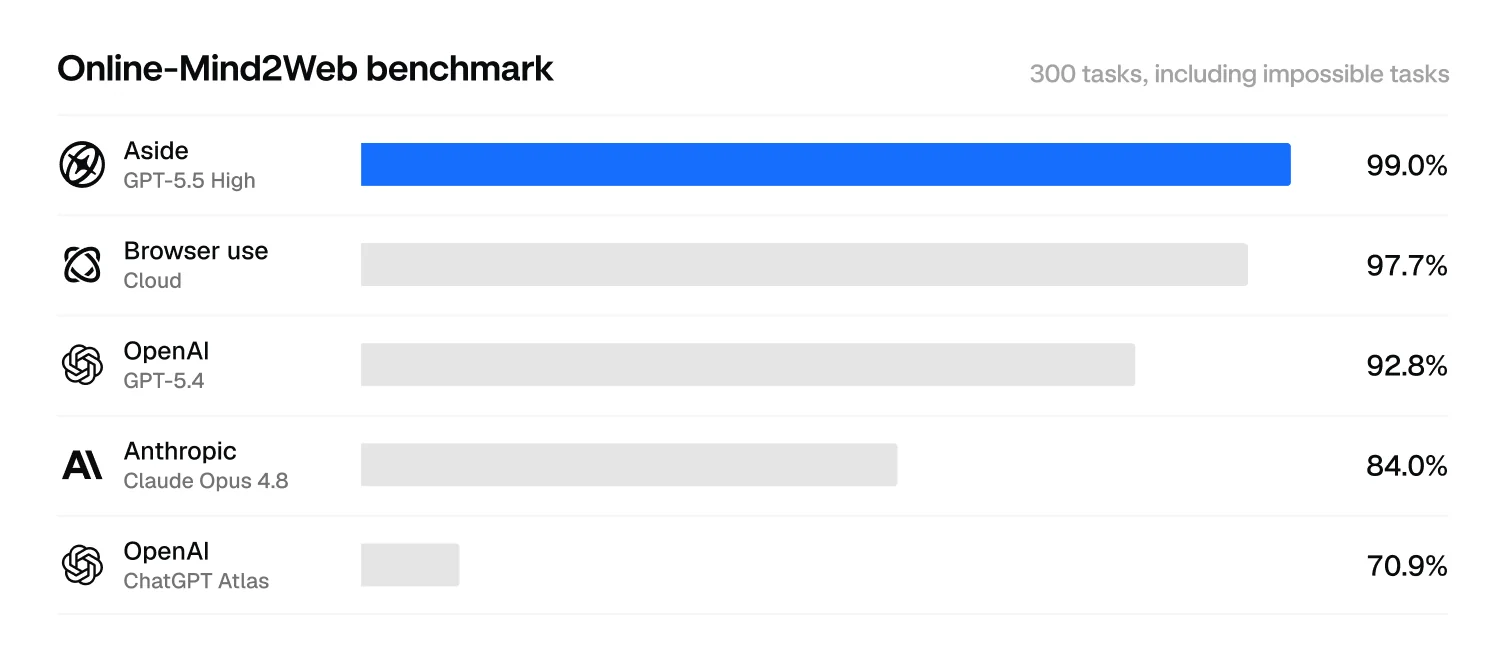
Credit where it's due: the results are detailed, broken down by difficulty, with the failures named (one impossible task, two genuine misses). But the caveat is the whole story here. These are self-reported numbers, sitting in Aside's own GitHub repo, graded by Aside's own setup, with the framing post literally titled "how we built the SOTA browser agent that outperforms Fable." That's a self-claim, not an audited leaderboard.
It's worth knowing that the Online-Mind2Web benchmark exists precisely because earlier web-agent benchmarks "dramatically overestimate agent performance" once you test under realistic conditions. So the rule of thumb I'd apply to any agent score, Aside's included: read the number, then read who graded it.
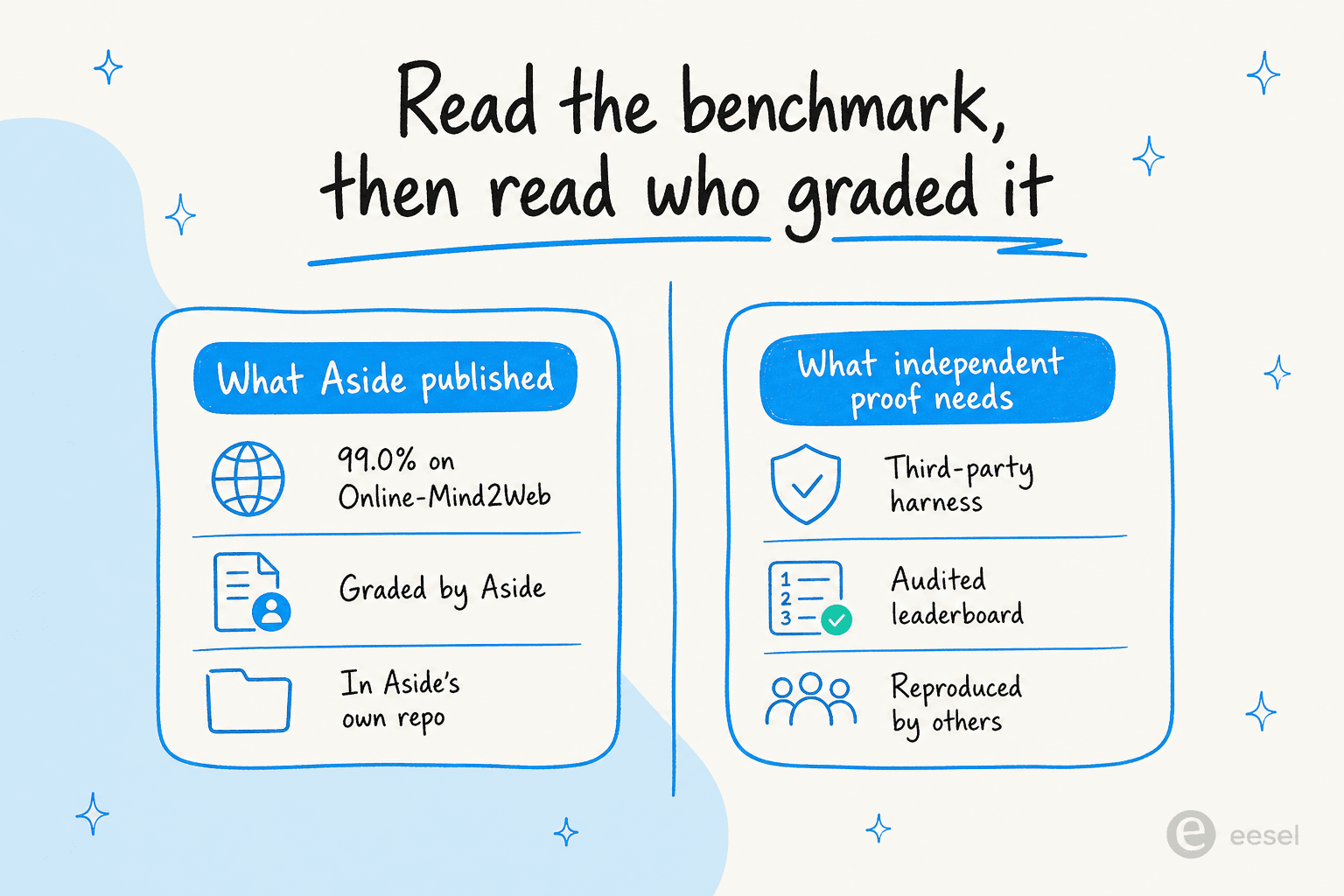
Impressive if it holds up. Worth waiting for someone outside Aside to reproduce it before treating "beats everyone" as settled.
What Aside actually costs
Here's the honest answer: nobody outside Aside knows yet. There's no pricing page. Aside is bring-your-own-model, so you plug in your existing ChatGPT or Claude subscription or an API key, and the product runs on top of that. The privacy policy references Stripe billing, subscriptions, usage credits, and auto-reload, which tells you paid tiers are coming, but no rates are published anywhere.
For a personal tool you're trying out for free, that's tolerable. For anyone budgeting a rollout, an undefined price plus your own model costs plus future usage credits is a lot of unknowns stacked together. It's a useful contrast with how AI support pricing is trending, toward a clear per-outcome number you can forecast before you commit.
Who should use Aside, and who should skip it
After going through it, the split is pretty clean.
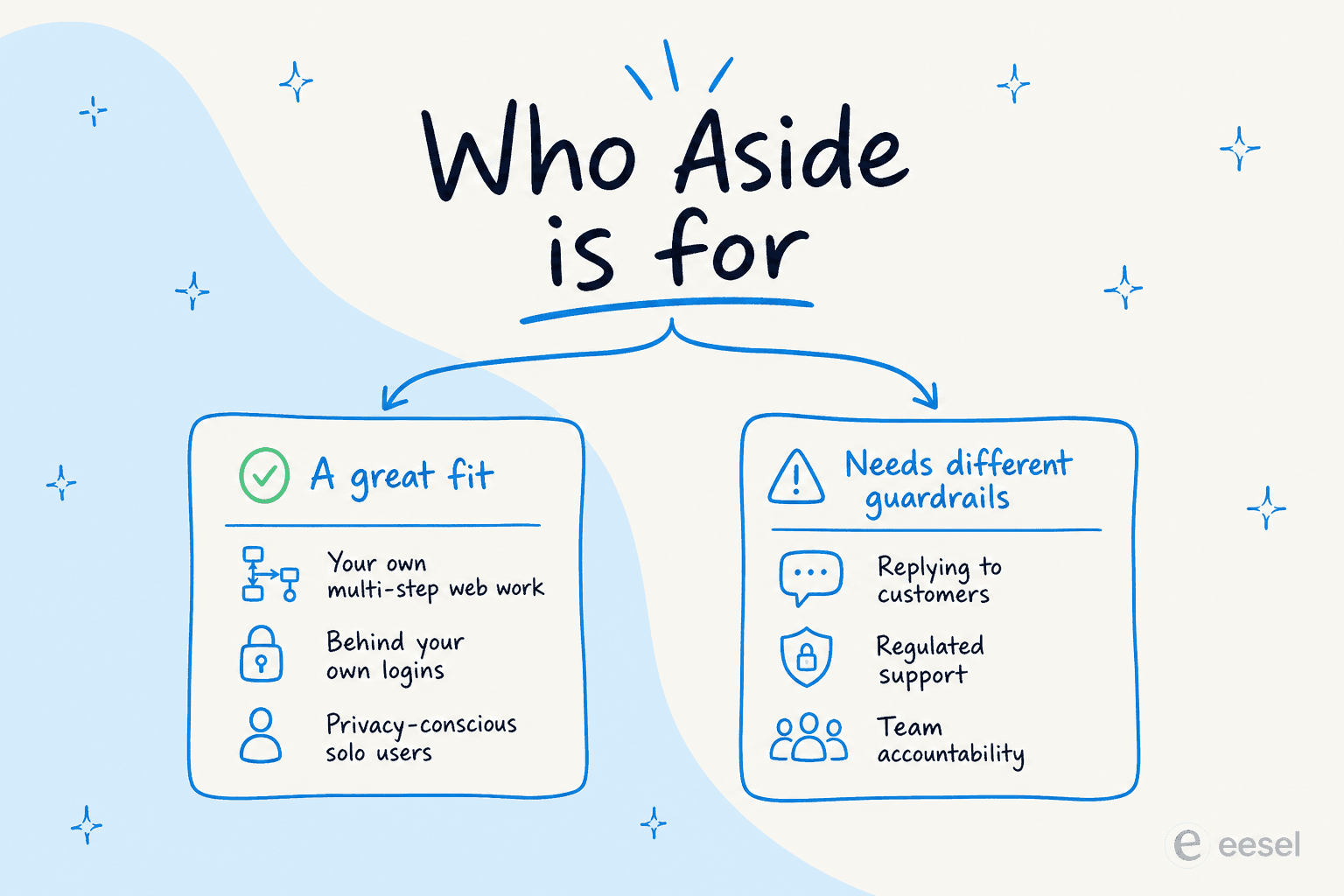
Use Aside if you want an agent for your multi-step web work, the kind of jobs that span logins and tabs, and you like the idea of memory and credentials staying on your machine. Privacy-conscious solo users and power users are the sweet spot, and since it's free to download, the cost of trying it is just your time.
Skip it, or at least don't reach for it, if the job is acting toward other people: replying to customers, anything regulated, or any workflow where a team needs accountability for what the agent said. That's not a flaw in Aside, it's just a different category of tool, and it's the one worth talking about next.
Where an AI browser doesn't belong: customer support
This is the reframe I keep coming back to after years putting AI agents on live support queues. The defaults that make Aside great for your own work are the wrong defaults for customer-facing work.
When an agent does your tasks, "run until it's done, no approval step" is a feature, because you're the one who catches a mistake. When an agent answers your customers, the same behaviour is a liability. I've watched confident-sounding bots quietly hand out wrong answers, which is exactly why a support agent needs the opposite of unbounded autonomy: reply only when confident, and hand off to a human when it isn't.
That's a different shape of problem from personal automation. It's why replacing a support team with AI is never an overnight switch, why the agents-vs-chatbots distinction matters once real customers are involved, and why you want hallucination guardrails baked in from day one.
An AI browser is a personal power tool. Customer-facing automation is a system you have to be able to trust at scale, and trust comes from being able to test it before it goes live, measure it, and hold it back when it isn't sure.
Try eesel for customer-facing AI
If what you actually need is an agent for your help desk rather than your personal browser, that's the problem I built eesel to solve. It plugs into the helpdesk you already run (Zendesk, Freshdesk, Gorgias, Help Scout, and more), learns from your past tickets and help docs on day one, and, the part that matters most here, lets you simulate it against thousands of your real historical tickets before it ever replies to a customer, so you see exactly what it would have said and how much it would have resolved.

And unlike Aside's still-unknown pricing, the cost is published and predictable: usage-based at 40¢ per resolved ticket, no per-seat fees, no platform minimum, with a free trial that doesn't need a card. Different tool, different guardrails, for a job where the guardrails are the whole point.
Frequently Asked Questions
Is the Aside AI browser worth it?
For personal, multi-step web work behind your own logins, it's one of the more interesting AI browsers to try right now, and it's free to download. The honest caveat for any Aside AI browser review: it's days old and a little buggy, its pricing isn't published, and its #1 benchmark claims are self-reported. Try it for your own tasks, not for anything customer-facing.
How much does the Aside AI browser cost?
There's no public pricing page yet. Aside is bring-your-own-model, so you connect an existing ChatGPT or Claude subscription (or an API key), and its privacy policy references paid plans and usage credits, so tiers are coming. If you want a cost you can actually predict, an outcome-based tool like eesel charges per resolved ticket instead.
Are Aside's #1 benchmark results real?
The numbers are real, including 297/300 (99.0%) on Online-Mind2Web, but they're self-reported from Aside's own repository with its own grading setup, not an independently audited leaderboard. Treat them as a vendor claim until a third party reproduces them, the same caution you'd apply to any agent score.
Is Aside safe to use?
Its local-first design is genuinely thoughtful: tasks and memory stay on-device, and the password manager logs the agent in without exposing your credentials to the model. The thing to watch is autonomy, an agent that runs "until it's done" needs a clear approval gate, which matters far more once it's acting toward other people. For that, you want hallucination guardrails built in.
Can I use Aside for customer support?
You could point it at a support inbox, but an AI browser is built for your own work, not for replying to customers at scale. Customer-facing automation needs the opposite defaults: testing before it goes live, confidence thresholds, and human handoff. That's what a helpdesk-native tool like the eesel AI agent is built for.


Article by
Rama Adi
Rama is a software engineer at eesel AI with two years of experience writing about B2B SaaS, AI tools, and customer support technology. Based in Bali, Indonesia, he brings a developer's perspective to product comparisons — cutting through marketing copy to what the integrations and APIs actually do.