

What Aside actually costs right now
Let me set the scene, because it matters for how you read every number below. Aside launched around June 23-24, 2026, out of Y Combinator's Fall 2025 batch, from a three-person team in San Francisco. It's a downloadable, Chromium-based browser with an agent that operates your logged-in sites directly, rather than wiring up 20-plus integrations. The pitch is "a browser rebuilt for people and agents."
Here's the thing a pricing post has to admit up front: there is no Aside pricing page. I looked. The homepage CTA is "Download," not "See plans." The one place money shows up is the privacy policy, which lists exactly the plumbing you'd expect from a paid product: "Stripe customer IDs, Stripe subscription IDs... plan, subscription status, billing interval, billing period dates... credit balances, credit ledger entries, auto-reload settings" (Aside privacy policy, last updated June 23, 2026).
Translated: paid plans exist, billed monthly through Stripe, with usage credits you can top up automatically. Aside just hasn't told anyone the rates. For a product this young that's normal, but it means anyone quoting you a hard "Aside costs $X/month" is guessing. What we can do is map every place a dollar leaves your account.
Bring-your-own-model: the three ways you actually pay
Aside's model line is explicit on the homepage: "Bring your own subscription, use your ChatGPT or Claude subscriptions, or bring your own API key." The product UI shows a GPT-5.5 model selector. That single design choice is the most important fact about Aside's pricing, because it means the browser mostly isn't the thing you pay for. The model is.
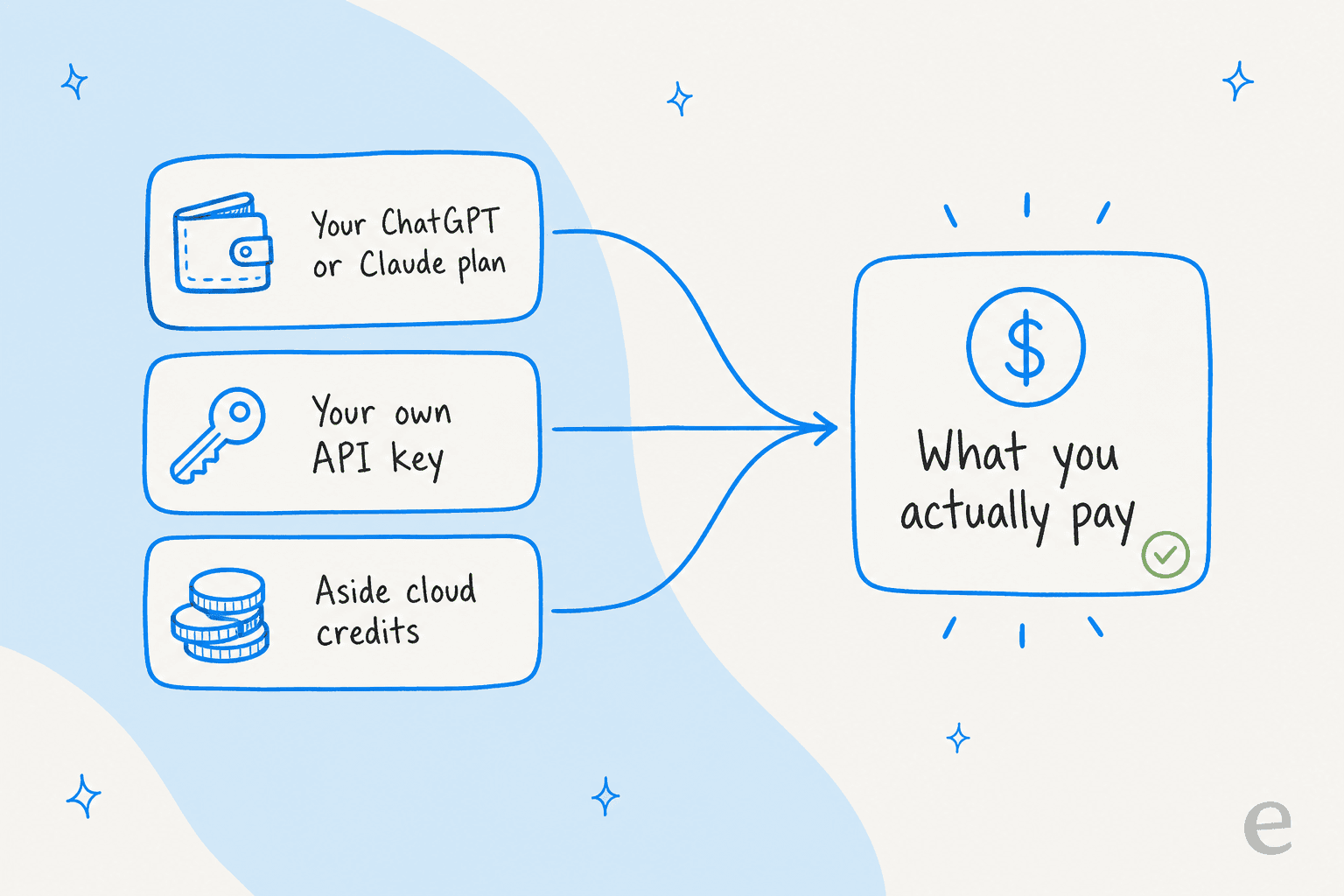
There are three distinct cost paths, and most people will land on one of them:
- Use an existing model subscription. Point Aside at the ChatGPT or Claude plan you already pay for. Your marginal cost for adding the browser is, on the model side, effectively zero. This is the cheapest path for anyone who's already a paying AI subscriber.
- Bring your own API key. Plug in an OpenAI or Anthropic API key and you pay the model provider per token, metered. This is pay-as-you-go: a quick lookup costs cents, a long autonomous task costs more. There's no Aside markup visible here, you're just paying the upstream provider directly.
- Aside cloud credits. Run tasks on Aside's own cloud instead of your machine, and you draw down prepaid credits with auto-reload. This is the one path where Aside itself is billing you, and it's also the one with no published rate.
The catch with bring-your-own-model is that your bill becomes a moving target. With a flat subscription it's predictable. With an API key, a heavy week of agent runs can quietly outrun a $20 subscription, which is the exact dynamic people already complain about with metered AI tools.
Local vs cloud: who pays for the compute
Aside lets you choose where a task runs, and this toggle is a real cost lever. The model selector carries a Local option ("Runs on your computer") and a Cloud option ("Run tasks on Aside cloud").
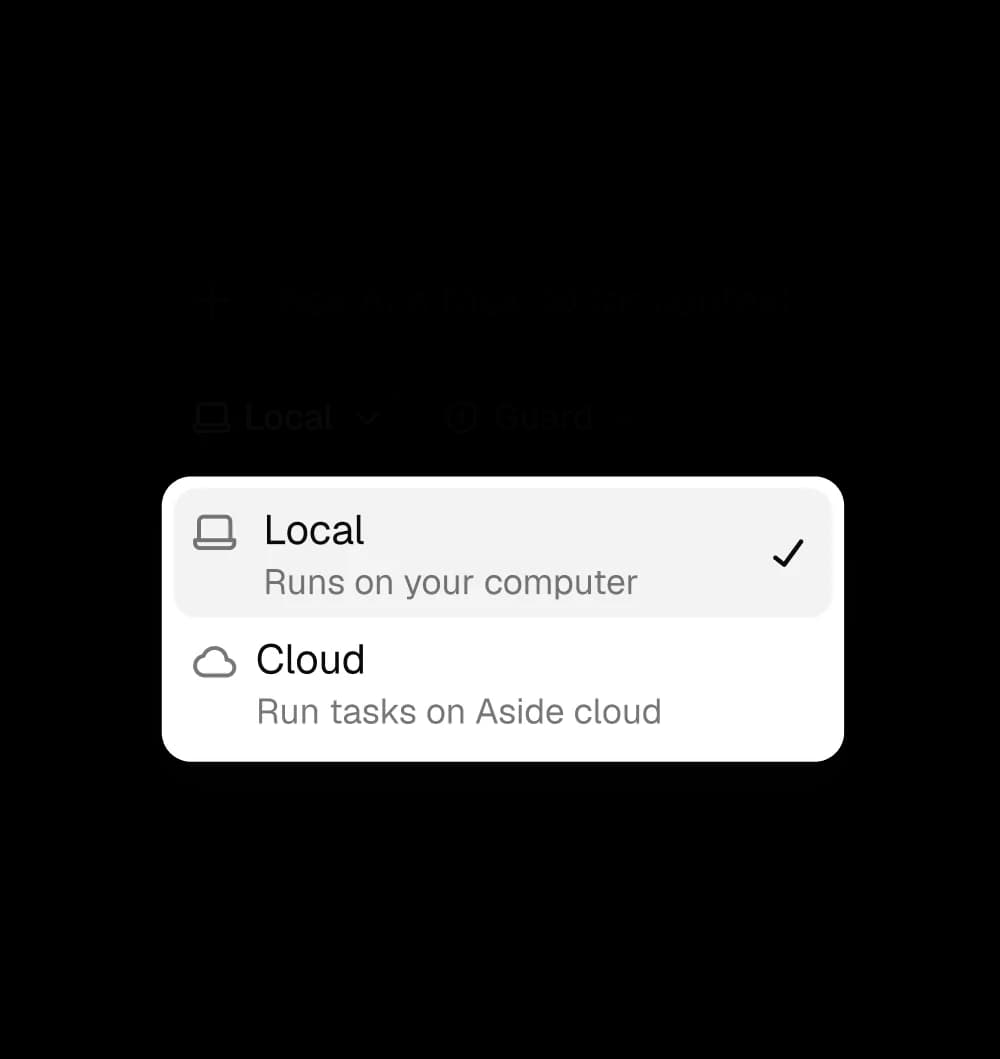
Run local and the compute happens on your own hardware, so the only model cost is whatever your subscription or API key charges. Run on Aside cloud and you're renting Aside's machines, which is where credits come in. For keeping the bill down, local-first is your friend, and it also happens to be Aside's whole privacy wedge: "tasks, memory, and data stay on your device."
What drives your token spend
If you go the API-key or cloud-credit route, your cost scales with how hard the agent works, and Aside makes that dial visible. The reasoning menu has four settings: Low, Medium, High, and Ultrabrowse.
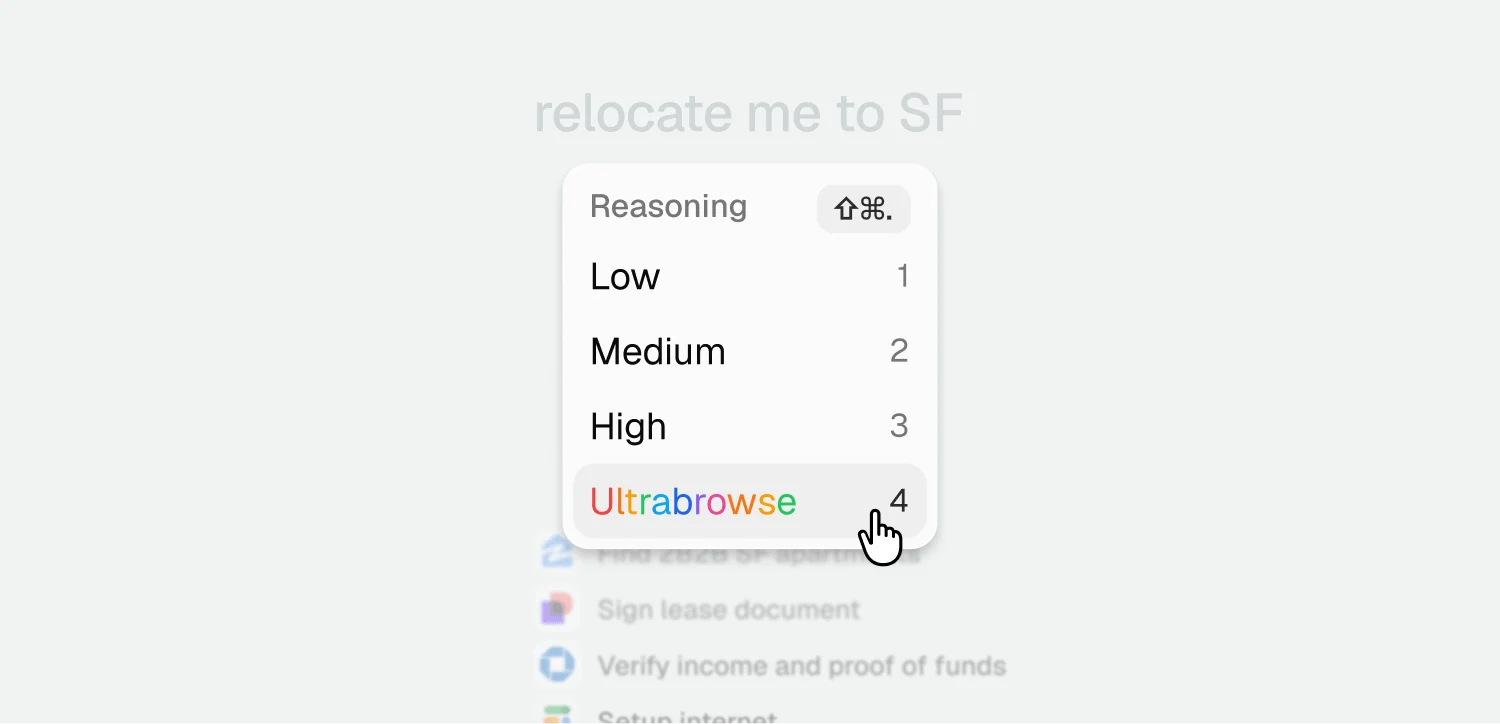
Ultrabrowse is the long-horizon mode, the one Aside shows running multi-step tasks "until done" for minutes at a time. More reasoning steps means more tokens, and more tokens means more money, whether that's drawn from your API budget or your cloud credits. The homepage demo proudly shows a task "Working for 3m 56s." That's impressive autonomy, and on a metered key, it's also a longer meter run than a five-second answer.
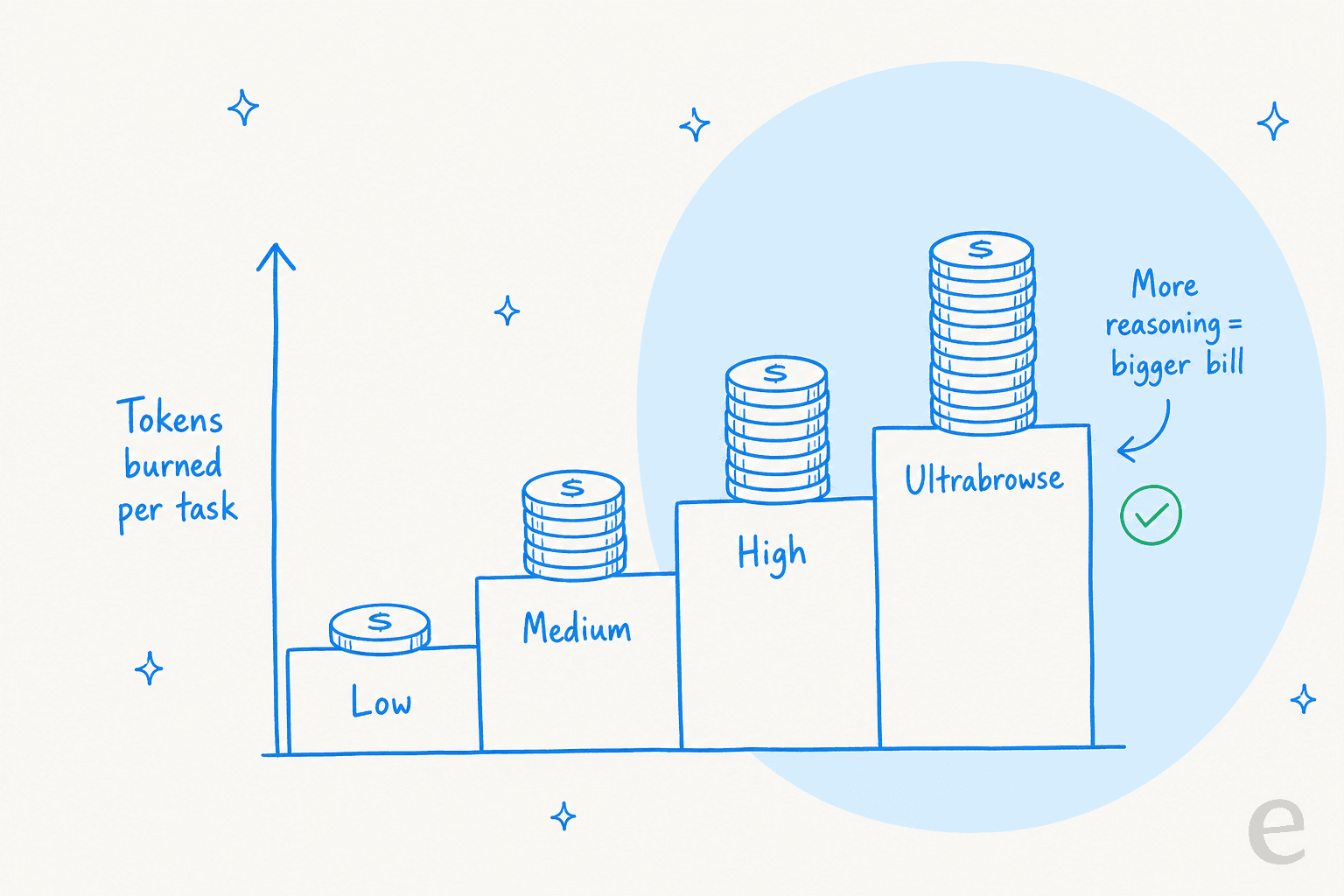
The practical takeaway: match the reasoning tier to the task. Drafting a quick reply doesn't need Ultrabrowse. A genuinely multi-step job (relocate-me-to-SF, fill out a workflow across five sites) is where the higher tier earns its cost. Treating every task like a marathon is the fastest way to a surprise bill.
The Aside pricing table (what's known vs unknown)
Since there's no official tier grid, here's the most honest table I can build, every cost component, what it is, and what it'll run you based on what Aside has actually disclosed.
| Cost component | What it is | What it costs |
|---|---|---|
| Aside app | The Chromium-based browser download | Free to download; no published app price |
| Existing model subscription | Run on your ChatGPT or Claude plan | Whatever you already pay; no extra Aside model fee |
| Your own API key | Pay-per-token to OpenAI / Anthropic | Metered by usage, paid to the provider; scales with task length and reasoning tier |
| Aside cloud credits | Run tasks on Aside's servers | Prepaid credits with auto-reload (via Stripe); rate not published |
| Aside paid plan | Subscription referenced in the privacy policy | Confirmed to exist (Stripe subscription + billing interval); rate not published |
| Password manager + sync | Encrypted vault, cross-device sync | Included in the app; no separate price disclosed |
The two "not published" rows are the ones to watch. When Aside does post rates, the cloud-credit price and the base-subscription price are what'll decide whether it's a cheap add-on to a sub you already have, or a second AI bill stacked on top of your first.
Bundled vs unbundled: why Aside's pricing feels different
Here's the mental model that makes Aside's approach click. Most AI browsers you've heard of bundle everything into one monthly fee, the browser and the model arrive together for a single price. Aside unbundles them.
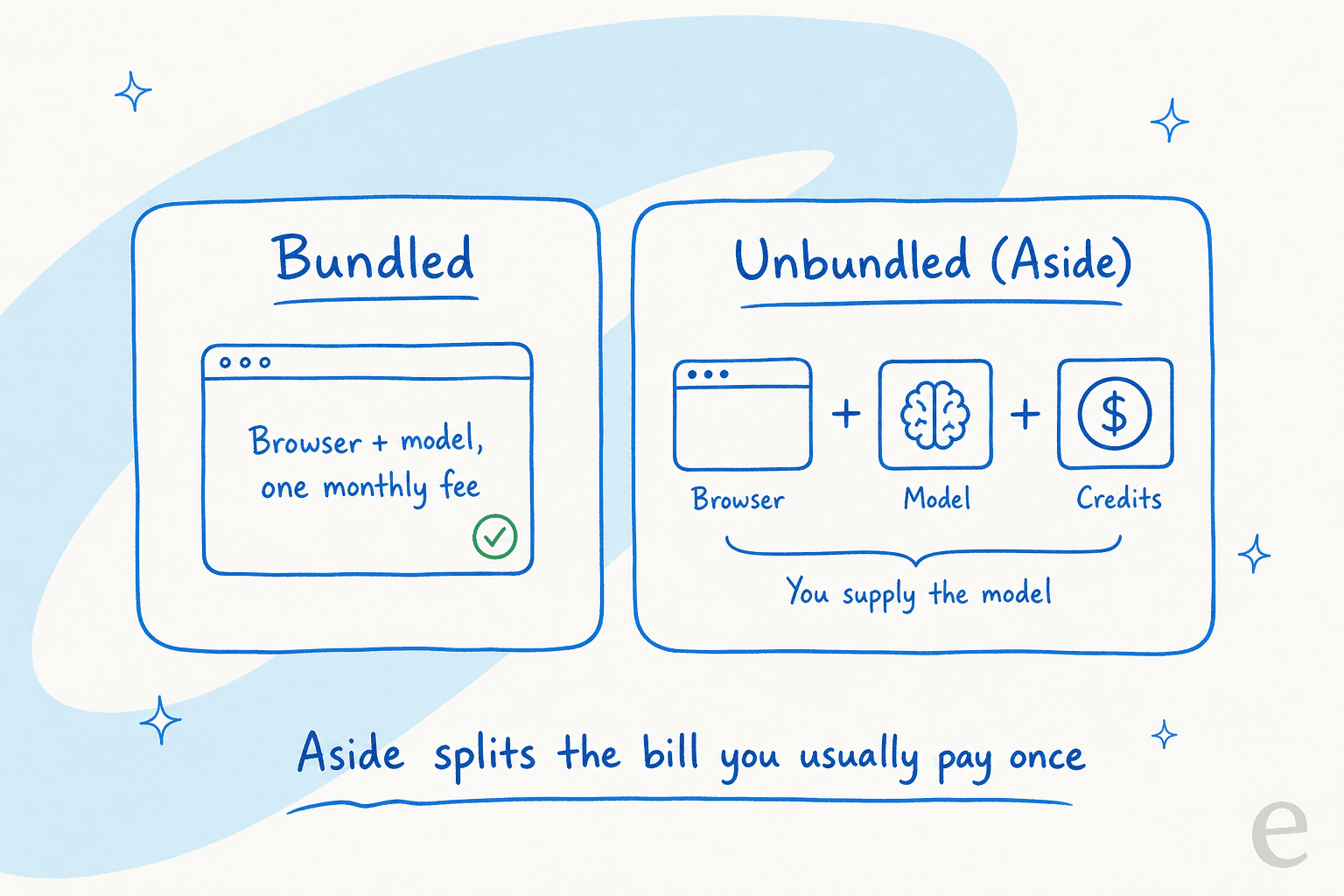
There's a genuine argument for each. Unbundling means if you're already paying for Claude or ChatGPT, you don't pay twice for the intelligence, you reuse it. It also means you control which model runs and you can swap to a cheaper one. The downside is that "it depends on your model" is a harder thing to budget than one flat number, and it pushes the cost-management work onto you.
By contrast, a bundled browser like Perplexity's Comet gives you one predictable line item and someone else worries about the token economics. Neither is wrong, they're just different bets on who should own the model bill. If you want the deeper comparison, my colleagues have written up Comet pricing and a 30-day Comet review separately.
Is Aside worth paying for?
This is where I have to be careful, because the most-quoted Aside numbers all come from Aside.
The headline value claim is benchmarks. Aside says it ranked #1 on three browser-agent benchmarks, Online-Mind2Web, BU-Bench-V1, and Odysseys, "surpassing OpenAI, Anthropic, and Browser Use."
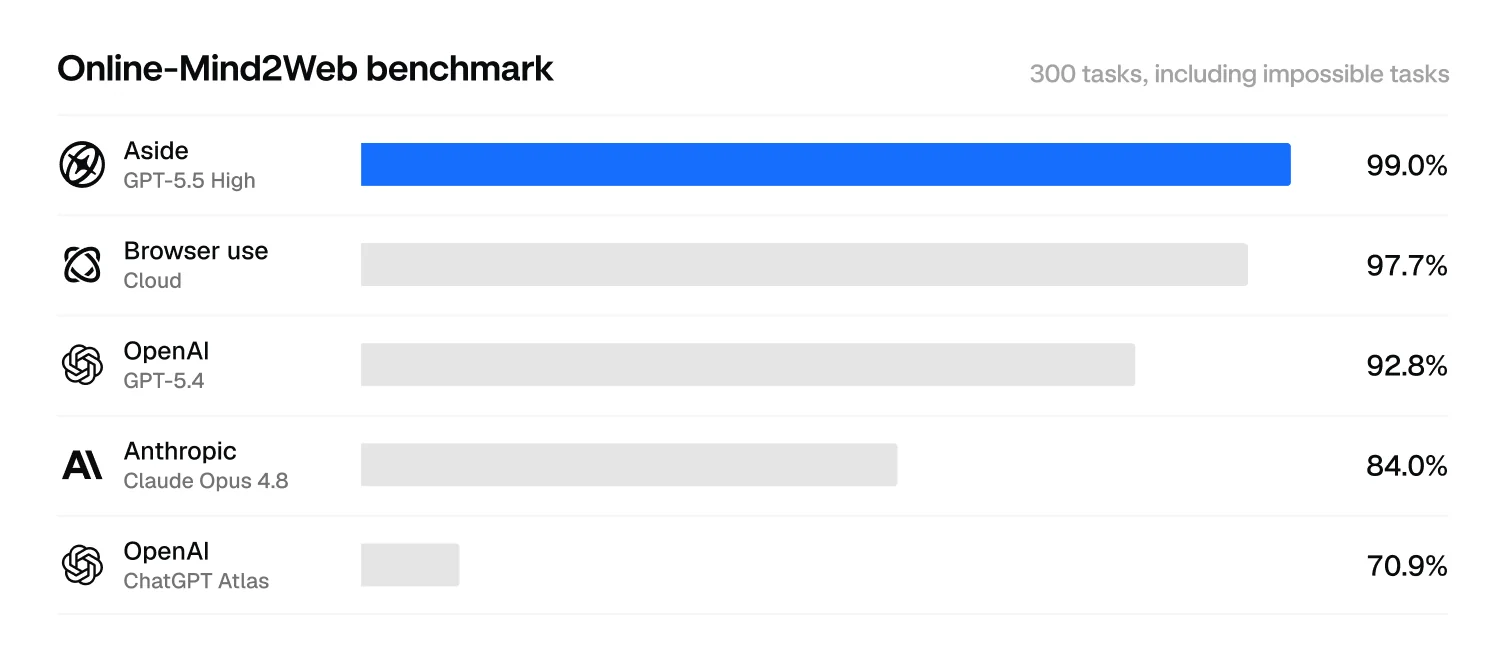
On Online-Mind2Web, Aside posts 99.0%, ahead of Browser Use (97.7%), GPT-5.4 (92.8%), Claude Opus 4.8 (84.0%), and ChatGPT Atlas (70.9%). Those are strong numbers. The asterisk: they're vendor self-reported. The scores live in Aside's own GitHub repo with Aside's own grading setup, not on an independently audited leaderboard. That's not an accusation, nobody has debunked them, but the academic literature on exactly this benchmark exists because prior web-agent scores "dramatically overestimate agent performance" under realistic conditions. The honest framing is "Aside claims SOTA, sourced to itself; treat with standard self-reported-benchmark caution."
Early hands-on signal is thin but real. The clearest verified reaction is from Hacker News, positive but already flagging rough edges:
"loved the demo video on X and did try it. amazing work! some little bugs with the side ai but overall i like the experience."
pranshu54, Hacker News, June 25, 2026

And the most quotable bit of skepticism isn't about the product at all, it's about the marketing-to-substance ratio at launch:
"5k likes on X and not a single comment here"
swah, Hacker News, June 25, 2026
So: is it worth paying for? If your model subscription is already sunk cost and you value the local-first privacy posture, the added cost of trying Aside is low, which makes the experiment cheap. Just don't pay a premium on the strength of self-reported benchmarks for a product that's days old.
What the privacy angle is really worth
The one thing reviewers and the founders consistently repeat isn't speed or benchmarks, it's privacy. Aside runs local-first, keeps memory on-device, and ships "the first password manager built for agents", credentials get autofilled into sites without ever being exposed to the AI.
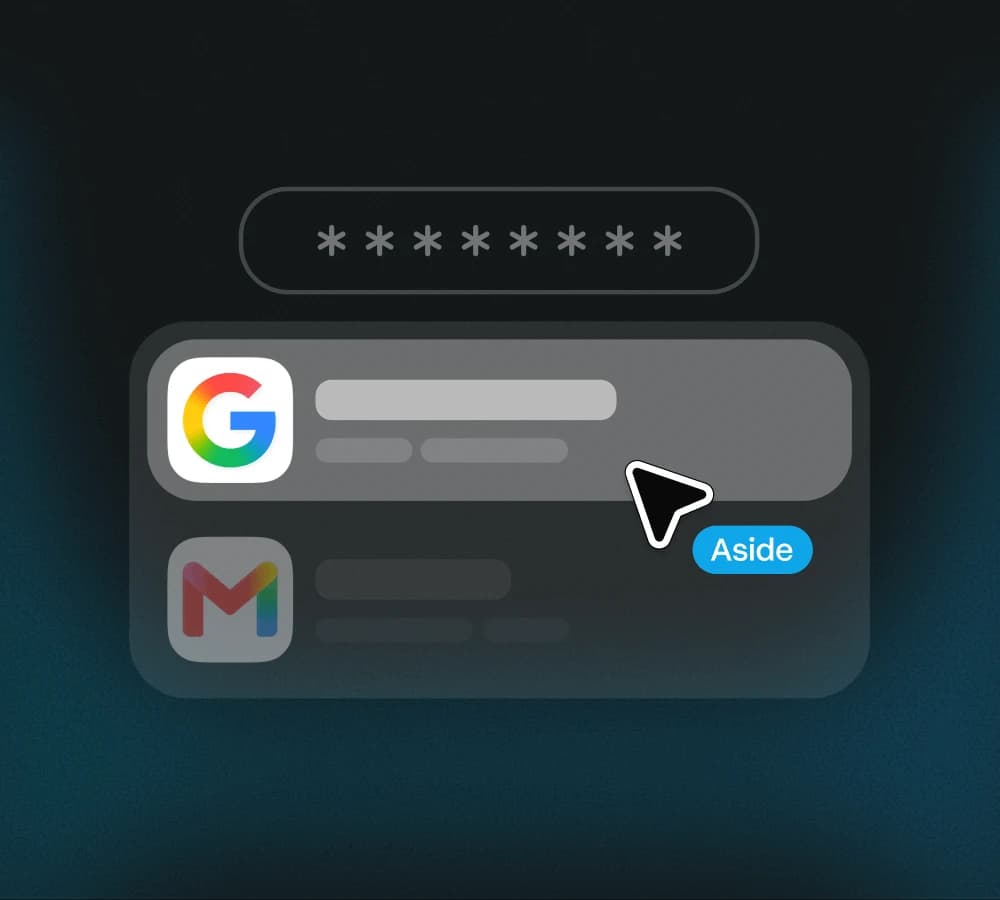
This matters for the value question because it's the genuine wedge against cloud-routed agents like Comet or Arc-style search browsers. The local-first pitch reads as a direct answer to the privacy complaints that dog cloud AI browsers. If that's the feature you're paying for, it's bundled into the app rather than a separate line item, which is a point in Aside's favor whenever the real rates do land.
Try eesel
Quick reality check if you landed here as a support, CX, or ops lead: Aside is a personal browser agent for knowledge workers. It's great at running your logged-in tabs, but it isn't built to staff a support queue, and its pricing, by its own design, is something you have to assemble yourself.
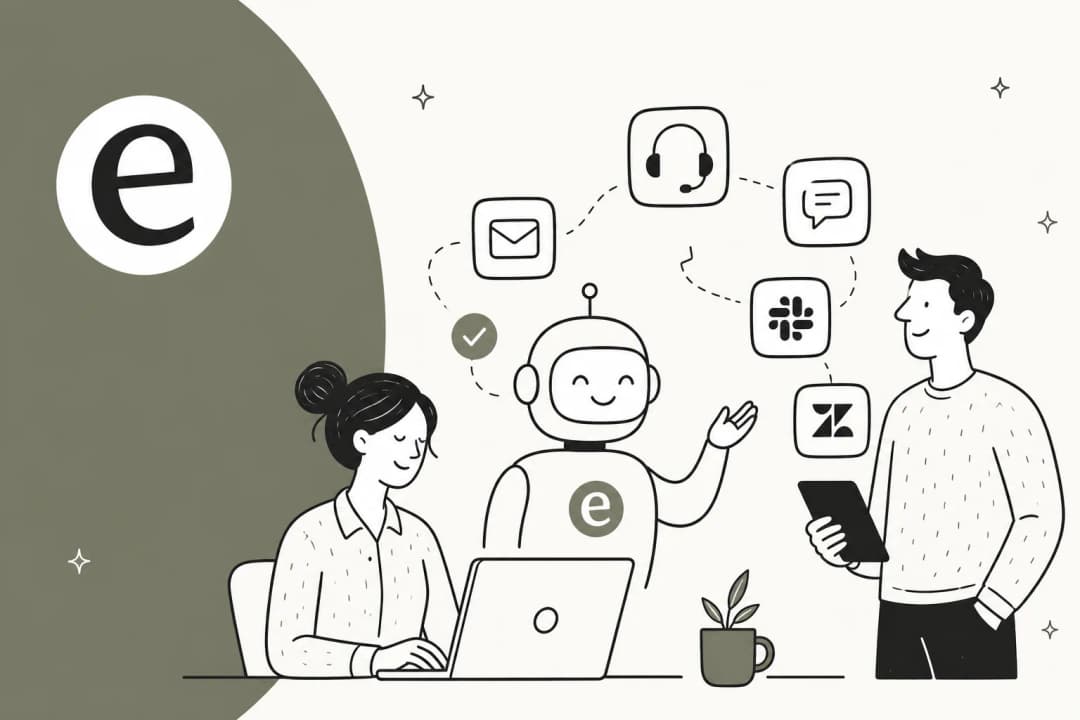
eesel AI is the opposite bet for teams. It's an AI agent for the helpdesk that plugs into Zendesk, Freshdesk, Intercom, Slack, and your knowledge base in minutes, trains on your past tickets, and runs a simulation against historical tickets before it answers a single live customer, so you know your resolution rate before go-live, not after. And the part most relevant to this post: eesel publishes its pricing. It's usage-based with no per-seat fees, so the bill scales with what the AI actually resolves, no assembling-your-own-cost required.
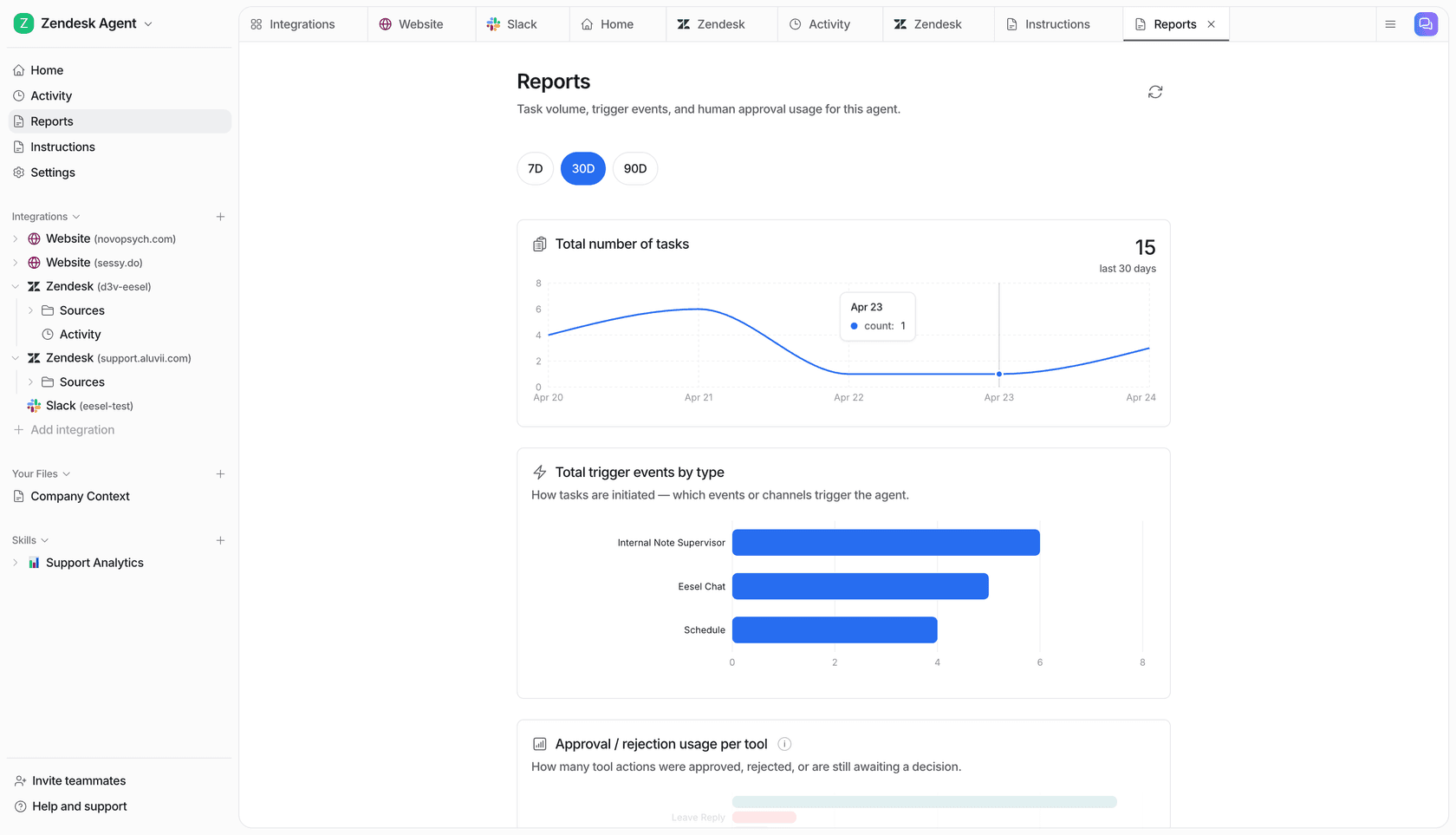
If you've spent this whole post trying to reverse-engineer a price, that contrast is the point. You can see eesel's plans and try it free.
Frequently Asked Questions
How much does the Aside AI browser cost?
Is Aside free to use?
Does Aside charge per task or per month?
What is the cheapest way to run Aside?
Is Aside worth paying for compared to other AI browsers?


Article by
Kurnia Kharisma
Kurnia is a software engineer and writer at eesel AI with two years of SEO experience, writing about AI tools, helpdesk software, and customer support. He pairs a developer's understanding of how these products are built with search-driven research into what actually ranks and resonates with the people searching for them.