


Claude Duet is Anthropic's new always-on agent. It sends you a short brief every morning, checks your connected apps every few hours, takes on tasks in its own cloud computer, and asks before it sends, pays, signs or deletes anything. It runs on Claude Opus 5.5 and can use the 6,000+ connectors and plugins in the Claude Marketplace.
Access is narrow for now. It's a waitlisted research preview for Pro and Max subscribers in the US, on iOS, Android and claude.ai. It costs nothing extra on top of Pro ($20/month) or Max ($100 or $200/month), but its background checks eat the same usage limits as your chats. That makes it the cheapest published way into a frontier-model personal agent, against $100/month for OpenAI Dots.
Where it stops: Duet is built for one person's inbox, calendar and side projects. It isn't on Team plans and it isn't made to work a shared support queue. That job belongs to a teammate built for it, like eesel's AI helpdesk teammate, which at Cape Coffee Beans sweeps the whole Zendesk queue every morning and emails the founder only what slipped.
What is Claude Duet?
Anthropic opened a research preview of Claude Duet on October 21, 2026. In Anthropic's own words, it's "a new app where Claude works as a proactive agent." The pitch is simple: the normal Claude app waits for you to open a chat, and Duet comes to you.
It's aimed at "professionals and small business owners with more on their plates than they can track." That's a different target than a coding assistant or a chat window, and closer to the AI personal assistant category than anything Anthropic has shipped before. Duet reads your email and calendar, decides what needs you, and messages you only then.
I've spent a good chunk of the last couple of years at eesel watching AI agents work live support queues for real customers. The single lesson that keeps repeating is that the model is rarely the problem. The line between "the agent does this alone" and "the agent asks a person" is. One DTC supplements CX lead running about 7,000 tickets a month put it better than any spec sheet:
"The AI will never be able to answer 100% of the questions... I need an AI who is only handling the tickets that it's confident to handle and all the other ones, leave them alone."
That is the right lens for Duet too. The interesting part of this launch isn't that Anthropic shipped an always-on agent (OpenAI, Meta and xAI all got there first). It's where Anthropic drew the approval line, and who it decided the product is for.
How does Claude Duet work?
Duet runs on your existing Claude account. Per the get started guide, "the memory, skills, and connectors you've set up in Claude are there from your first message." If you've already wired up Gmail or HubSpot in Claude, Duet starts with them.
The day has four moving parts.
The morning brief
Each morning Duet looks across your email and calendar, picks what most needs you, and can start the first steps, like drafting replies for you to review. Anthropic's demo shows a café owner's brief with five items: a hiring offer about to expire, a redlined $410K renewal, a health permit fee waiting on an OK, a funding meeting, and 27 wrong delivery orders with refunds already drafted.
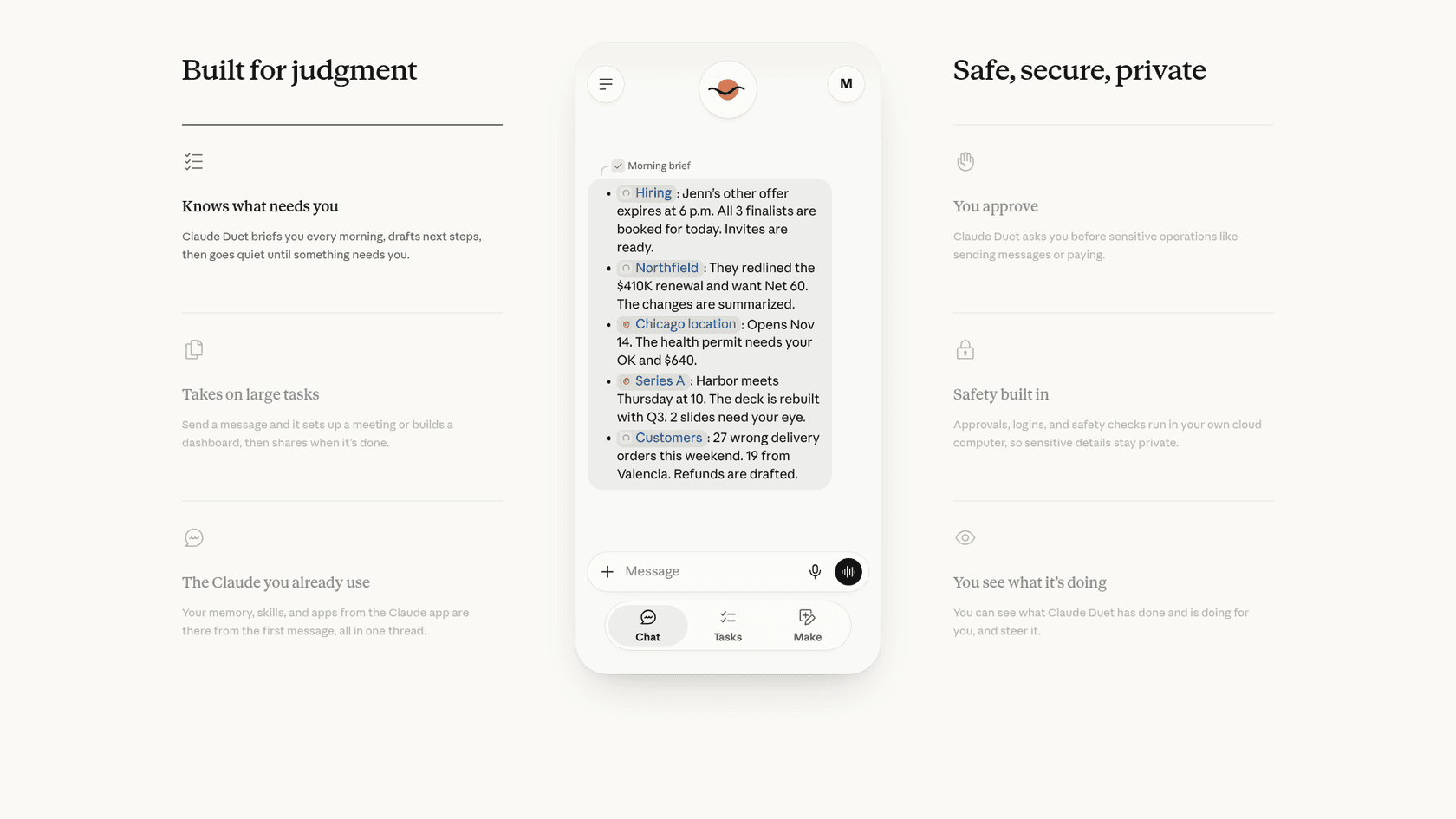
The app has three tabs: Chat for the one ongoing thread, Tasks for what it's working on, and Make for finished files. You can also start separate channels for different topics, and they share the same memory.
Check-ins every few hours
Duet doesn't watch your inbox nonstop. It "checks your connected accounts every few hours, because checking nonstop would use up your plan's limits much faster," per the announcement. You can tell it what you want to hear about and how often.
That's an honest trade, and it's also the one limit I'd flag first. The help center says plainly that "something urgent can arrive between checks." For a personal inbox, that's fine, and it's how most AI tools for small business work. For a customer waiting on a refund, a few hours is a long time.
Tasks on its own cloud computer
Duet has a virtual machine with its own browser, so it doesn't need your laptop or phone to be on. You describe a job in a message, and it works out which apps to use and how much effort the job takes. Bigger results come back as a research brief, a financial model, a slide deck or a dashboard.
For sites without a connector, it uses that cloud browser, a step beyond the local Claude for Chrome extension. My hands-on Dots review shows how much a cloud browser helps, and where sites block it. Anthropic's credential handling follows the design it uses for Claude Managed Agents, so Duet "never directly sees your passwords or sign-in tokens." When a site asks for a password, you type it into a separate form on your device.
Connectors, plugins and payments
Duet can use "the over 6,000 connectors and plugins" in the Claude Marketplace. Anthropic's examples are very small-business shaped: find missed Gmail and Slack messages, check QuickBooks or Stripe for unpaid invoices and draft reminders, prepare payroll in Gusto, send agreements through Docusign, and manage a Shopify store. If you've used Claude skills or Claude for Shopify, that list will look familiar.
Purchases go through two wallets that live only inside Duet for now. With Link by Stripe, you approve a maximum amount in the Link app, then Duet pays with a one-time card scoped to that merchant and amount. Shop Pay works the same way at Shopify stores. Duet can see the card type and last four digits, but not your full card number.
What will Claude Duet do without asking you?
This is the part I'd read twice. Anthropic sorts actions into three tiers, and the tiers are clearer than most agent launches I've read.
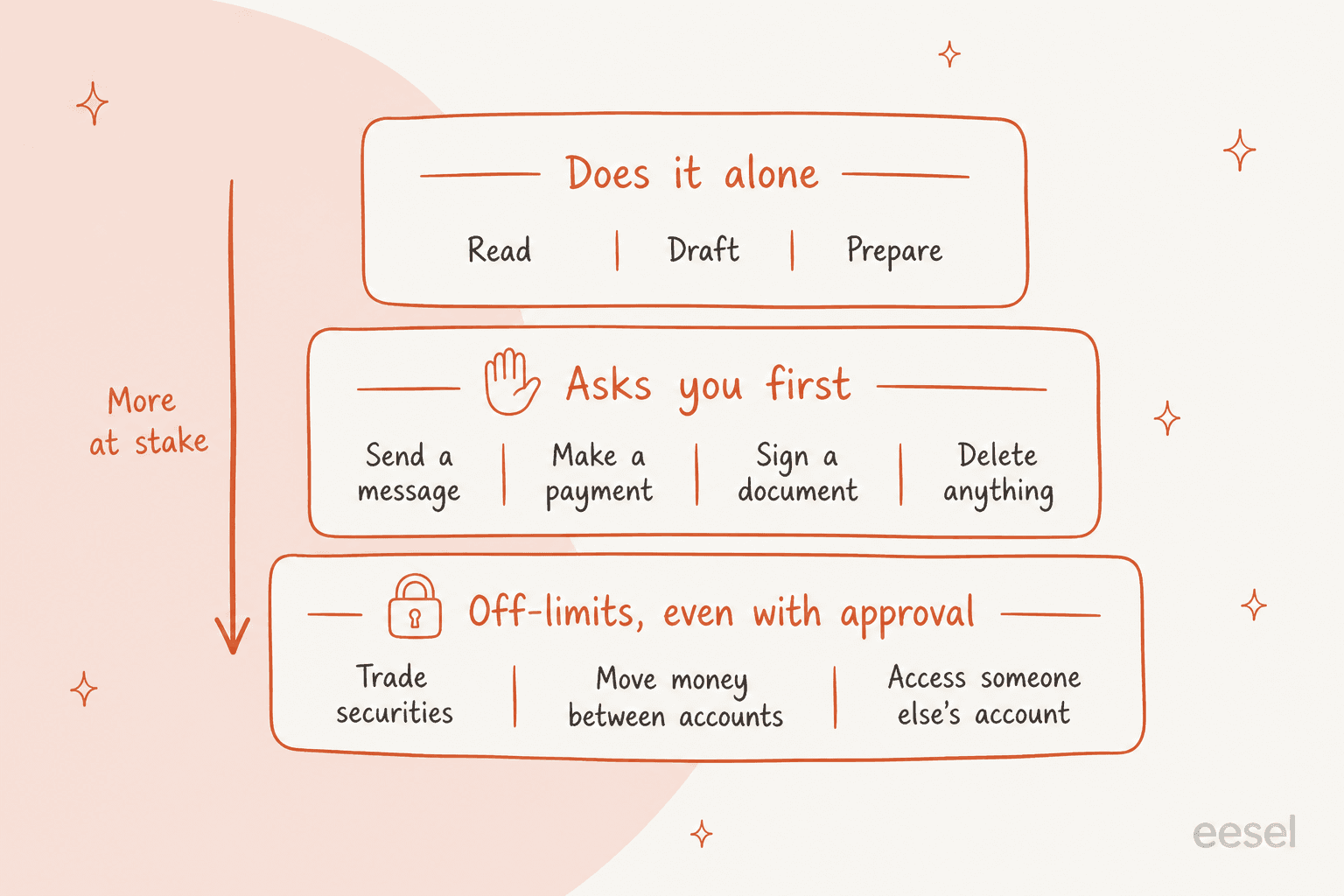
- Does it alone: reads, drafts and prepares work.
- Asks first: "before it sends a message, makes a payment, signs a document, or deletes anything, it shows you exactly what it's about to do and waits for your approval." If you can't approve right away, it finishes the rest of the task and brings the approval back later.
- Never, even with approval: trading securities, moving money between accounts, or accessing someone else's account.
There's more under the hood. Actions are checked by the same auto mode classifier that guards Claude Code, and a new dedicated classifier refuses to share the strictest tier of information, "including credit card numbers and government identification." Health or personal finance details go out only when you've explicitly told Duet to send them.
Anthropic is also candid about the weak spot. On prompt injection, the help center says "no defense is perfect, which is one reason consequential actions need your approval." I respect that sentence. It's the same reason eesel's helpdesk teammates draft first on most new rollouts and only send directly once a team trusts them.
Who can get Claude Duet, and what does it cost?
Here's the access list, straight from the help center:
- A Pro or Max plan
- A Claude account in the US
- An invitation from the waitlist
It isn't on Team or Enterprise yet ("we plan to bring it to those plans later"), and access opens in waves. One gotcha: access is tied to the email you gave the waitlist, so it has to match your Claude account and the Apple or Google account on your phone.
| Claude plan | Price (per Anthropic) | Claude Duet |
|---|---|---|
| Free | $0 | Not included |
| Pro | $20/month, or $17/month billed annually | Included in the research preview, US only |
| Max 5x | $100/month | Included in the research preview, US only |
| Max 20x | $200/month | Included in the research preview, US only |
| Team | From $20/seat/month billed annually | Not yet |
| Enterprise | $20/seat/month billed annually + usage at API rates | Not yet |
Prices come from Claude's pricing page and the Max plan article.
The full plan breakdown is in my Claude pricing guide, and the Claude Pro post covers what $20 buys outside Duet.
The real cost is your usage limit
"No extra cost" is true, but Duet isn't free to run. It uses your plan's five-hour session and weekly limits "at the same rate as chats in Claude," and background work like the morning brief and check-ins counts too. Larger jobs, like building a financial model or a deck, "require more model turns and background work."
Anthropic softens the landing a little: when you're admitted, you get one full limit reset (session and weekly), usable until November 30, 2026.
On Hacker News, this was the most practical objection:
"I really have no interest in this if it's going to use my plan's regular limits. I have less control over the context window, if its going off task."

My read: if you're on Pro and already hit limits in Claude Code or long chats, Duet will make that worse. Max is the realistic home for heavy Duet use.
What can't Claude Duet do yet?
The help center lists the limits plainly, which I appreciate:
- No model choice. It runs on Claude Opus 5.5 and decides the effort itself.
- No view into its browser. You can't watch it work or take over.
- Gaps between checks. Something urgent can arrive between check-ins.
- No local files. It can't see files on your computer, and it can read your Claude work but not change it.
- No calls or texts to others. With approval, it can send email from your connected accounts.
- Connector gaps. Slack "works with limits" (the Cowork Slack integration is fuller). Microsoft 365 "isn't available yet."
- Personal errands are weaker. Anthropic says booking tickets and similar tasks "aren't quite as strong."
One small conflict worth knowing: the Duet product page shows a Microsoft / Office 365 logo in its connector strip, while the help center says Microsoft 365 isn't available yet. I'd trust the help center until that changes, so Outlook-first teams should wait or look at Claude Cowork in the meantime.
The browser limit drew a sharp comparison from one early user on Hacker News, who had access and asked Duet to list its own files:
"I got access a little while ago and was curious to compare how Duet worked to Muse's setup, so I asked it to give me an ls of its VM's files and it refused."
How does Claude Duet compare to OpenAI Dots and Meta Muse?
Three labs shipped the same idea inside a few weeks, and the industry noticed. One of the top replies under Anthropic's launch post on X:
"Dot, meet Duet. Duet, meet Dot. Be nice to each other."
The products look alike from a distance, but the details differ in ways that decide who should pick which.
| Claude Duet | OpenAI Dots | Meta Muse | |
|---|---|---|---|
| Launched | Oct 21, 2026 | Sep 29, 2026 | Sep 8, 2026 |
| Model | Claude Opus 5.5 | GPT-6 Astra | Muse Spark 1.3 |
| Cheapest published plan | Claude Pro, $20/month | ChatGPT Pro, from $100/month | Free to start, paid tiers unpriced |
| Where | iOS, Android, claude.ai | ChatGPT, Slack, Teams | iOS, Android, web, WhatsApp |
| Regions | US only | Not on Pro in EEA, Switzerland, UK | US only |
| Apps | 6,000+ connectors and plugins | 4,000+ apps via plugins | Connectors gated by a separate permission agent |
| Hard lines on money | Never trades securities or moves money between accounts | Password changes and money transfers always handed back | Approval on every checkout |
| Team plans | Not yet | Business Premium | Consumer only |
Dots and Muse facts are from my earlier write-ups on OpenAI Dots, Dots pricing and Meta Muse.
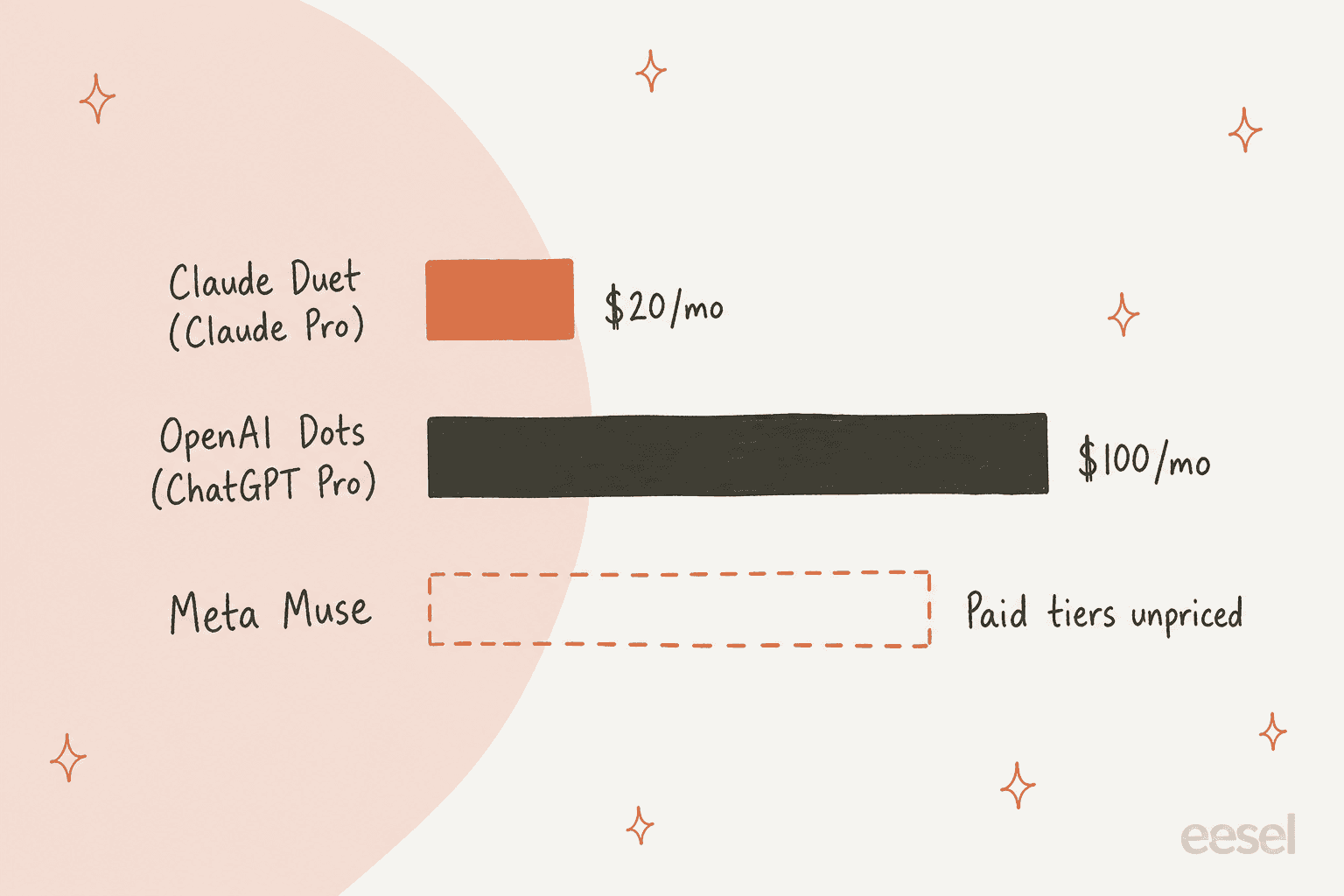
Price is where Duet wins outright. One Hacker News reader put the gap bluntly:
"Functionally, Anthropic will have a frontier model driving a personal agent available a 1/5 the cost of OpenAI."
Tone is the other difference. Muse and Dots lean into named, characterful assistants. Duet doesn't:
"A notable distinction between Duet and Meta Muse/OpenAI Dots is the lack of quirky anthropomorphic branding. As a result, the use cases are more clear/more professionally-oriented as they don't rely on you creating a magic pet/BFF that does whatever you want."
And one commenter who said they'd tried all three summed up the personalities in a way I keep thinking about:
"OpenAI: it’s 9pm you promised this person this note by EOD. Here’s what it should say. You want to draft it or me? (Wow yes I missed that, thank you) - Claude: hey you logged into Docusign, is that ok?"
That's a fair caricature of Duet's design choice. It errs toward asking, which is the same handoff rule I'd want from any agent touching money. Whether that reads as careful or chatty will depend on how much you already trust it. The launch thread on Hacker News has passed 540 points and 500 comments, and trust was the biggest single theme. Several commenters said they already run a home-built version, with Claude Code and cron jobs or a self-hosted agent in the spirit of OpenClaw.
If you're picking between them today, here's a quick fit check.
Which always-on agent fits your situation?
Based on each vendor's published access rules as of October 23, 2026.
Is Claude Duet worth it?
For a US founder or consultant already paying for Claude, yes, join the waitlist. The morning brief is the feature that justifies it, and the testers Anthropic quotes are telling. A real estate broker had Duet catch a property showing booked on the wrong day "without having to ask." A brand strategist had it notice a client call sat right before her flight and offer to move it.
The case is weaker if:
- You're tight on limits. Pro users who already hit the five-hour cap will feel Duet's background checks.
- You run on Microsoft 365. It isn't available yet.
- You want to see inside the agent. You can't watch its browser or browse its files.
- You need it for a team. Team and Enterprise aren't included yet.
The trust question also hasn't gone away. Some readers in the launch thread were blunt about it:
"Love LLMs, use them extensively, but they cannot intuit what actions they can take on my behalf that I will or will not approve of, and therefore I will never use one of these things."
I'd answer that with Duet's own design: start with read-and-draft tasks, keep payments disconnected until you've watched a week of briefs, and only then connect Link. That's the same path I'd recommend for any AI email assistant or scheduling assistant.
Where Claude Duet stops, and where a teammate starts
Look closely at one of Anthropic's own testers. Amin Ebrahimi owns Shahs of Kabob in South Florida, with about 110 employees, and says he's used Duet "for accounting, customer support, and marketing." That's a great fit for an owner keeping track of everything. It is not the same thing as running a support queue.
A support queue belongs to a team, not one inbox. It needs answers in minutes, not every few hours, and it needs someone accountable for every ticket, not a brief that the owner skims at 7am. Duet is a generalist built for one person. That's the gap an AI helpdesk agent was built for, and the one I've watched personal agents like Dots struggle to fill.
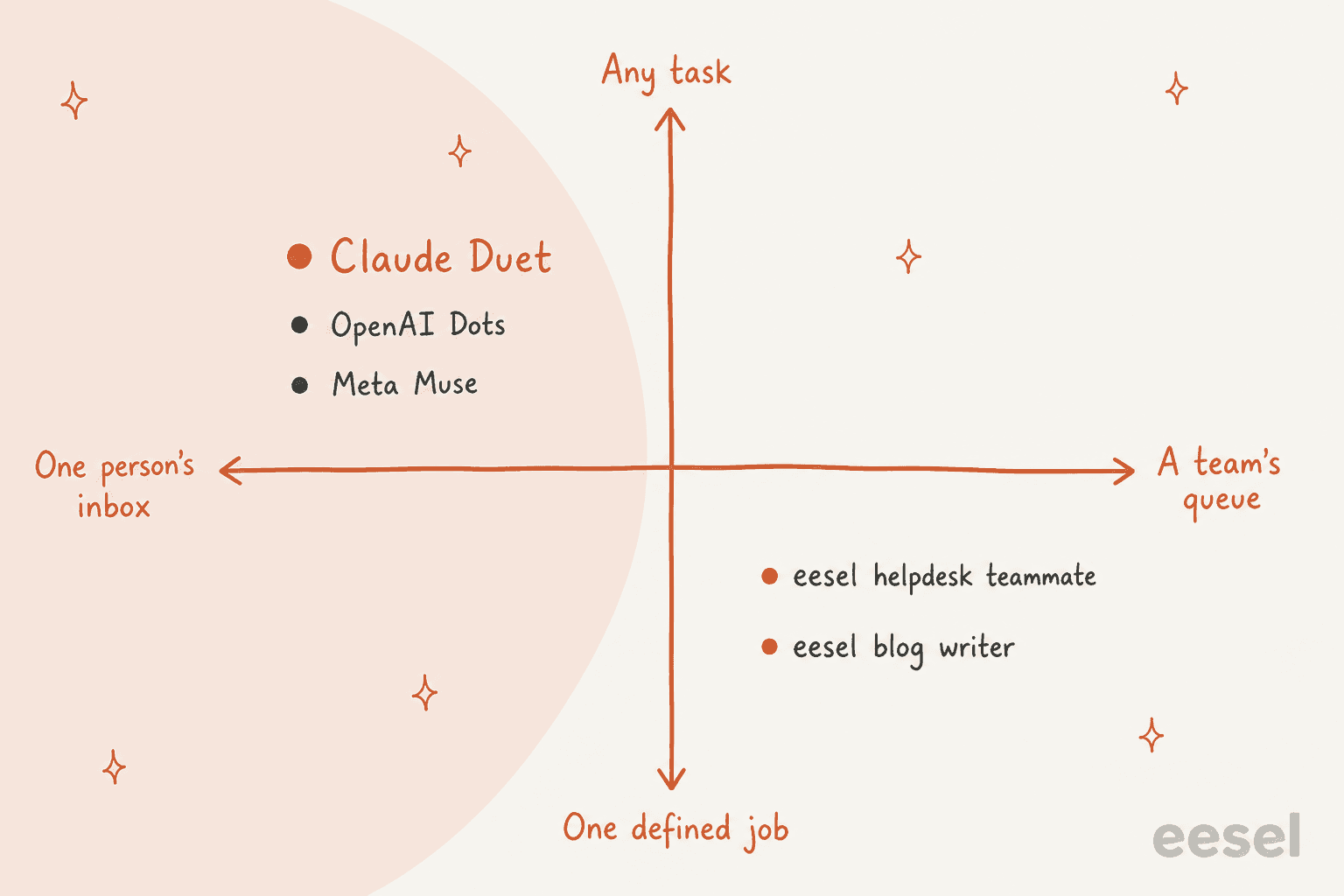
eesel gives you AI teammates hired for a specific job: today that's the AI helpdesk teammate and the AI blog writer. Each one arrives with the skills, integrations and company context for its role, and works your team's tools rather than your personal inbox.
Here's what that looks like in production, from published eesel customer stories:
- A morning sweep, for a whole queue. Cape Coffee Beans runs eesel on Zendesk, Shopify and Google Drive. Every morning it sweeps the Zendesk queue for unassigned tickets, pending tickets with no follow-up date, and leads on the wrong form, then emails the founder a short list. That's about 160 scheduled checks a month, and it's read-only on those sweeps.
- Drafts first, for a team that wants control. Cactus Club Cafe, a Vancouver restaurant group, has a tier 1 agent on its internal Zendesk tech desk. In one month it handled 750 tickets and wrote 790 draft replies for the team, against 51 sent directly.
- One agent per product, at volume. SE Ranking runs three agents for three products on Zendesk, handling 4,650 conversations in a month, including 2,100 live chats answered first by eesel.
Notice the pattern: the same "read, draft, ask" ladder Duet uses, applied to a shared queue with the helpdesk as the source of truth. If you want the broader comparison, my roundup of AI agents for small business and my posts on the AI employee idea and the best AI teammates go deeper.
And if you're a Claude Code user, you don't have to leave the terminal. The eesel CLI lets you connect a helpdesk, read and edit the teammate's standing instructions, and approve or deny pending actions from the command line, and every workspace also works as an MCP server you can add to Claude Code. My AI agent CLI post walks through it.
Try eesel for your support queue
If Duet has you thinking about what an always-on agent could do for your business, point that thinking at the queue your customers actually wait in. eesel's helpdesk teammate plugs into Zendesk, Freshdesk, Gorgias and more, learns from your help center and past tickets, and drafts or answers with the same approval steps you'd want from Duet.
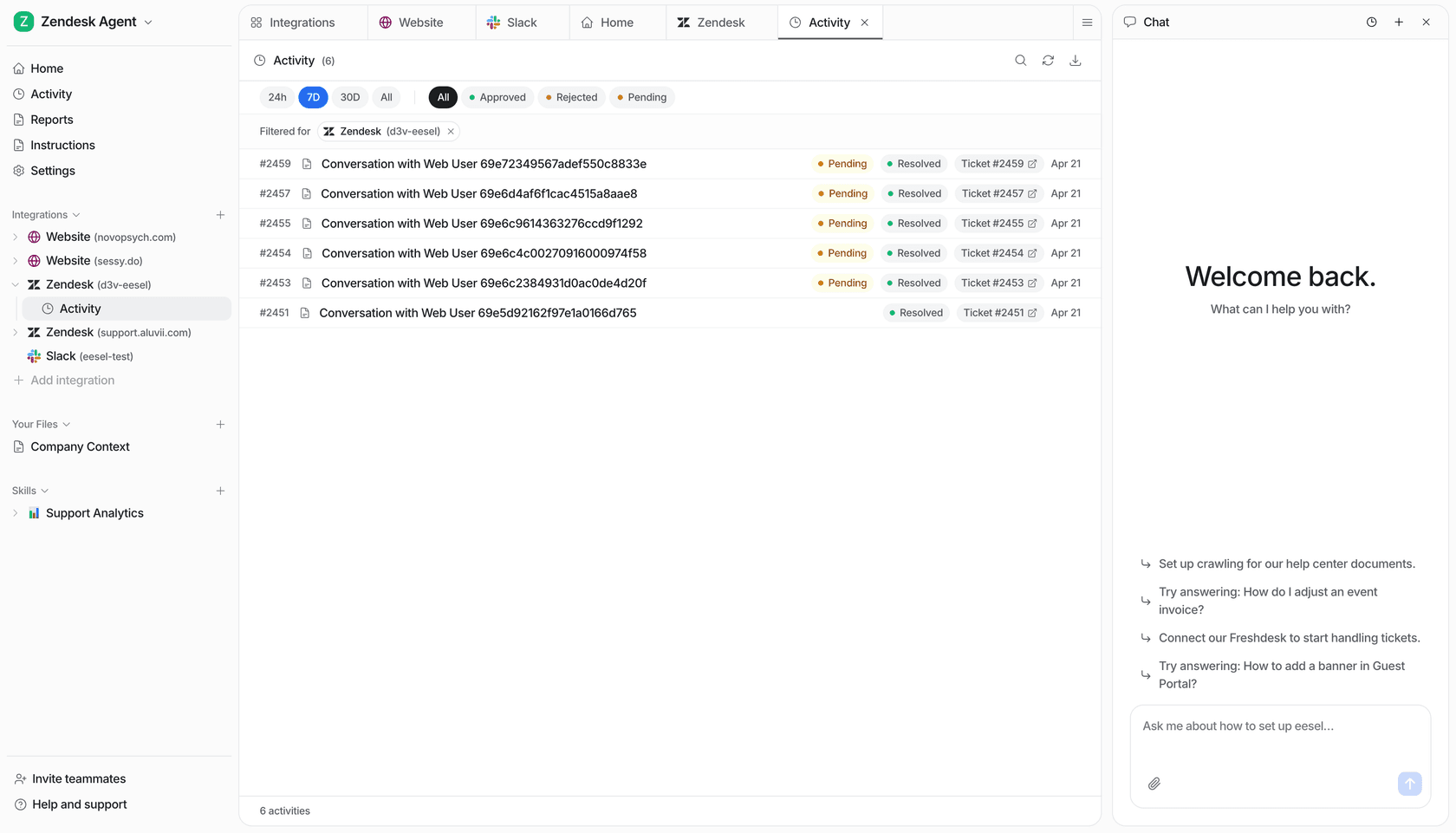
Pricing is public: a free plan with 100 credits and no card, then teammate plans from $299/month for 500 credits, where one ticket or chat is one credit. Details are on the pricing page. Try eesel and have a helpdesk teammate reading your real tickets the same afternoon.
Frequently Asked Questions
What is Claude Duet?
Claude Duet is a research preview from Anthropic, launched October 21, 2026: a standalone app where Claude works as a proactive agent. It sends a morning brief, checks your connected apps every few hours, runs tasks on its own cloud computer, and asks before it sends, pays, signs or deletes. It runs on Claude Opus 5.5. If you want the wider category first, my AI personal assistant guide covers it.
How much does Claude Duet cost?
During the research preview Claude Duet is included with Pro and Max at no extra cost, per Anthropic's help center. Pro is $20 a month ($17 a month billed annually), Max 5x is $100 and Max 20x is $200. It shares your plan's usage limits, and its background checks count toward them. My Claude pricing breakdown covers the plans in full.
Who can use Claude Duet right now?
Pro and Max subscribers with a Claude account in the US who get an invitation from the waitlist. It isn't on Team or Enterprise plans yet, and invitations go out in waves. If you're outside the US or on a team plan, Claude Cowork is the nearest thing you can use today.
Is Claude Duet safe to connect to my email and payments?
Anthropic built in approval before sending, paying, signing or deleting, a hard block on trading securities and moving money between accounts, and payments through one-time cards from Link or Shop Pay so your real card number isn't shared. Anthropic also says no prompt injection defense is perfect. My notes on agent handoffs cover how to decide what an agent should do alone.
How is Claude Duet different from OpenAI Dots?
Both are always-on personal agents with their own cloud computer. Duet runs on Opus 5.5 and starts on the $20 Pro plan in the US; OpenAI Dots run on GPT-6 Astra and start on ChatGPT Pro at $100 a month. Dots also work in Slack and Teams, while Duet lives in its own phone app and on claude.ai. The Dots pricing post has the plan detail.
Can Claude Duet handle customer support for my business?
It can find missed Gmail and Slack messages and draft replies for you to approve, which helps a solo owner. It isn't built to work a shared helpdesk queue: it checks at set intervals, can't text or call customers, and isn't on Team plans. For a support inbox, an AI helpdesk agent like eesel works inside Zendesk and other helpdesks for the whole team.
What can't Claude Duet do yet?
Per Anthropic's help center: you can't pick a model, you can't watch or take over its browser, it doesn't make phone calls or send texts to other people, it can't see files on your computer, Microsoft 365 isn't available yet, and Slack works with limits. It can also miss something urgent that lands between check-ins. Compare that with Meta Muse if transparency matters to you.