

How Claude Motion pricing works
I write about pricing for a living, and the first thing I check on any "X pricing" search is what the buyer is really asking. Here, it is "do I have to pay extra for this, and if so, how much?" The answer comes in two parts.
Part one: there is no Motion fee. Anthropic's Claude Motion help article says Motion "counts toward your plan's usage limits, like the rest of your work with Claude." There is no add-on, no per-animation charge and no Motion SKU on the Claude pricing page.
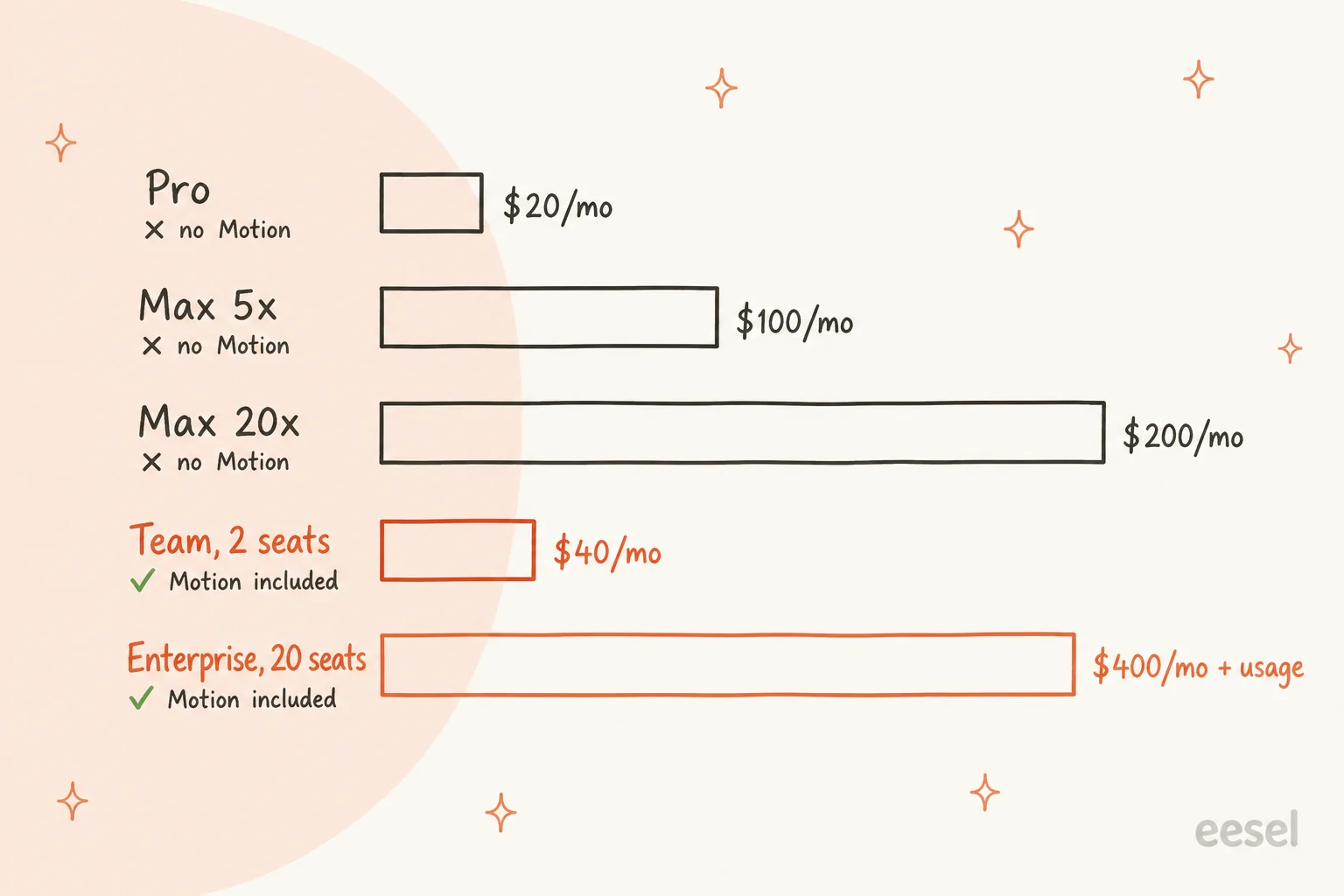
Part two: access is plan-gated. The same pricing page lists "Claude Motion (beta)" as included on Team, Enterprise (self-serve) and Enterprise (sales-assisted), and not included on Free, Pro, Max 5x or Max 20x. If you are new to the product itself, my Claude Motion overview covers what it makes and how.
That combination creates the oddest price ladder I have seen in AI tooling this year. You can spend more on Claude and get less Motion.
Claude Motion pricing by plan
Here is every plan with its list price and whether Motion is in it, straight from claude.com/pricing as of October 9, 2026. Prices exclude tax.
| Plan | Price | Who it's for | Claude Motion | How Motion usage is paid |
|---|---|---|---|---|
| Free | $0 | Individuals | Not included | n/a |
| Pro | $17/month billed annually ($200 up front), $20 monthly | Individuals | Not included | n/a |
| Max 5x | From $100/month | Individuals | Not included | n/a |
| Max 20x | $200/month | Individuals | Not included | n/a |
| Team, Standard seat | $20/seat/month billed annually, $25 monthly | Teams of 2 to 150 | Included (beta), on by default | Seat usage limits, then optional usage credits at API rates |
| Team, Premium seat | $100/seat/month billed annually, $125 monthly | Power users on a Team plan | Included (beta), on by default | 5x the usage of a Standard seat, then optional usage credits |
| Enterprise, self-serve | $20/seat/month billed annually, 20-seat minimum | Larger orgs buying online | Included (beta), off until an owner turns it on | Every token at API rates, from credits bought upfront |
| Enterprise, sales-assisted | Same seat price, 50-seat minimum | Orgs working with Anthropic sales | Included (beta), off until an owner turns it on | Every token at API rates, invoiced monthly in arrears |
The seat minimums come from Anthropic's Enterprise plan article (20 self-serve, 50 sales-assisted) and the "For teams of 2 to 150" line on the Team card. Team plans can mix Standard and Premium seats, so you only pay Premium for the people who need it.
The plan gate drew a reaction within hours of launch:
"why is motion not in max already?"
Fair question, and nothing in Anthropic's docs promises a change. For now, a solo creator who wants Motion has to start a Team workspace, which needs at least two seats.
What a Motion animation actually costs you
This is where Team and Enterprise behave completely differently, and it is the part most early coverage skips.
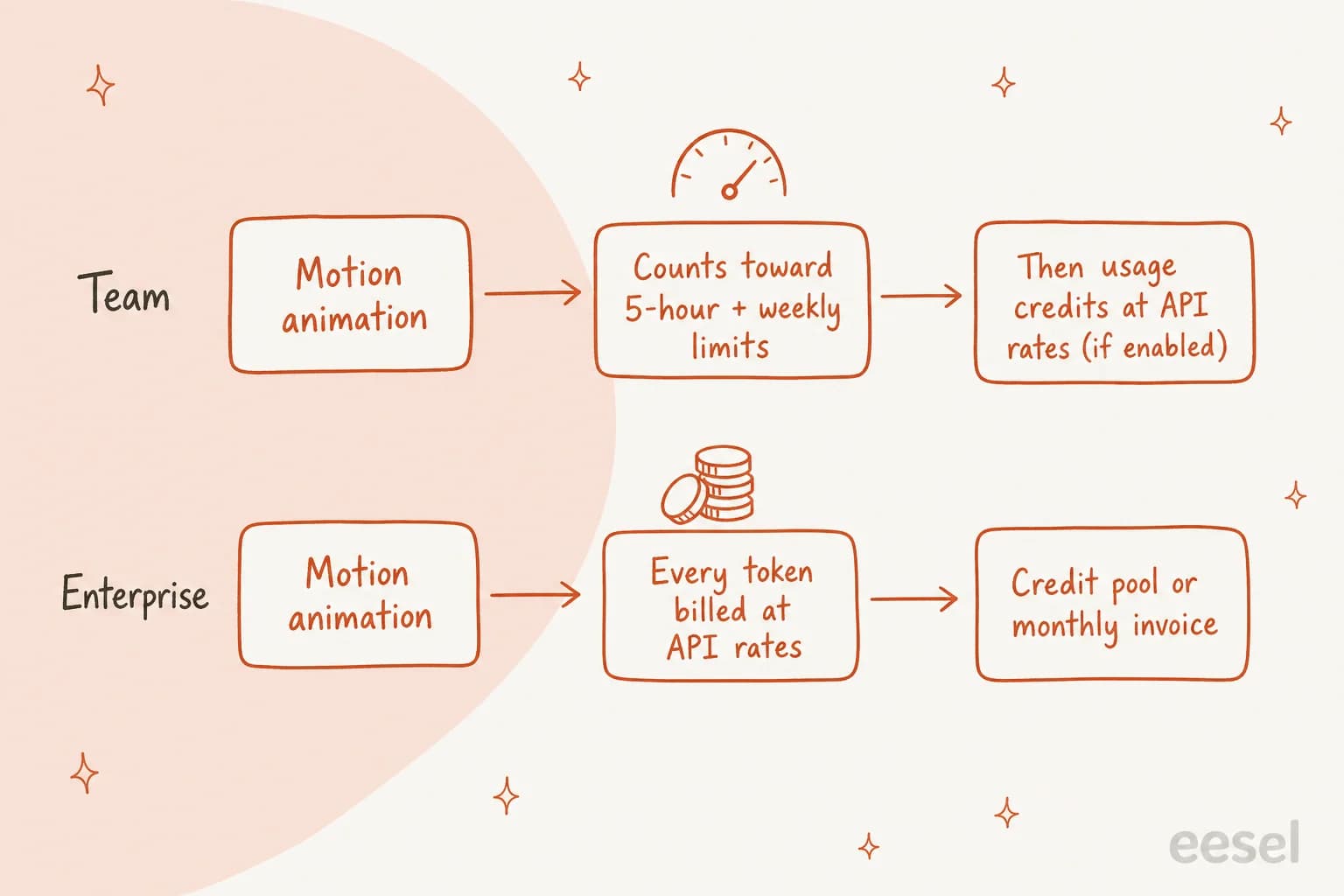
On Team: you pay in limits, not dollars
A Team seat comes with a session limit that resets every five hours and a weekly limit, per Anthropic's usage and length limits article. Motion draws on those, and longer or more complex animations use more of your limit than a typical message. Your chats, files and Claude Code work all share the same pool, so a heavy animation afternoon can leave less room for everything else.
When a member hits the limit, two things can happen:
- They wait. The session limit resets in five hours, the weekly one once a week.
- They keep going on usage credits. If an owner has turned on usage credits for Team, the extra work is billed at standard API rates from a pre-purchased balance, with organization-wide and per-user monthly spend limits.
So on Team, Motion only turns into a dollar figure after someone runs out of seat usage. If one person on your team animates every day, the cleaner fix is usually a Premium seat (5x the usage of Standard) rather than open-ended credits. Upgrading a Standard seat to Premium is a reassignment, charged as a prorated difference.
On Enterprise: every animation is a line on the bill
Enterprise works the other way round. Anthropic's Enterprise billing article says the seat fee "doesn't include any usage," and every token your team uses is billed at standard API rates. There are no per-seat usage limits, which sounds generous until you remember there is also no ceiling.
How that shows up depends on how you bought Enterprise:
- Self-serve: usage comes out of credits bought upfront. When the balance hits zero, usage stops for the whole organization until an owner buys more. One person rendering a lot of animations drains the pool for everyone.
- Sales-assisted: usage is metered and added to a monthly invoice. Nobody gets blocked; the bill just grows.
Two more Enterprise details that affect the number. If your organization has US-only inference turned on, usage is billed at 1.1x standard API rates for Claude Opus 4.6, Sonnet 4.6 and later models. And the model and effort level matter: Anthropic's limits article lists the model and effort level among the factors that drive usage. For reference, the API pricing table puts Claude Opus 5.5 at $4 input / $20 output per million tokens and Claude Sonnet 5.5 at $2 / $10.
Why I can't give you a per-animation price
Anthropic has not published a typical token count for a Motion animation, and I would rather tell you that than invent one. Because Motion writes the animation as code, cost scales with how much code Claude writes and rewrites: a 10-second animated chart with one revision is a different job from a 60-second walkthrough with six rounds of "slow down scene two."
The practical way to find your number is to measure it. On Team, owners get usage analytics (listed on the pricing page for Team) and, once usage credits are on, an MTD spend column per member under Organization settings > Usage. On Enterprise, owners can set spend limits for the organization, groups or individual users under Organization settings > Usage. Run a week of real animations with a modest cap, then size the budget from what you saw.
Worked examples by team size
Seat costs are exact; usage on top is the variable you measure. All Team figures below use annual billing unless noted, and match the maths in Anthropic's own Team billing examples.
| Scenario | Setup | Seat cost per month | Seat cost per year | Usage on top |
|---|---|---|---|---|
| Solo creator who wants Motion | Team, 2 Standard seats | $40 ($50 if monthly) | $480 | Covered by seat limits; credits optional |
| 10-person marketing team | Team, 10 Standard seats | $200 ($250 if monthly) | $2,400 | Covered by seat limits; credits optional |
| Same team, 2 heavy animators | Team, 8 Standard + 2 Premium | $360 | $4,320 | 2 people get 5x the usage |
| Smallest self-serve Enterprise | Enterprise, 20 seats | $400 | $4,800 | Every token at API rates, prepaid credits |
| Smallest sales-assisted Enterprise | Enterprise, 50 seats | $1,000 | $12,000 | Every token at API rates, monthly invoice |
The solo case is the one I would think hardest about. Paying $480 a year for a second seat you don't need, just to unlock a beta feature, is a lot of money for short animations. If the second seat is a real colleague, the maths is easy.
Want to run your own numbers? Plug your seat mix in here.
The fine print that changes the bill
A few details on Anthropic's own pages that move the real cost, in both directions.
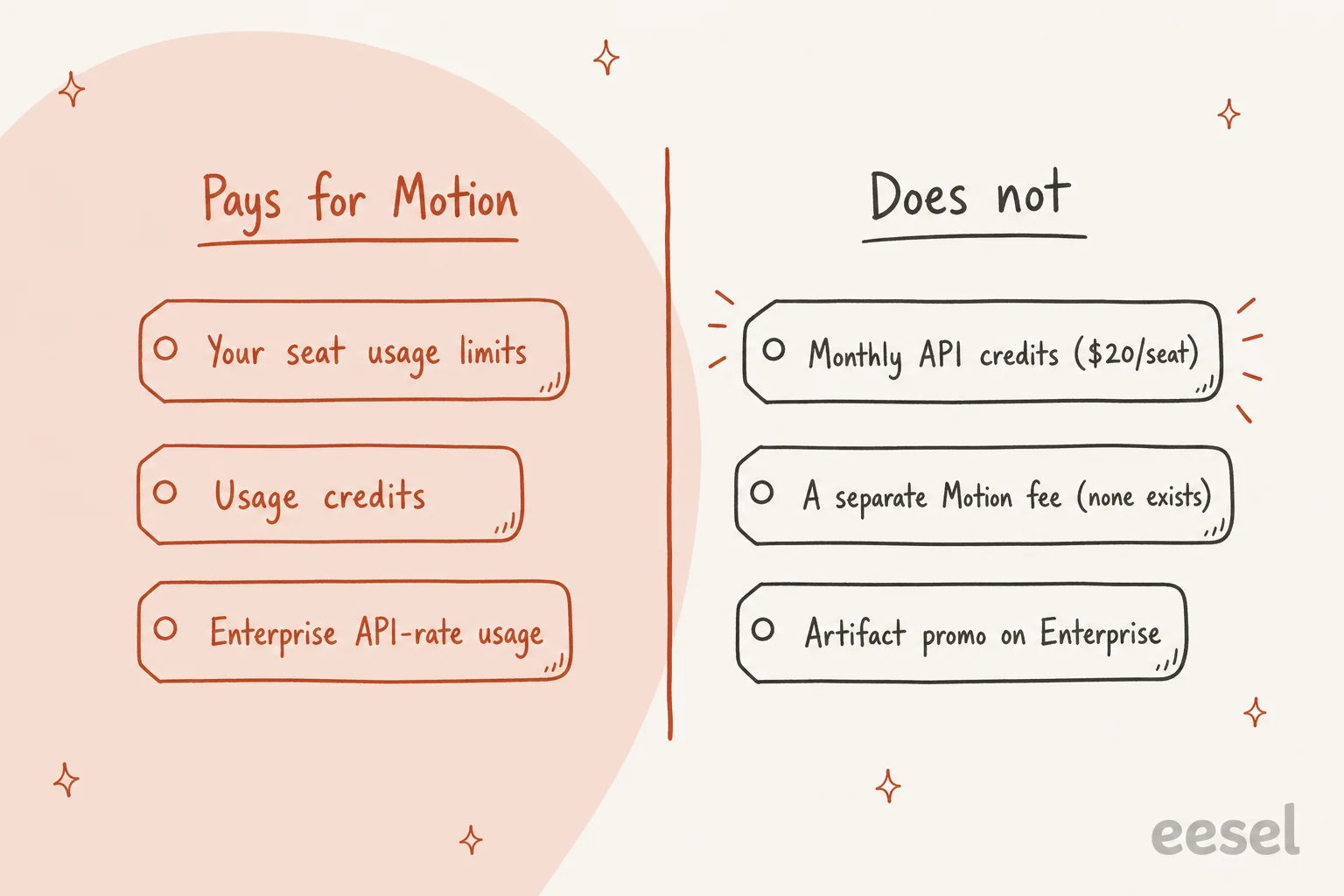
Monthly API credits don't cover Motion. Team plans now include monthly API credits: $20 per Standard seat and $100 per Premium seat, pooled and capped at $500 a month. Anthropic's own example is three Standard plus two Premium seats getting $260. It is easy to read that as "Motion is paid for," but the credits only cover the Claude Platform (the API, the Console Playground, Managed Agents and the Agent SDK) and explicitly don't apply to extra usage in Claude, Claude Code or Cowork. Motion runs in the Claude app, so it never touches that pool.
The artifact promo helps Team, not Enterprise. Anthropic's artifact usage promotion runs October 1 to 15, 2026. When Claude creates or edits an artifact, the next 10 messages in that chat use 50% less of your five-hour session limit, for up to the first 15 steps of each reply. Motion animations are artifacts, so Team users get a cheaper first week of experimenting. It does not touch the weekly limit, does not discount usage credits, and excludes all Enterprise plans.
Seat changes are not refunded mid-term. On Team, reducing seats or moving someone from Premium to Standard takes effect at your next renewal, with no prorated refund. On self-serve Enterprise, seats cannot be removed mid-term at all. If you are adding seats to try Motion, start on monthly Team billing ($25 per Standard seat) until you know it sticks.
Turning it on is free but not instant on Enterprise. Motion is on by default on Team and off by default on Enterprise, and it needs "Cloud code execution and file creation" turned on first, per the artifacts admin guide. Enterprise owners can limit it to specific groups with custom roles, which is also the simplest way to keep animation spend with the people who need it. My Claude Code admin controls guide covers the wider admin settings.
Claude Motion vs paying for a video tool
If you are not on Claude Team yet, the honest comparison is not "Motion vs nothing." It is a Team plan against a dedicated tool you may already pay for. Motion only animates text, charts, shapes and images you give it; Anthropic's docs say it "doesn't use a video generation model," so there is no generated footage and no AI presenters.
| Tool | What you pay for | Makes footage or people? | Good fit |
|---|---|---|---|
| Claude Motion | A Team or Enterprise seat, then usage | No | Animated charts and explainers from your own content |
| Descript | Its own subscription | Edits footage you recorded | Editing real recordings |
| HeyGen | Its own subscription | AI avatars | Presenter-led videos |
| Runway | Its own subscription | Generated footage | Generated B-roll and scenes |
| Luma AI | Its own subscription | Generated footage | Generated scenes |
The tools are complements more than rivals. Anthropic lists Adobe, Descript, HeyGen, Higgsfield, invideo, Luma AI and Runway as places you can open a Motion animation to keep going.
So the question is usually "is Motion good enough to skip one of these?" For numbers-heavy explainers that get revised every quarter, it often is. For anything with a human on screen, it isn't. My Synthesia pricing and Runway alternatives breakdowns cover the generative side.
If you want the same "animation as code" idea without a Team seat, the older route still works: Claude Code plus Remotion, a framework for making videos with React. It runs on any plan that includes Claude Code, needs Node.js and a terminal, and Remotion has its own license terms for companies. My Claude Code pricing guide covers that side.
Is Claude Motion worth paying for?
My verdict, by situation:
- Already on Team: yes, it costs nothing extra. Try it on the chart you would otherwise paste into next week's deck as a static image. Watch your usage analytics for a week before you buy any credits.
- On Enterprise: yes, but set a spend limit and a custom role first. Uncapped, API-rate billing is fine for a few board-deck charts and painful if 200 people discover it in the same week.
- On Pro or Max: no, not for Motion alone while it is in beta. A Team plan costs at least $480 a year for two seats, and that only makes sense if the second seat is a real colleague.
- Need footage or a presenter: Motion was never the right tool. Budget for a video generator or avatar tool instead.
For the wider plan picture, my Claude pricing guide covers every tier, and the Claude Design pricing and Claude Cowork pricing breakdowns cover the sibling features that draw on the same usage.
If you are weighing other assistants entirely, see the Claude alternatives roundup, or compare with ChatGPT pricing and Gemini pricing.
Try eesel for the post your animation lives in
Claude Motion gives you the 30-second animated chart. The blog post that chart belongs in still needs research, writing, internal links, visuals and a publish button, and that is a separate job I compared across AI blog writing tools. The eesel AI blog writer is built for it: give it a keyword and your site, and it researches primary sources, writes in your brand voice, makes the hero banner and infographics, adds internal links and FAQs, and hands back a post ready to ship. One SEO content lead on Webflow uses that keyword-to-publish pipeline to run 360+ posts a month.
Make the animation in Motion, export the MP4, and drop it into a post the blog writer already drafted from the same data; my guide on adding videos to blogs covers the embed. It is free to start, so try eesel on your next post.
Frequently Asked Questions
How much does Claude Motion cost?
Claude Motion has no separate price. It comes with a Team seat ($20 per seat per month billed annually, $25 monthly) or an Enterprise seat ($20 per seat per month billed annually, plus usage at API rates). Each animation then draws from your plan's usage. My Claude pricing guide covers every plan in detail.
Is Claude Motion included in Claude Pro or Max?
No. Anthropic's pricing page marks Claude Motion (beta) as not included on Free, Pro, Max 5x or Max 20x. A Max 20x subscriber paying $200 a month cannot use it, while a two-seat Team plan at $40 a month can. See my Claude Pro pricing breakdown for what the individual plans do include.
What is the cheapest way to get Claude Motion?
A Team plan with two Standard seats, the smallest Team size Anthropic sells. That is $40 a month billed annually ($480 a year) or $50 a month billed monthly. Enterprise needs at least 20 seats self-serve, so it starts at $400 a month in seat fees before any usage. My Claude Motion overview covers what you get for that.
Do Claude Motion animations use up my usage limits?
Yes. Anthropic's help article says Motion counts toward your plan's usage limits, and longer or more complex animations use more of your limit than a typical message. On Team that means the five-hour and weekly limits shared with your other Claude and Claude Code work.
How is Claude Motion billed on Enterprise plans?
On current Enterprise plans the seat fee covers access only. Every token an animation uses is billed at standard Anthropic API rates, either from upfront credits (self-serve) or on a monthly invoice (sales-assisted). There are no per-seat usage limits, so admins should set spend limits.
Can I use Team plan monthly API credits to pay for Claude Motion?
No. The monthly API credits that come with Team seats ($20 per Standard seat, $100 per Premium seat, pooled and capped at $500) only work on the Claude Platform, such as the API and Managed Agents. They do not apply to usage or usage credits in the Claude app, where Motion runs. My Claude Cowork pricing guide explains the same split for Cowork.


Article by
Kurnia Kharisma
Kurnia is a software engineer and writer at eesel AI with two years of SEO experience, writing about AI tools, helpdesk software, and customer support. He pairs a developer's understanding of how these products are built with search-driven research into what actually ranks and resonates with the people searching for them.