

The comparison everyone wants does not exist yet
Start with the uncomfortable bit, because every other article on this matchup just skips over it.
A model comparison needs two sets of numbers. Anthropic published theirs: a system card, a price sheet, plus a whole wall of named launch partners putting figures on the record. Alibaba published two posts on X and a working paid endpoint. That is the entire evidentiary base, for a model which it calls second-best in the world.
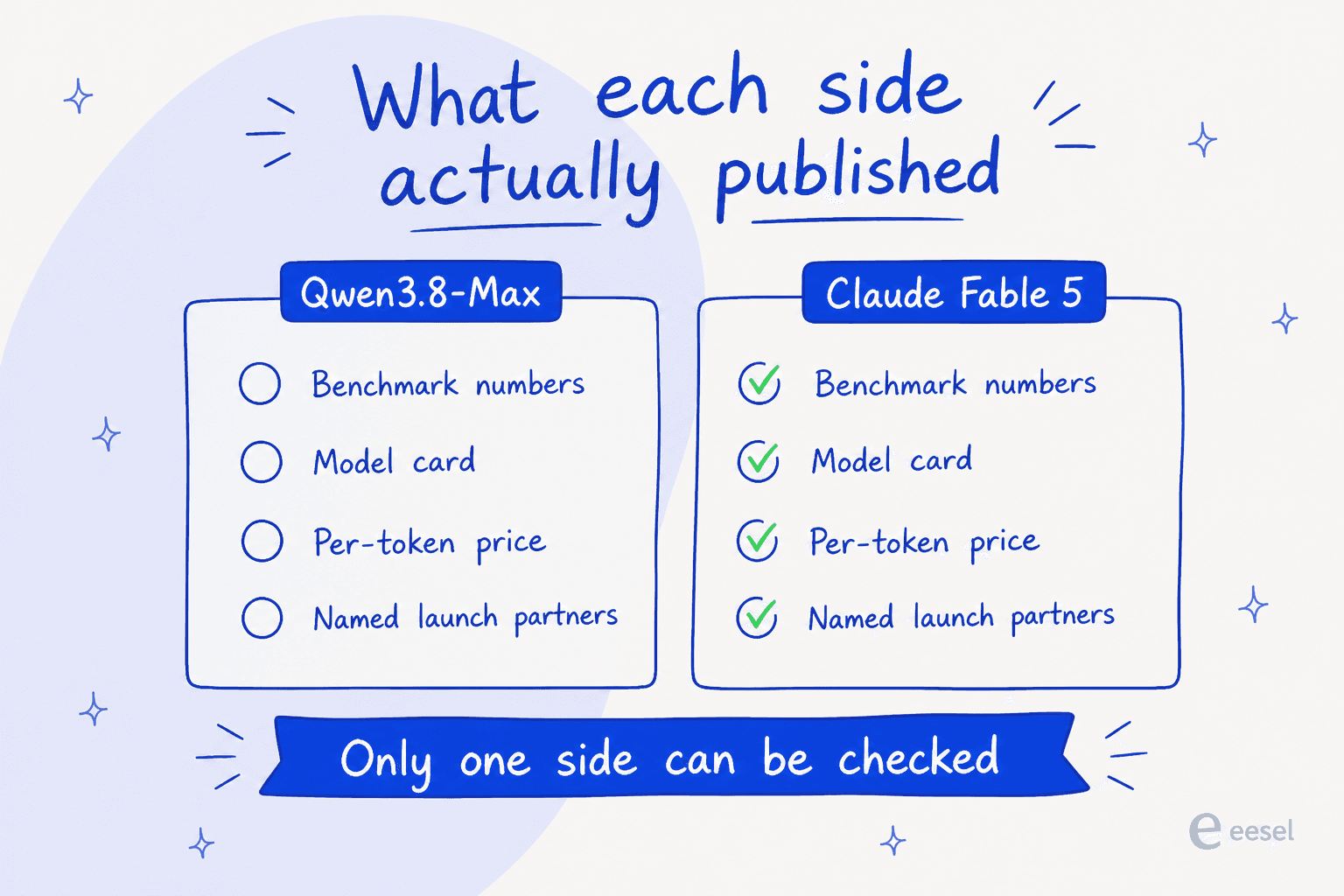
For a context on how far that falls from Alibaba's own bar: the previous flagship Qwen3.7-Max launched in May 2026 with real numbers attached, 80.4% on SWE-bench Verified, and the highest-placed Chinese model on the Artificial Analysis index at that time. Qwen3.8-Max arrived with the confidence and none of the receipts.
So treat what follows as a comparison of two products, and not of two intelligences. It is the only comparison which the evidence actually supports.
What Qwen3.8-Max actually is
Qwen is Alibaba Cloud's model family, and "Max" is the proprietary flagship line, sitting above the cheaper Plus and Turbo tiers. Qwen3.8-Max got previewed on July 19, 2026.
The specs Alibaba states:
- 2.4 trillion total parameters in a sparse Mixture-of-Experts design, per Qwen on X.
- The first multimodal Qwen above 1T parameters, taking text, images, video and documents, per lead researcher Shuai Bai.
- A 1-million-token context window, carried over from Qwen3.7-Max.
- Aimed at coding and agentic work, which is where Alibaba says it beats its predecessor.
The active-parameter count, the sparsity ratio and the license were all of them missing. A 2.4T dense model would be far too expensive to serve, so the MoE routing is what makes that number affordable at all, and it is exactly the number which nobody published.
"Qwen3.8-Max Preview is now available for early access! This is our first trillion-parameter multimodal model."
What Claude Fable 5 actually is
Anthropic pitches Fable 5 as its most capable generally available model, built for "ambitious, long-running, asynchronous work". The framing is unusually narrow for a flagship. Anthropic's own models overview tells you to start with Claude Opus 5, and to step up to Fable 5 only for the workloads which need the highest available capability.
A few things make it a genuinely different animal from a normal model release.
Thinking is always on. Fable 5 does not accept the legacy extended-thinking parameter, and it has no published off switch. Depth gets controlled by effort level instead.
It reroutes its own traffic. Fable 5 ships with safeguards for cybersecurity and biology, and flagged queries get automatically routed to less capable models. Cyber queries drop to Opus 4.8, biology to Opus 5. An Opus answer is literally what a blocked Fable request gives back, which is a strange thing for discovering mid-workflow.
Using it requires 30-day data retention for safety monitoring. For a regulated buyer, that is a procurement conversation and not a checkbox.
The launch-partner numbers are the strongest evidence in this whole comparison, and it is worth to read them as cost claims rather than intelligence claims. One partner reports Fable 5 beating Opus 4.8 on an everyday spreadsheet suite at every effort level, while finishing runs 25-30% faster. Another one says it reached frontier physics results using a third of the reasoning tokens.
Head to head on what is actually published
Here is every dimension where both of the sides have said something concrete. Blank cells are blank because the vendor did not publish it, not because I could not find it.
| Qwen3.8-Max | Claude Fable 5 | |
|---|---|---|
| Vendor | Alibaba Cloud | Anthropic |
| Status | Preview (Qwen3.8-Max-Preview) | Generally available |
| Launched | July 19, 2026 | June 9, 2026 |
| Model ID | not published | claude-fable-5 |
| Architecture | 2.4T sparse Mixture-of-Experts | not published |
| Multimodal input | Text, images, video, documents | Text, images, diagrams, charts, PDFs |
| Context window | 1M tokens | 1M tokens |
| Max output | not published | 128k tokens |
| Input price | no per-token rate published | $10 / MTok |
| Output price | no per-token rate published | $50 / MTok |
| How you buy it | Token Plan subscription, Qoder, QoderWork | Claude API, Bedrock, Google Cloud, Microsoft Foundry |
| Prompt caching discount | not published | 90% on input tokens |
| Benchmark table | none at preview | partner benchmarks, no public numeric table |
| Model / system card | none | system card published |
| Open weights | promised "soon", no date or license | no |
| API protocols | OpenAI and Anthropic compatible | Anthropic |
| Data retention | not published | 30 days, mandatory |
| Documented outage | n/a (preview) | June 12 to July 1, 2026 |
| Knowledge cutoff | not published | January 2026 |
Two of the rows deserve a second look.
The API protocol row is the sleeper advantage. Alibaba's Token Plan endpoint speaks both the OpenAI and the Anthropic protocols, so Claude Code, Cursor and Cline all work against Qwen3.8-Max once you have got a key. Trying it is a five-minute job, and that accessibility is doing quite a lot of the work behind the hype.
The knowledge cutoff row is the quiet Fable 5 oddity. January 2026 is four months older than the May 2026 cutoff on Opus 5, despite Fable being the newer and the pricier model. So if your work leans on recent facts, the expensive model knows less.
Price: two sheets that do not line up
This is the place where the comparison breaks down completely, rather than just getting fuzzy.
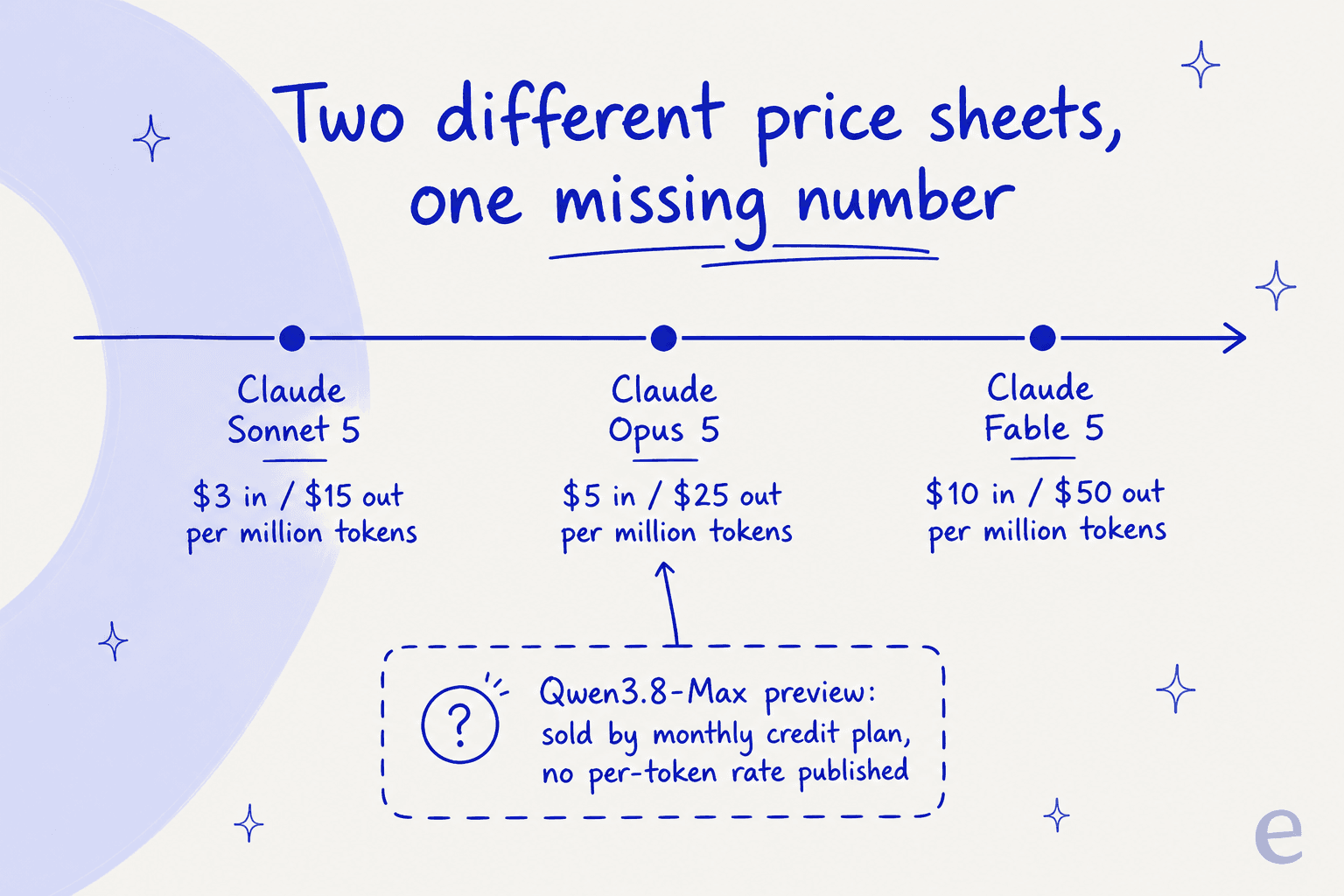
Anthropic sells tokens. Fable 5 is $10 in and $50 out per million, exactly the double of Claude Opus 5 on both lines, with the 90% prompt-caching discount still applying, and US-only inference available at 1.1x.
Alibaba sells a subscription instead. During preview, Qwen3.8-Max runs at 10% of standard pricing through the Token Plan, with Personal tiers at roughly $6, $20 and $70 a month for Lite, Standard and Pro. Then stack the night discount on top, an extra 80% off credit consumption between 22:00 and 08:00 (UTC+8), and off-hours runs land somewhere near 0.2% of the standard rate.
You cannot divide those two into each other. One of them is a rate, the other one is a quota, and the quota's denominator is credits whose token conversion never got published.
There is also a second trap in the subscription model, and it is not a hypothetical. On the previous generation, Qwen users reported credits burning far faster than what they expected, and Qwen models do tend to emit more output tokens per task than peers. Which quietly inflates the real cost even when the sticker looks unbeatable. The preview discount papers over it for now. Budget for the day it ends, and read our Qwen3.8-Max pricing breakdown before you commit any workload.
Meanwhile the Fable 5 partner claims cut the other way on total cost. Fewer turns, and a third of the reasoning tokens on hard tasks, means the 2x sticker is not a 2x bill. It is the same logic we walk through in our Opus 5 vs Sonnet 5 comparison, where the cheaper model is not automatically also the cheaper job.
Where each one actually breaks
Ask "which is better" and you get a shrug. Ask "which one can I put into production on Monday", and both of them answer no, for completely different reasons.
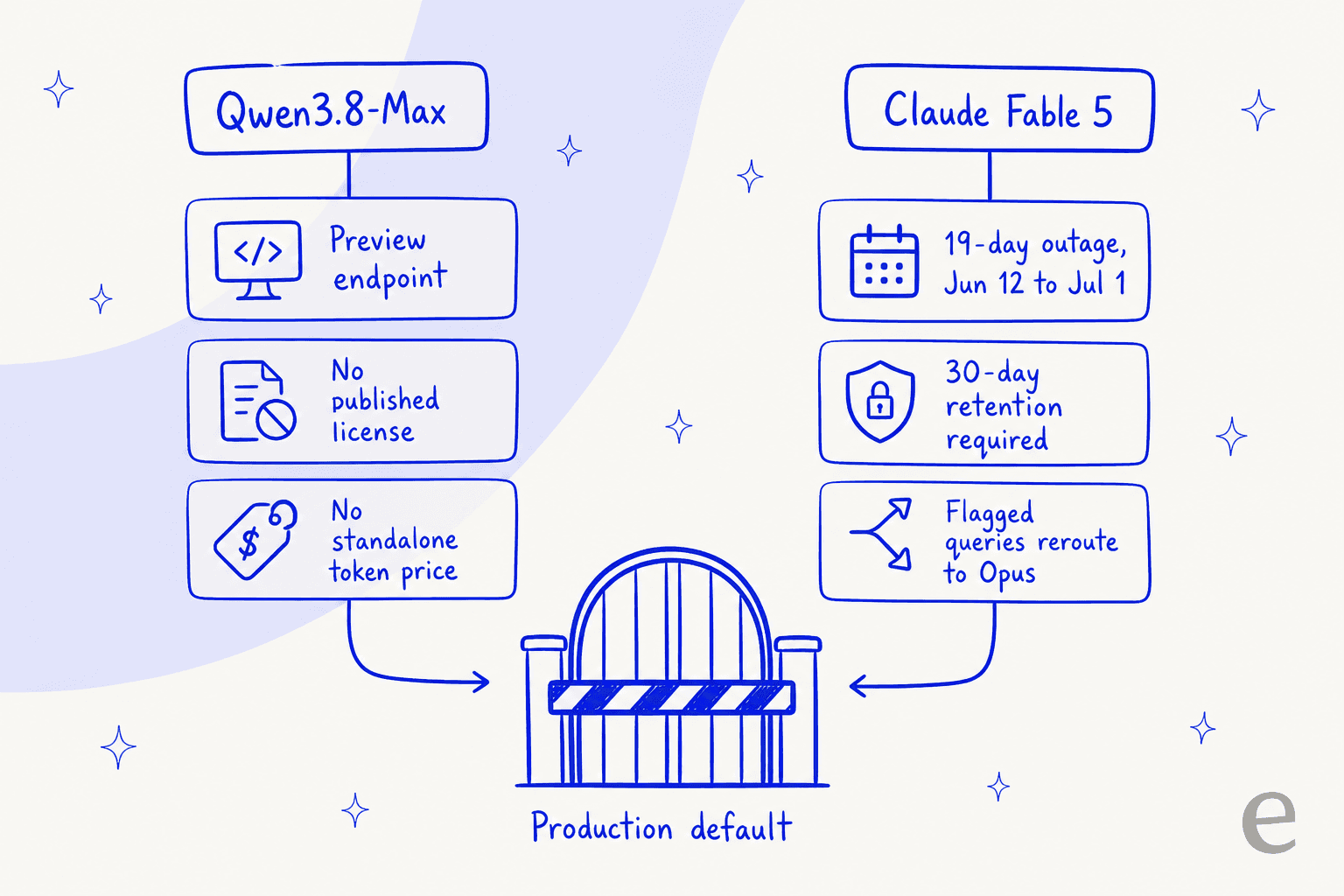
Qwen3.8-Max is a preview. No license and no per-token price, no model card either, plus an endpoint which can change under you. Fine for experiments, and disqualifying for anything with a customer attached to it.
Fable 5 has a public availability record with a hole in the middle of it. Anthropic launched on June 9, pulled access on June 12, then restored it on July 1. Nineteen days, acknowledged by the vendor on its own site. Add the mandatory 30-day retention and the safeguard reroute, and you have got three procurement questions to answer before a single ticket does.
Neither of those is a knock on the underlying model. They are both reasons why the choice matters less than the architecture which you put around it.
So which one should you actually test?
The preview is cheap and the flagship is fast, which makes "should I switch" into the wrong question. Work out first what it is you are actually testing.
Qwen3.8-Max or Claude Fable 5?
Pick the job you actually have.
What this actually means if you are buying for support
Now here is the part which I care about, because building AI agents for support queues is my day job.
Every few weeks a launch like this one makes people think the model is the bottleneck. It is not, and the gap is precisely the place where most AI support projects quietly die. Qwen3.8-Max and Fable 5 both give you raw reasoning. Neither of them knows your refund policy, or your product edge cases, or the fact that ticket #4021 is a VIP who has already emailed twice. Neither has a guardrail which stops it from confidently inventing an answer, and neither connects to the helpdesk where the work actually happens.
We have spent years putting AI onto live support queues, and the lesson which stuck is that a confident wrong answer is worse than no answer at all. One customer's bot cheerfully confirmed it supported product models that were not in their database, because the help center said "we support all models". A bigger parameter count makes that failure more likely and not less, because the model sounds even more certain. One support lead put the requirement to me better than I could:
"The AI will never be able to answer 100% of the questions, but if it tries and just answers wrong, I cannot go check all my 7,000 tickets to see if it made a good answer. I need an AI that only handles the tickets it's confident about, and leaves the rest alone."
a DTC brand CX lead handling 7,000 tickets a month
That is a statement about architecture and not about model choice. It is the reason why eesel AI simulates against your historical tickets before anything at all goes live, so you see the resolution rate and the exact replies on real past conversations, instead of finding it out through a customer. It is also why answers route by confidence: unsure means draft or escalate, and never guess. Running it in that way, Gridwise hit 73% tier-1 resolution in its first month.
The wider point is the one worth to take from this whole matchup. Two labs just moved the size ceiling inside a fortnight, Kimi K3 at 2.8T and Qwen3.8-Max at 2.4T, and then Anthropic shipped a model which works unattended for days. The model layer is getting better and cheaper faster than what any procurement cycle can track. So build in a way where you can swap the engine without re-plumbing everything around it, and every one of those gains lands in your lap for free.
Try eesel AI
If you came here trying to work out which model to point at your support queue, the honest answer is that this choice matters far less than the layer sitting above it. That layer is the thing which eesel AI is.
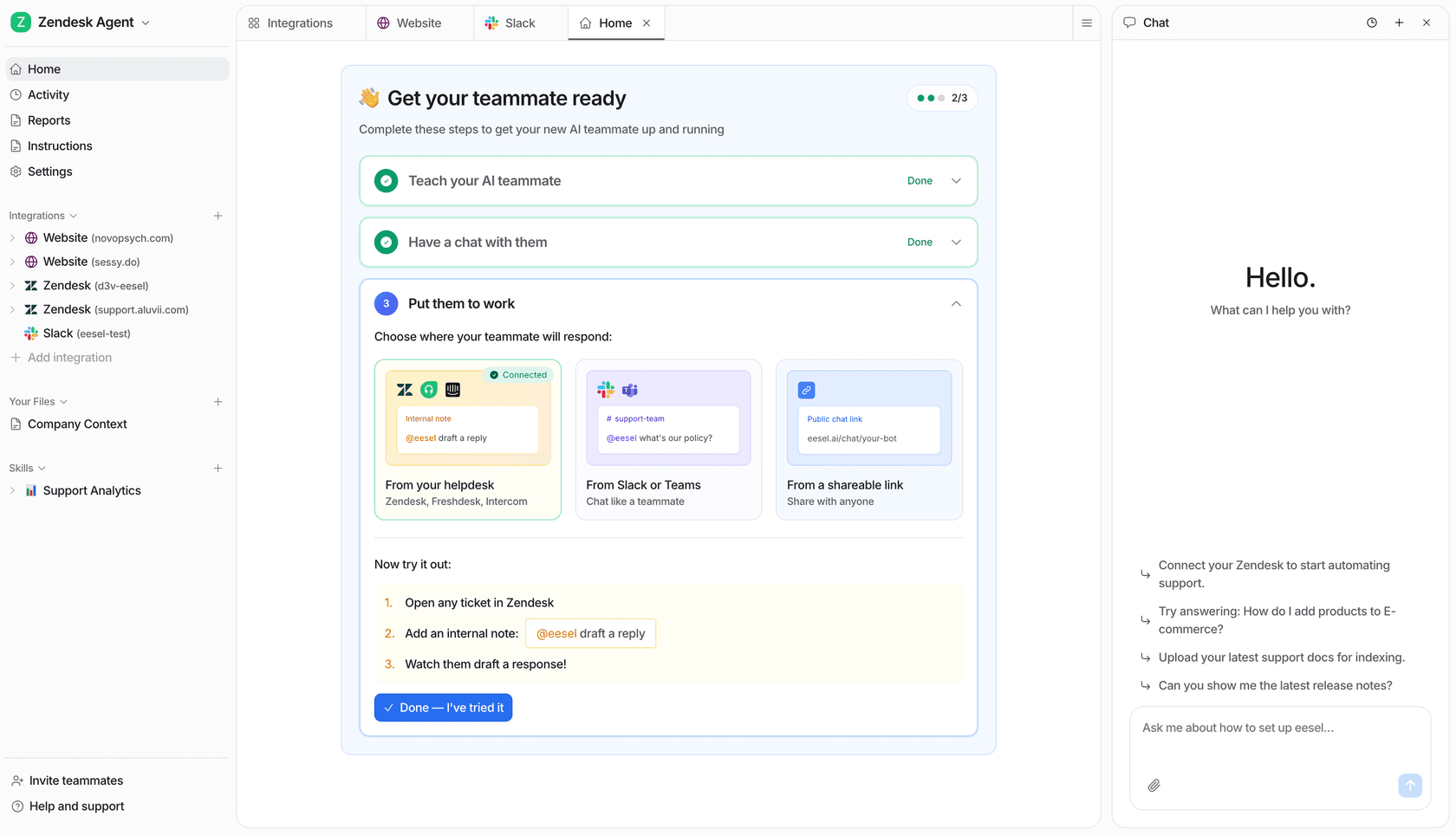
It plugs into Zendesk, Freshdesk, Slack and 100+ other tools, it learns from your help center and past tickets, and starts drafting within minutes. The differentiator is the trust ramp: simulate on your real ticket history, read the numbers, start off in draft mode, then go autonomous only at the point when you are happy. You get the frontier model's smarts with guardrails built for support, and you never have to run this comparison again yourself. Try eesel free, no credit card needed.
Frequently Asked Questions
Is Qwen3.8-Max better than Claude Fable 5?
How does Qwen3.8-Max pricing compare to Claude Fable 5 pricing?
What is the context window on Qwen3.8-Max vs Claude Fable 5?
Is Qwen3.8-Max open source and Claude Fable 5 not?
Can I use Qwen3.8-Max or Claude Fable 5 for customer support?
Which model should I pick if I need reliable uptime?
What are the best alternatives to Qwen3.8-Max?


Article by
Kurnia Kharisma Agung Samiadjie
Kurnia is a software engineer and writer at eesel AI with two years of SEO experience, writing about AI tools, helpdesk software, and customer support. He pairs a developer's understanding of how these products are built with search-driven research into what actually ranks and resonates with the people searching for them.