8 best Gemini 3.5 Pro alternatives in 2026

Kurnia Kharisma

Katelin Teen
Last edited July 19, 2026

Wait, Gemini 3.5 Pro doesn't exist yet?
Correct, and it trips up almost everyone. Google's naming has drifted into genuinely confusing territory, and if you provision a model by name you can walk straight into it.
Here's the state of the Gemini 3 family as it actually ships today. The current flagship is Gemini 3.5 Flash, a Flash-tier model that Google bills as its most capable. The Pro tier is still Gemini 3.1 Pro, a full version number behind that flagship. And "Gemini 3.5 Pro" sits on the page with a "coming soon" tag, unshipped and unpriced.
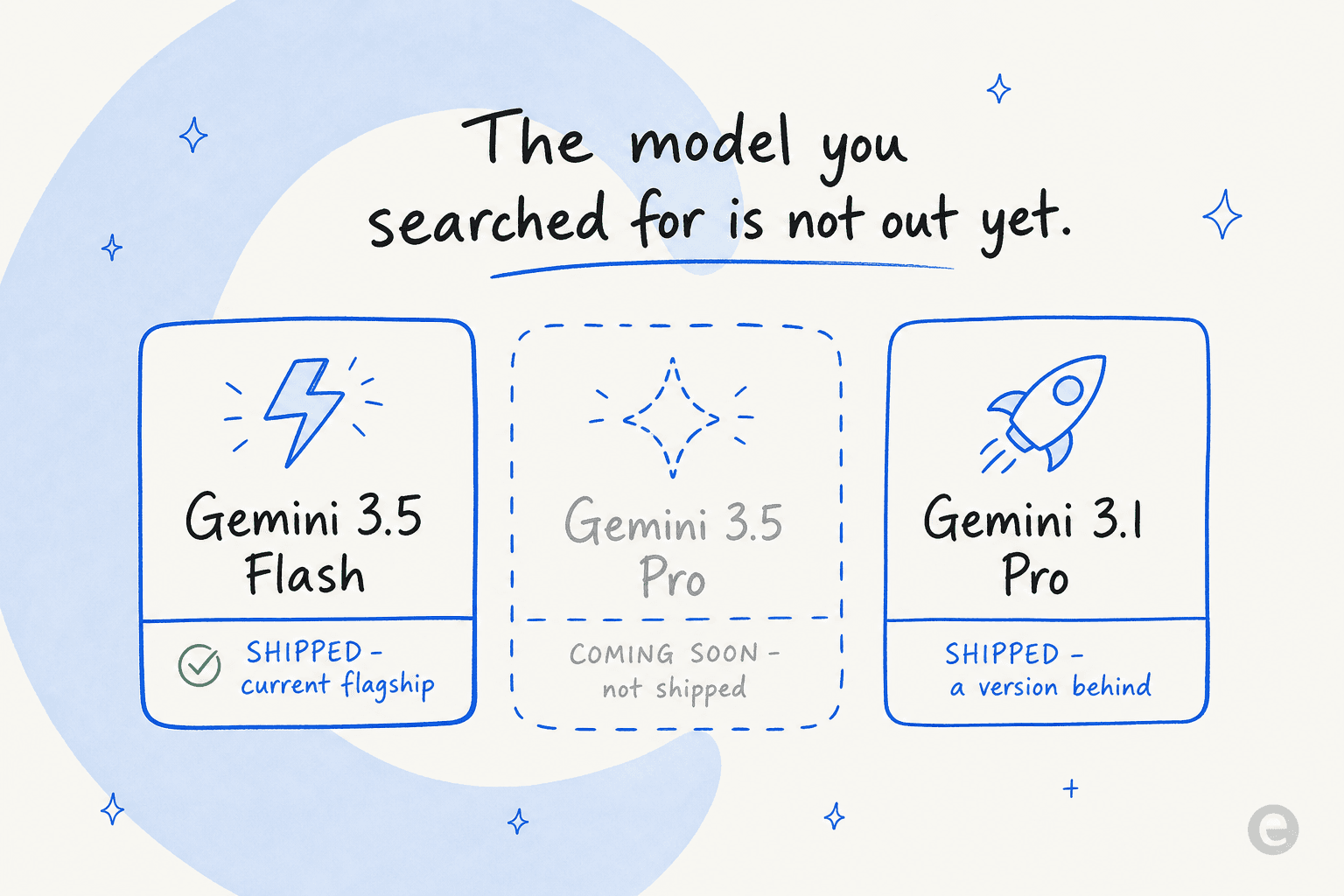
Third-party blogs have floated a July target date, a rebuild after "structural failures," and a rumoured 2M-token context window, but none of that appears on any Google page, so treat it as rumour, not roadmap. The only defensible fact right now is that the model you searched for is vapourware. That's not a knock on Google, big labs pre-announce constantly, but it does mean the practical move is to pick from what's live.
The closest thing: Google's own shipping models
If you liked the idea of Gemini 3.5 Pro because you're already in Google Workspace, the least disruptive path is to use the Gemini models that have shipped. There are two worth knowing, and they're priced very differently.
Gemini 3.5 Flash is the current flagship, carries a roughly 1M-token context window, and is tuned for agentic and coding work. Gemini 3.1 Pro carries the same ~1M window with Google's "better thinking, improved token efficiency" claims, but it's a generation behind and costs more. Here's the live API pricing:
| Model | Input $/1M (≤200k) | Output $/1M (≤200k) | Above 200k (in/out) | Context |
|---|---|---|---|---|
| Gemini 3.5 Flash | $1.50 | $9.00 | flat | ~1M tokens |
| Gemini 3.1 Pro (Preview) | $2.00 | $12.00 | $4.00 / $18.00 | ~1M tokens |
| Gemini 3.1 Flash-Lite | $0.25 | $1.50 | flat | ~1M tokens |
| Gemini 2.5 Pro | $1.25 | $10.00 | $2.50 / $15.00 | ~1M tokens |
| Gemini 3.5 Pro | not priced | not priced | - | coming soon |
There's a real catch buried in Flash's price. That $9.00 output rate is billed including the model's invisible "thinking" tokens, which you can't fully see or control. One developer put the frustration bluntly on Google's own forum:
"Gemini 3.5 Flash is actively penalizing developers who write good, efficient prompts."
On the consumer side, access to the top models is plan-gated. Google AI Plus is $7.99/month, Google AI Pro is $19.99/month, and Google AI Ultra runs from $99.99 up to $199.99/month, with the reasoning-heavy Gemini 3.1 Deep Think locked to Ultra. Those quota tiers have been a sore spot too: after a May change, paid users reported features silently thinning out.
"I subscribed to Gemini AI Pro back in December 2025, lured by the launch of Gemini 3 Pro. The first month was great, but since February 1st, 2026, my experience has turned into a technical nightmare. The 'Pro' mode has completely disappeared from my UI on both Desktop and Android."

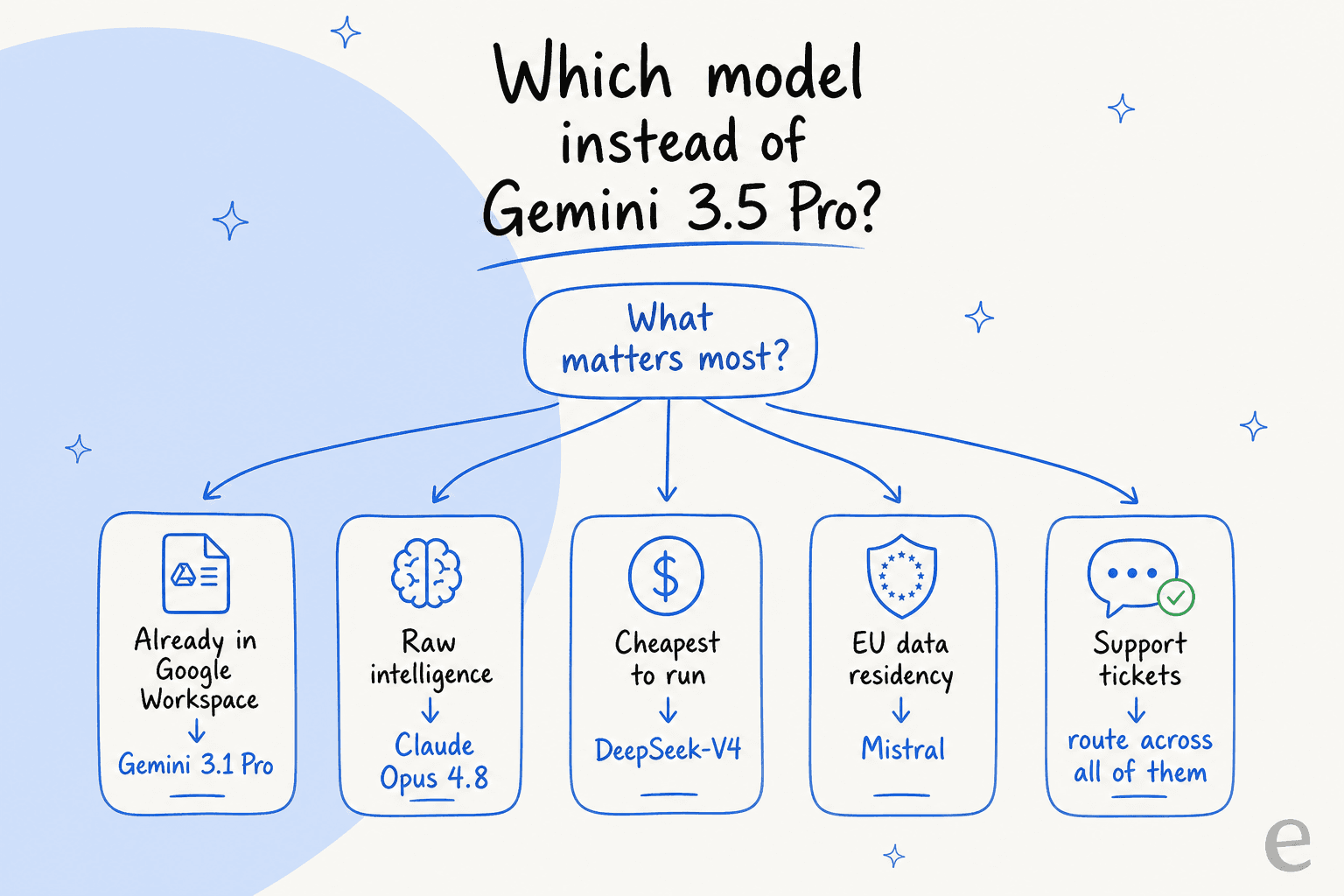
My take: if you're committed to Google, use Gemini 3.1 Pro today and treat 3.5 Pro as a free upgrade whenever it lands. If you were only on Gemini for the raw capability, the rest of this list is where it gets interesting. Full numbers are in our Gemini pricing breakdown and Gemini alternatives roundup.
The 8 alternatives at a glance
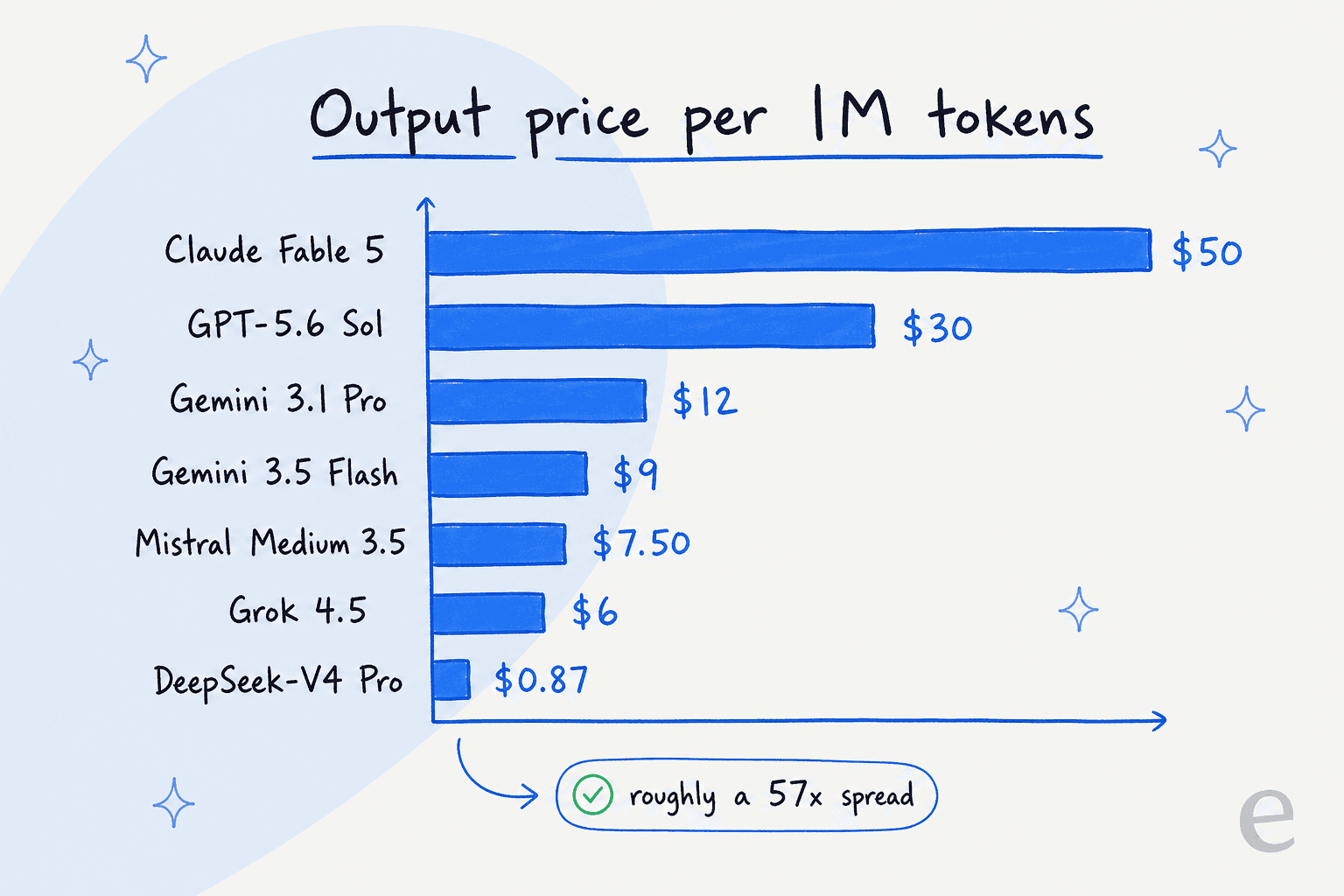
These are the models I'd actually put in front of Gemini 3.5 Pro's slot. The prices are API rates per 1M tokens unless the tool is subscription-only.
| Model | Best for | Input $/1M | Output $/1M | Context | Open weights |
|---|---|---|---|---|---|
| Claude Opus 4.8 | Raw intelligence, long-horizon work | $10.00 | $50.00 | 1M tokens | No |
| GPT-5.6 | Clean speed-vs-power ladder | $1.00–$5.00 | $6.00–$30.00 | Large (undisclosed) | No |
| Grok 4.5 | Cheap frontier-class tool use | $2.00 | $6.00 | 500K tokens | No |
| DeepSeek-V4 | Rock-bottom cost, open weights | $0.44 | $0.87 | 1M tokens | Yes |
| Qwen3.7-Max | Self-hosting, cheapest API | $1.25 | $3.75 | 1M tokens | Yes (Qwen3 line) |
| Mistral Vibe | EU data residency, speed | $1.50 | $7.50 | 256K tokens | Partial |
| Perplexity | Cited, web-grounded answers | subscription | subscription | N/A | No |
| Meta AI | Free, everywhere | free | free | undisclosed | Partial (Llama) |
How I picked these
Three filters. First, it has to actually ship, which is the whole point of this post. Second, it has to be a real substitute for what people wanted from a Gemini Pro-tier model: strong reasoning, long context, or a price that makes high-volume use sane. Third, I leaned toward models with public, verifiable pricing, because "contact sales" is its own kind of answer. Each item closes with a labelled Verdict naming who it's for and who should skip it.
1. Claude Opus 4.8 - best for raw intelligence
Best for: teams where being right matters more than being cheap.
Anthropic's Claude line is the model most rivals get measured against, and for good reason: it consistently tops independent leaderboards on reasoning and long-horizon coding. Opus 4.8 is the workhorse tier; the flagship Fable 5 sits above it for the hardest autonomous work.
Pricing: Opus 4.8 API rates, with Fable 5 running $10 input / $50 output per 1M tokens, exactly 2x Opus 4.8's rate, with a 90% prompt-caching discount on repeated context.
Verdict: the pick if intelligence and reliability matter more than the invoice. It's the most expensive option here, so it's overkill for high-volume, low-stakes work. Full detail in our Claude Opus 4.8 coverage.
2. GPT-5.6 - best all-round frontier ladder
Best for: buyers who want to pick a tier by how hard the job is.
Where Gemini's lineup is a naming maze, GPT-5.6 is disciplined: three tiers, all one generation. Sol is the flagship, Terra balances performance and cost, Luna is the fast one. Sol tops OpenAI's own Terminal-Bench 2.1 chart at 91.9% in its multi-agent mode, and the mid-tier Terra got a real upgrade without a price hike.
The community found the seams fast, though, with one widely-shared take questioning what Terra actually is:
GPT-5.6 Terra actually scores worse than GPT-5.5 on many benchmarks. It's not GPT-5.5 trained with more compute; it's basically GPT-5.6-mini that's been distilled from GPT-5.6 full size.

Pricing: Sol $5/$30, Terra $2.50/$15, Luna $1/$6 per 1M tokens. One wrinkle: only Sol is selectable in standard ChatGPT; Terra and Luna live in the API and Codex, per the GPT-5.6 review.
Verdict: the safest all-rounder if you want frontier quality without decoding which model is "actually" newest. Pricing detail in the GPT-5.6 pricing guide.
3. Grok 4.5 - best for cheap agentic tool use
Best for: agentic workloads that call a lot of tools on a budget.
Grok 4.5 is xAI's frontier-adjacent model, and its pitch is price. At $2/$6 per 1M tokens it comes in at less than half of GPT-5.6 Sol and undercuts Gemini 3.1 Pro on output, while holding a 500K-token context window that's plenty for most agentic loops.
Pricing: $2.00 input, $6.00 output per 1M tokens.
Verdict: the pick if you want near-frontier agentic performance at a price the flagship tiers don't match. Full breakdown in our Grok 4.5 review and Grok 4.5 pricing guide.
4. DeepSeek-V4 - best cheap open-weight pick
Best for: high-volume, cost-sensitive workloads.
DeepSeek is the price story of the year. deepseek-v4-pro at $0.44/$0.87 per 1M tokens is roughly a tenth of what the frontier flagships charge, and the web and app chat are free with no metered cap. The open weights mean you can self-host, and the 1M-token context matches the big labs.
Pricing: deepseek-v4-pro $0.435/$0.87; deepseek-v4-flash even cheaper at $0.14/$0.28 per 1M tokens.
Verdict: if your workload is high-volume and cost-sensitive rather than research-freshness-sensitive, this beats every Gemini tier by roughly an order of magnitude. More detail in our DeepSeek overview and Together AI pricing guide, which hosts DeepSeek-V4 too.
5. Qwen - best for self-hosting
Best for: technical teams who want to run the model themselves.
Qwen is Alibaba Cloud's line, and it's the best answer if you want near-frontier output on your own hardware. Qwen3.7-Max runs on the API at a promo-discounted $1.25/$3.75, and the open-weight Qwen3 line goes far cheaper, with a recurring Reddit theme of a quantised 30B model running locally on an M4 MacBook at roughly 45 tokens/sec.
Pricing: Qwen3.7-Max at a discounted $1.25/$3.75 per 1M tokens (undiscounted $2.50/$7.50); the open-weight Qwen3 line from $0.05/1M, or free self-hosted.
Verdict: the pick if you're technical enough to self-host or want the cheapest ticket into near-frontier output. Full pricing in our Qwen pricing guide and Qwen alternatives roundup.
6. Mistral Vibe - best for EU data residency
Best for: teams where EU data residency is a hard compliance line.
Mistral's Vibe (the rebranded Le Chat) is the European frontier lab, and its edge is jurisdiction: data stays in the EU. Mistral Medium 3.5 handles general work at a fair price, and the tiny Mistral Small 4 is cheap enough for bulk tasks.
Pricing: Mistral Medium 3.5 at $1.50/$7.50 per 1M tokens; Mistral Small 4 at $0.10/$0.30. Vibe subscriptions start free, Pro at $14.99/month.
Verdict: the right call if EU residency is a requirement, not a preference. Otherwise the intelligence gap versus Claude and GPT-5.6 is real. See our Mistral pricing guide, Mistral reviews roundup, and Mistral vs Microsoft Copilot.
7. Perplexity - best if you want a search engine
Best for: research where you need sources on every claim.
If what you actually liked about Gemini was its research and web-grounding, Perplexity is the more focused tool. It runs frontier models under the hood but wraps them in a cited answer engine, so every response comes with links you can check.
Pricing: free tier with limited Pro searches; Pro at $20/month ($17/month annual); Max at $200/month; Enterprise from $40/seat/month.
Verdict: pick this when the job is research with receipts, not open-ended reasoning or coding. More in our Perplexity pricing guide and Perplexity review.
8. Meta AI - best free everyday pick
Best for: casual questions inside apps you already use.
Meta AI runs on the Llama family and is free across Facebook, Instagram, and WhatsApp, with no subscription tier at all. It's the lowest-friction option here, but it's tuned for convenience, not for being reliably right.
Pricing: free, full stop, across every surface.
Verdict: fine for quick, casual questions inside an app you're already in; not a serious pick for anything that has to be correct. More in our Meta AI chatbot guide and Meta AI overview.
Does the underlying model even matter for support?
Here's the pattern that repeats across every model on this list, Gemini included: every lab ships a capable model, and not one of them ships a hard stop on confidently wrong answers. Gemini quietly bills you for invisible thinking tokens. Claude buries a second, silent safeguard tier. DeepSeek and Qwen are cheap but their hallucination rates aren't independently audited the way the big labs' are. Meta AI will answer a support question wrong with the same confidence it answers one right.
I've watched this play out on live support queues at eesel for years, and the failure mode is always the same regardless of the model underneath: a bot with no hard fallback on a failed knowledge-base lookup will fabricate an answer rather than say it doesn't know. That's not a Gemini problem or a Claude problem, it's what every capable model does by default the moment nothing stops it from guessing. It's exactly why eesel runs simulation mode against your own historical tickets before any model goes live on a real customer, the same rigour you'd want applied to any lab claiming a benchmark win on a page that also says "coming soon."
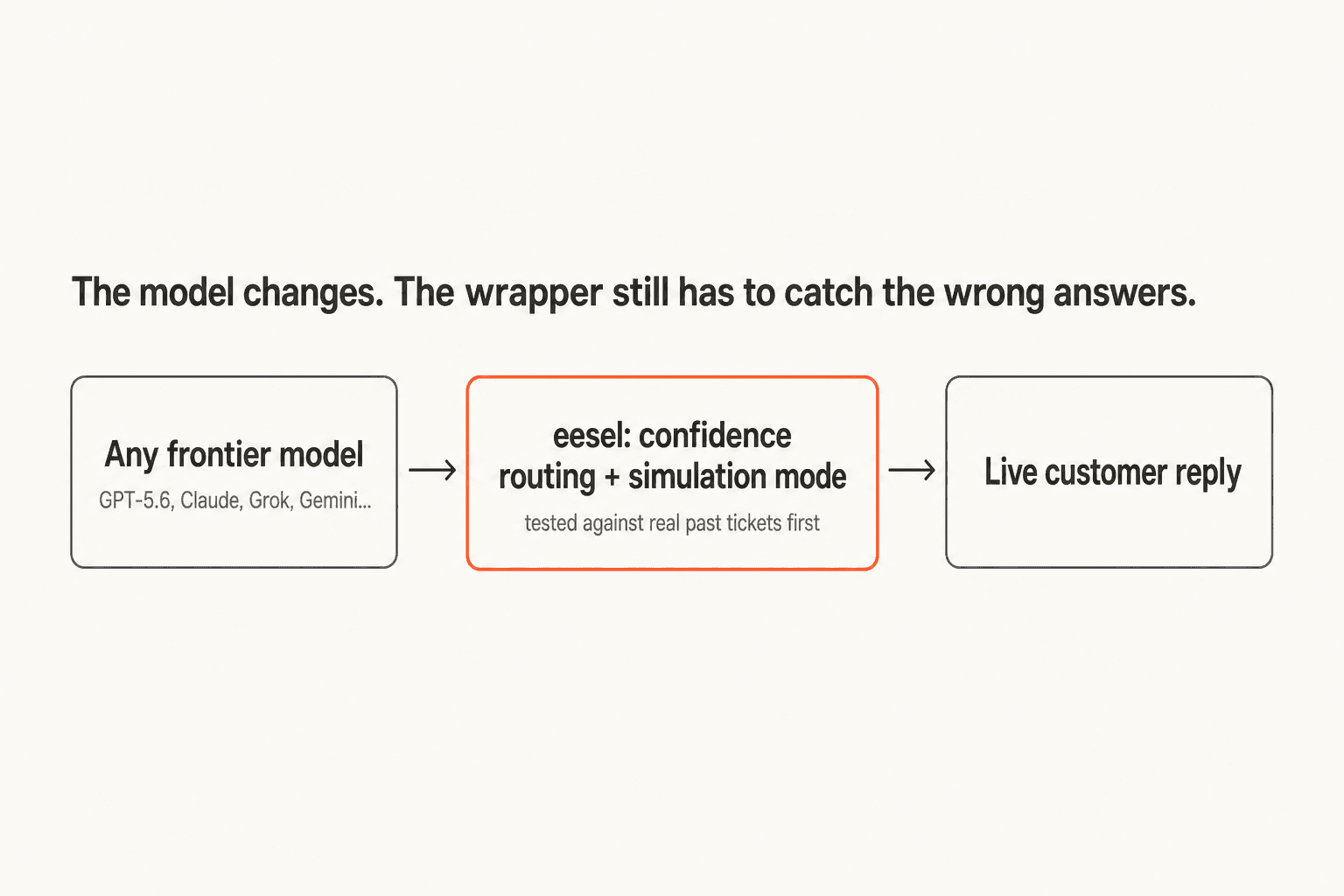
This is also why locking your stack to one model by name is risky. The applied-math crowd on Reddit swears Gemini handles notation better than GPT; coding teams often lean the other way. Both can be true, which is the point:
As an applied math student, I've noticed Gemini is way better with math expressions. GPT makes dumb mistakes with operators and coefficients all the time-like it's smart with words but sloppy with symbols. Gemini just gets the notation right.
Try eesel
Whichever model wins this round, Gemini 3.5 Pro once it finally ships, Claude Opus 4.8, GPT-5.6, or something cheaper entirely, the hard part of AI support was never picking the smartest LLM underneath it. eesel sits on top of your existing helpdesk, whether that's Zendesk, Freshdesk, Gorgias, HubSpot, or Front, learns from your real ticket history on day one, and runs simulation mode against thousands of your past tickets before it ever answers a live customer. Because it's model-agnostic, a "coming soon" tag turning into a launch is a settings change, not a re-platforming. Pricing is one fixed monthly price, from $299/month for 500 credits (1 credit per ticket or chat), with no seat fees, so a lab's launch day never means re-paying for a model you didn't ask for. You can try eesel free with 100 credits, no card.