What is Nano Banana 2 Lite?
Nano Banana 2 Lite is Google's marketing name for Gemini 3.1 Flash-Lite Image, API model ID gemini-3.1-flash-lite-image. Google describes it as "our fastest, most cost-efficient image model in the Nano Banana family yet, built for high throughput, speed and scale." It's the volume end of the lineup, not a downgrade for downgrade's sake.
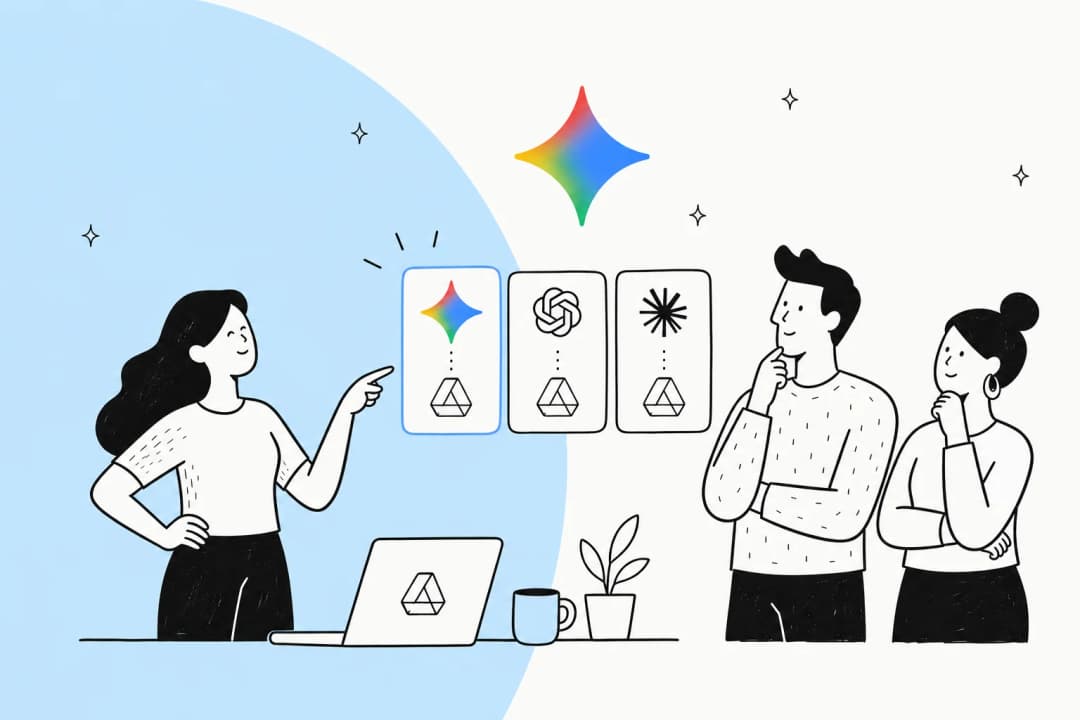
The naming is a small maze, so here's the map. There are four models in the family right now:
- Nano Banana (
gemini-2.5-flash-image) - the original, now legacy. - Nano Banana 2 Lite (
gemini-3.1-flash-lite-image) - the new fast, cheap tier, and the subject of this post. - Nano Banana 2 (
gemini-3.1-flash-image) - the "generalist workhorse," balancing quality and cost. - Nano Banana Pro (
gemini-3-pro-image) - the professional tier, built for accuracy over speed.
Google's own guidance for anyone still on the original Nano Banana is blunt: "you can swap it out now for immediate benefits across key performance dimensions." Lite isn't positioned as a sidegrade, it's the recommended default upgrade path.
How it stacks up against Nano Banana 2 and Nano Banana Pro
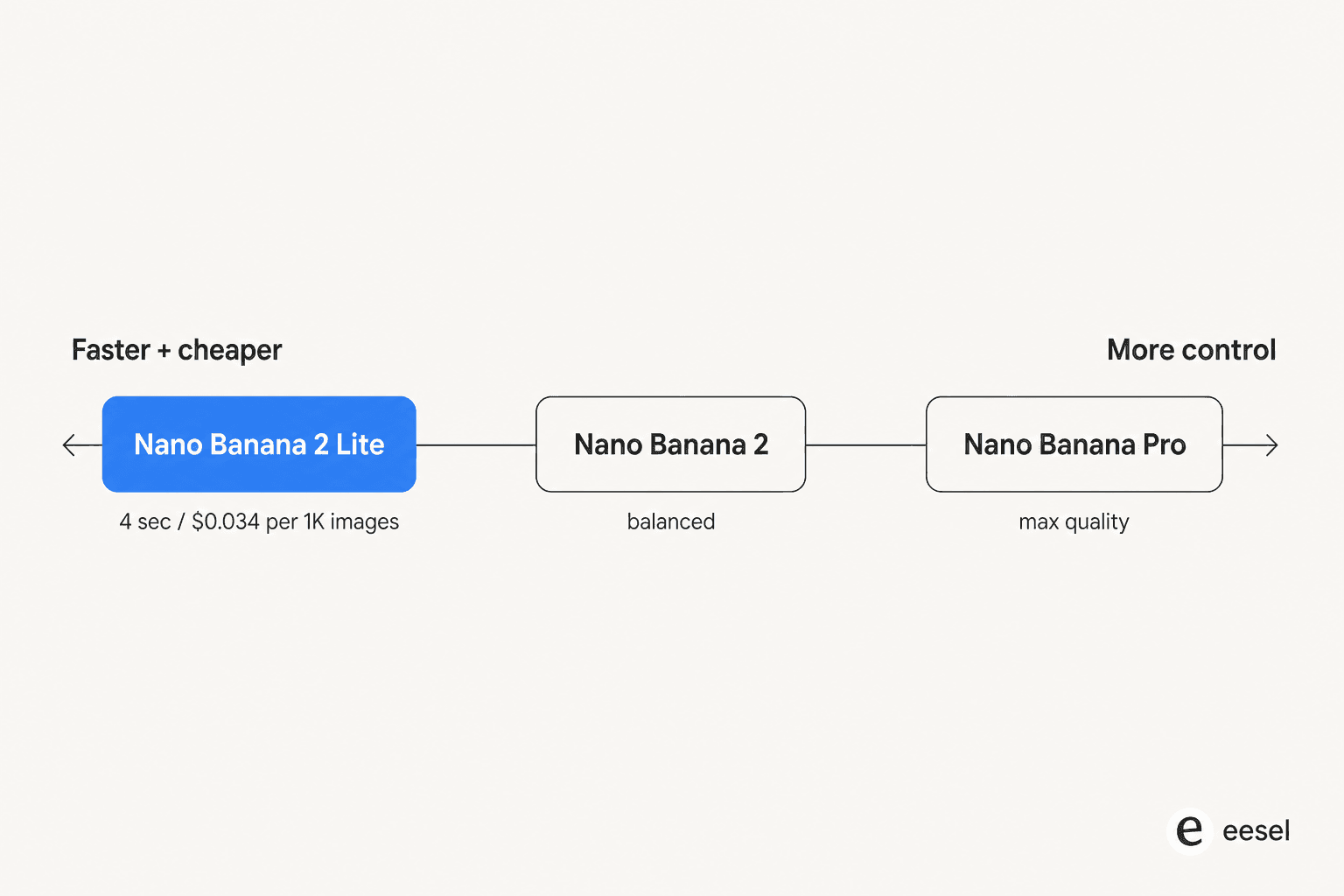
The way Google frames its own family tells you exactly who each tier is for:
| Model | Positioning (Google's own words) | Speed | Price per 1K image (Standard) |
|---|---|---|---|
| Nano Banana 2 Lite | "Built for speed... near-real-time, high-volume workflows" | ~4 sec | $0.0336 |
| Nano Banana 2 | "The generalist workhorse... best balance of performance and cost" | ~20 sec | $0.067 |
| Nano Banana Pro | "Optimized for complex, professional use cases... accuracy is more important than speed" | slower | $0.134 (1K/2K) |
This positioning is the whole pitch in one row: Lite is exactly half the price of full Nano Banana 2 at every resolution tier, per the official pricing page, and roughly a quarter of Nano Banana Pro's. What you give up is the top end of quality and control, and, based on the only concrete resolution figure Google states in a customer quote, output that tops out around 1K resolution rather than the 2K/4K options the higher tiers support.
The benchmarks: what you actually get for the price cut
Google published its own head-to-head numbers against the rest of the field, and the gap between Lite and full Nano Banana 2 is smaller than a 2x price difference would suggest:
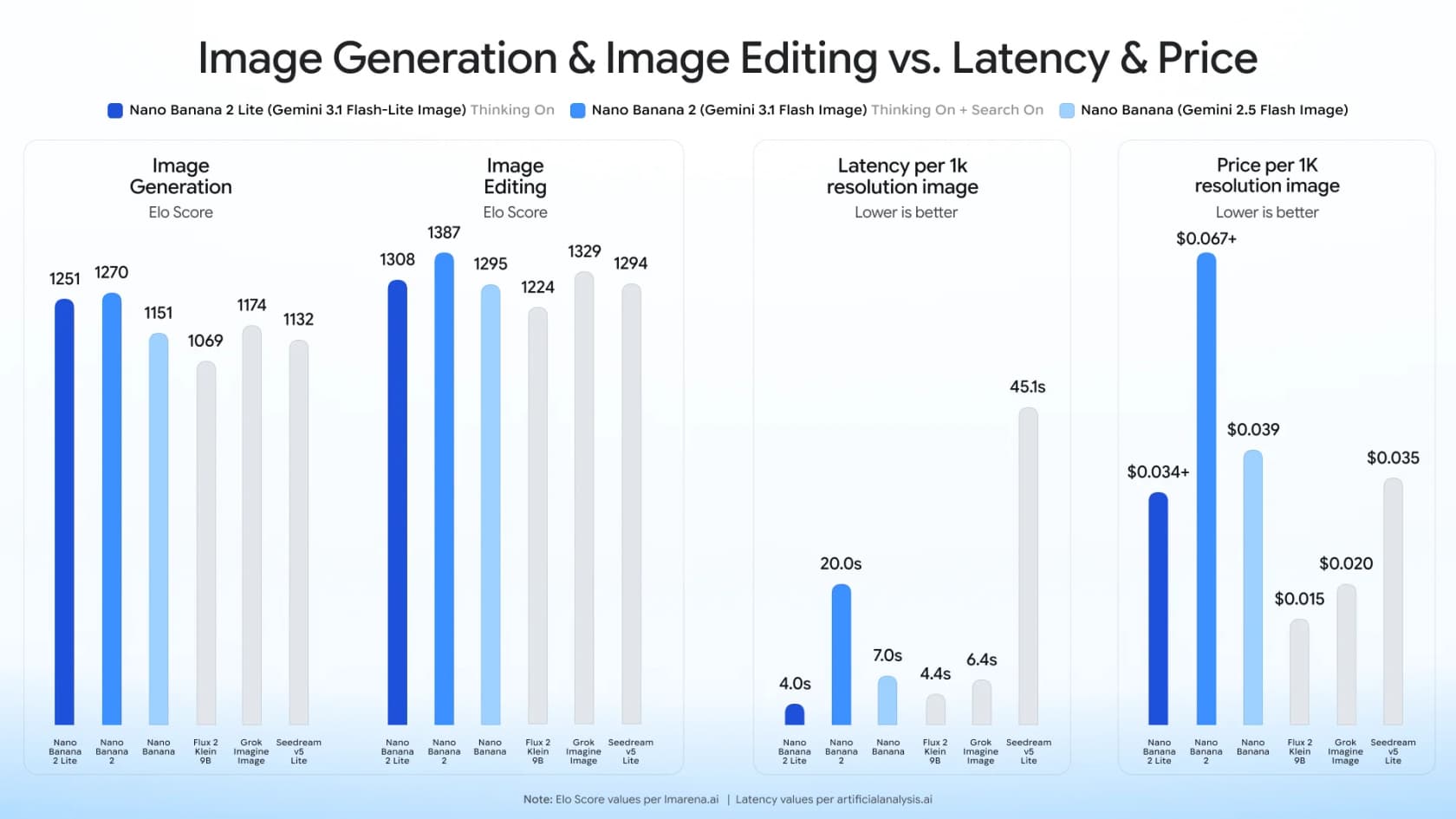
- Image editing (arena.ai Elo): Nano Banana 2 Lite scores 1308 versus full Nano Banana 2's 1387, an 80-point gap, and still beats Grok Imagine Image and Seedream v5 Lite.
- Image generation (arena.ai Elo): Lite scores 1251 versus 1270 for the full model, only 19 points back, and comfortably ahead of the original Nano Banana's 1151.
- Latency: 4.0 seconds versus 20.0 seconds for full Nano Banana 2, roughly five times faster.
- Price per 1K image: $0.034+ versus $0.067+.
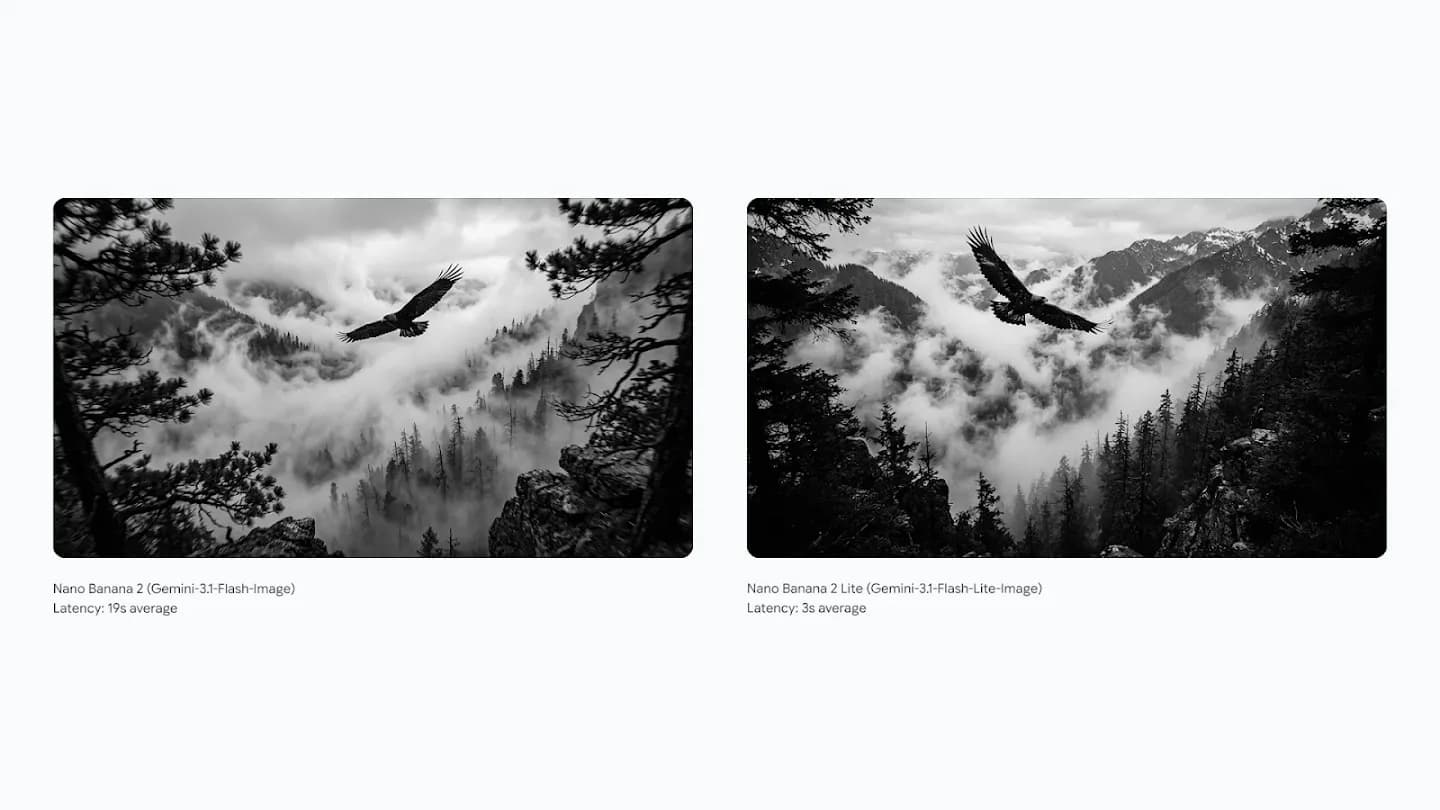
Google's own side-by-side comparison shots make the trade visible rather than just claimed:
Google Cloud's own launch post went further, running an actual AI Studio comparison across all three tiers on the same prompt:
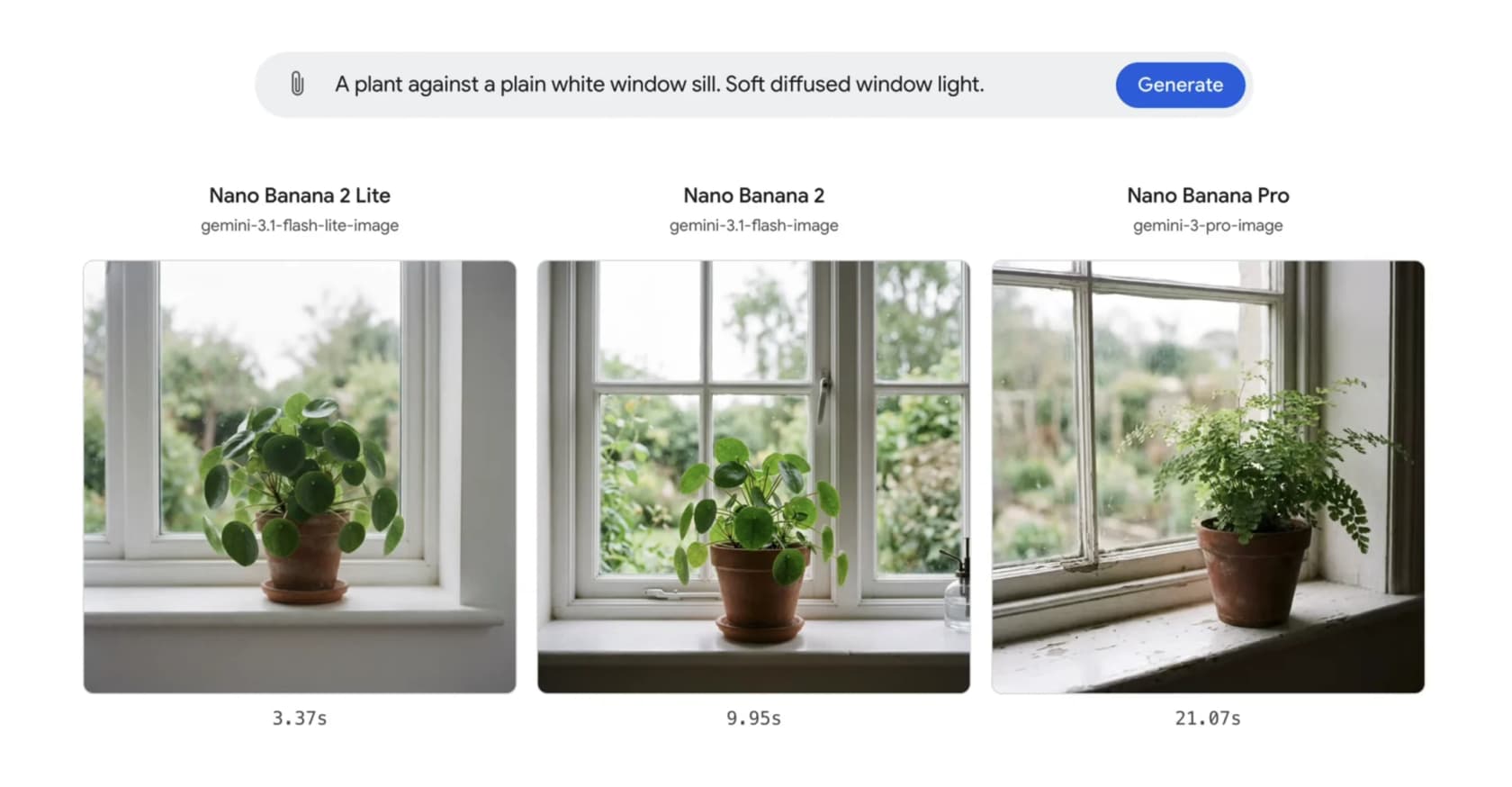
That's a 6.3x speed gap between Lite and Pro on identical output, for a real, visible drop in fine detail rather than a marketing footnote.
Where you can actually use it
Nano Banana 2 Lite is available today across three developer surfaces and a long list of consumer products:
- Google AI Studio - the fastest path from prompt to production, per Google.
- Gemini API - text-to-image, editing, and multi-image composition in one drop-in call.
- Gemini Enterprise Agent Platform - generally available, with provisioned throughput for high-concurrency workloads live from day one.
It's also rolling out inside AI Mode in Search, the Gemini app, NotebookLM, Google Photos, Stitch, Google Flow, and Google Ads, so most people will meet it without ever touching a model picker.
Who's already using it
The launch quotes read like a checklist of latency-sensitive products: Figma is running it inside Figma Weave's node-based canvas, with co-founder Itay Schiff saying it's "fast and reliable, helping designers explore more ideas... while staying in the creative flow." Manus AI is using it for real-time image generation inside autonomous agent workflows, with co-founder Tao Zhang noting the image quality "comes close to the full Nano Banana 2." Adobe is folding both Nano Banana 2 Lite and Gemini Omni Flash into Adobe Firefly.
Pairing it with Gemini Omni Flash
The more interesting use case isn't Nano Banana 2 Lite alone, it's the model chained to Gemini Omni Flash, Google's new video generation and conversational-editing model, priced at $0.10 per second of video, the same as Veo 3.1 Fast.
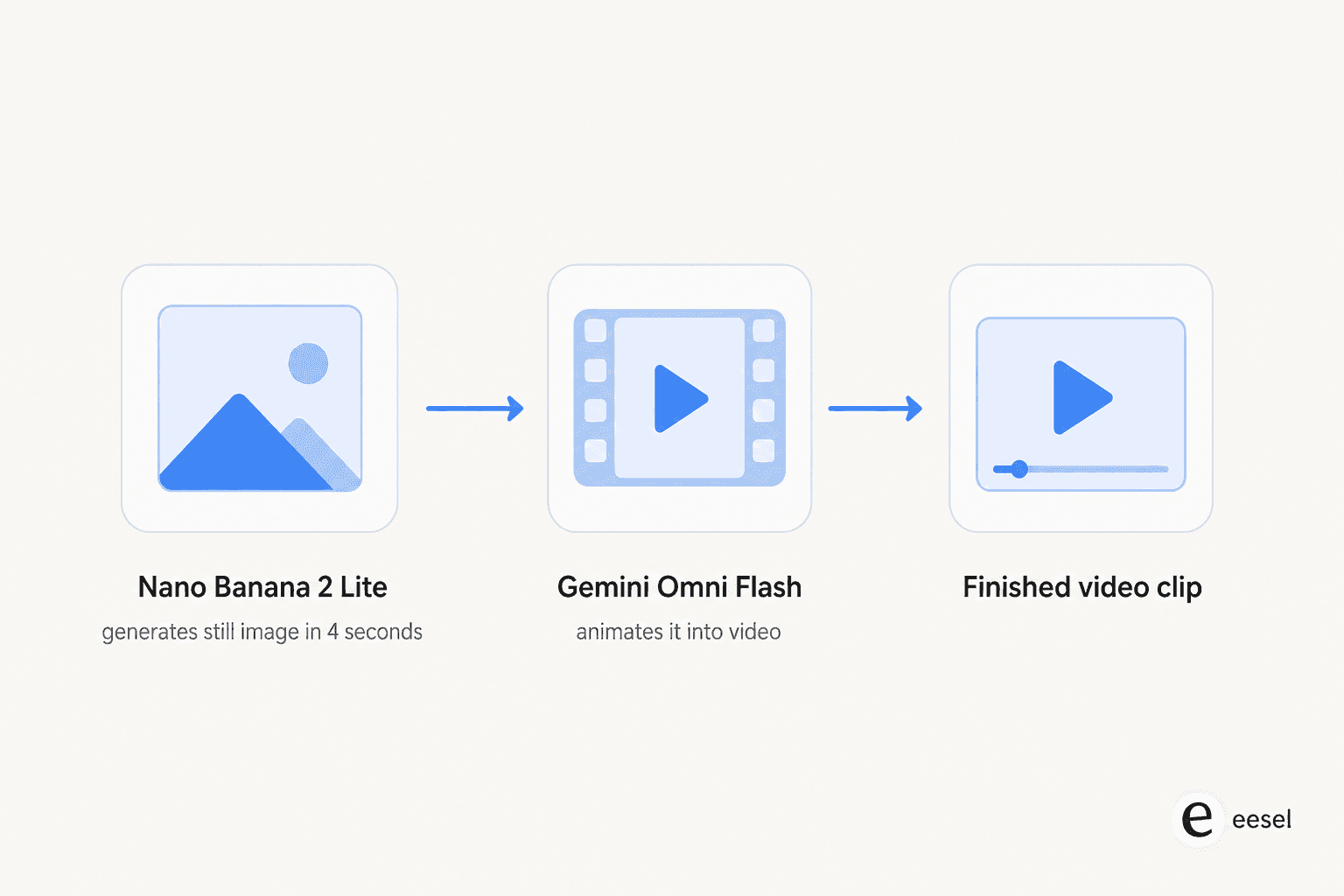
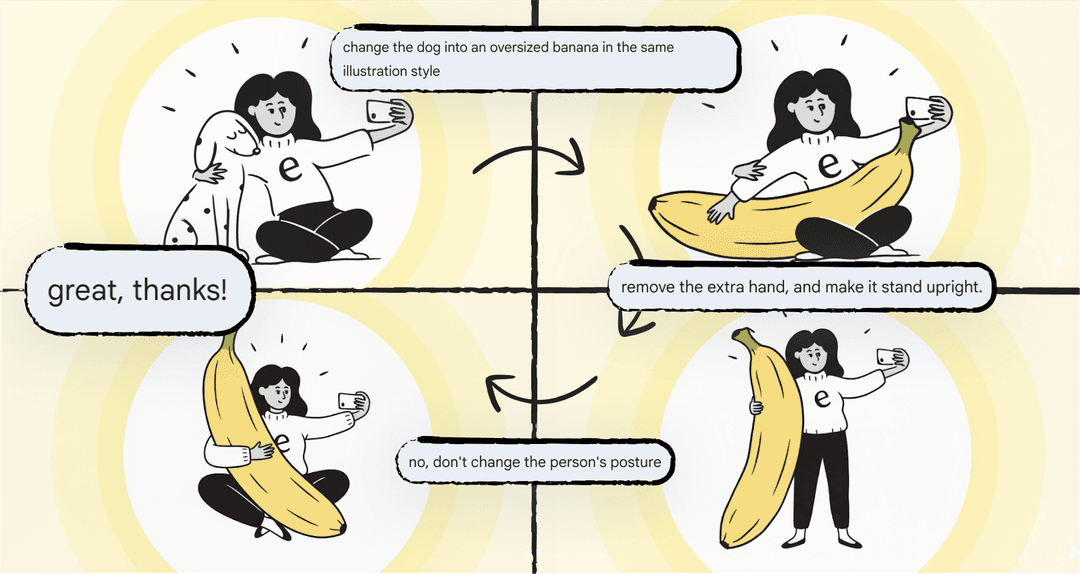
Google's own demo apps show the pattern: Anywhere uses Nano Banana 2 Lite to drop a selfie into a landmark, then Omni Flash animates the result into a clip. Space Lift generates room redesign concepts, then turns a chosen one into a cinematic walkthrough. Using the Interactions API, developers can stack up to three sequential edits in one session, which is the actual unlock for anyone building an iterative design tool rather than a one-shot generator.
What people are saying
Reaction to the launch has, so far, come mostly from inside Google and the AI news beat rather than independent power users, which is worth flagging rather than papering over. Logan Kilpatrick of Google DeepMind called the speed gain a category-opener:
The speed of Nano Banana 2 Lite is going to enable so many new use cases where there is a high degree of latency sensitivity, honestly feels like magic. - Logan Kilpatrick on X
TestingCatalog, an independent AI-news account that tracks unreleased features, confirmed the model was live inside the Gemini app within hours of the announcement, which is a faster real-world rollout than most model launches get.
The limits Google is upfront about
To Google's credit, the model page doesn't just list wins. Stated limitations across the Gemini image family, which apply to Lite too:
- Struggles with small faces, accurate spelling, and fine details.
- Real-world knowledge is "extensive but not infallible" for infographics or data-driven visuals; verify anything data-driven before publishing it.
- Text generation across languages can trip on grammar, spelling, or cultural nuance.
- Complex edits like masked editing or major lighting changes can produce artifacts.
- Character consistency is strong but "may not always get it right," and Google says it's still working on reliability.
None of that is unusual for the category. It's the same reason a Midjourney output still gets a human once-over before it ships, just faster and cheaper here than most of the field.
Fast images aren't a finished blog post
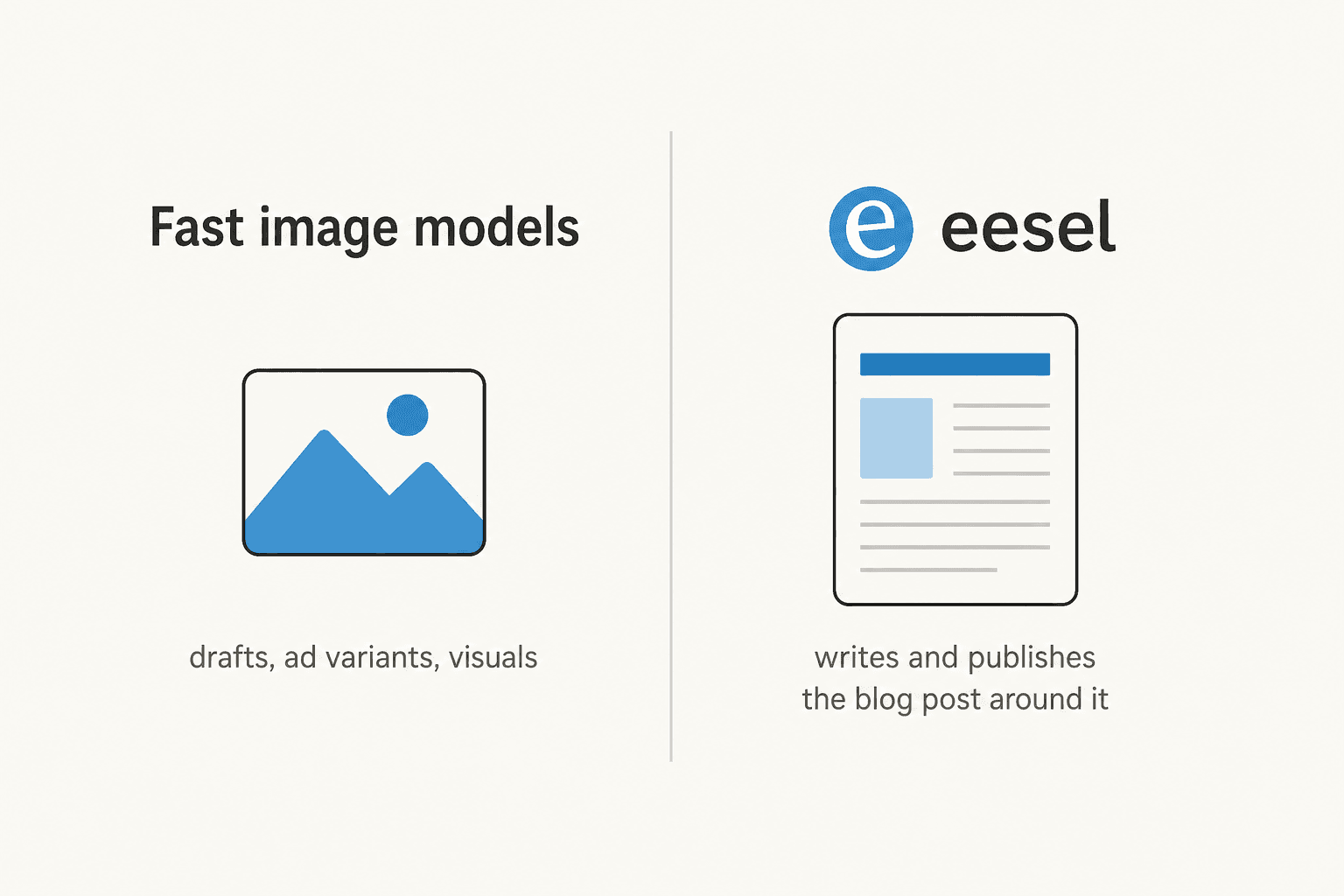
Here's the part most coverage skips. Nano Banana 2 Lite solves a real, narrow problem: getting a usable image out in seconds instead of minutes, cheap enough to generate dozens of variants without blinking. That's useful for ad-variant testing, storyboarding, and rapid prototyping.
But an image is one piece of a published post, not the post itself. Someone still has to write the headline, the body, the internal links, the SEO metadata, and decide where the image actually goes. That's a content-writer problem, not an image-model problem, and closing that gap is what an AI content pipeline is actually for.
Try eesel
If your actual goal is shipping content faster, the eesel AI blog writer is built for the writing half of that job. It learns your brand voice, past posts, and internal-linking structure, then drafts the article itself, on a usage-based $4 per blog post draft, no seat fees or platform minimum attached.
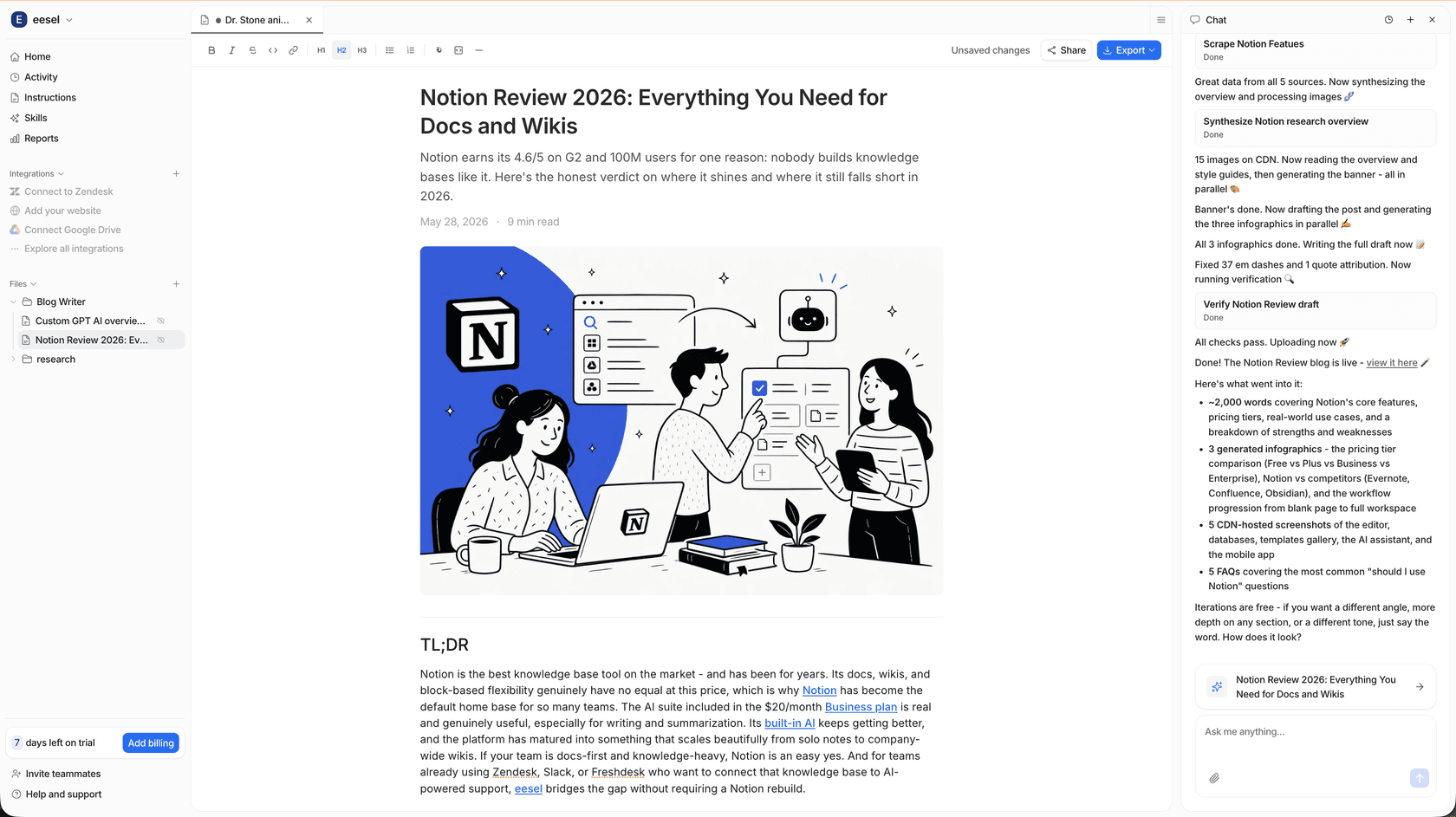
Pair a fast image model like Nano Banana 2 Lite for the visuals with an AI content writer that actually knows your site for the words, and the whole pipeline moves at the speed the model launches keep promising. Try eesel and see how much of the writing side it can take off your plate.
Frequently Asked Questions
What is Nano Banana 2 Lite?
gemini-3.1-flash-lite-image, and it generates a text-to-image output in about 4 seconds at roughly $0.034 per 1,000 images. It sits below full Nano Banana 2 and Gemini's Pro-tier image model in quality ceiling but keeps most of the family's prompt adherence and character consistency.How much does Nano Banana 2 Lite cost?
How is Nano Banana 2 Lite different from Nano Banana 2?
Where can I use Nano Banana 2 Lite?
Can I use Nano Banana 2 Lite for blog content or marketing images?


Article by
Kurnia Kharisma
Kurnia is a software engineer and writer at eesel AI with two years of SEO experience, writing about AI tools, helpdesk software, and customer support. He pairs a developer's understanding of how these products are built with search-driven research into what actually ranks and resonates with the people searching for them.