
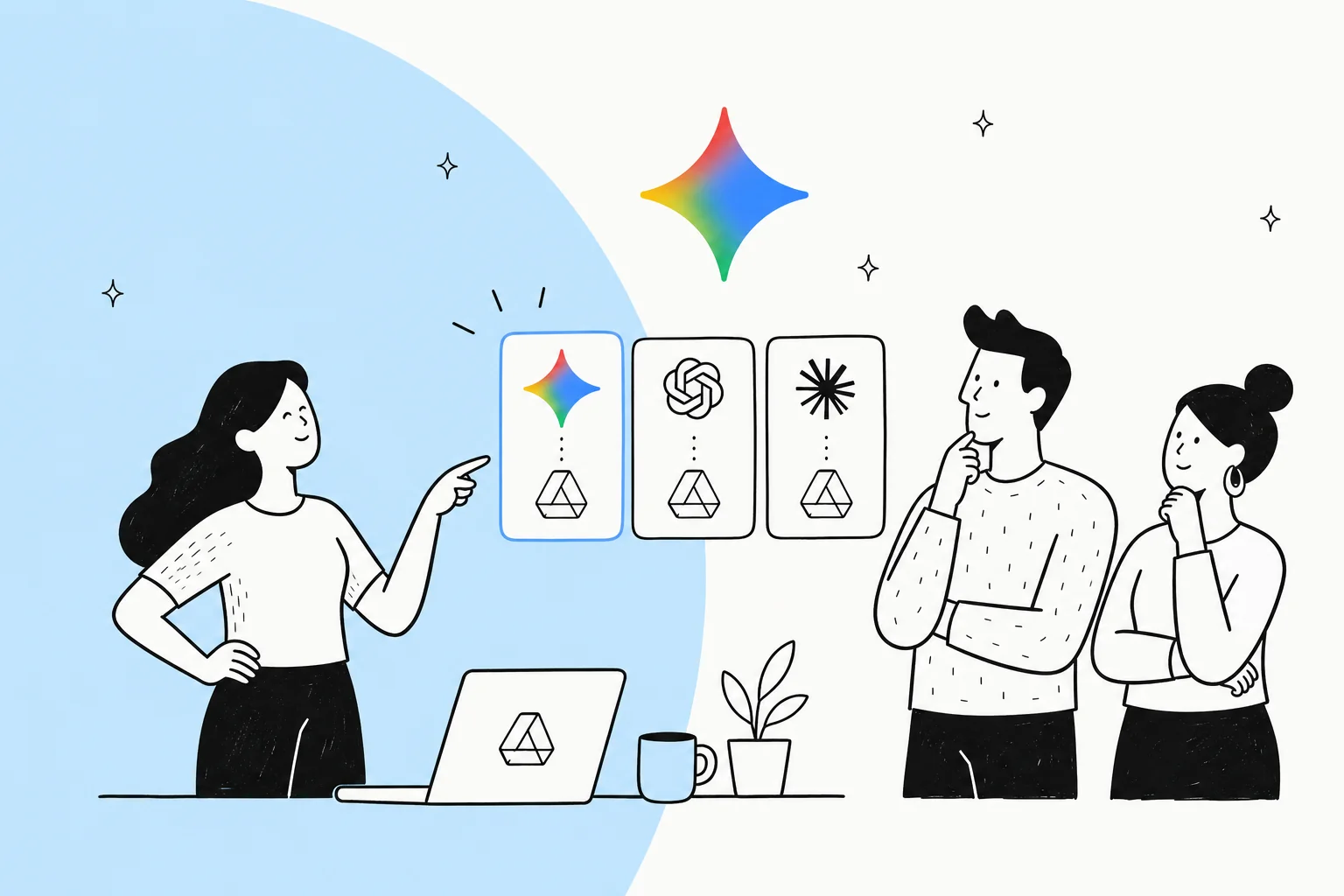
What "works with Google Drive" actually means
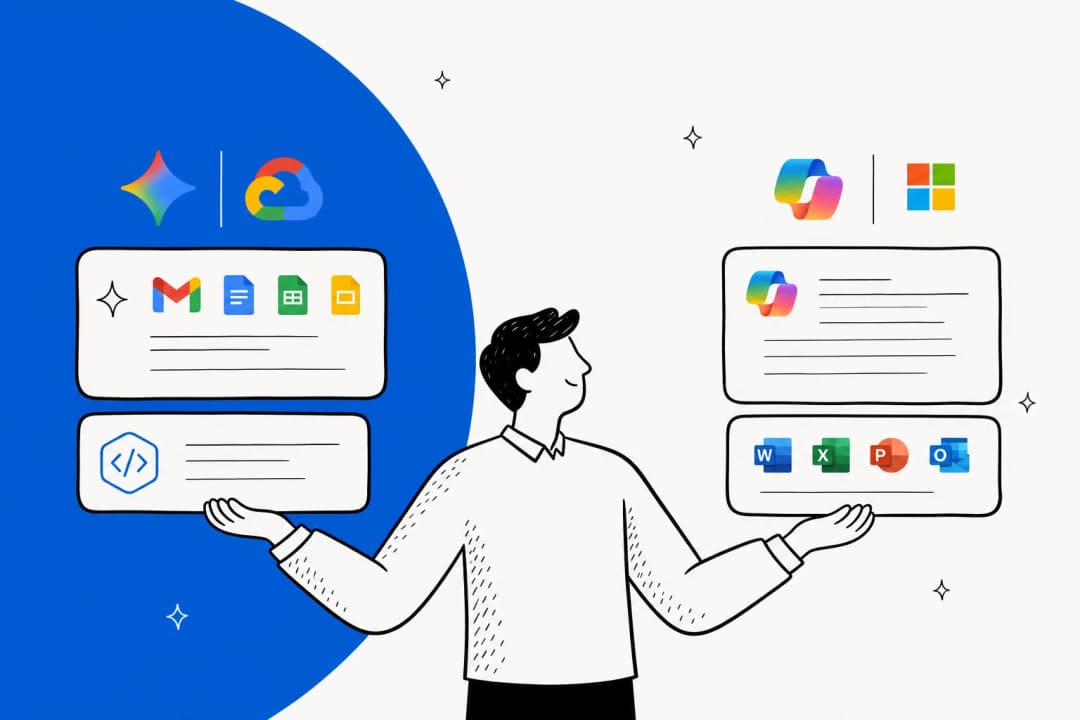
Here's the trap most comparisons fall into: they treat every tool as if it does the same job. It doesn't. There are really three different ways an AI can "work with" your Drive, and which one you need decides everything.
- Native, inside Workspace. Gemini reads your Drive because it is Google. No connector, no permissions dance. The trade-off is that it lives inside the Workspace apps and reaches across the rest of your stack only weakly.
- Connector-based chat. ChatGPT and Claude bolt Drive on as one more connected source. Brilliant for asking a question in a chat window, but the answer lives in a personal chat, not a shared team surface.
- A unified knowledge layer. eesel, Glean, and Guru index Drive alongside your other tools, enforce the original file permissions, and serve cited answers wherever your team works. This is the category most teams actually need and the one Drive-only comparisons forget.
So the honest answer to "which one works better" is: it depends on whether your knowledge really lives only in Drive, or whether Drive is just one drawer in a much messier filing cabinet. For most teams past a handful of people, it's the messy cabinet.
We tested these tools the way a real buyer would: we set each one loose on a Drive full of mixed docs, sheets, and PDFs, asked it to find and summarize specific files, and watched how it handled questions that spanned more than one source. The notes below are grounded in each product's own docs, pricing, and UI, plus what real users say about living with them.
The Google Drive AI assistants compared
| Tool | Best for | How it reaches Drive | Where you ask | Setup | Entry price | Cited answers | Security |
|---|---|---|---|---|---|---|---|
| Gemini for Workspace | Teams all-in on Google Workspace | Native (no connector) | Workspace apps + Gemini app | Instant (bundled) | $14/user/mo | Within Workspace | ISO 42001, SOC 1/2/3, HIPAA-eligible |
| eesel AI | Answers across Drive + every other tool | Connector + unified index | Slack, Teams, helpdesk, chat widget | Minutes | From $299/mo (free plan, 100 credits) | Yes, with real-time sync | SOC 2 Type II, EU residency, GDPR |
| Glean | Company-wide enterprise search | Connector + unified index | Web app + in-app assistant | Weeks (enterprise rollout) | Custom (no public price) | Yes, permission-aware | SOC 2 Type II, ISO 27001, ISO 42001, HIPAA |
| ChatGPT | One-off questions + general reasoning | Google Drive connector | ChatGPT app | Minutes (per user) | Weak | $20/user/mo (Plus) | SOC 2 on Business/Enterprise only |
| Guru | A governed, verified knowledge base | Source connector + MCP | Slack, Teams, browser, MCP | Sales-led | Custom (enterprise-only) | Yes, verified + cited | Permission-aware, enterprise-grade |
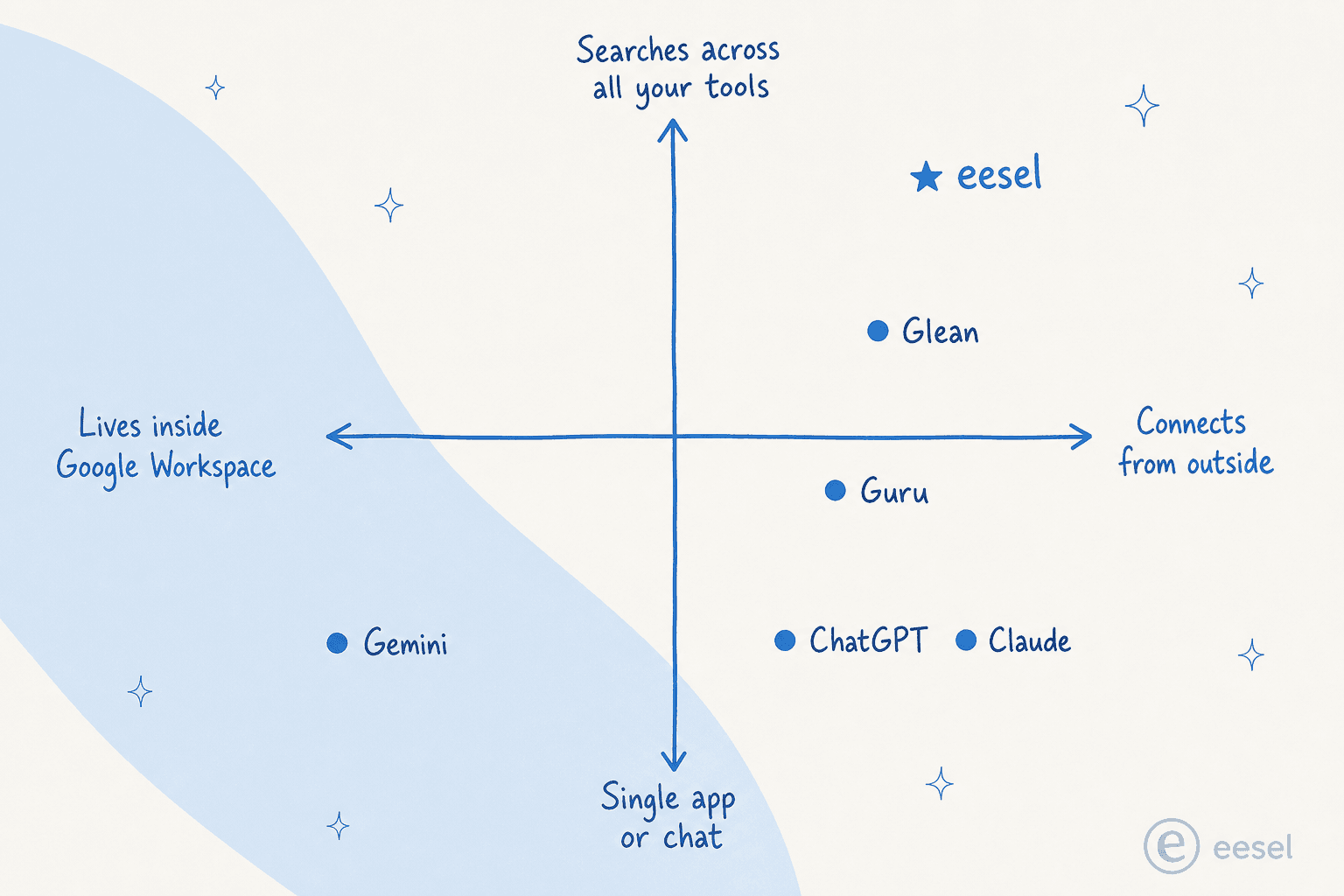
A quick read of that table: Gemini wins on zero setup, ChatGPT and Claude win on general intelligence, and the unified-layer tools win on breadth and citations. Here's the same idea as a map, where a tool sits tells you what it's actually for.
1. Gemini for Workspace
Best for: teams already paying for Google Workspace who want AI writing, summaries, and Q&A without bolting on a third-party tool.
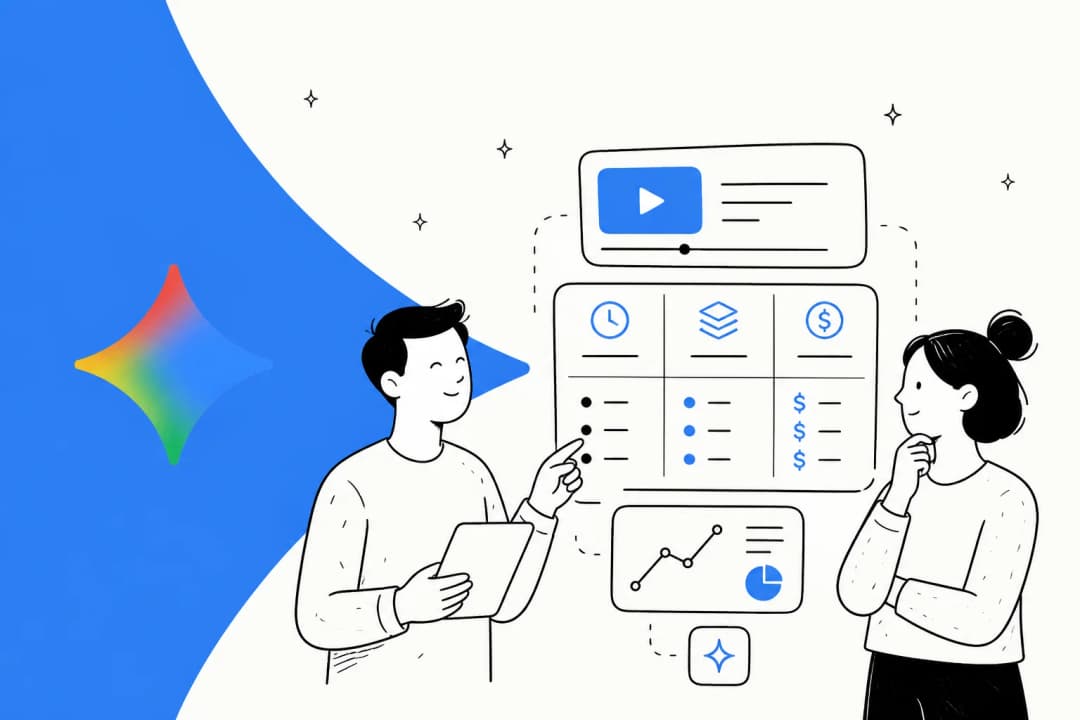
Gemini is Google's productivity AI, embedded across Gmail, Docs, Sheets, Slides, Drive, Meet, and Chat, plus the standalone Gemini app and NotebookLM. Since January 2025 it's included in every paid Workspace plan at no extra cost, and as of the April 2026 "Workspace Intelligence" rebrand it reads semantically across all of your Workspace data, not just the file you're in.
For finding and summarizing a Drive file, Gemini is genuinely hard to beat on convenience. You open the side panel, ask "summarize the Q3 planning doc," and it does, because it already has native access to everything you can see. There's no connector to authorize and no second login.
Pros:
- Zero setup, it's already there if you're on Workspace.
- Native access means no permission-sync lag for your own files.
- Strong inside the apps: "Help me write" in Docs, Smart Fill in Sheets, "Take notes for me" in Meet.
- Privacy posture is solid, your Workspace data isn't used to train Gemini models, and it's HIPAA-eligible.
Cons:
- The pricing trap: the $7 Business Starter tier only includes Gemini in Gmail and Vids. The full bundle across Docs, Sheets, Slides, and Drive starts at Business Standard, $14/user/month.
- It reaches across your other tools (Confluence, Notion, Zendesk) weakly or not at all, it's a Workspace assistant first.
- Answers live in the Workspace surface, not in Slack, Teams, or your helpdesk where support and ops teams actually work.
- It only sees what each user can access, so it can quietly miss files that aren't shared with the person asking.
Pricing:
| Plan | Price (annual) | Gemini scope |
|---|---|---|
| Business Starter | $7/user/mo | Gemini in Gmail + Vids only |
| Business Standard | $14/user/mo | Full Gemini bundle across Workspace |
| Business Plus | $22/user/mo | Standard + Vault, eDiscovery |
| Enterprise | Contact sales | Plus + DLP, AI Classification, agent governance |
Our take: if your whole world is Google Workspace and you want a personal writing-and-summary assistant, Gemini is the right answer and you already own it. It stops being enough the moment "the answer" lives outside Workspace, or the moment you need a shared bot the whole team can ask in Slack. For a fuller picture of where it falls short, our roundup of Gemini alternatives digs in, and if you're weighing it against a connector-based chat tool, Gemini vs ChatGPT is the head-to-head.
2. eesel AI
Best for: teams whose knowledge is scattered across Drive and Confluence, Notion, a help center, and past tickets, who want one cited answer, fast, wherever they work.
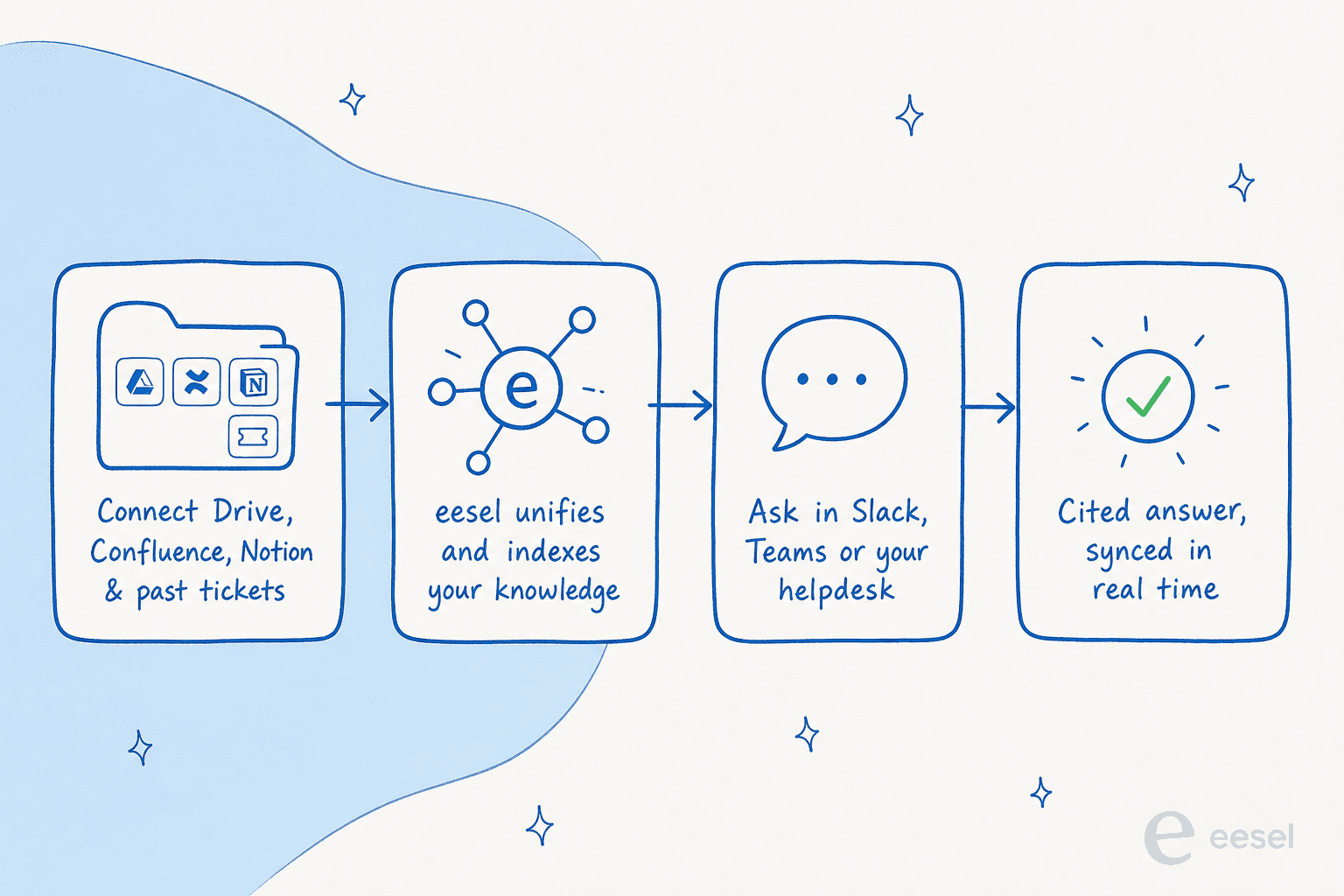
eesel AI takes the opposite approach to Gemini. Instead of living inside one suite, it connects Google Drive as one of 100+ knowledge sources, unifies them into a single index, and then answers questions inside Slack, Microsoft Teams, your helpdesk, or a chat widget, with citations back to the source file.
The setup is the part people consistently call out, you connect Drive, point it at your other sources, brief it in plain language, and it's answering in minutes. No sales cycle, no implementation project. Here's the shape of how it actually works over Drive:
The differentiator that matters most for Drive specifically is real-time sync. Because eesel re-reads connected docs as they change, the answer you get reflects the current version of the file, not a stale snapshot. One eesel user on Reddit put it plainly:
"we didn't gel well with zendesk's ai, so we went with an app (eesel ai) for zen and integrated with our slack and stuff instead... we use it in slack to help source info. I think the majority of our employees use it, even for small stuff, because the way it works means the info u get from the bot is always updated in real-time as the docs are instead of having to ask someone etc."

That "instead of having to ask someone" line is the whole point. The job isn't to summarize one doc, it's to stop people pinging a colleague every time an answer is buried in a folder somewhere. Support teams feel it directly, as one eesel customer running on Notion and Google Docs sources described it:
"Our agents can instantly draft replies to customers. We don't have to look through all our documentation on Notion, Google Docs or our help center anymore because eesel AI does it for us."
A support team at a meeting-productivity SaaS, via eesel
Pros:
- Connects Drive alongside Confluence, Notion, SharePoint, and 100+ other sources into one index.
- Answers natively in Slack and Teams, your helpdesk, or a widget, not just a separate app.
- Real-time doc sync, so answers track the current version of the file.
- Cited, confidence-based answers, low-confidence ones get drafted for review or escalated instead of guessed.
- One fixed monthly price with no per-seat fee, so cost follows volume, not headcount.
Cons:
- It's not a document editor, it answers and drafts off your knowledge rather than rewriting your Docs in place like Gemini does.
- Usage-based pricing can be harder to forecast than a flat per-seat plan if your query volume is spiky.
Pricing: free to start with 100 credits and no credit card. Paid plans start at $299/month for 500 credits (1 credit per ticket or chat, however long), with bigger batches up to 5,000 credits at $1,899/month. SSO and MFA (from $199/month) and data residency ($500/month) are add-ons. No platform fee, no per-seat charge.
Our take: if Drive is just one of several places your knowledge lives, and especially if a support, IT, or ops team needs answers in Slack or a helpdesk, this is the one we'd reach for first. It's the rare tool that's both fast to stand up and genuinely cross-tool, which is exactly the gap Gemini leaves open.
3. Glean
Best for: large enterprises that want one secure, permission-aware search layer across every system, and have the budget and runway for it.
Glean is the enterprise heavyweight of this list. It connects Google Drive alongside Slack, Confluence, Jira, SharePoint, GitHub, and Salesforce, then layers enterprise search, an assistant, and agents on top, all permission-aware so users only see what they're allowed to. Booking.com made it its first company-wide AI platform across 14,000 employees, and Zillow reports 1.5+ hours saved weekly per user.
On the core job, finding and answering across Drive plus everything else, Glean is excellent. The catch is everything around it.
Pros:
- Deep, permission-aware search across Drive and the whole enterprise stack.
- Strong governance and observability, built for compliance-heavy environments (SOC 2 Type II, ISO 27001, ISO 42001, HIPAA, TX-RAMP).
- Model-flexible and proven at very large scale.
Cons:
- No public pricing, every deal is a custom enterprise quote. Third-party sources have historically floated figures around $40-50/user/month, but that's unconfirmed and not on Glean's own site.
- Enterprise rollout is a project measured in weeks, not the minutes a smaller team wants.
- Overkill (and over-budget) for SMBs, which is exactly why people search for Glean alternatives.
Pricing: custom only, contact sales. There's no free tier and no published plan ladder. Our Glean reviews breakdown covers what buyers actually report paying.
Our take: Glean is the right call for a large organization standardizing on one governed AI layer across thousands of seats. For a mid-sized team that just needs Drive-plus-a-few-tools answered quickly, it's more platform (and more cost) than the problem warrants, eesel covers the same cross-tool job without the enterprise rollout.
4. ChatGPT (with the Google Drive connector)
Best for: individuals who want a powerful general assistant that can also pull in a Drive file when asked.
ChatGPT can connect to Google Drive through its connectors, so you can ask it to summarize or reason over a specific file inside a chat. Combined with its general reasoning and writing strength, that makes it a fantastic personal tool. The same is true of Claude, which offers its own Google Drive integration, if you prefer Anthropic's models the trade-offs here are nearly identical.
Where it falls down as a team Drive assistant: the answer lives in one person's chat, citations back to the source doc are weak, and on individual plans there's no SOC 2 or HIPAA coverage. It's a personal copilot, not a shared knowledge bot.
Pros:
- Best-in-class general reasoning and writing.
- Drive connector is quick to set up for a single user.
- Huge ecosystem of apps and custom GPTs.
Cons:
- Connectors and stronger compliance are gated to paid and Business/Enterprise tiers, see the ChatGPT connector guide.
- Answers are personal and ephemeral, not a shared, citable team surface.
- Weak source citations make it risky for answers that need to be traceable.
Pricing: Free tier exists; Plus is $20/user/month, Pro is $100/month, and connectors/compliance live on the Business and Enterprise plans.
Our take: keep ChatGPT (or Claude) for what it's brilliant at, general thinking and one-off file questions. Just don't mistake it for a team knowledge assistant, the moment two people need the same cited answer from Drive, you want a unified layer instead. If you're building a ChatGPT knowledge base for a team, that's the tell you've outgrown the raw connector.
5. Guru
Best for: mid-market and enterprise teams that need a governed, continuously verified knowledge base underneath their AI answers.
Guru is less a search tool and more a knowledge governance layer. Every piece of knowledge has an owner, a verification interval, and gets auto-flagged when it goes stale. It connects Google Drive (and 100+ other sources) and serves cited, permission-aware answers in Slack, Teams, a browser extension, and via an MCP server for other AI tools.
That verification layer is genuinely useful in regulated work where a wrong answer has consequences. But it's also overhead, the governance only pays off if someone actively owns it.
Pros:
- Verification engine keeps answers trustworthy and current.
- Permission-aware, cited answers across Drive and your other sources.
- Available via MCP to Claude, ChatGPT, and Copilot, one governed layer under many tools.
Cons:
- Enterprise-only, no public pricing and no self-serve trial as of mid-2026.
- The verification system needs a dedicated knowledge manager, it's not set-and-forget.
- Internal-only, every reader needs a paid seat, see the Guru alternatives if that's a dealbreaker.
Pricing: custom, enterprise-only. Historical self-serve pricing sat around $25/seat/month with a 10-seat minimum, but that's largely retired in favor of sales-led quotes.
Our take: pick Guru when trust in the answer is the whole game and you have someone to own the knowledge. For teams that want cited, cross-tool answers without standing up a governance program, it's heavier than necessary, and the comparison with a lighter wiki-style tool (Guru vs Confluence) is worth a read before you commit.
How to actually choose
Strip away the feature lists and the decision comes down to one question: where does your knowledge live, and where do you need the answer to show up?
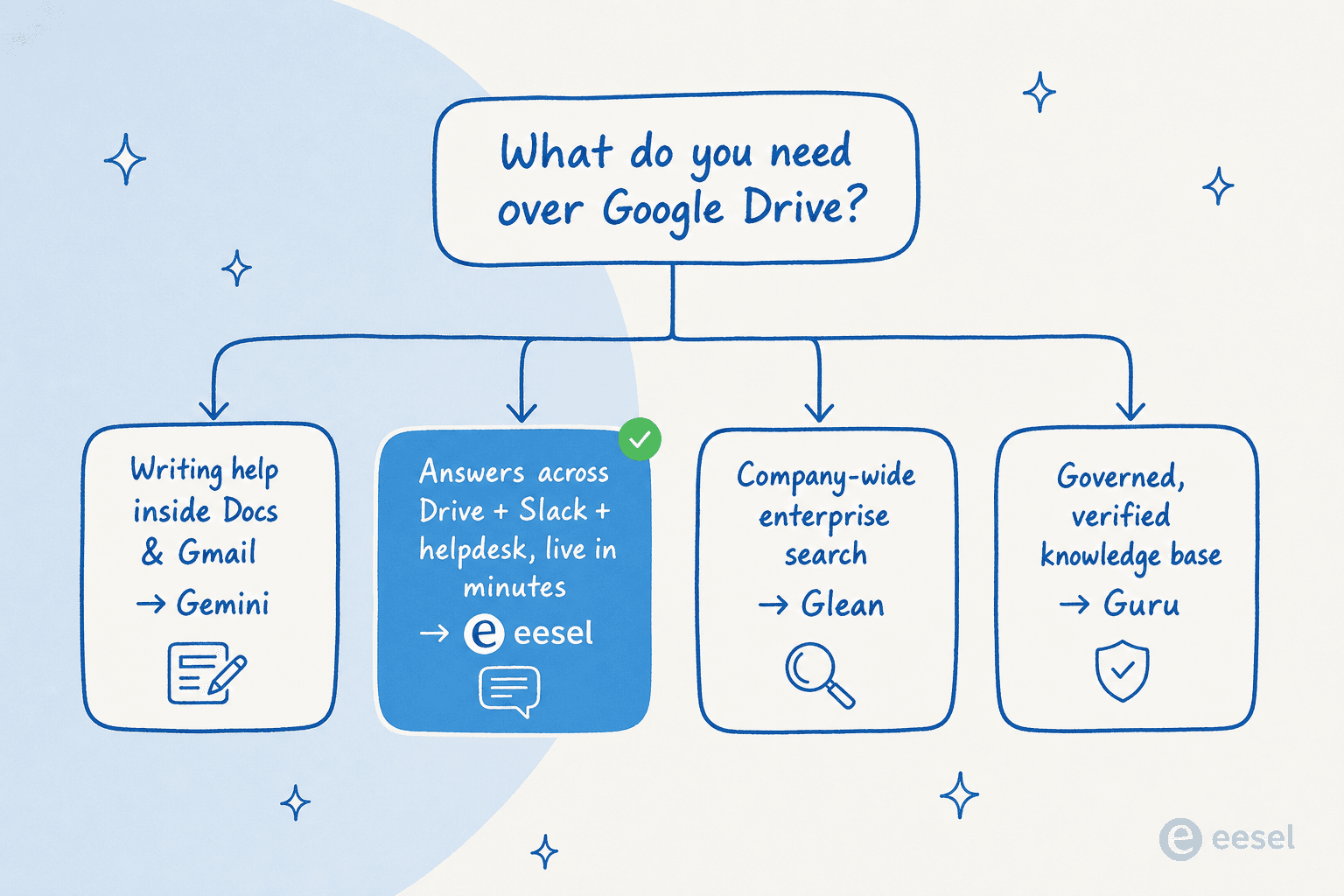
- All-in on Workspace, want writing help in Docs and Gmail? Use Gemini. You already pay for it, and for that job nothing's more convenient.
- Knowledge spread across Drive + Slack + helpdesk, want answers live in minutes? Use eesel AI. Fast to stand up, cross-tool, and it answers where your team works.
- Thousands of seats, standardizing on one governed search layer, budget in hand? Use Glean.
- Need a verified, owned knowledge base under your answers? Use Guru.
- Just want a personal assistant for one-off file questions and general thinking? ChatGPT or Claude.
The mistake we see most often is reaching for Gemini by default because it's already there, then quietly losing hours when answers turn out to live in Confluence, a Notion wiki, or last month's tickets. Drive is rarely the only drawer. If yours isn't, a unified layer is the answer, even if Gemini handles the Docs-and-Gmail half beautifully.
Try eesel for Google Drive
If your team's knowledge is scattered across Google Drive, Confluence, Notion, a help center, and a backlog of past tickets, eesel AI pulls all of it into one place and answers questions, with citations, right inside Slack, Teams, or your helpdesk. It connects in minutes, syncs in real time so answers never go stale, and bills per use instead of per seat, so you're not paying for a Drive assistant by headcount.
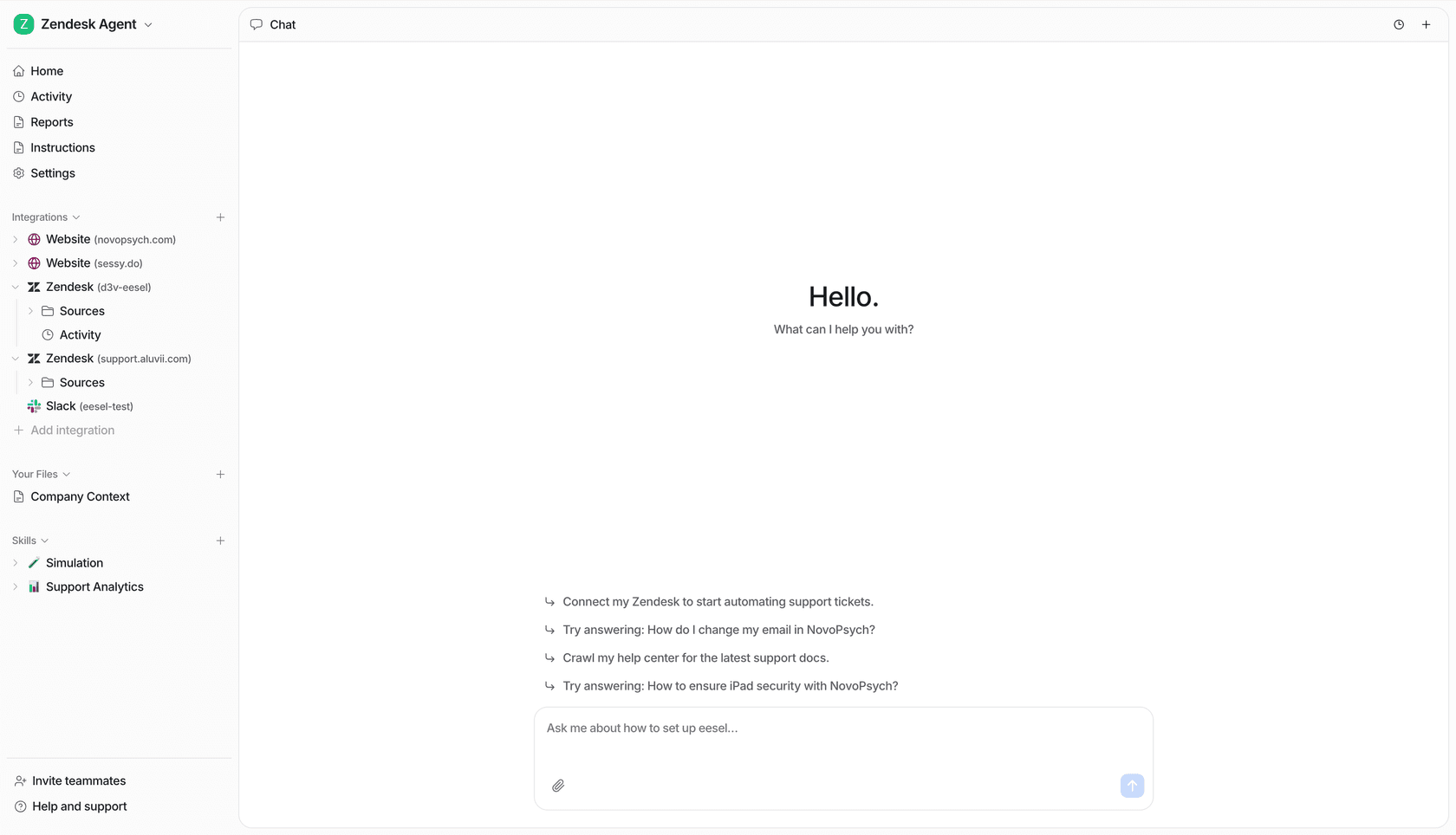
You can connect your Google Drive and start asking questions on the free plan, 100 credits, no credit card. Try eesel and see how it handles a question that spans more than one of your tools.
Frequently Asked Questions
Does Gemini work with Google Drive out of the box?
Can ChatGPT or Claude read my Google Drive files?
How much does a Google Drive AI assistant cost?
Why does Gemini sometimes miss files in my Drive?
Do these Google Drive AI assistants cite their sources?
Can I get a Google Drive AI assistant that answers in Slack or Teams?


Article by
Kira
Kira is a writer at eesel AI with a Computer Science background and over a year of hands-on experience evaluating AI-powered customer service tools. She focuses on breaking down how helpdesk platforms and AI agents actually work so that support teams can make better buying decisions.