
Picking the right AI image generator has gotten harder, not easier. A few years ago, the gap between top models was obvious. Now, GPT Image 2, Midjourney v7, and DALL-E 3 are all capable of producing work that would have seemed impossible just a short while ago. The differences between them are subtler, more specific, and more consequential for your actual workflow.
It is like choosing between a high-end camera, a digital canvas, and a precision design tool. You can get a great image from any of them, but the process and the "feel" of the output will be completely different. The question is not which one is the absolute best, but which one fits the specific task you are trying to tackle today.
Let's break down the current landscape of AI imagery in 2026 and see how these three giants compare across the dimensions that actually matter: precision, style, and integration.
1. The state of AI imagery in 2026
The AI image generation market in 2026 is no longer just about who can make the prettiest picture. We have moved into an era of "thinking" multimodal models that do not just follow a prompt, but actually reason through a design request.
As we noted in our recent guide on the best AI content generators, the shift toward integrated platforms is accelerating. Readers are now looking for tools that can handle global scripts, complex typography, and brand-consistent characters without needing a dozen different plugins.
Whether you are a designer, a marketer, or a developer, the choice of a generator now comes down to a workflow decision. Do you need a creative partner that adds its own artistic flair? Or do you need a literal interpreter that follows your instructions to the letter?
2. What is GPT Image 2?
Released in early 2026, GPT Image 2 (also referred to as Images 2.0) represents OpenAI's move toward a truly native multimodal framework. It is not just an update to DALL-E 3; it is a complete rebuild within the GPT-4o architecture.
This model was designed to act as a visual thought partner. Instead of just predicting pixels, it uses recursive rendering and model reasoning to transform rough inputs into cohesive assets. It understands the nuances of layout, the physics of light, and the rules of typography in ways its predecessors simply could not.
One of the biggest wins here is the flexible aspect ratios. Whether you need a vertical mobile screen or a horizontal panoramic banner, GPT Image 2 handles the composition without stretching or cropping awkwardly. It is built for a world where content needs to live across multiple formats simultaneously.
3. Midjourney v7: The aesthetic benchmark
If OpenAI is the precision engineer, Midjourney remains the master artist. The latest v7 model continues to set the standard for "aesthetic intelligence." Midjourney images do not just look generated, they look "made." There is a sense of intentionality in the lighting, the composition, and the textures that makes them feel designed by a human.
One of the most powerful features for professionals in 2026 is the character reference system, or --cref. This allows you to maintain a consistent character's appearance across dozens of different generations. You can also use --sref to lock in a specific style or color palette, ensuring your brand visuals stay coherent.
The platform has also successfully transitioned from its Discord-only roots to a dedicated web interface. This has made it much more accessible for those who found the chat-based command system a bit too technical. While it still lacks a general public API, it remains the top choice for pure creative work.
4. DALL-E 3 vs. GPT Image 2: What is the difference?
You might wonder why we are still talking about DALL-E 3 when GPT Image 2 is available. Within the OpenAI ecosystem, the transition has been subtle but important. DALL-E 3 is now effectively the "legacy" foundation that brought us easy prompt following, while GPT Image 2 is the native successor that adds "thinking" capabilities.
The comparison between these models often comes down to the intended output. DALL-E 3 is still surprisingly popular for quick, stylized sketches where you do not need perfect realism. However, for anything involving text or complex layouts, GPT Image 2 is the clear choice.
OpenAI has unified these models within ChatGPT, so most users will naturally find themselves using the latest version without even realizing it. But for developers using the API, knowing the difference between the standard DALL-E 3 endpoints and the new multimodal GPT Image 2 endpoints is critical for cost and quality control.
5. Head-to-head comparison: Precision vs. Style
To help you decide which tool deserves a spot in your tech stack, we have compared them across four key dimensions that define the 2026 creative workflow.
Text rendering and typography
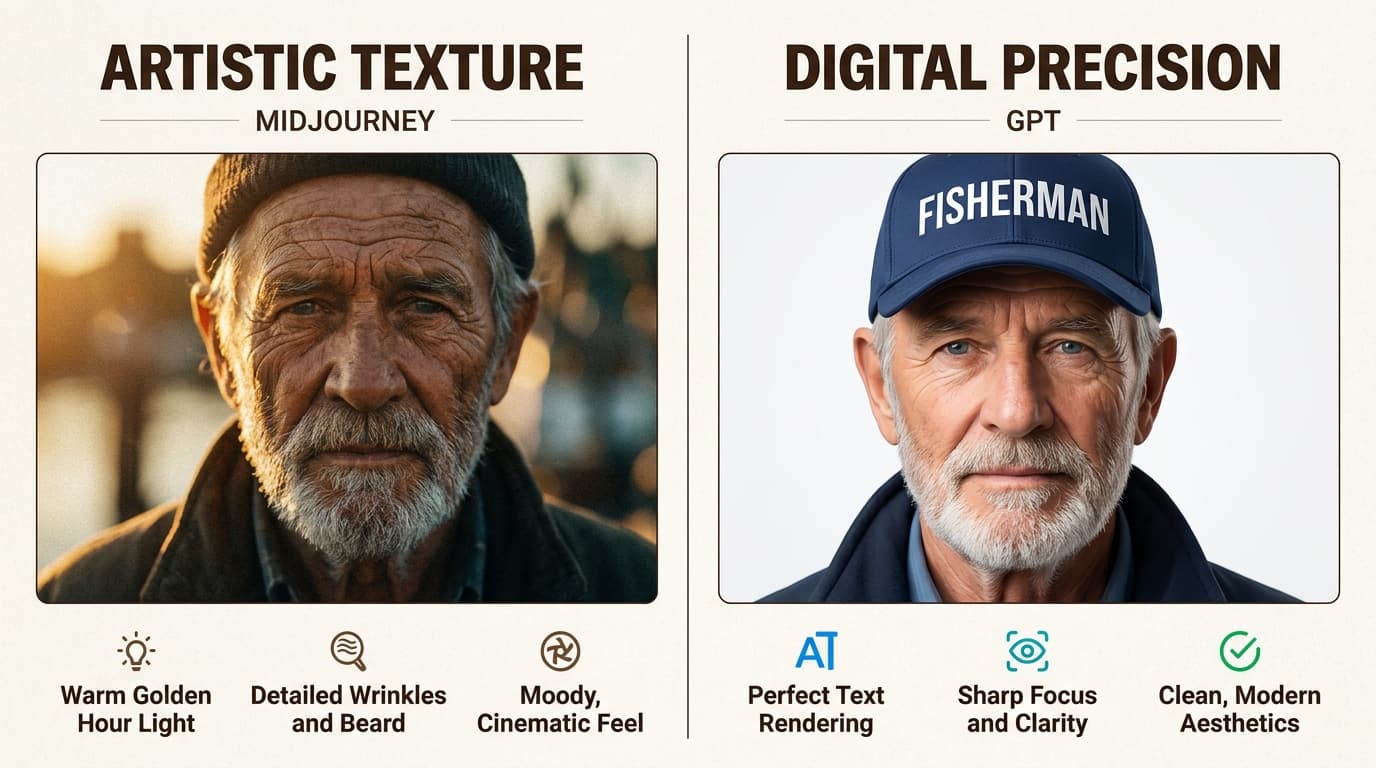
This is where GPT Image 2 currently holds a massive lead. It can accurately render multi-word text, logos, and signage in images across global scripts like Japanese, Arabic, and Cyrillic. If your work involves ad creatives or branded content that needs legible text, GPT is your winner. Midjourney has improved, but long phrases still tend to produce the occasional "OPEEN" instead of "OPEN."
Photorealism and "designed" looks
Midjourney v7 remains the king of the "film-look." Its photos look like they came from a high-end Hasselblad camera, with organic grain and creamy bokeh. GPT Image 2 is very clean and bright, which is great for product shots, but it can sometimes feel a bit "too perfect" or synthetic compared to Midjourney's more cinematic results.
Prompt adherence
GPT Image 2 is the "literal interpreter." If you ask for three red apples on a blue table with a cat on the left, you will get exactly that. Midjourney is more of a "creative partner." It might add a fourth apple if it thinks it makes the composition look better. As noted in several AI image generator reviews, you have to decide if you want the AI to follow your instructions or improve upon them.
Workflow speed
In terms of raw generation speed, the landscape is very competitive:
- GPT Image 2: Typically 10 to 20 seconds within ChatGPT.
- Midjourney v7: 15 to 30 seconds in Fast mode; unlimited time in Relaxed mode.
- Google Imagen 3: Roughly 5 to 10 seconds, making it one of the fastest enterprise options.
6. Pricing and access in 2026
Pricing has shifted toward usage-based models for professionals, while casual users stay within the $20 monthly subscription tier.
| Feature | GPT Image 2 | Midjourney v7 | DALL-E 3 |
|---|---|---|---|
| Pricing | $20/mo (ChatGPT Plus) | $10 to $120/mo | Included in Plus |
| API Access | Yes ($0.04 to $0.08 per image) | Limited / Partner only | Yes |
| Primary Strength | Text & Precision | Aesthetics & Style | Simple Stylization |
| Ideal For | Ads, Mockups, Guides | Art, Character Design | Quick Ideation |
Midjourney's subscription tiers are great for individuals, but for those building automated content pipelines, the OpenAI API or Google Cloud's Vertex AI are much more scalable.
7. Finding the right AI teammate for your workflow
Ultimately, the best AI image generator for you depends on what you are trying to build. If you need a hyper-realistic character for a comic book, Midjourney is unmatched. If you are building an automated system to generate 500 personalized ad banners with text, GPT Image 2 is the only tool that can realistically handle it.
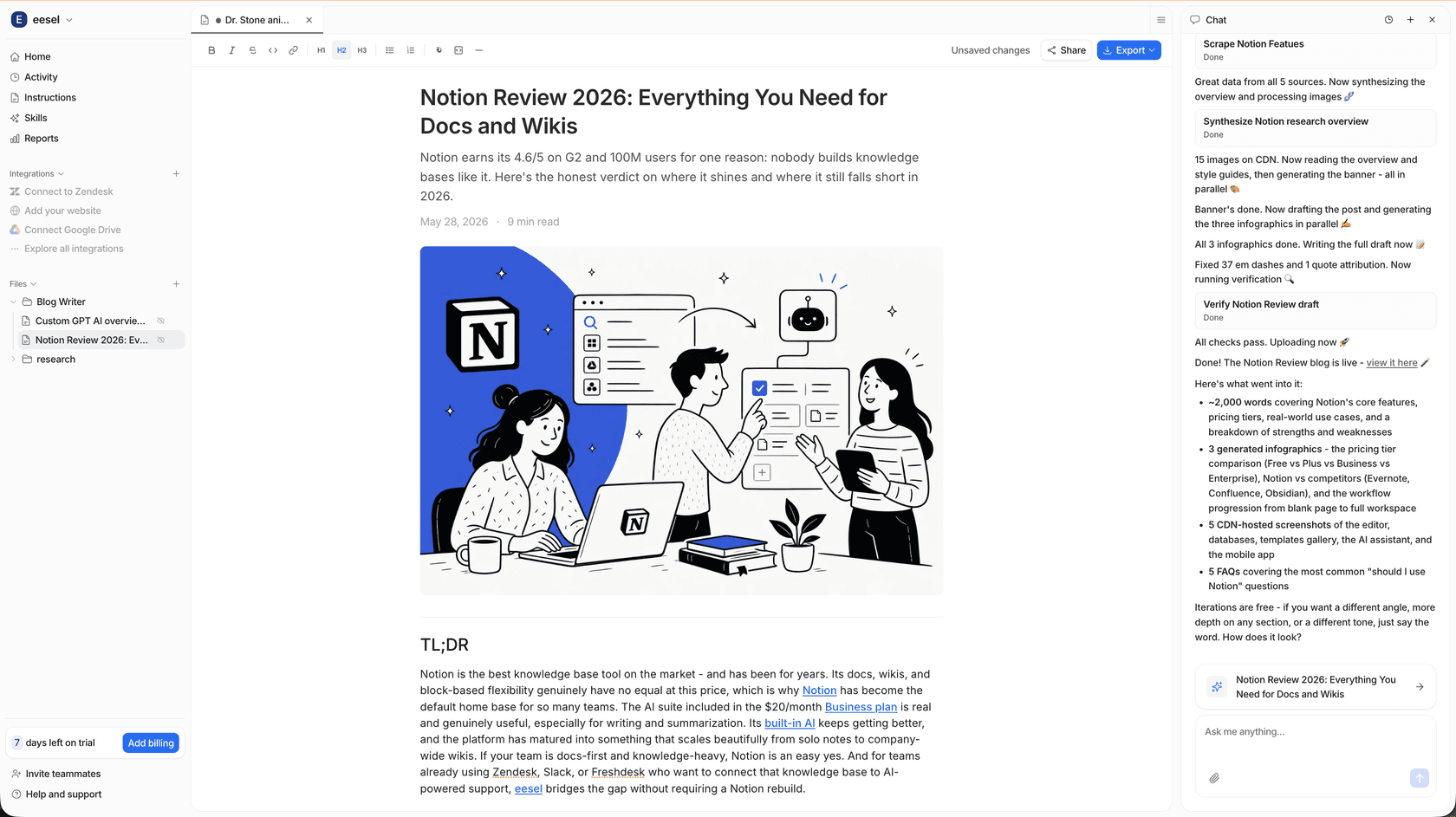
But here is the real challenge: even with the best image generator, you still have to manage the workflow. You have to research topics, structure the content, and figure out where those images actually fit. This is where the gap between human writers and AI tools used to be widest.
At eesel AI, we have spent a lot of time thinking about how to close that gap. We built our AI Blog Writer to act as a fully autonomous teammate that handles the research, drafting, and image placement for you. Instead of jumping between tools, you get a cohesive asset that follows your brand rules and uses the right model for the right task.
Whether you are using GPT, Midjourney, or our integrated teammates, the goal is the same: spending less time on the mechanics of creation and more time on the strategy behind it.
If you are ready to scale your content without losing that human touch, we would love to show you how our AI teammates can help.