

What Nano Banana 2 Lite actually is
Announced June 30, 2026, Nano Banana 2 Lite is the speed-and-cost tier of Google's Nano Banana image family, sitting below full Nano Banana 2 (the generalist workhorse) and Nano Banana Pro (the professional, high-control tier). Google's own framing on the DeepMind model page puts it plainly: "built to deliver high-speed generation and editing at our lowest cost yet."
It generates a text-to-image output in about 4 seconds, five times faster than full Nano Banana 2's 20 seconds, while staying within roughly 80 Elo points of the full model on image editing and 19 points on generation, according to Google's own arena.ai benchmarks. It isn't a stripped-down toy; it's the volume end of a three-tier lineup, and the pricing follows that logic closely.
The pricing, in full
Google prices its image models by output token, and the per-image cost is a derived figure rather than a headline number. Here's the full Gemini API pricing page breakdown for Nano Banana 2 Lite:
| Free tier | Standard (paid) | Batch (paid) | |
|---|---|---|---|
| Input price (per 1M tokens) | Not available | $0.25 | $0.125 |
| Text/thinking output (per 1M tokens) | Not available | $1.50 | $0.75 |
| Image output (per 1M tokens) | Not available | $30.00 | $15.00 |
| Per 1K-resolution image | - | $0.0336 | $0.0168 |
| Used to improve Google's products | Yes | No | No |
The Batch tier is exactly half of Standard across every line item, which matches the pattern Google runs elsewhere on the same pricing page. There's no published resolution tier above 1K for this model specifically - Google states the 1K figure explicitly, but doesn't publish separate 2K or 4K per-image rates for the Lite tier the way it does for the two models above it.
How the token math actually works
The $0.0336 figure isn't arbitrary - it's derived directly from token consumption, and knowing the formula matters if you're estimating a real budget rather than trusting a single published number:
$30.00 per 1,000,000 output tokens ÷ 1,000,000 × 1,120 tokens (the token cost of one 1024×1024px image) = $0.0336 per image
Google states this explicitly as a footnote on its pricing page: "Output images at 1K (1024x1024px) consume 1120 tokens and are equivalent to $0.0336 per image." That's worth internalizing because it means the per-image price scales with whatever the model actually outputs, not a flat per-request fee - if Google ships a higher-resolution option for this tier later, the price will move with the token count, not stay pinned at $0.0336.
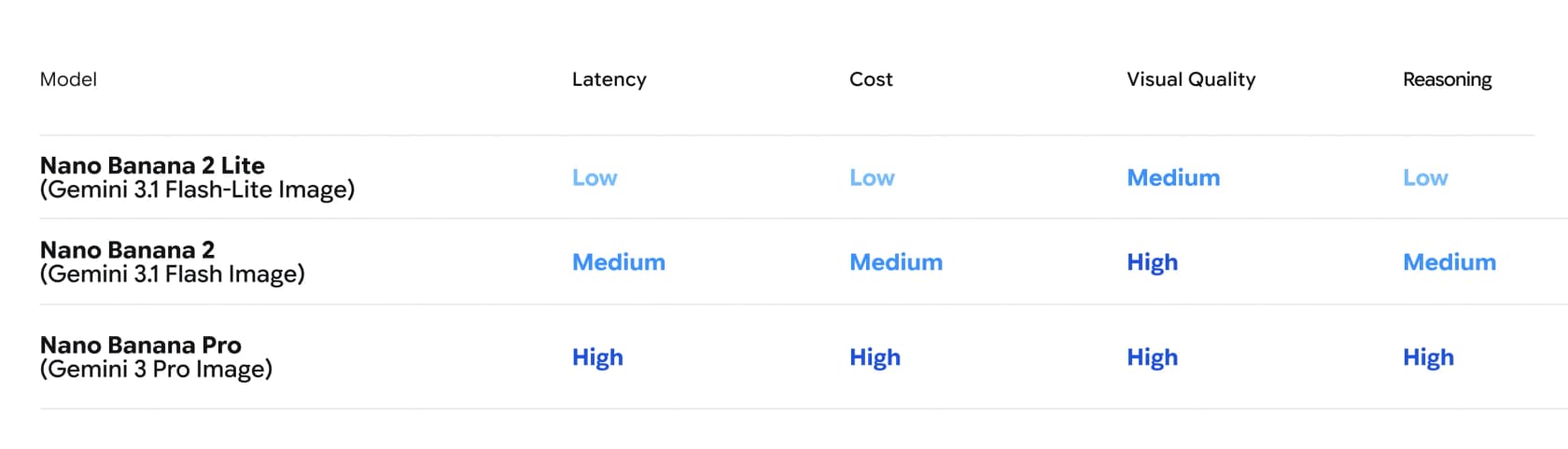
Nano Banana 2 Lite vs Nano Banana 2 vs Nano Banana Pro: full pricing comparison
The Lite tier's whole value proposition is price and speed relative to its two siblings. Here's every tier, side by side, at Standard pricing:
| Model | API ID | Input (per 1M tokens) | Image output (per 1M tokens) | Per 1K image | Latency (1K image) |
|---|---|---|---|---|---|
| Nano Banana 2 Lite | gemini-3.1-flash-lite-image | $0.25 | $30.00 | $0.0336 | ~4.0s |
| Nano Banana 2 (full) | gemini-3.1-flash-image | $0.50 | $60.00 | $0.067 | ~20.0s |
| Nano Banana Pro | gemini-3-pro-image | $2.00 | $120.00 | $0.134 | Not published |
Nano Banana 2 Lite is exactly 2x cheaper than full Nano Banana 2 at every resolution and tier, and roughly 4x cheaper than Nano Banana Pro on a per-image basis. On Batch pricing the same ratios hold: $0.0168 (Lite) vs $0.034 (full) vs Pro's batch rate of $0.067 per 1K/2K image.
Full Nano Banana 2 and Nano Banana Pro both publish per-resolution breakdowns across 0.5K, 1K, 2K, and 4K - Nano Banana 2 Lite only publishes the 1K figure. If you need a specific higher-resolution output and want to price it in advance, that's a real limitation to plan around, not a rounding gap in the research.
"We have been testing Nano Banana 2 Lite to power real-time image generation within Manus's autonomous workflows - from slide decks to web pages... The image quality is also impressive, coming close to the full Nano Banana 2."
- Tao Zhang, Co-founder and Chief Product Officer, Manus AI
Worked cost examples
Sticker prices are easy to skim past; a few concrete scenarios make the number land. All figures use Standard-tier pricing unless noted, and assume standard 1K-resolution text-to-image generation (no separate input-image cost for edits, which would add a small input-token charge on top).
| Use case | Volume | Standard cost | Batch cost |
|---|---|---|---|
| A single blog hero image | 1 image | $0.03 | $0.02 |
| A month of blog visuals for a small content team | 100 images | $3.36 | $1.68 |
| Daily A/B ad-variant testing | 1,000 images/month | $33.60 | $16.80 |
| A social app generating on-demand avatars | 100,000 images/month | $3,360 | $1,680 |
| An enterprise creative pipeline (Artlist-scale) | 1,000,000 images/month | $33,600 | $16,800 |
The gap between Standard and Batch only gets more meaningful as volume climbs - at 1 million images a month, choosing Batch over Standard is the difference between roughly $34,000 and $17,000. That's the actual decision most teams should be making, not "is Nano Banana 2 Lite cheap" (it clearly is) but "am I paying for synchronous speed I don't need."
Standard vs Batch: which tier actually fits your workflow
This is the one lever inside Nano Banana 2 Lite's own pricing that most teams leave un-pulled. Standard tier returns your image synchronously, in that ~4-second window - the right choice for anything a user is watching happen live: an interactive design tool, a chat-based image edit, a real-time game asset. Batch tier processes requests asynchronously at half the price; Google doesn't publish a guaranteed batch turnaround time on the pricing page, but Batch APIs generally aren't built for a user sitting and waiting.
The practical rule: if a human is watching the spinner, pay for Standard. If you're generating a queue of images ahead of time - a week's worth of social thumbnails, a batch of ad variants for tomorrow's test, product mockups for an upcoming catalog - route it through Batch and keep half the budget.
What you're actually paying for at that price
The reason $0.0336 per image is worth paying attention to (rather than just being "the cheap one") is what Google didn't cut to hit that price. Per the DeepMind model card, Nano Banana 2 Lite keeps:
- Character consistency - maintaining a subject's identity and object fidelity across multiple generations, useful for storyboarding or ecommerce virtual try-ons, though Google's own limitations section notes it "may not always get it right."
- Legible in-image text rendering - even at 4-second generation speed, useful for checking typography across localized ad variants.
- World knowledge - drawing on Gemini's broader knowledge for contextually accurate scenes, rough data visualizations, and location-specific mockups.
- Reliable prompt adherence - Google's phrasing, not a marketing gloss on a weaker model.
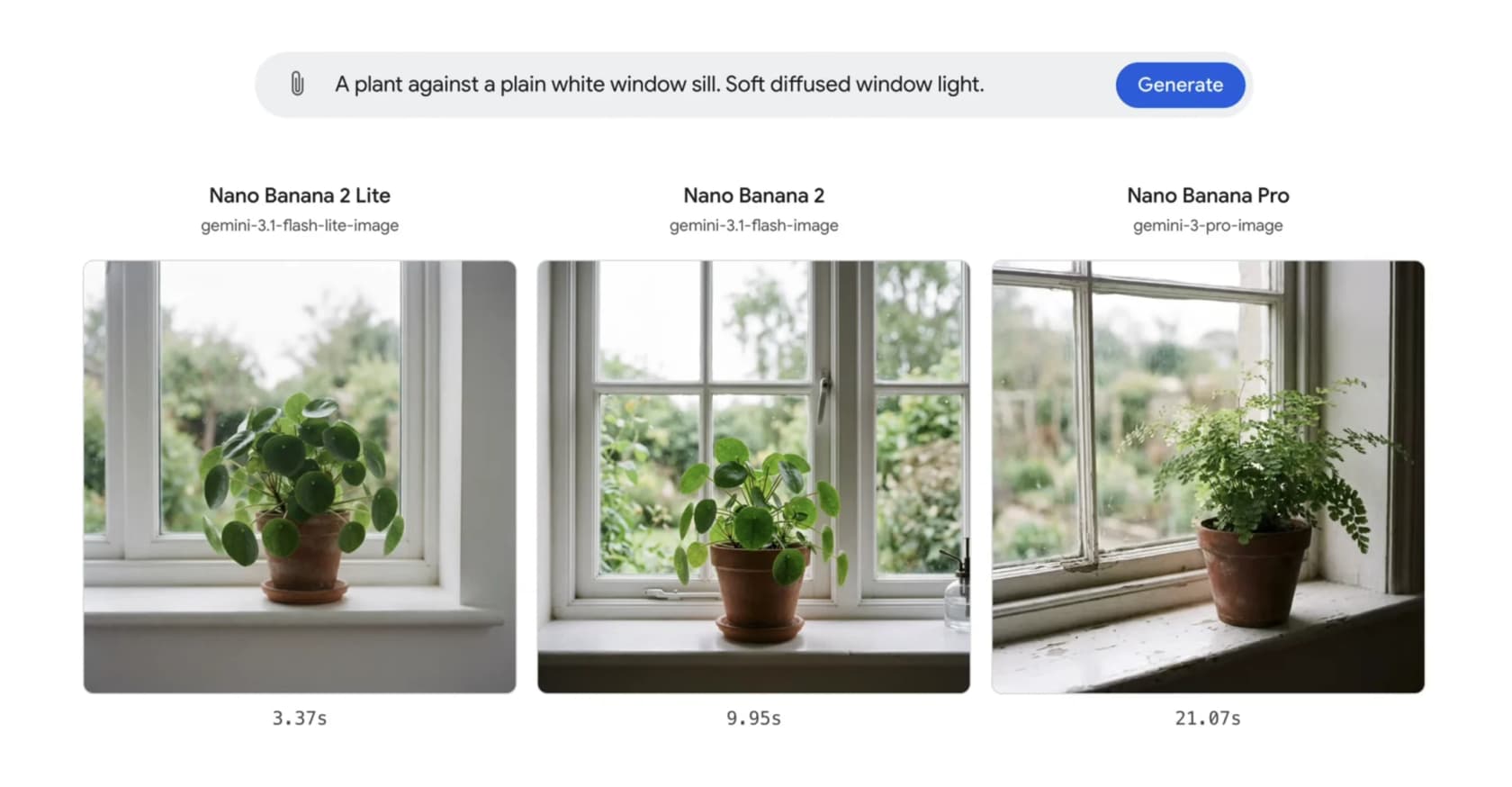
That screenshot, taken from Google's own launch materials, is the clearest illustration of the trade: the exact same prompt run against all three tiers, with Nano Banana 2 Lite returning in 3.37 seconds against 9.95 seconds for the full model and 21.07 seconds for Pro. On a benchmark chart tracking Elo scores for both generation and editing quality against latency and price, Google positions Lite as beating the older full-size Nano Banana model outright on generation quality (1251 Elo vs 1151) while still being faster and only marginally more expensive per image.
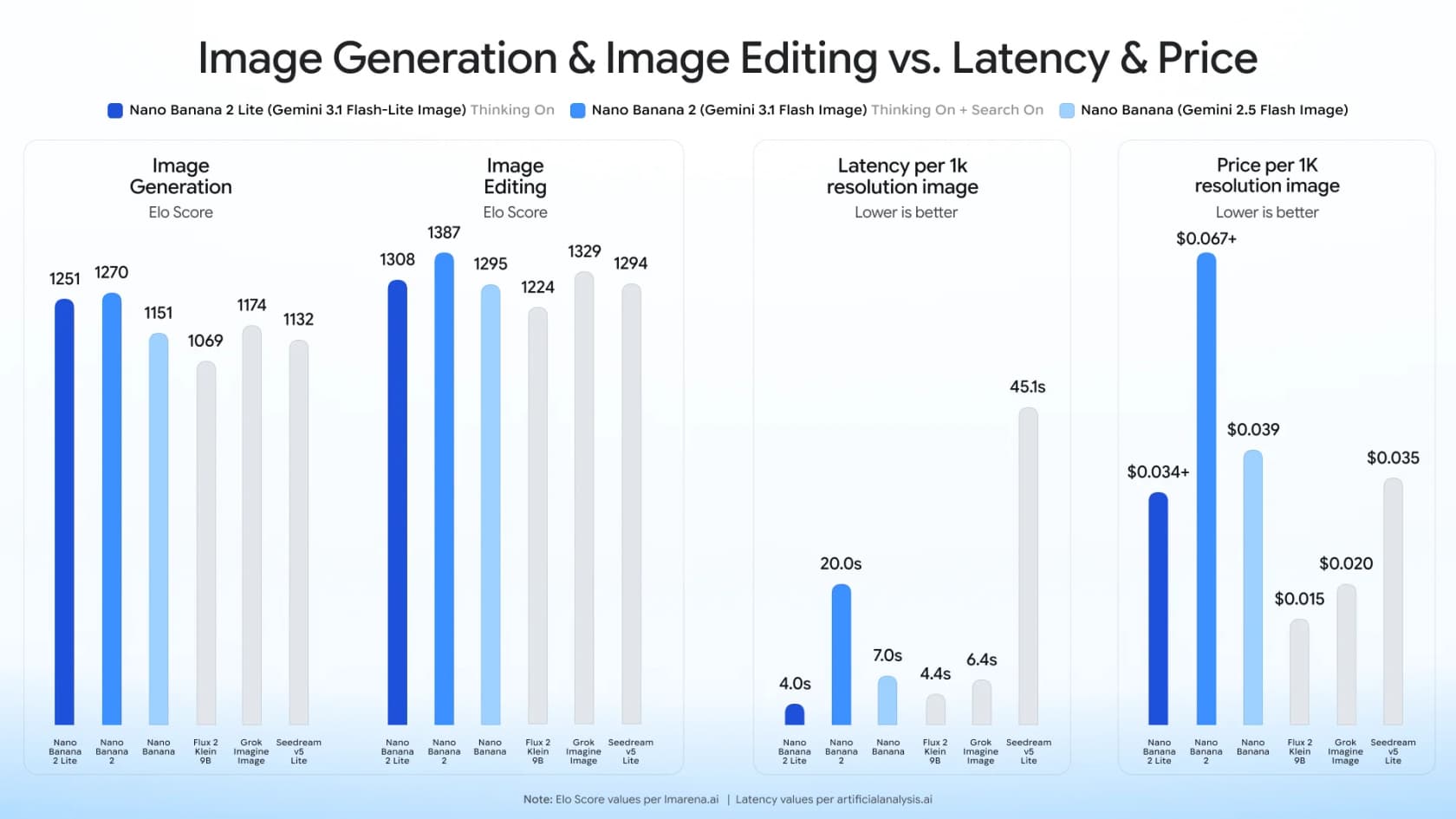
Against outside competitors on that same chart, Nano Banana 2 Lite's $0.034 per-image price sits close to Seedream v5 Lite ($0.035) and above Flux 2 Klein 9B ($0.015), but its 4.0-second latency beats every model on the chart except Flux 2 Klein 9B's 4.4 seconds - while scoring meaningfully higher on both Elo benchmarks than either.
The costs that don't show up in the per-image number
A few gotchas worth knowing before you budget against $0.0336 and call it done:
- No free tier for API usage. Both Standard and Batch pricing tables list "Not available" under Free Tier. You can experiment for free inside Google AI Studio or the Gemini app, but production API calls are billed from the first request.
- Editing runs slightly slower than generation. Google's own enterprise notes call out that "image generation offers the fastest latency; image editing may see slightly higher response time" - the 4-second figure is a generation number, not a universal one.
- Data goes toward improving Google's products on the Free Tier only - both paid tiers explicitly opt you out of that, which matters if you're comparing this to a competitor that trains on paid-tier data by default.
- No published resolution ceiling for this tier. If your use case needs a guaranteed 2K or 4K output, you're looking at full Nano Banana 2 or Nano Banana Pro instead, at 2x and 4x the per-image price respectively.
- Provisioned throughput is a separate line item. For enterprise buyers on the Gemini Enterprise Agent Platform, provisioned throughput for handling high-concurrency requests reliably at scale is available today for Nano Banana 2 Lite, and priced separately from the per-token API rate.
"Speed is no longer a limitation. When generation is faster than imagination, creators can stay inside the idea instead of waiting on the tool... For Artlist's users, it means less time staring at a progress bar and more time creating, iterating, personalizing, and moving at the speed of culture."
- Idan Yonas, Director of AI Content & Innovation, Artlist
Community reaction to the launch
Reaction to the June 30 launch skewed heavily toward Google-affiliated voices rather than independent third-party reviews, which is worth flagging rather than papering over. Logan Kilpatrick of Google DeepMind/AI Studio called the latency "honestly feels like magic," predicting it "will enable so many new use cases where there is a high degree of latency sensitivity." TestingCatalog, an AI-news aggregator, confirmed the model went live and selectable inside the Gemini app shortly after the announcement, treating it as a notable launch moment alongside its video sibling, Gemini Omni Flash.
Where Nano Banana 2 Lite fits if you're paying for content, not just images
Here's the framing shift worth sitting with: $0.0336 per image is genuinely cheap, cheap enough that per-image cost basically stops being the constraint for most teams. Once the image itself is a rounding error, the actual bottleneck for anyone running a content pipeline shifts to everything around the image - the brief, the article it illustrates, the SEO structure, the fifty other things a blog post needs beyond a picture. Pricing posts like this one tend to fixate on the number because it's the easiest thing to measure, but for a content team, the image was rarely the expensive part.
That's the gap eesel's AI blog writer is built to close: it researches the topic from primary sources, writes in your brand voice, and drops in generated visuals as part of the same pipeline, so the image-generation cost question becomes moot because the image was never the bottleneck to begin with.
Try eesel for AI content workflows
eesel builds AI teammates that plug into your existing tools and start doing real work from day one, and the AI blog writer is one of two current products, alongside AI for helpdesks. If the reason you're pricing out Nano Banana 2 Lite is to power a content pipeline - thumbnails, in-article illustrations, social assets to go with a blog post - eesel's blog writer handles the research, drafting, and visual generation together, rather than leaving you to stitch a model API into a separate writing workflow.
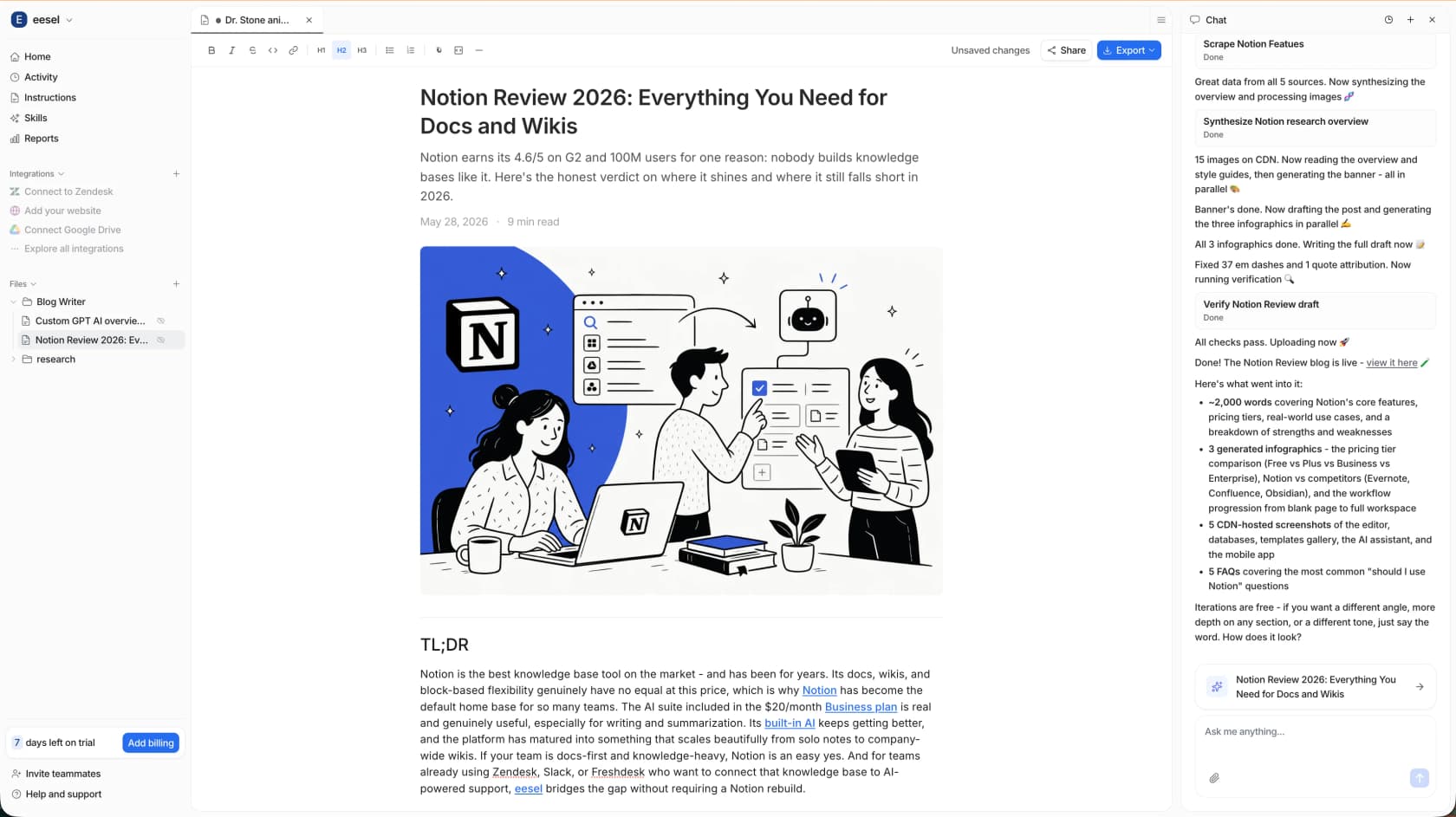
It's free to try, and the pricing follows the same per-task logic Google uses for image tokens: pay for what you actually generate, not a seat.
Frequently Asked Questions
How much does Nano Banana 2 Lite cost?
gemini-3.1-flash-lite-image) costs $0.25 per 1M input tokens and $30.00 per 1M image-output tokens, which works out to roughly $0.0336 per 1K-resolution image. The Batch tier is exactly half that, at about $0.0168 per image. There's no separate free tier for paid API usage.Is Nano Banana 2 Lite cheaper than Nano Banana 2?
What's the difference between Standard and Batch pricing?
Does Nano Banana 2 Lite have a free tier?
Is Nano Banana 2 Lite worth it compared to the full model?
How is the per-image price calculated from token pricing?


Article by
Kira
Kira is a writer at eesel AI with a Computer Science background and over a year of hands-on experience evaluating AI-powered customer service tools. She focuses on breaking down how helpdesk platforms and AI agents actually work so that support teams can make better buying decisions.