


Freshdesk AI features come in three parts: Freddy AI Agent, included on every paid plan with 500 one-time sessions and then $49 per 100; Freddy AI Copilot, $29 per agent a month on Pro and Enterprise; and Freddy AI Insights, on Enterprise only. The AI agent answers email on any Freshdesk plan (chat needs Freshdesk Omni) and can now read Google Drive, SharePoint and Confluence as well as your help center. What it doesn't list among its knowledge sources is your past tickets, which is where eesel comes in: it works inside Freshdesk and learns from your help center, canned responses and resolved tickets. If you run setup from a coding agent like Claude Code, the eesel CLI can connect Freshdesk, upload approved articles and ask test questions before go-live, though connecting the helpdesk still takes an admin's API key.
Disclosure: I'm on eesel's support team, and eesel sells AI that works inside Freshdesk. I read Freshdesk's own materials and help center for every fact below.
What is Freshdesk AI?
"Freshdesk AI" is the umbrella name for the AI built into Freshdesk, and the engine behind it is Freddy AI, which Freshworks built in-house. Freshworks' own FAQ says the two names mean the same thing. You can think of Freddy as the brain and Freshdesk AI as all the different features it powers.
Freddy comes in three parts:
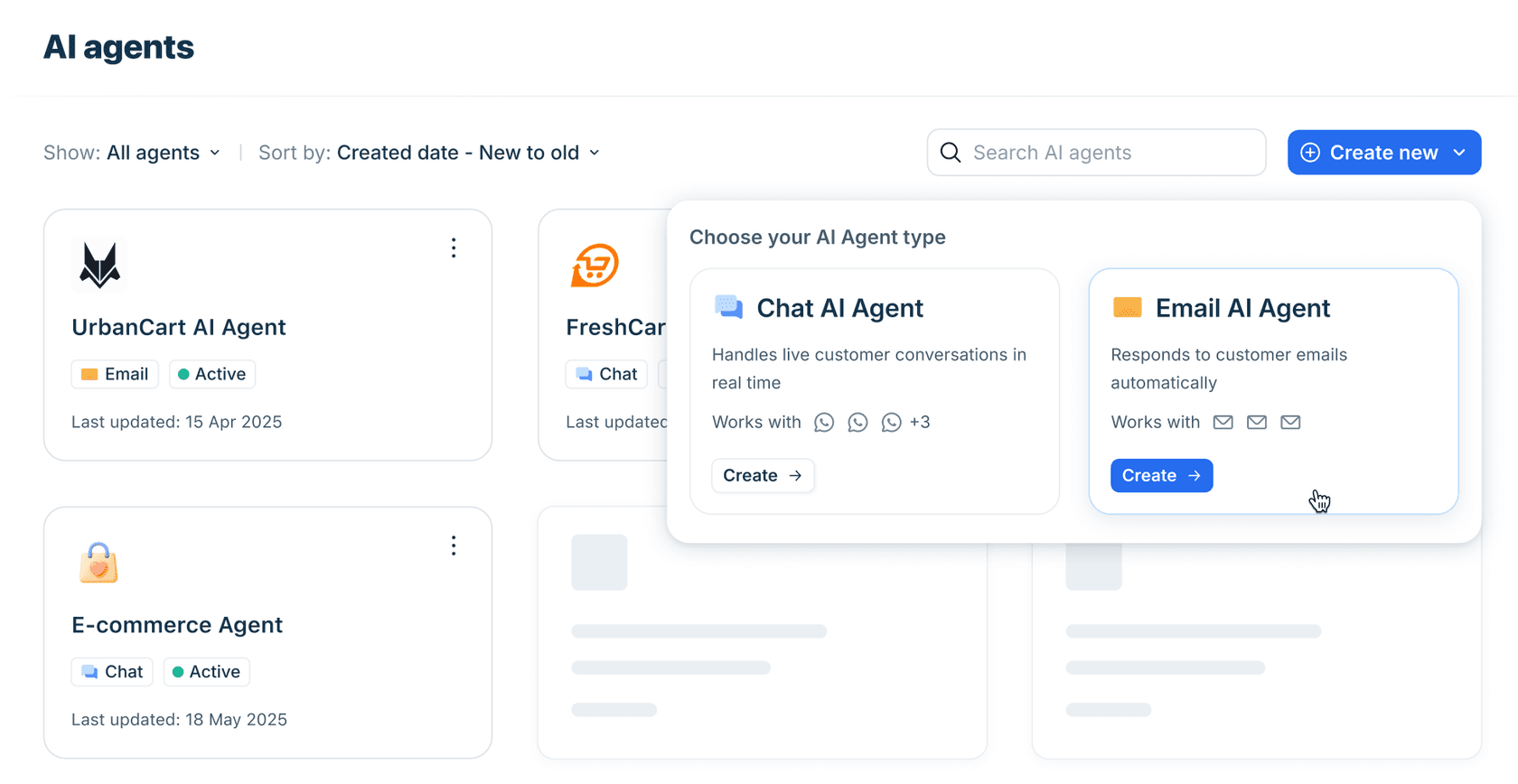
- Freddy AI Agent: the bot your customers talk to. You build it in AI Agent Studio, and it answers questions and takes actions before a person picks up the ticket.
- Freddy AI Copilot: the assistant for your agents. It sits inside the ticket and helps them find information, write replies and catch up on long conversations.
- Freddy AI Insights: the analytics part for managers, which flags trends in your support data and answers reporting questions in plain language.
Which product you're on matters. Freshworks now sells Freshdesk and Freshdesk Omni as two products, and its add-ons article says the Email AI Agent works in both, while the Chat AI Agent is only in Freshdesk Omni. Freshworks says on its pricing page that more than 74,000 businesses use it.
Which Freshdesk AI features help agents? Freddy AI Copilot
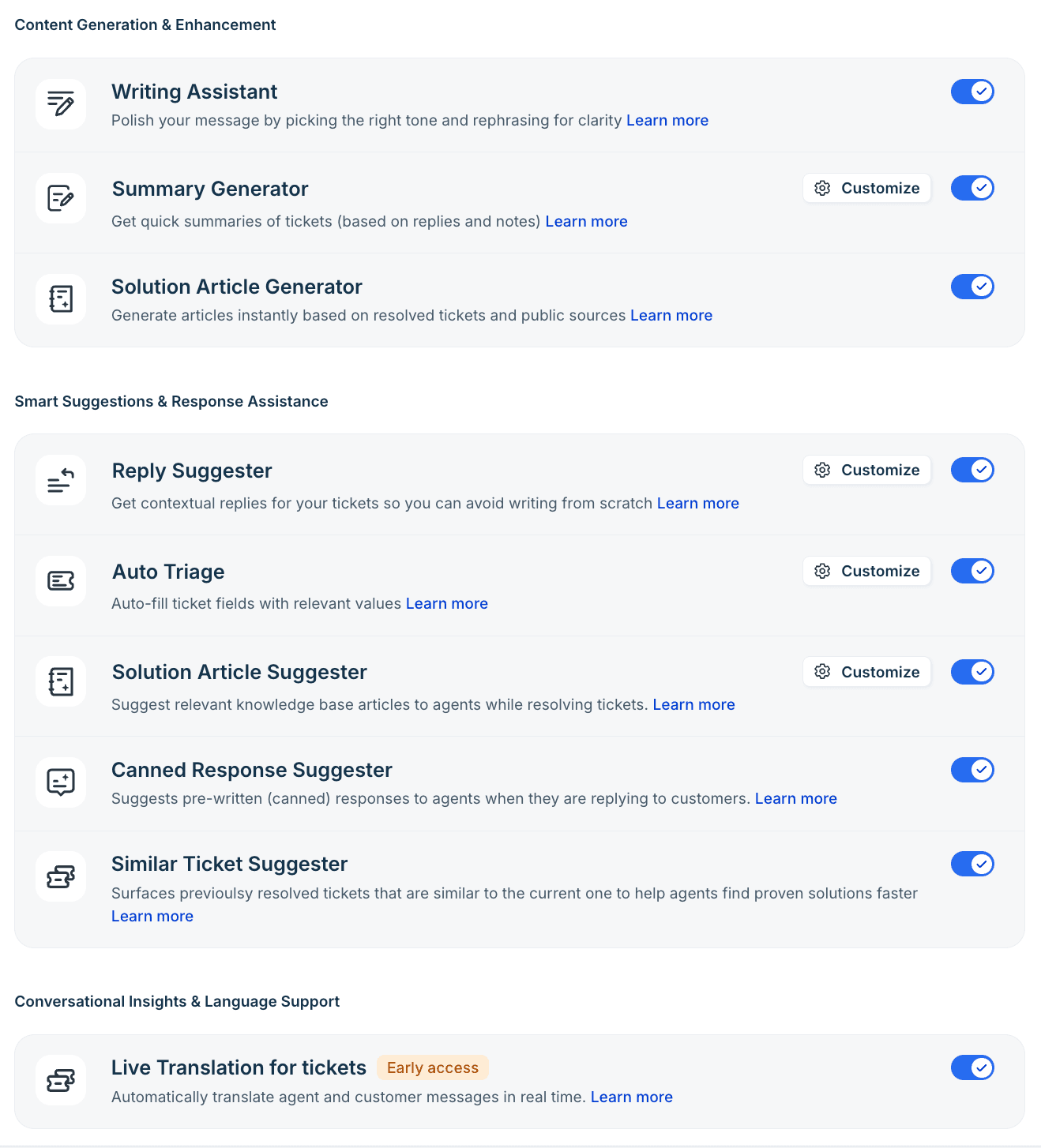
Freddy AI Copilot is the AI copilot for your agents: it cuts the time they spend on repetitive work so they can put their attention on the hard tickets. It's a paid add-on on Pro and Enterprise, assigned per agent, and Freshdesk's feature list names a dozen features, from the writing assistant to a "thank you detector" that stops a ticket reopening when a customer only writes back to say thanks.
On G2, one reviewer at a company of more than 1,000 people put it this way:
"The Freddy AI Copilot is the actual game changer that it assists with summaries, reply suggestions, and even live translations, which allow working with tickets to be quicker and more precise."

Ticket summaries
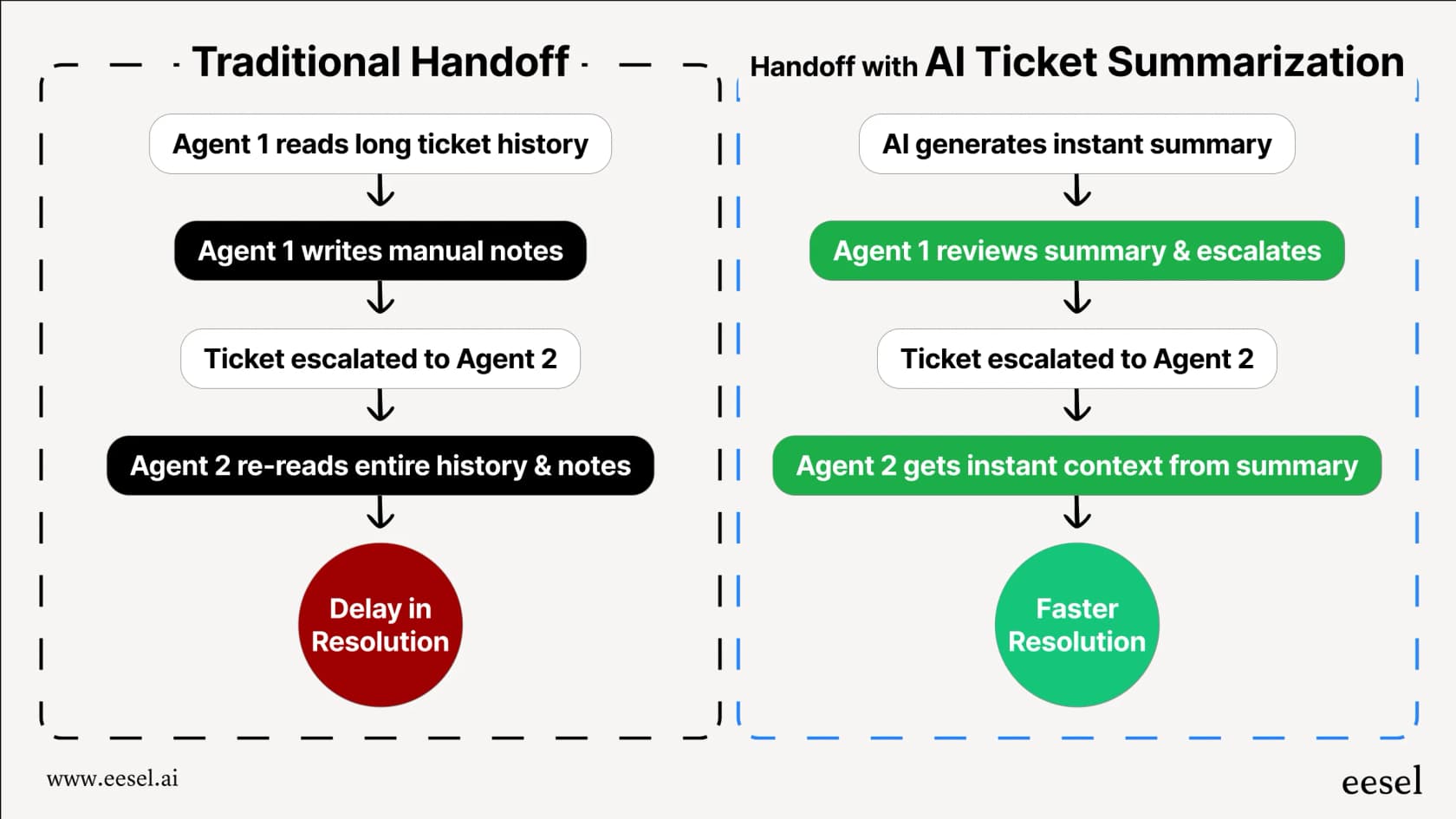
We've all been there: you get a ticket with a conversation thread so long it could be a short novel. Freddy's summary generator condenses the replies and notes into a short ticket summary. This saves a lot of time, especially when a ticket gets passed to a new agent who needs to get up to speed in a hurry.
Reply suggestions and writing help
This is where Copilot does most of its daily work.
- Reply suggester: drafts a response to the incoming ticket from your knowledge. An improved version that can draw on more sources is in an early access program, per its help article.
- Canned response suggester: reads the ticket and suggests one of your canned responses, so agents don't go digging for the right one.
- Solution article suggester and similar tickets: if the answer is already in your knowledge base, Freddy tees up the article. The Similar Ticket Suggester surfaces previously resolved tickets that look like the current one.
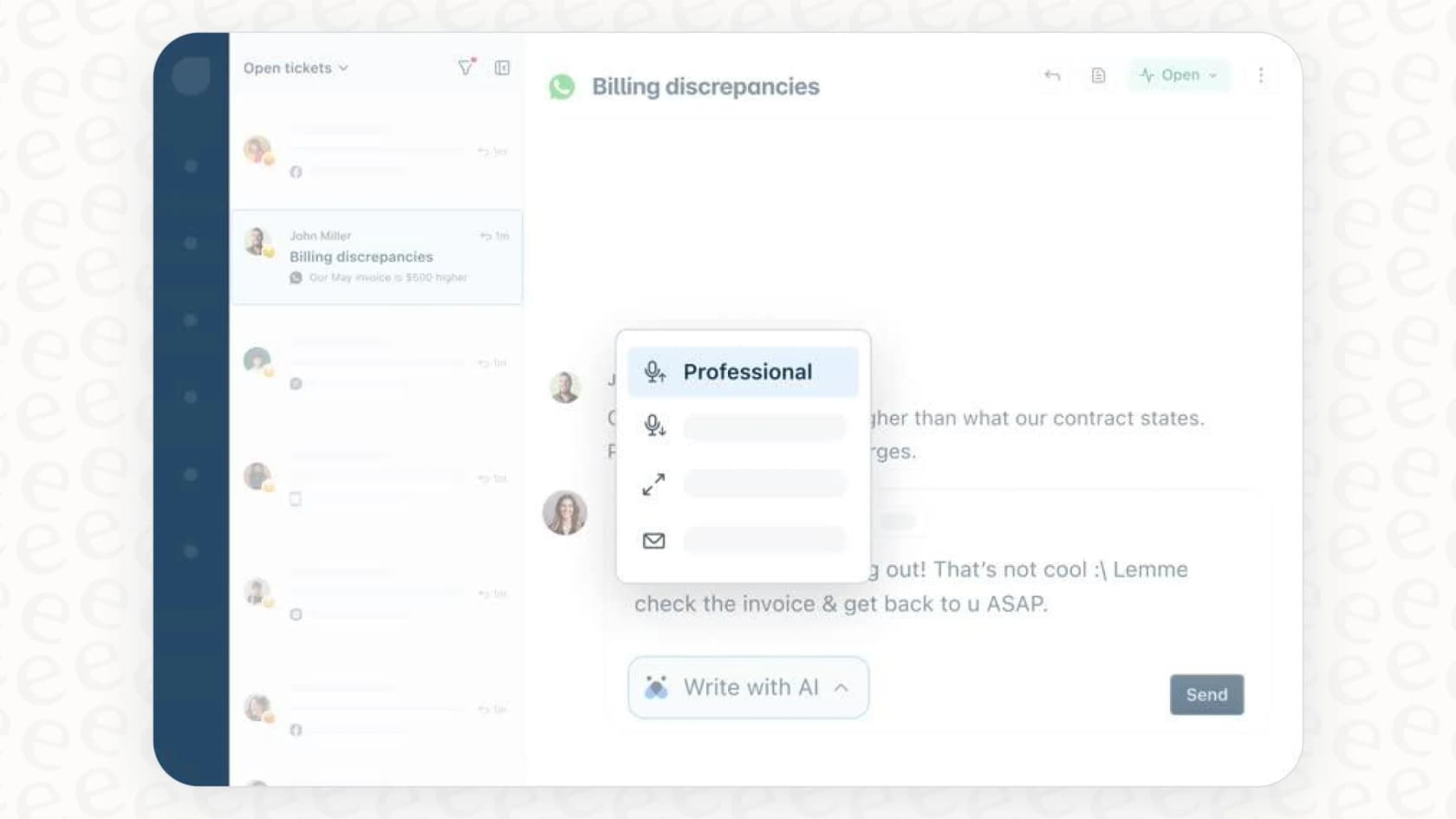
- Writing Assistant: the Writing Assistant has Rephrase, More formal, Less formal, Expand and Expand as email, which turns a few notes into a full reply using the ticket's subject and the customer's messages.
- Live Translate: translates between agent and customer in real time, across more than 60 languages according to the Copilot page. My Freshdesk translation guide covers the setup.
Solution article generation
You know that feeling when an agent writes the perfect, detailed solution to a tricky problem? That should be a help center article, but that task usually gets pushed to the bottom of the list. The solution article generator lets agents draft or update knowledge base articles from resolved tickets, so the good answers get saved for everyone.
Sentiment analysis and auto triage
Freddy reads the mood of each conversation and tags it positive, neutral or negative, so agents can get to the most frustrated customers first. My Freshdesk sentiment analysis post shows where those tags appear.
Auto triage fills in ticket fields for you. It predicts Priority, Group and Type, plus custom dropdowns, from the ticket text, the customer's intent and sentiment, and your history. Two things to know before you switch it on: Freshdesk recommends at least 2,000 historical tickets for good accuracy, and your automation rules always win when both try to set the same field. My auto triage guide goes through the settings.
Which Freshdesk AI features automate replies? Freddy AI Agent
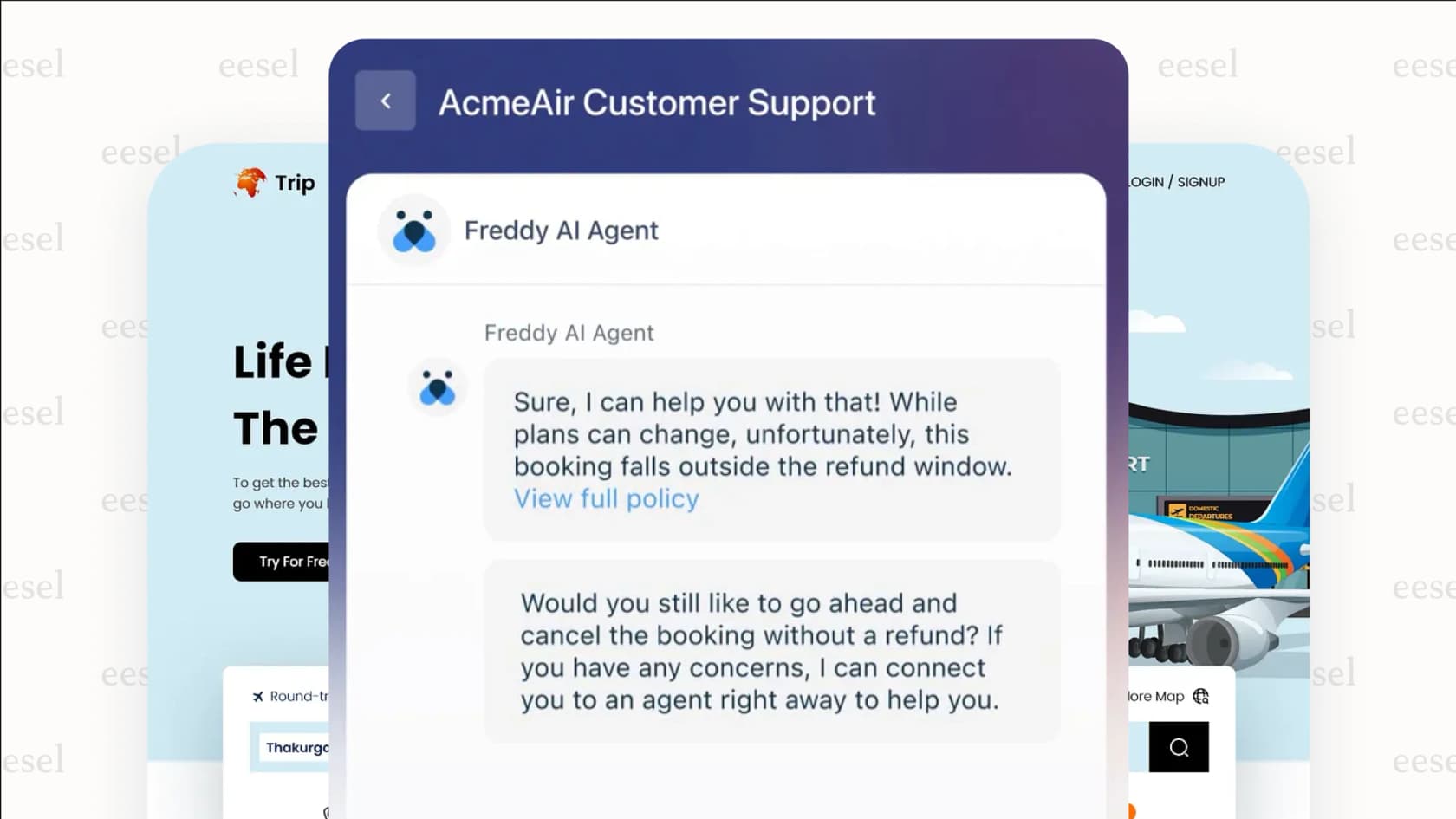
Freddy AI Agent answers customers without an agent, and it's on Growth, Pro and Enterprise. You build and run it in AI Agent Studio, which allows up to 50 AI agents per account across chat and email.
Chat AI agents (Freshdesk Omni)
On Freshdesk Omni you can put Freddy's AI chatbot on your website, WhatsApp, Instagram, Messenger, LINE and other Freshchat channels. It understands natural language, replies in more than 60 languages, and hands over to a person with the full conversation when it needs to. The standalone email-first Freshdesk only offers the Email AI Agent.
Email AI agent
The Email AI Agent works in your support inbox. It reads each new email ticket, writes a reply from your knowledge, and either resolves the ticket or escalates it to a person. You choose which mailboxes, portals and web forms it covers, and you can add a signature, a legal footer and a fallback message for when it can't answer.
Actions and workflows
Freddy does more than answer questions now. Freshworks says on the AI Agent page that vertical AI agents come with 50+ agentic workflows and connect to Shopify, Stripe, PayPal, FedEx and more, so the agent can track an order, process an exchange, reschedule a booking or change a subscription. There is also a Discover tool that analyzes historical tickets to find what's worth automating and where your knowledge has gaps.
What knowledge can Freshdesk AI use?
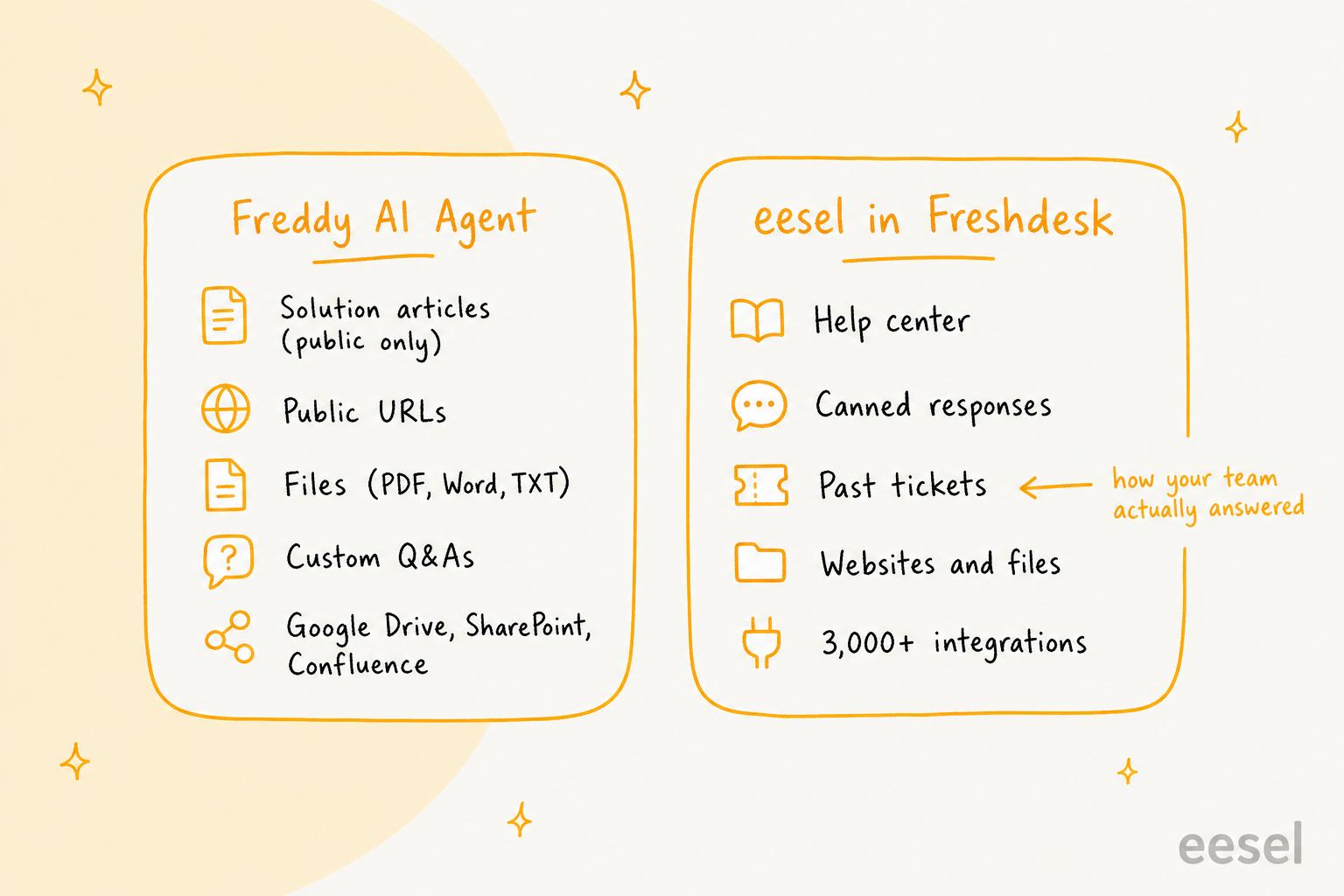
Freddy AI Agent can learn from solution articles, public URLs, uploaded files, custom Q&As and three connected apps: Google Drive, SharePoint and Confluence, per Freshdesk's knowledge sources article. Copilot uses your solution articles by default, and the newer Copilot Agent in AI Agent Studio can add URLs, files and the same three apps. My Freddy knowledge sources post covers each one.
The limits are worth knowing before you plan around them:
- Only solution articles visible to all users are used for learning; private or restricted articles are left out.
- URLs must be public, with up to 10 per AI agent, 25 per account and up to 3,000 pages per site. Files are PDF, Word or text, up to 200 files of 35 MB each.
- Google Drive connects shared drives (up to 100), and text inside tables and images isn't indexed.
- The Confluence connector needs the Merge app from the Atlassian Marketplace, and public Confluence spaces can't be indexed or searched yet. My Freshdesk and Confluence guide has the workarounds.
The outside sources in Copilot arrive through the newer Copilot Agent, which Freshworks is rolling out feature by feature, so not every account has them yet. That matches what one G2 reviewer wrote in October 2026:
"I also think Freddy AI within the ticketing system has room for improvement. It would be much more useful if it could access and reference information from websites and knowledge sources provided by the company, similar to how the AI agent on the website works."
Past tickets are not on the list of knowledge types the AI agent answers from. Freddy uses your ticket history for auto triage, the Similar Ticket Suggester and Discover, but the answers it sends come from articles, pages, files and Q&As. This is the gap I see most often on eesel's side: a team's best answers usually live in resolved tickets, not in the help center. eesel learns from your help center, canned responses and past tickets in Freshdesk, and from 3,000+ other integrations. Qontro, for example, runs eesel on Freshdesk with 9,800 past tickets and help articles behind it, and in one month (August to September 2026) eesel drafted replies on about 190 of its tickets.
How do you test Freshdesk AI before it goes live?
Freshdesk gives you two ways to test. AI Agent Studio has a Test step for trying responses on realistic questions before you deploy, and the Email AI Agent has a shadow mode where it drafts a reply as a private note on each new ticket and never emails the customer. Your agents can use, edit or ignore those drafts.
The catch with shadow mode is timing. Freshdesk's article says only tickets received after you turn on shadow mode are processed; existing tickets aren't. So you learn how good the agent is at the speed your inbox fills, which can take weeks for a low-volume queue. A Freshdesk sandbox on Enterprise helps with configuration, but not with answer quality on real questions.
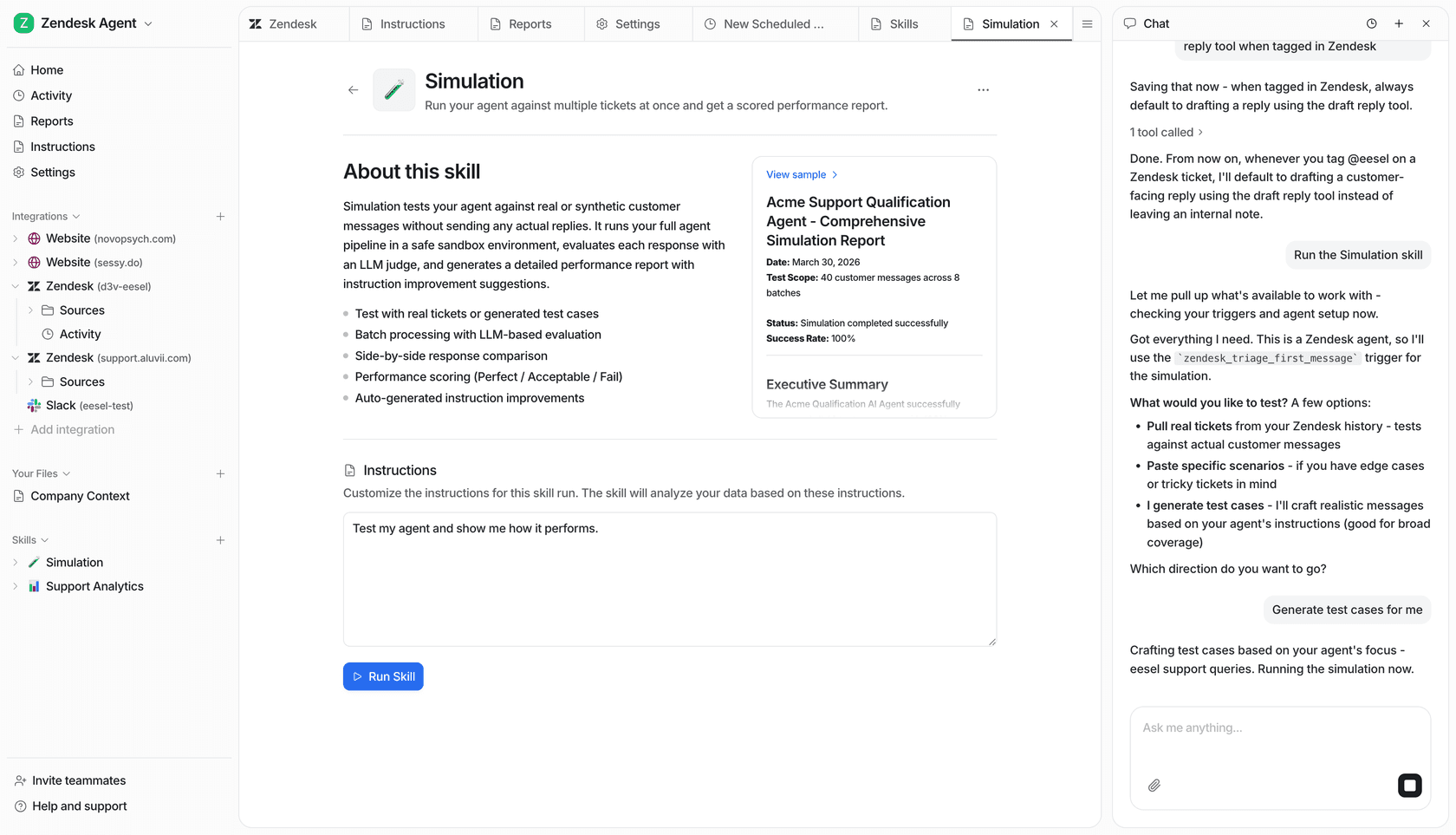
eesel tests the other way round. Its simulation replays your past tickets and scores each answer against the reply your team actually sent, so you see where the gaps are before a single customer gets an AI reply. My comparison of eesel and Freddy shows how the two rollouts differ.
What does Freddy AI Insights do?
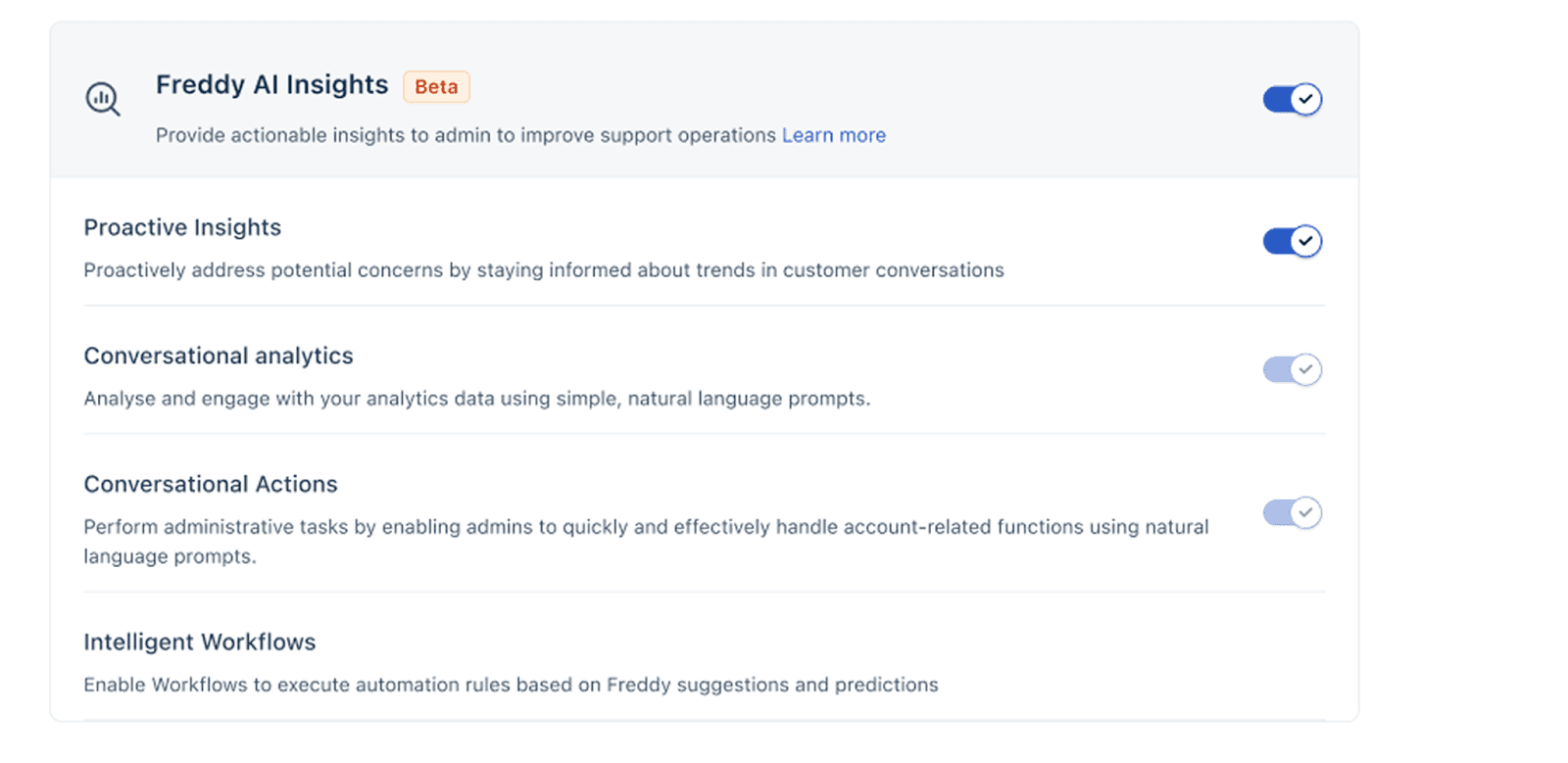
Freddy AI Insights is the manager's feature, and it's only on the Freshdesk and Freshdesk Omni Enterprise plans, per Freshworks' Insights FAQ. It has two parts:
- Proactive insights: flags trends and outliers on its own, such as a sudden drop in resolved tickets or a spike in SLA violations for one group, with the likely causes.
- Conversational analytics: you ask a reporting question in plain language and get the chart back.
Insights is English-only for now, and its reports can't be exported, according to the same FAQ.
How much do Freshdesk AI features cost?
Freddy AI Agent is included on every paid plan with 500 sessions once per account, then $49 per 100 sessions; Copilot is $29 per agent a month on Pro and Enterprise. Here's how the AI fits into Freshdesk's plans, from the pricing page (annual billing):
| Plan | Price | Freddy AI Agent | Freddy AI Copilot | Freddy AI Insights |
|---|---|---|---|---|
| Free Program | $0 for 6 months, 2 agents | Not included | Not included | Not included |
| Growth | $19/agent/month | First 500 sessions, then $49 per 100 | Not offered | Not included |
| Pro | $55/agent/month | First 500 sessions, then $49 per 100 | +$29/agent/month | Not included |
| Enterprise | $89/agent/month | First 500 sessions, then $49 per 100 | +$29/agent/month | Included |
Prices are from Freshdesk's pricing page in November 2026. The Free Program terms are from Freshdesk's plans article.
A few details change the bill:
- Sessions. An Email AI Agent session is a 72-hour window from the customer's first email, however many replies the AI sends in it. A Chat AI Agent session is 24 hours. My session consumption post explains how to track them.
- Copilot seats. You don't have to buy Copilot for every agent; you assign licenses to the agents you choose, and day passes don't include Copilot.
- Other add-ons. MCP actions cost $15 per 1,000 and connector app tasks $80 per 5,000.
- Freshdesk Omni costs more per seat ($29, $79 and $119 a month on Growth, Pro and Enterprise) with the same AI add-on prices. See Freshdesk Omni pricing.
A worked example: 10 agents on Pro, Copilot for all 10, and the Email AI Agent handling 1,000 email conversations a month once the free 500 are gone. That's $550 for seats, $290 for Copilot and $490 for ten session packs, so $1,330 a month, of which $780 is AI. My Freddy AI pricing post runs more team sizes.
eesel prices differently. Its pricing page starts at $299 a month for 500 credits, where one credit is one ticket or chat, and no per-seat fee. The same 1,000 tickets a month is $499, with extra credits at $0.80 each up to a cap you set. The units aren't identical (a Freddy session is one conversation window, an eesel credit is one ticket or chat), but they're close enough to compare for an email queue.
Try eesel next to Freddy in Freshdesk
Freddy is a solid choice if you want everything native: a small Growth team can try the Email AI Agent on the 500 free sessions, and at 300 conversations a month the packs after that cost $147, while Copilot's summaries and writing help are worth $29 for agents who live in the ticket view. Where I'd add eesel is when your best answers sit in years of resolved tickets, or when you want to know how the AI will do before any customer sees it.
eesel joins Freshdesk like a teammate with its own seat. You connect it with your subdomain and an API key, with no app to install, and it reads your help center, canned responses and past tickets. Then it drafts replies as private notes for your agents, or answers the routine tickets itself, depending on the rules you give it. Timengo had it prepare about 300 Freshdesk tickets in a month (August to September 2026), working from 5,300 past tickets and help center articles, and Innr gets drafts in the customer's own language, whether Dutch, German, English or French.
Run the simulation on your own past tickets first, then turn on drafts for one group. Try eesel with a free 7-day trial and 100 credits, no card needed.
Frequently asked questions
What are the core Freshdesk AI features?
Freshdesk AI is Freddy AI, sold in three parts: Freddy AI Agent answers customers by email (and by chat on Freshdesk Omni), Freddy AI Copilot helps agents with summaries, reply suggestions, writing and triage, and Freddy AI Insights spots trends for managers. My Freddy AI Copilot guide goes deeper on the agent side.
Which Freshdesk plan includes Freddy AI?
Growth, Pro and Enterprise all include Freddy AI Agent with 500 sessions once per account. Copilot is a $29 per agent add-on on Pro and Enterprise only, and Insights comes with Enterprise. The Free Program has no Freddy features. See my Freshdesk pricing breakdown.
How much does Freddy AI cost in Freshdesk?
After the first 500 sessions, Freddy AI Agent costs $49 per pack of 100 sessions, and Copilot costs $29 per agent a month billed annually. An email session covers 72 hours of replies from the customer's first email. My Freddy AI pricing post works through more bills.
Can Freshdesk AI help my agents write replies faster?
Yes. Freddy AI Copilot suggests replies, canned responses and solution articles, summarizes long threads, and its Writing Assistant rephrases, expands or changes the formality of a draft. eesel can also draft Freshdesk replies as private notes from your past tickets.
Can Freddy AI use knowledge from Confluence or Google Drive?
Yes. AI Agent Studio connects Google Drive shared drives, SharePoint sites and Confluence spaces as knowledge sources, alongside public solution articles, public URLs, files and custom Q&As. Confluence needs the Merge app, and public Confluence spaces can't be indexed yet. More in Freddy AI knowledge sources.
How do I test Freshdesk AI before customers see it?
Use the Test step in AI Agent Studio, then deploy the Email AI Agent in shadow mode, where it writes private notes on new tickets and never emails customers. Shadow mode only sees tickets that arrive after you turn it on, so for a check against old tickets eesel's simulation on past tickets is the faster route.
What is a good alternative to Freddy AI for Freshdesk?
If you want an AI that learns from your past Freshdesk tickets and costs the same however many agents you have, eesel works inside Freshdesk from $299 a month for 500 credits. My Freshdesk AI alternatives list compares the options.