Freshdesk vs Gorgias: pricing, AI, and who each one fits

Kurnia Kharisma Agung Samiadjie

Katelin Teen
Last edited July 31, 2026
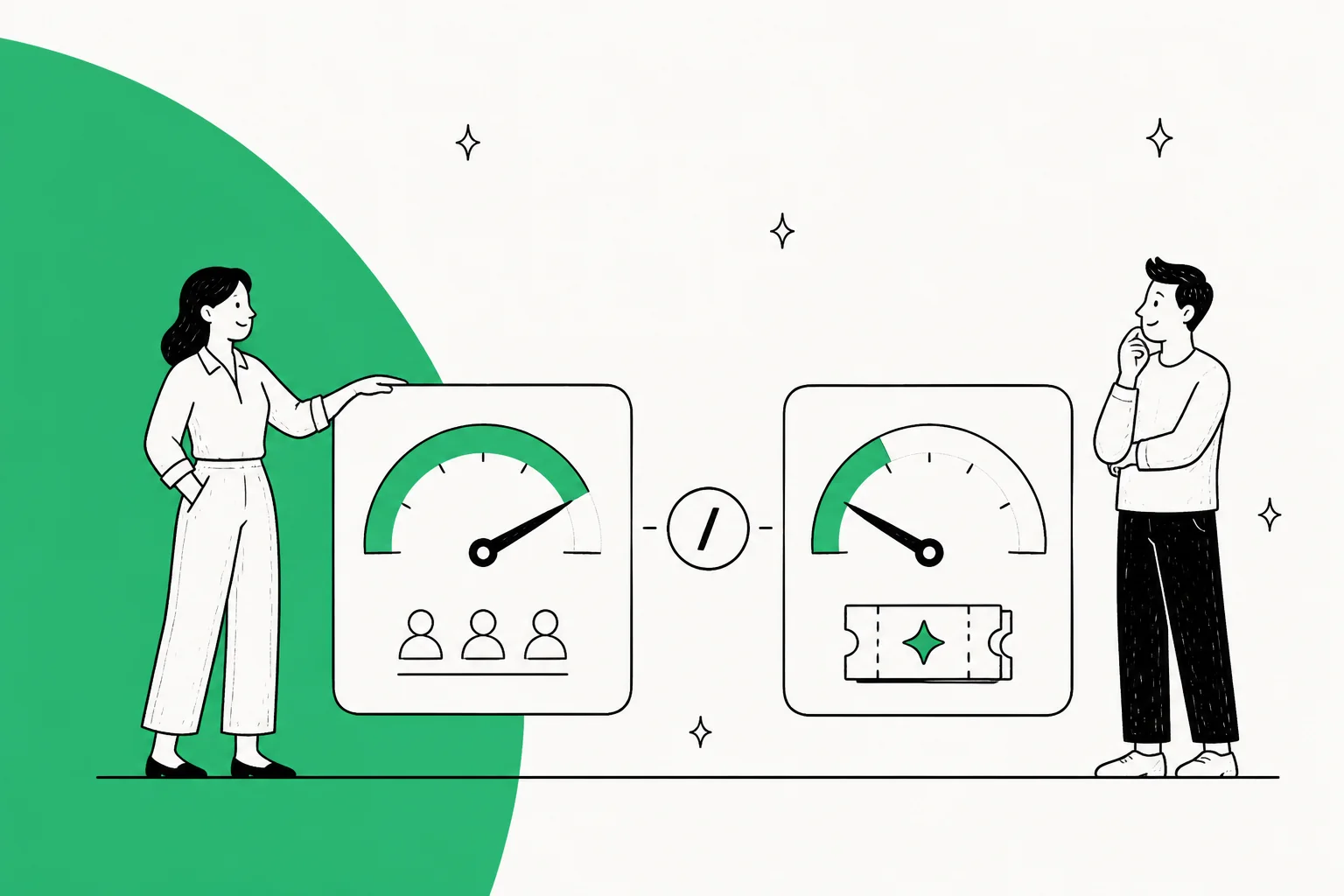
Freshdesk vs Gorgias at a glance
| Freshdesk | Gorgias | |
|---|---|---|
| Billing unit | Per agent seat | Per ticket volume |
| Entry price | $19/agent/mo (Growth, annual) | $40/mo (Starter, monthly only) |
| Mid tier | $55/agent/mo (Pro) | $471/mo annual (Pro, 2,000 tickets) |
| Top self-serve tier | $89/agent/mo (Enterprise) | $1,227/mo annual (Advanced, 5,000 tickets) |
| Seats included | Billed individually | 3 on Starter, 500 on every other plan |
| Customer-facing AI | Freddy AI Agent, first 500 sessions free, then $49/100 | AI Agent bundled on every plan, $1.50 per interaction past bundle |
| Agent-side AI | Freddy AI Copilot, $29/agent/mo, Pro and Enterprise only | AI coaching included |
| Ticket overage | Not applicable | $0.40 (Starter, Basic), $0.36 (Pro, Advanced) |
| Ecommerce depth | Marketplace app, 3.0/5 from 61 reviews | Native Shopify, BigCommerce, WooCommerce, Magento |
| Integrations | Freshworks Marketplace | 254 apps |
| API rate limit | Tier-dependent | 2 req/sec self-serve, 4 req/sec Enterprise |
| Audit logs | Enterprise-oriented | Pro and Advanced only |
| Voice / SMS | Freshcaller, separate SKU | Add-ons from $25/mo and $17/mo |
| G2 rating | 4.4/5, ~3,750 reviews | 4.6/5, 560 reviews |
| Best for | Email-first teams, small headcount, non-ecommerce | Shopify brands where tickets need store actions |
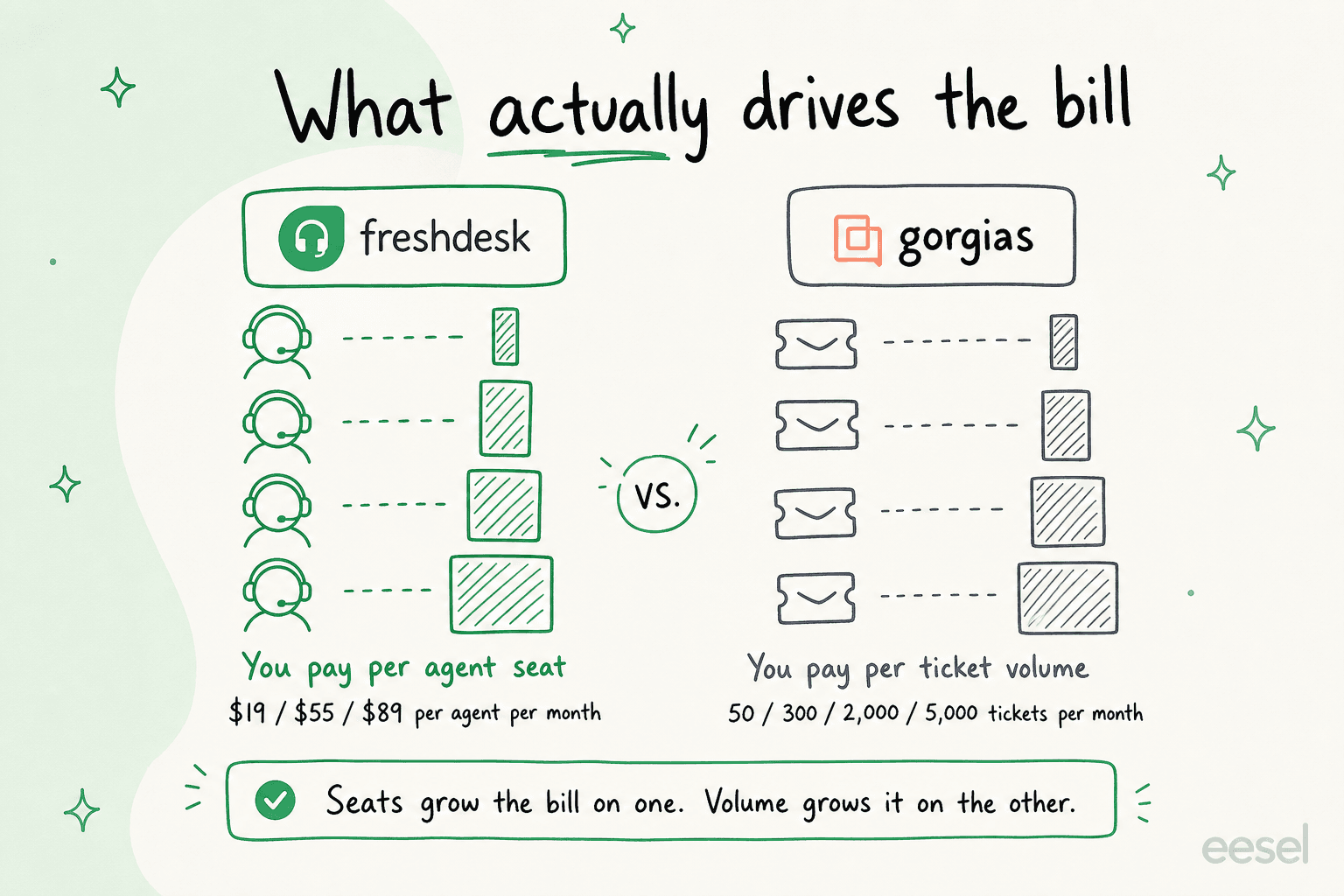
I have spent the last few years watching AI go live on real support queues, and one pattern keeps repeating: nobody loses money on the tool they picked, they lose it on the meter they did not read. Which is why this comparison starts with pricing mechanics instead of a feature checklist. Features do matter, and I get to them further down, but they rarely decide the invoice.
What Freshdesk actually is
Freshdesk is Freshworks' help desk, and it began life as a shared inbox. That origin still shows through. Incoming email turns into a threaded ticket, gets routed, picks up an SLA on the way, and that is still the shape of the Freshdesk ticketing system today. Freshworks says it is used by 74,000+ businesses, with Pearson, Bridgestone, and Decathlon on the logo wall.
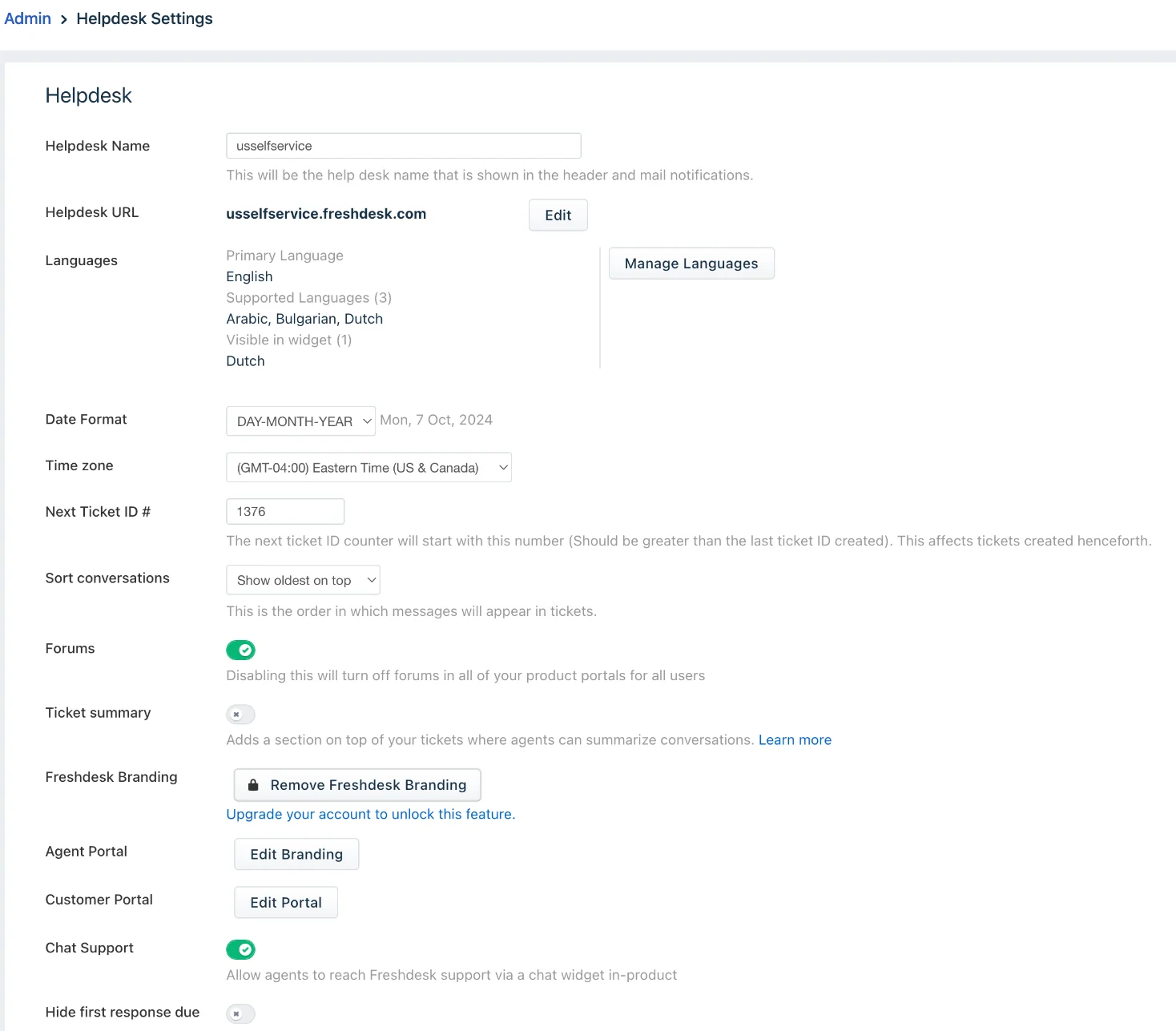
What surprises people arriving from a slicker product is how much of Freshdesk is configuration. Ticket fields, SLA policies, automation rules, skill-based routing, roles and permissions: all of it lives in admin screens like the one above. Strength, if you want the ticket lifecycle bent around your process. A cost, if what you wanted was something running by Friday.
The AI carries the Freddy brand, and it splits into three separate products that are very easy to conflate:
- Freddy AI Agent is the customer-facing one, the deflection bot. A dedicated Email AI Agent handles inbound support mail, and you build it no-code inside AI Agent Studio.
- Freddy AI Copilot is the agent-side helper: reply suggestions, summaries, tone rewriting, live translation. Per-seat add-on, this one.
- Freddy AI Insights is the leader-side analytics layer, and it turns up on Enterprise only.
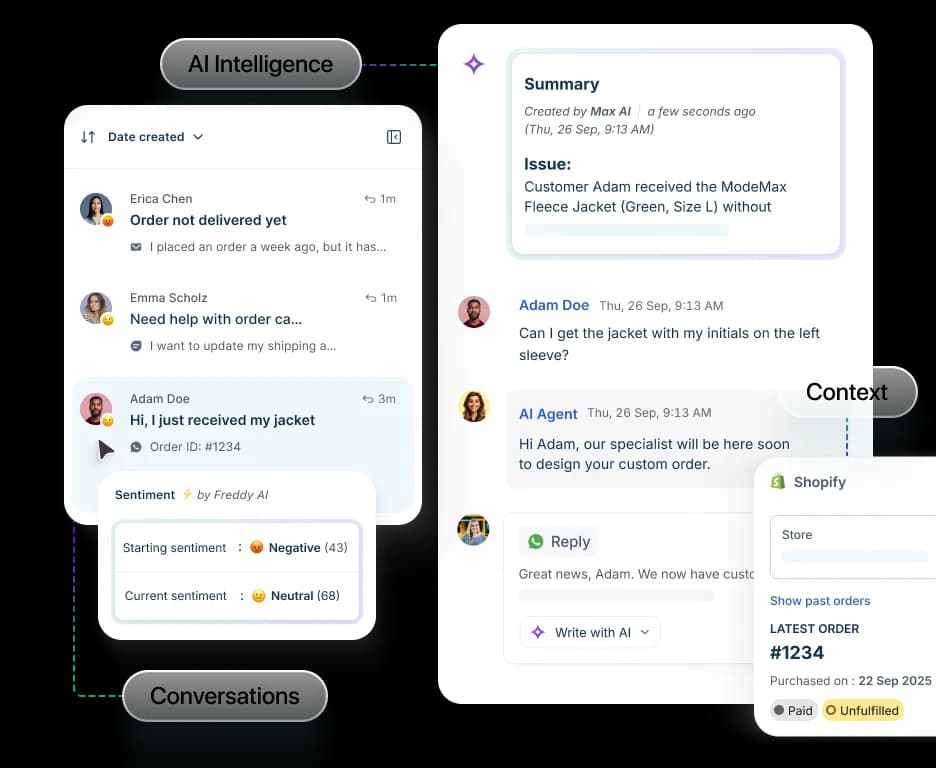
In its Customer Service Benchmark Report 2025, Freshworks quotes up to 80% resolutions with Freddy AI Agent. Treat that as a vendor claim rather than an independent benchmark. I say that as someone who has watched plenty of confident-sounding bots fall over on ticket 40.
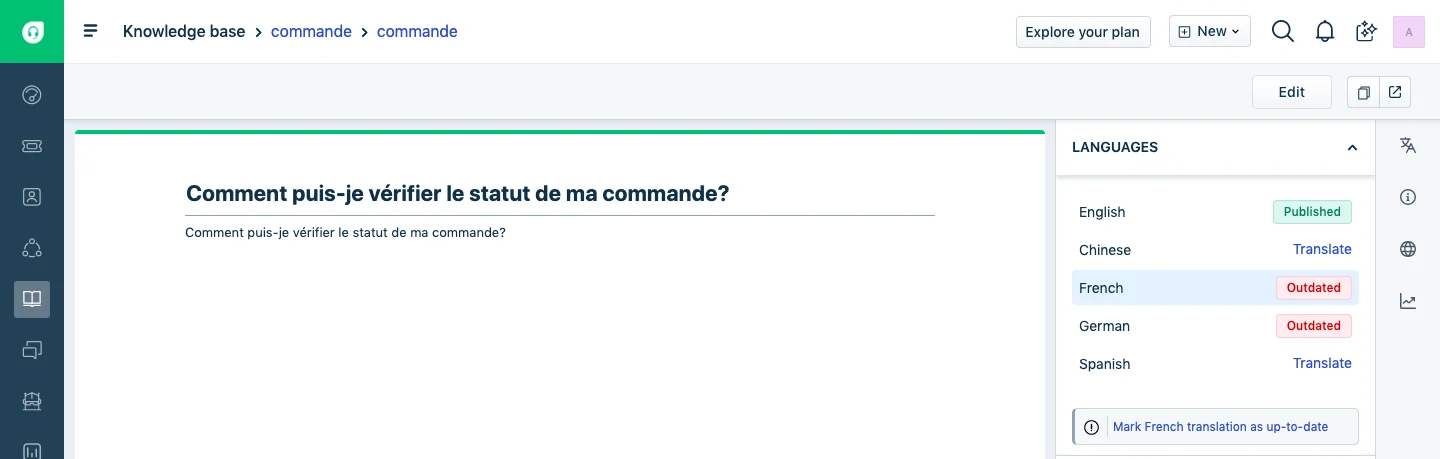
Freshdesk is quietly strong on the unglamorous stuff. Multilingual knowledge base handling, for one. The article editor keeps track of which translations have gone out of date, instead of quietly serving somebody a stale German version.
Where it falls down: the ecommerce story. On the Freshworks Marketplace the Freshdesk Shopify app sits at 3.0 out of 5 from 61 reviews. Not a disaster. It is a marketplace connector doing marketplace-connector things, which is a different class of thing from a native integration. Freshdesk itself holds 4.4 out of 5 from around 3,750 G2 reviews, and that is a strong score for a product deployed this widely.
What Gorgias actually is
Gorgias is an ecommerce helpdesk. Not a general helpdesk with a Shopify app bolted to the side of it, an ecommerce helpdesk. Orders, customers and store data all live inside it natively through the Gorgias Shopify integration, so an agent can cancel, refund, discount, or edit an order without ever leaving the ticket. Gorgias says it powers conversations for 40% of Shopify brands, and labels its Pro plan as used by 12,400+ brands.
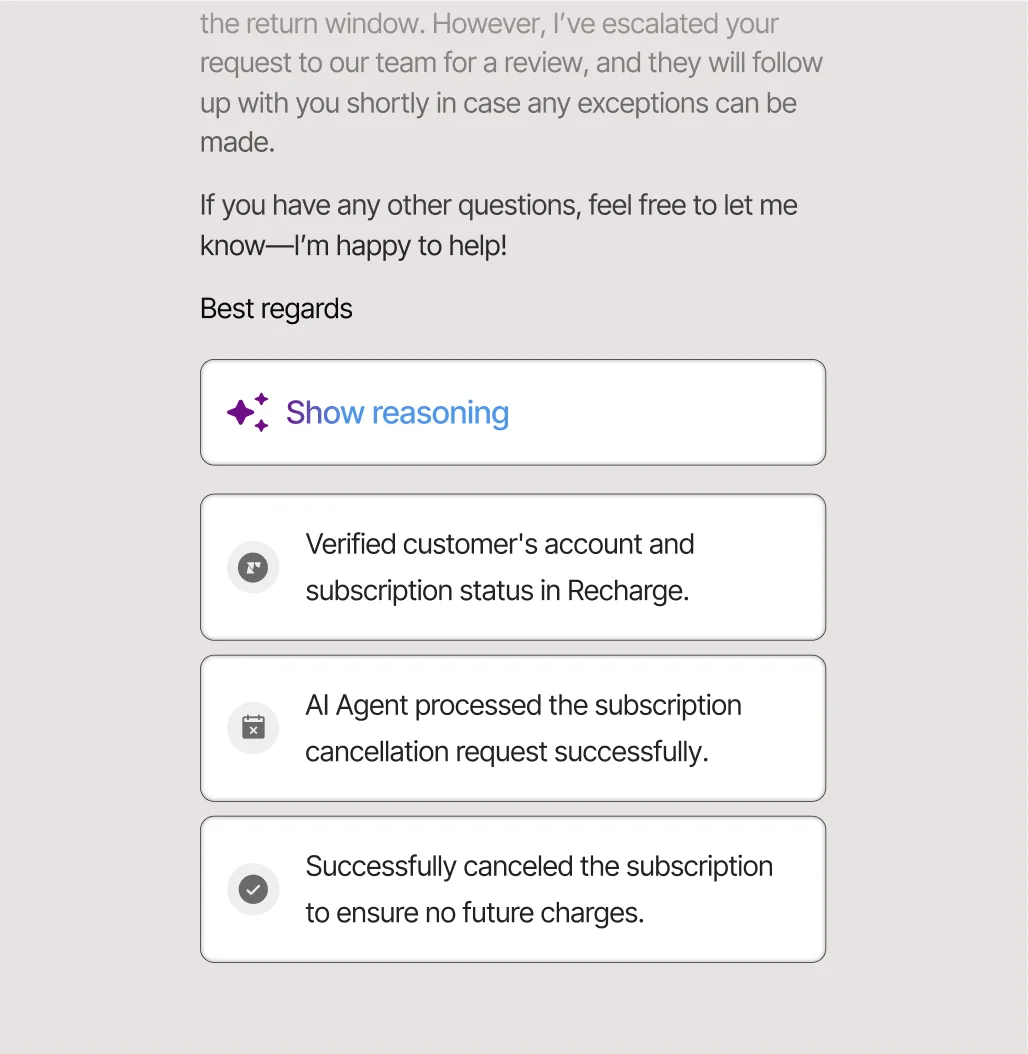
That screenshot is the entire pitch in one frame. The AI did not simply write a nice paragraph about the return window. It verified the subscription in Recharge, processed the cancellation, then logged every step under "Show reasoning". A general helpdesk with a chatbot bolted on writes the paragraph, and after that it creates a task so a human can go do the work.
The Gorgias AI Agent comes pre-trained on ecommerce conversations, and you configure it with tone, policies and guidance rules instead of a flowchart. Then on the deterministic side there is Gorgias Rules, which handles the repetitive patterns. It has a live preview too, so you see the customer-facing message before you switch anything on.
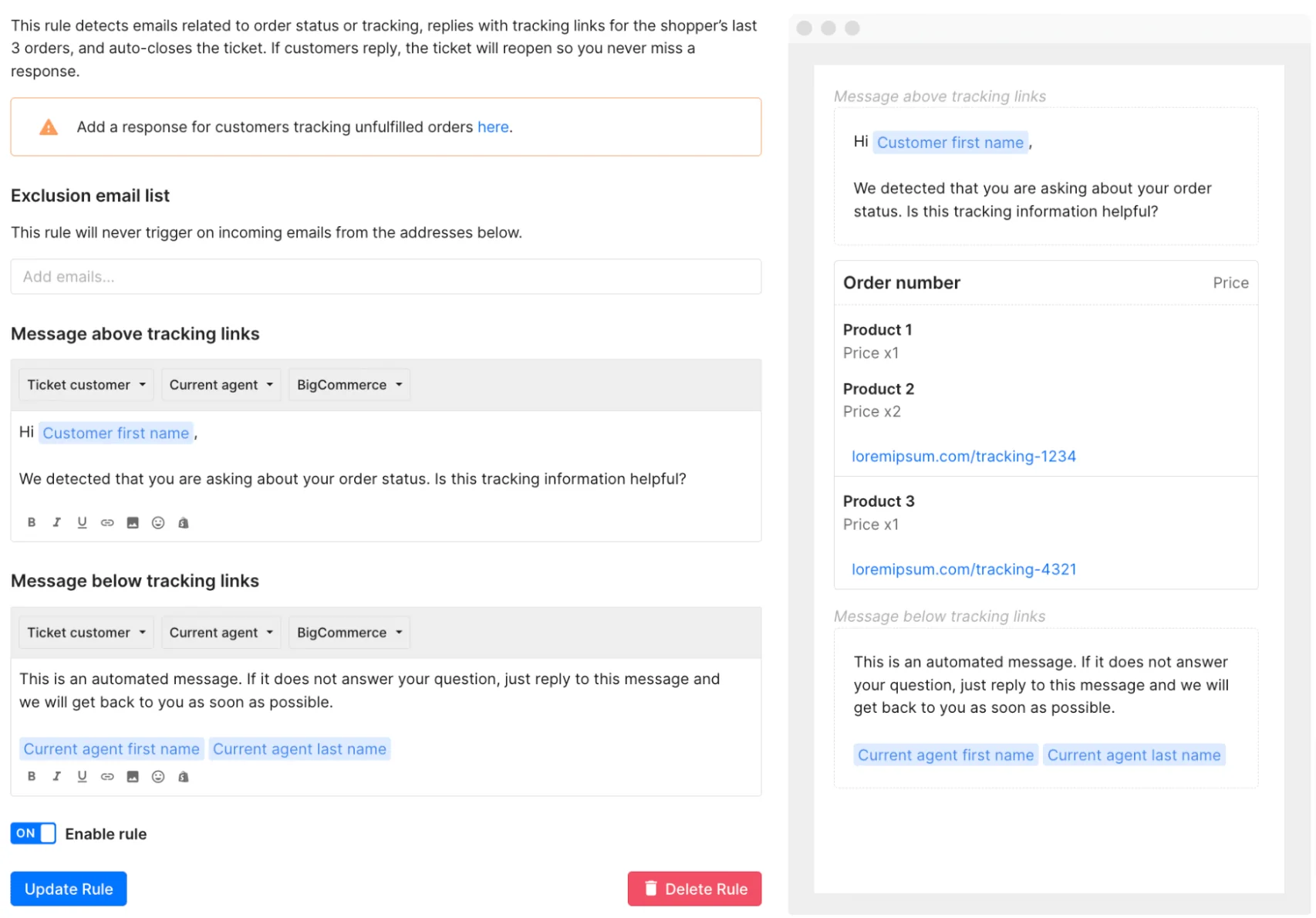
The AI can take real actions and automated tasks as well, not only draft text. There is also a customer-facing order management portal, and that is the piece that actually moves your WISMO numbers. Shoppers check status and report an issue on their own, instead of opening a ticket you then get to pay for. Cheapest kind of ticket deflection there is.
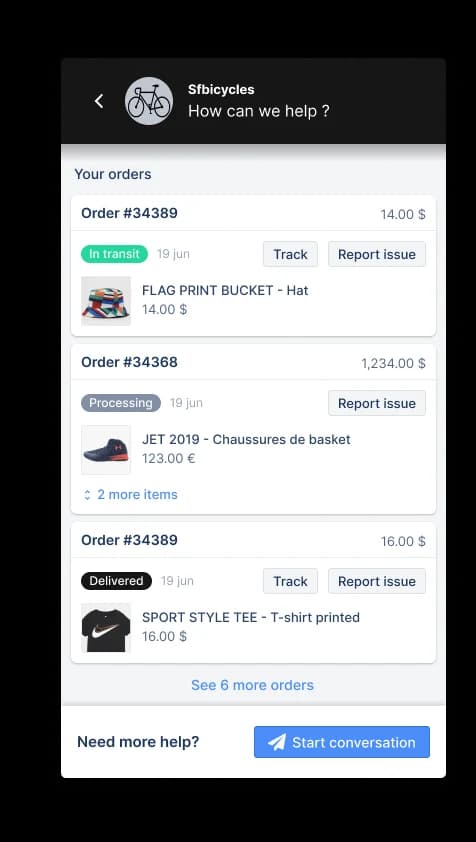
Where it falls down: it is narrow on purpose. Are you a B2B SaaS company, an IT team, or anyone whose tickets are not attached to an order? Then most of what you are paying for is scenery. Gorgias also caps the self-serve API at 2 requests per second on every published plan, with 4 req/sec held back for Enterprise, which gets tight if you were planning to build much on the Gorgias API. Audit logs, Pro and Advanced only. On G2 it holds 4.6 out of 5 from 560 reviews, a higher score than Freshdesk on a much smaller sample.
The pricing tables, in full
Both vendors publish real numbers, so here they are, captured on 2026-07-27. Deeper tier-by-tier breakdowns live in my Freshdesk pricing and Gorgias plans comparison posts.
Freshdesk, standalone SKU, annual billing:
| Plan | Price | Freddy AI Agent | Freddy AI Copilot | Day passes |
|---|---|---|---|---|
| Growth | $19/agent/mo | First 500 sessions, then $49/100 | Not offered | $2/pass |
| Pro | $55/agent/mo | First 500 sessions, then $49/100 | $29/agent/mo | $7/pass |
| Enterprise | $89/agent/mo | First 500 sessions, then $49/100 | $29/agent/mo | $12/pass |
Connector app tasks run $80 per 5,000 on all three tiers. One thing to watch: Freshworks also sells a separate Freshdesk Omni suite at different prices, so do not go mixing the two number sets while you budget.
Gorgias, all tiers:
| Plan | Monthly | Annual (per month) | Tickets/mo | Automated interactions | Ticket overage | AI overage |
|---|---|---|---|---|---|---|
| Starter | $40 | Monthly only | 50 | 30 | $0.40 | $1.50 |
| Basic | $90 | $77 | 300 | 30 | $0.40 | $1.50 |
| Pro | $550 | $471 | 2,000 | 190 | $0.36 | $1.50 |
| Advanced | $1,430 | $1,227 | 5,000 | 530 | $0.36 | $1.50 |
| Enterprise | Custom | Custom | 5,000+ | Custom | Custom | Custom |
Two things are worth flagging before you take those numbers as gospel. First, Starter is a demo tier, not a plan: 50 tickets, 3 seats, monthly billing only, and no brand voice, guardrails, or AI actions. Real capability begins at Basic. The second one is subtler. That helpdesk and AI split Gorgias prints under each card sums to the annual rate, not the monthly one, so "$300/mo Helpdesk" on Pro is not what you actually pay month to month.
Where the cheaper option flips
Here is the part most comparisons skip over. The two bill on different axes, so neither one is universally cheaper, and the winner flips in both directions depending on where you happen to sit.
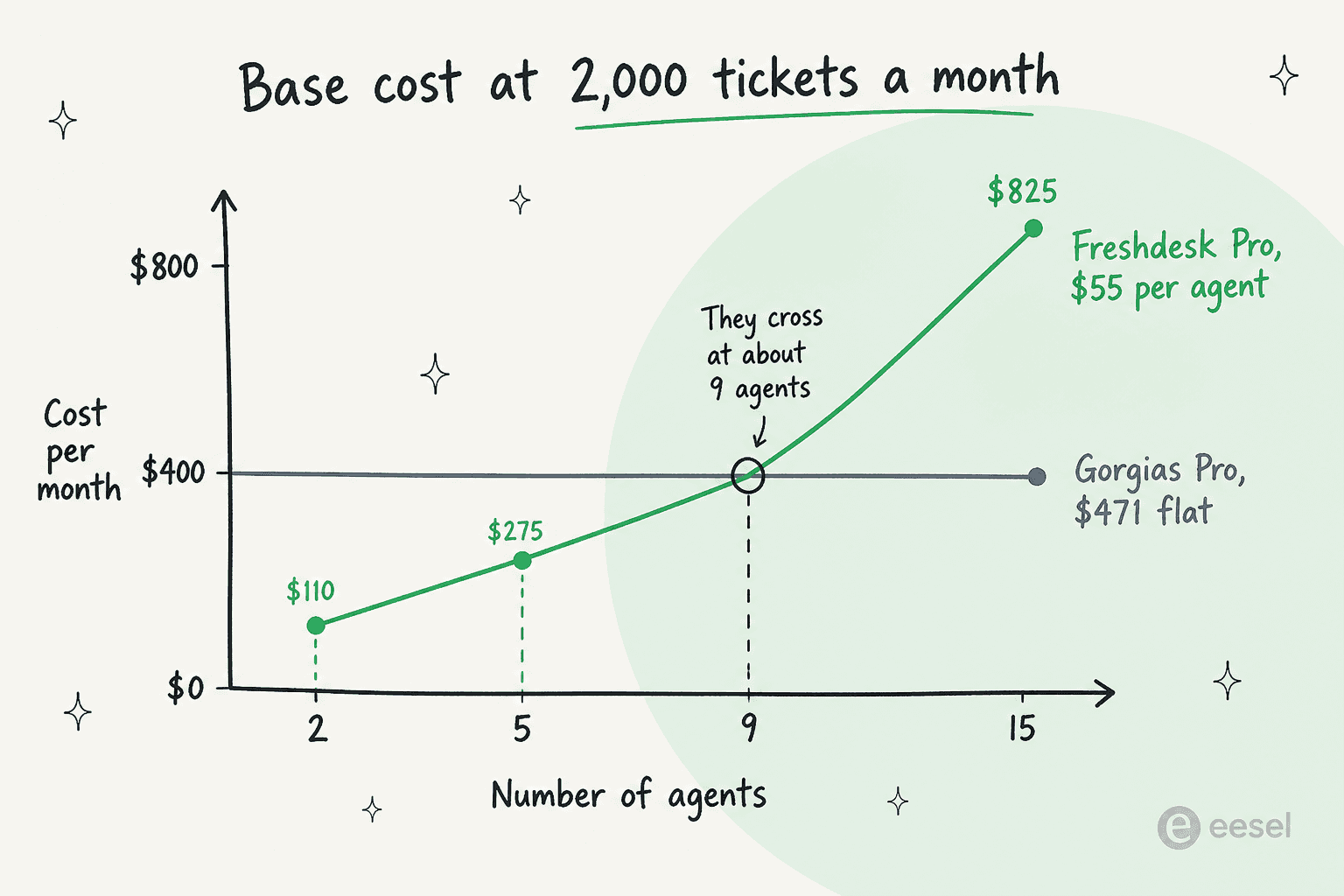
At 2,000 tickets a month, Freshdesk Pro runs $110 for two agents, $275 for five, $825 for fifteen. Gorgias Pro stays at $471 whether you have three agents or three hundred, since seats are capped at 500 and never billed. The lines cross at about nine agents. Above roughly nine agents at that volume, the tool everybody calls expensive is the cheaper one.
Move the ticket volume around and it flips back the other way. Pick your own square:
Which one is cheaper for you?
Helpdesk base cost only, annual billing, AI billed separately.
Gorgias, by $88 a month
Freshdesk Pro: $165Gorgias Basic: $77
Low volume plus a small team is the one square where Gorgias is the budget option.
Freshdesk, by $306 a month
Freshdesk Pro: $165Gorgias Pro: $471
Three agents handling 2,000 tickets means heavy automation already. You pay Gorgias for volume you have three people to cover.
Freshdesk, by $1,062 a month
Freshdesk Pro: $165Gorgias Advanced: $1,227
The widest gap on the grid. At this ratio the volume meter punishes you hard.
Gorgias, by $363 a month
Freshdesk Pro: $440Gorgias Basic: $77
Eight agents on 300 tickets is a high-touch, low-volume queue. Seats are what is costing you.
Freshdesk, by $31 a month
Freshdesk Pro: $440Gorgias Pro: $471
Close enough that price should not decide it. Pick on whether your tickets need store actions.
Freshdesk, by $787 a month
Freshdesk Pro: $440Gorgias Advanced: $1,227
Advanced is a big step up from Pro. Check whether deflection can hold you under 2,000 billable tickets first.
Gorgias, by $748 a month
Freshdesk Pro: $825Gorgias Basic: $77
Fifteen agents on 300 tickets is unusual, but it shows the mechanic cleanly: seats are free on one side.
Gorgias, by $354 a month
Freshdesk Pro: $825Gorgias Pro: $471
Past the nine-agent crossover. This is the square that surprises people who priced Gorgias two years ago.
Freshdesk, by $402 a month
Freshdesk Pro: $825Gorgias Advanced: $1,227
Big team, big volume: Freshdesk edges it on base cost, and the AI meters below will decide the rest.
Two honest caveats on that grid. It shows helpdesk base cost only, annual billing, AI excluded, and it assumes you buy the cheapest Gorgias plan that covers your volume instead of paying overage on a smaller one. That overage route is almost always the worse deal: at 2,000 tickets, Basic plus 1,700 tickets at $0.40 comes to $757, against $471 for Pro.
The AI bill is a second meter
Now the part that actually moves invoices. Both vendors meter AI separately from the helpdesk, and the thing they are measuring is not the same thing.
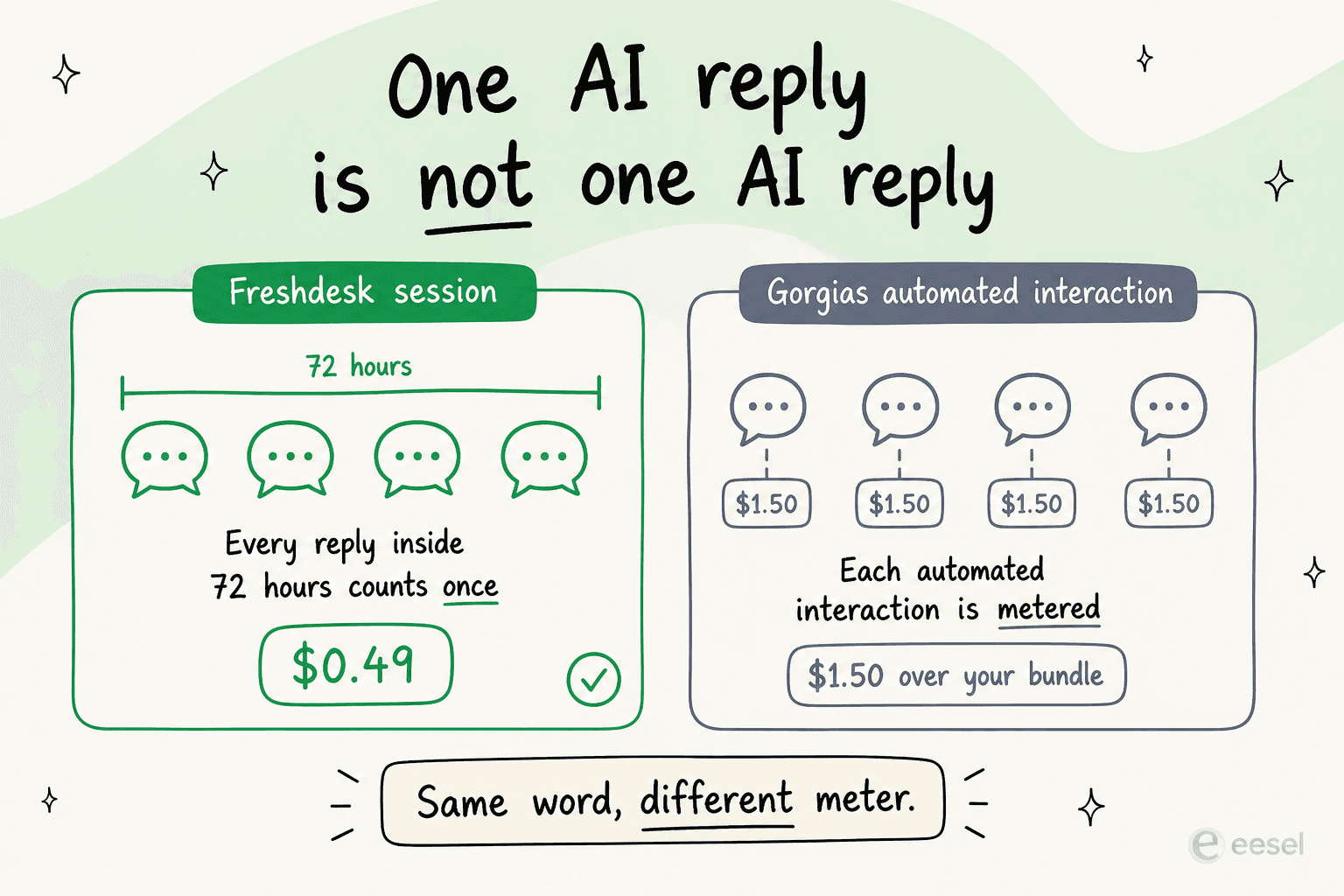
A Freshdesk Email AI Agent session is a 72-hour window that starts from the customer's first email, and every AI reply inside that window still counts as the one session. You get 500 free, once per account, and after that it is $49 per 100, so $0.49 a session. Generous unit, that. A three-email back-and-forth resolved inside three days costs you the same as a one-liner.
On the Gorgias side the metered unit printed on every plan card is the automated interaction, and past your bundle it costs $1.50. Worth noticing: the Gorgias pricing headline says you pay "only when it resolves a conversation," but the unit printed on the cards is the interaction, not the resolution. Those are not the same word. Work it out from Gorgias's own figures and the bundled effective rate lands at $1.00 on Starter, $0.90 on Basic, Pro and Advanced, so overage runs roughly 1.5 to 1.7 times what the same interaction costs inside your bundle. A spike month gets punished twice.
There is an AI floor underneath all this too. The AI component sits baked into the plan price ($30 on Starter through $477 on Advanced), so you pay for it even in a month where the agent resolves nothing at all.
Freshdesk's agent-side Freddy AI Copilot is its own line item at $29 per agent per month, and on Growth it is not offered at all. For a ten-agent team on Pro, that comes to $290 a month stacked on top of $550 of seats, before a single customer-facing session has been billed.
What teams actually say
The community read on Gorgias has stayed stable for years now. It is not quite "too expensive." It is "expensive unless your tickets need the store."
"I've been around ecommerce for 10+ years and this is honestly how I'd choose: 40%+ tickets need Shopify actions → I'd lean Gorgias. Mostly conversational support → Zendesk is fine."

That 40% line is the best heuristic I have seen anybody offer, and it maps cleanly onto Freshdesk as well. Another operator in the same thread gave the small-team version of it:
"Gorgias starts to make sense when you have a larger team and want everything tightly wired into Shopify. For a single agent (or even 2–3), the pricing jump is hard to justify unless you're really squeezing value out of those workflows."
Over on the Freshdesk side, people like the helpdesk and save the complaints for the AI. The recurring theme: Freddy is fine on simple tickets, and struggles the moment you go past that:
"We tested an ai integration in freshdesk and had almost the exact same experience. it worked for very simple tickets but anything slightly complex got misclassified. agents ended up spending more time fixing errors than before, so we had to rethink our approach."
That last line is the one to sit with for a minute. An AI that is wrong is more expensive than no AI, because now a human has to go find the mistake and undo it. Same failure mode I wrote about in my guide to AI hallucinations in support, and it is why I do not trust an AI resolution rate that shows up without a confidence threshold beside it. The other half of the problem is handoff: a bot that escalates cleanly costs far less than one that guesses.
When the Gorgias automation is working, though, the numbers are real. Orthofeet's customer service lead is on record with a specific one:
"When we first started with Gorgias, our goal was to hit 30% automation in 30 days. We surpassed that and are now above 50% automation, and we're still climbing."
Courtney Bajek, Customer Service Lead at Orthofeet, Gorgias customer story
The option neither vendor puts on the pricing page
Here is what I keep running into on sales calls. It is also the reason this comparison usually ends up with a third answer.
Teams do not actually want to migrate helpdesks. What they want is for the AI to be better. A CX lead at a DTC supplements brand running Gorgias plus Shopify, somewhere around 7,000 tickets and 30,000 orders a month, put the requirement about as precisely as anyone has:
"The AI will never be able to answer 100% of the questions, but if it tries and just answers 'sorry I don't know this,' I cannot go and check all my 7,000 tickets to see if the AI actually made a good answer, then the point is a little bit gone. I need an AI who is only handling the tickets that it's confident to handle and all the other ones, leave them alone."
This is not a Gorgias problem, and it is not a Freshdesk problem either. It is what happens when the AI layer is welded onto the helpdesk and you inherit whatever scoping controls the vendor felt like shipping. On the Freshdesk side I have watched the mirror image of it: one customer could not get their existing automation rules to coexist with a new AI rule, and every time they asked Freshdesk support about it, they got steered back toward Freddy.
The alternative is to keep the helpdesk you already pay for and swap out only the AI layer. Which is what eesel does. It connects to Freshdesk and Gorgias, trains on your own historical tickets instead of just the help center, and lets you decide exactly which tickets it is allowed to touch.
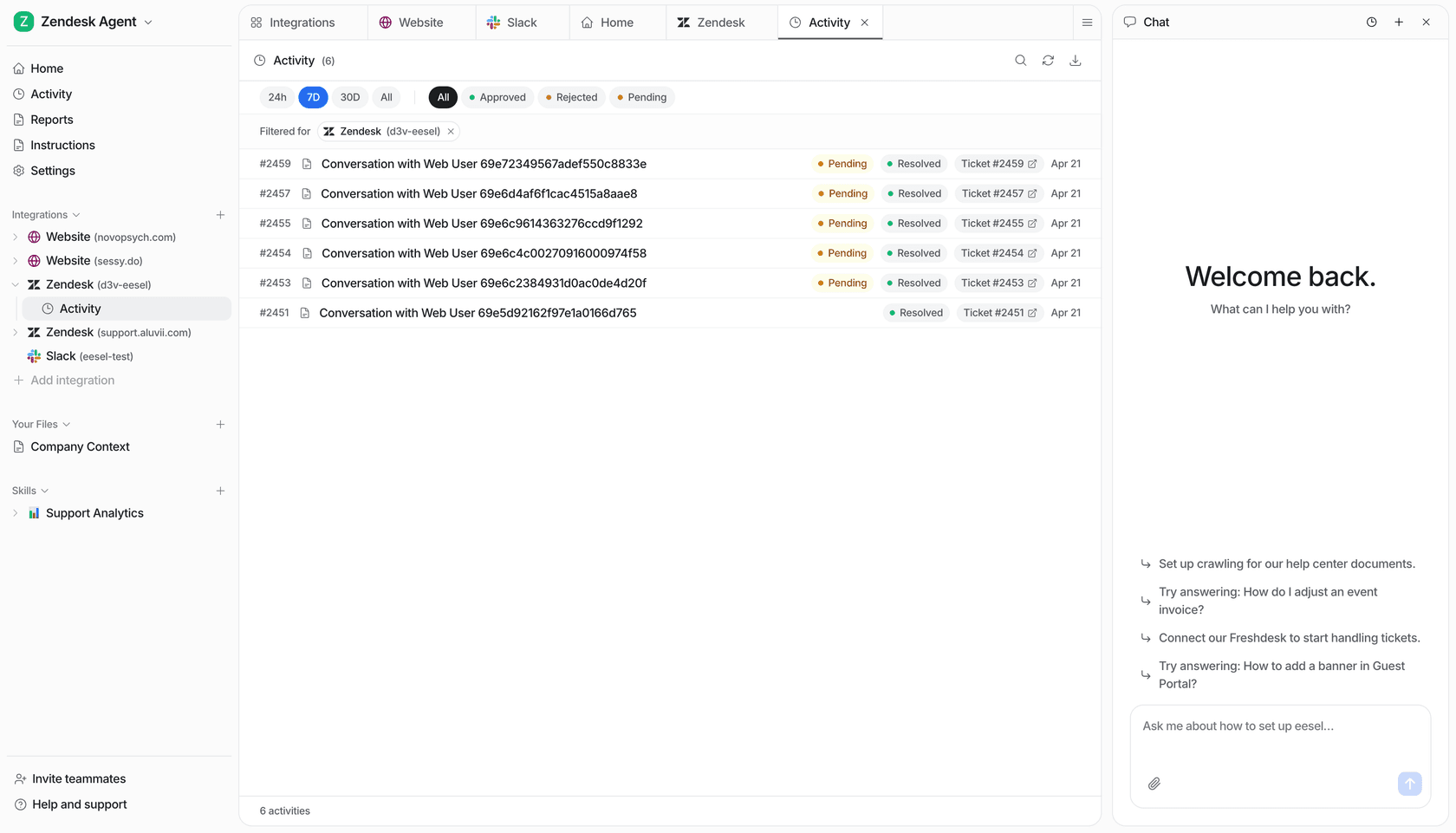
Scoping is the part that matters, and it is the reason every rollout gets simulated against historical tickets before it goes anywhere near a live queue. You get to see what the AI would have said to the last few thousand real tickets, adjust it, and only then let it reply to anybody. As far as I am concerned that order of operations is not optional, because the other way round means discovering the misclassification pattern in production.
Which one I would pick
Pick Gorgias if you are a Shopify, BigCommerce, WooCommerce, or Magento brand and a meaningful slice of your queue needs the store touched: refunds, cancellations, address edits, subscription changes. That 40% heuristic from the Reddit thread holds up well. And if your team is over nine agents at 2,000 tickets a month, run the math before assuming it is the expensive option, because it probably is not.
Pick Freshdesk if your queue is mostly email, your team is small, or you are not in ecommerce at all. The ticketing core is mature, the automation and routing configuration goes deep, and per-seat pricing is cheap while the seat count stays low. Just budget the Copilot add-on and the AI sessions as real line items and not rounding errors, and go in knowing the Shopify connector is a connector.
Pick neither, yet, if the thing pushing you to switch is the AI and not the helpdesk. Migrating a helpdesk is weeks of work, plus a permanent change to how your team operates. Swapping the AI layer takes an afternoon and it is reversible. Try that first. My roundups of the best AI for Freshdesk and best AI for Gorgias cover the field either way, and if you do decide you want out, there are Freshdesk alternatives and Gorgias alternatives worth a look.
Try eesel on Freshdesk or Gorgias
If the helpdesk is fine and the native AI is the thing letting you down, you do not have to pick between these two at all. eesel plugs into Freshdesk or Gorgias in a few minutes, learns from the tickets your team has already answered, and lets you set a confidence threshold so it replies only where it should and leaves everything else alone. And you can simulate the whole thing against your ticket history before anything goes live, so the first customer who meets your AI is not also the first test of it.
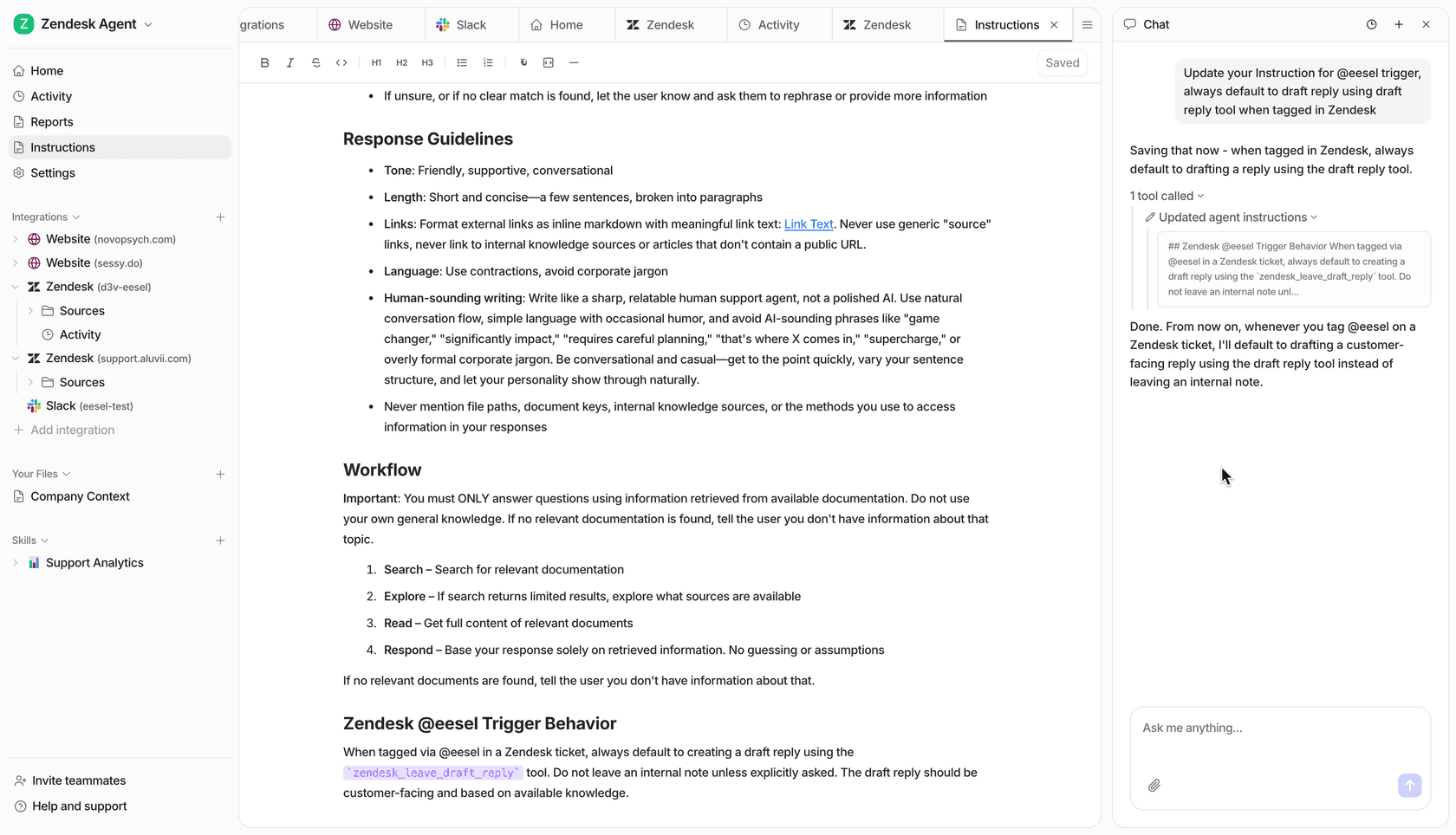
Billing is per ticket handled, not per seat, which means it does not add a third meter shaped exactly like the one you are already trying to escape. Try eesel free, no card, and point it at your existing queue.
Frequently Asked Questions
Is Gorgias more expensive than Freshdesk?
What is the difference between Freshdesk and Gorgias?
How much does Freshdesk AI cost per session?
Does Gorgias charge per resolution or per interaction?
Is Freshdesk good for Shopify stores?
Can I keep my helpdesk and just replace the AI?
Which is better for a small team on a tight budget?



Article by
Kurnia Kharisma Agung Samiadjie
Kurnia is a software engineer and writer at eesel AI with two years of SEO experience, writing about AI tools, helpdesk software, and customer support. He pairs a developer's understanding of how these products are built with search-driven research into what actually ranks and resonates with the people searching for them.