


The AI world moves at a dizzying pace. You finally get your team up to speed on one model, and then something like Claude Opus 4.5 drops, promising to change the game all over again.
It's easy to get lost in the hype and the benchmark scores. What do these updates really mean for your team's daily workflow? Is this just another small step forward, or is it a genuine leap that could change how you work?
This review of Claude Opus 4.5 examines its coding skills, autonomous agent capabilities, limitations, and new pricing structure, exploring its implications for businesses, particularly in customer support.
What is Claude Opus 4.5?
What exactly is Claude Opus 4.5? It is the newest top-tier large language model from Anthropic, which they released in November 2025. Anthropic makes several claims, calling it the "best model in the world for coding, agents, computer use, and enterprise workflows."
This is not just a minor update. The company emphasizes its improved reasoning and its ability to deal with confusing or unclear information. Plus, it is more efficient and less expensive than the previous version, which is beneficial for businesses seeking to use high-end AI cost-effectively.
It is positioned to compete with major models like Google's Gemini 3 Pro and OpenAI's GPT-5.1. You can think of it as an all-rounder that is particularly adept at handling complex, specialized jobs.
Key features and capabilities
Let's get into the nitty-gritty of the new features and what they mean for you, based on official info and what users are saying.
A leading model for coding and development
Opus 4.5 has garnered attention from developers.
It scored 80.9% on the SWE-bench Verified benchmark, which is a challenging test that involves fixing real GitHub issues. This is a significant achievement and indicates its advanced coding capabilities.
Notably, it outperformed every human applicant on Anthropic's own grueling engineering exam. This suggests it can make tough technical calls under pressure, much like a senior developer.
Its capabilities extend beyond code generation. The updated "Plan Mode" in Claude Code lets the model ask questions to clarify what you want and then create an editable "plan.md" file. This helps ensure you get the right output from the get-go.
I think Claude is better when it comes to actual engineering work, and especially if you use the more advanced features, Claude code is just better than Gemini cli

The emergence of autonomous AI agents
Some AI models are challenged by unstructured, real-world business data. For example, a test from Nate's Newsletter showed Opus 4.5 could match a typed shipping manifest with an unstructured, handwritten tally sheet. This is a task that requires a strong understanding of unstructured information.
Opus 4.5 also performs well on tasks that take a while and require it to think things through. It can oversee a team of sub-agents and uses something called context compaction to keep itself on track during complicated workflows, so you don't have to constantly check in on it. This was a key point in its official announcement.
It put together all of the foundational documents for my next side project in so little time at such high quality, it’s like having the worlds best team of interns and grad students all competing to be your top performer.
Being able to work on its own for extended periods makes it feel less like a basic tool and more like a reliable team member you can trust to handle a process from beginning to end.
Significant improvements in cost and efficiency
The API now has an "effort" parameter, which is a notable feature. It lets developers balance speed, cost, and power. You can pick low, medium, or high effort based on how tough your task is.
The difference in efficiency is substantial. At a medium effort setting, Opus 4.5 performs just as well as the powerful Sonnet 4.5 model but uses 76% fewer output tokens to get the job done.
This kind of efficiency opens the door for more companies to use advanced AI. Complex workflows that were previously too expensive for regular use are suddenly more accessible.
Performance analysis: Strengths and weaknesses
Here is a look at how it performs in the real world, based on reports from others.
Strength: A collaborative tool for developers
Developers seem to see Opus 4.5 as less of a tool and more of a teammate. A technical review on Medium pointed out that it makes "surgical, targeted changes" rather than just rewriting big blocks of code, which indicates a nuanced understanding of existing code.
Its huge context window means it can take in entire codebases and stick to the official documentation. If you're a developer working with new SDKs or custom hardware, this is a significant advantage. As one user stated: "I literally dont ever accept any code from any model if it didnt read documentation first." Opus 4.5 is designed for exactly that.
Strength: Handling unstructured business data
Most company knowledge is not stored in a perfectly organized database. It's all over the place, in support tickets, internal wikis, and never-ending Slack conversations. The "Christmas tree challenge" showed that Opus 4.5 is proficient at sorting through this kind of messy information.
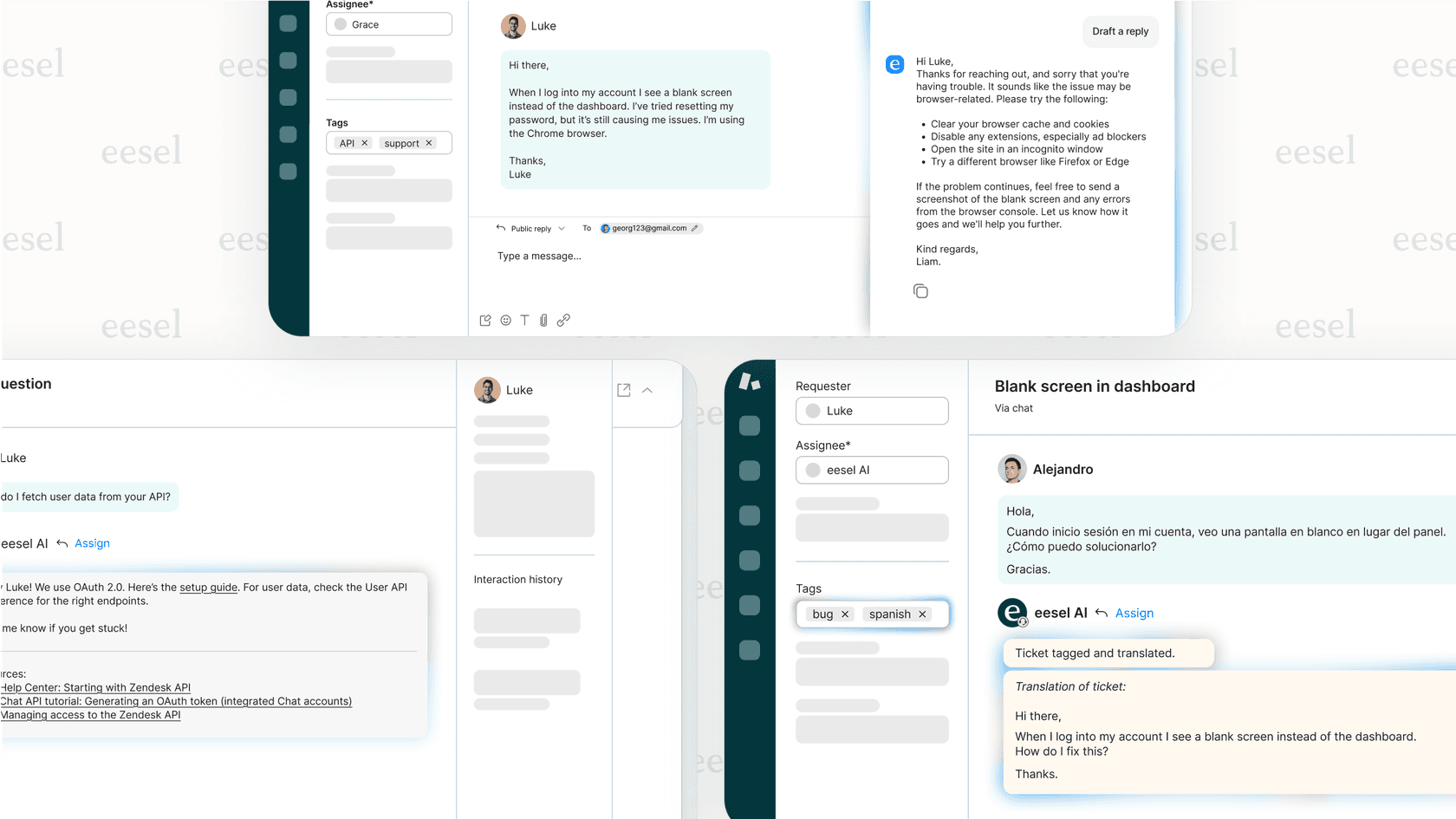
This is exactly what allows an AI teammate like eesel AI to pick up on your company's specific tone and rules. You don't have to manually set it up or go through a complicated configuration. It just learns from your existing help desk data, old tickets, and knowledge bases. That way, it can start solving problems correctly right away, using your brand's voice.
Strength: High-level safety and reliability
Security is a significant concern for any business using AI, particularly when it comes to prompt injection attacks. In a test for this exact problem, Opus 4.5 emerged as the most secure model in this test.
Tests from Vellum.ai found that these kinds of attacks only worked 4.7% of the time on Opus 4.5. That is a lower rate than Gemini 3 Pro (12.5%) and GPT-5.1 (21.9%), positioning it as a more secure option for applications that are customer-facing or handle sensitive information.
Weakness: Mixed feedback on abstract reasoning
For all its strengths, the community feedback isn't all positive. Some developers on Reddit report that it produces "so many false positives." They actually prefer competitors like GPT-5.1 Codex, saying it's "way more production ready" and takes a "more careful and systematical approach."
My problem with Opus is that its programming approach lacks solid scientific and mathematical reasoning.
It excels at following a coding plan but may perform less effectively on highly abstract, PhD-level reasoning. On the GPQA Diamond benchmark, for instance, Opus 4.5 scored 82.4%, while its main rival, GPT-5.1 Codex Max, hit 89.4%.
The bottom line is that Opus 4.5 seems to be a specialist. It is likely the best model available for carrying out complex coding and agent-like tasks, but it is not the best at every kind of abstract problem you can throw at it.
Pricing and availability
Let's review the pricing and accessibility details.
A more accessible price point
The official API price is $5 per million input tokens and $25 per million output tokens.
This represents a significant reduction from the old Opus 4.1 model, which was previously $15 for input. This new pricing means businesses can use it every day, instead of saving it for special projects.
Price comparison with other models
Although Claude Opus 4.5 is significantly cheaper than the last version, it is still priced as a premium model compared to its rivals. But because it's so efficient with tokens, the actual cost of using it might be lower than you'd think just by looking at the price list.
Here's a quick look at how the standard pay-as-you-go prices compare.
| Model | Input Cost (per 1M tokens) | Output Cost (per 1M tokens) |
|---|---|---|
| Claude Opus 4.5 | $5.00 | $25.00 |
| Claude Sonnet 4.5 | $3.00 | $15.00 |
| OpenAI GPT-5.1 | $1.25 | $10.00 |
| Google Gemini 3 Pro | $2.00 | $12.00 |
Pricing data sourced from official pages for Anthropic, OpenAI, and Google as of late 2025.
How to access Claude Opus 4.5
You can get the model through the official Claude API, the Claude web and desktop apps, and on big cloud platforms like AWS Bedrock and Google Cloud Vertex AI.
If you're using it as an individual or part of a team, Opus 4.5 is available on the Max, Team, and Enterprise plans. From what people are saying, it looks like Pro users might need to have "extra usage" turned on or upgrade to a higher plan to use it everywhere.
I think you might have extra usage on. I pray for your bank account.
Implications for businesses
So, what does this all mean for your business?
The biggest change with models like Opus 4.5 is that we're moving from AI as a simple "assistant" that just fetches information to an "AI teammate" that can actually do things on its own.
Think about it in terms of customer support. An older AI might just find a help article and send a link. An AI using Opus 4.5 can understand the customer's problem, find their order in Shopify, check the return policy in a Google Doc, process the return using an internal tool, and then close the ticket in Zendesk. It handles the whole thing.
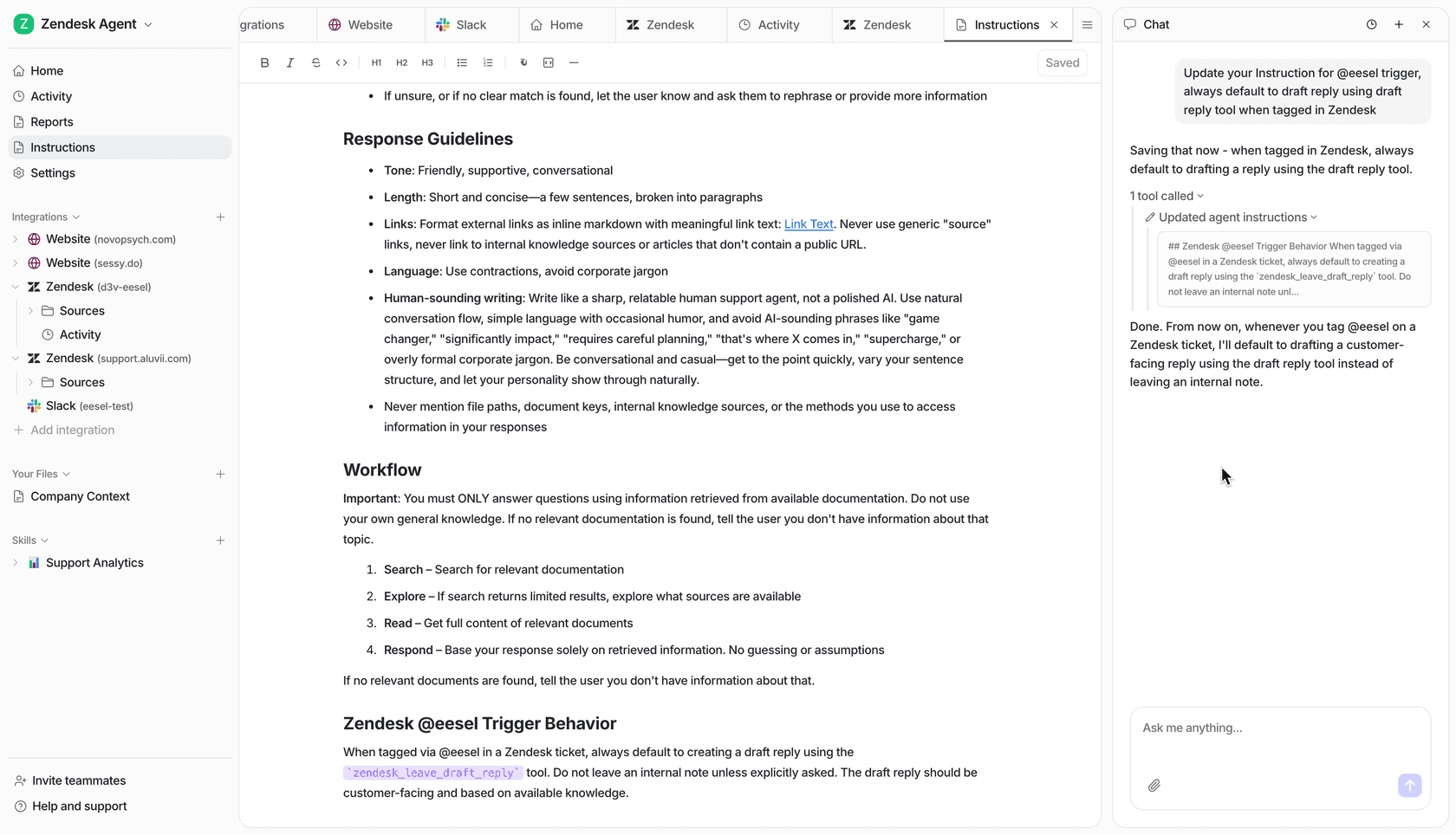
This is the idea that drives eesel's AI Agent. Rather than building a stiff, rule-based bot, you essentially "hire" an AI teammate. It learns from the tools and data you already use to solve customer problems by itself, and only brings in a human agent when a personal touch is really needed.
To see a live demonstration of how Claude Opus 4.5 handles a real-world engineering task, check out the video below. It provides an in-depth look at the model's capabilities when put to the test on a practical coding challenge.
The rise of the AI teammate
Claude Opus 4.5 represents a significant development. Its excellent coding skills, ability to handle long, automated tasks, and accessible price make it a solid base for a new wave of AI tools.
More than anything, this signifies a shift away from basic chatbots and toward real AI partners that you can trust with complicated, start-to-finish business workflows.
The future isn't about replacing your team; it's about supplementing them with capable AI teammates. To see how this new kind of AI can support your customer service crew, try eesel AI for free.
Frequently asked questions
What is the main takeaway for developers?
The main takeaway is that Opus 4.5 acts more like a coding partner than a simple tool. It is excellent at understanding entire codebases, making precise changes, and following documentation, which makes it useful for complex, real-world development tasks.
Is Claude Opus 4.5 suitable for all task types?
Not entirely. While it is a top performer for coding and autonomous, multi-step tasks, it can lag behind on highly abstract, PhD-level reasoning compared to some competitors like GPT-5.1 Codex Max. It is more of a specialist than a generalist model.
How does the pricing of Claude Opus 4.5 compare to older models?
The pricing is a significant improvement. At $5 for input and $25 for output per million tokens, it is substantially cheaper than the previous Opus 4.1 model. This price drop makes it more accessible for businesses to use on a daily basis.
What is the most significant business application mentioned?
The model's ability to function as an "AI teammate," especially in customer support, is highlighted. It can handle complex, end-to-end workflows like processing a return by interacting with multiple apps (Shopify, Zendesk, etc.), moving beyond simple chatbot responses.
How secure is Claude Opus 4.5?
It is considered to have industry-leading security. Tests show it is highly resistant to prompt injection attacks, with a success rate of only 4.7% for attackers. This makes it a reliable choice for customer-facing applications where security is a priority.
Is Claude Opus 4.5 better than GPT-5.1?
It depends on the task. Opus 4.5 is superior for specific coding benchmarks (like SWE-bench) and agentic workflows. However, GPT-5.1 Codex Max scores higher on abstract reasoning benchmarks, so the "better" model depends on the specific use case.