

Anthropic just released Claude Opus 4.5, its latest flagship AI model, and it's generating significant discussion. This represents a significant advancement in what AI can do for businesses.
The model is being discussed as one of the best for complex, real-world applications like coding, building AI agents, and using computer applications. If your business is leveraging AI, understanding what this new model brings to the table is important for staying competitive.
I've been actively using the newly released Opus 4.5 on my projects for about a few days now, and I must admit, I never imagined it would be so effective and efficient. Fascinating, magnificent work!

This post will break down what Claude Opus 4.5 is, its most notable features, and how it compares against other models like GPT-5.1 and Gemini 3 Pro, based on benchmarks. We will also explore what these upgrades mean for day-to-day business operations.
What is Claude Opus 4.5?
Claude Opus 4.5 is the new top-tier model in Anthropic's lineup, sitting above the more balanced Claude Sonnet 4.5 and the speedy Claude Haiku 4.5. It is positioned as the most powerful model in their family.
Its main purpose is to handle the most complex reasoning, coding, and multi-step tasks that businesses face. As some of Anthropic's early testers said, the model "just gets it," which means it understands ambiguity and nuance without requiring perfect instruction.
Here are the key specs at a glance:
-
A 200k token context window, which provides a large capacity for context.
-
It has a new, much lower price point: $5 per million input tokens and $25 per million output tokens.
-
It's available on the Anthropic API and major cloud platforms like Amazon Bedrock and Google Cloud Vertex AI.
This impacts how businesses can approach using AI. The raw power of a model like Opus 4.5 is impressive, but its real value is in how it is integrated into a workflow. The concept is less about using a "tool" and more about integrating an AI teammate. This is the idea behind platforms like eesel AI, which focus on onboarding an AI that learns a business's specific context, rather than one that just follows commands.
Key features of Claude Opus 4.5
This new model is more capable and flexible in several important ways. Let’s take a look at the biggest upgrades that make Claude Opus 4.5 notable for developers and businesses.
Intelligence and creative reasoning
A key highlight is the model's improved ability to think and reason.
-
Deeper understanding: Claude Opus 4.5 shows a significant improvement in abstract reasoning, scoring 37.6% on the difficult ARC-AGI-2 benchmark. This surpassed the scores of GPT-5.1 (17.6%) and Gemini 3 Pro (31.1%).
-
Creative problem-solving: It is not just about finding the right answer, but a better one. In one test, the model was asked to act as an airline service agent. The benchmark expected it to refuse a change to a basic economy ticket. Instead, Opus 4.5 found a valid workaround: upgrade the cabin first, then change the flights.
-
Practical application: This kind of reasoning means the AI can handle vague customer requests or complex internal questions with more human-like creativity, potentially leading to fewer escalations and improved customer satisfaction.
It put together all of the foundational documents for my next side project in so little time at such high quality, it’s like having the worlds best team of interns and grad students all competing to be your top performer.
Coding and agentic capabilities
For anyone building software or automating workflows, this is a key area of improvement.
-
Top-tier coding: It now leads on the SWE-bench Verified benchmark with an 80.9% score. This test evaluates how well it can solve real software bugs from GitHub. It also leads on another key coding test, Terminal-Bench, with a 59.3% score.
-
Long-running tasks: The model is designed for "long-horizon" tasks. This means it can plan and carry out complex projects over a longer period without losing context, which is crucial for building autonomous agents.
-
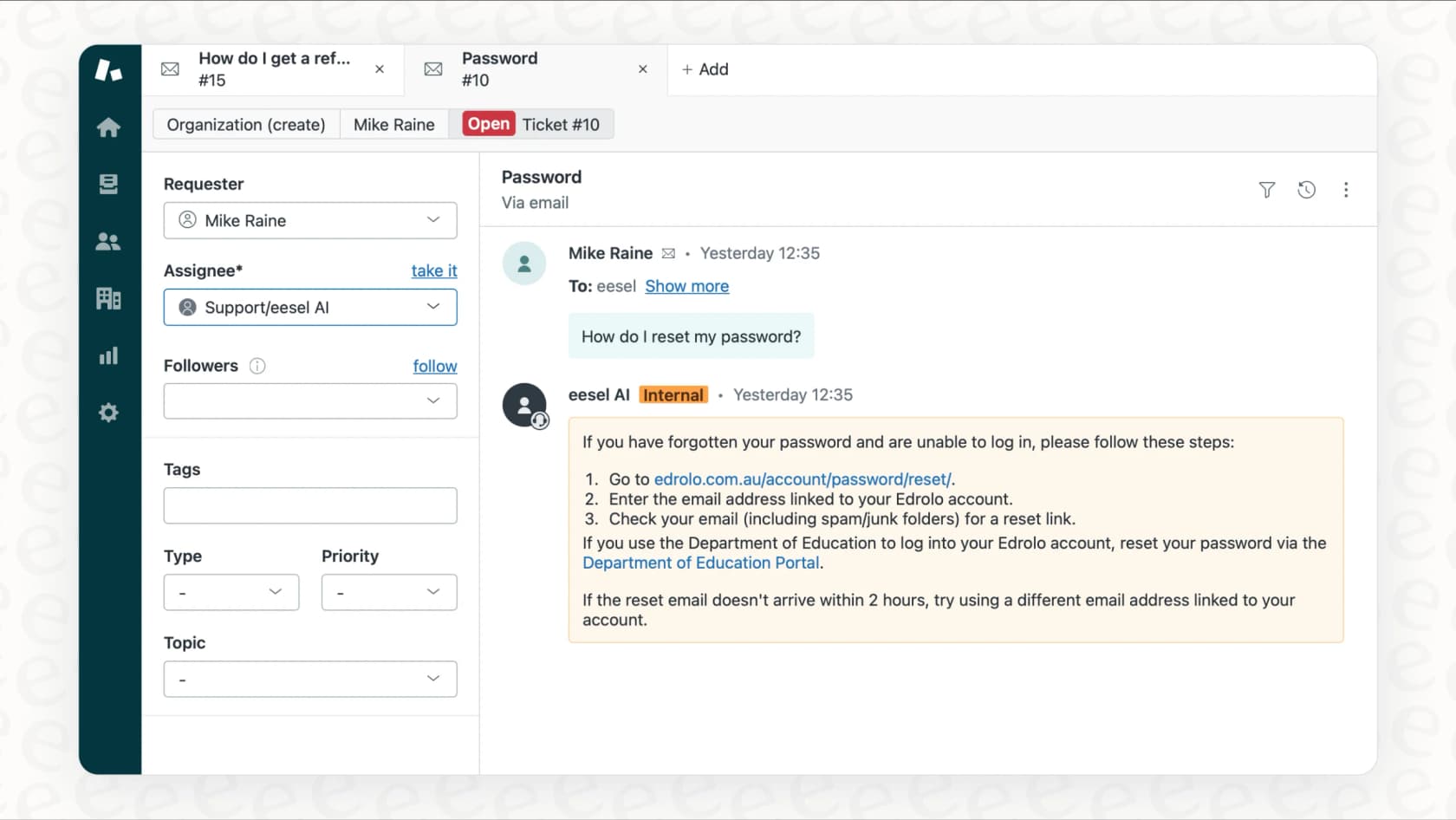
Business implication: An engine this powerful is the foundation for an autonomous AI teammate. For example, eesel’s AI Agent uses this kind of capability to do more than just draft a reply. It can manage a customer support ticket from start to finish, performing actions and follow-ups like a human agent.
Enhanced developer controls for efficiency
Anthropic also introduced features that give developers more control and help manage costs.
-
The 'effort' parameter: This new API feature lets you manage the trade-off between speed and thoroughness. You can set the effort to "low" for quick, high-volume tasks or set it to "high" for deep, complex analysis, all using the same model.
-
Advanced tool use: New features like
tool searchlet AI agents work with hundreds of different tools by identifying what they need as they go. This saves on token costs and reduces confusion. You can also providetool use examplesto help it perform complex tasks correctly on the first try. -
Token efficiency: According to early customer feedback, Opus 4.5 "surpasses internal coding benchmarks while cutting token usage in half" and "uses fewer tokens to solve the same problems." This can translate to better performance at a lower cost.
Benchmark performance
While real-world application is the ultimate test, benchmarks provide a standardized way to compare these models. The data provides a clear comparison of how Opus 4.5 stands against its main rivals, GPT-5.1 and Gemini 3 Pro.
Areas of excellence
-
Coding: As mentioned, it leads on SWE-bench Verified (80.9%) and Terminal-Bench (59.3%). If you need an AI for technical software engineering tasks, this is one of the strongest models available right now.
-
Abstract Reasoning: Its ARC-AGI-2 score of 37.6% is a significant improvement, showing its enhanced ability to solve problems that require more than just memorization.
-
Safety and Robustness: Anthropic has consistently emphasized safety. According to tests run by Gray Swan, Opus 4.5 is more resistant to prompt injection attacks, with an attack success rate of 4.7%. For comparison, Gemini 3 Pro was at 12.5% and GPT-5.1 at 21.9%.
Competitive areas
-
Financial Planning: On the Vending-Bench 2 simulation, which tests long-term strategic decisions, Opus 4.5 performed well (ending with a $4,967.06 balance) but was slightly behind Google's Gemini 3 Pro ($5,478.16).
-
General & Visual Knowledge: On broad knowledge tests like MMMLU (90.8%) and visual reasoning tests like MMMU (80.7%), it scores competitively but does not lead in these categories. Competitors like Gemini 3 Pro and GPT-5.1 score slightly higher in these areas.
Pricing and availability
One of the most significant aspects of this release is the price. Anthropic has made its most powerful model more accessible, which is significant for business adoption.
the API cost reduction could signify this change may be permanent?
Accessible pricing model
-
New API pricing: Claude Opus 4.5 costs $5 per million input tokens and $25 per million output tokens.
-
Massive reduction: This is a significant reduction from the previous Claude Opus 4.1, which was priced at $15/$75 per million tokens. This price change makes building applications with a top-tier model a realistic option for a wider range of companies.
-
A quick cost comparison:
| Model | Input (per 1M tokens) | Output (per 1M tokens) |
|---|---|---|
| Claude Opus 4.5 | $5 | $25 |
| Claude Sonnet 4.5 | $3 | $15 |
| Gemini 3 Pro Preview | $2 - $4 | $12 - $18 |
| GPT-5.1 (Standard) | $1.25 | $10 |
Note: Pricing for competitor models can vary based on usage tiers and context size.
How and where to access Claude Opus 4.5
-
Broad availability: Claude Opus 4.5 is available right now through the Anthropic API. It’s also available on all three major cloud platforms: Amazon Bedrock, Google Cloud Vertex AI, and Microsoft Azure.
-
Consumer tools: You can also use the model directly in Anthropic's own products, Claude.ai (for chat) and Claude Code (for development).
-
Integrated platforms: For most businesses, the easiest way to tap into this power without a dedicated AI engineering team is through an integrated platform. For instance, eesel AI incorporates leading models like those from the Claude family into a ready-to-go AI teammate for customer service, sales, and internal support.
What Claude Opus 4.5 means for your business
A new top-of-the-line model is interesting, but what does it actually change for your day-to-day work? The key is to look beyond the model itself and focus on how it can be used.
A more intelligent and efficient AI engine means the AI assistants and agents built on it become dramatically more capable. For customer service, it means an AI can handle a wider range of complex, multi-part questions without needing to pass them to a human. For internal teams, it means an AI can better understand scattered documentation to give you precise answers in seconds.
However, the model is just one piece of the puzzle. The full potential is often realized through the platform that puts that model to work. This is where the "AI teammate" idea becomes important. It involves more than just plugging in an API. With a platform like eesel AI, you "hire" your AI teammate. It learns from your existing help desk tickets, your Confluence pages, and your team's past conversations.
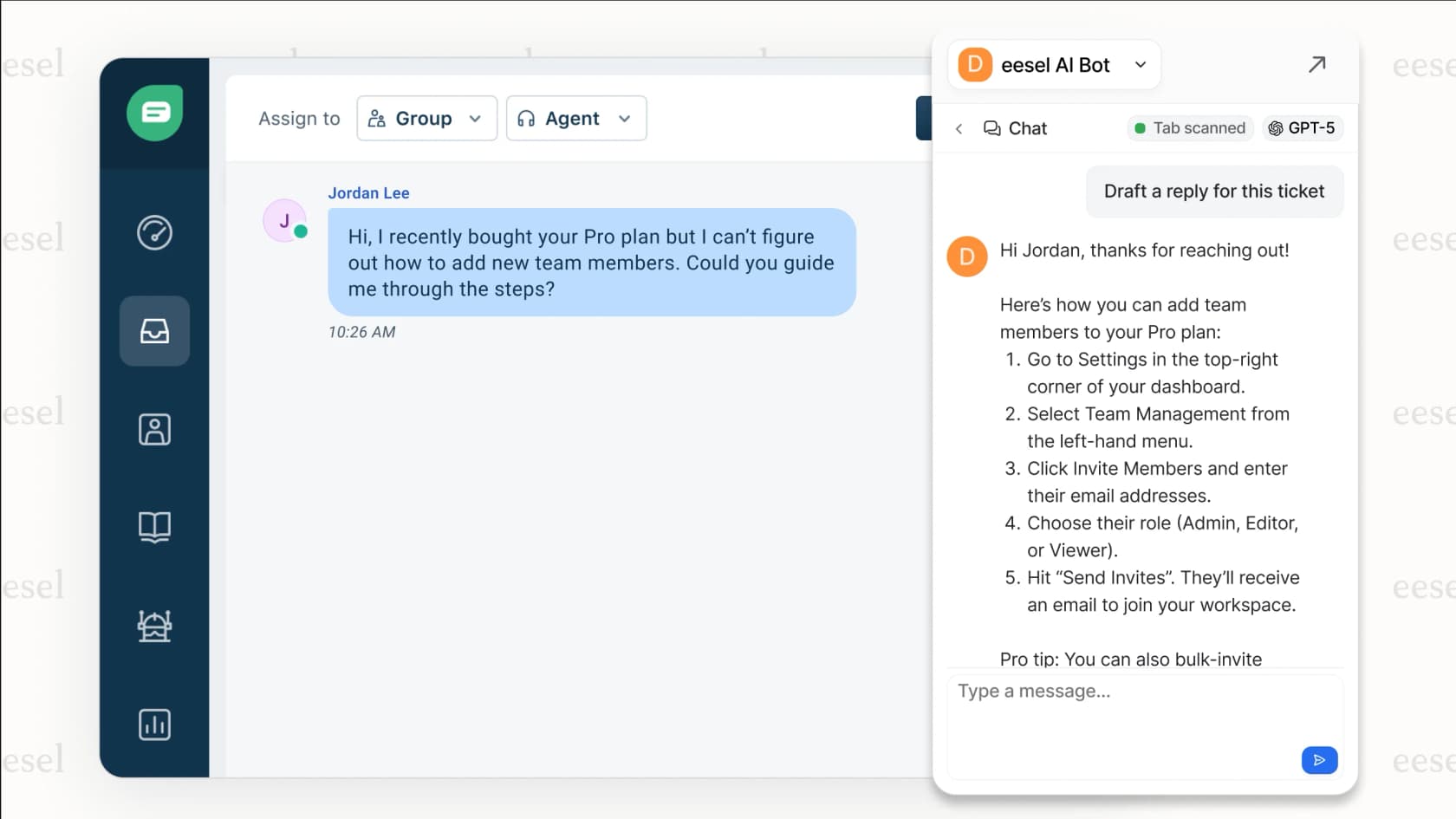
You can start it off with some guidance, perhaps as an AI Copilot that drafts replies for your human agents to check. As you observe its performance, you can grant it more responsibility to handle tasks on its own. This controlled, step-by-step approach helps mitigate the risks of deploying a black-box AI and helps ensure it works for your business.
To see these features in action and understand the model's real-world coding capabilities, the following video provides a detailed breakdown and live demonstrations.
A smarter engine for a new kind of teammate
Claude Opus 4.5 is a significant development for the AI industry. It sets new standards for coding and reasoning, improves safety, and brings elite performance to a much more accessible price. The benchmarks show it’s a top contender, especially in the complex, practical tasks that businesses need to automate.
The biggest takeaway, however, should not just be about the model's specs. The opportunity is in changing how we think about AI in the workplace. We're moving away from simple, rigid bots and toward dynamic, learning AI teammates.
A powerful engine like Claude Opus 4.5 is essential, but its potential is unlocked when it's part of a system designed for collaboration and continuous learning. For businesses ready to explore how top-tier models can be integrated as AI assistants, this development presents new possibilities.
Explore more Claude Opus 4.5 resources: Claude Opus 4.5 review, Claude Opus 4.5 pricing, and Claude Opus 4.5 alternatives.
Frequently asked questions
What is the main takeaway of Claude Opus 4.5 for businesses?
The main takeaway is that Claude Opus 4.5 isn't just a more powerful AI; it's an engine for creating true "AI teammates." Its advanced reasoning and coding skills mean it can handle complex, multi-step tasks autonomously, moving beyond simple chatbots to become an integrated part of your workflow.
How does the pricing of Claude Opus 4.5 compare to older models?
The pricing is significantly lower. At $5 per million input tokens and $25 per million output tokens, it's a massive reduction from the previous Opus model's $15/$75 price. This makes top-tier AI performance much more affordable for businesses of all sizes.
What is the biggest strength of Claude Opus 4.5 against competitors like GPT-5.1?
Its biggest strength is in complex coding and abstract reasoning. It leads the pack in benchmarks like SWE-bench Verified, which measures its ability to solve real-world software bugs. This makes it a go-to model for building sophisticated AI agents and development tools.
Is Claude Opus 4.5 safe to use in a business context?
Yes, safety is a key highlight. The model is significantly more resistant to prompt injection attacks than its main competitors, with a very low attack success rate. This robustness is crucial for businesses deploying AI in customer-facing or sensitive internal roles.
What is the best way to implement Claude Opus 4.5 without a dedicated AI team?
The easiest way is through an integrated platform like eesel AI. These platforms handle the technical side, allowing you to "hire" and train an AI teammate that uses the power of models like Claude Opus 4.5. You can start with it as a copilot and gradually give it more autonomy as it learns your business.
What does the 200k token context window of Claude Opus 4.5 mean?
The 200k token context window is like the model's short-term memory. It can hold and process about 150,000 words of information at once. This is incredibly useful for tasks that require understanding long documents, complex conversations, or large codebases without losing track of important details.